Amazon Invests Another $4 Billion in Anthropic, Doubling Down on AWS-Anthropic Partnership

Table of Contents
Amazon Invests Another $4 Billion in Anthropic, Doubling Down on AWS-Anthropic Partnership #
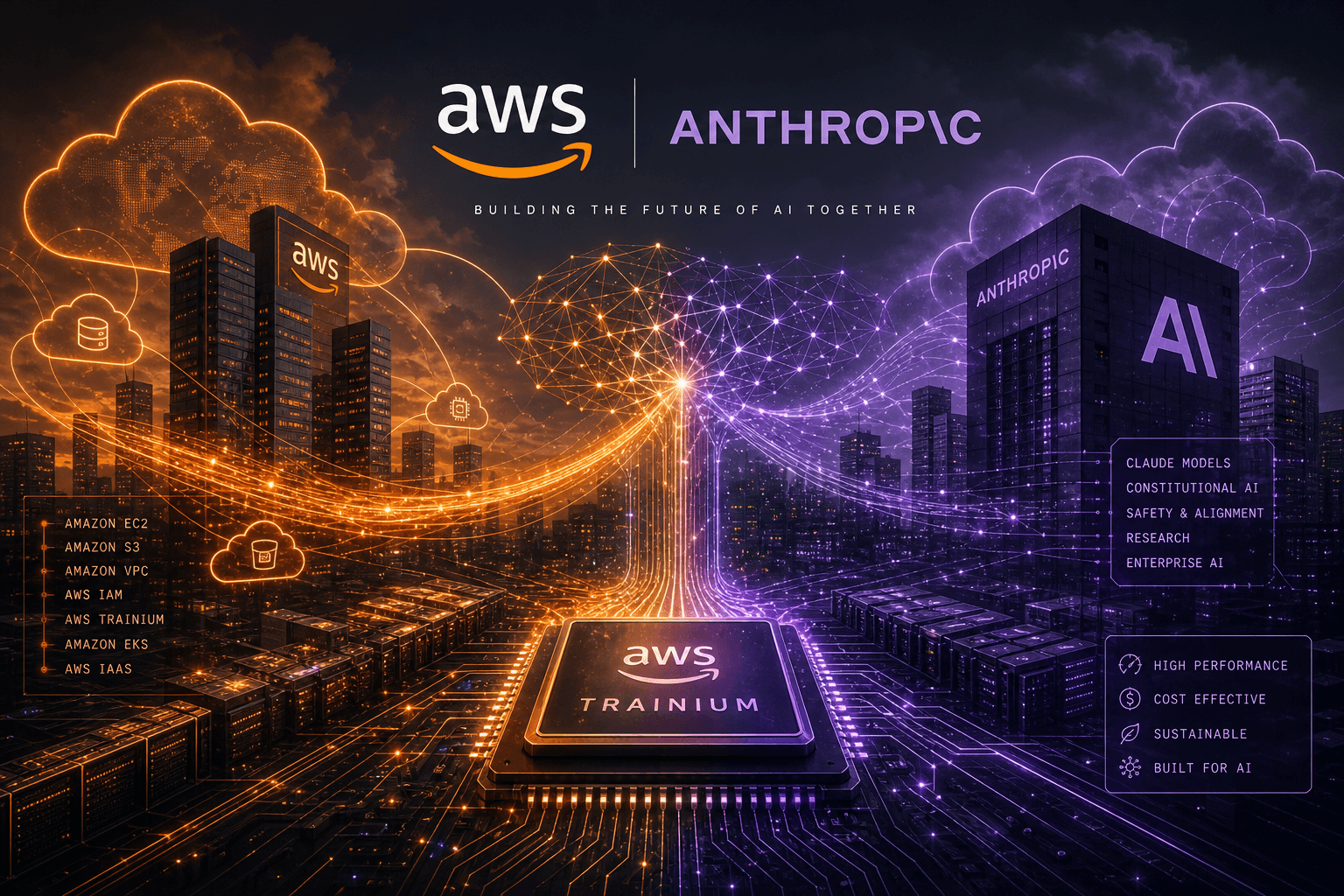
Amazon just announced an additional $4 billion investment in Anthropic, bringing its total commitment to $8 billion. This move cements AWS as Anthropic's primary cloud and training partner while deepening Claude's integration into Amazon Bedrock. Here's what this expanded partnership means for enterprises building on AWS, the competitive landscape against Microsoft-OpenAI, and why Amazon is betting its custom silicon strategy on Anthropic's success.
Table of Contents #
- The $8 Billion Total: Breaking Down Amazon's Anthropic Investment Timeline — How the $4B new tranche builds on the 2023-2024 foundation
- Deal Terms: What Amazon Gets Beyond Equity — Trainium commitments, Bedrock exclusivity, and strategic positioning
- AWS as Anthropic's Primary Cloud Partner: The Infrastructure Play — Why this designation matters for compute supply
- Claude's Deeper Integration with Amazon Bedrock — Model availability, enterprise adoption, and real-world usage
- The Trainium Strategy: Amazon's Custom Silicon Bet — Inferentia2, Trainium2, and the NVIDIA alternative
- Strategic Implications: AWS vs. Microsoft-OpenAI vs. Google — How this reshapes the cloud AI wars
- What This Means for Enterprise AI Buyers — Pricing, model choice, and vendor lock-in considerations
- Frequently Asked Questions
- Bottom Line: The AWS-Anthropic Alliance Solidifies
The $8 Billion Total: Breaking Down Amazon's Anthropic Investment Timeline #
Amazon's total investment in Anthropic now stands at $8 billion following a fresh $4 billion commitment announced today. This represents a doubling of Amazon's previous $4 billion stake and signals the company's confidence in Anthropic as its primary AI model partner.
The investment timeline traces Amazon's escalating commitment to the Claude maker:
| Date | Investment | Cumulative Total | Context |
|---|---|---|---|
| September 2023 | $1.25 billion | $1.25 billion | Initial investment with option to reach $4 billion |
| March 2024 | $2.75 billion | $4 billion | Completed the initial commitment |
| November 2024 | $4 billion | $8 billion | New expanded partnership announced today |
The initial September 2023 deal gave Amazon a minority stake with non-voting equity convertible under certain conditions. Anthropic committed to using AWS as its primary cloud provider for training and deploying Claude models, with a focus on Amazon's custom Trainium and Inferentia chips.
The March 2024 tranche completed that original commitment, but today's $4 billion injection represents something more significant: a recognition that the AI infrastructure arms race requires substantially more capital than initially projected. Amazon is now Anthropic's largest corporate investor and its designated primary training partner.
The investment structure follows the pattern of big tech AI deals: substantial cash infusions tied to compute commitments and commercial milestones. Unlike traditional venture capital, these corporate strategic investments are as much about securing favorable infrastructure relationships as they are about equity returns.
Deal Terms: What Amazon Gets Beyond Equity #
Beyond the $4 billion cash injection, Amazon secures strategic advantages that extend far beyond simple equity ownership. The expanded partnership includes explicit commitments from Anthropic that position AWS as the definitive platform for Claude's infrastructure needs.
The key non-cash terms include:
Primary Cloud and Training Partner Designation: AWS is now officially Anthropic's primary cloud provider for mission-critical workloads. This isn't just a preferred vendor relationship—it means Anthropic's most demanding training runs and inference operations run on AWS infrastructure first.
Custom Chip Adoption: Anthropic commits to building, training, and deploying future Claude foundation models using AWS Trainium and Inferentia chips. This validates Amazon's billion-dollar custom silicon program and provides a flagship customer for its NVIDIA alternatives.
Bedrock Integration: Claude models remain deeply integrated into Amazon Bedrock, AWS's fully managed foundation model service. This gives AWS customers direct access to Opus, Sonnet, and Haiku without managing separate Anthropic credentials or billing.
Long-term Compute Commitments: Anthropic has committed to purchasing substantial AWS capacity over the next decade, ensuring AWS will generate significant revenue from its investment even as Anthropic grows.
The deal structure is convertible debt that can become equity, similar to the September 2023 arrangement. Amazon remains a minority investor—Anthropic maintains its independence and multi-cloud strategy—but the "primary partner" designation gives AWS effective exclusivity on Anthropic's largest training workloads.
The UK Competition and Markets Authority reviewed the initial $4 billion phase and concluded it didn't trigger merger review thresholds. This additional $4 billion may draw renewed regulatory scrutiny, particularly as regulators worldwide examine big tech's AI investment patterns.
AWS as Anthropic's Primary Cloud Partner: The Infrastructure Play #
The "primary cloud and training partner" designation is more than marketing language—it represents a fundamental restructuring of how Anthropic accesses compute infrastructure. This relationship tier gives AWS preferred status for Anthropic's most demanding AI workloads.
In standard cloud vendor relationships, companies distribute workloads across providers for redundancy and pricing leverage. Anthropic will likely maintain some multi-cloud presence, but the AWS designation means:
Priority Capacity Access: When Anthropic needs thousands of GPUs or Trainium chips for a major training run, AWS gets first right of refusal. During the ongoing AI compute crunch, this guaranteed capacity access is worth billions.
Infrastructure Co-Development: Anthropic's model roadmap now influences AWS silicon design. Trainium2 and future generations are being optimized partly based on Anthropic's transformer training patterns.
Joint Optimization: AWS engineers work directly with Anthropic's infrastructure team to optimize model serving. This translates to better latency and throughput for Claude on Bedrock compared to other deployment options.
The compute scale involved is staggering. Training modern foundation models like Claude 3 Opus requires clusters of thousands of accelerators running for weeks or months. Inference at scale—serving millions of API requests—demands even more total compute capacity. Anthropic's growth plans require multi-gigawatt data center commitments, and AWS is positioning itself as the primary supplier.
This relationship mirrors Microsoft's OpenAI partnership but with key differences. Microsoft has deeper integration with OpenAI's model development and exclusive API rights. AWS's Anthropic deal is slightly more arms-length—Anthropic maintains its own API business and multi-cloud flexibility—but the "primary partner" language suggests AWS is moving toward a Microsoft-OpenAI-style tight integration.
Claude's Deeper Integration with Amazon Bedrock #
Amazon Bedrock now hosts over 100,000 customers running Claude models, with the expanded partnership promising deeper integration and earlier access to future model releases. This scale represents one of the largest enterprise AI deployments outside of OpenAI's direct customer base.
The current Claude model lineup on Bedrock includes:
| Model | Use Case | Bedrock Availability |
|---|---|---|
| Claude 3 Opus | Complex reasoning, coding, analysis | Full production access |
| Claude 3.5 Sonnet | Balanced performance and speed | Full production access |
| Claude 3 Haiku | Fast, lightweight tasks | Full production access |
Lyft provides the most prominent case study: the ride-sharing company uses Claude on Bedrock to power customer service automation, reducing support resolution times by 87% while handling 30% more issues without human intervention. This real-world validation demonstrates Claude's readiness for enterprise production workloads.
Other documented enterprise adopters include:
- Intuit: Using Claude for tax preparation assistance and customer support
- Adobe: Integrating Claude into creative workflow tools
- Novartis: Applying Claude to medical research and drug discovery workflows
The expanded partnership means AWS customers can expect earlier access to new Claude models as they're released. Bedrock's unified API—which provides consistent access across foundation models from Anthropic, AI21 Labs, Cohere, Meta, Mistral, and Stability AI—simplifies model switching and experimentation.
For AWS customers, the integration offers practical benefits:
- Unified billing through existing AWS accounts
- IAM integration for access control and compliance
- VPC support for private model access
- Guardrails for content filtering and safety controls
The Trainium Strategy: Amazon's Custom Silicon Bet #
Amazon's $4 billion Anthropic investment is simultaneously a bet on its own custom silicon: Trainium chips for AI training and Inferentia for inference. Anthropic's commitment to build future Claude models on Trainium validates AWS's multi-billion dollar effort to reduce dependence on NVIDIA GPUs.
The custom chip landscape in cloud AI breaks down as follows:
| Provider | Training Chips | Inference Chips | Strategy |
|---|---|---|---|
| AWS | Trainium2, Trainium3 | Inferentia2 | Full stack, Anthropic as flagship |
| TPU v5p, v6e | TPU v5e | Vertical integration with Gemini | |
| Microsoft | Maia 100 (limited) | Custom FPGA/ASIC | Primarily NVIDIA-dependent |
| NVIDIA | H100, H200, Blackwell | Various | Industry standard, high margins |
Trainium2, launched earlier this year, offers competitive performance for transformer training at significantly lower cost than NVIDIA H100 clusters. Trainium3 is in development with plans for 2025 deployment. Anthropic's commitment means these chips have a marquee customer from day one.
The strategic calculus is straightforward:
Margin Capture: NVIDIA captures 60-70% gross margins on AI accelerators. By building its own chips, AWS keeps that margin in-house.
Supply Security: During the ongoing GPU shortage, AWS can prioritize its own silicon for Anthropic workloads while competitors compete for limited NVIDIA allocation.
Customization: Trainium can be optimized specifically for Anthropic's model architectures—transformers with specific attention patterns—delivering better price/performance than general-purpose GPUs.
Dario Amodei, Anthropic's CEO, has publicly praised the Trainium collaboration: "We've been impressed with the performance improvements on Trainium2 and look forward to training future models on this infrastructure."
However, the NVIDIA dependency isn't disappearing. Anthropic will likely maintain hybrid infrastructure—Trainium for certain workloads, NVIDIA for others—giving it leverage in pricing negotiations with both suppliers.
Strategic Implications: AWS vs. Microsoft-OpenAI vs. Google #
The expanded AWS-Anthropic partnership solidifies a three-way race for cloud AI dominance, with each hyperscaler pursuing a fundamentally different strategy. Understanding these distinct approaches helps enterprises navigate their AI infrastructure decisions.
The Three Cloud AI Strategies #
| Provider | AI Partner | Model Strategy | Integration Depth |
|---|---|---|---|
| Microsoft | OpenAI (exclusive) | GPT-4/4o/4.5 via Azure OpenAI Service | Deepest—Microsoft invested $13B+, exclusive cloud rights |
| None (internal) | Gemini family, developed in-house | Full vertical integration—TPU, model, cloud all Google | |
| AWS | Anthropic (primary) | Claude via Bedrock + multiple others | Strong but non-exclusive—Anthropic maintains independence |
Microsoft's OpenAI partnership remains the tightest integration in the industry. The $13+ billion Microsoft investment gives Azure exclusive cloud rights for OpenAI model serving, with GPT-4 variants available only through Azure OpenAI Service or OpenAI's own API—not through AWS or Google Cloud. This exclusivity has driven significant Azure market share gains in AI workloads.
Google takes the opposite approach: complete vertical integration. Gemini models run on Google's own TPU infrastructure, with no external model provider dependencies. This offers maximum optimization potential but limits flexibility—customers wanting Claude or GPT-4 must look elsewhere.
AWS's Anthropic strategy occupies a middle ground. Amazon Bedrock offers the broadest model selection—Claude alongside models from AI21, Cohere, Meta, Mistral, and Stability AI—giving customers genuine choice. The Anthropic partnership adds depth to that selection without exclusivity that might trigger regulatory concern.
The competitive dynamic is shifting:
- Microsoft's lead: Azure OpenAI Service has the strongest enterprise momentum, but faces capacity constraints and occasional model availability issues.
- Google's challenge: Despite technical strength, Gemini adoption lags in the enterprise. The upcoming Gemini 2 release may change this.
- AWS's position: Bedrock's multi-model approach plus the strengthened Anthropic relationship gives AWS a credible alternative to Azure OpenAI.
The $4 billion additional investment signals AWS is serious about closing the gap with Microsoft-OpenAI. Whether it succeeds depends on Anthropic's ability to match OpenAI's model advancement pace and AWS's capacity to convert the partnership into enterprise market share.
What This Means for Enterprise AI Buyers #
Enterprises evaluating AI infrastructure face a clearer choice today: Azure OpenAI for pure GPT-4 integration, Google Cloud for Gemini and vertical stack optimization, or AWS Bedrock for multi-model flexibility with Claude as the flagship. The expanded AWS-Anthropic partnership strengthens the Bedrock proposition without changing the fundamental architecture decision.
Decision Framework by Use Case #
| Priority | Best Choice | Rationale |
|---|---|---|
| Maximum model capability | Azure OpenAI (GPT-4o/4.5) | Current state-of-the-art on most benchmarks |
| Multi-model experimentation | AWS Bedrock | Claude + multiple alternatives, easy switching |
| Cost optimization | AWS Bedrock | Competitive Claude pricing, Trainium cost advantages |
| Existing AWS infrastructure | AWS Bedrock | IAM, VPC, Guardrails integration |
| TPU/Gemini optimization | Google Cloud | Vertical stack efficiency for Gemini workloads |
Pricing considerations remain dynamic. Claude 3.5 Sonnet on Bedrock generally matches or undercuts GPT-4 on Azure OpenAI, but enterprise pricing varies significantly based on commitment levels and volume. The expanded partnership may lead to preferential Bedrock pricing for Anthropic models—something to watch in coming quarters.
Lock-in risks deserve attention. Choosing Azure OpenAI creates dependence on both Microsoft and OpenAI. AWS Bedrock's multi-model approach reduces single-model risk—you can migrate from Claude to Llama or Command if needed. However, Bedrock itself creates AWS platform lock-in.
Multi-cloud strategies are increasingly viable. Many enterprises now deploy Claude on Bedrock for AWS-centric workloads while using Azure OpenAI for Microsoft-integrated applications. The expanded AWS-Anthropic investment doesn't preclude this approach—Anthropic's own API remains available for cross-cloud consistency.
For existing AWS customers, today's announcement is unequivocally positive: deeper integration, continued model access, and implicit AWS commitment to keeping Bedrock competitive with Azure OpenAI. For others, the decision matrix hasn't fundamentally changed—evaluate models on capability, platforms on integration, and pricing on total cost of ownership.
Frequently Asked Questions #
Q: How much has Amazon invested in Anthropic total? #
Amazon has invested $8 billion total in Anthropic following today's additional $4 billion commitment. The initial $4 billion was deployed in two tranches: $1.25 billion in September 2023 and $2.75 billion in March 2024. This $8 billion total makes Amazon Anthropic's largest corporate investor, though it remains a minority stakeholder.
Q: When did Amazon announce the additional $4 billion Anthropic investment? #
Amazon announced the additional $4 billion investment on November 22, 2024. This announcement came alongside news that AWS is now Anthropic's designated "primary cloud and training partner" for mission-critical AI workloads. The timing follows Anthropic's recent Claude 3.5 model releases and positions both companies for 2025 capacity expansion.
Q: What is Amazon Bedrock and how does Claude integrate with it? #
Amazon Bedrock is AWS's fully managed foundation model service that provides API access to Claude alongside models from AI21, Cohere, Meta, Mistral, and Stability AI. The integration means AWS customers access Claude through their existing AWS accounts, with unified IAM authentication, VPC networking, and Guardrails content filtering. Over 100,000 customers currently run Claude models through Bedrock.
Q: Does this investment give Amazon control over Anthropic? #
No, Amazon remains a minority investor without controlling interest. The $8 billion investment does not give Amazon board control or operational authority over Anthropic. Anthropic maintains independence, its own API business, and multi-cloud deployment capabilities. The "primary partner" designation gives AWS preferential access for large training workloads but does not create exclusivity.
Q: What are AWS Trainium chips and why do they matter for AI? #
Trainium is Amazon's custom AI accelerator designed specifically for training large language models. Trainium2, currently available, competes with NVIDIA H100 on price-performance for transformer workloads. The chips matter because they reduce AWS's dependence on NVIDIA, capture margin internally, and can be optimized for specific model architectures like Claude. Anthropic's commitment to Trainium validates Amazon's billion-dollar silicon investment.
Q: How does the AWS-Anthropic partnership compare to Microsoft-OpenAI? #
The AWS-Anthropic partnership is similar in structure but less exclusive than Microsoft-OpenAI. Microsoft invested over $13 billion in OpenAI and obtained exclusive cloud rights for GPT-4 serving. AWS's Anthropic deal is slightly more arms-length: Anthropic maintains its own API, can deploy on multiple clouds, and AWS offers multiple models through Bedrock. Both partnerships reflect cloud providers securing flagship AI model relationships.
Q: Which Claude models are available on Amazon Bedrock? #
Bedrock currently offers Claude 3 Opus, Claude 3.5 Sonnet, and Claude 3 Haiku. Opus handles complex reasoning and coding tasks. Sonnet provides balanced performance for most applications. Haiku delivers fast, cost-effective responses for lightweight workloads. The expanded partnership suggests future Claude model releases will arrive on Bedrock simultaneously with or shortly after Anthropic's direct API.
Q: What does "primary cloud and training partner" mean for AWS? #
The designation means AWS gets first right of refusal on Anthropic's largest compute needs. When Anthropic needs thousands of accelerators for a major training run, AWS is the default provider. It also triggers joint engineering collaboration on optimization and gives AWS early insight into Anthropic's roadmap. Anthropic may still use other clouds, but AWS handles the mission-critical workloads.
Q: How does this affect enterprise pricing for Claude on AWS? #
Direct pricing changes haven't been announced, but the expanded partnership likely positions AWS to offer competitive Claude rates. Enterprises should expect continued parity between Bedrock Claude pricing and Anthropic's direct API, with volume discounts potentially favoring AWS for large commitments. The Trainium integration may eventually enable lower-cost inference tiers exclusive to Bedrock.
Q: Why is Amazon investing in Anthropic instead of building its own models? #
Amazon's strategy prioritizes platform breadth over single-model competition. AWS offers multiple foundation models through Bedrock rather than betting everything on an in-house model. The Anthropic investment secures a best-in-class model partner while preserving customer choice. This differs from Google's Gemini-everywhere approach or Microsoft's heavy OpenAI bet—AWS wants to be the platform for all major models, not just one.
Q: What other companies use Claude through Amazon Bedrock? #
Notable Bedrock customers include Lyft, Intuit, Adobe, and Novartis. Lyft reduced customer support resolution time by 87% using Claude on Bedrock. Intuit applies Claude to tax preparation assistance. Adobe integrates Claude into creative workflows. Novartis uses Claude for medical research. Over 100,000 total customers run Claude models through Bedrock across industries.
Q: How does this investment impact the competitive AI landscape? #
The investment solidifies a three-way cloud AI race: Microsoft-OpenAI, Google-Gemini, and AWS-Anthropic.** Each represents a distinct strategy: Microsoft has deepest integration, Google has full vertical stack, AWS has broadest model selection. The $4 billion additional commitment signals AWS won't cede the AI cloud market without a fight. For customers, this competition drives pricing pressure and capability advancement across all three platforms.
Bottom Line: The AWS-Anthropic Alliance Solidifies #
Amazon's additional $4 billion Anthropic investment transforms a tentative partnership into a strategic alliance. The $8 billion total commitment, combined with the "primary cloud partner" designation, positions AWS as the definitive enterprise platform for Claude deployment. For AWS customers, this means deeper integration, earlier model access, and continued competitive pressure on pricing. For the broader AI landscape, it confirms that the cloud AI wars will be fought through partnerships rather than pure in-house development.
The enterprise takeaway is straightforward: if you're building on AWS, Bedrock's Claude integration just became a safer long-term bet. If you're multi-cloud, the expanded partnership gives you leverage in negotiating across Azure OpenAI, Google Gemini, and AWS Bedrock. And if you're still evaluating AI infrastructure, the three-way competitive dynamic—each with distinct strengths—creates genuine choice in a market that risked consolidating around a single provider.
For builders and enterprises looking to operationalize Claude on AWS infrastructure, the path forward is clearer than ever. Whether you're building AI automation pipelines, custom agent workflows, or integrating generative AI into web applications, the AWS-Anthropic partnership provides the foundation.
Looking to implement Claude on AWS for your business? I help companies design and deploy production-grade AI systems on Amazon Bedrock—from custom agent architectures to automated workflows that integrate Claude with your existing AWS infrastructure. If you're exploring how to operationalize generative AI for your team, book an AI automation strategy call and we'll map out your implementation roadmap.
For premium web experiences powered by AI—whether that's dynamic content generation, personalized user experiences, or AI-assisted creative tools on Bedrock infrastructure—I also design and build custom flagship websites for brands ready to lead. Start a discovery call if you're planning a 5-figure web project that needs the latest AI capabilities wired in.
Related posts:
- Claude 3.5 Sonnet: The Complete Technical Review — Deep-dive on Anthropic's current flagship model
- Amazon Bedrock vs. Azure OpenAI: Enterprise AI Platform Comparison — Head-to-head cloud AI infrastructure evaluation
- Building Self-Healing AI Workflows with n8n and Claude — Practical implementation guide for AI automation pipelines
Related Posts
Google I/O 2026 Action List: How I Prompted Gemini 3.5 Flash and Antigravity Workflows
Google I/O 2026 just reset the AI tooling landscape. Here's the 9-action checklist for builders who want to ship this week, not just watch the keynote.
Anthropic vs. OpenAI vs. Google: The State of the Frontier in May 2026
A head-to-head breakdown of the three AI giants in May 2026: Claude Opus 4.6, GPT-5.3 and 5.4, Gemini 3.1 Pro. Real specs, real pricing, and what actually matters for builders.
Kimi K2 Open Weights: How I Prompted Moonshot's Frontier Model for Agentic Tool Use
How I direct Kimi K2 by Moonshot AI for agentic workflows, long-context tool calling, and workflow automation. A 1 trillion parameter MoE model with competitive benchmarks at 5-17x lower cost than GPT-5 and Claude.