Building AI Agents in n8n: Automating Complexity with LLMs and RAG

Table of Contents
Building AI Agents in n8n: Automating Complexity with LLMs and RAG #
Workflow automation has historically been a highly deterministic game: If X happens, do Y exactly the same way every time. While this rigid logic absolutely rules standard API plumbing, it falls drastically short when dealing with unstructured data, ambiguous user inputs, or complex tasks requiring cognitive reasoning. You can't write an If/Else statement to read a rambling, angry customer support email and perfectly route it to the correct department every time.
In 2024, the automation paradigm fundamentally shifted. The introduction of robust AI capabilities directly inside n8n has transformed standard software integrations into autonomous ecosystems. By deeply integrating LangChain's complex architectural theory into a low-code canvas, n8n isn't just moving data anymore—it is actively reasoning about that data.
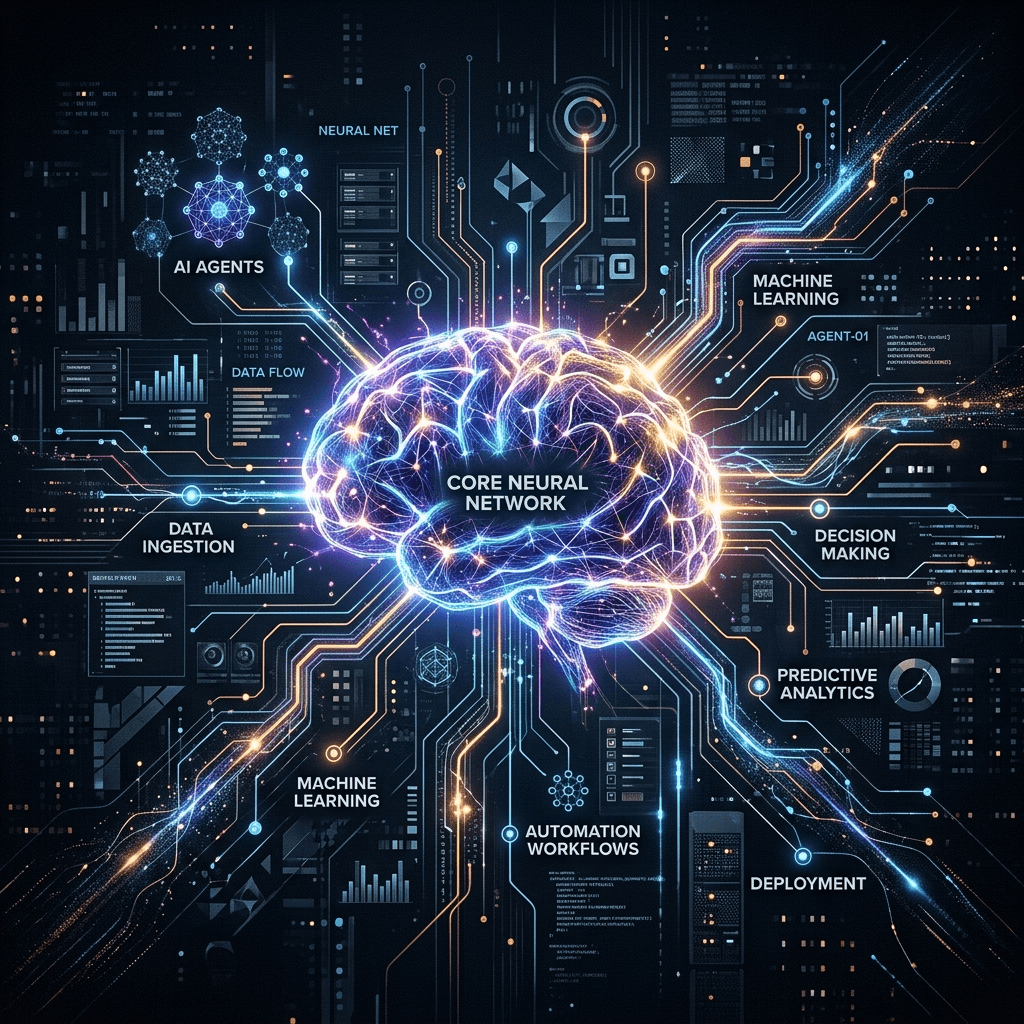
This comprehensive guide will walk you through the architectural theory and practical application of utilizing n8n to build functional, highly resilient AI Agents and scalable RAG pipelines.
1. The AI Automation Paradigm: Deterministic vs. Agentic #
To build effective AI networks, you must understand the difference between how traditional software "acts" and how AI "thinks."
The Limitations of Explicit Routing Logic #
For the last decade of cloud integration, tasks had to be painfully explicit. When building a workflow, you had to define every possible branch. If an API returned a status code you hadn't specifically programmed an error handler for, the entire workflow would crash. Deterministic systems are brittle. They require perfectly sanitized numerical or boolean input to operate correctly.
Utilizing Fuzzy Context Processing #
Agentic workflows flip this paradigm. They utilize Large Language Models (LLMs) as localized routing engines. Instead of coding the precise how, you prompt the what. By passing a block of messy JSON or unstructured text to an LLM node within n8n, the AI evaluates the context and returns beautifully structured output. The AI acts as an infinitely flexible "fuzzy" parsing layer, gracefully handling errors, typos, and edge cases that would normally obliterate a standard regex string.
2. What are AI Agents? (Beyond Chatbots) #
The industry uses the term "Agent" very loosely right now. We need to distinguish between a simple text generator and true agentic architecture.
Defining Multi-Turn Reasoning Loops #
A standard chatbot is a single-turn mechanism: you ask a question, it generates an answer based on its training data, and the execution stops. An AI Agent goes significantly further. It operates on a multi-turn reasoning loop, often referred to as ReAct (Reasoning and Acting). The Agent evaluates your request, realizes it doesn't have the answer, devises a plan to retrieve the answer, executes the first step of that plan, evaluates the new data, and repeats the loop until it achieves the final objective.
Autonomous Task Completion #
Because Agents can loop and reason, they act autonomously. You give them a high-level goal—"Audit these 50 Salesforce leads and draft customized cold emails for the ones in the healthcare sector"—and the agent manages its own intermediate steps to complete the task organically within n8n.
3. n8n's Deep LangChain Integration Explained #
Building robust AI agents from scratch using pure Python is incredibly difficult. You have to manage conversation memory arrays, write custom document loaders, orchestrate vector dimension matching, and inject monolithic prompt templates.
Visualizing the LangChain Architecture #
LangChain is the industry standard framework for developing applications powered by language models. What makes n8n profoundly powerful is that it visually exposes the conceptual building blocks of LangChain directly onto the canvas. It allows you to physically connect lines between a memory module and a chain, abstracting thousands of lines of boilerplate Python code into a simple green node.
Node-Based Abstraction of Complex Code #
Instead of worrying about asynchronous loop timeouts or manually parsing output arrays, n8n handles the syntactic heavy lifting. You can immediately focus on the logic of your AI Agent rather than debugging the API connection overhead of your chosen AI provider.
4. The Core Nodes: LLMs, Memory, and Tools #
To build an agent in n8n, you combine three specific sub-components into a primary "Advanced AI" node.
Selecting the Right LLM Backend #
The brain of your agent is the LLM Node. You can instantly snap in OpenAI (GPT-4o), Anthropic (Claude 3.5 Sonnet), or Cohere. The separation of the AI logic from the base model means you can swap out OpenAI for Anthropic with three clicks if an API goes down, instantly upgrading your workflow's resilience.
Buffer Windows and Session Management #
An agent is useless if it suffers from immediate amnesia. The Memory Node connects directly to the agent, creating a persistent session buffer. You can define sliding windows (e.g., "Remember only the last 10 messages") to prevent context window overflow while still maintaining deep conversational coherence.
5. Demystifying Retrieval-Augmented Generation (RAG) #
If you ask an LLM about your company's highly proprietary 2024 Q3 earnings report, it will hallucinate an answer because that specific document was not in its public training data. This is where RAG comes in.
Eliminating LLM Hallucinations #
Retrieval-Augmented Generation (RAG) prevents hallucination by enforcing a strict reading assignment. Before the AI answers a specific user prompt, the system rapidly searches a private database to find the relevant document, hands that document to the AI, and instructs the AI: "Answer the user's question, but use ONLY the information contained in this document."
Ingesting Proprietary Business Logic #
By using RAG architecture, you avoid the immense expense and technical complexity of trying to "fine-tune" a custom neural network. You simply upload your PDF training manuals, Slack histories, and HR policies into your RAG pipeline, immediately making a generic AI model a highly specialized expert on your company.
6. Building Your First Vector Store Pipeline in n8n #
RAG relies on converting human text into mathematical arrays known as vectors. This process requires a specific ingestion pipeline natively handled by n8n.
Standardizing Document Formats #
First, you use an n8n Trigger to listen for new files (e.g., "New PDF added to Google Drive"). You connect this to an n8n Document Loader node, which strips away the styling and extracts the raw textual content.
Generating Embeddings via Pinecone or Qdrant #
Next, you connect an Embeddings Node (often powered by OpenAI's embedding models) and a Text Splitter Node. The text splitter chops your massive 100-page PDF into tiny, discrete paragraphs. The embeddings node translates those paragraphs into mathematical coordinates. Finally, n8n pushes those coordinates straight into a Vector Database like Pinecone, Qdrant, or Supabase, completing the ingestion phase.
7. Constructing the RAG Retrieval Chain #
With your local files properly vectorized and stored, you create a secondary n8n workflow designed to answer questions.
Triggering the Query Process #
You start with an incoming request—perhaps a Slack trigger that activates whenever a user tags the AI bot. That text message is instantly sent to a Vector Store Retrieval Node.
Injecting Mathematical Context #
n8n orchestrates a mathematical similarity search. It finds the three document "chunks" in your database that mathematically align closest with the user's question. It bundles the original question and the retrieved text chunks together, passes them into the LLM node, and returns the mathematically perfect, hallucination-free response back to Slack.
8. Tool-Calling: Giving Agents the Power to Act #
The true, terrifying power of an "Agent" is its ability to directly influence the digital world through Tool Calling.
Giving AI the Keys to the API #
Through n8n's "AI App Tool" integration, you expose standard workflow actions directly to the AI model model as callable functions. For example, you can give your AI Agent access to the 'Stripe Refund' node and the 'Shopify Product Search' node. The AI independently determines if and when it should use these tools based strictly on conversational context.
Defensive Safeguards and the Human in the Loop #
However, absolute autonomy can be dangerous. We do not want an AI hallucinating and accidentally wiping an entire production database. By pairing n8n's tool-calling with a Wait node, you can implement a "Human-in-the-Loop" architecture. If the AI determines it needs to execute a highly destructive API call, it pauses the workflow and sends an approval Ping to a human manager before proceeding.
9. Local Models vs. Cloud Providers (Ollama in n8n) #
Privacy is the paramount concern when adopting AI within the enterprise sector. Many compliance departments strictly forbid passing intellectual property to OpenAI servers.
Securing Air-Gapped Compliance #
n8n solves this elegantly. Because the platform can be entirely self-hosted, you can completely air-gap your automation server from the broader internet.
Utilizing the Ollama Integration #
n8n features native support for local inference engines like Ollama. This means you can run powerful open-source models like Meta's Llama 3 or Mistral locally on the exact same server hardware hosting n8n. Your proprietary data is passed to the open-source LLM, parsed, and utilized without a single packet of information ever leaving your local intra-net.
10. The Future of Autonomous Digital Workforces #
The fusion of deep API orchestration and frontier AI capabilities has solidified n8n as the premier operating system for the next decade of business infrastructure.
Re-Imagining the Org Chart #
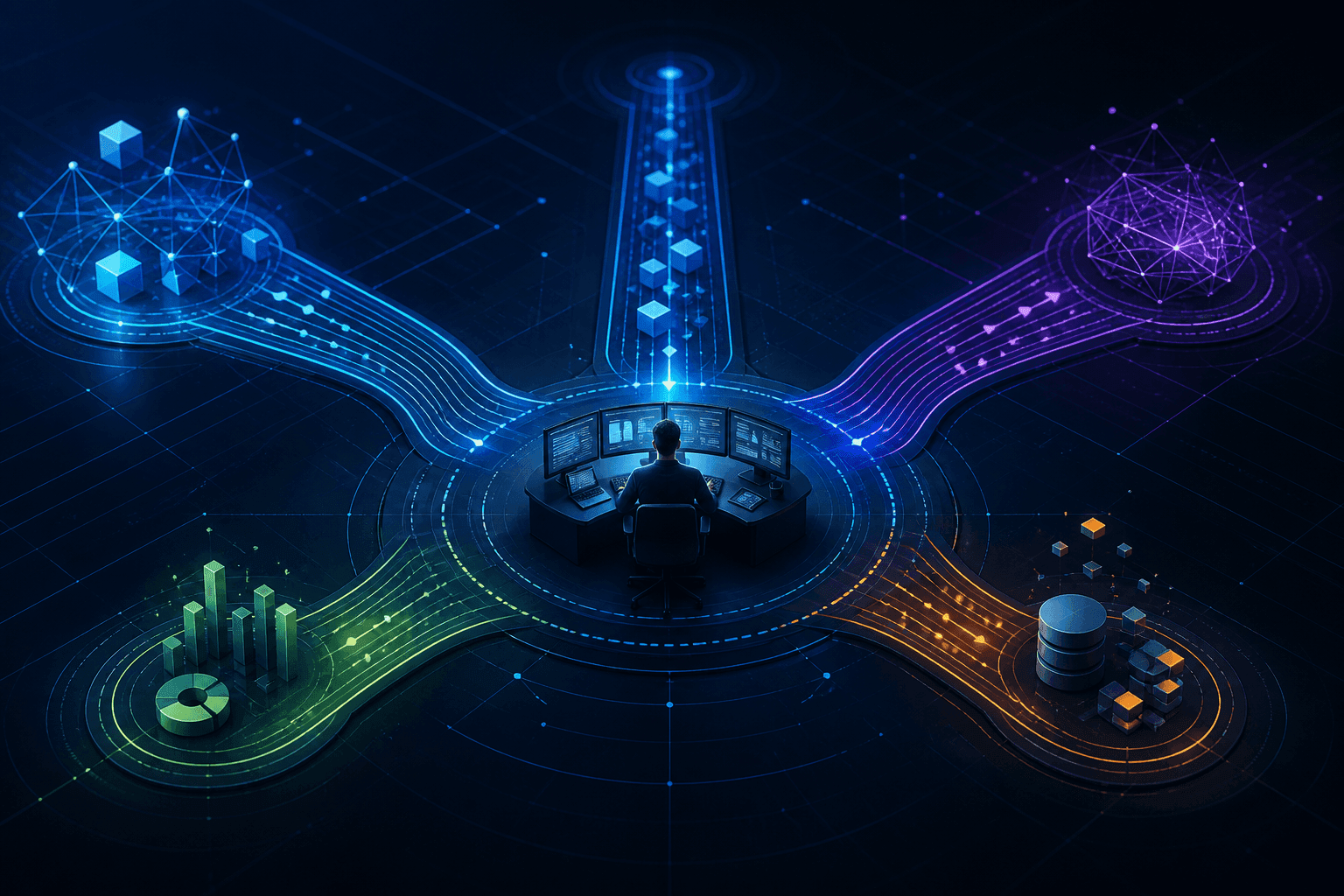
We are rapidly approaching an era where a company's org chart includes digital employees. You will have a primary n8n instance acting as a "Manager Agent," overseeing a fleet of specific "Worker Agents" handling inbound sales routing, preliminary graphic design generation, and level 1 technical support.
A Shift to Management #
This does not mean the end of human labor; rather, it introduces a monumental shift. Humans will stop acting as rote doers and start acting as tactical reviewers. The individuals who master platforms like n8n today will be the people architecting and managing the autonomous mega-corporations of tomorrow.
FAQ Section #
Q: What does RAG actually stand for? #
A: RAG stands for Retrieval-Augmented Generation. It is an architectural framework that prevents AI hallucination by retrieving relevant, private factual data from a database and injecting it into the prompt before the language model generates its final response.
Q: Can I run local, fully open-source AI models with n8n? #
A: Yes! By utilizing dedicated integrations with open-source hosting platforms like Ollama or LM Studio, you can connect n8n workflows directly to local models (e.g., Llama 3) allowing for absolute data privacy and off-grid compliance.
Q: Is building a RAG vector pipeline in n8n difficult? #
A: Understanding the conceptual math of embeddings takes a moment, but n8n's visual node abstraction makes the actual implementation significantly faster and infinitely more stable than writing custom Python LangChain scripts from scratch.
Q: How do AI actions impact overall workflow execution time? #
A: AI nodes natively take slightly longer to execute than simple API calls because the workflow must wait for the external LLM provider (like OpenAI or Anthropic) to physically generate the requested tokens. Expect ~1-5 seconds of added latency per AI node.
Q: What is the difference between an AI Chatbot and an AI Agent? #
A: An AI chatbot is purely conversational and responds iteratively to incoming human text. An AI Agent operates autonomously, utilizing "tools" to independently execute API commands, database queries, and external software edits to achieve a high-level goal.
Q: Does n8n charge more to use the Advanced AI Nodes? #
A: No, n8n treats AI nodes as standard execution steps. However, you are separately responsible for the API costs charged directly by your LLM provider (e.g., your OpenAI API bill) or the hosting costs of running your own local Ollama server.
Q: What is a Vector Database, and why do I need one for RAG? #
A: Standard databases store text in rows and columns. Vector databases (like Pinecone) store mathematical representations of text. This allows the AI to perform "similarity searches," finding concepts that mean the same thing, even if the exact keywords don't match.
Q: Can an AI Agent in n8n accidentally trigger the wrong API? #
A: While advanced models are highly accurate, hallucinations can happen. n8n natively supports complex routing, allowing you to easily build "Human-in-the-Loop" fallback nodes that pause execution and ping you for manual approval before an Agent makes a destructive action.
Q: Which LLM is best for agentic routing in n8n automations? #
A: As of 2024, Anthropic's Claude 3.5 Sonnet and OpenAI's GPT-4o are consistently regarded as the bleeding edge for agentic reasoning and tool-calling accuracy. Choosing between them usually depends on personal API rate limits.
Q: Does n8n natively support OpenAI's Assistant API? #
A: Yes. In addition to LangChain integrations, n8n has dedicated nodes enabling you to tap directly into OpenAI's proprietary Assistant API, allowing OpenAI to handle internal memory threading and document retrieval natively on their end.
Conclusion #
By wrapping the immense architectural complexity of LangChain into intuitive, drag-and-drop visual nodes, n8n allows teams to rapidly prototype and deploy AI Agents that were computationally out of reach just a year ago. Stop treating your workflows like rigid train tracks, and start equipping them with intelligent autonomy. Start with one simple task, attach an LLM logic layer, and watch your digital workforce evolve.
Related Posts
How to Stop Client-Facing AI Agents From Hallucinating
Client-facing AI agents hallucinate when they answer without grounding. Here's the layered guardrail stack I use to keep agents accurate and on-script.
AI Sales Systems vs Traditional CRM Automation
Traditional CRM automation fires rules; AI sales systems reason about each lead. Here's how they differ, where each wins, and how to combine them.

The Manual Workflows With the Highest ROI When Replaced by AI Agents
Not every task is worth automating. Here are the manual workflows with the highest ROI when you replace them with AI agents, ranked by payback speed.