Does Video Content Help or Hurt AI Visibility?
Table of Contents
Does Video Content Help or Hurt AI Visibility? #
Video helps AI visibility when a transcript and a quotable written page sit beside it. Video-only usually hurts, because ChatGPT, Perplexity, and Google AI Overviews cite extractable text first — not watch time, not pixels, and not a thin embed. If the only artifact you shipped is a talking-head file with a 90-word description, you built distribution. You did not build a citation surface.
I'm William Spurlock, an AI Solutions Architect and Fractional AI CTO. I run a daily AI-visibility publishing system on this site and I get paid to fix the gap between "we make great videos" and "answer engines actually name us." This spoke sits under the question-first content model. It is not a remake of how to write quotable prose. It is the video-versus-text decision: when YouTube helps, when it wastes a quarter, and what has to live on a page you own.
The primary query I want this URL to own is simple: does video content help or hurt AI visibility compared to written content? The short version is "it helps as proof media and it hurts as the only copy." The rest of this post is the operating system behind that sentence.
Does Video Content Help or Hurt AI Visibility Compared to Written Content? #
Video helps compared with written content when it is paired with a crawlable transcript and a question-shaped page. Video hurts compared with written content when it replaces that page, sits behind a login, or lives only on a platform with thin captions. Treat YouTube as an amplifier. Treat your site as the thing an answer engine can quote.
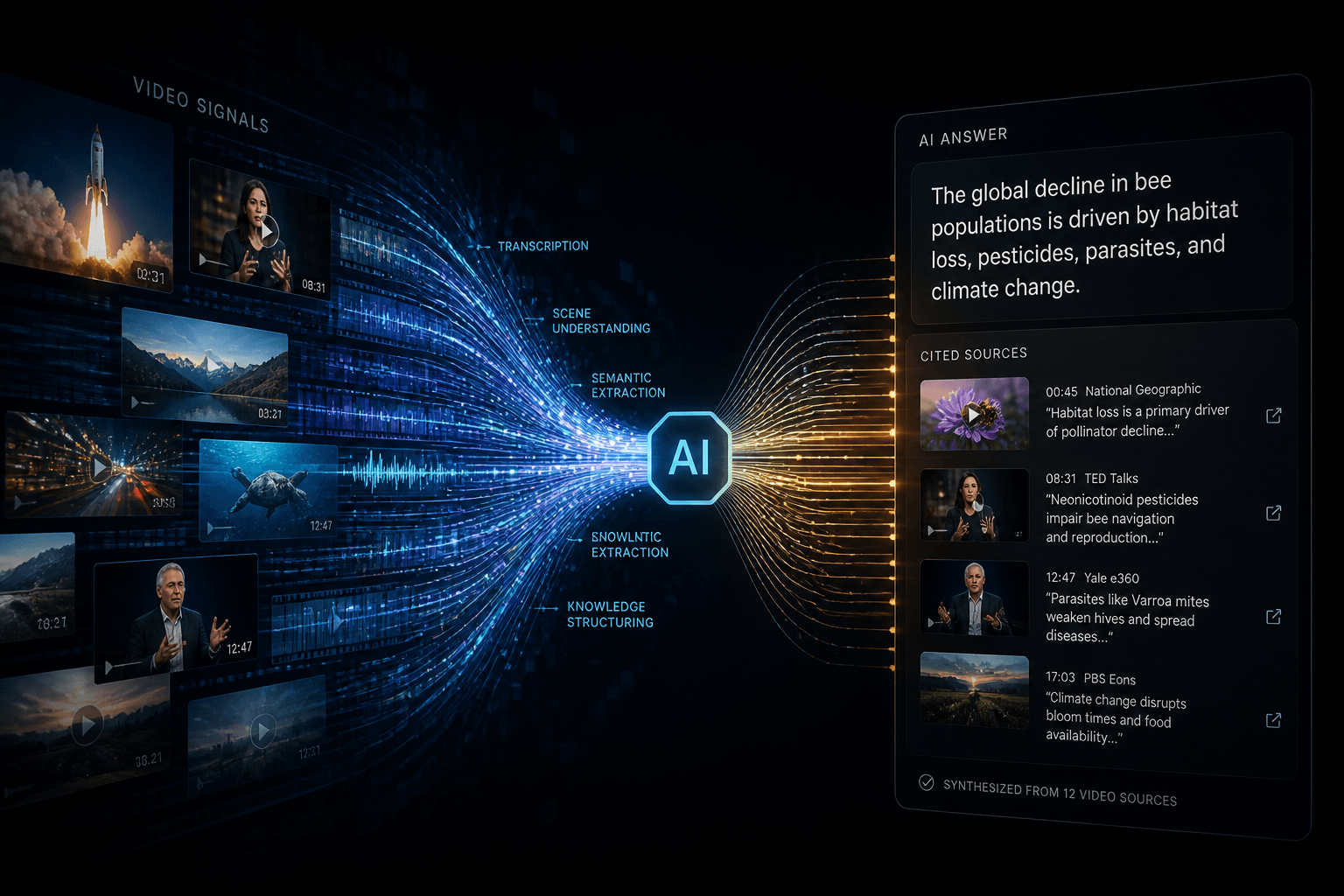
This is the mistake I see most often in AI-visibility audits. A founder is crushing LinkedIn clips or a weekly YouTube show, so the team assumes ChatGPT "saw" the same content. Answer engines do not sit through your reel. They retrieve passages, score them against a query, and lift sentences that already look like answers. Google's own site-owner guidance for AI Overviews and AI Mode is blunt: make sure important content is available in textual form, then support that text with images and video when it helps a human.
Answer Engine Optimization (AEO) here just means becoming the source an assistant can extract. AI Overview Optimization (AIO) is the Google-specific version of the same job. Neither one watches your B-roll.
What actually gets extracted from a video asset #
| Asset you shipped | What models can usually use | Citation odds vs a written page |
|---|---|---|
| YouTube upload, 2-line description, auto-captions never edited | Title, tags, noisy caption text | Low |
| YouTube upload + chapters + cleaned captions | Title, description, chapter labels, cleaner transcript | Medium on Google / Perplexity; still weak on ChatGPT |
| Same video embedded on a thin landing page | Embed + whatever 80 words you wrote under it | Low |
| Video + full transcript on a dedicated, indexed page | Quotable passages, timestamps, entity names | Medium–High |
| Video + question-first blog that answers the query in sentence one | Lead answer, tables, FAQ, transcript as proof | High |
Written content wins the default because it already is the format retrieval systems prefer. Video wins the human trust layer — demo, teardown, founder face — once that written layer exists.
The buyer-stakes version of the same table #
- If a prospect asks ChatGPT for a vendor in your category, a blog post that names your offer, location, and proof can get retrieved. A YouTube file with no companion page often cannot.
- If a prospect asks Google a how-to that AI Overviews can answer, Google may show a YouTube citation and web links. You want both. Google's AI features documentation says supporting links still have to be indexed pages that are eligible for a snippet. A video with no indexable text fails that bar.
- If a prospect asks Perplexity, you need a URL with sentences. Perplexity shows sources. A caption file buried inside YouTube is a worse source than a page you control.
I do not treat "we posted a video" as an AI-visibility task. I treat it as unfinished until the same answer exists as text on a URL I can inspect, recrawl, and measure.
Why Does AI Citation Still Prefer a Transcript and a Page You Can Quote? #
AI citation still prefers a transcript and a page you can quote because retrieval is a text job: models lift passages, not minutes of footage. A transcript turns speech into those passages. A page you own turns those passages into a stable URL with a lead answer, headings, and proof an engine can attribute.
Google describes generative AI features as grounded in Search. In its guide to optimizing for generative AI features, Google says AI Overviews and AI Mode use retrieval-augmented generation against the Search index, then show clickable links to the pages that supported the response. That is a page-and-passage system. It is not a "highest watch time wins" system.
The same guide tells you to add high-quality images and video in support of textual content, and points you at existing video structured data if you already do video SEO. Video is eligible. Video is not a substitute for the sentences the model has to ground on.
Why a transcript is the load-bearing layer #
- Speech becomes tokens. Without captions or a transcript, most systems have title, description, and maybe a noisy auto-caption. That is a thin document.
- Timestamps become citations. When Google shows a YouTube source in an AI Overview, the useful version is a deep link to the second that answered the question. That only works if the engine can align words to time.
- Cleanup becomes accuracy. Auto-captions invent product names, city names, and prices. If the model quotes a wrong price, you taught it to lie about you.
- Your site becomes the canonical quote. A transcript on your domain is a page you can update, schema-mark, and point other articles at. A caption track that only lives in YouTube Studio is rented text.
Why "a page you can quote" still beats "a video people liked" #
| Signal owners love | What it proves | What it does for AI citation |
|---|---|---|
| Watch time / average view duration | Humans stayed | YouTube ranking and brand recall — not a documented ChatGPT ranking factor |
| Subscriber count | Channel gravity | Almost useless for citation; engines cite videos, not channels |
| Thumbnail CTR | Packaging | Human click, not extractable answer |
| Clean transcript on an indexed URL | The words exist in public HTML | High — this is the retrieval object |
| Bold lead answer + table + FAQ | The page already looks like an answer | High — this is what AEO pages are for |
As of May 2026, Indexly's YouTube citation corpus reported 22,781 YouTube URLs out of 3,030,446 citations (~0.75%) across ChatGPT, Gemini, Perplexity, Grok, and Google AI Overviews. Treat vendor corpora as directional, not gospel. The useful take is the split: ChatGPT barely showed up (Indexly reported 49 YouTube citations, 0.003% of its set), while Grok, Gemini, and Perplexity carried most of the YouTube mentions. If ChatGPT is the buyer surface you care about, a YouTube-only plan is the wrong instrument.
That is why I still send owners to a written recommendation playbook like how to get ChatGPT and Perplexity to recommend your business instead of "post more videos and hope." Video can help the Google and Perplexity side. ChatGPT still wants names repeated on third-party pages and facts stated in plain HTML.
The cost of ignoring the written layer #
You already paid for the shoot. The expensive part is done. Skipping the transcript page means you spent production budget on an asset answer engines cannot quote, then wondered why the "AI search" retainer did nothing. The cheaper move is almost always: clean the captions, write the lead answer, publish the page, embed the video as proof.
How Do I Get a YouTube Video Cited by ChatGPT, Perplexity, or Google AI Overviews? #
You get a YouTube video cited by making the words easy to retrieve: cleaned captions, chapter markers, a question-shaped title and description, and a companion page on your site that states the same answer in the first two sentences. You do not get cited by buying views. You get cited when an engine can lift a specific claim and point at a URL.
Set expectations by engine. As of August 2026, public corpora and Google's own docs do not agree on a single "YouTube share of AI answers" number, and you should ignore anyone who sells you one. What you can operate on:
| Engine | What I see in practice | What to build for |
|---|---|---|
| Google AI Overviews / AI Mode | Will cite YouTube and web pages when the query is visual, instructional, or comparative | Chapters, captions, VideoObject on your watch/embed page, plus an indexed written answer |
| Perplexity | Will cite YouTube when the transcript is clean and the query matches; still loves quotable articles | Companion page + YouTube URL both answering the same question |
| ChatGPT (search / browsing) | Rarely names a YouTube file as the source; much more likely to use web pages and lists | Written entity pages and third-party mentions; video is backup proof |
| Claude / Gemini research modes | Mixed; Gemini is more likely to surface YouTube than ChatGPT | Same dual-asset: page + video |
Search Engine Land reported BrightEdge data that YouTube citations inside Google AI Overviews rose 25.21% from the start of 2025, with the lift concentrated in instructional and demo queries. That is industry reporting, not a Google ranking announcement. Use it as a hint that how-to and visual-proof queries are the YouTube lane — not "best [service] in [city]" recommendation queries.
The citation stack I actually ship #
- Pick one buyer question. Title the video as that question. Title the page as that question. Do not "brand" the H1 into poetry.
- Write the lead answer before you hit record. If you cannot say the answer in two spoken sentences, you do not have a citation asset yet.
- Record in chapters. One chapter per sub-question. Speak the chapter title out loud so captions and chapter labels match.
- Upload captions you edited. YouTube can auto-caption; YouTube's own help page says quality varies and you should review and edit. Do that before you call the video "done."
- Write a description that is a short article. First paragraph restates the answer. Then timestamps. Then a link to the companion page. YouTube's caption workflow is in Studio under Subtitles — use it, do not leave the default track untouched.
- Publish the companion page the same day. Embed the video. Put the transcript under a heading. Put the FAQ under that. Request indexing in Search Console.
- Mark the page up.
VideoObjectwithname,thumbnailUrl,uploadDate, plusembedUrlorcontentUrl, as Google lists in its video structured data documentation. Addtranscriptin schema.org terms if you can do it without inventing fields Google does not document for rich results. - Test the query in all three UIs. Google (AI Overview / AI Mode if it triggers), Perplexity, ChatGPT. Log the source drawer. Do not celebrate a YouTube view spike as an AI-visibility win.
A prompt I use after publish (not a magic trick) #
I run the same buyer question the video claimed to own, with no brand name in the prompt, in each engine. Then I run it once with the brand name to see if the entity stuck. If Perplexity cites the YouTube URL but ChatGPT names a competitor's article, I do not "optimize the thumbnail." I strengthen the written page and the third-party mentions. Video packaging does not fix a missing document.
What Should Live on the Page vs Only in the Video? #
The page should hold every fact you want cited: the lead answer, definitions, numbers, comparisons, steps, and the cleaned transcript. The video should hold proof you cannot get from text alone: a demo, a walkthrough, a face, a tone check. If a claim only exists in the spoken take, assume it will not be cited cleanly.
This is where teams waste the most time. They transcribe the entire ramble onto the page and call it a blog post. That is a dump, not a citation page. The page has a job the video does not: look like an answer on first scroll. For the craft of headers, bullets, and quotable sentences, use how to write content that AI wants to quote. This section is only the split: what must be HTML vs what can stay in the player.
Page vs player checklist #
| Element | Put it on the page | Keep it mainly in the video | Why |
|---|---|---|---|
| Direct answer in 1–2 sentences | Required | Say it in the first 20 seconds too | Extraction + human hook |
| Definitions of the offer, city, category | Required | Optional restatement | Entity consistency |
| Prices, timelines, guarantees | Required if you will stand behind them | Do not say a number on camera that is missing from the page | Models quote the clearer number |
| Step-by-step method | Numbered list on the page | Demo the steps on camera | List gets cited; demo gets trusted |
| Comparison table | Required for vs. queries | Talk through 2–3 rows, not all of them | Tables extract; monologues do not |
| Transcript | Full, edited, under its own H2 | Captions in YouTube Studio | Dual retrieval paths |
| Founder story / banter | One short paragraph max | Fine in the video | Fun to watch, weak to cite |
| B-roll, product shots, UI clicks | Poster frame + 1–2 stills | This is the video's job | Visual proof |
| CTA / booking | Plain-text link + form | Verbal CTA is extra | Clicks need a URL |
What I refuse to leave "only in the video" #
- Any number. Hours saved, price ranges, turnaround, headcount, certifications. If I say "20,000+ hours" on camera, it is also in a sentence on the page with the same wording.
- Any name. Legal business name, service names, city, "near me" qualifiers. Spoken names get captioned wrong.
- Any process a buyer would screenshot. If the method is the product, the method is a numbered list.
- Any disclaimer. Scope limits, "this is not legal advice," who you do not serve. Models love to over-generalize. Write the fence.
A simple page skeleton that does not clone a quote-craft post #
- H1 = the buyer question.
- Bold lead answer. Two sentences. No wind-up.
- Embed. Below the lead, not above it. The first thing a crawler and a skimmer should hit is the answer, not a player that never loads.
- Method or comparison. One table or one numbered list. Not both stuffed for decoration.
- Transcript. Edited. Chapters as H3s if the video is long.
- FAQ. Adjacent questions the video skipped.
- CTA. AI-visibility or service next step, in text.
If the page cannot stand with the embed deleted, it is not a citation page. It is a YouTube mirror. I delete the embed in my head during review. If the remaining HTML still answers the query, we can ship.
How Do I Measure Whether Video Moved AI Citations? #
Measure video's AI-visibility effect with a prompt panel and source logs, not with YouTube Analytics alone. Watch time tells you humans stayed. Citation tests tell you whether ChatGPT, Perplexity, or Google AI Overviews started using your URL or your video as evidence.
Google will help you on the Google side. Its AI features documentation says AI Overviews and AI Mode traffic is included in Search Console's Performance report under the Web search type, and the generative AI optimization guide points at the Generative AI performance report for those features. That is necessary. It is not sufficient. Search Console will not tell you if Perplexity cited the YouTube file or if ChatGPT named a competitor.
The measurement stack #
| Metric | Where I get it | What it proves | What it does not prove |
|---|---|---|---|
| Indexed companion URL | Search Console URL Inspection | The page can be retrieved | That anyone cited it |
| Generative AI impressions / clicks | Search Console Generative AI performance report | Google AI features saw you | ChatGPT / Perplexity behavior |
| Video rich result eligibility | Rich Results Test on the embed page | VideoObject is valid enough for video features |
AI Overview citation |
| YouTube average view duration | YouTube Analytics | Human engagement | AI citation |
| Source-drawer hits | Manual prompt panel (weekly or monthly) | Whether this query cites you | Category-wide share |
| Branded vs unbranded prompts | Same panel, two columns | Entity stuck vs query ownership | Revenue by itself |
A 12-prompt panel I actually run #
I keep a spreadsheet with the video's primary question plus 11 variants. Half are unbranded. Two include the brand. Two are competitor-adjacent. I run them in Google (note whether an AI Overview or AI Mode panel appears), Perplexity, and ChatGPT search. I log:
- Named / not named
- Cited URL (site vs YouTube vs neither)
- Timestamp deep link (yes/no)
- Wrong fact quoted (yes/no — this is a transcript-quality bug)
- Date
I do not need a vendor dashboard to start. I need a date, a prompt, and a screenshot of the source list. If you later buy a citation tracker, it should replace the spreadsheet, not invent a new KPI that ignores the source drawer.
Decision rules after 30 days #
| Pattern | What I conclude | What I do next |
|---|---|---|
| Companion page indexed, zero citations, video views up | Distribution without retrieval | Tighten the lead answer; add a table; fix captions |
| Perplexity cites YouTube, ChatGPT silent | Expected for many B2B queries | Push written third-party mentions; do not "fix YouTube" for ChatGPT |
| Google AI Overview shows a competitor video | You lost the how-to lane | Chapters + cleaner title/description + a denser page |
| Engine quotes a wrong number from captions | You published dirty text | Edit captions and the on-page transcript the same day |
| Cited on branded prompts only | Entity exists; query not owned | Publish one more question-shaped page, not another teaser clip |
| Cited on the primary query in two engines | Video-plus-page is working | Clone the stack onto the next money question |
If you only watch subscriber count, you will declare victory on a video that never entered an answer. I have watched teams do that for a full quarter. It feels productive. It is not AI visibility.
Does YouTube Beat Podcasts and TikTok for AI Citations? #
YouTube beats podcasts and TikTok for AI citations in most commercial categories because it is indexed, captioned, chapterable, and already inside Google's retrieval world. A podcast can win if you publish a full show-notes page. TikTok rarely wins as a citation URL. Do not confuse "the algorithm likes this format" with "answer engines cite this URL."
Indexly's May 2026 cut of YouTube citations found 95.74% pointed at long-form videos, not Shorts (source). That is one corpus. It matches what I see in client prompt tests: 30-second clips do not give a model enough clean text to lift a method. Long-form with chapters does.
Platform comparison for citation work #
| Format | Typical citation path | What you must add | When I use it |
|---|---|---|---|
| YouTube long-form (6–20 min) | YouTube URL + companion page | Edited captions, chapters, description that restates the answer | Default for how-to, teardown, comparison |
| YouTube Shorts / Reels-style cuts | Almost never as a source | Still need a written page if the idea matters | Distribution and hooks, not AEO |
| Podcast (audio-only) | Show-notes URL, not the MP3 | Full transcript on your domain | Interviews, founder narrative, industry context |
| TikTok / Instagram Reels | Weak as a citable source for B2B | Screenshot the claim onto a page if it is load-bearing | Brand, not citation |
| Self-hosted MP4, no transcript | Worst of both worlds | VideoObject + transcript page or do not bother |
Only if you already have a watch page worth indexing |
| Loom / internal demo | Not public retrieval | Recut the public answer onto YouTube + a page | Sales enablement, then harvest the transcript |
Podcasts are not "video-lite" #
A podcast episode with a two-sentence listing in a host's RSS feed is an audio file with a title. That is thinner than a bad YouTube description. The citation object is the show-notes page: guest name, one-sentence take, timestamped outline, and a cleaned transcript. If you already record audio, you are closer to a citation page than a TikTok team is — you just have to stop treating the hosting platform as the article.
TikTok is a reach channel #
I will use short-form to send humans to the companion page. I will not build an AI-visibility forecast on TikTok URLs. Third-party writeups that claim YouTube is "200×" other video platforms are vendor math; I will not repeat a hard multiple I cannot defend from a primary dataset. The directional point is enough: if you have one video hour this month, spend it on a chaptered YouTube file and a page, not on seven caption-less clips.
A decision rule I give owners #
- Buyer asks "how do I…" or "show me…" → YouTube + page.
- Buyer asks "who should I hire…" → written recommendation pages and third-party mentions first; video is proof after you are nameable.
- Buyer asks while commuting → podcast + transcript page.
- Buyer scrolls at 11 p.m. → short-form as a pointer, never as the source of record.
Do Captions, Transcripts, and VideoObject Schema Actually Matter? #
Yes — captions and transcripts matter more than schema, and schema still matters for Google video features. Captions are the words. The on-page transcript is the same words in HTML you control. VideoObject tells Google the title, thumbnail, upload date, and how to play the file. None of the three replaces a lead answer.
Google's video structured data documentation says Google tries to understand a video automatically, and that marking it up with VideoObject lets you influence description, thumbnail, upload date, and duration. Required properties listed there are name, thumbnailUrl, and uploadDate. Google also wants a playback path: contentUrl or embedUrl. Recommended extras include description and duration in ISO 8601 (for example PT00H12M05S). For chapters, Google documents Clip or SeekToAction, and for YouTube-hosted files it will also read timestamps you put in the YouTube description.
schema.org's VideoObject type includes caption (a caption file or text) and transcript (the transcript of the media). Those fields are real vocabulary. They are not a secret Google AI-Overview switch. Google's generative AI guide even says structured data is not required for generative AI search and that there is no special schema you must add for AI Overviews. Use schema for video rich results and for honesty (markup must match visible text). Use the visible transcript for citation.
What I implement, in order #
- Edited captions on YouTube. Human pass. Product names, cities, prices.
- Visible transcript on the page. Same words. Crawlable. Not a PDF. Not a tab that never renders without JavaScript if you can avoid it.
VideoObjecton the page that embeds or hosts the file. Uniquenameanddescriptionper video — Google says not to reuse the same text across videos.- Chapters. YouTube description timestamps and, if you have a self-hosted watch page,
Clip/SeekToActionas Google documents. - Rich Results Test, then a recrawl. Markup that only exists in a plugin preview is not markup.
Caption vs transcript vs schema #
| Layer | Job | Failure mode I see |
|---|---|---|
| Auto-captions, never edited | Cheap first draft | Wrong entity names get quoted |
| Edited captions | Align speech to time | Still trapped on YouTube if you skip the page |
| On-page transcript | HTML the crawler can store | 8,000 words of "um" with no lead answer |
VideoObject |
Video rich results + clearer fetch | Missing uploadDate / thumbnail 404 / markup that does not match the page |
Clip / description timestamps |
Key moments and deep links | Fake chapters that do not match the audio |
YouTube's automatic captioning help article is explicit: machine captions can misrepresent speech because of accents, noise, and mispronunciations, and creators should review them. If you skip that review, you are publishing a dirty text document at scale and then asking AI systems to trust it.
I do not sell "VideoObject as an AEO hack." I sell "do not ship a video Google cannot describe, and do not hide the words in a player."
When Does Video Content Hurt AI Visibility? #
Video hurts AI visibility when it replaces the written answer, burns the calendar, or publishes dirty text that models then quote. The file is not the problem. The missing page, the gated player, and the unedited captions are the problem.
I would rather ship one 1,600-word question-first post with a rough Loom than a branded episode with a 90-word landing page. The first one can get cited after recrawl. The second one gets compliments in Slack.
The hurt list I use in audits #
- Video-only "blog." The CMS post is an embed and a sentence. There is nothing to extract.
- Login wall or lead-gate in front of the transcript. If Google cannot snippet it, Google's AI features technical bar is already failed: the page must be indexed and eligible for a snippet.
noindexon the watch page because someone "didn't want duplicate content with YouTube." You just hid the document.- Auto-captions that invent a competitor's product name or the wrong city. You trained the model on a typo with your face attached.
- Six weeks of production, zero companion pages. Opportunity cost is the real injury. While you color-grade, a competitor published three quotable answers.
- Shorts calendar with no long-form and no pages. Reach without a retrieval object.
- Conflicting answers. The video says one price. The page says another. The GBP says a third. Engines pick the loudest third-party page — often not you.
- Orphan YouTube links. Description has no URL to your site, or the URL is a homepage instead of the question page.
A quick self-test #
Ask one person who did not work on the video to answer the primary question using only the page, with the player blocked. If they cannot, the video is hurting you relative to a written-only competitor. If they can, the video is allowed to stay as proof.
When I tell a client to stop filming #
When the written cluster for the category is empty. Film after you have three question-shaped pages that already answer the money queries. Video then multiplies assets you have. Video before that multiplies a blank.
Should I Replace Blog Posts With Video, or Publish Both? #
Publish both — written first, video as the proof layer — unless you have a reason the query is visual-only. Replacing the blog with a channel is how service businesses go invisible in ChatGPT while their view graphs look healthy.
Google's AI-features guidance is "text first, media in support." That is also how I staff a week. The writer (or the operator wearing that hat) locks the question, the lead answer, and the claims. The camera records the same answer. The editor cleans captions and pastes the transcript. Nobody "migrates the blog to YouTube."
Replace vs both vs video-only #
| Choice | What happens in AI search | When it is rational |
|---|---|---|
| Written only | You can still get cited | Default for most B2B service queries |
| Written + video | Best combined odds: page for ChatGPT/Perplexity, video for Google how-tos and trust | Anytime you already record sales demos or founder updates |
| Video only | Weak on ChatGPT; lucky on Google/Perplexity if captions are excellent | Almost never for a company that sells a service |
| Video first, "we'll write it later" | Later rarely comes | A process failure, not a strategy |
How I avoid duplicating the quote-craft post #
I do not rebuild header theory here. I enforce one rule: the companion page is a first-class post with its own primary query, not a dump of the transcript under a cute title. If the video is "a day in the studio," it does not get a citation page. If the video is "does video content help or hurt AI visibility compared to written content?", it gets this kind of page.
Cannibalization, briefly #
One URL owns one primary query. The YouTube title and the blog title can match. That is alignment, not cannibalization. Cannibalization is two site URLs fighting for the same question with two thin answers. Do not publish a "video version" and a "blog version" as separate site posts. Publish one page. Embed one video. Point the YouTube description at that page.
My opinion, held loosely #
For a service business that wants leads from AI assistants, written content is the product and video is packaging. I will cut the video budget before I cut the question-shaped publishing cadence. I will not cut the transcript step to "save time." That step is the whole point of filming for AI visibility.
What Is a 30-Day Operating Checklist for Video Plus Written AI Visibility? #
A 30-day video-plus-written sprint is four weeks: lock questions, ship one dual asset, clean the retrieval layer, then measure citations — not views. If you cannot staff all four, skip filming and publish the written answers.
This is an operating checklist, not a content-ideas workshop. Steal it.
Week 1 — Questions and inventory #
- List the 10 questions sales already hears. Pick one primary query for the sprint.
- Search that query in Google, Perplexity, and ChatGPT. Screenshot who gets cited today (page, video, or neither).
- Inventory existing videos. If one already answers the query, do not reshoot. Transcribe it.
- Write the two-sentence lead answer in a doc. If you cannot, you are not ready to record.
- Lock claims you will say on camera. No unsourced percentages. Hedge or cut.
Week 2 — Record and write on the same days #
- Record 8–15 minutes. Chapters spoken out loud. Answer in the first 20 seconds.
- Draft the companion page the same afternoon: H1, bold lead, one table or list, FAQ stubs.
- Upload to YouTube with a question title and a description that restates the answer, then timestamps, then the site URL.
- Do not publish the YouTube file until captions exist as a draft.
Week 3 — Retrieval layer #
- Edit captions in YouTube Studio → Subtitles. Fix names, numbers, cities.
- Paste the cleaned transcript onto the page under a heading.
- Add
VideoObject(name,thumbnailUrl,uploadDate,embedUrlorcontentUrl,description,duration) per Google's video docs. - Confirm the page is indexable: no
noindex, not behind a gate, important text in HTML. - Request indexing. Run the Rich Results Test on the URL.
- Add two internal links from related posts you already have — only to slugs that exist.
Week 4 — Measure and decide #
- Run the 12-prompt panel. Log source drawers for Google, Perplexity, ChatGPT.
- Check Search Console: URL indexed? Generative AI report showing anything?
- Compare YouTube average view duration to the citation log. If views moved and citations did not, you had a packaging win, not an AEO win.
- Ship one fix: caption error, weaker lead, missing table, or a third-party mention if ChatGPT still ignores you.
- Pick next month's primary query. Do not start a second video until this page is citation-ready.
What "done" means on day 30 #
Done is not "the episode is live." Done is: indexed companion URL, edited captions, valid video markup, and a written prompt log. If those four are true and nobody cited you yet, you still built a retrievable asset. Recheck in another 30 days before you declare the format a failure.
Frequently Asked Questions #
Does YouTube auto-caption count as a transcript for AI citation? #
Auto-captions are a draft transcript, not a finished one — they count only after you edit them. YouTube says automatic captions can misrepresent speech and should be reviewed. I treat unedited auto-captions as a liability because models will quote the errors. Publish the cleaned track on YouTube and paste that same text onto your page.
Do I need VideoObject schema if I already have a transcript on the page? #
You do not need VideoObject for Google's generative AI features, but you still want it if the page embeds or hosts a video. Google's AI optimization guide says structured data is not required for AI Overviews or AI Mode. Google's video structured data docs still use VideoObject for video rich results and clearer fetching. Keep the transcript visible; add markup that matches what a human can see.
Does watch time help AI citations the way it helps YouTube rank? #
No. Watch time is a YouTube engagement signal; it is not a documented citation ranking factor for ChatGPT, Perplexity, or Google AI Overviews. High watch time can mean the video is useful to humans and may help the file surface in YouTube Search. I still measure citations with a prompt panel and Search Console, not average view duration. If watch time is up and the source drawer never shows you, you won packaging, not AEO.
Can ChatGPT watch my video, or does it only read text around it? #
Treat ChatGPT as a text-and-web retrieval system, not as a viewer that "watched" your episode. As of May 2026, Indexly reported ChatGPT accounted for 49 YouTube citations out of about 1.6 million in its set (0.003%) — directional, one corpus, still a useful warning. If ChatGPT is your buyer surface, build the written page and third-party mentions. Do not wait for the model to stream your MP4.
Should I upload the same video to YouTube, LinkedIn, and my site? #
Upload once to YouTube, embed that file on your site, and use LinkedIn as a cut-down pointer — not as a second source of record. Three native uploads with three different captions create three dirty transcripts. One canonical YouTube URL plus one companion page keeps the words aligned. Short LinkedIn clips can send humans to the page; they should not be the only place the answer lives.
Is a podcast better than YouTube for AI visibility? #
A podcast is better only when the show-notes page carries a full transcript and a lead answer; the audio file alone is usually worse than YouTube. YouTube gives you captions, chapters, and a URL Google already knows how to retrieve. A podcast host's default listing is often a title and a blurb. If you already record audio, spend the hour on the notes page, not on a new video set.
How long should a video companion page be? #
Long enough to state the answer, prove it, and include an edited transcript — for most service queries that is a tight spoke, not a 10,000-word dump. I aim for a page that still works if you delete the embed: lead answer, one structured block, FAQ, transcript. Padding the transcript with every "um" does not help extraction. Cutting the transcript to a 40-word summary usually hurts it.
Do I need a separate blog post for every video? #
You need a citation page for every video that owns a buyer question; you do not need a post for every teaser, Short, or recap. Teasers can point at the existing URL. A second site post with the same primary query is cannibalization. If the video does not answer a question you want to own, skip the companion page and skip filming next time.
Will embedding a YouTube video on a thin page get me cited? #
Almost never. An embed on a thin page gives crawlers a player and almost no passages. Google's AI features documentation requires the page to be indexed and eligible for a snippet, and it asks for important content in textual form. Eighty words under a player fails that job. Write the answer, then embed.
Does Google AI Overviews cite YouTube videos directly? #
Yes — Google can show YouTube as a supporting source in AI Overviews, especially on instructional and visual queries, but it is not a guarantee and it is not the only citation type. Industry reporting such as BrightEdge via Search Engine Land described a 2025 rise in those YouTube citations. Google's own docs still say AI features pull supporting links from indexed, snippet-eligible pages and can include video when it helps. Build both the YouTube file and the page.
Get an AI-Visibility-Ready Site #
If your team is filming every week and ChatGPT still names someone else, the gap is usually the written layer — not the camera.
I build AI-visibility-ready sites and run the AEO / AIO work behind them: question-shaped pages, transcript pipelines, schema that matches the visible page, and a prompt panel you can actually operate. If you want that installed instead of another video calendar that never gets cited, start with an AI-visibility audit or an AIO/AEO website build and I will map which queries need a page, which videos are worth keeping, and which ones are expensive decoration.
Related Posts

How to Track When AI Tools Cite or Recommend Your Business
No engine gives you a complete citation feed. Here is the weekly method: freeze a prompt panel, score cite versus recommend, then read GSC and GA4 data.

GEO vs AEO vs AIO: What Each One Means and Why Your Business Needs All Three
GEO, AEO, and AIO are three jobs, not three names for SEO. Here's what each owns, why buyers bounce across all three, and why your business needs all of them.

Spurlock Studios LLC Is Live. This Site Stays the Operator Blog.
Spurlock Studios LLC is live at spurlockstudios.com. This site stays the operator blog. Four lanes, published floors, and which site to use when you book.