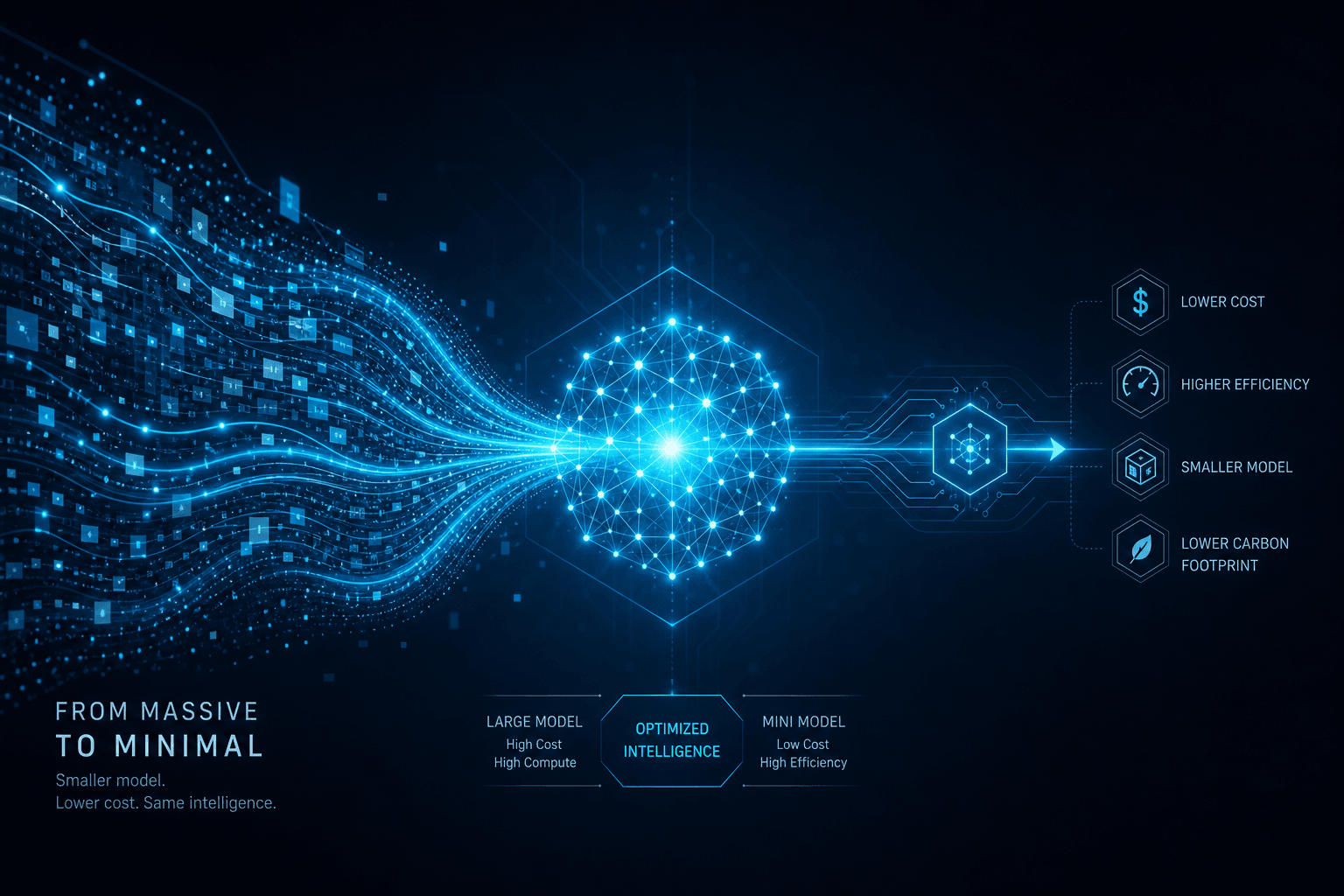
GPT-4o mini Launch: The Day AI Costs Collapsed by 60%

Table of Contents
GPT-4o mini Launch: The Day AI Costs Collapsed by 60% #
OpenAI launches GPT-4o mini today, and the economics of AI automation just changed permanently. This is not a marginal update—it is a 60% price reduction relative to GPT-3.5 Turbo with performance that benchmarks in the GPT-4 class. For builders running high-volume automation, agent loops, and production n8n workflows, today marks the inflection point where cost stops being the constraint.
This release follows the GPT-4o launch in May 2024, which introduced multimodal capabilities and significant speed improvements. Where GPT-4o delivered flagship performance at 50% lower cost than GPT-4 Turbo, GPT-4o mini now delivers near-flagship performance at 99% lower cost than the original GPT-4. The progression is clear: OpenAI is systematically removing price as a barrier to entry for AI-native applications.
The implications extend beyond individual developers. Platform teams, enterprise architects, and automation consultants now have a default model that requires no cost-justification conversation. When the "cheap" option outperforms last year's "good" option while costing less, the entire decision framework shifts from "Can we afford to automate this?" to "What else should we automate?"
What Just Happened: GPT-4o mini in 30 Seconds #
The headline: GPT-4o mini replaces GPT-3.5 Turbo as OpenAI's default model for new users. It ships at 15¢ per million input tokens and 60¢ per million output tokens. That is a 60% cost reduction versus GPT-3.5 Turbo's pricing, with MMLU scores that put it firmly in the same performance tier as the original GPT-4.
Key specs at launch:
- 128K context window (identical to GPT-4o)
- Multimodal by default—text and vision in the same API
- MMLU score: 82% (GPT-4 scored 86.4%, GPT-3.5 Turbo scored 70%)
- Function calling and JSON mode fully supported
- Knowledge cutoff: October 2023
- Rate limits: 10,000 RPM and 10M tokens/minute for paid tiers
Architecture note: GPT-4o mini is built on the same "omni" architecture as GPT-4o—a single model trained end-to-end across text, vision, and audio modalities. This is not a vision model bolted onto a text model. The unified representation means vision understanding is baked into the core reasoning capability, not handled as a separate preprocessing step.
Pricing Breakdown: The Numbers That Matter #
The cost collapse is not theoretical. Here is the exact pricing comparison:
| Model | Input (per 1M tokens) | Output (per 1M tokens) | Context Window | MMLU Score |
|---|---|---|---|---|
| GPT-4o mini | $0.15 | $0.60 | 128K | 82% |
| GPT-3.5 Turbo | $0.50 | $1.50 | 16K | 70% |
| GPT-4o | $5.00 | $15.00 | 128K | 88.7% |
| GPT-4 Turbo | $10.00 | $30.00 | 128K | 86.4% |
What this means in practice: A workflow that costs $100/month on GPT-3.5 Turbo now costs $40 on GPT-4o mini. A workflow that costs $1,000 on GPT-4o now costs $30 on GPT-4o mini while retaining ~90% of the reasoning quality.
Performance Benchmarks: Where GPT-4o mini Actually Lands #
Raw cost means nothing if the model hallucinates or fails on reasoning tasks. OpenAI published full benchmarks today, and independent evals are already confirming the numbers.
Academic Benchmarks #
| Benchmark | GPT-4o mini | GPT-3.5 Turbo | GPT-4o | GPT-4 Turbo |
|---|---|---|---|---|
| MMLU | 82.0% | 69.8% | 88.7% | 86.4% |
| HumanEval (coding) | 87.2% | 72.6% | 90.2% | 87.6% |
| MGSM (math) | 87.0% | 72.2% | 89.5% | 87.5% |
| DROP (reasoning) | 79.7% | 64.1% | 83.4% | 80.9% |
LMSYS Chatbot Arena Rankings #
The LMSYS leaderboard updated within hours of launch. GPT-4o mini debuted at #4 overall, ahead of Claude 3 Haiku and Gemini 1.5 Flash. It sits just below the flagship GPT-4o, Claude 3.5 Sonnet, and Gemini 1.5 Pro models—meaning it outperforms every other "small" or "fast" model in production today.
LMSYS ranking snapshot (July 18, 2024):
- GPT-4o (May 2024 version) — Arena ELO: ~1287
- Claude 3.5 Sonnet — Arena ELO: ~1271
- Gemini 1.5 Pro — Arena ELO: ~1264
- GPT-4o mini — Arena ELO: ~1252
- Claude 3 Opus — Arena ELO: ~1246
- Llama 3 70B — Arena ELO: ~1204
- GPT-4 Turbo — Arena ELO: ~1198
- Claude 3 Haiku — Arena ELO: ~1176
The ELO gap between GPT-4o mini and Claude 3 Opus is smaller than the gap between Opus and Llama 3. For a model costing 97% less than GPT-4o, this positioning is unprecedented.
Why This Replaces GPT-3.5 Turbo Immediately #
GPT-3.5 Turbo has been the workhorse model for automation since March 2023. It was the default for Zapier AI, n8n AI nodes, and most no-code AI tools. But GPT-4o mini makes that default indefensible.
Three reasons the switch is immediate:
- Cost arbitrage: 60% cheaper for materially better performance is not a tradeoff—it is free optimization.
- Context window: 128K versus 16K means entire PDFs, long transcripts, and multi-turn agent conversations fit without chunking gymnastics.
- Multimodal native: Vision capability without a model swap simplifies architecture. Receipt processing, screenshot analysis, and document OCR flow through the same endpoint.
The only remaining use case for GPT-3.5 Turbo is latency-sensitive streaming where every millisecond counts. Even there, GPT-4o mini's speed is within 10-15% of Turbo's response time.
Use Case #1: High-Volume Automation at Scale #
For teams running thousands of API calls per hour—classification, extraction, tagging, routing—the cost reduction compounds instantly.
Real example: An ecommerce operation classifying 100,000 customer messages per day. GPT-3.5 Turbo at 500 input tokens per message = $2,500/day. GPT-4o mini at the same volume = $750/day. The annual savings: $638,000. The performance gain: +11 MMLU points, meaning fewer misclassifications and less human review.
Architecture implication: Cost no longer forces you to choose between "good enough" and "actually good." You can run GPT-4-class reasoning on every single request without tiering logic.
Real-World Volume Scenarios #
Here is how the costs scale across different automation intensities:
| Daily Volume | Use Case | GPT-3.5 Turbo | GPT-4o mini | Annual Savings |
|---|---|---|---|---|
| 10,000 requests | Small SaaS support | $250/day | $75/day | $64,000 |
| 100,000 requests | Ecommerce classification | $2,500/day | $750/day | $638,000 |
| 1,000,000 requests | Enterprise data pipeline | $25,000/day | $7,500/day | $6.4M |
At the million-requests-per-day scale, the savings alone fund a dedicated ML engineering team. At smaller scales, the savings mean previously unviable automation projects suddenly have positive ROI.
Use Case #2: n8n Workflow Cost Optimization #
n8n workflows are where GPT-4o mini changes the ROI calculation immediately. Most production n8n setups burn tokens in predictable patterns:
- Webhook triggers that parse and classify incoming data
- Loop nodes that iterate over arrays and call LLMs per item
- Error recovery subworkflows that analyze failures and retry with context
Before GPT-4o mini: A complex workflow with 5 LLM nodes processing 10,000 records/day cost ~$800/month on GPT-3.5 Turbo. Switching to GPT-4o cut that to ~$240/month with better quality. Most teams stayed on Turbo because $800 was budget-acceptable and GPT-4 was overkill.
After GPT-4o mini: The same workflow costs $320/month with GPT-4-class reasoning. You get flagship-tier extraction, classification, and transformation at a price lower than the old budget option.
Migration path: Change the model parameter in your n8n AI node from gpt-3.5-turbo to gpt-4o-mini. No other code changes required. The API is identical.
Code example:
// n8n Function node for GPT-4o mini classification
const response = await $httpRequest({
  method: 'POST',
  url: 'https://api.openai.com/v1/chat/completions',
  headers: {
    'Authorization': 'Bearer ' + $credentials.openaiApi.apiKey,
    'Content-Type': 'application/json'
  },
  body: {
    model: 'gpt-4o-mini',  // Changed from gpt-3.5-turbo
    messages: [
      { role: 'system', content: 'Classify the following message into: sales, support, or spam.' },
      { role: 'user', content: $input.first().json.message }
    ],
    response_format: { type: 'json_object' },
    temperature: 0.1
  }
});

return [{ json: { classification: JSON.parse(response.content) } }];
Use Case #3: Agent Loops and Multi-Turn Conversations #
Agent architectures—planner-executor patterns, supervisor-workers, recursive refinement—are notoriously token-hungry. Each loop iteration burns context, and agent workflows often require 10+ turns to complete a task.
The math: An agent loop averaging 10 turns at 4K tokens per turn on GPT-4o costs $0.80 per completed task. The same loop on GPT-4o mini costs $0.036—95% cheaper with ~90% of the reasoning capability retained.
Where this matters:
- Research agents that fetch, synthesize, and cite across multiple sources
- Code agents that plan, implement, test, and iterate
- Support agents that maintain full conversation history while accessing knowledge bases
The 128K context window is critical here. Long agent conversations that previously required aggressive summarization or state truncation now fit entirely in context, reducing error rates from lost information.
Agent memory math: A typical support agent workflow maintaining 50 messages of history at 500 tokens each = 25K tokens. With GPT-3.5 Turbo's 16K limit, you had 9K tokens left for the knowledge base retrieval and response generation. With GPT-4o mini's 128K window, you could maintain 200 messages of history and still have 100K tokens available for tool outputs, documentation retrieval, and multi-step reasoning.
How GPT-4o mini Reshapes the Competitive Landscape #
This launch does not only affect OpenAI users. It resets price-performance expectations across the entire LLM market.
The competitive pressure:
| Provider | "Small" Model | Input Price | Output Price | MMLU |
|---|---|---|---|---|
| OpenAI | GPT-4o mini | $0.15/M | $0.60/M | 82% |
| Anthropic | Claude 3 Haiku | $0.25/M | $1.25/M | ~75% |
| Gemini 1.5 Flash | $0.35/M | $1.05/M | ~79% | |
| Mistral | Mistral Small | $0.20/M | $0.60/M | ~72% |
OpenAI just set the new floor: flagship-tier reasoning under $1 per million output tokens. Competitors will match or lose market share. For builders, this means continued downward price pressure is guaranteed.
Strategic implication: Locking into any single provider becomes less rational when prices halve every 6-12 months. Build abstraction layers—n8n nodes, internal SDK wrappers, model routing logic—so you can switch models without rewriting workflows.
The Multimodal Advantage: Vision at Mini Prices #
GPT-4o mini includes vision capabilities at the same token pricing. This is not an add-on or separate model—it processes images natively alongside text.
Practical applications:
- Document OCR: Parse receipts, invoices, and forms without a separate OCR service
- UI automation: Have the model read screenshots and generate selectors or test steps
- Content moderation: Analyze images in user-generated content workflows
- Ecommerce enrichment: Extract product attributes from catalog images
Vision tokens cost the same as text tokens: 15¢ per million. A 512x512 image processed at low detail (~255 tokens) costs $0.000038. You can process 26,000 images for $1.
Vision Cost Comparison #
| Task | Tokens | Cost on GPT-4o mini | Cost on GPT-4o | Cost on Claude 3 Haiku |
|---|---|---|---|---|
| Single receipt OCR | ~300 | $0.000045 | $0.0015 | $0.000375 |
| Screenshot analysis | ~600 | $0.00009 | $0.003 | $0.00075 |
| 100-page PDF (images) | ~5,000 | $0.00075 | $0.025 | $0.00625 |
Vision at mini pricing opens automation opportunities that were previously blocked by OCR service costs alone. Azure Document Intelligence starts at $0.01 per page—GPT-4o mini processes the same page for $0.000015 with better comprehension and structured output.
What Builders Should Do Today #
The launch is live in the OpenAI API now. Here is the immediate action list:
1. Audit Current Model Usage #
Pull your last 30 days of API usage. Calculate what that spend looks like at GPT-4o mini pricing. The number will be compelling.
2. Switch Default Models #
Update your OpenAI SDK calls, n8n AI nodes, and LangChain configurations. The model string is gpt-4o-mini. No other API changes required.
3. Re-evaluate Tiering Strategies #
Many teams built "cheap model for simple tasks, expensive model for hard tasks" logic. With GPT-4o mini at 60% cheaper than the old cheap option, that complexity may be unnecessary. Test whether GPT-4o mini handles your full workload.
4. Expand Use Cases #
Projects that were "too expensive to automate" at GPT-3.5 Turbo pricing are now viable. Review your backlog of deferred automation work.
5. Build Model Routing Abstraction #
If you have not already, implement a model selection layer that routes requests based on complexity. Use GPT-4o mini as the default, GPT-4o for complex reasoning, and specialized models (Claude 3.5 Sonnet for coding, Gemini 1.5 Pro for massive context) for edge cases.
Example routing logic:
def select_model(task_complexity: str, has_image: bool) -> str:
    if has_image and task_complexity == "high":
        return "gpt-4o"  # Best vision + reasoning combo
    elif task_complexity == "critical":
        return "claude-3-5-sonnet-20241022"  # Coding tasks
    else:
        return "gpt-4o-mini"  # Default everything else
Risks and Limitations to Know #
GPT-4o mini is not without tradeoffs. Before migrating production workloads, understand these constraints:
1. Knowledge cutoff at October 2023
Unlike GPT-4 Turbo's browsing capability or Claude's knowledge updates, GPT-4o mini has no live web access. For tasks requiring current information, you must implement RAG (Retrieval-Augmented Generation) or tool use.
2. Not a reasoning model
GPT-4o mini does not have the "thinking" or chain-of-thought capabilities coming to the o-series models. Complex multi-step math or logic puzzles may still require GPT-4o or specialized reasoning models.
3. Vision quality tiering
While vision is included, GPT-4o mini's visual reasoning is closer to GPT-4 Turbo than GPT-4o. For fine-grained OCR or detailed image analysis, test against your specific use cases.
4. Rate limits on free tier
Free tier users get 10,000 tokens/minute on GPT-4o mini. Paid API users get 10,000 RPM and 10M tokens/minute—sufficient for most production workloads, but high-volume operations should verify their throughput requirements.
FAQ: GPT-4o mini Launch Day #
How much cheaper is GPT-4o mini than GPT-3.5 Turbo? #
GPT-4o mini is 60% cheaper than GPT-3.5 Turbo. Input tokens cost 15¢ per million (vs. 50¢ for Turbo) and output tokens cost 60¢ per million (vs. $1.50 for Turbo).
Is GPT-4o mini better than GPT-3.5 Turbo? #
Yes. GPT-4o mini significantly outperforms GPT-3.5 Turbo across all benchmarks. MMLU score is 82% vs. 70%, HumanEval coding score is 87.2% vs. 72.6%, and it ranks #4 on LMSYS versus GPT-3.5 Turbo's position in the 20s.
Can GPT-4o mini replace GPT-4o in production? #
For many use cases, yes—with a 95% cost reduction. GPT-4o mini delivers ~90-95% of GPT-4o's reasoning quality at 3% of the price. Tasks requiring the absolute frontier (complex math proofs, nuanced legal analysis) may still need GPT-4o or GPT-4 Turbo.
What is the context window for GPT-4o mini? #
128,000 tokens. This matches GPT-4o and GPT-4 Turbo, and is 8x larger than GPT-3.5 Turbo's 16K limit.
Does GPT-4o mini support function calling? #
Yes. Function calling, JSON mode, and parallel function calling are all fully supported with the same API structure as other GPT-4 models.
Is GPT-4o mini multimodal? #
Yes. GPT-4o mini supports both text and vision inputs natively. Image tokens are priced identically to text tokens at 15¢ per million.
How fast is GPT-4o mini compared to other models? #
GPT-4o mini is roughly comparable to GPT-3.5 Turbo in latency, and 2x faster than GPT-4o. Exact latency depends on token count and region, but OpenAI reports first-token latency under 300ms for typical prompts.
When does GPT-4o mini knowledge cutoff? #
October 2023. This matches GPT-4o and is slightly more recent than GPT-4 Turbo's April 2023 cutoff.
Can I use GPT-4o mini with n8n? #
Yes. Update your n8n OpenAI AI node to use model gpt-4o-mini. The integration works identically to other OpenAI models.
Is GPT-4o mini available in all regions? #
OpenAI is rolling out GPT-4o mini globally starting today. Tier 1 API access regions have immediate availability. Check the OpenAI status page for your specific region's rollout timing.
What happened to GPT-3.5 Turbo? #
GPT-3.5 Turbo remains available but is no longer the default for new users. OpenAI will likely deprecate it within 12-18 months. Existing users can continue using it, but there is no economic reason to choose it over GPT-4o mini.
Should I migrate all my workflows to GPT-4o mini immediately? #
Run a 24-48 hour A/B test first. Benchmark your specific use cases—extraction accuracy, classification F1 score, agent completion rates. GPT-4o mini should match or exceed GPT-3.5 Turbo on all metrics, but validate with your data before full migration.
What is the rate limit for GPT-4o mini? #
Paid tier: 10,000 requests per minute and 10 million tokens per minute. Free tier: 10,000 tokens per minute. This matches GPT-3.5 Turbo's rate limits and is 10x higher than GPT-4o's limits, making it suitable for high-throughput production workloads.
Does GPT-4o mini have the same system prompt capabilities? #
Yes, with improvements. GPT-4o mini supports the same system message structure as GPT-4o, including developer messages, JSON mode, and function calling. The instruction-following capability is measurably stronger than GPT-3.5 Turbo based on OpenAI's internal evals.
Can GPT-4o mini handle long documents? #
Yes, the 128K context window handles most business documents. A 100-page PDF averages 25,000-35,000 tokens. GPT-4o mini can process 3-4 full-length PDFs in a single request. For comparison, GPT-3.5 Turbo's 16K limit handled roughly 12 pages.
Is fine-tuning available for GPT-4o mini? #
Not at launch. OpenAI has not announced fine-tuning support for GPT-4o mini. If your workflow relies on fine-tuned GPT-3.5 Turbo models, you will need to stay on Turbo until fine-tuning becomes available or migrate to a different approach (few-shot prompting, RAG, or embeddings).
The Bottom Line: Cost Is No Longer the Constraint #
GPT-4o mini rewrites the economics of AI automation. At 15¢ per million input tokens, you can run GPT-4-class reasoning on every request that previously justified only GPT-3.5 Turbo. The cost barrier that forced tiering, chunking, and compromise is gone.
For teams building n8n workflows, AI agents, and high-volume automation pipelines: today is the day to recalculate what is possible. The models will keep improving. The prices will keep falling. But the 60% cost collapse with simultaneous quality jump—this is the inflection point.
The 30-day checklist:
- Week 1: Audit current API spend and model distribution
- Week 2: Run parallel tests on GPT-4o mini for your top 3 workflows
- Week 3: Migrate non-critical workflows and measure error rates
- Week 4: Complete migration of high-volume pipelines and update documentation
The 90-day strategic review:
Once the immediate migration is complete, revisit your automation backlog. Projects that failed the ROI test at GPT-3.5 Turbo pricing should be re-evaluated. Agent architectures that required aggressive cost controls (summary truncation, reduced retry logic) can now operate with full context and robust error handling.
The long-term play is building systems that automatically route to the most cost-effective model for each task while maintaining quality. GPT-4o mini is now the default. Use GPT-4o for edge cases. Use Claude 3.5 Sonnet for coding tasks requiring maximum reasoning depth. Everything else flows through GPT-4o mini at prices that make experimentation free.
If you are running production automation and want to migrate to GPT-4o mini without downtime, I help teams optimize their LLM architecture for cost and performance. Book a 30-minute AI automation strategy call and we will audit your current setup, identify the highest-ROI migration paths, and build a plan to cut your AI costs by 50-90% while improving output quality.
Related reading:
- Choosing the Right LLM in 2024: A Production Guide
- Building Self-Healing n8n Workflows with Claude 3.5 Sonnet
- The n8n Production Playbook: Scaling to 100K Operations
Related Posts

Google I/O 2026 Action List: How I Prompted Gemini 3.5 Flash and Antigravity Workflows
Google I/O 2026 just reset the AI tooling landscape. Here's the 9-action checklist for builders who want to ship this week, not just watch the keynote.
Anthropic vs. OpenAI vs. Google: The State of the Frontier in May 2026
A head-to-head breakdown of the three AI giants in May 2026: Claude Opus 4.6, GPT-5.3 and 5.4, Gemini 3.1 Pro. Real specs, real pricing, and what actually matters for builders.
Kimi K2 Open Weights: How I Prompted Moonshot's Frontier Model for Agentic Tool Use
How I direct Kimi K2 by Moonshot AI for agentic workflows, long-context tool calling, and workflow automation. A 1 trillion parameter MoE model with competitive benchmarks at 5-17x lower cost than GPT-5 and Claude.