Grok-2 Image Generation API + Free X Tier: xAI's Distribution Play

Table of Contents
Grok-2 Image Generation API + Free X Tier: xAI's Distribution Play #
The Announcement: API Access and Free Tier Rollout #
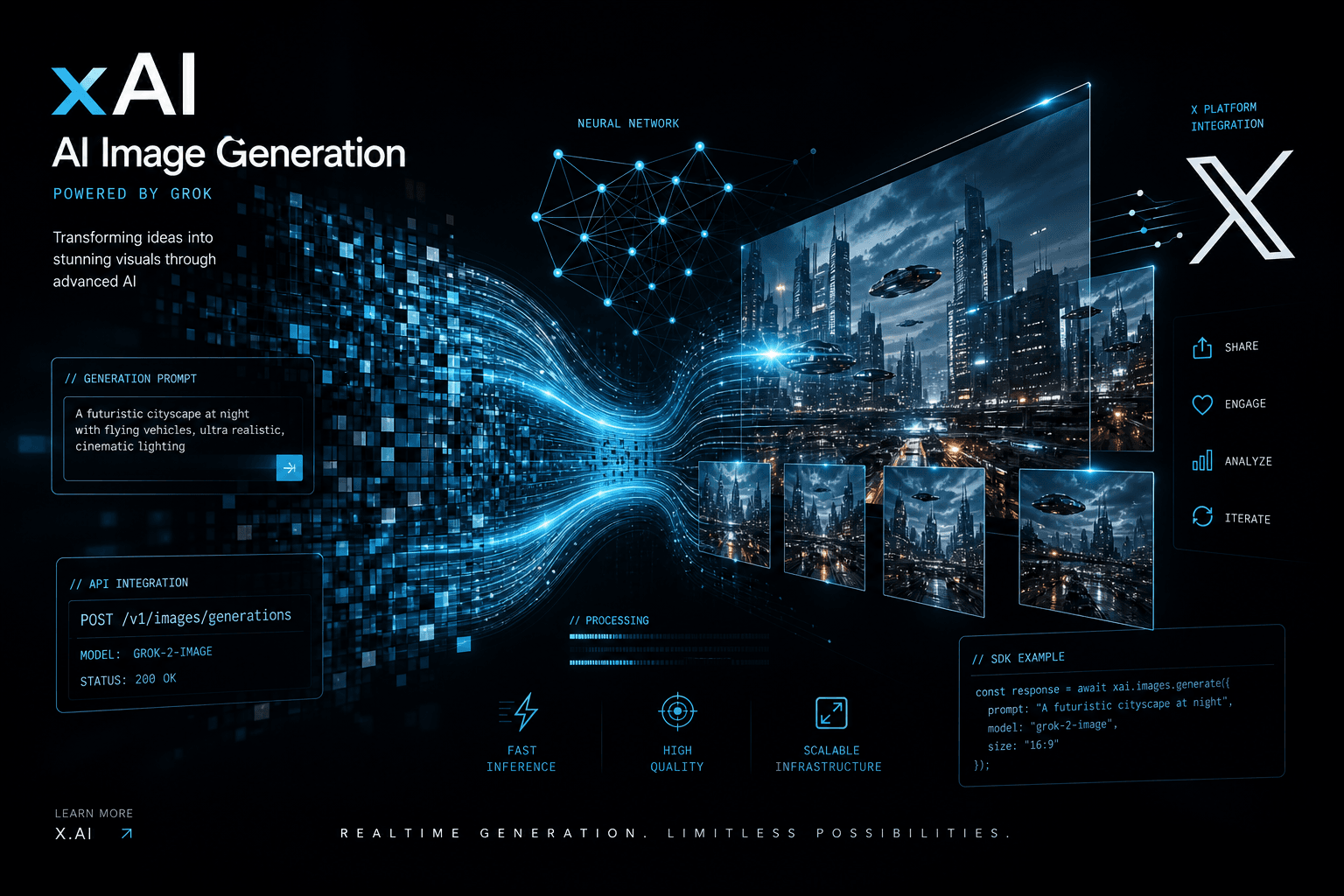
xAI is making two major moves this week that signal aggressive expansion in the AI image generation wars. The company has opened API access to Grok-2 models—including the image generation capabilities powered by Black Forest Labs' FLUX.1—and is quietly testing a free tier of Grok-2 on X (formerly Twitter) starting with users in New Zealand.
This dual release represents xAI's most significant distribution play yet. After eight months of X Premium exclusivity, Grok-2 is finally opening to developers via API and to mainstream users through a limited free tier. The timing is strategic: OpenAI has dominated the developer ecosystem with DALL-E 3, Midjourney commands the premium creative market, and open-source FLUX has been eating the middle ground. xAI needs volume—and it's willing to buy it with free credits and aggressive pricing.
Grok-2 Image Generation: What the API Delivers #
FLUX.1 Under the Hood #
xAI's image generation isn't built in-house. The company partnered with Black Forest Labs—the German startup founded by former Stability AI researchers—to integrate FLUX.1 into Grok-2's multimodal stack. Black Forest Labs emerged in August 2024 with $31 million in seed funding and a simple pitch: image quality that beats Midjourney v6.0 and DALL-E 3 on visual fidelity, prompt adherence, and text rendering.
The FLUX.1 integration gives Grok-2 several technical advantages:
- 12 billion parameter flow-based transformer architecture producing photorealistic outputs at 1024×1024 resolution
- Superior typography compared to DALL-E 3, with readable text in generated images
- Fewer safety guardrails than competitors—a deliberate design choice that has generated both praise and controversy
- Natural language prompt handling similar to ChatGPT's DALL-E 3 integration
API developers access this through xAI's console at console.x.ai, which launched its public beta this week. The API supports OpenAI and Anthropic SDK compatibility—meaning developers can switch from GPT-4o or Claude by changing a base URL and model string.
API Pricing and Rate Structure #
xAI's pricing strategy is competitive but not disruptive:
| Model | Input Tokens | Output Tokens | Image Generation |
|---|---|---|---|
| grok-beta (text) | $5 per 1M | $15 per 1M | N/A |
| grok-vision-beta | $5 per 1M | $15 per 1M | N/A |
| FLUX via Grok (estimated) | Bundled | Bundled | ~$0.035/image* |
*Based on Fal.AI FLUX Pro pricing at $0.05 per generation; xAI has not published specific image generation API pricing as of this week.
During the public beta period through December 2024, xAI is offering $25 in free API credits monthly to all developers. Users who prepaid for API access receive both their purchased credits plus the $25 monthly allocation. This effectively makes experimentation free for most developers building prototypes or handling low-volume workloads.
The pricing positions xAI slightly above OpenAI's GPT-4o ($2.50/$10 per million tokens) but below Anthropic's Claude 3.5 Sonnet ($3/$15). For image generation specifically, xAI hasn't published per-image pricing yet, though industry analysts estimate FLUX-based generation costs roughly $0.03–$0.05 per image at scale.
The Free Tier Strategy: New Zealand as Testbed #
Regional Rollout Approach #
While the API opening grabs developer headlines, the free tier rollout on X is the more significant strategic move. Starting this week, X is testing free Grok-2 access with users in New Zealand—a classic market testing strategy that leverages the country's English-speaking, tech-savvy population with limited downside from scaling failures.
The free tier isn't universally available. Access requires:
- Account age of at least 7 days
- A linked phone number for verification
- Geographic location in the test market (currently New Zealand)
Users meeting these criteria see Grok-2 appear in their X interface without a Premium subscription.
Usage Limitations and Rate Caps #
Free tier access comes with aggressive rate limiting designed to prevent abuse while encouraging upgrade conversion:
| Feature | Free Tier | Premium ($8/mo) | Premium+ ($16/mo) |
|---|---|---|---|
| Grok-2 queries | 10 per 2 hours | Unlimited | Unlimited |
| Grok-2 mini queries | 20 per 2 hours | Unlimited | Unlimited |
| Image analysis | 3 per day | Higher limits | Highest limits |
| Image generation | Included | Included | Included |
These limits are tight. Ten queries per two hours equals roughly 80 interactions per day—enough for casual exploration but insufficient for power users, researchers, or anyone building workflow dependencies around Grok. The message is clear: xAI wants free users to hit the wall and convert.
Why X Is the Distribution Channel #
The X platform integration is xAI's core competitive advantage. Grok-2 isn't a standalone product—it's embedded directly into the social media feed where hundreds of millions of users already spend time. This eliminates the friction of downloading apps, creating new accounts, or learning new interfaces.
Consider the distribution math:
- ChatGPT reaches users who seek it out actively
- Midjourney requires Discord fluency
- Grok-2 appears in the X sidebar for anyone scrolling their feed
For xAI, the X integration means zero customer acquisition cost for its free tier and minimal incremental cost for Premium conversions. Every X user who experiments with Grok-2 image generation becomes a potential API customer, a potential Premium subscriber, or at minimum—a training data contributor.
Capabilities Deep-Dive: What Grok-2 Image Generation Actually Does #
Realism and Photographic Quality #
Independent testing from LmSYS and industry reviewers shows Grok-2's FLUX-powered image generation excels at photorealism. When prompted with detailed scene descriptions—VSCO filters, Polaroid aesthetics, flash photography effects—Grok-2 produces outputs that match or exceed Midjourney v6.0 in perceived realism.
The model handles complex lighting scenarios naturally: nightclub atmospherics with harsh flash, golden hour outdoor portraits, interior scenes with mixed color temperatures. Skin textures, fabric draping, and environmental details render with fewer "AI tells" than DALL-E 3's sometimes plasticine output.
However, Grok-2's image resolution maxes at 1024×1024, below DALL-E 3's 1792×1024 widescreen option. For social media content—X's native use case—this limitation is irrelevant. For print applications or high-resolution display, it's a constraint.
Text Rendering: The FLUX Advantage #
Where Grok-2 truly distinguishes itself is text generation within images. Black Forest Labs optimized FLUX.1 specifically for typography, and the results show:
- Signage and poster text renders legibly at small sizes
- Handwriting simulation produces believable pen and marker textures
- Complex multi-line text layouts maintain coherent spacing
- Mixed fonts and styles within single compositions work reliably
DALL-E 3 handles basic text adequately but struggles with longer phrases and complex layouts. Midjourney historically avoided text entirely, though v6.0 introduced limited capabilities. Grok-2/FLUX operates at a different level—approaching Ideogram's text-first architecture while maintaining superior photorealism.
The Guardrail Gap: What Grok-2 Won't Refuse #
This is where xAI's strategy becomes controversial. Grok-2 lacks the content restrictions that OpenAI and Midjourney have implemented:
DALL-E 3 restrictions: No public figures, no political content, no copyrighted characters, no violent or sexual imagery
Midjourney restrictions: Similar prohibitions with community moderation overlays
Grok-2/FLUX restrictions: Minimal—primarily illegal content and direct impersonation
The practical impact: Grok-2 generates images of political candidates, celebrities, and copyrighted characters with minimal resistance. It renders photorealistic scenes that other systems refuse. This permissiveness has generated headlines—particularly around political deepfake potential—but it's also a genuine differentiator for creators who find competitors' guardrails overreaching.
xAI's stated philosophy is "maximal truth-seeking" with minimal censorship. The company claims this approach serves free speech principles and prevents centralized arbiters of acceptable content. Critics argue it accelerates misinformation risks and normalizes synthetic media without disclosure.
Competitive Positioning: Grok-2 vs. The Field #
Grok-2 vs. DALL-E 3 (ChatGPT) #
| Capability | Grok-2/FLUX | DALL-E 3 |
|---|---|---|
| Image quality | Superior photorealism, less "AI look" | Good, occasionally plasticky |
| Text rendering | Excellent | Adequate |
| Resolution | 1024×1024 | Up to 1792×1024 |
| Content restrictions | Minimal | Extensive |
| Integration | X platform native | ChatGPT/Standalone |
| Pricing | Free tier + Premium | ChatGPT Plus required ($20/mo) |
The choice is straightforward: creators prioritizing photorealism and permissive content generation prefer Grok-2. Users needing widescreen formats, established workflows, or corporate-safe outputs lean toward DALL-E 3.
Grok-2 vs. Midjourney v6.0 #
Midjourney remains the premium creative tool for artistic imagery. Its aesthetic tuning—film grain, color grading, compositional flair—produces gallery-worthy results that FLUX and DALL-E rarely match. However, Midjourney's Discord-based interface creates friction, and its $10–$120/month pricing excludes casual users.
Grok-2 targets a different use case: quick, frictionless image generation for social content, memes, and rapid prototyping. It won't replace Midjourney for serious artists, but it will capture the volume market of users who want "good enough" images without subscription commitment.
Grok-2 vs. FLUX Direct (Black Forest Labs API) #
Black Forest Labs launched its own API in October 2024, creating an interesting competitive dynamic with xAI. Developers now choose between:
- FLUX.1 [pro] via Black Forest Labs: $0.05/image, direct model access, full parameter control
- FLUX via Grok-2 API: Bundled pricing, conversational interface, X platform integration
- FLUX via Fal.AI: $0.035/image, fast inference, developer tooling
For pure image generation at scale, direct FLUX APIs offer better pricing and control. For multimodal applications combining text and image generation, Grok-2's unified API simplifies architecture. For X-native content workflows, Grok-2 has no alternative.
Distribution Strategy Analysis: Why This Matters #
The API Play: Capturing Developer Mindshare #
xAI's API launch follows a familiar playbook: generous free credits during beta, SDK compatibility with existing leaders, competitive pricing, and minimal friction. The $25 monthly credit allocation covers approximately 500,000–1,000,000 input tokens—enough for serious prototyping without immediate cost concerns.
The SDK compatibility is particularly clever. By supporting OpenAI and Anthropic SDK patterns, xAI minimizes migration friction. A developer running GPT-4o for image analysis can test Grok-2 vision capabilities by changing two lines of code. This "drop-in replacement" positioning accelerates experimentation and lowers the barrier to switching.
But xAI faces challenges:
- Ecosystem maturity: OpenAI has years of documentation, community resources, and established patterns
- Model breadth: GPT-4o's multimodal capabilities extend beyond images to audio and structured outputs
- Enterprise trust: Anthropic's safety reputation attracts risk-conscious organizations
The Free Tier Play: Volume and Data #
The X free tier serves multiple strategic objectives simultaneously:
- User acquisition: Converting X's 500M+ user base into Grok-2 experimenters at near-zero CAC
- Training data: Every interaction improves the RLHF (reinforcement learning from human feedback) dataset
- Competitive pressure: Forcing OpenAI, Google, and Anthropic to consider their own free offerings
- Premium conversion: Using rate limits as a natural upgrade funnel
The New Zealand test follows standard product rollout patterns: limited geography enables monitoring for abuse, performance issues, and unexpected behavior before global scale. Expect broader rollout to English-speaking markets (US, UK, Canada, Australia) within weeks if the test metrics meet targets.
The X Platform Moat #
No competitor can replicate X's distribution advantage. ChatGPT has brand recognition but requires intentional navigation. Midjourney operates in Discord's walled garden. Google's Gemini has distribution through Search and Android but lacks cultural relevance.
X combines scale (hundreds of millions of active users), cultural centrality (the platform where news breaks and discourse happens), and Elon Musk's gravitational media pull. Grok-2 doesn't need to be better than competitors—it needs to be present where users already are.
This is classic platform strategy: embed your product in high-frequency user workflows, make the default option good enough, and capture value from the users who need more.
Implications for Builders and Businesses #
For AI Developers #
The Grok-2 API opens new options for multimodal applications. The FLUX integration specifically enables:
- Social media automation: Image generation paired with text for X-native content workflows
- E-commerce prototyping: Product visualization with superior text rendering for labels and packaging
- Creative tooling: Lower-cost alternative to Midjourney for applications needing permissive content generation
- Research and analysis: Vision capabilities for image understanding at competitive pricing
The SDK compatibility means minimal technical risk in experimentation. Developers should evaluate Grok-2 against existing pipelines for cost, quality, and latency—particularly for text-heavy image generation where FLUX excels.
For Content Creators #
Free tier access removes the subscription barrier for casual creators. The rate limits force intentionality: 10 queries per 2 hours means planning image prompts rather than shotgun experimentation. For creators already on X, Grok-2 offers immediate value without new accounts or interfaces.
The permissive content policy opens creative possibilities other platforms restrict—though creators should self-police regarding disclosure and ethical use. Generating photorealistic images of real people without consent carries reputational and potential legal risks regardless of platform permissions.
For the AI Industry #
xAI's moves signal intensifying competition at every layer:
- Foundation models: Grok-2's LmSYS rankings (#3 overall, #2 in coding) demonstrate legitimate capability
- API economics: $25 free credits sets a new baseline for developer onboarding
- Distribution strategy: Platform integration beats standalone products for consumer adoption
- Content policy: Minimal restrictions create differentiation but invite regulatory scrutiny
The broader trend: AI capabilities commoditize rapidly, and distribution becomes the primary moat. OpenAI has developer mindshare. Google has Search and Android. xAI has X. Anthropic has safety reputation. The winners will combine capability with distribution better than competitors.
Technical Deep-Dive: How the Grok-2 API Works #
Authentication and Setup #
Developers access the Grok-2 API through standard HTTP authentication:
curl https://api.x.ai/v1/chat/completions \
  -H "Content-Type: application/json" \
  -H "Authorization: Bearer $XAI_API_KEY" \
  -d '{
    "model": "grok-beta",
    "messages": [
      {"role": "system", "content": "You are Grok, an AI assistant."},
      {"role": "user", "content": "Generate an image of a futuristic cityscape"}
    ]
  }'
The API supports streaming responses, function calling, and system prompts—matching OpenAI's interface patterns closely enough that existing codebases require minimal modification.
Multimodal Capabilities #
Grok-2 vision (grok-vision-beta) accepts image inputs alongside text:
{
  "model": "grok-vision-beta",
  "messages": [
    {
      "role": "user",
      "content": [
        {"type": "text", "text": "What's in this image?"},
        {"type": "image_url", "image_url": {"url": "https://example.com/image.jpg"}}
      ]
    }
  ]
}
This enables applications like visual Q&A, image captioning, document analysis, and content moderation workflows.
Image Generation Through FLUX #
While xAI hasn't published the exact API schema for image generation, the integration follows FLUX.1's architecture. Prompts undergo tokenization and adaptation to FLUX's input format, with xAI potentially applying system-level tweaks for content policy enforcement (lighter than competitors, but present).
The generation pipeline likely runs on xAI's Colossus supercomputer in Memphis— Elon Musk's claimed "most powerful AI training system in the world"—which provides the compute necessary for real-time image generation at X's scale.
Challenges and Risks #
Content Moderation at Scale #
Minimal guardrails create genuine risks. Grok-2's ability to generate photorealistic images of political figures, celebrities, and controversial scenarios accelerates misinformation potential. The timing—weeks after a contentious US election—highlights these concerns.
xAI's response to moderation challenges will test the company's "maximal truth-seeking" philosophy against practical reality. If viral misinformation campaigns exploit Grok-2's permissiveness, regulatory pressure will intensify.
Technical Reliability #
Early access reports indicate service instability. Reviewers noted that Grok-2 image generation briefly stopped working during testing—suggesting either service caps or server overload. At X's scale, reliability engineering presents serious challenges.
The free tier's aggressive rate limiting partly reflects capacity constraints. xAI may not yet have sufficient inference infrastructure to serve hundreds of millions of X users generating images simultaneously.
Competitive Response #
OpenAI, Google, and Anthropic won't ignore xAI's moves. Potential responses include:
- OpenAI expanding DALL-E 3 free access or lowering ChatGPT Plus pricing
- Google integrating Imagen 3 more aggressively into Search and Workspace
- Anthropic launching Claude vision capabilities with its characteristic safety emphasis
xAI's first-mover advantage in X integration is defensible, but API and standalone product competition will intensify.
The Verdict: Signal or Noise? #
xAI's Grok-2 API and free tier launch is legitimate signal—not hype. The technical capabilities are real: LmSYS rankings confirm Grok-2's competitive position, and FLUX.1 integration delivers genuine quality advantages. The distribution strategy is smart: X platform embedding creates unmatched user acquisition efficiency.
For builders, this expands the tool landscape meaningfully. Grok-2's API offers viable alternatives for multimodal applications, particularly where text rendering and permissive content generation matter. The free tier on X democratizes access for casual users while creating natural upgrade pathways.
For the industry, this accelerates competitive pressure. OpenAI's developer dominance faces genuine challenge. The "maximal truth-seeking" content policy—however controversial—creates differentiation in a market where competitors converged on similar safety restrictions.
The long-term question: Can xAI convert distribution advantage into sustainable value? X's user base provides volume, but converting free tier users to Premium subscribers and API customers requires product quality that keeps users engaged after the novelty fades.
Grok-2 is increasingly credible as a product. Whether it becomes dominant depends on execution reliability, ecosystem development, and whether the permissive content strategy attracts more users than it repels.
Frequently Asked Questions #
What is Grok-2's image generation API? #
Grok-2's image generation API allows developers to generate photorealistic images programmatically using the FLUX.1 model developed by Black Forest Labs. The API launched in public beta in November 2024 alongside xAI's broader developer platform, offering $25 in free monthly credits during the beta period. Developers can access it through console.x.ai using OpenAI-compatible SDKs.
How does Grok-2 image generation compare to DALL-E 3? #
Grok-2 produces more photorealistic images with superior text rendering compared to DALL-E 3, though at lower maximum resolution (1024×1024 vs. 1792×1024). The FLUX.1 model powering Grok-2 excels at realistic photography, lighting, and typography while having significantly fewer content restrictions than OpenAI's heavily moderated system.
Is Grok-2 free on X? #
Grok-2 is currently being tested as a free service for select X users in New Zealand, with rate limits of 10 queries per 2 hours for the full model and 20 queries per 2 hours for Grok-2 mini. The free tier requires accounts to be at least 7 days old with linked phone numbers. X Premium ($8/month) and Premium+ ($16/month) subscribers continue to have unlimited access globally.
What is the pricing for xAI's Grok-2 API? #
xAI charges $5 per million input tokens and $15 per million output tokens for text models, with $25 in free credits monthly during the public beta through December 2024. Specific image generation pricing hasn't been published, though industry estimates suggest approximately $0.03–$0.05 per image based on comparable FLUX.1 API pricing from Black Forest Labs and Fal.AI.
How does Grok-2 handle content restrictions compared to Midjourney? #
Grok-2 has significantly fewer content restrictions than Midjourney, allowing generation of political figures, celebrities, and copyrighted characters that competitors prohibit. This "minimal guardrail" approach aligns with xAI's "maximal truth-seeking" philosophy but has generated controversy around potential misinformation and deepfake creation.
What is FLUX.1 and how does it relate to Grok-2? #
FLUX.1 is Black Forest Labs' 12-billion-parameter image generation model that powers Grok-2's visual capabilities. Founded by former Stability AI researchers, Black Forest Labs released FLUX.1 in August 2024 with benchmarks showing superior performance to Midjourney v6.0 and DALL-E 3 on visual quality, prompt adherence, and typography. xAI partnered with Black Forest Labs rather than building image generation in-house.
Can developers use Grok-2 for commercial applications? #
Yes, xAI's API terms permit commercial use of Grok-2 outputs, though developers should verify current terms of service at x.ai as policies may evolve. The API's SDK compatibility with OpenAI and Anthropic patterns makes it straightforward to integrate into existing commercial products, particularly for multimodal applications combining text and image generation.
What are the rate limits for Grok-2 API? #
Specific rate limits vary by account tier, with new developers receiving $25 monthly credits sufficient for approximately 500,000–1,000,000 input tokens during the beta period. Production workloads will require prepaid credit arrangements. The free tier on X has stricter limits: 10 Grok-2 queries or 20 Grok-2 mini queries per 2-hour window, plus 3 image analyses per day.
How does xAI's API compare to OpenAI's for image generation? #
xAI's API offers competitive pricing and SDK compatibility but a narrower feature set compared to OpenAI's comprehensive platform. While OpenAI provides DALL-E 3, GPT-4o vision, audio capabilities, and extensive ecosystem tools, xAI currently focuses on text and image generation. The $25 free monthly credits exceed OpenAI's typical trial allocations, making xAI attractive for experimentation and cost-sensitive applications.
Will Grok-2's free tier expand beyond New Zealand? #
xAI hasn't announced specific timelines, but industry patterns suggest gradual expansion to English-speaking markets (US, UK, Canada, Australia) if the New Zealand test succeeds. The limited rollout enables monitoring for abuse, performance validation, and capacity planning before serving X's full 500+ million user base.
Closing: Building in the Multimodal Era #
xAI's Grok-2 image generation API and free tier expansion mark another milestone in AI's rapid capability deployment. For builders, the message is clear: multimodal AI is now table stakes, and competitive options exist beyond the OpenAI ecosystem.
The strategic insight isn't just about Grok-2's specific capabilities—it's about distribution architecture. xAI's X platform integration creates user access patterns that standalone products can't replicate. Whether you're building consumer applications, developer tools, or enterprise workflows, understanding how AI capabilities embed into existing platforms matters as much as raw model quality.
If you're exploring AI integration for your business—whether that's automating content workflows, building multimodal applications, or developing custom AI agents—I'd be happy to discuss how these capabilities fit your specific use case. Book an AI automation strategy call and we'll map the landscape to your requirements.
Related reading:
Related Posts

Google I/O 2026 Action List: How I Prompted Gemini 3.5 Flash and Antigravity Workflows
Google I/O 2026 just reset the AI tooling landscape. Here's the 9-action checklist for builders who want to ship this week, not just watch the keynote.
Anthropic vs. OpenAI vs. Google: The State of the Frontier in May 2026
A head-to-head breakdown of the three AI giants in May 2026: Claude Opus 4.6, GPT-5.3 and 5.4, Gemini 3.1 Pro. Real specs, real pricing, and what actually matters for builders.
Kimi K2 Open Weights: How I Prompted Moonshot's Frontier Model for Agentic Tool Use
How I direct Kimi K2 by Moonshot AI for agentic workflows, long-context tool calling, and workflow automation. A 1 trillion parameter MoE model with competitive benchmarks at 5-17x lower cost than GPT-5 and Claude.