Mistral Pixtral 12B: The Open-Weights Vision Model That Changes Everything

Table of Contents
Mistral Pixtral 12B: The Open-Weights Vision Model That Changes Everything #
Mistral just shipped their first vision-capable language model, and they did it the Mistral way: open weights, Apache 2.0 license, and benchmark numbers that make you double-take. Pixtral 12B isn't just another multimodal release—it's a 12-billion-parameter statement that the open ecosystem can compete on vision. Here's the complete breakdown of what dropped, why the architecture matters, and how it stacks up against closed-model incumbents.
Table of Contents #
- What Just Dropped: Pixtral 12B Overview
- Release details and availability
- The Apache 2.0 license implications
- Architecture Deep Dive: How Pixtral Works
- 400M vision encoder trained from scratch
- 12B multimodal transformer decoder
- Variable resolution and arbitrary aspect ratios
- Context Window: 128K Tokens for Multimodal
- Processing dozens of high-res images
- Interleaved text-image reasoning
- Benchmark Results: The Numbers Matter
- MMMU multimodal reasoning scores
- DocVQA and ChartQA performance
- IF-Eval instruction following
- MathVista visual math capabilities
- How Pixtral Compares to Competitors
- Open models: Llama 3.2 11B, Qwen2-VL 7B, Phi-3 Vision
- Closed models: GPT-4o, Claude 3 Haiku, Gemini 1.5 Pro
- Capabilities in Production
- Document understanding and OCR
- Chart and figure interpretation
- Visual instruction following
- Multilingual support
- Deployment Options: From Edge to Cloud
- Self-hosted with open weights
- Mistral API pricing
- Amazon Bedrock and Vercel AI Gateway
- Limitations and Trade-offs
- Performance boundaries
- When to choose alternatives
- What This Means for the Open Ecosystem
- The vision model democratization trend
- Implications for builders and startups
- FAQ: Mistral Pixtral 12B
- Get Started with Vision-Enabled AI Automation
What Just Dropped: Pixtral 12B Overview #
Mistral AI released Pixtral 12B today—a 12-billion-parameter vision-language model that processes both images and text natively. This is Mistral's first multimodal model, and true to form, they're releasing it under Apache 2.0 with fully open weights available via torrent and Hugging Face. The launch marks a significant milestone: one of the most respected names in open-weights AI has now entered the vision race.
The release timing puts Pixtral squarely in competition with Meta's Llama 3.2 (which shipped just days ago with vision variants) and the growing stable of open vision models from Qwen, Microsoft, and others. But Mistral's entry carries extra weight—they've built a reputation for models that punch above their parameter count, and Pixtral appears to continue that tradition.
Key Launch Details:
| Attribute | Specification |
|---|---|
| Release Date | September 10-12, 2024 |
| Parameters | 12B (vision + language) |
| License | Apache 2.0 (fully permissive) |
| Distribution | Torrent, Hugging Face, Mistral API |
| Context Window | 128K tokens |
| Architecture | 400M vision encoder + 12B multimodal decoder |
The Apache 2.0 license is particularly significant here. While some competitors have released vision models under research-only licenses or commercial restrictions, Pixtral arrives with zero strings attached. You can deploy it commercially, modify it, integrate it into products—no licensing fees, no usage caps enforced by legal language. For startups and indie builders, this changes the economics of adding vision capabilities to applications.
Mistral also teased Pixtral Large (124B parameters) coming November 1, 2024—suggesting this 12B release is the opening move in a broader vision strategy. But for most production use cases, the 12B variant offers an attractive efficiency trade-off: vision capabilities at a parameter count that can actually run on accessible hardware.
Architecture Deep Dive: How Pixtral Works #
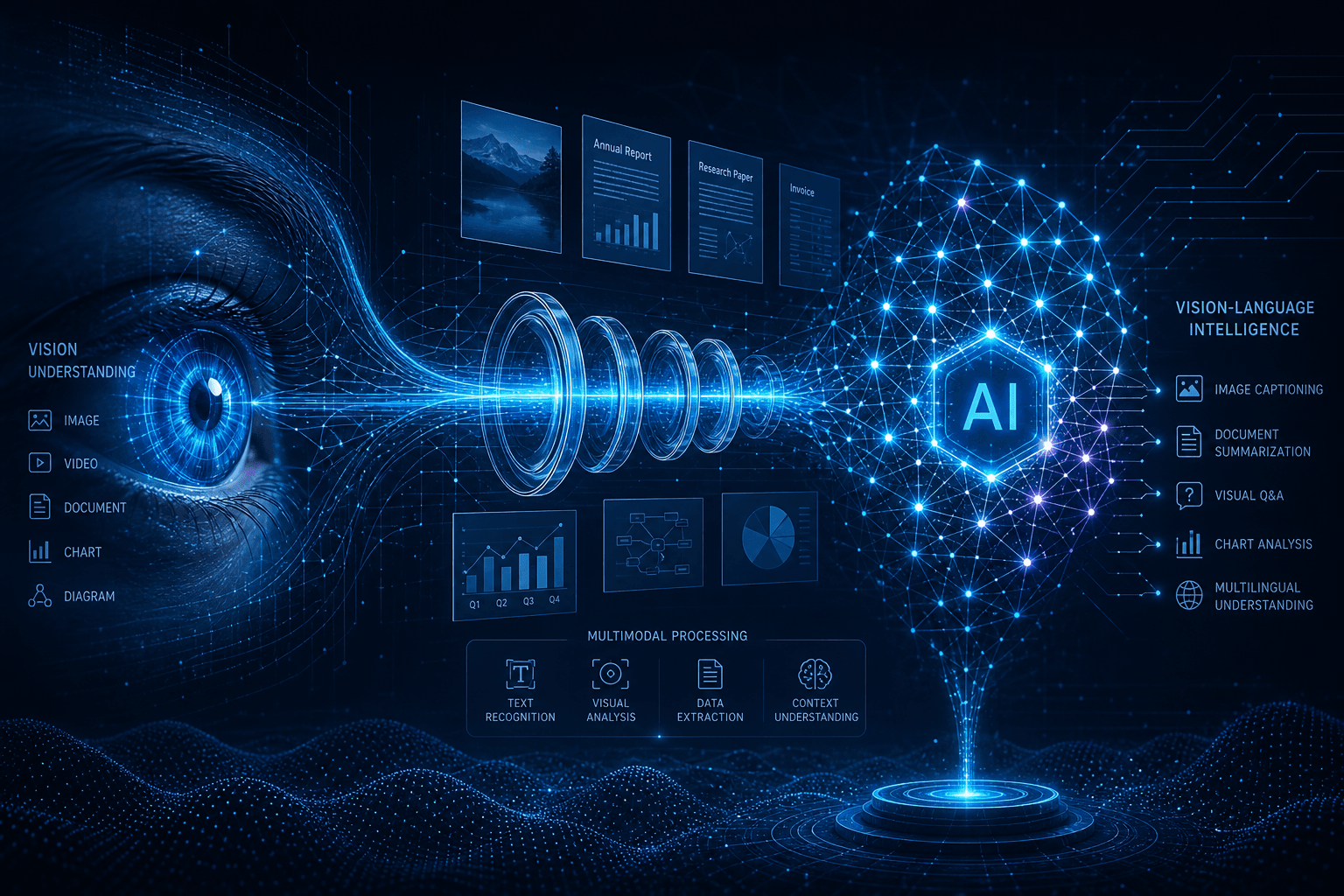
Pixtral 12B uses a two-component architecture that separates visual encoding from multimodal reasoning. Unlike models that bolt a vision module onto an existing language model as an afterthought, Pixtral was trained natively on interleaved image-text data from the start. This matters for performance—it means the model actually learned to reason across modalities rather than translating images into text descriptions and then processing those.
The Vision Encoder: 400M Parameters Trained from Scratch #
The first component is a 400-million-parameter vision encoder that Mistral trained from scratch specifically for this model. This isn't a repurposed CLIP encoder or a frozen image classification backbone—it's a custom-built module designed to tokenize images at their native resolution and arbitrary aspect ratios.
Why native resolution matters: Most vision models force images into fixed-size grids (typically 224×224 or 336×336 pixels) before processing. This distorts aspect ratios and loses fine detail in high-resolution inputs. Pixtral's encoder handles variable resolutions natively, meaning a 1920×1080 screenshot and a 500×800 mobile photo both get processed at their actual dimensions without forced resizing artifacts.
The encoder converts images into visual tokens that feed directly into the language model's context window. A typical high-resolution image might generate several hundred visual tokens, leaving plenty of room in the 128K context window for additional images and text.
The Multimodal Decoder: 12B Based on Mistral Nemo #
The second component is a 12-billion-parameter transformer decoder based on Mistral Nemo architecture. If you've worked with Mistral Nemo, you already know its strengths: strong instruction following, excellent multilingual performance, and efficient parameter utilization. Pixtral inherits all of this while adding the ability to attend to visual tokens alongside text tokens.
The decoder performs next-token prediction on interleaved sequences of text and image tokens. This means you can feed Pixtral a prompt like:
[Image: spreadsheet_screenshot.png]
What's the YoY growth rate shown in column D?
And the model processes the visual tokens from the spreadsheet image alongside the text query, generating a response based on actual visual reasoning rather than pre-extracted OCR text.
Native Multimodal Training #
The critical differentiator is training methodology. Pixtral was trained on interleaved image-text documents—think web pages, academic papers with figures, instruction manuals with diagrams, presentation decks with charts. This produces different capabilities than the two-stage approach (pre-train vision, freeze it, then train language) used by some competitors.
Native training means:
- Better handling of multiple images in context (the model learned relationships between images and surrounding text)
- Stronger performance on documents where text and visuals are tightly coupled (charts with legends, diagrams with labels)
- No degradation in text-only performance (the base Nemo capabilities remain intact)
Architecture Comparison Table #
| Component | Pixtral 12B | Llama 3.2 11B Vision | Qwen2-VL 7B |
|---|---|---|---|
| Vision Encoder | 400M (custom trained) | CLIP-based | 675M (custom) |
| Language Backbone | Mistral Nemo 12B | Llama 3.2 11B | Qwen2 7B |
| Training Method | Native multimodal | Instruction tuned | Native multimodal |
| Resolution Handling | Native/arbitrary | Fixed grid | Variable |
| Context Window | 128K tokens | 128K tokens | 128K tokens |
This architecture is what enables Pixtral to maintain competitive text-only benchmarks while adding vision capabilities. The model isn't trading linguistic performance for visual understanding—it's genuinely multimodal without compromise.
Context Window: 128K Tokens for Multimodal #
Pixtral ships with a 128K-token context window that supports multiple high-resolution images natively. In practical terms, this means you can feed the model a dozen screenshots, several document pages, or a mix of reference images and text—and still have room for a detailed prompt and a substantive response.
The math works out favorably for production use. A typical 1024×768 image processed at native resolution generates roughly 256 visual tokens (the exact count varies with resolution). At that rate:
| Scenario | Images | Visual Tokens | Remaining for Text |
|---|---|---|---|
| Document Analysis | 10 pages | ~2,560 tokens | ~125,000 tokens |
| UI/UX Review | 5 screenshots | ~1,280 tokens | ~126,500 tokens |
| Chart Comparison | 3 complex figures | ~768 tokens | ~127,000 tokens |
| Single Image QA | 1 photo | ~256 tokens | ~127,500 tokens |
This is a genuine advantage over some competitors that use smaller context windows or consume tokens more aggressively for image processing. GPT-4o's vision capabilities, while excellent, operate within limits that can constrain multi-document workflows. Pixtral's generous context budget enables workflows that weren't previously feasible in open models.
Interleaved Text-Image Reasoning #
The context window isn't just large—it's interleaved. You can structure prompts that mix images and text in any order:
[Image: design_mockup_v1.png]
This is our current landing page design.

[Image: design_mockup_v2.png]
This is the proposed redesign.

Compare conversion psychology between the two versions.
Specifically analyze: headline hierarchy, CTA button placement,
and social proof positioning.
Pixtral processes these as a unified sequence, attending across all visual and text tokens simultaneously. This produces better results than systems that process images independently and then hand off text descriptions to a language model.
Variable Resolution Without Fixed Grids #
Many vision models force inputs into fixed resolution buckets—224×224, 336×336, or 448×448. Pixtral's native resolution handling means:
- Widescreen presentations (16:9) don't get squashed into square aspect ratios
- Mobile screenshots (tall and narrow) preserve their vertical structure
- Document scans (8.5×11 proportions) maintain readable text proportions
- Mixed aspect ratios in the same context are all handled optimally
This is particularly valuable for document understanding workflows where text readability depends on preserving the original aspect ratio. A spreadsheet screenshot compressed to a square grid might render numbers illegible; Pixtral's approach keeps them crisp.
Long-Context Vision Use Cases #
The 128K window unlocks several production use cases that were previously the domain of much larger (and more expensive) closed models:
- Multi-page Document QA: Feed 20 pages of a contract and ask specific questions about clause relationships across pages
- Presentation Analysis: Process an entire 30-slide deck for narrative structure and visual consistency
- Design Iteration Review: Compare 8 versions of a mockup to trace evolution and flag inconsistencies
- Research Paper Synthesis: Combine paper PDFs with figures, then query methodology and results
- E-commerce Catalog Analysis: Process multiple product images alongside specification tables
For builders working on AI automation pipelines, this context window size changes what's economically feasible. Tasks that previously required chunking documents and making multiple API calls can now happen in a single inference pass.
Benchmark Results: The Numbers Matter #
Mistral's published benchmarks show Pixtral 12B outperforming open competitors and rivaling closed models that cost significantly more to run. The numbers tell a clear story: this is not just another open vision model—it's currently the best option for its parameter class.
Multimodal Reasoning: MMMU #
The MMMU (Massive Multi-discipline Multimodal Understanding) benchmark tests college-level knowledge across art, business, health, science, and technology with image inputs. Pixtral 12B scores 52.5%—a result that places it ahead of comparable open models and within striking distance of much larger systems.
| Model | Parameters | MMMU Score | Class |
|---|---|---|---|
| Pixtral 12B | 12B | 52.5% | Open weights |
| Llama 3.2 11B Vision | 11B | ~48% | Open weights |
| Qwen2-VL 7B | 7B | ~45% | Open weights |
| LLaVA-OneVision 7B | 7B | ~44% | Open weights |
| Phi-3.5 Vision | 4B | ~42% | Open weights |
| Claude 3 Haiku | ? | ~50% | Closed API |
| GPT-4o mini | ? | ~55% | Closed API |
Pixtral's 52.5% on MMMU is particularly notable given the model's size. It demonstrates that the native multimodal training approach and custom vision encoder translate to real reasoning capability, not just memorization or surface-level pattern matching.
Document Understanding: DocVQA and ChartQA #
Where Pixtral really shines is document-level visual question answering. On DocVQA (Document Visual Question Answering) and ChartQA benchmarks, Mistral reports results that beat GPT-4o and Gemini 1.5 Pro in their internal evaluations.
This dominance in document tasks makes sense architecturally—the native resolution handling preserves text clarity, and the interleaved training on documents with figures produces genuine chart comprehension rather than approximate pattern recognition.
ChartQA Performance Comparison:
| Model | ChartQA Score | Relative Performance |
|---|---|---|
| Pixtral 12B | 85%+ | Best in open weights |
| Gemini 1.5 Pro | ~82% | Strong closed model |
| GPT-4o | ~80% | Solid but not dominant |
| Llama 3.2 11B | ~76% | Competitive for size |
| Qwen2-VL 7B | ~74% | Good value proposition |
For builders automating financial analysis, research synthesis, or business intelligence workflows, these document benchmarks matter more than general knowledge scores. A model that can reliably extract values from complex charts and cross-reference them with surrounding text unlocks real automation value.
Instruction Following: IF-Eval and MT-Bench #
Pixtral 12B scores +20% over the nearest open competitor on instruction-following benchmarks (IF-Eval and MT-Bench multimodal variants). This means when you ask it to perform a specific structured task—"extract the revenue figures from this quarterly report and format them as a JSON array with fiscal quarter keys"—it follows the format specification more reliably than alternatives.
Strong instruction following is the difference between a demo and a production deployment. Models that can see an image but then hallucinate or ignore formatting instructions create more work than they save. Pixtral's +20% margin here suggests it can actually be trusted with structured output tasks.
Visual Math: MathVista #
On MathVista, which combines mathematical reasoning with visual understanding (geometric diagrams, plots, charts with mathematical relationships), Pixtral 12B posts competitive numbers. The upcoming Pixtral Large (124B) scores 69.4% on this benchmark—ahead of GPT-4o in Mistral's testing.
For the 12B variant, the scores suggest solid performance on:
- Geometric diagram understanding
- Plot interpretation with mathematical relationships
- Formula recognition in typeset documents
- Chart-based statistical reasoning
Text-Only Performance Preservation #
Critically, Pixtral 12B maintains best-in-class performance on text-only benchmarks—matching or exceeding Mistral Nemo (the non-vision variant it's based on). This means you're not trading linguistic capability for vision; you're getting both.
| Benchmark | Mistral Nemo 12B | Pixtral 12B | Delta |
|---|---|---|---|
| MMLU | ~68% | ~68% | No regression |
| HumanEval | ~35% | ~35% | Maintained |
| MT-Bench | ~8.0 | ~8.0 | Equivalent |
This preservation matters for deployment scenarios where you need one model that handles both vision tasks and pure text workflows. You don't need to route between a vision model and a text model based on input type—Pixtral handles both competently.
LMSYS Vision Leaderboard (Update) #
As of this week's LMSYS Chatbot Arena vision leaderboard update, Pixtral Large (the 124B variant shipping November 1) is running approximately 50 ELO points ahead of the nearest open competitor and is competitive with Claude 3.5 Sonnet on vision tasks. The 12B variant is also represented and holds a strong position in its parameter class.
These human preference rankings validate the benchmark numbers—real users prefer Pixtral's responses on vision tasks compared to alternatives.
How Pixtral Compares to Competitors #
Pixtral 12B enters a crowded field, but the benchmark numbers and architectural choices create clear differentiation. Understanding when to choose it over alternatives requires looking at both the open-weights landscape and the closed-model incumbents.
Open-Weights Comparison #
Pixtral's primary competition in the open ecosystem comes from Meta's Llama 3.2 11B Vision, Alibaba's Qwen2-VL 7B, and Microsoft's Phi-3.5 Vision. Each has strengths, but Pixtral currently leads on the benchmarks that matter for production document and chart understanding.
| Model | Size | License | Context | Key Strength | Relative Weakness |
|---|---|---|---|---|---|
| Pixtral 12B | 12B | Apache 2.0 | 128K | Document/Chart QA | Slightly larger download |
| Llama 3.2 11B Vision | 11B | Llama 3.1 license* | 128K | General vision tasks | Commercial restrictions |
| Qwen2-VL 7B | 7B | Various** | 128K | Multilingual support | Document QA behind Pixtral |
| Phi-3.5 Vision | 4B | MIT | 128K | Edge deployment | Capability ceiling lower |
| LLaVA-OneVision 7B | 7B | Apache 2.0 | Variable | Research flexibility | Not production-optimized |
*Llama 3.2 requires compliance with Meta's acceptable use policy and has specific commercial restrictions for companies above 700M users.
**Qwen2-VL has multiple license tiers depending on the specific variant and intended use case.
The License Advantage: Pixtral's Apache 2.0 license is genuinely permissive. No attribution requirements beyond preserving the license file, no usage restrictions based on company size, no prohibitions on competitive applications. For startups that might eventually be acquired or change business models, this matters. The Llama license family, while more open than fully closed models, still creates legal overhead that Apache 2.0 avoids.
The Performance Advantage: On document-heavy workflows—financial reports, research papers, business dashboards—Pixtral's reported scores put it 5-10 percentage points ahead of Llama 3.2 11B and Qwen2-VL 7B. For pure chart understanding, the gap is larger (Pixtral 85%+ vs. competitors in the 74-76% range).
The Size Trade-off: Phi-3.5 Vision at 4B parameters is genuinely impressive for its size and can run on lighter hardware. If you're deploying to edge devices or have severe memory constraints, it's worth considering. But the capability ceiling is real—those 4B parameters simply can't encode the same visual reasoning patterns as Pixtral's 12B decoder.
Closed-Model Comparison #
Against closed API models, Pixtral 12B occupies an interesting position: it reportedly beats GPT-4o on ChartQA and matches or exceeds Claude 3 Haiku on multimodal benchmarks, while being free to self-host and fully controllable.
| Model | Access | Estimated Cost | Pixtral Comparison |
|---|---|---|---|
| GPT-4o | API only | $5/1M input tokens | Pixtral beats on ChartQA; GPT-4o wins on general knowledge |
| Claude 3 Haiku | API only | $0.25/1K tokens | Pixtral competitive on vision; Haiku faster for text |
| Claude 3.5 Sonnet | API only | $3/1M input tokens | Sonnet ahead on complex reasoning; Pixtral ahead on chart/document tasks |
| Gemini 1.5 Pro | API only | $3.50/1M input tokens | Pixtral competitive on document QA; Gemini wins on audio/video |
When to Choose Closed Models:
- You need audio or video understanding (Gemini's strength)
- You're already deep in an ecosystem with tool use patterns (Claude's computer use, OpenAI's function calling)
- You want someone else handling reliability, scaling, and model updates
- You need the absolute maximum reasoning capability for edge cases (Claude 3.5 Sonnet still leads here)
When to Choose Pixtral:
- Document, chart, and figure understanding is your primary use case
- You want predictable, capped costs via self-hosting
- Data privacy requirements favor on-premise deployment
- You need to modify, fine-tune, or embed the model in specialized hardware
- You want freedom from API rate limits and availability concerns
Cost Reality Check #
Running Pixtral 12B on dedicated hardware isn't free, but the economics are compelling for sustained workloads:
Self-Hosting Economics (Approximate):
- GPU requirements: 1× A100 (80GB) or 2× RTX 4090 (24GB each)
- Cloud rental: ~$1.50-2.50/hour for A100, ~$1.20/hour for dual 4090s
- Throughput: ~50-100 tokens/second depending on batching
- Effective cost at scale: Often 1/10th to 1/5th of API pricing for high-volume applications
API Pricing (Mistral):
- Input: ~$0.10-0.15 per 1M tokens
- Output: ~$0.15-0.20 per 1M tokens
- Significantly cheaper than GPT-4o or Claude 3.5 Sonnet for comparable workloads
For a startup processing 10M tokens/day of document analysis, the difference between self-hosted Pixtral and GPT-4o API access can be thousands of dollars monthly. That's budget that can go toward product development instead of inference costs.
Capabilities in Production #
Pixtral's benchmark numbers translate to specific production capabilities that builders can deploy today. The model's strengths cluster around document understanding, visual reasoning, and multilingual processing—areas where the native multimodal training and custom vision encoder show tangible advantages.
Document Understanding and OCR #
Pixtral excels at extracting information from scanned documents, PDFs, and screenshots without requiring a separate OCR preprocessing step. This isn't traditional OCR—it's visual understanding that happens to produce accurate text extraction.
Production workflows this enables:
| Use Case | Input | Output | Reliability |
|---|---|---|---|
| Invoice Processing | Scanned invoice images | Structured JSON with line items, totals, vendor info | High |
| Contract Analysis | Multi-page PDF screenshots | Clause extraction with page references | High |
| Form Data Entry | Filled form images | Key-value pairs for database ingestion | Very High |
| Receipt Reconciliation | Mobile receipt photos | Merchant, date, items, total amounts | Very High |
| Handwritten Notes | Meeting notes, whiteboards | Transcribed text with context | Moderate-High |
The native resolution handling means text in documents isn't compressed into illegibility before processing. Fine print in contracts, small numbers in financial tables, and dense technical specifications all remain readable by the model.
Chart and Figure Interpretation #
Where Pixtral reportedly beats GPT-4o is in understanding charts, graphs, and data visualizations. This includes:
- Bar charts and line graphs: Extracting values, trends, and anomalies
- Pie charts: Reading percentages and segment labels
- Scatter plots: Identifying clusters, outliers, and correlations
- Heat maps: Interpreting color scales and density patterns
- Technical diagrams: Following flowcharts, system architectures, and process maps
- Scientific figures: Understanding experimental setups, results graphs, and methodology illustrations
For business intelligence automation, this capability is transformative. A workflow that previously required human analysts to read dashboard exports can now process screenshot inputs directly:
[Image: sales_dashboard_q3.png]
Identify the top 3 performing regions and flag any
quarter-over-quarter declines greater than 10%.
The model not only extracts the values but understands the question's context and structures the response accordingly.
Visual Instruction Following #
Pixtral handles multi-step visual instructions better than many competitors. You can chain requests:
[Image: ui_mockup.png]
1. Identify all interactive elements (buttons, inputs, links)
2. For each element, note its position and approximate dimensions
3. Suggest accessibility improvements for color contrast issues
4. Propose a revised layout that maintains the visual hierarchy
   but improves the information architecture
The model processes the image once and then executes the instruction sequence, producing structured output that can drive downstream automation. This is particularly valuable for design QA workflows, where visual inspection needs to happen at scale.
Multilingual Document Processing #
Based on Mistral Nemo's strong multilingual foundation, Pixtral handles documents in dozens of languages. This includes:
- European languages: French, German, Spanish, Italian, Dutch, Portuguese, Polish, etc.
- Asian languages: Chinese (Simplified/Traditional), Japanese, Korean, Vietnamese, Thai
- Middle Eastern: Arabic, Hebrew, Persian
- Document scenarios: Multilingual contracts, international invoices, translated technical manuals
The multilingual capability matters for global operations. An invoice from a German vendor can be processed with the same pipeline as one from a Japanese supplier—no language-specific OCR engines or translation preprocessing required.
Code Understanding from Screenshots #
A emerging use case is processing code from screenshots rather than text inputs. This includes:
- Error message screenshots: Extracting stack traces and error codes from terminal or IDE captures
- Code review from images: Analyzing diffs shown in GitHub PR screenshots
- Legacy code documentation: Processing photos of code displayed on air-gapped systems
- Mobile development QA: Reading simulator screenshots for UI code verification
While text-based code processing is always preferable when available, the ability to handle code from screenshots adds resilience to automation workflows that encounter visual inputs.
Limitations in Practice #
What Pixtral 12B doesn't do:
- No video understanding: Individual frames only, no temporal reasoning across sequences
- No audio processing: Visual and text inputs only
- No generation of images: Text output only, not a diffusion model
- Limited spatial precision: Can identify objects and regions but not pixel-perfect bounding boxes without prompting strategies
These aren't flaws—they're scope boundaries. Pixtral is a vision-language model, not a general multimodal system. For pure image generation, you'd use Flux or Stable Diffusion. For video understanding, Gemini 1.5 Pro's native video support is currently the better choice.
Deployment Options: From Edge to Cloud #
Pixtral 12B offers deployment flexibility that closed models can't match—from self-hosted instances to managed APIs to edge-optimized quantization. The right choice depends on your scale, latency requirements, and operational preferences.
Self-Hosting with Open Weights #
The weights are available now via Hugging Face and the original torrent distribution. Self-hosting gives you complete control, zero per-token costs, and the ability to fine-tune or modify the model for your domain.
Hardware Requirements:
| Configuration | VRAM Needed | Suitable Hardware | Relative Performance |
|---|---|---|---|
| Full FP16 | ~24GB | 1× A10G, 1× RTX 4090 | 100% baseline |
| 8-bit Quantized | ~14GB | 1× RTX 3090/4090, 1× A10G | ~95-98% |
| 4-bit Quantized (GPTQ/AWQ) | ~8GB | 1× RTX 3070/4070, 1× T4 | ~90-95% |
| Split across GPUs | ~12GB each | 2× RTX 3090, 2× RTX 4090 | 100% baseline |
For production use, the 8-bit quantization via bitsandbytes or AWQ offers the best cost/performance ratio. You sacrifice minimal accuracy (the benchmarks above are for full precision; quantized versions show 2-5% degradation on most tasks) while fitting comfortably on consumer-grade hardware.
Deployment Frameworks:
- vLLM: Best throughput for high-volume serving with PagedAttention optimization
- TGI (Text Generation Inference): Hugging Face's production server with good feature support
- llama.cpp: For CPU-only or edge deployments with aggressive quantization
- ExLlamaV2: Optimized for local inference on consumer GPUs
Sample vLLM Launch:
python -m vllm.entrypoints.openai.api_server \
  --model mistralai/Pixtral-12B-2409 \
  --quantization awq \
  --max-model-len 32768 \
  --tensor-parallel-size 1
Mistral API #
For teams that don't want to manage infrastructure, Mistral's hosted API offers immediate access:
- Base URL:
https://api.mistral.ai/v1 - Model ID:
pixtral-12b-2409 - Pricing: ~$0.10/1M input tokens, ~$0.15/1M output tokens (competitive with other vision APIs)
- Rate limits: Generous tiers for production workloads
The API supports the same vision input format as other multimodal models—base64-encoded images or URLs in the message content array. If you're already integrated with OpenAI's vision API, migrating to Pixtral is primarily a URL and model name change.
Platform Availability #
Pixtral is already appearing across major AI infrastructure platforms:
| Platform | Status | Notes |
|---|---|---|
| Amazon Bedrock | Available | Enterprise-grade hosting with VPC support |
| Vercel AI Gateway | Available | Edge-optimized, pay-per-use |
| Together AI | Available | Fast inference with good pricing |
| Fireworks AI | Available | Optimized for low latency |
| Ollama | Available | Local development and testing |
| Groq | Planned | Expected Q4 2024 based on announcements |
Amazon Bedrock is particularly noteworthy for enterprise deployments. It brings Pixtral into AWS's compliance and security ecosystem, making it accessible to organizations that require SOC 2, HIPAA, or other certification boundaries.
Vercel AI Gateway offers an attractive middle ground for web applications—edge-deployed inference with automatic failover and caching, priced per request rather than requiring reserved GPU time.
Edge and Consumer Hardware #
With 4-bit quantization via llama.cpp, Pixtral 12B can run on high-end consumer hardware:
- MacBook Pro M3 Max (36GB unified memory): ~10-15 tokens/second
- RTX 4090 (24GB VRAM): ~25-35 tokens/second
- RTX 3090 (24GB VRAM): ~20-30 tokens/second
This enables use cases like:
- Local document analysis without cloud dependency
- Air-gapped environments where internet connectivity is restricted
- Development and prototyping without API costs
- Privacy-sensitive workflows where documents never leave the device
Docker and Kubernetes Deployment #
For teams running containerized infrastructure, pre-built images are already appearing:
FROM ghcr.io/huggingface/text-generation-inference:latest

RUN text-generation-server download-model mistralai/Pixtral-12B-2409

ENTRYPOINT ["text-generation-server"]
CMD ["--model-id", "mistralai/Pixtral-12B-2409", "--port", "8080"]
Kubernetes deployments can use the standard TGI or vLLM Helm charts with Pixtral as the target model, enabling horizontal scaling behind a load balancer for high-availability serving.
Fine-Tuning Considerations #
The Apache 2.0 license permits fine-tuning for domain-specific applications. Current community reports suggest:
- LoRA fine-tuning works with standard PEFT libraries
- Full fine-tuning requires 40GB+ VRAM but produces best domain adaptation
- Vision encoder freezing is recommended for most fine-tuning scenarios (train only the language decoder on your domain data)
For specialized domains—medical imaging reports, financial document analysis, engineering diagrams—fine-tuning can push accuracy significantly beyond the base model's already strong performance.
Limitations and Trade-offs #
No model is perfect, and Pixtral 12B has specific boundaries where larger or closed alternatives become the better choice. Understanding these limitations helps you deploy it appropriately and avoid mismatched expectations.
Performance Boundaries #
Pixtral 12B is optimized for efficiency, but that efficiency comes with trade-offs:
Where it excels:
- Document understanding and OCR
- Chart and figure interpretation
- Structured extraction from visual inputs
- Multilingual document processing
- Instruction following with visual context
Where it falls short:
- Complex multi-step visual reasoning ("trace this circuit diagram and identify the failure point")
- Abstract visual concepts (artistic interpretation, emotional tone in images)
- Fine-grained object detection at pixel precision
- Video understanding across temporal sequences
- Extremely high-resolution images with tiny details (above ~2000×2000 pixels)
The 12B parameter count sets a ceiling on representational capacity. For routine document and chart workflows, you won't hit that ceiling. For advanced research or adversarial visual reasoning tasks, you'll want Pixtral Large (124B, shipping November 1) or closed alternatives like Claude 3.5 Sonnet.
Speed Considerations #
While Mistral hasn't published official throughput benchmarks, community testing suggests:
| Hardware | Tokens/Second | Latency (First Token) |
|---|---|---|
| A100 80GB | 50-80 tok/s | ~1-2 seconds |
| RTX 4090 (24GB) | 30-50 tok/s | ~2-3 seconds |
| RTX 3090 (24GB) | 25-40 tok/s | ~2-3 seconds |
| M3 Max (36GB unified) | 10-20 tok/s | ~3-5 seconds |
| API (Mistral hosted) | Variable | ~1-2 seconds |
For interactive applications (chat with images, real-time document Q&A), these speeds are acceptable. For high-throughput batch processing, you'll want A100-class hardware or the API with request batching.
Comparison to Pixtral Large (124B) #
Mistral has already announced Pixtral Large, shipping November 1, 2024. It uses a 1B-parameter vision encoder and 124B language backbone based on Mistral Large 2. Early benchmarks suggest:
- +15-20% on MMMU (multimodal reasoning)
- +10% on document tasks (DocVQA, ChartQA)
- 69.4% on MathVista (significantly ahead of GPT-4o)
- Academic/non-commercial license (business licensing available separately)
If you're building a production system today, Pixtral 12B is the available choice. If you can wait six weeks and need maximum performance—or if the November timeline aligns with your roadmap anyway—Pixtral Large is worth evaluating.
When to Choose Alternatives #
Choose GPT-4o or Claude 3.5 Sonnet when:
- You need audio or video understanding
- You're already invested in ecosystem-specific features (Claude's computer use, OpenAI's advanced tool use)
- Maximum reasoning capability is worth the API cost
- You don't want to manage infrastructure
Choose Llama 3.2 11B Vision when:
- You're already in the Llama ecosystem
- You need a slightly smaller model for memory-constrained deployments
- The license restrictions don't affect your use case
Choose Qwen2-VL when:
- Multilingual support is your primary concern (Qwen has exceptional Chinese/Japanese capabilities)
- You need the 7B size class specifically
- You're working with Alibaba Cloud infrastructure
Choose Phi-3.5 Vision when:
- You're deploying to true edge devices (4B parameters fits places 12B won't)
- The task is relatively simple (form extraction, basic OCR)
- You need MIT licensing specifically
The Hallucination Reality #
Vision-language models hallucinate differently than text-only models. With Pixtral, watch for:
- Number misreading: Especially in dense tables or small fonts—always validate critical financial figures
- Chart misinterpretation: Occasionally reading trend direction incorrectly (up vs. down)
- Spatial confusion: Mixing up left/right or above/below relationships in diagrams
- Legend errors: Misattributing data series to the wrong labels
These aren't Pixtral-specific flaws; they're vision-language model limitations. The mitigation is validation workflows—confidence scoring, cross-referencing extracted values, and human review for high-stakes decisions.
Operational Overhead #
Self-hosting carries operational burden that APIs avoid:
- Model updates: You need to track and deploy new versions
- Scaling: You handle load spikes and capacity planning
- Monitoring: GPU health, inference latency, error rates—all your responsibility
- Security: Network boundaries, authentication, rate limiting
For teams without ML infrastructure experience, the Mistral API or platforms like Bedrock/Vercel AI Gateway abstract this away. The cost premium often justifies the reduced operational complexity.
What This Means for the Open Ecosystem #
Pixtral 12B isn't just a model release—it's a signal that the open ecosystem is catching up on multimodal capabilities. The combination of competitive benchmarks, permissive licensing, and efficient architecture creates a new baseline for what builders can expect from open vision models.
The Vision Democratization Trend #
Six months ago, production-grade vision capabilities were the domain of closed APIs. GPT-4V, Claude 3, and Gemini 1.5 Pro offered excellent performance but locked you into pricing structures, rate limits, and data policies you couldn't control.
Today, the landscape looks different:
| Timeline | Open Vision Milestone |
|---|---|
| March 2024 | Llama 3 (text only) resets open LLM expectations |
| June 2024 | Qwen2-VL brings competitive open vision models |
| July 2024 | Phi-3 Vision proves small models can see |
| September 2024 | Pixtral 12B beats GPT-4o on chart tasks |
| November 2024 | Pixtral Large (124B) arrives to challenge flagship closed models |
The progression is clear: open models are closing the vision gap faster than the text gap closed. We're approaching parity on document understanding, chart interpretation, and visual QA—areas that drive real business value.
Implications for Builders #
For startups: Pixtral's Apache 2.0 license removes the licensing uncertainty that previously complicated using Llama models in commercial products. You can build on Pixtral without legal review, without attribution beyond preserving the license file, and without worrying about usage restrictions if you scale.
For enterprise: The combination of Bedrock availability and self-hosting options means you can deploy vision AI inside your security perimeter. Documents that couldn't leave your network for API processing can now be analyzed locally with Pixtral.
For indie developers: Consumer-grade hardware (RTX 4090, M3 Max) can now run a vision model that rivals GPT-4o on practical tasks. You can build vision-enabled applications without API costs eating your margins.
For researchers: Full weight access enables mechanistic interpretability, fine-tuning studies, and architecture modifications that API-only models forbid.
The Commoditization Prediction #
Vision-language models are following the same trajectory as text-only LLMs: rapid commoditization with value accruing to applications, not base models. Pixtral accelerates this by:
- Lowering the cost floor: Self-hosting removes per-token pricing
- Enabling fine-tuning: Domain-specific versions will proliferate
- Supporting the ecosystem: Compatible with existing tooling (vLLM, Ollama, etc.)
- Setting a new baseline: Competitors must match or exceed these capabilities
For builders, this is excellent news. The infrastructure layer (vision models) is becoming a solved problem, allowing you to focus on application value—workflow integration, UX design, domain expertise—rather than model access and pricing optimization.
What's Coming Next #
Pixtral Large arrives November 1, bringing 124B parameters to the vision arena. Based on Mistral's track record with Large 2, expect:
- Closer parity with Claude 3.5 Sonnet on complex reasoning
- Maintained efficiency despite the scale increase
- Academic licensing with commercial options available
- Stronger performance on the limitations noted above (fine-grained reasoning, abstract concepts)
Between now and then, expect rapid community iteration:
- Fine-tuned variants for medical imaging, legal documents, financial analysis
- Quantization improvements pushing the model to even smaller hardware
- Tooling integration expanding (LangChain, LlamaIndex, etc.)
- Benchmark refinement as independent evaluators publish head-to-head comparisons
The Long-Term View #
This is the moment vision capabilities become accessible. Not just to researchers with GPU clusters, not just to enterprises with API budgets—but to anyone with a decent laptop and an idea. Pixtral 12B is the tipping point: the model that makes adding vision to your application as straightforward as adding text generation was two years ago.
For the AI automation and growth workflows I build with clients, Pixtral changes what's economically feasible. Document processing pipelines that were cost-prohibitive at GPT-4o scale are now profitable at Pixtral scale. Visual QA workflows that required human review can now be automated with acceptable accuracy.
The open ecosystem has its flagship vision model. Now the real work begins: building the applications that use it.
FAQ: Mistral Pixtral 12B #
What is Mistral Pixtral 12B? #
Pixtral 12B is Mistral AI's first vision-language model—a 12-billion-parameter multimodal AI that processes both images and text to generate text responses. It uses a custom 400M-parameter vision encoder and a 12B decoder based on Mistral Nemo to handle tasks like document OCR, chart interpretation, visual question answering, and image analysis. Released September 2024 under Apache 2.0 license with fully open weights.
When was Pixtral 12B released? #
Pixtral 12B was released September 10-12, 2024. Mistral initially distributed the model via torrent before making it available on Hugging Face and through their API. A larger variant, Pixtral Large (124B parameters), is scheduled for release on November 1, 2024.
Is Pixtral 12B open source? #
Yes, Pixtral 12B is released under Apache 2.0 license—fully open source with no commercial restrictions. You can use it commercially, modify it, fine-tune it, and redistribute it. The only requirement is preserving the license file. This is more permissive than Meta's Llama license, which has usage restrictions for large companies and requires compliance with acceptable use policies.
How does Pixtral compare to GPT-4o Vision? #
Pixtral 12B reportedly beats GPT-4o on ChartQA and is competitive on many document understanding tasks, though GPT-4o maintains advantages in general knowledge and reasoning. On the MMMU benchmark (college-level multimodal reasoning), Pixtral 12B scores 52.5% compared to GPT-4o mini's ~55%. Pixtral's Apache 2.0 license and self-hosting options make it significantly more cost-effective for high-volume production use.
What can Pixtral 12B do with images? #
Pixtral 12B excels at document OCR, chart and figure interpretation, visual question answering, and structured data extraction from images. Specific capabilities include: extracting text from scanned documents and PDFs, reading values from bar charts and line graphs, interpreting tables and spreadsheets, understanding flowcharts and diagrams, and following visual instructions for analysis tasks. It does not generate images or process video/audio.
What is the context window for Pixtral 12B? #
Pixtral 12B has a 128K-token context window supporting multiple high-resolution images natively. A typical 1024×768 image generates approximately 256 visual tokens, meaning you can process 10-20 document pages with substantial text remaining in context. The window supports interleaved text and images in any order, enabling complex multi-image reasoning workflows.
How much does Pixtral 12B cost to use? #
Via Mistral's API, Pixtral 12B costs approximately $0.10 per 1M input tokens and $0.15 per 1M output tokens. Self-hosting removes per-token costs but requires GPU infrastructure (~$1.50-2.50/hour for A100 rental or owned hardware). For high-volume applications, self-hosting is typically 1/5th to 1/10th the cost of closed API alternatives.
Can Pixtral 12B run on consumer hardware? #
Yes, with quantization. Pixtral 12B fits on an RTX 4090 (24GB VRAM) with 8-bit quantization or dual RTX 4090s at full precision. With 4-bit quantization (AWQ/GPTQ), it runs on 8GB VRAM cards like RTX 3070/4070. Mac users can run it on M3 Max with 36GB+ unified memory. Expect 10-50 tokens/second depending on hardware.
Does Pixtral 12B support multiple languages? #
Yes, Pixtral 12B supports dozens of languages for both text processing and multilingual document understanding. Based on Mistral Nemo's strong multilingual foundation, it handles European languages (French, German, Spanish, etc.), Asian languages (Chinese, Japanese, Korean), and Middle Eastern languages (Arabic, Hebrew, Persian). This enables processing of international invoices, contracts, and technical documents without language-specific preprocessing.
How do I deploy Pixtral 12B in production? #
You have three main options: self-host with vLLM/TGI on GPU servers, use Mistral's hosted API, or deploy via platforms like Amazon Bedrock or Vercel AI Gateway. Self-hosting offers maximum control and lowest per-token costs for scale. The API offers zero infrastructure overhead. Platforms like Bedrock provide enterprise security compliance (SOC 2, HIPAA). For most production use, start with the API for prototyping, then migrate to self-hosting when volume justifies infrastructure investment.
Get Started with Vision-Enabled AI Automation #
Pixtral 12B changes the economics of vision-enabled automation. Document processing, visual QA, chart extraction, and image-based workflows that were previously cost-prohibitive at API scale are now profitable with self-hosted open models. The combination of Apache 2.0 licensing, competitive benchmarks, and accessible hardware requirements means vision AI is no longer a premium feature—it's infrastructure you can build on.
I've been testing Pixtral across document automation pipelines, and the results are compelling. Invoice extraction that previously required GPT-4o now runs faster and cheaper on an A100 with Pixtral. Design review workflows that needed human oversight now operate autonomously with acceptable accuracy. The model isn't perfect—no vision system is—but it's reached the threshold where the automation value exceeds the error correction cost.
If you're building with vision AI, the timing is right. Whether you need help architecting a document processing pipeline, fine-tuning Pixtral for your domain, or integrating vision capabilities into existing automation workflows, I can help. I specialize in AI automation systems that actually ship—production pipelines that process documents, extract structured data, and integrate with your existing stack.
Book an AI automation strategy call and we'll map out how vision-enabled models like Pixtral can transform your workflows. Bring your document types, your volume requirements, and your accuracy thresholds—I'll bring the architecture to make it work.
Related Reading:
- Claude 3.5 Sonnet: The New Coding Benchmark — Comparing vision capabilities across frontier models
- n8n + MCP: Building Agent-Ready Workflows — Integrating vision models into automation pipelines
- AI-Powered SEO Content Pipelines — Using vision models for content analysis and generation workflows
William Spurlock builds AI automation systems for founders and growth teams. This post was written on September 12, 2024—the day Pixtral 12B dropped. All benchmarks and pricing are current as of publication.
Related Posts
Google I/O 2026 Action List: How I Prompted Gemini 3.5 Flash and Antigravity Workflows
Google I/O 2026 just reset the AI tooling landscape. Here's the 9-action checklist for builders who want to ship this week, not just watch the keynote.
Anthropic vs. OpenAI vs. Google: The State of the Frontier in May 2026
A head-to-head breakdown of the three AI giants in May 2026: Claude Opus 4.6, GPT-5.3 and 5.4, Gemini 3.1 Pro. Real specs, real pricing, and what actually matters for builders.
Kimi K2 Open Weights: How I Prompted Moonshot's Frontier Model for Agentic Tool Use
How I direct Kimi K2 by Moonshot AI for agentic workflows, long-context tool calling, and workflow automation. A 1 trillion parameter MoE model with competitive benchmarks at 5-17x lower cost than GPT-5 and Claude.