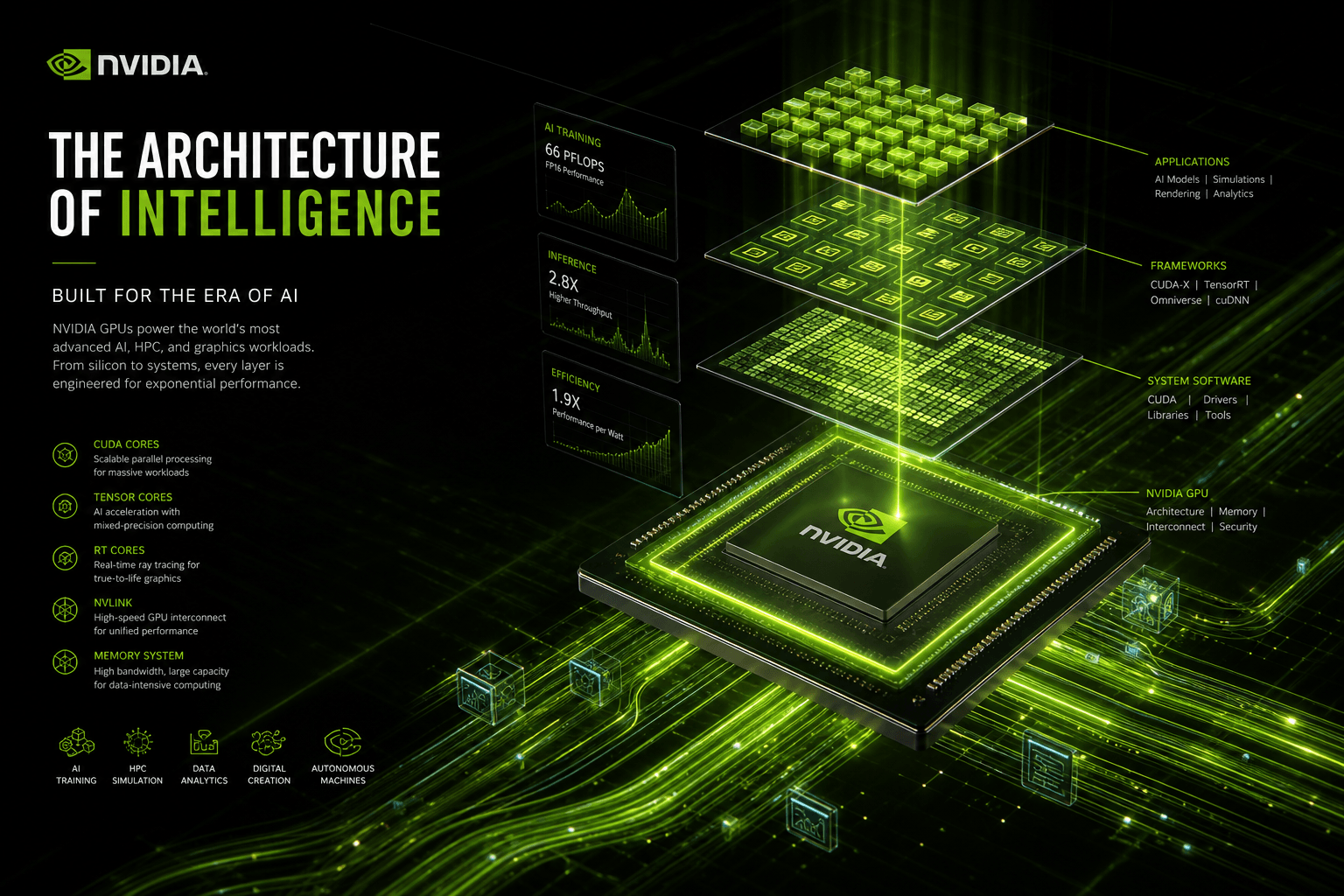
NVIDIA CES 2025: Project DIGITS, Cosmos World Foundation Models, RTX 50 Blackwell GPUs

Table of Contents
Las Vegas, January 6, 2025 — This morning, NVIDIA CEO Jensen Huang took the CES keynote stage and delivered what I'm calling the most consequential hardware announcement cycle in the company's history. Three massive product lines unveiled in a single 90-minute presentation: a personal AI supercomputer that puts petaflops on your desk, world foundation models that simulate physics for robots and autonomous vehicles, and a GPU generation leap that redefines what's possible in neural rendering.
I've been tracking NVIDIA's trajectory from gaming silicon to full-stack AI compute. Today's announcements cement their position as the infrastructure layer for the next decade of AI — from the data center to your desktop, from digital twins to physical robots. Let me walk you through what just happened, what it means for engineers and builders, and where this technology fits into the broader AI landscape I've been covering.
What Did NVIDIA Announce at CES 2025? #
NVIDIA announced three flagship products at CES 2025: Project DIGITS (a personal AI supercomputer), Cosmos (world foundation models for physical AI), and the GeForce RTX 50 series Blackwell GPUs (RTX 5090, 5080, 5070 Ti, and 5070). The keynote emphasized the transition from perception AI and generative AI to "physical AI" — systems that perceive, reason, plan, and act in the real world.
Jensen opened with a striking demo: an AI-generated digital twin of the Las Vegas venue itself, rendered in real-time. It was a visual metaphor for the theme that would dominate the presentation — the blurring line between simulated and physical reality, powered by NVIDIA's compute platforms.
The announcements span the entire AI stack:
| Product | Category | Target Audience | Key Innovation |
|---|---|---|---|
| Project DIGITS | Desktop AI Supercomputer | AI researchers, data scientists, students, startups | 1 petaflop FP4 in a desktop form factor |
| Cosmos | World Foundation Models | Robotics engineers, AV developers, physical AI researchers | Physics-aware video generation for synthetic training data |
| RTX 50 Series | Consumer/Prosumer GPUs | Gamers, creators, AI developers | DLSS 4 with Multi Frame Generation, up to 8X performance boost |
Each represents a different compute tier — from cloud-scale training (DGX) to edge inference (AGX) to personal prototyping (DIGITS) to consumer acceleration (RTX). It's a complete ecosystem play that competitors like AMD, Intel, and the emerging AI chip startups will struggle to match.
What Is Project DIGITS? #
Project DIGITS is NVIDIA's "world's smallest AI supercomputer," a desktop system built around the GB10 Grace Blackwell Superchip that delivers up to 1 petaflop of AI performance (FP4 precision) and can run 200 billion parameter LLMs natively. Two units can be linked to handle 405B parameter models.
This is the announcement that made me sit up straight. For years, AI developers have faced a frustrating gap: you prototype on cloud GPUs, rack up compute bills, deal with data transfer overhead, or you work with compromised local hardware that can't handle meaningful model sizes. Project DIGITS bridges that gap.
Project DIGITS Specifications #
| Component | Specification |
|---|---|
| Superchip | NVIDIA GB10 Grace Blackwell SoC (Blackwell GPU + Grace CPU with 20 Arm cores) |
| AI Performance | Up to 1 PFLOP (petaflop) at FP4 precision |
| Model Support | Up to 200B parameters native; 405B with dual-unit NVLink |
| Memory | 128 GB unified coherent LPDDR5X (~500 GB/s bandwidth) |
| Storage | Up to 4 TB NVMe SSD |
| Connectivity | Wi-Fi, Bluetooth, USB, ConnectX networking (NCCL, RDMA, GPUDirect support) |
| Power | Standard electrical outlet (no specialized power infrastructure required) |
| OS/Software | NVIDIA DGX OS (Ubuntu 22.04-based), full NVIDIA AI stack |
The collaboration with MediaTek on the CPU efficiency is notable — MediaTek's mobile SoC expertise translates to power-efficient Arm cores that don't compromise on the bandwidth needed to feed the Blackwell GPU. This isn't a stripped-down developer kit; it's a full DGX environment in a form factor that fits on any desk.
Who Is Project DIGITS For? #
Jensen explicitly called out the target audience: AI researchers, data scientists, students, and startups. This democratizes access to serious AI compute. A PhD student can now fine-tune a 70B parameter model locally. A startup can iterate on model architectures without cloud spend anxiety. The direct deployment path to DGX Cloud or data centers means prototypes can graduate to production without architecture rewrites.
The software stack is complete: DGX OS, NGC catalog access, NeMo framework, RAPIDS for data science, PyTorch, Jupyter — everything you'd get on a full DGX server. This is NVIDIA recognizing that the development experience matters as much as the raw compute.
Project DIGITS Pricing and Availability #
NVIDIA did not announce official pricing for Project DIGITS at CES 2025. Based on the specifications and positioning against DGX systems, expect a premium price point likely in the $10,000+ range, though NVIDIA emphasized accessibility for researchers and students.
Availability: Announced January 6, 2025, with shipping expected in 2025 (likely H1 or H2). No pre-order details were provided during the keynote.
For engineers watching this space: this is the first credible "AI workstation" that doesn't require a server closet. The comparison to Apple's Mac Studio with M2 Ultra is inevitable, but the DIGITS can handle model scales that Apple's unified memory architecture simply can't touch (128GB shared memory is generous, but not 200B parameter generous).
What Are NVIDIA Cosmos World Foundation Models? #
NVIDIA Cosmos is a platform of world foundation models (WFMs) designed to accelerate physical AI development for robots and autonomous vehicles by generating photorealistic, physics-aware synthetic video for training and simulation. It addresses the critical data bottleneck in physical AI: the prohibitive cost and danger of collecting real-world training data at scale.
This announcement signals NVIDIA's strategic bet on "physical AI" — the next evolution beyond perception and generative systems. If LLMs transformed text generation, and diffusion models transformed image synthesis, world foundation models aim to transform how AI understands and interacts with physical reality.
How Cosmos World Foundation Models Work #
Cosmos WFMs are neural networks trained to predict and generate physics-aware videos. Think of them as "world simulators" — given text, images, video, or robot motion data as input, they generate predictive video sequences that obey physical constraints: objects don't clip through each other, lighting behaves realistically, materials respond correctly to forces.
The architecture includes several key components:
| Component | Function | Key Capabilities |
|---|---|---|
| Cosmos Predict | Core world generation model | 2B and 14B parameter variants; generates predictive video up to 30 seconds; supports motion trajectories and custom fine-tuning |
| Cosmos Tokenizer | Visual tokenization | 8x better compression, 12x faster than leading alternatives |
| NeMo Framework | Training and customization | Processes 20 million hours of video in 14 days on Blackwell (vs. 3+ years on CPUs) |
| Data Pipeline | Video curation and labeling | Integrates with Omniverse for 3D scenario creation; synthetic data from USD assets |
The March 2025 GTC update added Cosmos Predict 2.5 with flow-based architecture for advanced world simulation, plus customizable reasoning models and Omniverse blueprints for synthetic data engines.
Cosmos Use Cases in Physical AI #
Cosmos serves as a "synthetic data factory" that multiplies the value of limited real-world data. Key applications include:
- Synthetic Data Generation: Create controllable, photorealistic training scenarios (snowy roads, warehouse navigation, edge cases) that would be dangerous or impossible to capture in reality
- Reinforcement Learning: Accelerate AI agent learning by simulating world states for policy training
- Video Search and Understanding: Query datasets for specific scenarios without manual annotation
- Digital Twin Integration: Pairs with NVIDIA Omniverse for full 3D world building and USD-based asset pipelines
The early adopter list reads like a who's who of physical AI: 1X, Agile Robots, Agility Robotics, Figure AI, Skild AI, Neura Robotics in robotics; Uber, Waabi, XPENG, Foretellix in autonomous vehicles. These companies are using Cosmos for post-training robots on edge cases, generating AV training scenarios, and building richer datasets than real-world collection allows.
Cosmos Availability and Licensing #
Cosmos models are available immediately under open licenses on the NVIDIA NGC catalog, Hugging Face, and the NVIDIA API Catalog for preview and download. NVIDIA NIM microservices are available for optimized deployment.
Enterprise support comes through NVIDIA DGX Cloud and NVIDIA AI Enterprise subscriptions. The open model approach contrasts with closed-world models from competitors and reflects NVIDIA's strategy of platform lock-in through ecosystem breadth rather than API control.
Jensen's framing was precise: "Just as large language models transformed generative AI, Cosmos WFMs are a breakthrough for physical AI." This is NVIDIA positioning itself as the infrastructure layer for the robotics revolution — not just the chip supplier, but the data and simulation platform too.
What Is the GeForce RTX 50 Series? #
The NVIDIA GeForce RTX 50 series is the Blackwell architecture generation of consumer GPUs, featuring four launch models: RTX 5090 ($1,999), RTX 5080 ($1,199), RTX 5070 Ti (~$749), and RTX 5070 ($599). They introduce DLSS 4 with Multi Frame Generation, delivering up to 8X performance improvements over native rendering.
This is the gaming and prosumer face of NVIDIA's AI compute dominance. While Project DIGITS targets AI developers and Cosmos targets robotics engineers, RTX 50 series puts Blackwell's neural rendering capabilities into the hands of gamers, streamers, content creators, and AI enthusiasts.
RTX 5090 Specifications and Pricing #
The RTX 5090 is NVIDIA's flagship consumer GPU with 21,760 CUDA cores, 32GB GDDR7 memory, and a 575W TDP, priced at $1,999. It represents the most powerful GeForce GPU ever created.
| Specification | RTX 5090 Value |
|---|---|
| Architecture | GB202 (Blackwell) |
| CUDA Cores | 21,760 (33% more than RTX 4090) |
| Tensor Cores | 680 (5th generation) |
| RT Cores | 170 (4th generation) |
| VRAM | 32 GB GDDR7 |
| Memory Interface | 512-bit |
| Memory Bandwidth | 1,792 GB/s (78% improvement over RTX 4090) |
| Base Clock | 2.017 GHz |
| Boost Clock | 2.407 GHz |
| L2 Cache | 98 MB |
| TDP | 575W |
| Power Connectors | 1x 16-pin + 4x 8-pin adapter |
| Process Node | TSMC 4NP |
| MSRP | $1,999 |
The 92 billion transistors and 3,352 trillion AI operations per second (TOPS) position this as both a gaming monster and a serious AI inference accelerator for local LLMs and diffusion models.
RTX 5080 Specifications and Pricing #
The RTX 5080 offers 10,752 CUDA cores, 16GB GDDR7 memory, and a 360W TDP, priced at $1,199. It delivers approximately 20-40% performance uplift over the RTX 4080 Super through Blackwell architecture improvements.
| Specification | RTX 5080 Value |
|---|---|
| Architecture | GB203 (Blackwell) |
| CUDA Cores | 10,752 |
| Tensor Cores | 336 (5th generation) |
| RT Cores | 84 (4th generation) |
| Base Clock | 2.295–2.30 GHz |
| Boost Clock | 2.617 GHz (reference); up to 2.78 GHz (AIB OC models) |
| VRAM | 16 GB GDDR7 |
| Memory Speed | 30 Gbps |
| Memory Interface | 256-bit |
| Memory Bandwidth | 960 GB/s |
| TDP | 360W |
| PCIe Interface | PCIe 5.0 x16 |
| Display Outputs | 3x DisplayPort 2.1b + 1x HDMI 2.1b |
| MSRP | $1,199 |
The ~5% CUDA core increase over RTX 4080 Super understates the generational gains. GDDR7's bandwidth improvements and DLSS 4's frame generation create a substantially smoother 4K gaming experience.
RTX 5070 Ti Specifications and Pricing #
The RTX 5070 Ti features 8,960 CUDA cores, 16GB GDDR7 memory, and a 300W TDP, with an estimated MSRP of $749–$799. It bridges the gap between the mainstream 5070 and the high-end 5080.
| Specification | RTX 5070 Ti Value |
|---|---|
| Architecture | GB203-300-A1 (Blackwell) |
| CUDA Cores | 8,960 (70 SMs) |
| Tensor Cores | 280 (5th generation) |
| RT Cores | 70 (4th generation) |
| Base Clock | 2.30 GHz |
| Boost Clock | 2.45 GHz |
| VRAM | 16 GB GDDR7 |
| Memory Speed | 28 Gbps |
| Memory Interface | 256-bit |
| Memory Bandwidth | 896 GB/s |
| TDP | 300W |
| AI Performance | 1,406 TOPS (INT8) |
| Estimated MSRP | $749–$799 |
With ~16% more CUDA cores than the RTX 4070 Ti and the architectural efficiency gains of Blackwell, this card excels at 1440p and entry-level 4K gaming while serving as a capable AI inference accelerator for local workloads.
RTX 5070 Specifications and Pricing #
The RTX 5070 delivers 6,144 CUDA cores, 12GB GDDR7 memory, and a 250W TDP, priced at $599. It represents the mainstream entry point into the Blackwell generation.
| Specification | RTX 5070 Value |
|---|---|
| Architecture | GB205 (Blackwell) |
| CUDA Cores | 6,144 |
| VRAM | 12 GB GDDR7 |
| Memory Speed | 28 Gbps |
| Memory Interface | 192-bit |
| Memory Bandwidth | 672 GB/s |
| TDP | 250W |
| MSRP | $599 |
The 12GB VRAM allocation may prove limiting in future VRAM-intensive titles, but at $599 with DLSS 4 support, this becomes the sensible upgrade path for GTX 1080 Ti and RTX 2070 Super owners who have been waiting for a meaningful performance jump.
Complete RTX 50 Series Comparison Table #
| Model | CUDA Cores | VRAM | Memory Bus | Bandwidth | TDP | MSRP |
|---|---|---|---|---|---|---|
| RTX 5090 | 21,760 | 32 GB GDDR7 | 512-bit | 1,792 GB/s | 575W | $1,999 |
| RTX 5080 | 10,752 | 16 GB GDDR7 | 256-bit | 960 GB/s | 360W | $1,199 |
| RTX 5070 Ti | 8,960 | 16 GB GDDR7 | 256-bit | 896 GB/s | 300W | $749–$799 |
| RTX 5070 | 6,144 | 12 GB GDDR7 | 192-bit | 672 GB/s | 250W | $599 |
What Is DLSS 4 and Multi Frame Generation? #
DLSS 4 is NVIDIA's latest neural rendering technology, introducing Multi Frame Generation (MFG) that uses AI to generate up to three additional frames per traditionally rendered frame, delivering up to 8X performance improvements over native rendering. It is exclusive to RTX 50 series GPUs.
This is where NVIDIA's AI expertise translates directly to gaming performance. DLSS 3 introduced single-frame generation; DLSS 4 multiplies that capability and fixes the pacing consistency issues that plagued the previous generation.
How DLSS 4 Multi Frame Generation Works #
The technical pipeline represents a fundamental rearchitecture of frame generation:
- AI Optical Flow: Replaces the hardware Optical Flow Accelerator with a more efficient AI model that computes pixel motion estimation in a single pass per frame
- Multi-Frame Neural Network: A transformer-based network generates up to three additional frames from one rendered frame using 5th-generation Tensor Cores
- Hardware Flip Metering: The Blackwell display engine handles frame pacing in hardware, eliminating the CPU-based variability that caused stutter in DLSS 3
- Combined Pipeline: Integrates with transformer-based Super Resolution, Ray Reconstruction, and DLAA for complete neural rendering
The efficiency gains are substantial: 40% faster model inference, 30% less VRAM usage, and the ability to generate 15 out of 16 pixels via AI while maintaining visual quality.
DLSS 4 Performance Improvements #
DLSS 4 delivers up to 8X performance multiplier over native rendering, or up to 1.7X uplift from DLSS 3 Frame Generation. By launch, 75+ games and applications supported the technology.
The practical impact: 4K 240 FPS fully ray-traced gaming becomes achievable on RTX 5090. Games like Warhammer 40,000: Darktide at 4K maximum settings show 10% faster FPS with 400MB less VRAM consumption compared to DLSS 3.
The later DLSS 4.5 update (announced CES 2026) added Dynamic MFG, automatically adjusting multipliers up to 6X (five generated frames) in real-time to match display refresh rates — like an "automatic transmission" for frame generation.
What Is the DRIVE Hyperion AV Platform? #
NVIDIA DRIVE Hyperion is the next-generation autonomous vehicle platform built on the AGX Thor SoC, supporting generative AI capabilities and functional safety certification. Toyota, the world's largest automaker, announced adoption of DRIVE AGX Orin with safety-certified DriveOS for next-generation vehicles.
Jensen's declaration that "the autonomous vehicle revolution is here" was backed by a concrete partnership with a manufacturing giant. This isn't vaporware; it's a production platform with a production customer.
NVIDIA's Three-Computer AV Architecture #
NVIDIA's autonomous vehicle stack spans three compute tiers:
| Computer | Hardware | Function |
|---|---|---|
| DGX | Data center GPUs | AI model training on massive datasets |
| Omniverse | Simulation platform | Testing, validation, synthetic data generation |
| DRIVE AGX | In-vehicle SoC | Real-time inference and vehicle control |
The AGX Thor SoC replaces the previous AGX Orin generation, delivering the compute headroom needed for generative AI models in vehicles while maintaining functional safety certification required for production deployment.
Toyota's adoption covers next-generation vehicle platforms with advanced driver assistance systems (ADAS). The DriveOS safety certification is the critical detail here — this isn't just AI acceleration, it's AI acceleration that meets automotive safety standards.
What About AI Foundation Models for RTX PCs? #
NVIDIA announced NIM microservices and AI Blueprints for RTX PCs, enabling local execution of digital human generation, podcast creation, image synthesis, and video generation workflows. These run directly on RTX 50 series and compatible RTX 40 series GPUs.
This is NVIDIA's consumer AI play: why rely on cloud APIs with rate limits and privacy concerns when your local GPU can run the same models? The NIM (NVIDIA Inference Microservices) architecture brings enterprise-grade model serving to consumer hardware.
AI Blueprints provide pre-configured pipelines for common generative workflows. The digital human blueprint, for instance, combines speech recognition, LLM inference, and neural rendering for real-time avatar generation — all running locally on an RTX 5090.
For creators concerned about AI tool subscription costs or content privacy, local execution on RTX hardware becomes increasingly compelling. The 32GB VRAM on RTX 5090 can handle meaningful LLM inference (70B parameter models with quantization), making it viable for serious AI experimentation beyond just gaming.
How Do These Announcements Fit Together? #
NVIDIA's CES 2025 announcements represent a complete stack strategy: Cosmos generates training data and simulates worlds, DGX and DIGITS train the models, DRIVE AGX deploys to vehicles and robots, and RTX brings consumer AI capabilities to gamers and creators. It's a vertically integrated physical AI ecosystem.
The strategic coherence is impressive. Each product reinforces the others:
- Cosmos creates synthetic training data that would be impossible or dangerous to collect in reality
- Project DIGITS puts that data processing and model training capability on every AI researcher's desk
- DRIVE AGX deploys the resulting models to vehicles and robots with safety certification
- RTX 50 series brings the same architecture to consumers, creating a developer ecosystem familiar with Blackwell capabilities
This is NVIDIA's "three-computer" strategy extended: DGX for training, Omniverse for simulation, and specialized edge platforms (DIGITS, DRIVE AGX, RTX) for deployment and development.
The competitive moat deepens. AMD can compete on raw GPU silicon. Intel can compete on integrated platforms. Cloud providers can compete on training capacity. But none can match the breadth of NVIDIA's physical AI stack — from world simulation to robot deployment to consumer hardware running the same architecture.
What Does This Mean for AI Developers? #
For AI developers, these announcements lower the barrier to entry for serious model work and expand the addressable use cases into physical AI. Project DIGITS specifically addresses the long-standing pain point of local development for large models.
If you're building AI applications, here's my take on the implications:
Local Development Viability: Project DIGITS makes it practical to fine-tune 70B parameter models or run 200B parameter inference locally. This changes the economics of AI startups and research labs. The iteration speed of local development — no cloud latency, no per-hour compute anxiety — compounds productivity.
Physical AI Opportunity: Cosmos opens robotics and autonomous systems development to teams without massive real-world data collection operations. If you're building embodied AI, synthetic data generation through Cosmos should be in your toolkit.
Edge Deployment Path: The Blackwell architecture consistency from RTX 5090 to DRIVE AGX to DIGITS means models developed on consumer hardware deploy cleanly to production edge platforms. This is NVIDIA's platform play — familiar tools, familiar architecture, from desktop to data center to vehicle.
Neural Rendering Integration: For applications combining AI with graphics (digital humans, synthetic media, game AI), DLSS 4 and the RTX 50 series provide a unified neural rendering pipeline that competitors can't match.
What Does This Mean for Gamers and Creators? #
For gamers, DLSS 4 Multi Frame Generation delivers generational performance improvements that make 4K high-refresh gaming accessible and 8K gaming viable. For creators, the AI inference capabilities on RTX 50 series enable local execution of workflows previously requiring cloud APIs.
The RTX 5090 at $1,999 is undeniably expensive, but the performance delta is equally undeniable. If you're gaming at 4K with ray tracing, DLSS 4's 8X multiplier over native rendering changes what's possible. The 32GB VRAM also enables creator workflows — 8K video editing, complex 3D scenes, local AI image generation — that previously required workstation-class hardware.
The RTX 5070 at $599 is the mainstream sweet spot. Yes, 12GB VRAM raises concerns for future-proofing, but for 1440p gaming and entry-level AI experimentation, the Blackwell architecture efficiency gains justify the upgrade from RTX 30 series or older.
For streamers and content creators, the AI-powered features — NVIDIA Broadcast background removal, eye contact correction, noise removal — run better on Blackwell's improved AI accelerators. The local LLM capabilities also enable new interactive streaming possibilities: real-time chatbots, dynamic content generation, AI-assisted moderation.
How Does This Compare to Competitors? #
AMD and Intel lack the breadth to compete with NVIDIA's physical AI stack. While AMD's RDNA 4 and Intel's Battlemage may offer competitive rasterization performance, neither has the world foundation models, robotics platforms, or neural rendering ecosystem that NVIDIA demonstrated.
The comparison becomes almost unfair when looking beyond raw GPU specs:
| Capability | NVIDIA | AMD | Intel |
|---|---|---|---|
| World Foundation Models | Cosmos (shipping) | No equivalent | No equivalent |
| Robotics Platform | Isaac + Cosmos + DRIVE | Limited | None |
| Neural Rendering | DLSS 4 (MFG, transformer-based) | FSR 3 (frame gen, lower quality) | XeSS (limited adoption) |
| AI Developer Ecosystem | Complete stack (DIGITS to DGX) | ROCm (limited adoption) | OpenVINO (niche) |
| AV Safety Certification | DRIVE AGX (production) | None | None |
AMD's FSR 4 may close the neural rendering gap somewhat, but the software ecosystem moat — CUDA, cuDNN, TensorRT, NIM, Omniverse, Cosmos — represents years of platform investment that competitors can't replicate quickly.
The specialized AI chip startups (Groq, Cerebras, SambaNova) compete on inference speed or training scale, but none offer the consumer-to-cloud-to-edge breadth that NVIDIA demonstrated today.
What Is the GB10 Grace Blackwell Superchip? #
The GB10 Grace Blackwell Superchip is a system-on-chip (SoC) combining a Blackwell GPU with a 20-core Arm-based Grace CPU, delivering up to 1 petaflop of AI compute in a single package. It powers both Project DIGITS and serves as the foundation for larger Blackwell deployments.
This is the silicon heart of NVIDIA's physical AI push. The GB10 represents years of co-design work between NVIDIA's GPU architecture teams and the Arm CPU division they acquired through their failed SoftBank purchase attempt — and subsequently developed in-house with MediaTek partnership.
GB10 Architecture Breakdown #
| Component | Specification | Purpose |
|---|---|---|
| Blackwell GPU | Latest generation compute architecture | AI inference, graphics, parallel compute |
| Grace CPU | 20 Armv9 cores | Sequential workloads, OS, orchestration |
| Memory Interface | LPDDR5X unified memory | High bandwidth, power efficiency |
| Memory Bandwidth | ~500 GB/s | Feeding the GPU without bottlenecks |
| Interconnect | NVLink-C2C (chip-to-chip) | Coherent memory between CPU and GPU |
The NVLink-C2C interconnect is the technical detail that matters. It provides cache-coherent memory between the Grace CPU and Blackwell GPU, meaning the CPU can access GPU memory directly without copy overhead, and vice versa. This unified memory architecture simplifies programming and eliminates the PCIe bottleneck that plagues discrete GPU setups.
MediaTek Collaboration #
NVIDIA's partnership with MediaTek is specifically for CPU power efficiency. MediaTek brings mobile SoC expertise — power management, thermal design, battery-optimized core scheduling — that translates surprisingly well to desktop AI workloads where sustained performance matters more than burst speeds.
The result is a 128GB LPDDR5X memory subsystem that doesn't require the complex cooling and power delivery that GDDR7 or HBM3 would demand. For a desktop system running from a standard wall outlet, these efficiency tradeoffs enable the DIGITS form factor.
What Is NVIDIA Reflex 2? #
NVIDIA Reflex 2 is an updated latency reduction system for competitive gaming, delivering up to 75% latency reduction over native rendering. It pairs with DLSS 4 to maintain responsiveness even when generating multiple AI frames.
Latency has always been the hidden cost of frame generation technology. If you're generating three AI frames between each rendered frame, traditional input polling and display timing create perceptible lag. Reflex 2 addresses this through hardware-level synchronization.
How Reflex 2 Works #
| Technology | Function | Benefit |
|---|---|---|
| Frame Warp | Adjusts frame timing based on latest input | Reduces perceived input lag |
| Enhanced Sync | Hardware-coordinated display timing | Eliminates frame pacing stutter |
| Low Latency Mode | Optimized driver path for competitive titles | Sub-10ms system latency in supported games |
The 75% latency reduction claim is specific to Reflex 2 combined with DLSS 4 Multi Frame Generation in supported titles. This matters for competitive gamers who want the visual quality benefits of AI frame generation without sacrificing the responsiveness needed for esports performance.
Games like Valorant, Apex Legends, and Counter-Strike 2 benefit disproportionately from these latency reductions. The RTX 50 series display engine hardware coordinates input sampling, frame generation, and output timing in ways that software-only solutions cannot match.
What Is the Blackwell Architecture? #
Blackwell is NVIDIA's latest GPU architecture, succeeding Ada Lovelace (RTX 40 series), featuring 5th-generation Tensor Cores, 4th-generation RT Cores, and a new AI-powered optical flow engine for DLSS 4. It powers everything from the RTX 5090 to Project DIGITS to data center DGX systems.
Named after mathematician David Blackwell, this architecture represents a refinement rather than revolution — but the cumulative improvements across AI, ray tracing, and power efficiency add up to a meaningful generational leap.
Blackwell Key Architectural Changes #
| Feature | Ada Lovelace (RTX 40) | Blackwell (RTX 50) | Improvement |
|---|---|---|---|
| Tensor Cores | 4th generation | 5th generation | 2X AI throughput per core |
| RT Cores | 3rd generation | 4th generation | 2X ray-triangle intersection rate |
| Optical Flow | Hardware accelerator | AI-powered | 40% faster, 30% less VRAM |
| Memory | GDDR6X | GDDR7 | 2X bandwidth per pin |
| PCIe | 4.0 x16 | 5.0 x16 | 2X host bandwidth |
| Display Engine | Traditional | Flip Metering hardware | Perfect frame pacing for MFG |
The 5th-generation Tensor Cores introduce support for FP4 precision — a 4-bit floating point format that doubles throughput compared to FP8. For AI inference workloads, this means the RTX 5090's "3,352 TOPS" headline figure reflects practical inference acceleration, not just theoretical peak performance.
The AI-powered optical flow in DLSS 4 replaces the dedicated hardware accelerator from previous generations. This seems counterintuitive — why replace dedicated hardware with AI? — but the efficiency gains are substantial. The AI model computes optical flow in a single pass with better accuracy than the hardware approach, enabling the multi-frame generation pipeline.
What Are the Early Adopter Use Cases for Cosmos? #
Cosmos early adopters span robotics companies (1X, Figure AI, Agility Robotics), autonomous vehicle developers (Uber, Waabi, XPENG), and industrial automation firms, using the platform for synthetic training data, policy validation, and edge case simulation.
The partner list NVIDIA announced reveals the strategic positioning: these aren't experimental research labs, they're production companies building deployable physical AI systems.
Robotics Applications #
| Company | Application | Cosmos Use Case |
|---|---|---|
| 1X | Humanoid robots | Synthetic home environment training |
| Figure AI | Warehouse automation | Physics-accurate manipulation training |
| Agility Robotics | Digit humanoid | Gait and balance simulation |
| Skild AI | General-purpose robotics | Multi-task policy training |
| Neura Robotics | Industrial cobots | Safety scenario generation |
The common thread: these companies need more training data than real-world collection allows. A humanoid robot practicing warehouse packing needs thousands of hours of manipulation data. Collecting that physically — even with parallel robot fleets — takes months. Cosmos generates equivalent training scenarios overnight.
Autonomous Vehicle Applications #
| Company | Focus | Cosmos Application |
|---|---|---|
| Uber | Ride-hail AV | Dense urban scenario simulation |
| Waabi | AI-first trucking | Adverse weather training data |
| XPENG | Chinese market ADAS | Local traffic pattern simulation |
| Foretellix | Safety validation | Edge case scenario generation |
The XPENG partnership is particularly notable for market dynamics. Chinese AV companies have struggled with data sharing restrictions and limited real-world testing permits. Cosmos provides a path to competitive training data without on-road miles.
Uber's continued investment in AV technology — despite selling off their Advanced Technologies Group to Aurora in 2020 — suggests they're building internal capabilities again, possibly for future ride-hail automation.
What Are the Technical Limitations? #
Key limitations include: Project DIGITS pricing remains unconfirmed and likely expensive; RTX 5070's 12GB VRAM may limit future game compatibility; DLSS 4 is exclusive to RTX 50 series; and Cosmos world models, while impressive, still exhibit artifacts in complex physics simulations.
Let's be clear-eyed about constraints:
Project DIGITS Accessibility: If pricing lands at $15,000+, the "democratization" narrative weakens. This is still enterprise hardware, just enterprise hardware that fits on a desk rather than in a rack.
RTX 5070 VRAM: 12GB at $599 in 2025 feels stingy. Games like Alan Wake 2 and Hogwarts Legacy already push VRAM boundaries at 4K. Future titles with heavy ray tracing and high-resolution textures may force texture quality compromises.
DLSS 4 Exclusivity: The best neural rendering features require new hardware. RTX 40 series owners get none of the Multi Frame Generation benefits. This is standard generational segmentation, but disappointing for recent adopters.
Cosmos Realism: World foundation models are impressive but not perfect. Complex fluid dynamics, deformable objects, and multi-body physics still challenge simulation accuracy. Synthetic data from Cosmos requires validation against real-world testing.
Power Consumption: The RTX 5090's 575W TDP demands serious power supply and cooling consideration. This isn't a drop-in upgrade for many existing builds.
Frequently Asked Questions #
What is the release date for NVIDIA's CES 2025 products? #
The RTX 50 series GPUs launched in January 2025 immediately after CES. Project DIGITS and Cosmos were announced January 6, 2025, with DIGITS availability expected in 2025 (H1 or H2) and Cosmos models available immediately on NGC and Hugging Face.
How much will Project DIGITS cost? #
NVIDIA has not announced official pricing for Project DIGITS. Based on the specifications and DGX product positioning, expect a premium price likely in the $10,000–$15,000 range, though NVIDIA emphasized accessibility for researchers and students.
Can RTX 40 series cards use DLSS 4? #
No, DLSS 4 Multi Frame Generation is exclusive to RTX 50 series Blackwell GPUs. The feature requires 5th-generation Tensor Cores and the Blackwell display engine's Flip Metering hardware. RTX 40 series will continue using DLSS 3.
What makes Cosmos different from other video generation models? #
Cosmos is specifically designed for physical AI with physics-aware generation, unlike entertainment-focused video models. It simulates spatial relationships, object permanence, and physical interactions — critical for robotics and AV training. Standard video generation models prioritize visual quality over physical accuracy.
How does Project DIGITS compare to Apple's Mac Studio? #
Project DIGITS supports significantly larger AI models (200B parameters vs. ~100B for Mac Studio M2 Ultra) and runs the full NVIDIA AI stack including CUDA, PyTorch, and NVIDIA NeMo. Mac Studio offers better power efficiency and unified memory architecture, but DIGITS provides the ecosystem and model scale that serious AI development requires.
What games support DLSS 4 at launch? #
Over 75 games and applications supported DLSS 4 at launch, including major titles with ray tracing. NVIDIA's partnership program ensures rapid adoption, though specific titles weren't enumerated in the keynote.
Is Cosmos open source? #
Cosmos models are available under open licenses on NGC, Hugging Face, and the NVIDIA API Catalog. This contrasts with closed models from competitors. The open approach accelerates adoption while building platform dependency on NVIDIA's broader ecosystem.
What power supply do I need for RTX 5090? #
NVIDIA recommends an 850W or greater PSU for RTX 5080; the 575W TDP RTX 5090 likely requires 1000W+ for stable operation. The card uses a 16-pin 12VHPWR connector or 4x 8-pin adapters. Verify your PSU has adequate wattage headroom and the correct connectors.
Can I use two Project DIGITS units together? #
Yes, two Project DIGITS units can be linked via ConnectX networking with NCCL, RDMA, and GPUDirect support to handle 405B parameter models. This effectively doubles the memory pool and compute capacity for the largest foundation models.
What is the difference between DGX and Project DIGITS? #
DGX systems are rack-scale data center servers; Project DIGITS is a desktop form factor with DGX-equivalent software stack. DIGITS brings the DGX development experience to individual researchers, with direct deployment paths to full DGX Cloud or on-premise infrastructure.
Will Cosmos replace real-world data collection for AVs? #
Cosmos complements but doesn't fully replace real-world data collection. Synthetic data accelerates training and enables dangerous edge case simulation, but production AV systems still require validation against actual road miles. Cosmos multiplies the value of limited real-world data rather than eliminating the need for it.
Is the RTX 5070 good value at $599? #
The RTX 5070 offers strong performance-per-dollar for 1440p gaming and entry-level AI workloads, though the 12GB VRAM allocation raises longevity concerns. For users on GTX 10 series or RTX 20 series, it's a compelling upgrade. RTX 30 series owners may want to evaluate whether the DLSS 4 benefits justify the purchase.
What is the GB203 GPU die used in? #
The GB203 die powers both the RTX 5080 and RTX 5070 Ti, featuring 10,752 CUDA cores at full specification (5080 uses the full die, 5070 Ti uses a cut-down variant with 8,960 cores enabled). This die sharing is typical NVIDIA practice — using salvaged chips from the same wafer for lower-tier products.
How does DLSS 4 affect VRAM usage? #
DLSS 4 Multi Frame Generation actually reduces VRAM usage compared to DLSS 3 — approximately 30% less memory for equivalent frame generation workloads. The improved AI model efficiency and single-pass generation of multiple frames means less intermediate state storage.
However, enabling DLSS 4 at high resolutions (4K, 8K) with ray tracing still consumes substantial VRAM. The RTX 5090's 32GB allocation handles this comfortably; the RTX 5070's 12GB may struggle in demanding titles even with DLSS 4 enabled.
What is the NVIDIA NIM platform? #
NVIDIA NIM (NVIDIA Inference Microservices) is a deployment platform for optimized AI model inference, providing containerized models with optimized TensorRT engines for specific hardware targets. The CES 2025 announcements extended NIM to RTX PCs for local model serving.
NIM abstracts away the complexity of model optimization. Rather than manually converting PyTorch models to TensorRT, selecting optimal batch sizes, and tuning CUDA streams, developers deploy a NIM container that handles optimization automatically for the target GPU.
For RTX 50 series owners, this means one-command deployment of LLMs, image generation models, and speech recognition systems that run locally with optimized performance.
Will Cosmos models run on non-NVIDIA hardware? #
Cosmos models are architecture-agnostic and can theoretically run on any hardware supporting PyTorch, but NVIDIA has optimized specifically for Blackwell Tensor Cores. Performance on AMD or Intel GPUs will be substantially degraded without equivalent optimization.
The open license on Hugging Face means the models are portable. The practical reality is that efficient inference — especially for real-time robotics applications — requires the 5th-generation Tensor Cores and NVLink bandwidth that only NVIDIA hardware provides.
What cooling solution does Project DIGITS use? #
NVIDIA has not detailed the Project DIGITS cooling system, but the desktop form factor and standard wall outlet power requirements suggest a sophisticated thermal design with heat pipes, vapor chambers, or liquid cooling. The 128GB LPDDR5X memory generates substantial heat that must be managed passively or with low-noise active cooling.
Given the "fits on every desk" positioning, expect quiet operation comparable to high-end workstations rather than data center server noise levels.
Closing Thoughts: NVIDIA's Platform Moat Deepens #
I've watched NVIDIA evolve from a gaming GPU company to an AI compute platform. Today's announcements represent the culmination of that transformation — and a warning shot to competitors.
Project DIGITS democratizes serious AI development. The ability to run 200B parameter models on a desktop changes what's possible for independent researchers and small teams. When paired with Cosmos for synthetic data generation, a two-person startup can now attempt robotics problems that previously required Waymo-scale resources.
Cosmos addresses the fundamental constraint in physical AI: data. Real-world data collection is expensive, slow, and dangerous. Synthetic data from world foundation models isn't perfect, but it's sufficient for training and infinitely scalable. NVIDIA's position here — infrastructure provider to the robotics revolution — is enviable.
RTX 50 series brings the Blackwell architecture to consumers in a way that matters. DLSS 4 isn't marketing fluff; it's a genuine generational leap in neural rendering. The consistency of architecture from RTX 5090 to DIGITS to DGX to DRIVE AGX means skills and models transfer across the entire NVIDIA ecosystem.
For engineers and builders, the takeaway is clear: NVIDIA's platform investments over the past decade — CUDA, cuDNN, TensorRT, Omniverse, now Cosmos — create a compounding advantage that raw silicon competitors can't match. The "three-computer" strategy (training, simulation, deployment) covers the complete AI lifecycle.
The strategic risk for NVIDIA remains the same: concentration in a single supplier for critical AI infrastructure. But today's announcements make that alternative even harder to justify. When the platform spans from your laptop to the data center to the robot in your warehouse, switching costs become prohibitive.
If you're building AI systems — whether LLM applications, computer vision pipelines, or physical robots — CES 2025 demonstrated that NVIDIA's ecosystem breadth is unmatched. The technical decisions for 2025 just got simpler, even if the philosophical questions about AI concentration got more complicated.
Ready to Build AI Systems That Compete? #
The tools NVIDIA announced today — from desktop supercomputers to world simulators — lower the barrier to entry for serious AI development. But tools alone don't create competitive advantage. Strategy, architecture, and execution do.
Book an AI automation strategy call if you're looking to integrate these capabilities into your product roadmap, build autonomous systems, or deploy AI infrastructure that scales from prototype to production.
I help teams navigate the full AI stack — from CUDA optimization to multi-modal model selection to robotics deployment. Whether you're prototyping on Project DIGITS or shipping to DRIVE AGX, the architecture decisions you make now determine your velocity for the next three years.
Related Reading #
- AWS re:Invent 2024: Nova Models, Trainium3, and Bedrock AgentCore — How Amazon's AI infrastructure announcements compare to NVIDIA's platform play
- DeepSeek-V3: The 671B Parameter Open Weights Challenger — Open foundation models that can run on Project DIGITS-class hardware
- Year-End AI League Tables 2024 — My comprehensive ranking of AI infrastructure providers as we entered 2025
Disclosure: I have no financial relationship with NVIDIA. This analysis is based on public CES 2025 keynote materials, press releases, and technical specifications. GPU pricing and availability are subject to market conditions and retailer inventory.
Related Posts

How to Get ChatGPT and Perplexity to Recommend Your Business
A practical owner playbook for getting ChatGPT and Perplexity to name your business — third-party proof, schema, a 30/60/90 plan, and monthly prompt tests.

How to Build the Author Authority AI Looks For
AI cites people it can verify. Here's how LinkedIn, author markup, and consistent profiles turn your name into a machine-readable authority signal.

AI Agents for Operations: Replacing the Repetitive Tasks That Drain Your Team
Yes — an AI agent can analyze your ops data and recommend next moves, but only if you give it the right access, read-only first, and a human approval layer.