Salesforce Agentforce 2.0: The Enterprise Agent Evolution

Table of Contents
Salesforce Agentforce 2.0: The Enterprise Agent Evolution #
What Is Agentforce 2.0 and Why It Ships Today #
Agentforce 2.0 is Salesforce's major platform upgrade that transforms autonomous AI agents from experimental tools into production-ready digital labor, now available with enhanced reasoning, Slack deployment, and a library of pre-built skills. Announced in December 2024 and rolling out through early 2025, this release represents the maturation of Salesforce's agent strategy from proof-of-concept to enterprise infrastructure.
The timing matters. Three months after Agentforce's initial general availability in October 2024, enterprises are no longer asking whether AI agents work—they're asking how to deploy them at scale across their organizations. Agentforce 2.0 answers that question with practical capabilities: deeper reasoning for complex multi-step tasks, native Slack integration for team collaboration, and ready-to-use skills spanning CRM, analytics, and workflow automation.
Marc Benioff, Salesforce's Chair and CEO, has been clear about the vision: building what he calls "the first digital labor platform for enterprises." With Agentforce 2.0, that vision moves from keynote slides to production deployments. The platform now handles the nuanced, context-dependent work that previous automation tools couldn't touch—nurturing leads through multi-touch sequences, coaching sales reps based on actual call analysis, and resolving customer issues that require understanding history, context, and business rules.
The release is phased: core capabilities and new CRM skills became available in December 2024, Slack integration and natural language agent creation arrive this month (January 2025), and full general availability with advanced reasoning enhancements completes in February 2025. This staged rollout lets early adopters capture immediate value while Salesforce refines the most complex features.
The Atlas Reasoning Engine Gets Smarter #
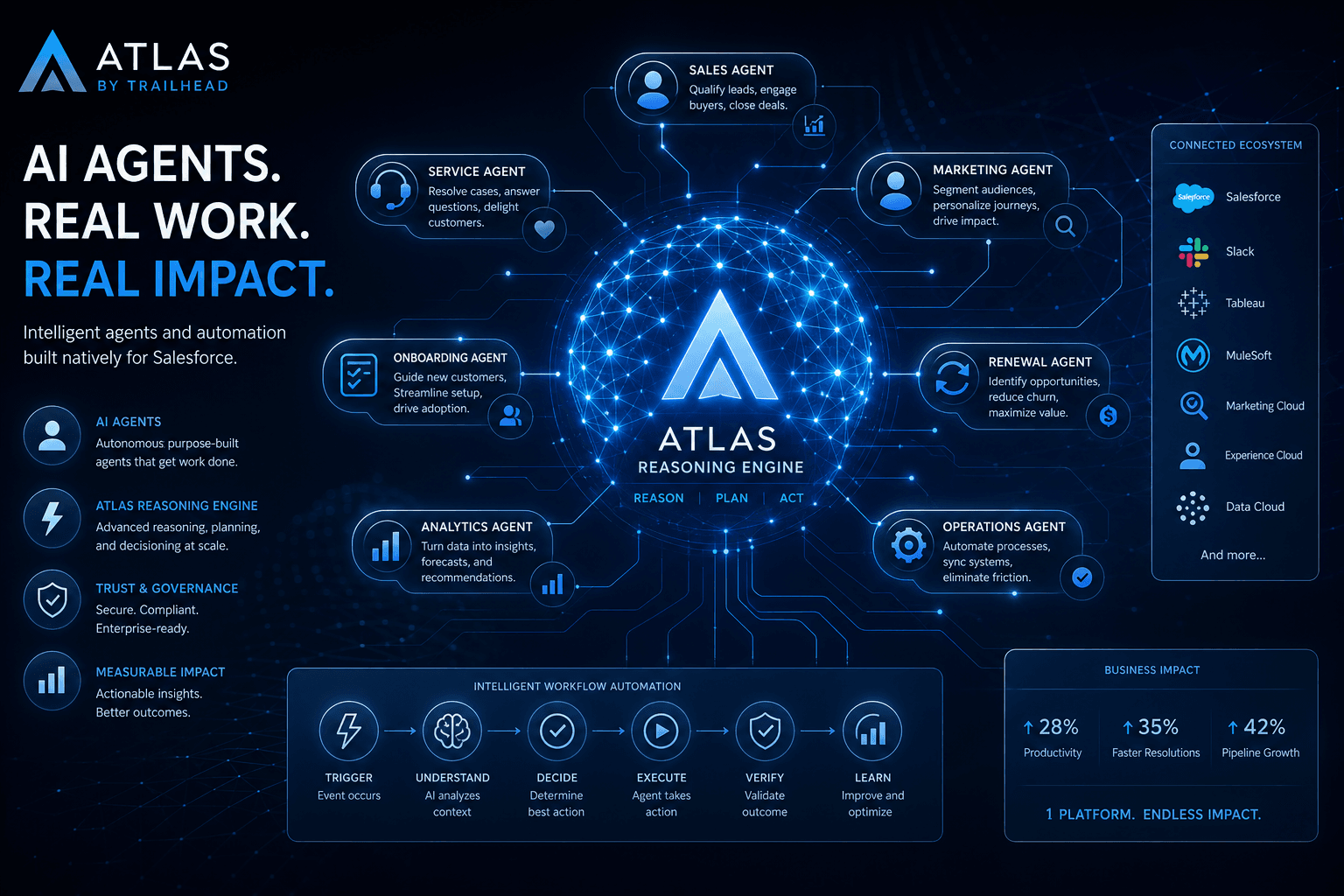
Agentforce 2.0 introduces enhanced reasoning capabilities powered by the Atlas Reasoning Engine, now capable of handling complex multi-step questions with improved data retrieval and contextual understanding through advanced RAG (Retrieval Augmented Generation). The original Atlas engine launched with Agentforce in October 2024; the 2.0 upgrade adds what Salesforce calls "enhanced reasoning with advanced retrievers"—essentially giving agents better tools for finding, evaluating, and synthesizing information.
The core architecture remains: Atlas evaluates queries, retrieves relevant data from Salesforce's Data Cloud, constructs execution plans, and completes tasks autonomously. What's new is the depth of that reasoning. Simple questions like "what's the status of my order?" get rapid basic reasoning. Complex questions like "what investment vehicle fits my risk profile based on my income, existing portfolio, and retirement timeline?" trigger enhanced reasoning that refines the query before retrieval, pulls from multiple data sources, and uses what Salesforce calls an "agentic loop" to verify and improve the answer.
Enhanced RAG with Metadata Enrichment #
A key 2.0 improvement is how Data Cloud now enriches RAG chunks—the retrieved snippets of information—with metadata from the Salesforce Platform. This means agents understand not just the raw data but its business context: which department generated it, when it was last updated, what business rules apply, and how it relates to other records. The result is more accurate answers that respect your organization's unique data conventions without requiring custom configuration.
Reasoning Availability Timeline #
| Feature | Availability | Enterprise Impact |
|---|---|---|
| Basic Atlas Reasoning | GA October 2024 | Available now in production |
| Enhanced Reasoning | February 2025 | Complex multi-step tasks |
| Advanced Retrievers | February 2025 | Deeper context understanding |
| RAG with Metadata | February 2025 | Business-aware responses |
For enterprises already running Agentforce, this means agents will become more capable over the next two months without requiring configuration changes. The engine upgrade happens in the background, with immediate improvements to answer quality for complex queries.
Deploying Agentforce in Slack: Agents Where Work Happens #
Agentforce 2.0 enables deployment directly in Slack, allowing teams to @mention agents in channels and DMs, bringing autonomous AI into the flow of daily collaboration. This is the most significant workflow integration since Agentforce's launch—meeting employees where they already communicate rather than requiring them to open a separate interface.
The Slack integration, becoming generally available this month (January 2025), works through three key mechanisms:
Agentforce Hub in Slack: Teams can start conversations with agents directly from the Agentforce Hub interface within Slack. This provides a consistent entry point for accessing the full library of available agents without leaving the messaging environment.
@Mention Invocation: Users can @mention Agentforce agents in any channel or DM, treating them like team members. "@Agentforce, summarize what happened with the Acme deal this week" triggers the agent to pull CRM data, analyze recent activity, and return a concise summary—all within the thread.
Slack Enterprise Search Integration: Agentforce can now draw from conversational data in Slack—DMs, channels, and Canvases—to enhance response relevance. This is particularly powerful for knowledge work where critical context lives in discussions rather than formal databases.
Slack Actions in Agent Builder #
New pre-built Slack Actions in Agent Builder enable rapid creation of agents that engage with teams. Available actions include:
| Action | Function | Use Case Example |
|---|---|---|
| Send DM | Direct message to specific users | Alert sales rep when lead score changes |
| Message Channel | Post to team channels | Share deal updates to account teams |
| Create Canvas | Generate Slack Canvas documents | Document meeting outcomes automatically |
| Update Canvas | Modify existing Canvases | Add action items post-call |
These actions mean agents can proactively communicate rather than just respond. A sales development agent might detect a hot lead, send a DM to the assigned rep with context, and update the channel with status—all autonomously.
The Collaboration Model #
Salesforce's framing of this integration emphasizes "humans with agents working together." The agents don't replace team interaction; they augment it. A customer service channel might have a human team and an Agentforce service agent collaborating: the agent handles routine inquiries immediately, escalates complex issues with full context, and summarizes resolutions for the team's knowledge base.
For organizations already using Slack as their primary collaboration platform, this integration removes a major adoption barrier. No new interfaces to learn, no context switching, no separate login. The agents become part of the team structure.
The New Skills Library: Pre-Built Capabilities for Every Team #
Agentforce 2.0 introduces a comprehensive library of pre-built agent skills spanning CRM, Slack, Tableau, and partner-developed capabilities on AppExchange, eliminating the integration work that previously slowed agent deployment. Skills are essentially tasks agents can perform—the atomic units of agent capability that combine into complete workflows.
The challenge with the first-generation Agentforce was building enough capability to be useful. Organizations had to create custom topics and actions for most use cases, requiring Salesforce admin expertise and development time. The 2.0 skills library solves this by providing ready-to-use capabilities that can be assembled into agents through natural language instructions.
CRM Skills for Revenue Teams #
New CRM-specific skills target core revenue operations:
| Skill | Function | Outcome |
|---|---|---|
| Sales Development | Nurture leads based on engagement rules | Autonomous lead qualification and progression |
| Sales Coaching | Join calls, provide instant feedback | AI-powered rep development at scale |
| Marketing Campaign | Execute and optimize campaign workflows | Automated campaign lifecycle management |
| Commerce Merchant | Assist with storefront setup and optimization | Self-service ecommerce management |
| Service Scheduling | Handle appointment booking and management | 24/7 scheduling without human intervention |
The Sales Coaching skill is particularly notable. It joins prospecting calls, analyzes interactions against best practices, and provides immediate feedback to reps. This turns every call into a coaching opportunity without requiring managers to listen to recordings—scalable development that was previously impossible.
Tableau Skills for Analytics #
Tableau integration brings data visualization and prediction capabilities into agents. New Tableau Topics and Actions deliver:
- Conversational analytics: Ask questions about data in natural language, receive visualizations and insights
- Business context-rich answers: Responses grounded in Tableau Semantics for accuracy
- Predictive insights: Agent-driven predictions based on historical data patterns
This lowers the barrier to data access across organizations. Non-technical team members can ask an Agentforce-enabled Slack channel for sales forecasts, customer churn predictions, or campaign performance analysis—and receive formatted Tableau visualizations with explanations.
Partner Skills Through AppExchange #
The AppExchange now hosts partner-developed skills extending Agentforce beyond Salesforce's native capabilities. Notable partnerships include:
| Partner | Skill | Capability |
|---|---|---|
| Workday | Employee Service Agent | HR and workforce management automation |
| Docusign | Contract Management | Agreement workflow automation |
| Asymbl | Recruiting Automation | Talent acquisition workflows |
| Neuron 7 | Predictive Service | AI-powered service predictions |
This ecosystem approach is critical for enterprise adoption. Organizations don't want to rebuild their entire tech stack around one platform—they want their AI platform to work with their existing investments.
MuleSoft Integration for Custom Workflows #
MuleSoft for Flow enables Agentforce to work across any system, not just Salesforce's native stack. The new MuleSoft API Catalog provides a centralized view of APIs across Salesforce, MuleSoft, Heroku, and external services, making it easier to turn any API into an agent action.
The MuleSoft Topic Center goes further by enabling teams to infuse Agentforce metadata into every API they build. This ensures any new integration is automatically "agent-ready"—APIs become skills without additional development work.
Natural Language Agent Creation: From Description to Deployment #
Agentforce 2.0 enables natural language creation of agents in Agent Builder, allowing admins to describe what they want in plain English and have the system auto-generate agent configurations. This capability, becoming generally available this month, represents the most significant democratization of agent development in the platform's history.
The workflow is straightforward: an admin types something like "Create an agent that helps onboard new product managers by answering questions about our product roadmap, providing access to relevant documentation, and escalating technical questions to the engineering team." Agent Builder then:
- Interprets the intent: Understands the job to be done from the description
- Recommends skills: Pulls from the library of available skills and actions
- Auto-generates topics: Creates the conversation topics needed for the use case
- Drafts instructions: Writes natural language instructions for agent behavior
- Suggests refinements: Offers options to customize before deployment
This changes the creation timeline from hours (for admins familiar with the platform) to minutes (for anyone who can describe what they need). It also reduces the Salesforce-specific expertise required—domain experts can create agents without deep platform knowledge.
Agentforce Recommends Skills #
A related feature is Agentforce's ability to recommend skills for specific work. When describing a job, the system suggests relevant pre-built skills from the library, ensuring teams aren't reinventing capabilities that already exist. This is particularly valuable for organizations new to the platform who don't yet have mental models of what's possible.
Real-World Adoption: Who's Deploying Agentforce 2.0 Now #
Enterprise customers including Accenture, The Adecco Group, Indeed, IBM, Saks Global, and SharkNinja are actively deploying Agentforce 2.0 capabilities to augment their teams with digital labor. These aren't pilot programs—they're production implementations handling substantial business volume.
The Adecco Group: Transforming Recruitment at Scale #
The Adecco Group, one of the world's largest HR solutions providers, is using Agentforce to centralize data across 40+ systems and transform candidate experience. Their deployment focuses on:
- Prequalifying candidates: Automated screening and qualification
- CV enhancement: AI-powered resume improvement suggestions
- 24/7 operation: Continuous candidate engagement outside business hours
- Faster placements: Reduced time-to-hire through automation
"Agentforce will help prequalify candidates, enhance CVs, and ensure faster job placements," said Greg Shewmaker, Senior Vice President of Global Operations and AI at The Adecco Group. "Agentforce agents also operate 24/7, freeing recruiters to focus on meaningful connections while delivering speed and personalization at scale."
Indeed: Matching 580 Million Profiles with AI #
Indeed, processing 1.7 billion restaurant seats across 60,000 restaurants, has deployed Agentforce to handle the scale of their operation:
- Personalized job seeker engagement: Matching 580 million job seeker profiles with employers
- Unified data foundation: Data Cloud integration for comprehensive candidate views
- Mission alignment: Supporting Indeed's goal of reducing time-to-hire by 50%
"By leveraging Agentforce, Indeed can stay focused on its mission to help people find jobs while advancing its goals, including reducing time-to-hire by 50% and helping 30 million individuals facing barriers to employment secure jobs by fiscal year 2030," said Anthony Moisant, CIO at Indeed.
Accenture: Scaling Sales Productivity #
Accenture's Salesforce Business Group and Accenture Song are using Agentforce to automate sales operations:
- Contact and close plan creation: Automated account planning
- Enterprise search insights: Surfacing relevant information across systems
- Dynamic team alignment: Keeping distributed teams synchronized
"Our sales team is starting to use Agentforce to automate contact and close plan creation, surface insights through enterprise search, and keep teams aligned with dynamic updates," said Stephanie Sadowski, Salesforce Business Group lead at Accenture. "It's helping to increase time-to-effectiveness, accelerate decision-making, and is allowing them to focus on delivering innovative solutions."
Salesforce's Own Usage: 83% Self-Service Resolution #
Salesforce itself provides perhaps the most telling case study. The Salesforce Help page receives 60 million visits annually. Since launching Agentforce on help.salesforce.com in October 2024:
- 83% of queries resolved without human intervention
- 50% reduction in issues requiring human agents
- Nearly 2x increase in average weekly conversations
These metrics demonstrate what's possible at scale when autonomous agents handle routine inquiries while escalating complex issues appropriately.
Pricing and Availability: What Ships When #
Agentforce 2.0 features are rolling out in phases through February 2025, with pricing maintaining the $2 per conversation model for standard skills and volume discounts for enterprise scale. Understanding the timeline helps teams plan their deployment strategy.
Feature Availability Timeline #
| Component | Availability Status | Notes |
|---|---|---|
| Core Agentforce 2.0 Platform | Rolling through February 2025 | Phased regional rollout |
| Sales Development & Sales Coaching Skills | Available now | $2 per conversation pricing |
| Tableau Semantic Layer | Available now | Foundation for analytics skills |
| Tableau Skills | December 18, 2024 | Conversational analytics GA |
| Agentforce in Slack | January 2025 | This month's major release |
| Slack Actions in Agent Builder | January 2025 | Pre-built Slack integrations |
| Slack Enterprise Search | January 2025 | Conversational context integration |
| Natural Language Agent Creation | January 2025 | Simplified agent building |
| MuleSoft for Flow | February 2025 | Cross-system workflow automation |
| MuleSoft API Catalog | February 2025 | Centralized API management |
| Topic Center | February 2025 | Agent-first API metadata |
| Enhanced Reasoning & RAG | February 2025 | Advanced Atlas capabilities |
Pricing Model #
Agentforce maintains its consumption-based pricing approach:
- Standard skills: $2 per conversation starting point
- Volume discounts: Standard enterprise tiers apply
- Bundle inclusions: Einstein requests and Data Cloud credits included
- Salesforce Foundations: 1,000 free conversations included for eligible customers
The conversation-based model means organizations pay for outcomes (completed interactions) rather than infrastructure or seat licenses. For high-volume use cases like customer service, this aligns costs with value delivery.
Agentforce 2.0 vs Competitors: The Enterprise AI Landscape #
Agentforce 2.0 enters a competitive landscape where Microsoft Copilot, ServiceNow AI agents, and emerging platforms all vie for enterprise AI budgets. Understanding the comparative positioning helps teams choose the right platform for their specific requirements.
Head-to-Head: Agentforce 2.0 vs Microsoft Copilot #
| Capability | Agentforce 2.0 | Microsoft Copilot |
|---|---|---|
| Primary focus | CRM automation, customer-facing workflows | Productivity across M365 applications |
| Reasoning engine | Atlas (autonomous) | Assistive (human-prompted) |
| Deployment speed | Minutes via natural language | Requires customization and training |
| Integration depth | Native Salesforce + Data Cloud | Microsoft Graph + external connectors |
| Action capability | Completes tasks autonomously | Suggests actions, human executes |
| Pricing model | Per-conversation ($2 base) | Per-user licensing ($30/month M365) |
| Collaboration | Native Slack integration | Teams integration |
Marc Benioff's critique of Copilot as "Clippy 2.0"—lacking context and true autonomy—remains part of Salesforce's competitive framing. The reality is more nuanced: Copilot excels at knowledge work across documents and collaboration tools, while Agentforce 2.0 specializes in CRM-native workflows and customer-facing automation.
Head-to-Head: Agentforce 2.0 vs ServiceNow #
| Capability | Agentforce 2.0 | ServiceNow AI |
|---|---|---|
| Primary focus | Sales, service, marketing automation | IT service management, employee workflows |
| Deployment | Native platform integration | Requires foundational upgrades |
| Data unification | Zero Copy Partner Network | Limited, requires additional vendors |
| Use case breadth | Customer, employee, supplier touchpoints | Primarily employee-facing |
Salesforce claims 16x faster deployment, 75% higher accuracy, and 7.5x faster model setup compared to alternatives. While these figures come from Salesforce's own analysis, they reflect the platform's architectural advantage for organizations already invested in the Salesforce ecosystem.
The Integration Reality #
Most enterprises will deploy multiple AI agent platforms. A typical scenario:
- Agentforce 2.0 for CRM-centric customer and sales workflows
- Microsoft Copilot for document creation, analysis, and internal collaboration
- Custom solutions for specialized use cases requiring specific capabilities
The platforms are integrating rather than fighting in isolation. Salesforce data flows into Copilot through connectors; Microsoft actions can be triggered from Agentforce through the Partner Network. The goal is connected workflows, not winner-take-all competition.
Implementation Strategy: Deploying Agentforce 2.0 in Your Organization #
Organizations looking to deploy Agentforce 2.0 should follow a phased approach: start with high-value, well-defined use cases, prove ROI with existing CRM data, then expand to cross-system workflows as the platform matures through February 2025.
Phase 1: Foundation (January 2025) #
Before deploying agents, ensure:
- Data Cloud configured: Unified data foundation is mandatory
- Trust Layer active: Security and compliance framework enabled
- Use case selected: High-volume, well-defined scenario (order tracking, FAQs, lead qualification)
- Stakeholder alignment: Business owner, Salesforce admin, and IT security aligned
Phase 2: Pilot Deployment (January-February 2025) #
Deploy initial agents using available capabilities:
| Week | Activity | Deliverable |
|---|---|---|
| 1-2 | Agent Builder configuration | Natural language agent definition |
| 3 | Testing with real data | Parallel testing against existing process |
| 4 | Limited production deployment | 10-20% of target volume |
| 5-6 | Monitoring and refinement | Performance optimization |
Phase 3: Slack Integration (February 2025) #
Once Slack capabilities are fully available:
- Enable Agentforce in Slack: Workspace integration and permissions
- Configure @mentions: Set up agent invocation in relevant channels
- Train team members: Onboard users to agent collaboration patterns
- Monitor adoption: Track usage patterns and optimize channel placement
Phase 4: Cross-System Expansion (March 2025+) #
With MuleSoft integrations fully available, extend agents to:
- External systems through API Catalog
- Custom workflows via MuleSoft for Flow
- Industry-specific capabilities through AppExchange partners
The Bottom Line: Digital Labor Arrives #
Agentforce 2.0 represents the maturation of enterprise AI agents from experimental technology to production infrastructure. The combination of enhanced Atlas Reasoning, Slack integration, and a comprehensive skills library means organizations can deploy autonomous agents at scale without rebuilding their technology stack.
For Salesforce customers, this is the obvious next step in platform evolution. Agentforce 2.0 activates existing CRM investments, respects existing security models, and extends existing workflows into autonomous capabilities. The $2 per conversation pricing makes costs predictable and aligned with value delivery.
The competitive positioning is clear: Agentforce 2.0 specializes in customer-facing CRM automation with genuine autonomy, while alternatives focus on assistive capabilities in their respective domains. Most enterprises will use multiple platforms—Agentforce for CRM, Copilot for productivity, custom solutions for specialized needs.
What matters most is that Agentforce 2.0 ships with real capabilities today—not roadmaps, not promises, but working features that enterprises are already deploying. The digital labor platform Benioff envisioned is now operational.
Frequently Asked Questions #
What is Salesforce Agentforce 2.0? #
Agentforce 2.0 is Salesforce's upgraded digital labor platform featuring enhanced Atlas Reasoning Engine capabilities, Slack integration, and a library of pre-built skills for deploying autonomous AI agents across enterprise workflows. Released in phases beginning December 2024 and continuing through February 2025, it enables agents to handle complex multi-step tasks, take action across CRM and external systems, and collaborate with teams directly in Slack.
How is Agentforce 2.0 different from the original Agentforce? #
Agentforce 2.0 adds deeper reasoning capabilities through enhanced Atlas engine features, native Slack deployment for team collaboration, pre-built skills spanning CRM and analytics, and natural language agent creation in Agent Builder. The original Agentforce launched in October 2024 with core autonomous capabilities; 2.0 extends these with enterprise-ready integrations, improved RAG with metadata enrichment, and a skills library that eliminates custom development for common use cases.
When will Agentforce 2.0 be fully available? #
Full general availability of Agentforce 2.0 features completes in February 2025, with specific capabilities shipping in phases. Core CRM skills and Tableau integration shipped December 2024; Slack integration and natural language agent creation became available in January 2025; enhanced reasoning, MuleSoft integrations, and advanced RAG complete the rollout in February 2025.
How much does Agentforce 2.0 cost? #
Agentforce 2.0 maintains the $2 per conversation pricing model for standard skills, with volume discounts available for enterprise scale. The consumption-based model includes entitlements to Einstein requests and Data Cloud credits. Organizations can start with Salesforce Foundations, which includes 1,000 free conversations for eligible Enterprise Edition and higher customers.
Can Agentforce 2.0 integrate with systems outside Salesforce? #
Yes, Agentforce 2.0 integrates with external systems through MuleSoft, the Zero Copy Partner Network, and partner skills on AppExchange. MuleSoft for Flow enables low-code workflows spanning any system, the API Catalog centralizes API management across Salesforce and external services, and partner skills provide pre-built integrations with platforms like Workday, Docusign, and others.
What out-of-the-box skills are available in Agentforce 2.0? #
Agentforce 2.0 includes pre-built skills for Sales Development, Sales Coaching, Marketing Campaign, Commerce Merchant, Service Scheduling, Tableau analytics, and Slack collaboration. These skills enable immediate deployment for common use cases without custom development. Partner-developed skills on AppExchange extend capabilities to HR, contract management, recruiting, and other domains.
How does the Slack integration work? #
Agentforce 2.0 in Slack allows users to @mention agents in channels and DMs, invoke agents from the Agentforce Hub, and leverage Slack Enterprise Search for conversational context. New Slack Actions in Agent Builder enable agents to send DMs, post to channels, create and update Canvases, and participate in team workflows as collaborative team members.
What is the Atlas Reasoning Engine's enhanced reasoning capability? #
Enhanced reasoning in the Atlas Engine handles complex multi-step questions by refining queries before retrieval, using advanced data retrievers, and employing an "agentic loop" to verify and improve responses. Simple questions use basic reasoning for speed; complex questions trigger deeper analysis with metadata-enriched RAG and self-verification before delivering answers.
Can non-technical users create agents in Agentforce 2.0? #
Yes, Agentforce 2.0's natural language agent creation in Agent Builder enables admins to describe desired capabilities in plain English, and the system auto-generates agent configurations. The interface interprets intent, recommends relevant skills, auto-generates topics, and drafts instructions—reducing agent creation from hours to minutes without requiring deep Salesforce development expertise.
What results are enterprises seeing from Agentforce 2.0? #
Early adopters report significant operational improvements: Salesforce's own help portal now resolves 83% of queries without human intervention, The Adecco Group is automating candidate prequalification across 40+ systems, and Indeed is leveraging Agentforce to support its goal of reducing time-to-hire by 50% while helping 30 million job seekers facing employment barriers.
How does Agentforce 2.0 compare to Microsoft Copilot? #
Agentforce 2.0 focuses on autonomous CRM automation with the Atlas Reasoning Engine completing tasks without human intervention, while Microsoft Copilot emphasizes assistive productivity across Microsoft 365 applications. Agentforce specializes in customer-facing workflows with native Salesforce integration; Copilot excels at knowledge work and internal collaboration. Most enterprises will use both for different use cases.
What are the requirements to deploy Agentforce 2.0? #
Agentforce 2.0 requires Salesforce Enterprise, Unlimited, Performance, or Einstein 1 editions with Data Cloud configured and the Einstein Trust Layer activated. Organizations must have a unified data foundation through Data Cloud and active security governance. Slack integration requires Slack workspace permissions and Agentforce Hub configuration.
Ready to explore how autonomous AI agents can transform your customer operations? I help enterprises design and deploy production-grade agent systems that integrate with existing CRM investments. Book an AI automation strategy call to discuss your specific use cases and implementation roadmap.
Related reading: Salesforce Agentforce GA Momentum: Post-Dreamforce Enterprise Adoption | AWS re:Invent 2024: Amazon Nova Family, Trainium2, and Bedrock AgentCore | 2024: The Year of Multimodal + Agents + Reasoning + Open-Weights Catch-Up
Published January 7, 2025. Last updated January 7, 2025. Have questions or corrections? Email me or find me on LinkedIn.
Related Posts
How to Stop Client-Facing AI Agents From Hallucinating
Client-facing AI agents hallucinate when they answer without grounding. Here's the layered guardrail stack I use to keep agents accurate and on-script.
AI Sales Systems vs Traditional CRM Automation
Traditional CRM automation fires rules; AI sales systems reason about each lead. Here's how they differ, where each wins, and how to combine them.

The Manual Workflows With the Highest ROI When Replaced by AI Agents
Not every task is worth automating. Here are the manual workflows with the highest ROI when you replace them with AI agents, ranked by payback speed.