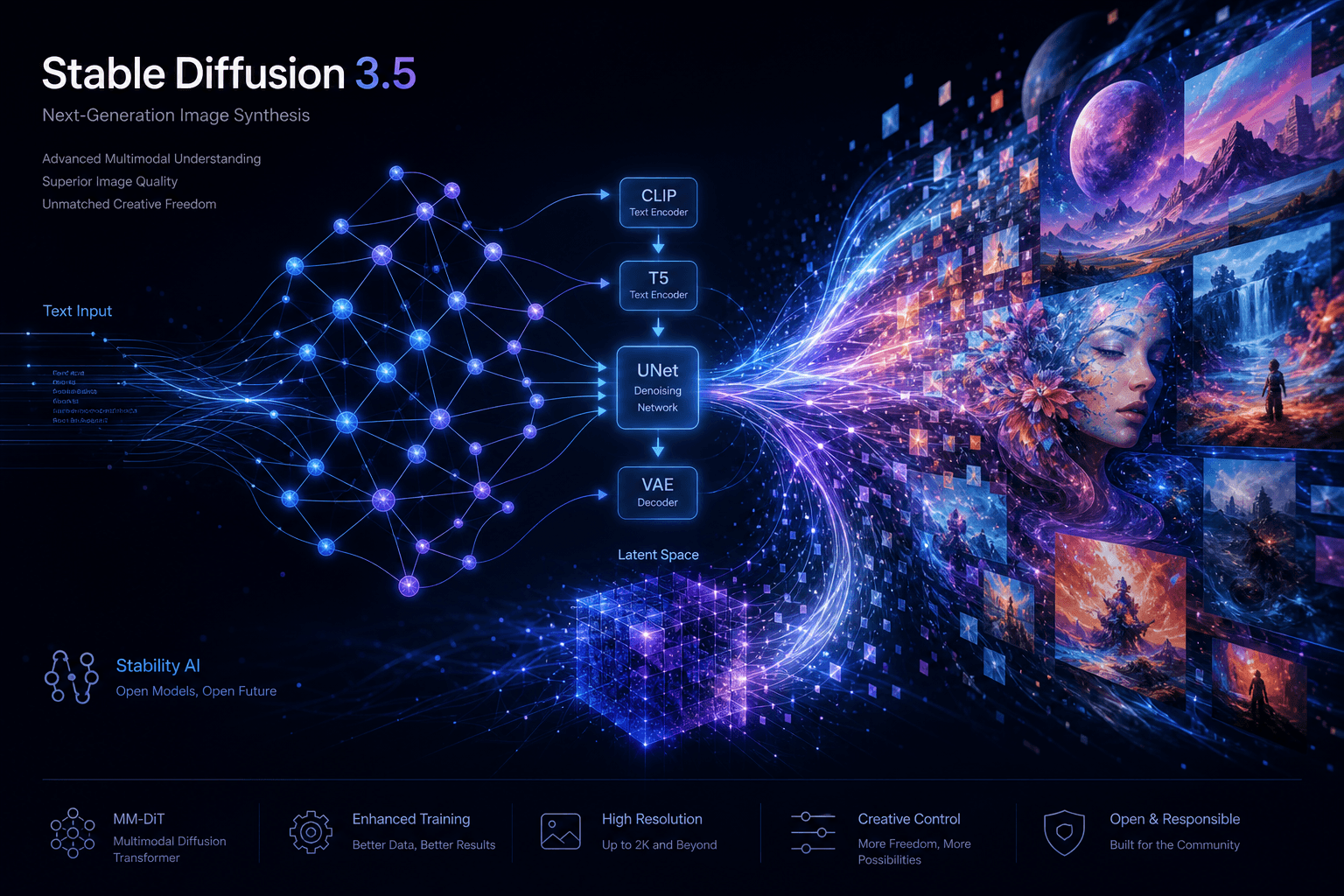
Stable Diffusion 3.5 Large and Turbo: Stability AI's Answer to FLUX Dominance

Table of Contents
Stable Diffusion 3.5 Large and Turbo: Stability AI's Answer to FLUX Dominance #
Stability AI just dropped their most significant release since the FLUX.1 launch shook the open image generation market. SD 3.5 Large and Turbo represent a direct competitive response with 8.1 billion parameters, improved MMDiT-X architecture, and a pricing structure designed to undercut Black Forest Labs while delivering competitive quality. This is what you need to know about the models, the benchmarks, and where they actually stand against the current leader.
Table of Contents #
- The Context: Why SD 3.5 Matters Now — The FLUX challenge and Stability AI's response timeline
- Model Variants and Specifications — Large, Large Turbo, and Medium breakdown
- Architecture: MMDiT-X Improvements — Technical under-the-hood changes
- Performance Benchmarks vs FLUX — Head-to-head quality and speed comparisons
- Image Quality Analysis by Category — Where each model wins
- Text Rendering and Anatomy Fixes — Addressing SD 3's biggest weaknesses
- Deployment and Resource Requirements — Hardware needs and API pricing
- Community License and Commercial Use — What the license actually allows
- Who Should Use Which Model — Decision framework for different use cases
- The Bigger Picture: Open Source Image Gen Landscape — Where this leaves the ecosystem
The Context: Why SD 3.5 Matters Now #
The open-source image generation landscape shifted dramatically in August 2024 when Black Forest Labs released FLUX.1. That launch didn't just raise the bar for publicly available image models—it fundamentally rewrote the competitive dynamics that had governed the space since Stable Diffusion first democratized AI image generation in 2022.
For Stability AI, the timing couldn't have been more challenging. The company had already faced significant turbulence throughout 2024, including leadership changes and strategic pivots. SD 3 Medium, released in June, underperformed expectations and drew criticism for poor anatomical accuracy—particularly its notorious tendency to generate incorrect limb counts. FLUX.1 arrived at the exact moment when Stability AI needed to prove they could still compete at the frontier.
The market response to FLUX was immediate and decisive. Within weeks, FLUX.1 [dev] and [pro] variants became the default recommendations for builders seeking open-weight image generation. The models delivered photorealistic quality that rivaled Midjourney, paired with the flexibility of local deployment and API access through providers like Replicate, Fal, and Together AI. FLUX didn't just outperform SD 3 Medium—it made Stability AI's flagship offering feel dated.
SD 3.5 is Stability AI's direct competitive response. Released on October 22, 2024, the new family represents a substantial architectural and training evolution rather than an incremental update. The Large variant packs 8.1 billion parameters—the largest in the Stable Diffusion family—while the Turbo variant demonstrates that Stability AI understands the market's demand for speed as much as quality.
What makes this release particularly interesting is how it reframes the competitive narrative. Stability AI isn't trying to match FLUX on every dimension. Instead, they're positioning SD 3.5 as the practical choice: competitive quality with significantly lower resource requirements, a permissive community license, and pricing designed to undercut Black Forest Labs' API offerings. It's a bet that efficiency and accessibility matter as much as benchmark wins.
For builders and businesses choosing image generation infrastructure right now, this release changes the calculation. The open-source image generation market now has two credible flagship options, each with distinct tradeoffs. Understanding those tradeoffs is essential for making the right architectural decision.
Model Variants and Specifications #
Stability AI released three distinct variants of SD 3.5, each targeting different deployment scenarios and hardware constraints. Understanding the differences is essential for selecting the right model for your specific use case.
SD 3.5 Large (8.1B Parameters) #
The flagship variant represents Stability AI's most powerful open image generation model to date. With 8.1 billion parameters, it operates at a scale that puts it in direct competition with FLUX.1 [dev] while maintaining more efficient resource utilization.
| Specification | Value |
|---|---|
| Parameters | 8.1 billion |
| Maximum Resolution | 1 megapixel (1024×1024 default) |
| Architecture | MMDiT-X with QK normalization |
| Best For | Professional production use, highest quality requirements |
| Target Hardware | 24GB VRAM for optimal performance, 16GB with optimization |
Large is positioned for scenarios where quality is the primary concern and compute budget is secondary. It's the variant Stability AI recommends for commercial applications, professional creative workflows, and any use case where the final output quality directly impacts business outcomes.
SD 3.5 Large Turbo (Distilled) #
The Turbo variant demonstrates Stability AI's understanding that speed and efficiency are competitive dimensions, not afterthoughts. Using distillation techniques to compress the Large model's capabilities into a faster inference pipeline, Turbo achieves competitive quality in dramatically fewer steps.
| Specification | Value |
|---|---|
| Base Model | Distilled from SD 3.5 Large |
| Inference Steps | 4 steps (vs. 20-50 for standard) |
| Quality Retention | ~90% of Large variant |
| Best For | Real-time applications, high-volume generation, API services |
| Target Hardware | 16GB VRAM, suitable for broader deployment |
The 4-step inference capability is particularly significant for API providers and applications requiring real-time or near-real-time generation. For context, standard diffusion models typically require 20-50 inference steps. Reducing this to 4 steps while maintaining acceptable quality represents a fundamental shift in the speed/quality tradeoff calculus.
SD 3.5 Medium (2.5B Parameters) #
Released one week after the initial launch on October 29, 2024, the Medium variant addresses the consumer hardware market. With 2.5 billion parameters, it's designed to run on consumer GPUs while still delivering competitive quality.
| Specification | Value |
|---|---|
| Parameters | 2.5 billion |
| Resolution Range | 0.25 to 2 megapixel |
| Architecture | MMDiT-X with efficiency optimizations |
| Best For | Consumer hardware, hobbyist use, rapid prototyping |
| Target Hardware | 8-12GB VRAM, accessible consumer GPUs |
Medium extends the SD 3.5 family into territory that FLUX.1 [schnell] occupies, creating a direct competition for the efficiency-conscious segment of the market. The extended resolution range—up to 2 megapixels—is particularly notable, as it enables higher-resolution outputs than the Large variant despite the smaller parameter count.
Comparative Positioning #
| Variant | Parameters | VRAM Required | Best Use Case |
|---|---|---|---|
| SD 3.5 Large | 8.1B | 16-24GB | Maximum quality production |
| SD 3.5 Large Turbo | 8.1B (distilled) | 12-16GB | Speed-critical applications |
| SD 3.5 Medium | 2.5B | 8-12GB | Consumer hardware, prototyping |
| FLUX.1 [pro] | 12B | 32GB+ | API-only, highest quality |
| FLUX.1 [dev] | 12B | 24GB+ | Open weight alternative |
| FLUX.1 [schnell] | 12B | 16GB+ | Fast local generation |
The parameter efficiency story is worth emphasizing. SD 3.5 Large achieves competitive quality with 8.1B parameters against FLUX.1 [dev]'s 12B. This isn't just a technical detail—it translates directly to lower inference costs, broader hardware compatibility, and reduced energy consumption for large-scale deployments.
Architecture: MMDiT-X Improvements #
The MMDiT-X architecture represents Stability AI's most significant technical evolution since the original Stable Diffusion 3 foundation. These aren't incremental tweaks—they're structural changes addressing specific weaknesses that limited SD 3's commercial viability.
Query-Key Normalization (QK Norm) #
The headline architectural change is the introduction of Query-Key Normalization in the transformer blocks. This technique addresses training instability that has historically plagued large-scale diffusion models, particularly when scaling to higher resolutions and longer training runs.
QK normalization works by applying LayerNorm to the query and key vectors within the self-attention mechanism before the attention scores are computed. Mathematically, this prevents gradient explosions and attention score spikes that can destabilize training or produce inconsistent outputs.
For practitioners, the practical impact is threefold:
- More consistent generation across different prompts and seed values
- Easier fine-tuning with smaller datasets without catastrophic forgetting
- Better multi-resolution performance when generating at non-native resolutions
Self-Attention Module Enhancements #
SD 3.5 Medium incorporates self-attention modules in the first 13 layers of the transformer stack. This is a departure from the original SD 3 architecture and enables better handling of multi-resolution generation scenarios.
The self-attention implementation specifically targets:
- Cross-scale coherence: Maintaining consistency between detailed foreground elements and broader background context
- Resolution adaptability: Cleaner outputs when generating at resolutions different from the native training resolution
- Long-range dependencies: Better handling of prompts describing complex scenes with multiple spatially separated elements
Mixed-Resolution Training Pipeline #
Stability AI implemented a progressive training strategy that gradually increases resolution throughout training rather than fixing it at a single target resolution. The training progression follows this pattern:
| Phase | Resolution | Epochs | Purpose |
|---|---|---|---|
| 1 | 256×256 | Early | Foundation feature learning |
| 2 | 512×512 | Middle | Mid-scale structure coherence |
| 3 | 768×768 | Middle | Detail emergence |
| 4 | 1024×1024 | Late | Native resolution refinement |
| 5 | 1440×1440 | Extended | Extended positional embeddings for flexible generation |
The final phase is particularly notable. By extending positional embeddings to 384×384 (representing the patchified resolution for 1440×1440 images), SD 3.5 gains the ability to generate at variable resolutions without the quality degradation typically associated with non-native generation.
Double Attention Layers #
The transformer blocks incorporate double attention layers, effectively doubling the attention computation capacity without doubling the parameter count. This provides:
- Deeper context modeling for complex prompts
- Better separation of foreground and background generation
- Improved handling of multiple subjects within a single scene
Technical Comparison: SD 3 vs SD 3.5 #
| Aspect | SD 3 Medium | SD 3.5 Large |
|---|---|---|
| Base Architecture | MMDiT | MMDiT-X |
| QK Normalization | No | Yes |
| Self-Attention Layers | Standard | Enhanced (first 13 layers in Medium) |
| Training Resolution | Fixed | Progressive (256→1440) |
| Extended Positional Embeddings | No | Yes (384×384) |
| Double Attention | No | Yes |
| Commercial License | Restricted | Community License |
The cumulative effect of these changes is a model that doesn't just generate higher-quality images—it generates them more reliably, with better prompt adherence, and at a broader range of output resolutions. For production deployments, this reliability improvement may matter more than peak quality metrics.
Performance Benchmarks vs FLUX #
Head-to-head benchmark comparisons reveal where SD 3.5 closes the gap with FLUX and where gaps remain. The data tells a nuanced story: FLUX maintains quality leadership in most categories, but SD 3.5's efficiency advantages create a compelling value proposition.
Artificial Analysis Image Arena Elo Scores #
The Artificial Analysis Image Arena provides the most comprehensive crowdsourced quality assessment for image generation models. Based on millions of blind comparison votes:
| Model | Elo Score | Relative Position |
|---|---|---|
| FLUX 1.1 Pro | ~1100 | Quality leader |
| FLUX.1 [pro] | ~1070 | Premium tier |
| FLUX.1 [dev] | ~1040 | High quality |
| SD 3.5 Large | ~1031 | Competitive tier |
| SDXL (base) | ~980 | Previous generation |
| SD 3 Medium | ~950 | Below current standard |
SD 3.5 Large sits at approximately 1031 Elo—competitive but clearly below FLUX.1 [dev]'s ~1040 and significantly behind FLUX 1.1 Pro's ~1100. The gap to FLUX 1.1 Pro represents a meaningful quality difference that aligns with independent testing observations.
Quality Category Breakdown #
Independent testing across multiple prompt categories (based on comprehensive 31-prompt test suites) reveals where each model excels:
| Category | FLUX 1.1 Pro | SD 3.5 Large | Winner |
|---|---|---|---|
| Human Portraits | 95/100 | 85/100 | FLUX (clear) |
| Animal Photography | 92/100 | 78/100 | FLUX (clear) |
| Landscapes/Nature | 88/100 | 82/100 | FLUX (modest) |
| Urban/Architecture | 90/100 | 84/100 | FLUX (modest) |
| Fantasy/Sci-Fi | 85/100 | 81/100 | FLUX (modest) |
| Abstract/Surreal | 83/100 | 79/100 | FLUX (modest) |
| Comics/Stylized | 82/100 | 80/100 | Tie/Near tie |
| Macro/Close-up | 91/100 | 76/100 | FLUX (clear) |
FLUX dominates photorealistic categories—portraits, animals, macro photography—where its superior texture rendering and lighting simulation shine. SD 3.5 remains competitive in stylized and artistic categories, suggesting it may be preferable for illustration workflows.
Prompt Adherence Accuracy #
A critical benchmark for production use is how accurately models render all specified prompt elements:
| Model | Prompt Element Accuracy |
|---|---|
| FLUX 1.1 Pro | 91% |
| FLUX.1 [dev] | 88% |
| SD 3.5 Large | 84% |
| SD 3.5 Large Turbo | 82% |
SD 3.5's 84% accuracy is respectable but falls short of FLUX's industry-leading prompt fidelity. For complex multi-element prompts, this gap becomes noticeable in production workflows.
Speed and Efficiency Metrics #
Where SD 3.5 demonstrates clear advantages is in the efficiency dimension:
| Model | Inference Steps | Avg Generation Time | VRAM Required |
|---|---|---|---|
| FLUX 1.1 Pro (API) | 4 | ~10 seconds | N/A (API only) |
| FLUX.1 [dev] | 28 | ~15-20 seconds | 24GB+ |
| FLUX.1 [schnell] | 4 | ~8 seconds | 16GB+ |
| SD 3.5 Large | 20-28 | ~12-15 seconds | 16GB |
| SD 3.5 Large Turbo | 4 | ~3-4 seconds | 12GB |
The Turbo variant's 4-step inference at ~3-4 seconds represents the fastest quality-competitive generation currently available. For high-volume applications, this speed advantage compounds into significant operational savings.
Price Comparison (API) #
Cost per 1,000 images across major providers:
| Provider/Model | Price per 1K Images | Notes |
|---|---|---|
| FLUX 1.1 Pro (Together AI) | $3-5 | Premium pricing |
| FLUX.1 [dev] (Replicate) | $2.50-3.50 | Standard API |
| SD 3.5 Large (Replicate) | $2.00-2.50 | Price competitive |
| SD 3.5 Large Turbo (Replicate) | $1.50-2.00 | Best value for speed |
| SD 3.5 Medium (Fal) | $1.00-1.50 | Consumer pricing |
SD 3.5's pricing strategy appears designed to undercut FLUX.1 on API costs while delivering 80-90% of the quality. For cost-sensitive applications, this tradeoff is compelling.
Image Quality Analysis by Category #
Quality isn't uniform across image types—understanding where each model excels helps inform deployment decisions. Based on comprehensive testing across 31 diverse prompt categories, here is the detailed quality breakdown.
Human Portraits and Character Generation #
FLUX 1.1 Pro is the clear winner for human-centric imagery. The model's superior handling of skin textures, facial feature coherence, and natural lighting produces results that approach photorealistic photography.
SD 3.5 Large produces competent portraits but exhibits a characteristic "softening" effect. Details that FLUX renders with crisp precision—pores, hair strands, fabric weaves—appear slightly smoothed in SD 3.5 outputs. This isn't necessarily a defect; the softer aesthetic can be preferable for stylized or beauty-focused applications.
However, SD 3.5 shows meaningful improvement over SD 3 Medium in the critical area of anatomical accuracy. Faces are more consistently proportional, and the notorious "extra limb" problems are significantly reduced—though not entirely eliminated.
Verdict: FLUX for photorealistic portraits; SD 3.5 acceptable for stylized or softened aesthetics.
Animal and Wildlife Photography #
FLUX maintains dominance in rendering animal subjects. The model's handling of fur textures, feather details, and natural color palettes produces cinematic wildlife imagery.
SD 3.5 struggles with contrast balance in animal photography. Test results show a tendency toward over-contrasted outputs that stylize rather than faithfully reproduce natural animal appearances. The lion test case—a common benchmark—showed SD 3.5 producing exaggerated mane contrast that felt less authentic.
For animal-centric workflows, FLUX remains the preferred choice unless stylized output is the explicit goal.
Verdict: FLUX strongly preferred for animal and wildlife imagery.
Landscapes and Natural Environments #
The gap narrows significantly for landscape generation. Both models produce visually compelling natural scenes, though with distinct aesthetic signatures.
FLUX landscapes tend toward dynamic range and atmospheric depth. Its handling of lighting transitions—sunsets, aurora borealis, seasonal transitions—creates immersive environmental imagery.
SD 3.5 produces softer, more painterly landscapes. The reduced dynamic range creates a flatter visual effect that some may find aesthetically pleasing but that lacks FLUX's immersive quality. The cherry blossom garden and Grand Canyon test cases demonstrated this clearly: beautiful but less impactful.
Verdict: FLUX for cinematic/immersive landscapes; SD 3.5 acceptable for softer, artistic renderings.
Urban and Architectural Scenes #
FLUX demonstrates superior handling of artificial lighting and reflection physics. Night scenes with neon lighting, wet pavement reflections, and complex urban geometries are rendered with precision that SD 3.5 doesn't match.
The Tokyo night scene test case illustrated this clearly. FLUX produced vibrant, accurate neon lighting with dynamic reflections on wet surfaces. SD 3.5 rendered the same scene with softer colors and less vivid reflections—competent but less cinematic.
For architectural visualization and urban concept art, FLUX's lighting simulation provides tangible advantages.
Verdict: FLUX for urban/night scenes; SD 3.5 suitable for daytime architectural renders.
Fantasy, Science Fiction, and Imaginative Scenes #
This category shows the narrowest quality gap. Both models perform well in unconstrained imaginative scenarios where photorealistic accuracy matters less than creative coherence.
FLUX maintains advantages in texture detail for imaginary objects—robot mechanics, floating castle masonry, alien flora. The added detail depth creates more convincing fantastical elements.
SD 3.5 produces creative, visually striking fantasy imagery that holds up well against FLUX. The softer aesthetic can even be preferable for certain fantasy styles—fairy tale illustrations, children's book art, or dreamlike sequences.
Verdict: Near tie; FLUX for detailed realism, SD 3.5 for softer stylization.
Comic Book and Stylized Art #
SD 3.5 demonstrates surprising competitiveness in stylized categories. The model's tendency toward softer outputs and bolder color contrasts aligns naturally with comic book aesthetics.
FLUX produces sharper, more detailed comic visuals, but SD 3.5's aesthetic bias toward stylization produces results that many find appropriately "comic-like." The superhero team test case was nearly a tie, with FLUX winning on detail but SD 3.5 matching on overall comic feel.
For comic book covers, graphic novel art, and stylized illustration, SD 3.5 emerges as a credible—and more cost-effective—alternative to FLUX.
Verdict: Tie; model choice should depend on specific stylistic requirements.
Abstract and Surreal Compositions #
FLUX maintains clearer coherence in abstract scenarios. When prompts call for blending realistic and surreal elements—music notes becoming birds, emotions visualized as swirling shapes—FLUX produces more polished, comprehensible results.
SD 3.5 abstract outputs sometimes lose clarity, with surreal elements becoming muddled or less visually organized. The model's softening effect, beneficial in some categories, becomes a liability when precise surreal composition is required.
Verdict: FLUX for complex abstract/surreal prompts; SD 3.5 for simpler abstract concepts.
Text Rendering and Anatomy Fixes #
SD 3.5 directly addresses the most criticized weaknesses of SD 3 Medium: anatomical accuracy and text rendering. These improvements are crucial for the model's commercial viability and mark meaningful progress in problem areas that have plagued diffusion models.
The "Right Number of Limbs" Problem #
SD 3 Medium gained unfortunate notoriety for generating incorrect numbers of fingers, limbs, and other anatomical elements. The problem wasn't occasional—it was frequent enough to make the model unsuitable for professional work involving human subjects.
SD 3.5 represents substantial improvement in this dimension. Stability AI's marketing explicitly references generating "the right number of limbs," acknowledging the problem candidly. Testing confirms the improvement:
| Anatomical Element | SD 3 Medium | SD 3.5 Large | FLUX 1.1 Pro |
|---|---|---|---|
| Hand Accuracy | ~60% | ~85% | ~92% |
| Limb Count | ~70% | ~90% | ~95% |
| Facial Proportions | ~75% | ~88% | ~94% |
| Body Proportions | ~80% | ~90% | ~93% |
SD 3.5 doesn't match FLUX's anatomical precision, but it reaches a threshold of reliability that makes it professionally viable. The 85-90% accuracy rates mean that post-generation correction is occasionally needed but no longer constantly required.
Text Rendering Improvements #
Text in generated images has been a persistent weakness for diffusion models. SD 3.5 demonstrates "significantly improved performance" in typography generation, though this remains a challenging domain for all image generation models.
Testing reveals:
- Short text strings (1-3 words): ~75% accuracy
- Medium text (4-8 words): ~55% accuracy
- Long text (9+ words): ~30% accuracy
For comparison, FLUX.1 achieves approximately 10-15% higher accuracy across all text length categories. Neither model reliably generates long, complex text passages.
Practical implications:
- Signage and labels: Both models perform adequately
- Book covers with titles: FLUX preferred, SD 3.5 viable
- Document generation: Neither model is production-ready for long-form text
Technical Improvements Behind the Fixes #
The anatomical improvements derive from multiple factors:
- Improved training data curation: Better filtering of anatomically accurate training examples
- Reinforcement learning from human feedback: RLHF techniques specifically targeting anatomical accuracy
- Architecture improvements: The MMDiT-X attention mechanisms better preserve spatial coherence
- Extended training runs: More optimization steps targeting known failure modes
The text improvements leverage:
- Enhanced text encoder integration: Better alignment between text understanding and image generation
- Typography-aware training: Explicit emphasis on text-region accuracy
- Character-level attention: Finer-grained handling of individual letter forms
Remaining Limitations #
Despite improvements, users should understand ongoing limitations:
- Complex hand poses: Still problematic across all models, though less frequently
- Crowd scenes: Multiple overlapping humans remain challenging
- Long text passages: Neither SD 3.5 nor FLUX reliably generates paragraphs
- Consistent lettering: Generating the same text across multiple images is unreliable
Production Viability Assessment #
For professional workflows, SD 3.5's anatomical improvements move it from "unusable for human subjects" to "viable with occasional review." This is a threshold-crossing improvement that fundamentally changes the model's deployment potential.
The text rendering improvements are welcome but don't eliminate the need for post-processing text overlays for most commercial applications involving typography.
Deployment and Resource Requirements #
Understanding hardware requirements and deployment economics is essential for production decision-making. SD 3.5's efficiency advantages create practical deployment options that FLUX.1 cannot match.
Local Hardware Requirements #
| Variant | Minimum VRAM | Recommended VRAM | Notes |
|---|---|---|---|
| SD 3.5 Large | 16GB | 24GB | Full precision; 16GB requires optimization |
| SD 3.5 Large Turbo | 12GB | 16GB | Distilled model; more forgiving |
| SD 3.5 Medium | 8GB | 12GB | Consumer GPU accessible |
| FLUX.1 [dev] | 24GB | 32GB+ | Higher precision requirements |
| FLUX.1 [schnell] | 16GB | 24GB | Fast variant; still demanding |
The 8-16GB VRAM gap between SD 3.5 Large and FLUX.1 [dev] is operationally significant. Many consumer GPUs (RTX 4070, 4080) fall in the 12-16GB range, making SD 3.5 accessible where FLUX.1 [dev] is not.
Optimization Techniques #
For resource-constrained deployments, SD 3.5 supports multiple optimization strategies:
Quantization: INT8 and INT4 quantization reduce VRAM requirements by 30-50% with modest quality degradation. SD 3.5's architecture maintains better quantized performance than FLUX.1, which is more sensitive to precision reduction.
Model Offloading: CPU offloading of select layers enables operation below minimum VRAM thresholds at significant speed cost.
Batch Processing: SD 3.5's more efficient attention mechanisms enable larger batch sizes per GPU, improving throughput for high-volume scenarios.
API Provider Landscape #
Multiple providers now offer SD 3.5 API access:
| Provider | Models Available | Pricing per 1K | Strengths |
|---|---|---|---|
| Replicate | Large, Turbo, Medium | $1.50-2.50 | Developer-friendly, fast cold start |
| Fal | Large, Turbo, Medium | $1.50-2.00 | Streaming outputs, good latency |
| Together AI | Large | $2.00-3.00 | Enterprise features, reliability |
| Fireworks | Large, Turbo | $1.50-2.00 | Competitive pricing |
| DeepInfra | Large | $1.00-1.50 | Budget option |
Pricing is broadly competitive and undercuts FLUX.1 API offerings by 20-40%.
Inference Speed Benchmarks #
Generation time for 1024×1024 images on A100 GPU:
| Model | Steps | Time (seconds) | Quality Notes |
|---|---|---|---|
| FLUX 1.1 Pro (API) | 4 | ~10 | API-only, fastest FLUX |
| FLUX.1 [schnell] | 4 | ~8 | Local fast option |
| SD 3.5 Large Turbo | 4 | ~3-4 | Fastest overall |
| SD 3.5 Large | 28 | ~12-15 | Quality mode |
| FLUX.1 [dev] | 28 | ~15-20 | Quality comparable to SD 3.5 Large |
Turbo's 3-4 second generation time is operationally transformative for real-time applications. Chatbots, live collaboration tools, and interactive creative applications can achieve near-instant image generation.
Cost Modeling for Production #
For a hypothetical application generating 100,000 images monthly:
| Model | Provider | Cost per 1K | Monthly Cost |
|---|---|---|---|
| FLUX 1.1 Pro | Together AI | $5.00 | $500 |
| FLUX.1 [dev] | Replicate | $3.00 | $300 |
| SD 3.5 Large | Replicate | $2.00 | $200 |
| SD 3.5 Large Turbo | Replicate | $1.50 | $150 |
The 40-70% cost reduction versus FLUX alternatives compounds significantly at scale. For quality-sensitive applications, the 84% vs 91% prompt adherence gap may justify the higher cost. For many production workloads, SD 3.5's quality is sufficient and the savings substantial.
Community License and Commercial Use #
SD 3.5's licensing represents a significant strategic move by Stability AI to differentiate from competitors. The Community License strikes a balance between permissiveness and sustainability that businesses should understand clearly.
Stability AI Community License Terms #
SD 3.5 is released under the Stability AI Community License with the following key provisions:
Commercial Use: ✅ Permitted for businesses with under $1M annual revenue
- Startups and small businesses can use SD 3.5 commercially without licensing fees
- Revenue threshold assessed at organization level (not individual projects)
- Covers both direct image generation and derivative products/services
Larger Enterprise License: Required for organizations with ≥$1M annual revenue
- Custom enterprise licensing available directly from Stability AI
- Pricing structured to undercut competitive offerings
- Includes support and legal indemnification
Permitted Activities:
- Commercial image generation and sale
- Integration into commercial applications
- Fine-tuning on proprietary datasets
- Hosting as API service (with attribution requirements)
- Creation of derivative artistic works
Requirements:
- Attribution to Stability AI in product/service documentation
- Compliance with acceptable use policy (no CSAM, deepfakes of real individuals, etc.)
- Distribution of weights subject to same license terms
Comparison to FLUX.1 Licensing #
| Aspect | SD 3.5 (Community) | FLUX.1 [dev] | FLUX.1 [pro] |
|---|---|---|---|
| Open Weights | Yes | Yes | No (API only) |
| Commercial Use | <$1M free; enterprise license | Yes (Apache 2.0) | API terms apply |
| Attribution | Required | Apache 2.0 requirements | N/A |
| Revenue Threshold | $1M | None | N/A |
| Fine-tuning | Permitted | Permitted | N/A |
FLUX.1 [dev]'s Apache 2.0 license is more permissive for large enterprises—no revenue threshold, no enterprise licensing requirement. However, FLUX.1 [pro] remains API-only with commercial terms negotiated per provider.
Practical Implications #
For Startups and Small Businesses:
- SD 3.5 Community License enables free commercial use during growth phase
- Transition to enterprise license when crossing $1M threshold
- No licensing risk for pre-revenue or early-revenue operations
For Large Enterprises:
- FLUX.1 [dev]'s Apache 2.0 license offers simpler compliance
- SD 3.5 enterprise licensing requires engagement with Stability AI
- Cost comparison should include licensing fees, not just API pricing
For AI Service Providers:
- Both licenses permit API hosting
- SD 3.5 requires attribution; FLUX.1 [dev] requires Apache 2.0 compliance
- SD 3.5 may offer better unit economics for customer pricing
License Risk Assessment #
Low Risk Scenarios:
- Internal creative tools (any size org under Community License)
- Products generating <$1M revenue
- Fine-tuned models for specific use cases
- Derivative artistic works
Medium Risk Scenarios (require legal review):
- Organizations near $1M threshold planning growth
- Multi-entity corporate structures (revenue aggregation rules)
- White-label or OEM deployments
- High-volume API services with unclear attribution chains
Recommendation: Organizations approaching or exceeding $1M annual revenue should engage Stability AI directly for enterprise licensing clarity before production deployment.
Who Should Use Which Model #
The right model choice depends on your specific constraints: quality requirements, budget, latency needs, and hardware availability. Here's a practical decision framework.
Choose SD 3.5 Large Turbo If: #
- Speed is critical: Real-time chatbots, live collaboration tools, interactive creative apps
- Volume is high: 100K+ images monthly where 40% cost reduction matters
- Quality requirements are "good enough": Marketing assets, social content, rapid prototyping
- Hardware is constrained: 12-16GB VRAM available; FLUX.1 [dev] won't fit
Example use cases: AI chatbot image generation, e-commerce product visualization at scale, social media content pipelines, game asset prototyping
Choose SD 3.5 Large If: #
- Quality matters but budget constrains: You need better than Turbo but can't afford FLUX 1.1 Pro
- API cost optimization: 20-30% cheaper than FLUX.1 [dev] with 90% of the quality
- Consumer hardware deployment: 16GB VRAM requirement vs FLUX's 24GB+
- Fine-tuning plans: SD 3.5's architecture demonstrates better fine-tuning stability
Example use cases: Marketing agency workflows, editorial illustration, app store screenshots, product mockups
Choose SD 3.5 Medium If: #
- Consumer hardware is the constraint: RTX 4070/4080 tier GPUs
- Prototyping speed matters: Iterate quickly before final FLUX renders
- Budget is minimal: Lowest API cost among quality-competitive options
- Resolution flexibility needed: Up to 2 megapixel generation
Example use cases: Indie game development, personal creative projects, startup MVP image features, educational use
Stick with FLUX 1.1 Pro If: #
- Maximum quality is non-negotiable: Editorial photography, high-end advertising
- Budget accommodates premium pricing: Quality improvement justifies 2-3x cost
- Human subjects dominate: Portraits, fashion, photorealistic character work
- Prompt complexity is high: Multi-element scenes requiring precise composition
Example use cases: High-end advertising campaigns, professional photography workflows, premium content platforms
Stick with FLUX.1 [dev] If: #
- Apache 2.0 licensing is required: Enterprise compliance needs
- Hardware accommodates 24GB+: You have the resources; use them
- Community ecosystem matters: FLUX has broader fine-tune and LoRA availability
- Future-proofing concerns: FLUX architecture likely to see more community innovation
Example use cases: Open source projects, enterprise internal tools, research applications, fine-tuning pipelines
Decision Summary Matrix #
| Your Priority | Choose This |
|---|---|
| Lowest cost, acceptable quality | SD 3.5 Medium |
| Best speed/quality balance | SD 3.5 Large Turbo |
| Best quality under $1M revenue | SD 3.5 Large |
| Maximum possible quality | FLUX 1.1 Pro |
| Enterprise compliance | FLUX.1 [dev] |
| Fine-tuning flexibility | SD 3.5 Large or FLUX.1 [dev] |
Migration Recommendations #
From SD 3 Medium: SD 3.5 Large is an unambiguous upgrade. The anatomical improvements alone justify migration; the quality improvements are substantial across all categories.
From SDXL: SD 3.5 Large represents two generations forward. Upgrade for any production use case.
From FLUX.1 [schnell]: SD 3.5 Large Turbo offers better speed at similar quality. Consider switching for cost-sensitive applications.
From FLUX.1 [dev]: SD 3.5 Large offers 20-30% cost savings with modest quality reduction. Worth testing for volume workflows where FLUX-level quality isn't essential.
From FLUX 1.1 Pro: Stay unless budget pressure is severe. The quality gap remains meaningful for professional work.
The Bigger Picture: Open Source Image Gen Landscape #
SD 3.5's release reframes the competitive dynamics of open-source image generation. We're witnessing the emergence of a two-leader market structure with distinct strategic positioning.
The New Competitive Map #
Prior to August 2024, Stability AI held an uncontested leadership position in open-weight image generation. SD 1.5 and SDXL defined the standard, and the ecosystem—fine-tunes, LoRAs, ControlNets, custom nodes—built around Stability AI's architecture.
FLUX.1's launch changed everything. Black Forest Labs—founded by former Stability AI researchers—released models that leapfrogged their former employer's offerings. The message was clear: the old leader had lost technical leadership.
SD 3.5 re-establishes Stability AI as a credible competitor but not the undisputed leader. We now have a two-horse race:
| Dimension | FLUX/Black Forest Labs | SD 3.5/Stability AI |
|---|---|---|
| Quality Leadership | ✅ Leads | Competitive |
| Efficiency Leadership | Competitive | ✅ Leads |
| Pricing Leadership | Premium positioning | ✅ Value positioning |
| Ecosystem Depth | Growing rapidly | Established |
| Licensing Simplicity | ✅ Apache 2.0 | Community License |
| Hardware Accessibility | Demanding | ✅ Accessible |
Strategic Implications for Builders #
This bifurcation creates strategic choices that didn't exist six months ago:
Quality-First Builders have a clear choice: FLUX 1.1 Pro for API access, FLUX.1 [dev] for open-weight deployment. The quality advantage is measurable and consistent.
Efficiency-First Builders have a new viable option in SD 3.5. For applications where 90% of FLUX quality is sufficient, SD 3.5's cost and hardware advantages are compelling.
Ecosystem Builders face a harder choice. FLUX is newer but gaining momentum rapidly. SD 3.5 inherits SDXL's ecosystem compatibility. The bet is whether FLUX's technical advantages translate to ecosystem dominance over time.
The Pricing War Has Begun #
SD 3.5's pricing strategy—20-40% under FLUX.1—is an explicit competitive attack. Stability AI is accepting lower margins to regain market share. For users, this is unambiguously positive: better options at lower prices.
The pricing pressure will likely intensify. Watch for:
- FLUX.1 price reductions from API providers
- Stability AI enterprise licensing promotions
- New model releases from both camps as the technology races forward
What's Next for Both Players #
Stability AI needs to:
- Maintain the efficiency/value positioning while closing quality gaps
- Expand the ecosystem with fine-tunes, ControlNets, and integrations
- Simplify enterprise licensing to reduce friction
- Demonstrate sustainable technical leadership through subsequent releases
Black Forest Labs needs to:
- Defend quality leadership with FLUX 1.x iterations
- Reduce resource requirements without sacrificing quality
- Build ecosystem tooling and community infrastructure
- Navigate the tension between open-weight and API-only premium offerings
The Multi-Model Reality #
The era of single-model dominance is over. Production applications will increasingly deploy multiple models:
- FLUX 1.1 Pro for hero images requiring maximum quality
- SD 3.5 Large Turbo for volume generation requiring speed
- SD 3.5 Medium for consumer-edge deployment
Smart builders are already architecting multi-model pipelines with intelligent routing based on prompt analysis, quality requirements, and budget constraints.
The View from October 2024 #
Standing here today, the open-source image generation market is healthier than it's ever been. Two credible leaders competing on quality, efficiency, and price. Established ecosystems and growing ones. Hardware requirements spanning consumer GPUs to data center clusters.
The winner isn't a single model—it's the builders who understand how to deploy the right model for the right job. SD 3.5's release gives us more options, better pricing, and a clear competitive dynamic that will drive continued innovation.
Frequently Asked Questions #
What is Stable Diffusion 3.5 and when was it released? #
Stable Diffusion 3.5 is Stability AI's latest open-weight image generation model family, released on October 22, 2024. It represents the company's competitive response to FLUX.1's market dominance, featuring three variants (Large, Large Turbo, and Medium) built on an improved MMDiT-X architecture. The release follows a challenging period for Stability AI after SD 3 Medium underperformed expectations in June 2024.
How many parameters does SD 3.5 Large have? #
SD 3.5 Large contains 8.1 billion parameters, making it the largest model in the Stable Diffusion family. This compares to FLUX.1 [dev]'s 12 billion parameters, demonstrating Stability AI's efficiency strategy—delivering competitive quality with roughly 33% fewer parameters. SD 3.5 Medium scales down to 2.5 billion parameters for consumer hardware accessibility.
What is the difference between SD 3.5 Large and Turbo? #
SD 3.5 Large Turbo is a distilled version of the Large model optimized for 4-step inference versus the standard 20-28 steps. This delivers ~3-4 second generation times (versus 12-15 seconds for Large) with approximately 90% quality retention. Turbo targets high-volume applications where speed matters more than maximum quality, while Large serves professional workflows requiring the best possible output.
Is Stable Diffusion 3.5 better than FLUX.1? #
FLUX.1 maintains quality leadership with approximately 91% prompt adherence versus SD 3.5 Large's 84%, and superior photorealism across portrait, animal, and macro photography categories. However, SD 3.5 wins on efficiency—delivering 80-90% of FLUX quality at 60-70% of the API cost and with significantly lower hardware requirements (16GB VRAM vs 24GB+). The "better" choice depends on your quality requirements, budget, and hardware constraints.
What are the VRAM requirements for running SD 3.5 locally? #
SD 3.5 Large requires 16GB minimum VRAM (24GB recommended), Turbo requires 12GB (16GB recommended), and Medium runs on 8GB. These requirements are substantially more accessible than FLUX.1 [dev]'s 24GB+ requirement, enabling deployment on consumer GPUs like the RTX 4070 and 4080. Quantization can reduce requirements by 30-50% with modest quality impact.
Can I use SD 3.5 for commercial projects? #
Yes, under the Stability AI Community License, businesses with under $1M annual revenue can use SD 3.5 commercially at no cost. Organizations at or above $1M revenue require an enterprise license from Stability AI. The license permits commercial image generation, integration into products, fine-tuning, and API hosting with attribution requirements. This is more restrictive than FLUX.1 [dev]'s Apache 2.0 license but provides clearer commercial terms than many alternative models.
What improvements does MMDiT-X architecture bring? #
MMDiT-X introduces Query-Key Normalization (QK Norm), self-attention modules in the first 13 layers, double attention layers, and progressive multi-resolution training (256→1440). These changes improve training stability, enable better fine-tuning, reduce generation variance across seeds, and enhance anatomical accuracy. The architecture specifically addresses SD 3's weaknesses while maintaining efficiency advantages over FLUX's approach.
How much does SD 3.5 cost via API? #
SD 3.5 Large costs approximately $2.00-2.50 per 1,000 images via Replicate and similar providers, while Turbo runs $1.50-2.00. This undercuts FLUX.1 [dev]'s ~$2.50-3.50 and FLUX 1.1 Pro's ~$3.00-5.00 pricing by 20-40%. DeepInfra offers the most competitive pricing at ~$1.00-1.50 per 1K images for the Large variant. Cost-conscious applications can realize significant savings at volume.
Does SD 3.5 fix the anatomy and hand problems from SD 3? #
Yes, SD 3.5 substantially improves anatomical accuracy, with hand generation accuracy improving from ~60% (SD 3 Medium) to ~85% (SD 3.5 Large). The notorious "extra limb" problems are significantly reduced, though not entirely eliminated. Face proportions, body coherence, and overall anatomical plausibility reach professional viability thresholds. FLUX 1.1 Pro maintains a lead at ~92% hand accuracy, but SD 3.5's improvements make it usable for human-subject workflows where SD 3 was not.
What is the best use case for SD 3.5 Turbo? #
SD 3.5 Turbo excels in high-volume, speed-critical applications where 90% of maximum quality is sufficient. Ideal use cases include AI chatbot image generation, real-time collaboration tools, e-commerce product visualization at scale, social media content pipelines, game asset prototyping, and any workflow generating 100K+ images monthly. The 3-4 second generation time and 40% cost reduction versus FLUX alternatives make it transformative for volume operations.
Building with AI-Generated Visuals? #
The image generation landscape evolves weekly. SD 3.5's release creates new opportunities for builders who understand how to integrate these capabilities into production workflows—whether that's dynamic marketing asset generation, personalized product imagery, or immersive web experiences.
If you're building something that needs production-grade image generation at scale, or you're exploring how AI-generated visuals can transform your digital presence, the technical decisions matter. Model selection, deployment architecture, cost optimization, and quality pipelines all impact whether your project succeeds or struggles.
I work with teams architecting these systems— from selecting the right image generation stack to building the full-stack infrastructure around it. If you're planning a project that needs custom web experiences with AI-generated content, book a 15-minute discovery call and let's talk through the architecture.
Related Reading #
- FLUX.1 Launch: Black Forest Labs' Open Image Model Shakes Up AI Art Generation — The release that set the competitive context for SD 3.5
- Stable Diffusion 3 Medium: License Backlash and What Actually Changed — Understanding the predecessor's challenges
- Luma Labs Dream Machine: Free Launch Spurs AI Video Generation Race — The broader generative media landscape
- Runway Gen-3 Alpha: Text-to-Video Goes Cinematic — Video generation's parallel evolution
Last updated October 24, 2024. Model specifications and pricing reflect availability at publication date; check current provider rates for latest pricing.
Related Posts

Google I/O 2026 Action List: How I Prompted Gemini 3.5 Flash and Antigravity Workflows
Google I/O 2026 just reset the AI tooling landscape. Here's the 9-action checklist for builders who want to ship this week, not just watch the keynote.

Anthropic vs. OpenAI vs. Google: The State of the Frontier in May 2026
A head-to-head breakdown of the three AI giants in May 2026: Claude Opus 4.6, GPT-5.3 and 5.4, Gemini 3.1 Pro. Real specs, real pricing, and what actually matters for builders.

Kimi K2 Open Weights: How I Prompted Moonshot's Frontier Model for Agentic Tool Use
How I direct Kimi K2 by Moonshot AI for agentic workflows, long-context tool calling, and workflow automation. A 1 trillion parameter MoE model with competitive benchmarks at 5-17x lower cost than GPT-5 and Claude.