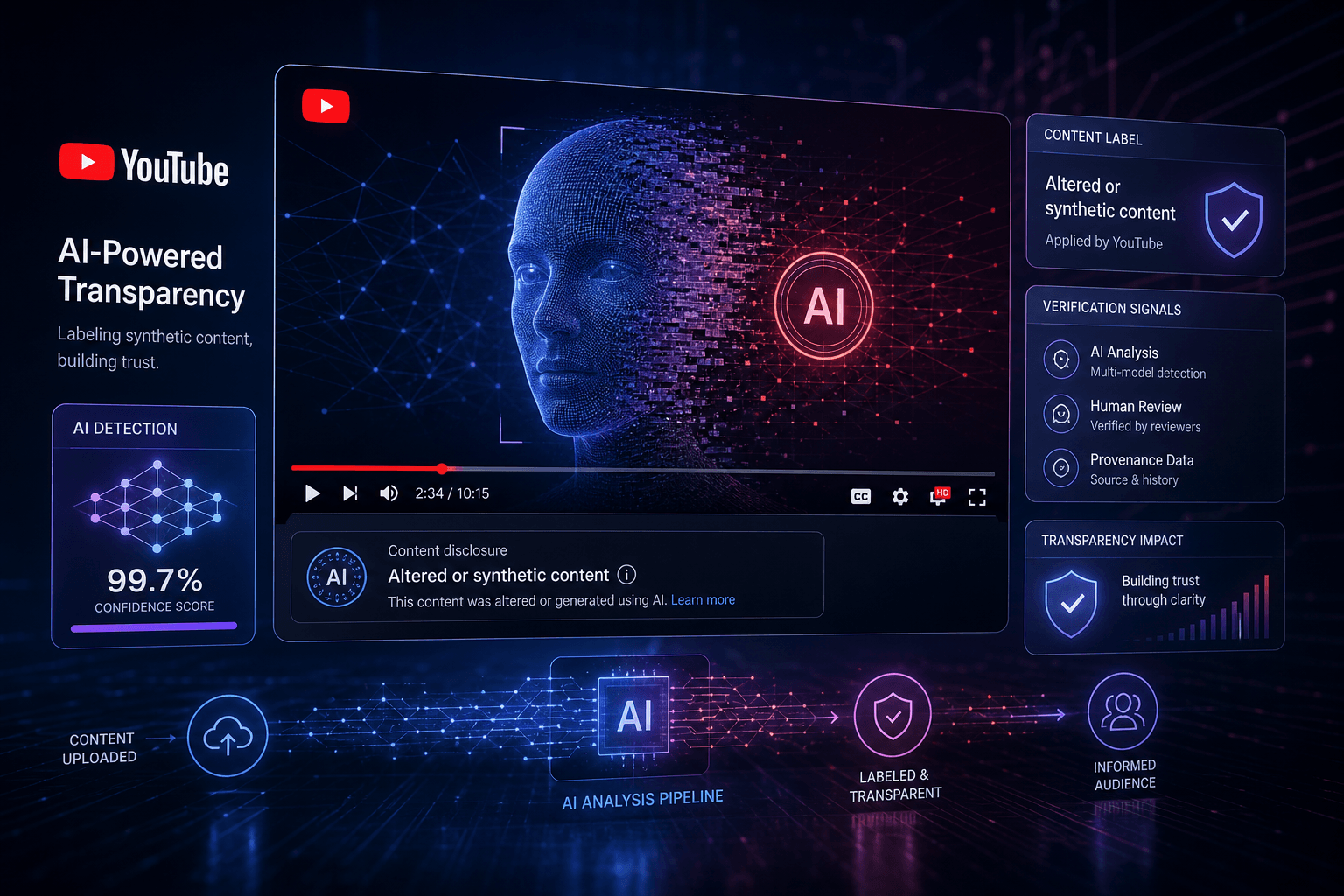
YouTube's New AI Content Labeling Requirements: What Creators Must Disclose

Table of Contents
YouTube's New AI Content Labeling Requirements: What Creators Must Disclose #
YouTube now requires creators to disclose when they upload realistic altered or synthetic content made with AI tools. The platform is rolling out new labeling options and penalties for non-compliance this month, fundamentally changing how AI-generated media is handled on the world's largest video platform.
This shift comes as generative AI tools become mainstream for creators—from AI voice clones and face swaps to fully synthetic video segments. YouTube's new policy creates a mandatory transparency layer that affects every creator using AI, regardless of channel size or monetization status.
Table of Contents #
- What Content Must Be Labeled Under YouTube's New Policy
- What AI Uses Are Exempt From Disclosure
- How the YouTube AI Labels Actually Work
- Sensitive Topics Get Prominent Labels
- Penalties for Failing to Disclose AI Content
- YouTube's AI Detection and Enforcement System
- Removal Requests for Synthetic Likeness
- What This Means for Creator Workflows
- The Future of AI Transparency on Social Platforms
- Frequently Asked Questions
What Content Must Be Labeled Under YouTube's New Policy #
Creators must label content that contains realistic altered or synthetic material generated using AI tools. YouTube's disclosure requirements target specific categories of AI-generated media that could mislead viewers about what they're watching.
The platform's policy focuses on three primary scenarios where AI labeling is mandatory:
| Scenario | Example | Label Required |
|---|---|---|
| Realistic fake events | AI-generated video depicting a disaster, protest, or incident that never happened | Yes |
| Synthetic versions of real people | AI face swap making someone appear to say/do something they didn't | Yes |
| Altered real footage | Genuine video with AI-modified elements that change its meaning | Yes |
Realistic altered or synthetic material is the key threshold. If an AI tool generates content that could plausibly be mistaken for authentic footage, it falls under the disclosure requirement. This includes:
- Deepfake videos showing public figures or private individuals in fabricated scenarios
- AI-generated news footage depicting events that didn't occur
- Synthetic b-roll inserted into otherwise authentic content
- AI voice clones replacing real audio with synthetic speech
- Face swaps that alter identity in realistic ways
YouTube's policy specifically calls out content showing someone "saying or doing something they didn't actually do" as a trigger for mandatory disclosure. The platform is particularly concerned about election-related content, with the 2024 U.S. election season driving urgency around these transparency measures.
The test is viewer deception: if a reasonable viewer could watch the content and believe they're seeing authentic footage when they're actually seeing AI-generated material, the disclosure box must be checked.
What AI Uses Are Exempt From Disclosure #
Not all AI use requires disclosure. YouTube explicitly exempts several categories of AI assistance that don't fundamentally alter the reality of what viewers see.
The platform recognizes that creators increasingly use AI as a production tool, and mere tool use doesn't constitute synthetic content requiring transparency. These uses are exempt from the labeling requirement:
Clearly Fictional or Artistic Content
- Animated fantasy scenes with obviously stylized visuals
- Science fiction content with spaceships, aliens, or impossible physics
- Abstract or surreal artistic creations
- Content where AI aesthetic is the entire point (AI art showcases)
Production Assistance Without Reality Alteration
- AI-generated thumbnails — AI-created preview images don't require video labeling
- Script drafting and ideation — Using AI to brainstorm or write scripts
- Captions and subtitles — AI-generated text overlays
- Color grading and correction — AI-enhanced visual polish
- Audio cleanup and enhancement — Noise reduction, EQ, compression
- Upscaling and resolution enhancement — Improving video quality without adding new content
Filters and Effects
- Beauty filters and cosmetic adjustments
- Background blur and virtual backgrounds
- AR filters and stickers
- Transition effects and motion graphics templates
The exemption test mirrors the labeling test: is the AI being used to change what's actually happening, or just how polished the presentation is? AI that improves production quality without manufacturing false reality stays exempt. A creator using ChatGPT to draft a script or Adobe Firefly to generate a custom thumbnail doesn't need to label their video—those are workflow tools, not reality distortion.
How the YouTube AI Labels Actually Work #
YouTube displays AI content labels in two places: a description panel indicator for all AI content, and a more prominent player label for sensitive-topic content. The system integrates directly into the upload workflow, requiring creators to actively select disclosure at the point of publication.
The Upload Disclosure Flow #
When creators upload a video to YouTube Studio, they now encounter disclosure options in the upload interface. The specific UI varies by platform (desktop Studio vs. mobile), but the core mechanism remains consistent:
- Upload the video through standard YouTube Studio workflow
- Select disclosure in the details or visibility section
- Mark content as containing "altered or synthetic material"
- Publish — the label automatically propagates to viewer-facing surfaces
YouTube doesn't publicly specify the exact checkbox wording creators see, but the requirement is framed as acknowledging when content "contains realistic altered or synthetic material."
Viewer-Facing Label Display #
Once labeled, viewers see disclosure in the description panel beneath the video:
Altered or synthetic content — This content has been altered or
generated using AI/ML technology.
This label appears consistently across all AI-disclosed content, regardless of topic sensitivity. It serves as baseline transparency without being intrusive to the viewing experience.
Platform-Wide Propagation #
The disclosure flag travels with the content across YouTube surfaces:
- Watch page — Description panel label appears
- Embed — Label carries through to embedded players
- Search results — AI-disclosed videos don't receive special badges in results
- Recommendations — Algorithmic distribution isn't visually flagged separately
YouTube's own AI-generated content receives the same labeling treatment. Videos created using YouTube Dream Screen or other first-party generative AI features automatically carry disclosure labels, modeling the behavior the platform expects from creators.
Sensitive Topics Get Prominent Labels #
YouTube applies enhanced labeling to AI content covering sensitive topics, displaying a prominent label directly in the video player rather than tucked away in the description. This two-tier system reflects the platform's risk assessment: some AI-generated content carries higher potential for real-world harm.
The sensitive topics triggering prominent player labels include:
| Topic Category | Examples | Label Placement |
|---|---|---|
| Elections | Campaign content, voting procedures, candidate statements | Video player overlay |
| Ongoing conflicts | War footage, military operations, geopolitical events | Video player overlay |
| Public health crises | Disease outbreaks, medical misinformation, health emergencies | Video player overlay |
| Public officials | Government leaders, elected representatives, law enforcement | Video player overlay |
YouTube's Jennifer Flannery O'Connor and Emily Moxley (Vice Presidents of Product Management) articulated this tiered approach in the platform's official policy announcement, emphasizing that "some synthetic media, regardless of whether it's labeled, will be removed from our platform if it violates our Community Guidelines."
The reasoning behind enhanced labels for sensitive topics is straightforward: viewers making decisions about voting, health, or public safety need maximum transparency about content authenticity. A hidden description label might not be noticed before a viewer forms beliefs based on potentially fabricated footage.
When Labels Aren't Enough #
YouTube reserves the right to remove AI-labeled content that still violates policies. A synthetic video depicting realistic violence, even properly labeled, can be removed if its goal is to shock or disgust viewers. Similarly, AI-generated election misinformation carries removal risk regardless of disclosure status.
This creates a three-tier enforcement model:
- Standard labeling — Description panel disclosure for general AI content
- Prominent labeling — Player overlay for sensitive-topic AI content
- Removal — Community Guidelines enforcement regardless of label status
Penalties for Failing to Disclose AI Content #
YouTube's enforcement escalates from warnings to serious consequences for creators who consistently fail to disclose AI-generated content. The penalty structure targets habitual non-compliance rather than honest mistakes.
The Enforcement Ladder #
| Violation Pattern | Consequence | Reversibility |
|---|---|---|
| First-time omission | Warning, content flagged for labeling | Correctable by adding label |
| Repeated omissions | Content removal | Appealable |
| Consistent non-compliance | YouTube Partner Program suspension | May be reversible after compliance period |
| Aggravated violations | Channel strikes, termination | Appealable through standard process |
YouTube explicitly warns that "creators who consistently choose not to disclose this information may be subject to content removal, suspension from the YouTube Partner Program, or other penalties." The key word is consistently — the platform is building a pattern-based enforcement system rather than hammering creators for single oversights.
YouTube Partner Program Impact #
For monetizing creators, YPP suspension represents the most significant penalty. Losing Partner Program status means:
- Immediate loss of ad revenue
- Ineligibility for channel memberships
- Loss of Super Chat, Super Stickers, and shopping features
- Potential impact on existing brand deals requiring YPP status
Suspension from YPP doesn't necessarily mean permanent banishment. YouTube's language suggests a compliance-based path to restoration: creators who demonstrate consistent disclosure practices after suspension can likely regain access.
Appeals and Dispute Resolution #
Standard YouTube appeals processes apply to AI labeling enforcement:
- Content removal appeals — Submit through Studio for review
- YPP suspension appeals — Formal reinstatement request process
- Strike appeals — Counter-notification where appropriate
Creators disputing AI labeling enforcement will need to demonstrate either (a) the content wasn't AI-generated, or (b) the AI use fell under exempt categories. Documentation of production workflows—showing what tools were used where—becomes valuable evidence in disputes.
YouTube's AI Detection and Enforcement System #
YouTube combines automated AI detection, human review, and community reporting to identify undisclosed synthetic content. The platform's enforcement architecture mirrors its existing content moderation systems, with AI classifiers handling scale and humans making final determinations.
The Three-Layer Detection Stack #
┌─────────────────────────────────────────────────────────────┐
│  LAYER 1: AI Classifiers                                     │
│  • Automated detection of synthetic media patterns           │
│  • Flags potentially undisclosed AI content                  │
│  • Generates scores for human reviewer attention             │
├─────────────────────────────────────────────────────────────┤
│  LAYER 2: Human Reviewers                                     │
│  • 20,000+ reviewers across Google                            │
│  • Confirm violations identified by classifiers               │
│  • Contextual judgment on edge cases                         │
├─────────────────────────────────────────────────────────────┤
│  LAYER 3: Community Reporting                                 │
│  • Viewer reports flag suspected undisclosed AI               │
│  • Creator community escalates concerns                        │
│  • Triggers targeted review of specific content                │
└─────────────────────────────────────────────────────────────┘
YouTube's generative AI content moderation strategy relies on expanding classifier training data. When new synthetic media threats emerge, the platform uses generative AI to rapidly create training examples, enabling classifiers to catch novel abuse patterns faster than traditional methods.
Community Guidelines Integration #
AI labeling enforcement operates within YouTube's broader Community Guidelines framework. The platform emphasizes that "all content uploaded to YouTube is subject to our Community Guidelines—regardless of how it's generated."
This means creators face two enforcement layers:
- AI disclosure layer — Did you label AI-generated content appropriately?
- Community Guidelines layer — Does the content violate harassment, misinformation, or harmful content policies?
A synthetic video can be perfectly labeled and still removed for Community Guidelines violations. Conversely, an unlabeled AI video might avoid removal if the content itself is benign—though the creator faces labeling enforcement.
The Speed Advantage #
YouTube's blog post notes that AI-powered moderation enables "identifying novel forms of abuse" more quickly. When a new deepfake technique emerges, generative AI helps create training data for classifiers within days rather than weeks, closing the gap between threat emergence and detection capability.
Removal Requests for Synthetic Likeness #
YouTube now enables individuals to request removal of AI-generated content that simulates their face or voice without permission. This privacy-based process operates separately from the labeling system and gives people direct recourse against unauthorized synthetic depictions.
Who Can Request Removal #
Two categories of rights-holders can file takedown requests:
- Individuals — Anyone whose identifiable likeness (face or voice) appears in AI-generated or synthetic content without authorization
- Music partners — Labels and distributors representing artists can request removal of AI-generated music mimicking an artist's unique singing or rapping voice
The process uses YouTube's existing privacy request infrastructure rather than copyright systems, acknowledging that synthetic likeness concerns are privacy violations rather than intellectual property issues.
Removal Decision Factors #
YouTube evaluates removal requests against several criteria, not all of which result in automatic takedown:
| Factor | Impact on Removal |
|---|---|
| Parody or satire | May weigh against removal |
| Unique identifiability | Must be clearly the requester |
| Public official status | Higher bar for removal (public interest) |
| News reporting | May protect synthetic content if journalistically relevant |
| Analysis or critique | Commentary on synthetic vocals may be protected |
Public figures and officials face a "higher bar" for removal, reflecting YouTube's balance between individual privacy and public interest in information about influential figures. A private citizen's unauthorized face swap has better removal odds than a public official's synthetic depiction in news commentary.
Music-Specific Provisions #
Artist voice cloning receives specialized treatment. YouTube's early AI music experiments program gives participating labels and distributors priority access to removal tools. The platform plans expanding access to "additional labels and distributors over the coming months," suggesting a gradual rollout rather than immediate universal availability.
This music-specific approach recognizes the explosion of AI-generated covers and voice clones on the platform, particularly using tools that can replicate distinctive vocal styles from short audio samples.
What This Means for Creator Workflows #
Creator workflows must now include AI disclosure checkpoints from production through publication. The labeling requirement adds friction to existing processes, but systematic documentation prevents last-minute compliance scrambling.
Production Documentation #
Creators using AI tools should maintain simple logs tracking:
- Which tools generated which segments
- Whether AI content is "realistic" or exempt
- Timestamps of AI-generated portions within longer videos
A basic tracking template:
Video: [Title]
Segment          | AI Tool Used      | Realistic? | Disclosure
-----------------|-------------------|------------|------------
0:00-0:30 intro | Synthesia avatar  | Yes        | Required
1:45-2:00 b-roll| Runway Gen-2      | Yes        | Required
3:20 thumbnail  | Midjourney        | No         | Exempt
This documentation becomes valuable if YouTube questions labeling decisions. Being able to demonstrate which tools were used where supports appeals and shows good-faith compliance efforts.
Upload Checklist Integration #
Standard upload workflows should now include an AI disclosure checkpoint:
- ✅ Video edited and finalized
- ✅ Title, description, tags complete
- ✅ Thumbnail created
- 🆕 AI disclosure reviewed — Any realistic AI content? Check the box if yes.
- ✅ Scheduled or published
Teams with multiple editors need clear communication protocols. The person uploading may not be the person who used AI during editing—handoff documentation prevents disclosure gaps.
Tool-Specific Considerations #
Popular creator AI tools and their typical disclosure requirements:
| Tool | Typical Use | Disclosure Required? |
|---|---|---|
| Synthesia, HeyGen | AI avatars, talking heads | Yes — realistic synthetic humans |
| Runway Gen-2, Pika | AI video generation | Depends — realistic footage requires disclosure |
| ElevenLabs | Voice cloning | Yes — realistic synthetic speech |
| ChatGPT, Claude | Script writing | No — exempt as production assistance |
| Midjourney, DALL-E | Thumbnails, graphics | No — exempt (unless video contains AI imagery) |
The key distinction remains: are viewers seeing AI-generated reality, or AI-assisted polish? Tools in the "production assistance" category don't trigger disclosure requirements even when they're sophisticated AI systems.
The Future of AI Transparency on Social Platforms #
YouTube's AI labeling requirements reflect a broader industry shift toward mandatory disclosure of synthetic media. Every major platform is implementing transparency measures as AI-generated content becomes indistinguishable from authentic footage.
Platform-by-Platform Comparison #
| Platform | AI Labeling Policy | Enforcement Level |
|---|---|---|
| YouTube | Mandatory disclosure for realistic AI; penalties for non-compliance | High — YPP suspension possible |
| TikTok | Labels AI-generated content; creator disclosure encouraged | Moderate — content labeling emphasis |
| Instagram/Facebook | "AI Info" labels on detected synthetic content; Meta-built AI labeled | Moderate — detection-based approach |
| X/Twitter | Limited formal policy; Community Notes may flag synthetic media | Low — minimal enforcement |
YouTube's approach is the most creator-accountable: active disclosure requirement with escalating penalties. Other platforms rely more heavily on automated detection and labeling rather than creator self-reporting.
The Regulatory Context #
YouTube's policy rollout coincides with broader regulatory pressure on AI transparency:
- EU AI Act — Mandates disclosure of AI-generated content in "deepfake" contexts
- U.S. state legislation — Multiple states considering synthetic media disclosure laws
- Platform self-regulation — Industry coalitions forming around AI transparency standards
Platforms are moving proactively to avoid government-imposed rules. YouTube's September 2024 enforcement timing positions the platform ahead of likely 2025 regulatory requirements.
What's Next for Creators #
The trend is clear: AI disclosure will become as standard as music licensing clearance. Creators should expect:
- Tighter detection — AI classifiers will improve at catching undisclosed synthetic content
- Broader scope — More AI use cases may move from "exempt" to "disclosure required"
- Cross-platform consistency — Industry standards emerging for unified disclosure
- Monetization linkage — Clear disclosure may become a requirement for monetization eligibility
Creators building systematic disclosure practices now will have advantages as requirements tighten. Those treating AI labeling as optional will face increasing friction.
Frequently Asked Questions #
Q: What happens if I forget to label my AI-generated content? #
YouTube treats single oversights differently from habitual non-compliance. A first-time omission typically results in a warning and content flagging rather than immediate penalties. However, creators who consistently fail to disclose AI-generated content face escalating consequences: content removal, suspension from the YouTube Partner Program, and potential channel strikes. The platform's enforcement language emphasizes "consistently choose not to disclose" as the trigger for serious penalties.
Q: Does AI-generated audio require the same disclosure as video? #
Yes, realistic AI-generated audio triggers the same disclosure requirements as video. If you use AI voice cloning (ElevenLabs, Play.ht, or similar) to create synthetic speech that mimics a real voice—including your own voice—you must disclose it. The "realistic" standard applies equally to audio: if listeners could believe they're hearing authentic recorded speech when they're actually hearing AI synthesis, the disclosure checkbox must be selected.
Q: Are AI-generated thumbnails required to be labeled? #
No, AI-generated thumbnails are exempt from video labeling requirements. YouTube explicitly states that "minor production assistance" including AI-generated thumbnails, filters, effects, and upscaling don't require disclosure. The video content itself must be labeled if it contains realistic AI material, but thumbnails are treated as separate production assets rather than part of the synthetic content being disclosed.
Q: Can I appeal if YouTube removes my content for an AI labeling violation? #
Yes, standard YouTube appeals processes apply to AI labeling enforcement. You can submit appeals through YouTube Studio for content removals, and formal reinstatement requests for YouTube Partner Program suspensions. Successful appeals typically require demonstrating either that (a) the flagged content wasn't actually AI-generated, or (b) the AI use fell under exempt categories like production assistance or clearly fictional content.
Q: How does YouTube know if content is AI-generated? #
YouTube employs a three-layer detection system combining AI classifiers, human reviewers, and community reporting. Automated classifiers scan for synthetic media patterns, flagging potentially undisclosed content for review by YouTube's 20,000+ human reviewers. Additionally, viewers and creators can report suspected undisclosed AI content, triggering targeted review. The platform also uses generative AI to rapidly train classifiers on new synthetic media threats as they emerge.
Q: Does labeling AI content affect my video's monetization or reach? #
Disclosure labels don't directly impact monetization eligibility or algorithmic distribution. YouTube has stated that properly labeled AI content isn't penalized in recommendations or search. However, content covering sensitive topics (elections, public health, conflicts) receives prominent player labels that may influence viewer behavior. Additionally, YouTube's July 2025 policy update made purely AI-generated videos without "genuine creative value" ineligible for monetization—adding commentary, storytelling, or editing to AI content maintains monetization eligibility.
Q: What if someone else uses AI to create content featuring me without permission? #
YouTube provides a privacy-based removal process for AI-generated content simulating identifiable individuals. You can submit a privacy request through YouTube's standard process to remove content showing your face or voice without authorization. YouTube evaluates these requests against factors including whether the content is parody or satire, whether you're uniquely identifiable, and whether you're a public official (which carries a higher removal bar). Music partners can also request removal of AI-generated songs mimicking artist voices.
Q: Are AI-generated music covers or voice clones required to be labeled? #
Yes, realistic AI-generated music and voice clones must be disclosed. If you create a cover using an AI voice model that mimics a specific artist's singing or rapping style, the video requires AI labeling. This applies whether you're cloning a celebrity voice or generating vocals with AI tools that produce realistic human-like singing. The September 2024 policy explicitly includes AI-generated music content in disclosure requirements.
Q: Does this policy apply to YouTube Shorts as well as long-form videos? #
Yes, YouTube's AI content labeling requirements apply to all video formats on the platform, including YouTube Shorts, livestreams, and standard long-form uploads. The disclosure checkbox appears in the upload interface regardless of content format. Short-form content actually faces heightened detection risk since AI-generated clips are easily mass-produced and platforms are particularly vigilant about viral synthetic media spreading misinformation.
Q: How do I label content that uses AI for some scenes but not others? #
You check the AI disclosure box if any portion of your video contains realistic altered or synthetic material. YouTube doesn't currently provide granular scene-by-scene labeling—it's a binary flag at the video level. The description panel label states that "some of the content was altered or synthetic," which accurately describes videos mixing authentic and AI-generated footage. Document which segments used AI tools for your own records, but the viewer-facing disclosure is all-or-nothing for the entire video.
Q: What counts as "realistic" AI content that needs labeling? #
"Realistic" content is media that could plausibly be mistaken for authentic footage by a reasonable viewer. YouTube's policy provides specific examples: AI-generated video depicting events that never happened, content showing someone saying or doing something they didn't actually do, and altered footage that changes the meaning of real events. The key test is whether viewers could be misled about what they're watching. Clearly stylized animation, obvious fantasy elements, and abstract artistic content don't meet the realistic threshold.
Q: When did YouTube's AI labeling requirements take effect? #
YouTube began rolling out AI content labeling requirements in September 2024. The platform announced the policy framework in November 2023 with a commitment to introduce disclosure options "over the coming months." By September 2024, the requirements are active and enforced, with creators facing penalties for consistent non-compliance. YouTube worked with creators during the rollout period to ensure understanding of the new requirements before full enforcement began.
AI Transparency at Scale #
YouTube's AI labeling requirements are just one component of a shifting transparency environment. As AI tools become standard in content production, creators and brands face mounting compliance complexity—disclosure requirements, removal request management, documentation standards, and cross-platform consistency.
The creators who thrive won't be those who treat compliance as an afterthought. They'll be the ones who build systematic AI governance into their workflows, automating documentation, standardizing disclosure practices, and staying ahead of platform policy shifts.
This is where automation meets creativity. I build AI-powered content operations that handle the compliance overhead while you focus on creation—tracking tool usage, flagging disclosure requirements, and generating documentation that protects your channel from enforcement action.
Book an AI automation strategy call to discuss how systematic AI governance can protect your content operation and free your creative energy.
Related reading:
- How AI Detection Systems Actually Work — Understanding the classifiers behind platform enforcement
- Content Moderation at Scale: How YouTube Reviews 500 Hours Per Minute — Inside YouTube's 20,000-reviewer human layer
- The AI Music Revolution: Artist Rights and Platform Policies — How voice cloning and AI covers are reshaping music rights
Related Posts
Google I/O 2026 Action List: How I Prompted Gemini 3.5 Flash and Antigravity Workflows
Google I/O 2026 just reset the AI tooling landscape. Here's the 9-action checklist for builders who want to ship this week, not just watch the keynote.
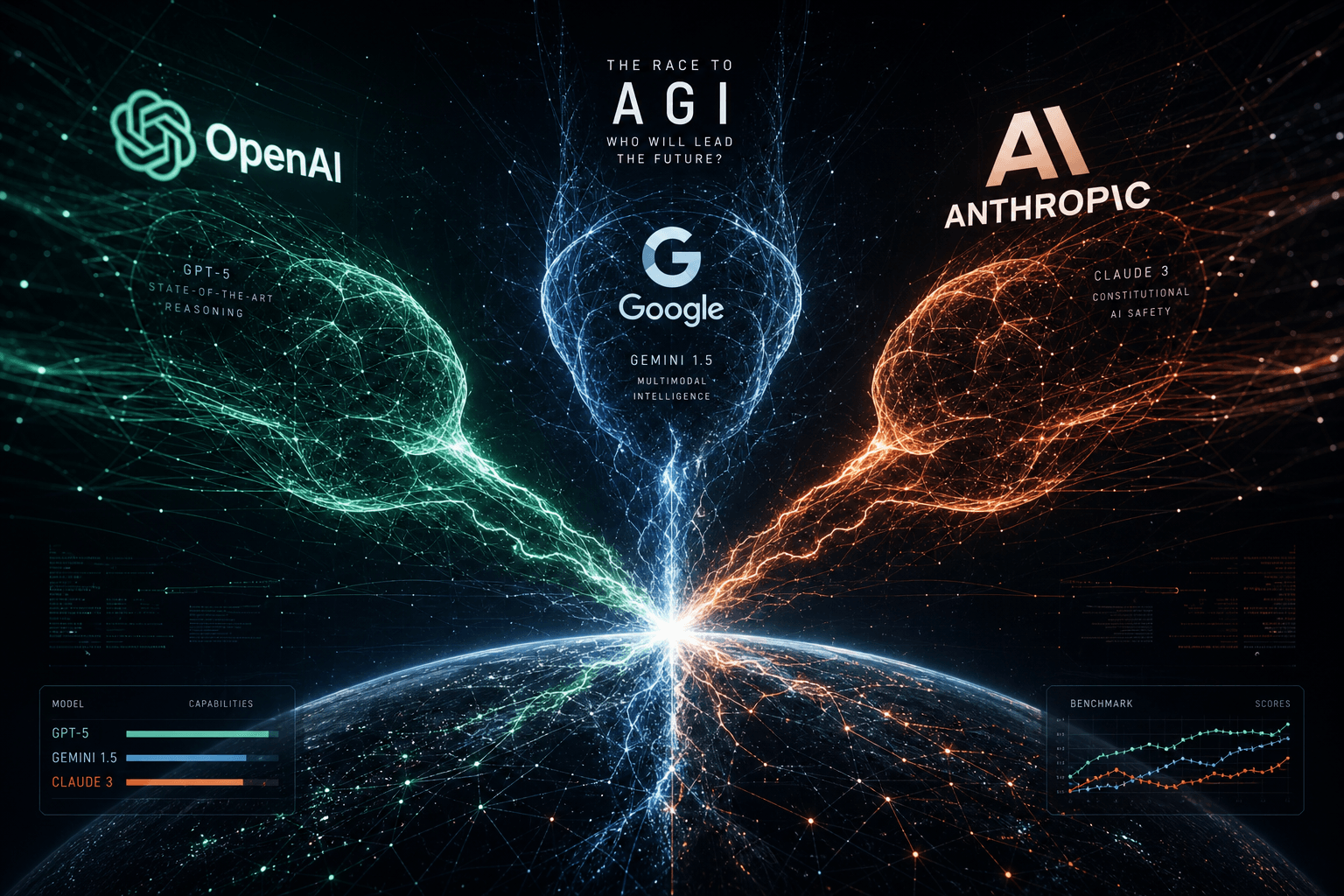
Anthropic vs. OpenAI vs. Google: The State of the Frontier in May 2026
A head-to-head breakdown of the three AI giants in May 2026: Claude Opus 4.6, GPT-5.3 and 5.4, Gemini 3.1 Pro. Real specs, real pricing, and what actually matters for builders.

Kimi K2 Open Weights: How I Prompted Moonshot's Frontier Model for Agentic Tool Use
How I direct Kimi K2 by Moonshot AI for agentic workflows, long-context tool calling, and workflow automation. A 1 trillion parameter MoE model with competitive benchmarks at 5-17x lower cost than GPT-5 and Claude.