Zapier vs. n8n: Why Your Business Needs Open-Source Automation in 2024

Table of Contents
Zapier vs. n8n: Why Your Business Needs Open-Source Automation in 2024 #
We are squarely in the era of doing more with less. If you are breathing life into a modern business, managing a startup, or scaling an enterprise, you are likely already utilizing some form of digital automation. But as workflows scale and data grows exponentially, many founders and technical operators hit a highly painful, incredibly expensive structural ceiling.
For nearly a decade, Zapier has been the unquestioned king of the integration ecosystem. It’s simple, ubiquitous, and historically reliable. However, the rise of powerful, developer-friendly open-source alternatives—led aggressively by n8n—is prompting CTOs and automation engineers to fundamentally rethink how they handle API plumbing.
Should you stick with the predictable comfort of Zapier, or is it absolutely essential that you deploy your own instance of n8n? Here is the definitive, deep-dive breakdown of the modern automation landscape.
1. The SaaS Integration Bottleneck #
Before we compare the tools, we must articulate the exact problem they solve.
The Explosion of Micro-SaaS #
Ten years ago, a company bought a single monolithic software suite to run its business. Today, an average mid-sized company uses over 100 distinct SaaS applications to operate: Slack for communication, Salesforce for leads, Jira for engineering, Stripe for billing. They are all highly specialized, but out of the box, they don't speak to one another.
Bridging the API Gap #
If Stripe doesn't natively talk to Slack, human beings have to manually copy and paste transaction data. This is the integration bottleneck. Zapier and n8n both exist as universal translators. They sit in the middle of these 100+ applications, catch the raw data from Application A, translate the underlying JSON payload, and physically push it into Application B. The fundamental difference between the platforms lies in how they allow you to structure those translations.
2. The Zapier Ecosystem Advantage #
It would be foolish and disingenuous to dismiss Zapier. It remains the gold standard for "no-code" connectivity for a very specific reason: market dominance.
The Unrivaled 6,000+ App Library #
The primary, undeniable advantage of Zapier is its sheer ecosystem size. With over 6,000+ app integrations out-of-the-box, if a SaaS app was built with an API in the last five years, it almost certainly has a native Zapier connector. You simply connect your account via OAuth and you are ready to go.
A Masterclass in User Onboarding #
Furthermore, Zapier is incredibly intuitive. The abstraction layer is flawless. A non-technical marketing manager who doesn't know what a webhook is can string together a lead-generation workflow in ten minutes. Zapier abstracts away the terrifying complexities of header variables, JSON parsing, API pagination, and authentication handshakes.
3. The Limitations of Linear Workflow Architecture #
While Zapier is brilliant for moving data from Step 1 to Step 2, its core architecture begins to buckle under the weight of enterprise logic.
The "If This Then That" Trap #
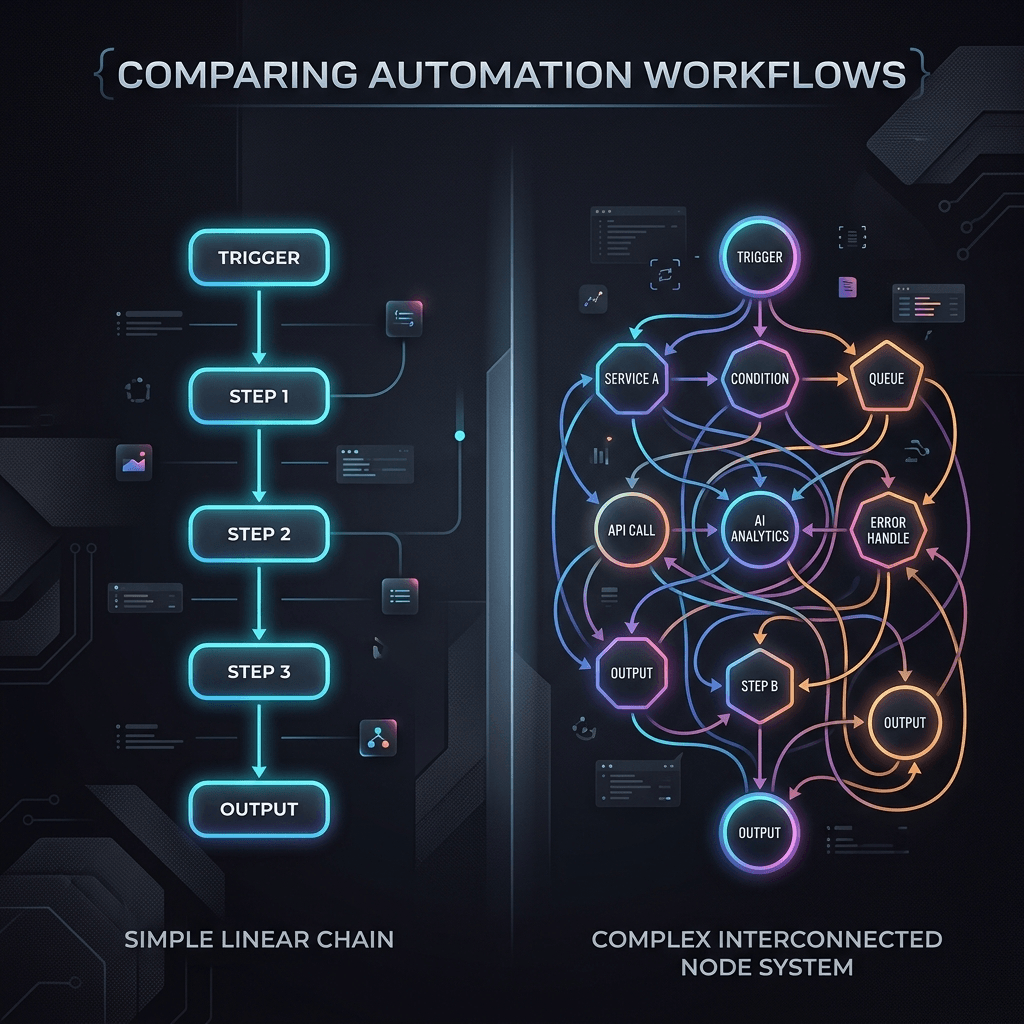
Zapier was built on a linear philosophy. It excels at a straight line. But business logic is rarely a straight line. When you attempt to build a Zapier workflow that requires complex routing—If the lead is over $5k go here, if the lead is in the EU go here, if the lead has no email pause for two days then send a webhook—the interface becomes a nightmare.
The Cost of Visualizing Complexity #
Zapier handles branching via "Paths." But building a 5-way nested Path in Zapier is not only visually confusing to audit, it is incredibly difficult to debug. You cannot easily see the "big picture" of the workflow because the steps are buried inside scrolling drop-down menus. Building a 50-step automation in Zapier feels like trying to write a novel via text message.
4. Enter n8n: The Node-Based Powerhouse #
This brings us to n8n, a fair-code, self-hostable workflow engine that visually resembles a neural network more than a spreadsheet.
The Infinite Canvas #
Unlike Zapier’s rigid vertical lists, n8n visualizes workflows as interconnected nodes on a vast, infinitely scrollable canvas. You drag a line from Node A to Node B to Node C. If you need the workflow to split into six different directions simultaneously, you simply drag six lines out of a Switch node. It feels like drawing on a whiteboard.
Debugging with Absolute Transparency #
When an n8n node executes, you can click on it and instantly see the raw JSON output on the right side of your screen. If an automation fails at step 24 out of 50, n8n highlights the exact node in red. You can view the raw payload that caused the failure, write a fix, and confidently re-run the exact data packet without having to trigger the whole workflow from the beginning.
5. Low-Code vs. No-Code Philosophies #
The difference between Zapier and n8n extends beyond the UI; it reflects two totally different philosophies regarding technical capability.
Abstracting the Code (Zapier) #
Zapier assumes you do not want to see code. It hides the API completely, giving you clean text boxes to fill out. This is great until Zapier's pre-built integration is missing a specific feature. If the Zapier "Create Contact" action doesn't support the custom "Birthday" field you need, you are entirely out of luck. You must wait for Zapier to update the application.
Exposing the Code (n8n) #
n8n assumes you appreciate the code. If a native integration doesn't exist, n8n offers absolute freedom. You can inject a "Code" node and write custom JavaScript or Python directly into the center of the workflow to parse an array or format a complex timestamp. Furthermore, n8n doesn't hide the data; you map variables directly using explicit JSON dot-notation expressions.
6. The True Cost of High-Volume Automation #
Perhaps the most aggressive and highly debated driver of the Zapier-to-n8n migration is the fundamental pricing model.
The Danger of Task-Based Billing #
Zapier charges per "Task." If a single automation executes 5 steps to process one customer, you are billed 5 Tasks. If you have 10,000 customers a month, that is 50,000 Tasks. In Zapier's pricing model, scaling your business success aggressively punishes your wallet. An automated business running high volumes will easily see recurring bills of $2,000 to $5,000 a month on Zapier purely in task overages.
n8n's Predictable Scaling #
n8n flips the script. Because n8n is source-available, you can self-host the entire engine on a platform like DigitalOcean or AWS. You pay standard server hosting fees (often $20 to $60 a month), and that is it. Under a self-hosted model, you are not charged per execution. Run 5,000 tasks or 5,000,000 tasks—your monthly bill remains exactly the same. Even n8n's managed Cloud option bills by "Workflows Executed" rather than individual tasks, scaling substantially better than Zapier.
7. Advanced Customization and HTTP Requests #
What happens when your core operational SaaS platform isn't supported natively by your automation platform?
The Generic Integration Hurdle #
In Zapier, connecting to an unsupported API requires using Webhooks or their relatively rigid API Request beta tool. It can be cumbersome and relies heavily on Zapier's interpretation of headers and authentication.
n8n's Ultimate Weapon: The HTTP Request Node #
In n8n, the generic HTTP Request node is arguably the most powerful tool on the canvas. It allows you to build custom, authenticated API calls (GET, POST, PUT, DELETE) completely from scratch. You provide the headers, you pass the payload, and you define the authentication architecture. If an obscure software tool has public API documentation, you can integrate it directly into n8n as if it were natively supported.
8. Data Privacy, Compliance, and Self-Hosting #
The enterprise sector views automation entirely through the lens of data sovereignty and regulatory compliance.
The Third-Party Server Risk #
When you use Zapier, highly sensitive information—patient records, unencrypted financial ledgers, proprietary software schematics—must physically leave your corporate network and process through Zapier's cloud infrastructure. For healthcare providers constrained by HIPAA, or finance orgs bound by SOC-2, this is a massive, often disqualifying security bottleneck.
The Self-Hosted Perimeter #
n8n's ability to be entirely self-hosted via Docker or NPM fundamentally solves the enterprise security dilemma. You install n8n directly behind your proprietary corporate firewall. Your automations run on your bare-metal servers. The sensitive data is parsed, routed, and dumped into your secure databases without a single byte ever hitting a public cloud environment or shared SaaS infrastructure.
9. AI Integration Capabilities #
As the world transitions to agentic workflows governed by Large Language Models (LLMs), how do these platforms stack up?
Zapier's Linear AI Approach #
Zapier has done a commendable job introducing AI, specifically through OpenAI step actions and its newer Central product. However, because of its linear nature, building complex, looping LLM reasoning chains (where an AI checks its own work multiple times) is incredibly difficult to scaffold.
n8n and LangChain Natives #
n8n is rapidly becoming the de facto tool for building complex AI Agents. It natively integrates the profound architectural complexities of LangChain straight into its nodes. You can drag a vector memory store onto the canvas, attach it to a Claude 3.5 Sonnet processing node, and wire it up to a Slack trigger—effectively visually building a Retrieval-Augmented Generation (RAG) pipeline in ten minutes. It’s a completely different league of AI orchestration.
10. Making the Transition: When to Migrate #
It is critical to evaluate if the pain of migrating is worth the immense operational gain. When should you make the leap?
Stick with Zapier If: #
- Your workflows represent simple A-to-B data relays (e.g., "Send an email when a Typeform is submitted").
- You rely heavily on niche, obscure apps without public API access.
- Your total monthly task volume is under 5,000, and your Zapier bill is negligible.
- Your team lacks basic technical literacy (specifically, an aversion to JSON).
Migrate to n8n If: #
- Your Zapier bill has crossed $250/month and is continuing to scale rapidly against your margins.
- You are trying to build complex 20+ step automations with multiple conditional routing paths.
- Your organization has strict data sovereignty limitations requiring air-gapped infrastructure.
- You want to begin deploying advanced, multi-tool autonomous AI agents.
FAQ Section #
Q: Is the community version of n8n completely free forever? #
A: Yes. Under the "fair-code" license, n8n’s community edition is entirely free to download, install via Docker or npm, and use internally for your business without arbitrary limits on nodes or workflow counts.
Q: Do I need to be a senior software developer to use n8n effectively? #
A: Not necessarily. While it is certainly harder to learn than Zapier, a technically-minded operator who understands basic JSON formatting and API concepts can master the platform in a matter of weeks without writing pure code.
Q: Does n8n have fewer app integrations than Zapier? #
A: Yes, n8n natively lists around 1,000+ nodes while Zapier boasts over 6,000. However, most modern platforms have open APIs, and n8n’s highly capable HTTP Request node allows you to manually integrate almost anything natively.
Q: Can n8n handle custom JavaScript in the middle of a workflow? #
A: Absolutely. If you hit an absolute logical roadblock using the visual interface, you can deploy a "Code" node to write raw JavaScript (or Python) to loop arrays or parse hyper-complex data payloads cleanly before the workflow continues.
Q: What is the main difference in debugging between Zapier and n8n? #
A: Zapier hides the backend logic, making tracing errors through nested paths extremely frustrating. n8n highlights failed nodes exactly where the pipeline broke and explicitly prints out the incoming failed JSON payload right on your screen.
Q: Is n8n Cloud drastically cheaper than Zapier? #
A: In almost all high-volume use cases, yes. Zapier chargers per step executed. n8n Cloud calculates pricing based on total workflow executions. If a workflow has 80 nodes, n8n Cloud bills it as one single unified execution.
Q: How difficult is the process of self-hosting n8n? #
A: If you are comfortable provisioning a generic Linux server on DigitalOcean and understanding basic Docker Compose commands, setting up a secure, production-ready n8n instance takes an experienced developer less than 30 minutes.
Q: Can I run local open-source AI models alongside n8n? #
A: Yes. Unlike Zapier, which is entirely reliant on cloud APIs, n8n natively integrates with tools like Ollama. This means you can run powerful open-source models completely locally on the same server, ensuring total data privacy.
Q: Will n8n workflows break if an external API changes? #
A: Like any automation tool, if an external SaaS company breaks or radically changes its API endpoints, the corresponding node may fail. However, open-source communities like n8n's often patch these breaking changes far faster than monolithic corporations.
Q: Can I export my Zapier Zaps directly into n8n? #
A: Due to fundamental architectural differences between Zapier's standard linear paths and n8n's complex graph models, there is no automatic "1-click import" tool. You will need to manually reconstruct your business logic.
Conclusion #
If your business is relying heavily on simple, two-step automations to move contacts from a form into Mailchimp, Zapier absolutely remains your best bet. Do not break what isn't broken.
However, if you are scaling complex data pipelines, experiencing shock when viewing excessive task-based pricing tiers, and finding Zapier’s rigid logic constraints structurally limiting, investigating n8n is no longer heavily optional—it is a competitive necessity. The barrier to entry for establishing highly technical, fully-owned automation architecture has never been lower.
Related Posts

How to Stop Client-Facing AI Agents From Hallucinating
Client-facing AI agents hallucinate when they answer without grounding. Here's the layered guardrail stack I use to keep agents accurate and on-script.

AI Sales Systems vs Traditional CRM Automation
Traditional CRM automation fires rules; AI sales systems reason about each lead. Here's how they differ, where each wins, and how to combine them.

The Manual Workflows With the Highest ROI When Replaced by AI Agents
Not every task is worth automating. Here are the manual workflows with the highest ROI when you replace them with AI agents, ranked by payback speed.