Zero-Click Search: How to Measure Value When Nobody Clicks
Table of Contents
Zero-Click Search: How to Measure Value When Nobody Clicks #
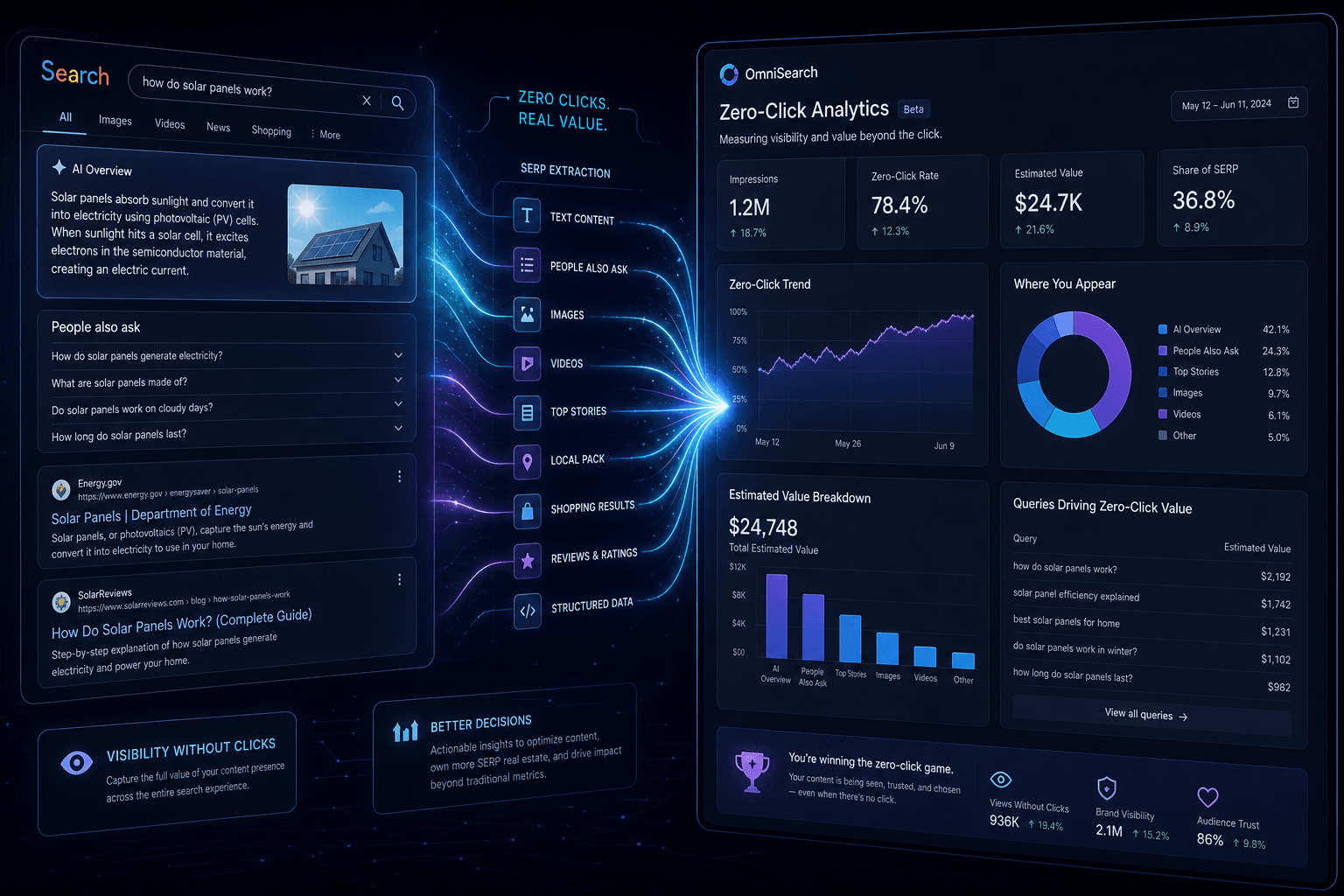
Zero-click search stopped being a theory the month Google shipped AI Overviews to the U.S. in May 2024 — and by mid-2024, a SparkToro and Datos clickstream study already showed 58.5% of U.S. Google searches and 59.7% of EU Google searches ending without a click. Google expected AI Overviews to reach over one billion users by the end of 2024. If your dashboard still treats every impression as a future click, you're measuring a channel that no longer exists.
William Spurlock here — AI Solutions Architect and Fractional AI CTO. I audit sites whose Google Search Console shows impressions climbing while clicks flatline. The content is still visible. The brand still shows up inside AI summaries. But GA4 says traffic dropped, leadership asks what broke, and the SEO team gets blamed for a ranking problem that isn't one.
The short version: zero-click search is a measurement problem before it's a traffic problem. Traditional SEO metrics — rank, CTR, sessions — still matter for pages that earn clicks. AI visibility metrics — citation rate, share of AI voice, branded search lift, assisted conversions — matter for pages that earn exposure without a click. You need both dashboards, not a fight over which channel is "real."
This post is the analytics companion to The Overlap Between SEO and AI Visibility, and Where They Split. That piece maps where ranking and citation diverge. This one maps how to count value when citation wins and clicks don't.
If you're still reporting SEO success as "organic sessions from Google," you're describing maybe half the picture on an informational site. The other half — brand exposure inside AI answers, assisted branded search, referral traffic from Perplexity and ChatGPT — doesn't show up in the default GA4 landing page report. That's not a tooling failure. It's a category error. Zero-click search didn't remove your visibility. It removed the click as the only unit of account.
What I see on audits in mid-2026:
- Informational content — highest zero-click exposure, lowest direct ROI in last-click models
- Comparison and decision content — partial zero-click, but clicks still happen when AI summaries can't pick a winner
- Transactional content — mostly unaffected by AI Overviews today, still measured cleanly in GA4
- Branded queries — often the lagging indicator that proves AI visibility worked even when non-branded clicks fell
The rest of this post gives you the metric map, the GEO measurement framework, the AI Overview tracking setup, and the FAQ block I wish more analytics teams had bookmarked six months ago.
What's the Difference Between AI Visibility Metrics and Traditional SEO Metrics? #
Traditional SEO metrics measure whether Google sends a visitor to your URL; AI visibility metrics measure whether AI systems surface your brand, content, or entity inside an answer — with or without a click. They share some inputs (rankings, authority, structure) but they answer different business questions.
Here's the split I use with client sites. Traditional SEO tells you if you're in the race. AI visibility tells you if you're on the podium when the race ends without anyone crossing the finish line on your domain.
| Metric | Traditional SEO | AI Visibility (AIO/AEO) | What Changed |
|---|---|---|---|
| Primary success signal | Organic clicks from Google | Citation / mention inside AI answers | Exposure can happen without a session |
| Impressions | GSC search impressions | AI answer appearances + query coverage | No native "AI impression" field in GSC yet |
| CTR | Clicks ÷ GSC impressions | Citation rate ÷ tracked AI queries | CTR collapses on informational queries when AI Overviews appear |
| Rank | Average position in blue links | Citation position inside AI block | Position 1 can still mean zero clicks |
| Traffic source | Google organic in GA4 | Fragmented: Google organic + referral from AI apps + direct branded | AI referral traffic is under-tagged |
| Conversion path | Last-click from organic session | Assisted: AI exposure → branded search → conversion | Attribution models miss the first touch |
| Content goal | Rank and earn the click | Rank, get cited, earn branded recall | Extraction-readiness becomes a KPI |
| Reporting cadence | Weekly GSC + GA4 | Weekly GSC + monthly AI citation audit | Manual citation tracking still required |
The data backs up why this table matters. An Ahrefs study from April 2025 aggregated Google Search Console data on 300,000 informational keywords and found that the presence of an AI Overview correlated with a 34.5% lower average CTR for the top-ranking page. Seer Interactive's September 2025 update found organic CTR for informational queries with AI Overviews fell 61% since mid-2024 — but being cited in the AI Overview can lift CTR versus not being cited.
Read that again. Citation isn't consolation prize traffic. It's a different success state with its own ROI. A page cited inside an AI Overview may lose the informational click and still win the branded search three days later when the user remembers your name.
Zero-click search doesn't mean zero value. It means the value moved from a single metric (organic clicks) to a stack of metrics (citations, branded search, assisted conversions, AI referral sessions). If you're only watching the first one, you're under-reporting ROI and over-panicking about traffic charts that reflect SERP design — not content failure.
Traditional SEO metrics still matter for:
- Transactional pages where AI Overviews rarely appear
- Complex comparison content where users click through for nuance
- Any query where your page holds position 1-3 and CTR hasn't moved
AI visibility metrics matter when:
- GSC shows impressions up, clicks down, CTR falling on informational queries
- Your content answers a question completely in two paragraphs — exactly what AI Overviews extract
- Leadership asks whether you're showing up in AI search and GA4 has no clean answer
I don't replace SEO reporting with AI reporting. I stack them. Same content cluster, two scoreboards. For the structural side of making content citable, start with FAQ Schema and AEO: The Highest-Yield Move for AI Citation — FAQPage JSON-LD is still the fastest signal you can add while you build the analytics layer.
Three AI visibility metrics I track on every audit that have no traditional SEO equivalent:
- Citation rate — percentage of target queries where your brand or URL appears inside the AI answer block
- Share of AI voice — your citations divided by total citations across competitors for the same query set
- Branded search lift — week-over-week change in branded queries in GSC after AI citation campaigns go live
None of these live in a single out-of-the-box GA4 report. That's the gap this post closes.
The Three Numbers That Replace CTR as Your North Star (On Informational Content) #
On pages where AI Overviews dominate, I stop treating CTR as the primary KPI. These three numbers tell me more:
- Citation rate (weekly) — Whether you appear inside the AI block on your target query sample. Target: trend up month-over-month after structural AEO changes.
- Impression-only reach (monthly) — GSC impressions minus clicks on tagged informational URLs. This estimates how many times Google showed a result associated with your site while the user may have gotten the answer without visiting. It's rough. It's still better than ignoring the gap.
- Branded search delta (28-day rolling) — Did branded queries in Google Search Console rise after citation rate improved? This is the assisted-conversion signal zero-click models hide.
If citation rate is flat, CTR is falling, and branded search is flat — your content ranks but isn't extractable. Fix structure first: FAQPage schema, bold H2 openers, entity definitions. That's the playbook in FAQ Schema and AEO: The Highest-Yield Move for AI Citation.
If citation rate is rising, CTR is falling, and branded search is rising — zero-click search is working. You're losing the informational click and winning recall. Report it that way or your stakeholders will think SEO is failing when it's repositioning.
How Do I Measure the Impact of GEO Efforts on Organic Traffic? #
Measure GEO (Generative Engine Optimization) impact on a split scoreboard: track organic clicks separately from AI citation coverage, then connect the two through branded search and assisted conversions — because GEO often moves the middle of the funnel, not the first click. If you only watch organic sessions, you'll conclude GEO failed when it actually shifted how people find you.
GEO is the work of making your content extractable and citable by Google AI Overviews, ChatGPT, Perplexity, and similar answer engines. The impact on "organic traffic" is rarely a clean +20% sessions line. It's messier and more useful than that.
Here's the diagnostic pattern I look for first. Run your top 50 informational URLs through Google Search Console for the last 90 days. Sort by largest CTR decline with stable or rising impressions. That fingerprint — impressions up, clicks down — is the AI Overview displacement signature described in The Overlap Between SEO and AI Visibility, and Where They Split. Those pages aren't necessarily losing rankings. They're losing clicks to zero-click answers.
The Pew Research Center behavioral study from July 2025 quantifies the user behavior behind that fingerprint: when an AI summary appeared, users clicked traditional links in only 8% of visits, compared to 15% when no AI summary appeared. Half the click behavior evaporated — not because your content got worse, but because the SERP layout changed.
My GEO impact measurement framework runs in four layers:
Layer 1 — Protect the click traffic you still own. Filter GSC to transactional and commercial queries. Track clicks, CTR, and average position weekly. GEO work shouldn't tank these. If it does, you probably changed URL structure or removed keyword intent — fix that before blaming AI.
Layer 2 — Quantify zero-click exposure. For your informational query set, track total impressions and total clicks monthly. Calculate "impression-only reach" — impressions minus expected clicks at your historical CTR baseline. That delta is your estimated zero-click exposure volume. It's an estimate, not gospel, but it stops the conversation from being purely emotional.
Layer 3 — Track citation outcomes from GEO changes. After adding FAQPage schema, bold direct answers, and entity-first definitions to a page group, run a manual citation audit at day 0, day 30, and day 90. Count how many target queries cite your brand or URL inside the AI Overview or Perplexity answer. Seer's data shows cited pages can outperform uncited pages on CTR even within the same AI Overview SERP — citation is measurable and it moves the needle.
Layer 4 — Connect to revenue through branded search. In GSC, isolate branded queries (yourbrand, yourbrand + topic). Plot 12-week trend against your GEO content updates. I consistently see branded search volume climb 2-8 weeks after citation frequency improves on informational queries — the user didn't click the first time, but they remembered the name.
A practical note on query tagging: export your GSC query report and add a column for ai_overview_eligible based on intent classification. Simple "what is" and "how to" queries with high impressions get tagged yes; transactional queries get tagged no. Filter your CTR charts by that tag. The delta between eligible and non-eligible query CTR is the cleanest single chart I know for isolating GEO impact from broader SEO noise.
For GA4 specifically, build a custom exploration with these segments:
- Google organic — non-branded (did SEO click traffic hold?)
- Google organic — branded (did AI exposure drive recall?)
- Referral — AI domains (ChatGPT, Perplexity, Claude, Gemini referrer patterns)
- Direct + branded landing (often the tail of an AI-assisted journey)
GEO didn't fail if non-branded clicks dipped 12% but branded clicks rose 9% and demo form submissions from branded landing pages held steady. That's a channel mix shift, not a collapse.
One opinion I'll stand behind: stop asking "did GEO increase traffic?" and start asking "did GEO increase qualified discovery?" Traffic is a proxy. Discovery — someone knowing your brand exists and trusting it enough to search or convert — is the outcome. Zero-click search forces that distinction.
GEO Before and After: What the Dashboard Should Look Like #
When GEO work is working, you should see this pattern within 60-90 days on updated informational clusters — not overnight, but directionally clear:
| Signal | Before GEO + AEO Structure | After GEO + AEO Structure |
|---|---|---|
| GSC impressions (informational) | Stable or rising | Stable or rising |
| GSC clicks (informational) | Flat or declining | May still decline — don't panic |
| GSC CTR (informational) | Falling on AI Overview queries | Decline slows or stabilizes on cited pages |
| AI Overview citation rate | Low or zero on target queries | Measurable increase on sample set |
| Branded search volume | Flat baseline | Uptick 2-8 weeks after citation gains |
| Perplexity/ChatGPT referral (GA4) | Minimal | Incremental growth on cited topics |
| Demo/form conversions from branded landing | Baseline | Held or improved despite non-branded click dip |
The row that trips people up: clicks may still decline after GEO wins. Citation rate and branded search are the compensating signals. If you report only clicks, you will defund the work that's building recall.
For attribution specifically, switch GA4's model comparison view between last-click and data-driven attribution on your primary conversion event. On sites with heavy informational content, data-driven models often assign more credit to early-touch organic and branded direct sequences — exactly the path zero-click search creates. It's not perfect. It's closer than last-click organic-only reporting.
How Do I Track AI Overview Inclusion Over Time? #
Track AI Overview inclusion with a repeatable query sample, a weekly citation log, and GSC impression/CTR trendlines — because Google still doesn't give you an "AI Overview appearances" column in Search Console. Manual tracking sounds annoying. So does flying blind while your CTR drops 34-61% on informational queries.
There's no official API that returns "you were cited in an AI Overview on June 3." Until that exists, the operators who win run a disciplined sampling system. Here's the setup I deploy on client sites — seven steps, roughly half a day to stand up, an hour a week to maintain.
Build your query sample list. Export your top 100-200 informational queries from GSC (90-day window, sorted by impressions). Tag each with intent: simple informational, comparison, how-to, transactional. AI Overview tracking only matters on the first three categories.
Create a baseline citation sheet. Columns: date, query, AI Overview present (Y/N), your brand cited (Y/N), your URL cited (Y/N), competitor citations, screenshot link. Run the full list once in incognito with a clean browser profile. That's your day-zero baseline.
Schedule weekly spot checks. Every Monday, re-run 25-50 queries from the sample — rotate through the full list monthly. Consistency beats volume. One person, same browser settings, same geo if you're targeting a specific market.
Pair with GSC CTR monitoring. For each query in your sample, pull 28-day CTR and impression trends in GSC. When AI Overview presence goes from N to Y and CTR drops, you've confirmed causation for that query — not just correlation across the site.
Log SERP feature changes separately from ranking changes. A position drop from 3 to 8 is an SEO problem. Position holding at 2 while CTR drops 40% is an AI Overview problem. Tag these differently in your reporting or you'll send the wrong fix team.
Track citation rate as a rolling metric. Formula: (queries where you're cited ÷ queries where AI Overview appears) × 100. Plot weekly. This is your primary AI Overview KPI until Google ships something native.
Review monthly and adjust the query sample. Add rising queries from GSC. Drop queries you've fully lost or won. Refresh the sample so you're tracking where the business actually competes, not where it competed last quarter.
For Perplexity and ChatGPT citation tracking, duplicate the same sheet with separate tabs — query, cited (Y/N), citation context (brand mention vs URL link), date. Perplexity often links sources directly; ChatGPT varies by mode and browsing settings. Treat them as separate channels with separate citation rates.
Prompt template I use when prioritizing which queries to check first (intent classification only — no LLM can predict whether Google will actually show an AI Overview on a given query):
"Given this list of 50 search queries about [topic cluster], classify each by intent: simple informational, comparison, how-to, or transactional. For the informational and comparison queries, note which of my pages at [domain] would be the most likely candidate to address that query based on URL slug and title alone."
That sorts your query list by intent so you spend manual SERP time on the right queries. The actual check — whether an AI Overview appears and whether you're cited — still requires opening an incognito browser.
If you're waiting for a perfect dashboard before you start tracking, you'll lose another quarter of data. The Ahrefs 34.5% CTR finding and Seer's 61% informational CTR decline are site-level aggregates. Your site has its own query mix. The weekly citation log is how you make those industry stats actionable for your URLs.
Five Tracking Mistakes I See on Every Audit #
These aren't theoretical — they're the reasons citation data looks noisy or GEO looks like it failed when it didn't.
- Checking citations logged-in or personalized. Your Google results aren't your user's results. Incognito, clean profile, consistent geo. Logged-in Google accounts skew AI Overview presence.
- Mixing ranking drops with AI Overview displacement. Pull average position alongside CTR. If position holds and CTR falls, you're in zero-click territory. If position falls, fix SEO first.
- Using a query sample that's too small or too stale. Ten head terms aren't enough. Rotate 100-200 queries from GSC and refresh monthly.
- Expecting GA4 to show AI Overview value directly. It won't for zero-click exposures. Pair GA4 with GSC and manual citation logs — always.
- Reporting citation wins without branded search follow-through. If citations rise for 90 days and branded search doesn't move, you're getting attributed in AI blocks users don't trust — or you're cited on queries with no commercial intent. Re-segment the query sample.
Automation helps at the margins. I wire n8n workflows that pull GSC data on a schedule and ping Slack when CTR drops more than 20% week-over-week on tagged URLs. The Airtable citation log still needs manual entries — there's no API that tells you when you appeared in an AI Overview. The automation handles the GSC metrics side; the citation side still needs human eyes weekly. AI SERPs change too fast to fully hands-off this in mid-2026.
How to Present Zero-Click Value to Stakeholders Who Only Trust GA4 #
The hardest part of zero-click measurement isn't technical — it's the board meeting where someone asks why organic sessions dropped 18% while revenue held. Here's the narrative I use with data attached:
Slide 1 — The industry context. Cite the SparkToro zero-click baseline (58.5% U.S. / 59.7% EU searches ending without a click as of mid-2024) and the Pew finding (8% link clicks with AI summary vs 15% without). Frame it as a SERP layout change, not a content quality collapse.
Slide 2 — Your site's fingerprint. GSC chart: impressions up, clicks down on informational URLs. Table of top 10 affected queries with AI Overview present Y/N from your citation log.
Slide 3 — The compensating signals. Branded search trend, citation rate trend, Perplexity/ChatGPT referral trend, conversion rate from branded landing pages. This is where GEO value shows up when GA4 organic sessions don't.
Slide 4 — The investment plan. Structural AEO on cited-eligible pages (FAQPage schema, direct answers), depth content on comparison/decision queries where clicks still happen, continued link acquisition so ranked pages stay in the extraction pool per The Overlap Between SEO and AI Visibility, and Where They Split.
That four-slide structure stops the "SEO is broken" conversation and moves it to "measurement was incomplete." Same data you're already collecting — just grouped for decision-makers who won't read a citation spreadsheet.
One final note on timing: citation rate moves in weeks. Branded search lift moves in months. Revenue attribution moves in quarters. Set expectations accordingly when you roll out zero-click reporting — the early win is diagnostic clarity, not an immediate sessions rebound.
Frequently Asked Questions #
How do I know if my traffic drop is from AI Overviews? #
Check GSC for the AI Overview fingerprint: impressions stable or rising, clicks falling, CTR dropping on informational queries where you still rank in positions 1-5. Cross-reference your top declining URLs against manual incognito searches — if an AI Overview answers the query above your listing, that's your culprit, not a ranking penalty. The SparkToro and Datos study showed the majority of Google searches already ended without a click before your traffic chart moved — AI Overviews accelerated a trend that was already underway. If average position dropped at the same time, you have two problems — fix rankings first, then re-run the citation audit.
Does Google Analytics show traffic from AI Overviews? #
GA4 does not isolate "AI Overview clicks" as a dedicated channel — most zero-click AI exposure never generates a session at all. When users do click from an AI Overview, those visits typically land in Google organic or direct, depending on the link path. Use GA4 for downstream behavior (branded search landing pages, conversion paths) and GSC plus manual citation tracking for AI Overview visibility itself. Create a custom exploration filtered to landing pages that lost the most organic sessions while GSC impressions rose — that's your short list for manual AI Overview checks.
Can I track Perplexity traffic separately in Google Analytics 4? #
Yes — Perplexity referral traffic can be segmented in GA4 when Perplexity passes referrer data, typically appearing under Referral with source perplexity.ai. Create a custom channel group or exploration filter for perplexity.ai and related subdomains. Coverage isn't perfect across all Perplexity surfaces, but it's enough to trend whether your AEO work is sending qualified referral sessions. Pair this with manual Perplexity citation checks — referral traffic is the click subset; citation tracking captures the zero-click majority. Also add chatgpt.com, gemini.google.com, and copilot.microsoft.com to the same referral segment group — AI referral traffic is fragmented, and you'll miss the trend if you only watch Perplexity.
What are AI impressions and how do I track them? #
AI impressions are exposures where your content or brand appears inside an AI-generated answer — with or without a click — and no major analytics platform reports them natively yet. Proxy them by combining GSC impression growth on informational queries with your weekly AI Overview citation log: queries where AI Overviews appear and cite you count as confirmed AI impressions; queries with AI Overviews that don't cite you count as missed opportunities. The gap between GSC impressions and confirmed citations is your zero-click reach estimate. Track that gap monthly — if it's widening while citation rate is flat, your rankings are generating visibility you're not converting into AI attribution.
Is there a Google Search Console equivalent for AI search traffic? #
No single tool replicates GSC for all AI search channels — GSC covers Google Search blue links and some feature data, but not AI Overview citations or ChatGPT/Perplexity answer inclusion. Build a composite stack: GSC for Google organic trends, GA4 referral segments for AI app traffic, and a manual or vendor-assisted citation tracker for answer engine visibility. Third-party tools (Ahrefs, Semrush, Otterly, Peec AI) fill gaps but none are complete as of mid-2026 — validate their query samples against your manual incognito checks.
How do I track brand mentions in ChatGPT and Perplexity? #
Run a scheduled prompt audit: ask target queries in ChatGPT and Perplexity in fresh sessions, log whether your brand or URL appears in the response, and track citation rate over time. Automate query list rotation with a spreadsheet and weekly manual checks — full automation still produces false positives because AI answers vary by session, model version, and browsing mode. For Perplexity, also monitor referral traffic in Google Analytics 4 as a click-based confirmation signal.
What is the best tool for monitoring AI citation tracking in 2026? #
No one tool wins every channel — I use GSC plus GA4 as the foundation and add Ahrefs or a dedicated AI visibility tracker for citation sampling at scale. Ahrefs published the April 2025 AI Overview CTR analysis that remains a useful benchmark layer; Seer Interactive's September 2025 update is the best public CTR trend reference for informational queries with AI Overviews. Pick a tool that covers your query set, not the one with the longest feature list.
What does "share of voice in AI" mean and how do I measure it? #
Share of voice in AI is the percentage of target queries where your brand is cited inside AI answers compared to the total citations given to all brands in those answers. Measure it by running your query sample weekly, counting citations per brand (yours and named competitors), and dividing your citations by total citations across the set. A 30% share of voice means AI systems cite you in three out of ten tracked queries where any brand gets cited — and that metric correlates more closely with future branded search lift than raw organic click volume in a zero-click environment.
Get Your AI Visibility Audit #
If your Google Search Console shows the zero-click pattern — impressions up, clicks down, leadership panicking — you don't need more blog posts. You need a measurement system that counts citation value alongside click traffic.
The sites that win in 2026 aren't the ones chasing clicks that AI Overviews already absorbed. They're the ones that count citations, branded recall, and assisted conversions — and fund the content structure that earns all three.
I run AI visibility audits that map exactly which queries trigger AI Overviews, which of your pages get cited, which competitors take your spot, and where FAQPage schema and direct-answer structure would move the citation rate fastest. Most sites I audit are already ranking. They're just not counting the visibility they're already earning.
What you walk away with after an audit:
- A tagged GSC query list split by AI Overview eligibility
- A weekly citation tracking template pre-loaded with your top 100 informational queries
- A dual scoreboard spec for GA4 — non-branded clicks, branded lift, AI referral, assisted conversions
- A prioritized URL list for structural AEO fixes (schema, direct answers, entity definitions)
Book an AI visibility audit or a discovery call — and I'll build the dual scoreboard with you: traditional SEO metrics for clicks, AI visibility metrics for everything zero-click search took off the GA4 dashboard.
Stop reporting half the story. Start measuring the full one.
Related Posts

Is Your Business Invisible to AI? How to Run a 15-Minute AI Visibility Audit
Run a 15-minute AI visibility audit to see if ChatGPT, Perplexity, and Google AI Overviews know your brand — then decide if you need the deeper 12-check dive.

How Long GEO Takes to Work, and How to Measure It
GEO usually shows first citation signals in weeks, not days. Measure progress at 30/60/90 days — and see how B2B, services, and clusters change the clock.

How to Sell AI Visibility Services: Packaging, Pricing, and Positioning
How agencies package, price, and position AI visibility (GEO/AEO) for SEO clients — offer tiers, objection scripts, and pricing ranges I have seen in 2026.