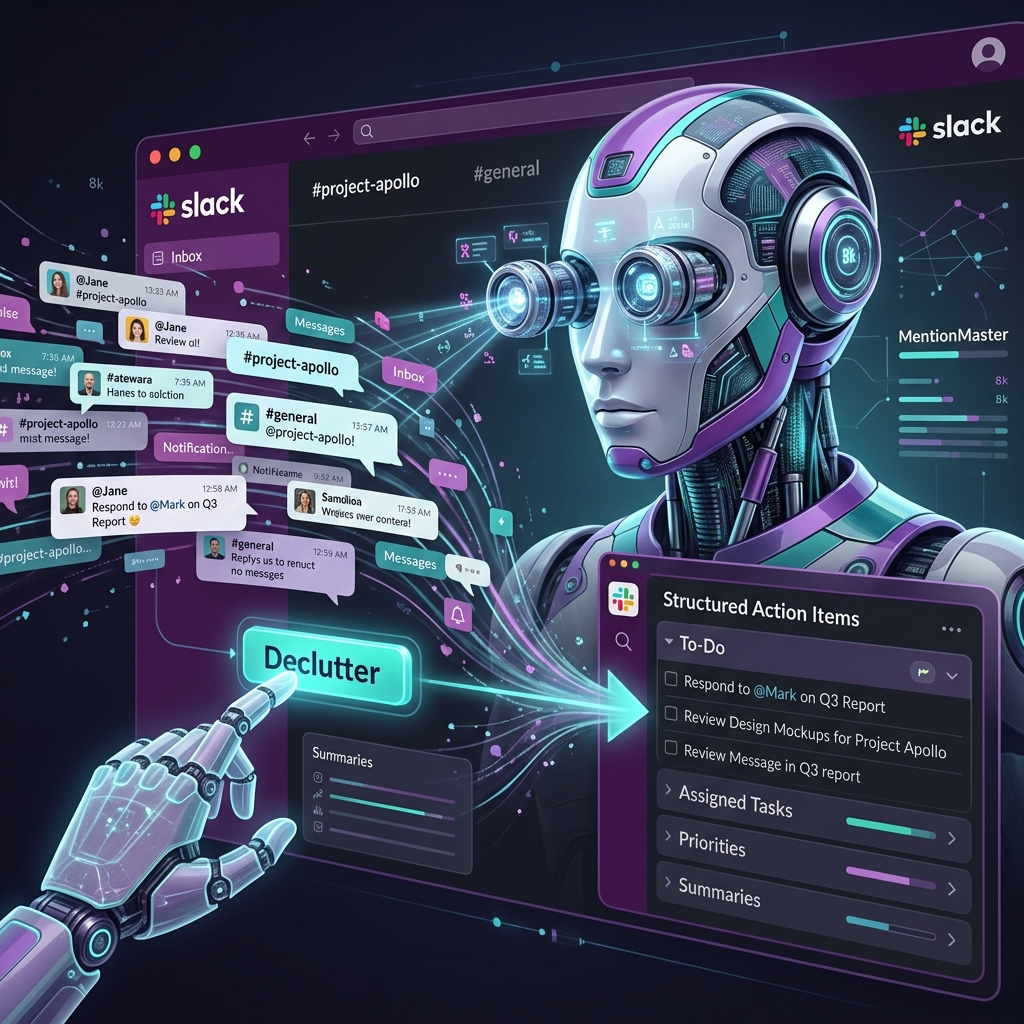
Slack Mention Analyst + Inbox Declutter
Slack Mention Analyst: turn @mentions into decision-ready briefings #
This sellable workflow treats Slack as an event bus: when someone pulls you into a thread, n8n retrieves context, an LLM compresses it into a three-part briefing (situation / ask / deadline), and optional search tools answer factual questions before you waste twenty minutes scrolling. Deeper digest mode batches overnight noise into a ranked list—useful for leaders who cannot live inside every channel.
Who is this automation built for? #
- Managers and IC leads who are @mentioned across product, sales, and incidents.
- Founders who need situational awareness without clicking fifty unread channels.
- Ops teams already standardized on Slack and willing to grant a bounded bot scope.
What goes wrong when mention triage is fully manual? #
- Context cost: You burn calendar time reproducing conversation state that already exists in plaintext.
- Missed urgency: A buried @mention in a busy channel behaves like a dropped ticket.
- Research asymmetry: Simple factual questions (“competitor pricing changed?”) spiral into ad-hoc browser tabs.
What you receive at handoff #
- n8n workflows for mention path + optional digest path.
- Slack app manifest notes: OAuth scopes, event subscriptions, Socket vs HTTP tradeoffs.
- Prompt pack for classification labels your culture actually uses (not generic “sentiment”).
- Failure runbook: thread too large, missing parent message, API 429.
- Data retention guidance for what gets logged outside Slack.
Architecture at a glance #
| Layer | Role | Implementation |
|---|---|---|
| Capture | Mention + thread IDs | Slack Events API / Socket Mode |
| Orchestration | Branch, store, retry | n8n |
| Context assembly | Historical messages | Slack Web API pagination |
| Reasoning | Summarize + classify | GPT-4o-mini class models or equivalent |
| Augment | External facts | Tavily / Serper HTTP nodes |
| Delivery | Human-readable | Slack DM blocks + optional task HTTP |
End-to-end execution flow #
- Event arrives with
channel,thread_ts,user. - Fetch parent + replies up to N configurable messages; truncate with summarizer if over token budget.
- Classify mention intent: question, approval request, FYI, blocker—set routing.
- If factual: run search tool with strict citation requirement; refuse if confidence low.
- Compose DM using block kit or plain text depending on mobile friendliness target.
- Optional: POST structured item to task system with dedupe key
thread_ts. - Log execution id + token usage row for cost review.
Stack, APIs, and orchestration #
- Slack tokens in n8n credentials; use least-privilege bot user, not user tokens, in production.
- n8n centralizes retries; push Slack rate-limit handling into a sub-workflow.
- LLM choice trades cost vs latency—classification can stay on mini models; rare long threads may need a larger model once summarization runs.
AI: where models help—and where they do not #
Models summarize and route. They do not approve spend, merge code, or delete channels. Any “post reply on my behalf” path belongs behind explicit human confirmation in v1.
Errors, retries, and human checkpoints #
- Pagination loop caps: never infinite-fetch a viral thread.
- 429 handling: honor
Retry-After. - Fallback: if summary fails, DM raw deep link to thread—better than silence.
Security, privacy, and data boundaries #
Slack content may include customer identifiers—restrict log destinations, encrypt at rest if persisting, and document retention for SOC2-minded buyers.
Deployment and environments #
- Self-hosted n8n recommended when Socket Mode long-lived connections matter.
- Per-workspace Slack apps for client isolation if you operate multi-tenant.
Engagement models #
- Internal productivity build with your workspace only.
- Agency rollout cloned per client with separate Slack apps and prompt packs.
Manual vs automated mention triage #
| Dimension | Manual browsing | Mention analyst |
|---|---|---|
| Context assembly | Slow, error-prone | Automated fetch + cap |
| Consistency | Mood-dependent | Prompt-governed |
| Research | Ad hoc tabs | Optional tool branch |
| Noise | High | Digest + classification |
Frequently asked questions #
Will this violate Slack Acceptable Use? #
Not when used for authorized workspace automation with disclosed bots and scoped permissions.
Can it read DMs? #
Only if you explicitly scope DM events—most builds stay in public/private channels with policy review.
Does it replace project management tools? #
No—it feeds them. Think intake, not replacement for Jira state machines.
How are hallucinations handled on research questions? #
Require citations or attach “unverified” banner in the DM template; low confidence → ask human.
Can we run entirely on-prem? #
Orchestration can; Slack cloud + LLM APIs still cross network boundaries unless you self-host models.
What is a sensible thread depth default? #
20–40 messages balances context with token cost; tune per workspace.
Next step #
Book an AI automation strategy call with your Slack workspace size and top three channels causing pain—I will map mention vs digest paths to your compliance reality.