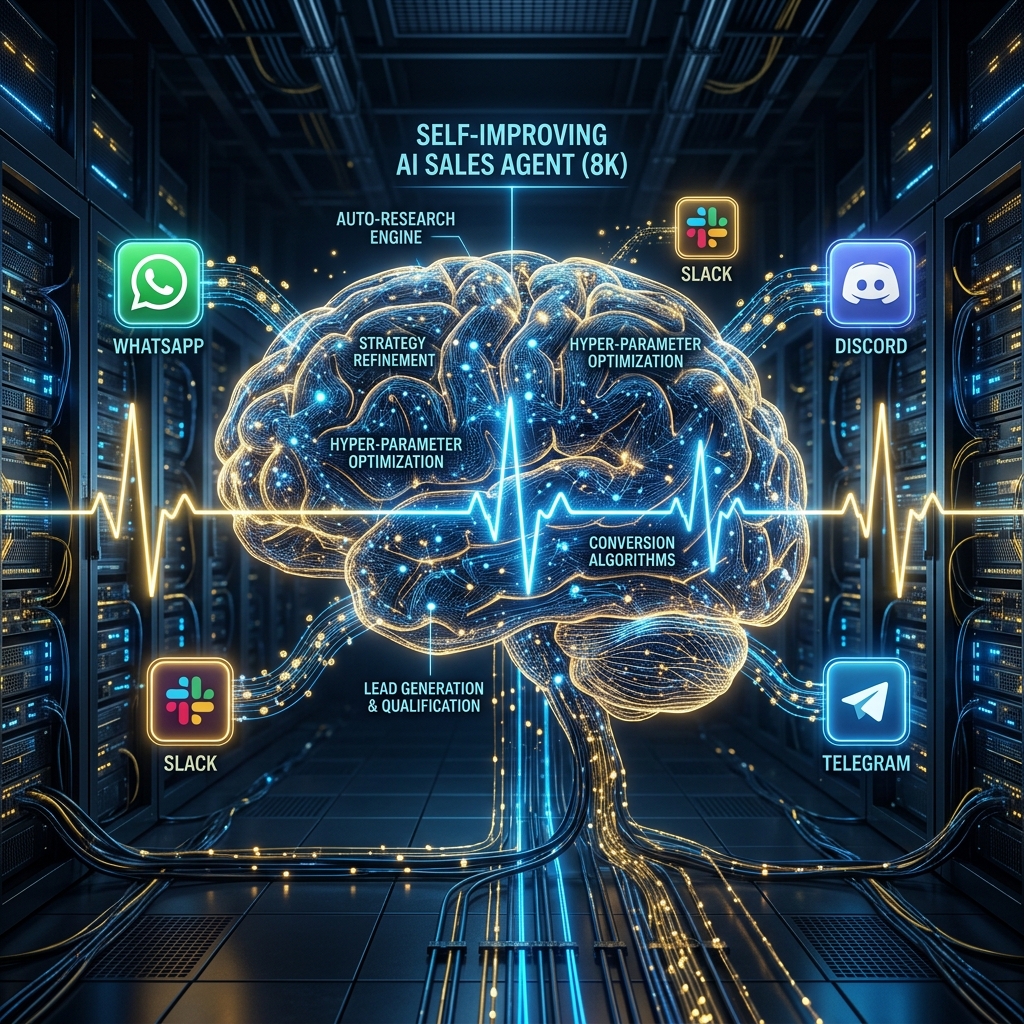
Ultimate Self-Improving AI Sales Agent
Ultimate AI sales agent: omni-channel autonomy with adult supervision #
The “ultimate” iteration extends v1’s email spine into a research-heavy, multi-surface agent: periodic heartbeat jobs drain follow-up queues, research subgraphs synthesize public dossiers with citations, messaging adapters normalize copy for WhatsApp/Telegram/Slack/Discord norms, and champion/challenger tests log performance deltas for humans to promote—plus a global kill switch, because autonomy without brakes is malpractice. Foundation here means explicit state, per-channel policy modules, and traces you can hand to legal—not a single mystery prompt.
Who is this automation built for? #
- Mature GTM orgs with legal review on messaging and channel policies.
- Founder-led enterprise sales juggling many stakeholders across chat surfaces.
- Teams that understand maintenance cost of autonomous systems—not a weekend hack.
What goes wrong when “ultimate” agents lack governance? #
- Platform bans from aggressive chat automation.
- Brand damage when tone drifts across surfaces.
- Unreadable ops state when graphs grow without observability.
What you receive at handoff #
- LangGraph (or equivalent) graph definitions with state schema docs.
- Per-channel credential vault pattern.
- Experiment dashboard spec (even if v1 is Sheets-backed).
- SLO definitions: max lag per queue, error budgets.
- Legal/compliance checklist per channel and region.
Architecture at a glance #
| Layer | Role | Stack |
|---|---|---|
| Research | Dossier | Multi-source ingest |
| Plan | Sequencing | Graph orchestrator |
| Act | Send | Channel adapters |
| Observe | Metrics | Event bus |
| Improve | Experiments | Stats + human gate |
| Safety | Kill | Admin API |
| Scale | Infra | Kubernetes workers |
End-to-end execution flow #
- Heartbeat enumerates due tasks: new outreach, bump, referral ask.
- Research subgraph refreshes stale dossiers on tunable TTL.
- Policy engine checks quiet hours, suppression, competitor list.
- Compose channel-specific messages from shared fact core.
- Send via adapter; capture message ids for traceability.
- Ingest replies; classify intent (meeting, objection, OOO).
- Experiment allocator picks hook variant; log outcome when known.
- Kill switch halts schedulers on red alert metrics.
Governance and traceability #
Every outbound path should log graph run id, channel, policy pack version, and message id returned by the vendor. “Why did it say that?” must be answerable from structured state, not from hope. Separate red-team / dry-run mode that composes messages without sending—essential for legal sign-off and for AIO-style documentation you can stand behind.
Scaling workers, heartbeats, and backpressure #
Kubernetes HPA on queue depth is the default scaling story; heartbeats should be cheap (schedule next tick, exit) so one stuck LLM call does not hold a whole worker hostage. Use dead-letter queues for poison messages. Cross-channel dedupe requires a contact graph store—email thread id, chat user id, CRM person id—so the same human does not get three uncoordinated nudges.
Stack, APIs, and orchestration #
- LangGraph (or equivalent) for explicit, inspectable state—not a black-box loop in production.
- Prometheus/Grafana (or vendor APM) for queue depth, send failures, and kill-switch activations.
- Event bus optional for fan-out (CRM updates, analytics, human approvals) without bloating the core graph.
AI: where models help—and where they do not #
Research synthesis and copy. Regulatory statements and contractual commitments require humans.
Errors, retries, and human checkpoints #
- Auto-promotion of winning hooks only after minimum sample + human ack.
Security, privacy, and data boundaries #
Channel tokens are nuclear secrets: short-lived, auditable, revocable, never committed to git. Per-tenant encryption of stored dossiers and reply payloads when multi-tenant. Admin routes (kill switch, replay) behind SSO + audit log. Assume compromisable webhooks—verify signatures on inbound reply events.
Deployment and environments #
- Namespace per brand if multi-tenant SaaS—no shared queues without isolation.
Engagement models #
- Enterprise implementation with SRE handoff.
- Pilot on one channel before omni expansion.
Single-channel v1 vs ultimate #
| Dimension | v1 email | Ultimate |
|---|---|---|
| Reach surfaces | 1 | Many |
| Research depth | Lighter | Heavier |
| Ops complexity | Moderate | High |
| Risk | Lower | Higher without governance |
Frequently asked questions #
Is this legal everywhere? #
**No—**channel Terms + local laws vary; counsel reviews templates.
Can it run fully unsupervised? #
**Not recommended—**human review gates on expansions protect you.
Integration with CRM? #
Bi-directional sync via APIs; conflict strategy documented.
Model vendor flexibility? #
**Yes—**abstract LLM client; route cheap/expensive models per task type.
How much infra cost? #
Scales with queue volume—budget review before launch.
What stops duplicate outreach? #
Dedupe on contact graph keys + cross-channel state store.
Next step #
Book an AI automation strategy call if you’ve outgrown single-channel experiments—I'll be blunt about whether you need “ultimate” or disciplined v1.