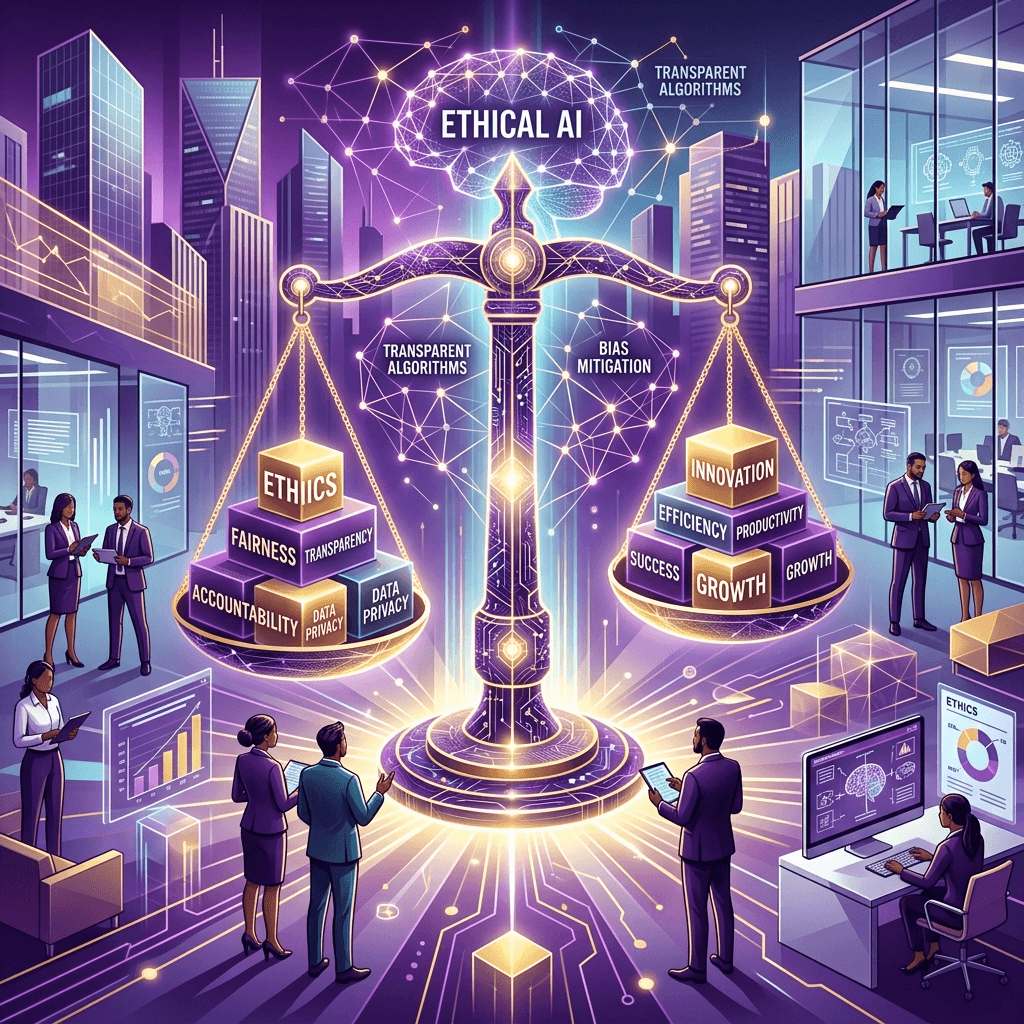
AI Ethics: Essential Considerations for Business Applications

Table of Contents
AI Ethics: Essential Considerations for Business Applications #
As artificial intelligence stops being a speculative laboratory experiment and starts being integrated into the core neural architecture of modern business operations, ethical considerations have officially shifted from "optional philosophy" to "mandatory operational requirement." Organizations deploying AI systems today face a complex, high-stakes landscape of questions regarding fairness, structural transparency, data privacy, and final accountability.
The true demarcation between a successful enterprise and one facing catastrophic reputational ruin in 2024 will be their commitment to ethical grounding. This article is a massive, structural deep-dive into the ten essential pillars of AI ethics for the modern business application.
1. The Business Case for Ethical AI Implementation #
To the uninitiated, "ethics" sounds like a cost center or a constraint on speed. In reality, it is a foundation for sustainable, high-velocity growth.
Risk Mitigation and Compliance #
The regulatory landscape is catching up to AI at breakneck speed. The EU AI Act and emerging US frameworks mean that unethical AI is no longer just a "PR problem"—it is a legal liability. A business built on ethical foundations is a business that won't be crippled by a sudden regulatory shift or a multi-million dollar class-action lawsuit.
Building Indestructible Customer Trust #
We are entering an era of peak AI skepticism. Customers are increasingly aware that their data is being harvested to train models. Businesses that are radically transparent about their AI ethical frameworks build a level of "brand armor" that price-slashing competitors cannot touch. Trust is the rarest currency in the AI economy.
2. Structural Fairness: Combating the Bias Bottleneck #
AI systems do not possess independent thoughts; they mirror the mathematical patterns found in their training data. If that data is historical, it almost certainly contains historical bias.
Identifying Hidden Algorithmic Bias #
Bias doesn't always look like overt discrimination. Often, it looks like "statistical noise." If a hiring AI is trained on successful resumes from the last 20 years, it may inadvertently learn that "candidates who play lacrosse" are better employees purely because of historical demographic skews. This isn't just unethical; it's bad for business because it overlooks high-value talent.
Proactive Mitigation Frameworks #
Solving bias requires more than a simple toggle. Businesses must implement "Inclusive Data Pipelines." This involves intentionally over-sampling under-represented datasets, using "Fairness Metrics" during the model validation phase, and maintaining cross-functional teams (not just engineers) to audit the outputs for unexpected demographic skews.
3. Algorithmic Transparency and the "Black Box" Problem #
The most powerful deep-learning models are notoriously opaque. Even their creators often struggle to explain exactly why a specific decision was reached.
The Dangers of Unexplained Decisions #
In high-stakes industries like healthcare or finance, a "Black Box" decision is unacceptable. If an AI denies a mortgage application, the bank must be able to explain why to both the customer and the regulator. If they can't, the decision is functionally arbitrary, which erodes the rule of law and organizational credibility.
Implementing Explainability (XAI) #
Explainable AI (XAI) is a suite of techniques designed to shed light on model logic. Businesses should use "Feature Importance" maps to show which variables (e.g., debt-to-income ratio) most heavily weighted a decision. While the underlying math remains complex, the logic becomes transparent and auditable.
4. Data Sovereignty and Purpose Limitation #
In the AI era, data is often referred to as "the new oil," but oil is a pollutant if handled incorrectly. Ethical AI requires strict boundaries around data usage.
The Principle of Purpose Limitation #
Just because a user gave you their data for "Customer Support" does not mean you have a moral or legal right to use that data to train your new "Sales Optimization" AI. Purpose limitation ensures that data is used strictly for the context in which it was collected, protecting user intent and preventing lateral data creep.
Enabling True Data Sovereignty #
Ethical organizations provide users with a "Control Dashboard." Users should be able to clearly see what data is being used for AI training and, crucially, have an easy "Opt-Out" mechanism. True sovereignty means that the user remains the ultimate owner of their digital footprint.
5. Accountability: Defining the "Final Arbiter" #
When an AI system fails—and they will eventually fail—who is responsible? The lack of clear accountability is one of the greatest organizational risks in the current AI gold rush.
The Liability Vacuum #
If an autonomous delivery bot hits a pedestrian, who takes the blame? The software developer? The company that bought it? The manufacturer of the sensors? Without a predefined accountability hierarchy, organizations face endless legal loops and the "diffusion of responsibility," where everyone blames the algorithm.
Establishing the "Human-in-the-Loop" #
Ethical AI frameworks strictly define a "Human-in-the-Loop." This means that for any decision above a certain risk threshold, a human must be the final arbiter who reviews the AI's suggestion and actively authorizes the execution. This ensures that a human being—with legal and moral standing—remains the responsible party for the outcome.
6. Privacy-by-Design in AI Architecture #
Privacy cannot be an "afterthought" or a "patch" applied at the end of a project. It must be woven into the code from day one.
Data Minimization Techniques #
The most secure data is the data you never collect. Scalable, ethical AI uses "Data Minimization." If an AI only needs a user's zip code to calculate shipping, it should never have access to their full street address. By stripping identifying information before it ever hits the AI processing node, businesses radically reduce their breach surface.
Federated Learning and On-Device Processing #
The future of ethical AI is decentralized. Techniques like "Federated Learning" allow models to be trained across thousands of disparate devices without the raw data ever leaving the user's phone or computer. This allows for massive intelligence scale without the massive centralization of sensitive user records.
7. The Ethical Cost of Computational Scale #
We rarely discuss the physical ethics of AI: the carbon footprint and water usage required to cool the massive GPU arrays powering these models.
Measuring the Carbon Intensity of Inference #
Training a single massive LLM can consume as much electricity as a small town. As businesses scale their AI usage, they must include "Environmental Impact" in their CSR (Corporate Social Responsibility) reports. Choosing models that have been trained using renewable energy is no longer just "nice to have"—it's a core ethical requirement for a sustainable future.
Efficiency as an Ethical Virtue #
Scaling ethically means scaling for efficiency. Instead of using a 70-billion-parameter model to summarize a 2-paragraph email, engineers should use highly-targeted "Mini Models" (like 7B or 1B parameter versions). This reduces costs, increases speed, and dramatically minimizes the environmental tax on the planet.
8. Labor Displacement and Radical Retraining #
The primary humanitarian concern regarding AI is the displacement of human workers. Businesses must manage this transition with profound empathy and tactical planning.
The Myth of "Automation is Inevitable" #
Automation is a choice made by leadership. Ethical businesses do not view AI as a way to "replace people," but as a way to "amplify humans." If a role is rendered obsolete by an AI agent, the ethical organization doesn't simply issue a severance check; they implement a "Radical Retraining" program.
Collaborative Intelligence #
The goal should be "Collaborative Intelligence," where humans and AI work together. A team of humans overseen by a few AI monitors is significantly less resilient than a team of humans given the tools by AI to execute more creative, high-impact work that moves the needle on business growth.
9. Security vs. Ethics: The Red-Teaming Mandate #
An unsecured AI is an unethical AI. If your bot can be tricked into leaking user secrets, you have failed your ethical duty.
Continuous Red-Teaming #
"Red-Teaming" involves hiring specialized "attackers" to try and trick your AI into doing something it shouldn't. This includes testing for prompt injection, jailbreaking (asking the AI to ignore its rules), and "data poisoning" (feeding it bad data during training). An ethical organization never assumes their AI is safe; they actively try to break it.
Secure Deployment Perimeters #
Ethical AI deployment uses "Sandbox" environments. The AI should never be given "God-mode" access to your entire corporate server. It should be restricted to a tiny, isolated container with exactly the permissions it needs to execute its one task—and nothing more.
10. The Roadmap: From Principles to Living Governance #
How does a company ensure these ethics aren't just a document buried in a Google Drive?
The AI Ethics Committee #
Every serious organization needs a cross-functional AI Ethics Committee. This isn't just for engineers. It must include voices from Legal, HR, Customer Support, and even outside ethical consultants. This committee should meet monthly to review have "Go/No-Go" authority over new AI deployments.
Dynamic Policy Iteration #
AI is moving too fast for static policies. Your ethical framework must be a "living document" that is updated every quarter to reflect new technical breakthroughs, newly discovered vulnerabilities, and evolving societal expectations.
FAQ Section #
Q: What is the biggest ethical risk in using AI for business? #
A: Algorithmic Bias. Because AI models are trained on historical data, they often inadvertently learn and amplify societal biases, leading to unfair decisions in hiring, lending, or customer service if not proactively mitigated.
Q: Can a small business afford to implement an AI ethics framework? #
A: Yes. AI ethics isn't about expensive hardware; it's about a series of intentional policy decisions—like being transparent with users, minimizing data collection, and always keeping a "Human-in-the-Loop" for consequential actions.
Q: What does "Black Box AI" mean? #
A: "Black Box" refers to AI models (like deep neural networks) whose internal decision-making processes are so complex that even the developers cannot easily explain how a specific output was reached, creating transparency and accountability issues.
Q: How do you prevent an AI from hallucinating false information? #
A: The most effective ethical safeguard is RAG (Retrieval-Augmented Generation). By forcing the AI to only use a specific "grounded" knowledge base to answer questions, you drastically reduce the chance of the model making up facts.
Q: Is it ethical to use AI to monitor employee productivity? #
A: This is a grey area that requires radical transparency. It is generally considered unethical to use "Black Box" surveillance. Any AI monitoring must be clearly disclosed, used only for constructive coaching, and have a clear opt-out or appeal process.
Q: What are "Fairness Metrics" in AI? #
A: Fairness Metrics are mathematical tests used during model training to ensure that an AI's accuracy is consistent across different groups (e.g., race, gender, age). If the AI is significantly less accurate for one group, the model is flagged for correction.
Q: How can AI ethics improve my company's revenue? #
A: Ethical AI builds massive "Brand Trust." As consumers become more skeptical of AI, they will gravitate toward transparent organizations that protect their privacy and ensure fairness, leading to higher customer retention and lower churn.
Q: Who is legally responsible if an AI makes a mistake? #
A: Currently, the legal responsibility almost always lies with the company that deployed the AI. This is why "Human-in-the-Loop" architecture is critical—it ensures a human being reviews and authorizes high-risk actions before they execute.
Q: Does self-hosting an AI model improve its ethical profile? #
A: Yes. Self-hosting (using tools like n8n or Ollama) ensures that sensitive corporate and customer data never leaves your secure firewall, radically improving your data sovereignty and security-based ethical standing.
Q: What is "Purpose Limitation" in data ethics? #
A: Purpose Limitation is the ethical principle that data collected for one specific reason (like customer support) should never be used for a different reason (like training a sales bot) without explicit new consent from the user.
Conclusion #
Ethical AI implementation is not merely about avoiding disaster—it's about building a sustainable, trustworthy digital engine that creates enduring long-term value. By proactively addressing bias, transparency, and accountability, businesses can harness the transcendent potential of artificial intelligence while remaining structurally aligned with their core values. In the long run, the organizations that prioritize ethics will be the only ones left standing.
Related Posts

Leveraging GPTs for Business Productivity
A deep dive into transitioning from casual ChatGPT usage to deploying highly specialized, secure Custom GPTs that natively optimize your enterprise workflows.

How to Stop Client-Facing AI Agents From Hallucinating
Client-facing AI agents hallucinate when they answer without grounding. Here's the layered guardrail stack I use to keep agents accurate and on-script.

AI Sales Systems vs Traditional CRM Automation
Traditional CRM automation fires rules; AI sales systems reason about each lead. Here's how they differ, where each wins, and how to combine them.