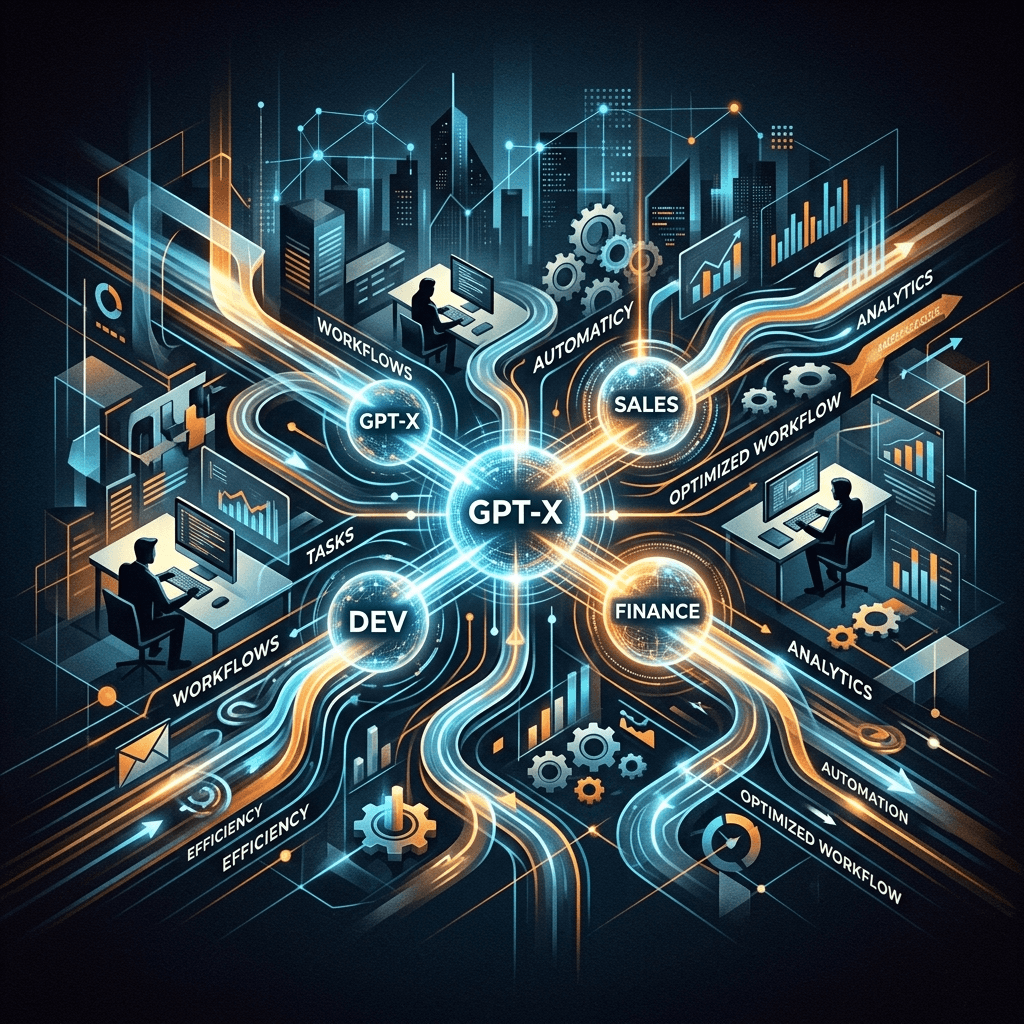
Leveraging GPTs for Business Productivity

Table of Contents
Leveraging GPTs for Business Productivity #
In late 2022, the business world was introduced to generative AI. For the better part of a year, usage was primarily conversational: an employee would copy an email into ChatGPT, ask for it to be made "more professional," and paste the result. While this offered a minor productivity bump, it was a fundamentally shallow application of a profoundly deep technology.
The true transformation of white-collar labor did not arrive until the introduction of Custom GPTs. By allowing organizations to pre-configure system prompts, upload proprietary knowledge bases via Retrieval-Augmented Generation (RAG), and connect secure external APIs, businesses stopped treating AI as a glorified autocomplete tool and started treating it as a programmable, highly specialized digital workforce.
This guide will thoroughly explore how to transition your organization from casual generative AI usage to deploying highly targeted Custom GPTs that measurably compress execution time and optimize corporate workflow.
1. The Custom GPT Revolution: Beyond Chat #
To understand how Custom GPTs drive business productivity, we must first separate the underlying model from the user interface.
The Problem with Generalized AI #
A standard LLM like GPT-4o is trained on essentially the entirety of the public internet. If a logistics manager asks a generic model how to route a shipping container, the AI will provide a textbook answer based on global supply chain best practices. But the logistics manager doesn’t need textbook theory; they need to know how to route the container according to their specific company's compliance manual.
Specialization Through Customization #
A Custom GPT solves this. It acts as a specialized wrapper around the base LLM. You configure the wrapper to explicitly ignore generic advice and strictly adhere to your internal corporate documentation. A Custom GPT transforms a brilliant but unfocused intern into a hyper-specialized senior operator who only operates within the precise bounds of your organizational logic.
2. Mapping Business Pain Points to Custom GPT Solutions #
Before building a Custom GPT, you must identify a structural bottleneck that warrants AI intervention. AI should not be applied randomly; it must be aimed therapeutically at organizational pain.
Identifying Repeatable Cognitive Labor #
Look for tasks in your business that require medium-level cognitive reasoning but are highly repetitive. For example, reading inbound vendor contracts to verify they meet your standard net-30 terms. This takes a human paralegal 45 minutes of tedious reading. It is a perfect target for a Custom GPT trained exclusively on your legal parameters to execute in 15 seconds.
The "One GPT, One Job" Principle #
The biggest mistake organizations make is trying to build one "Company GPT" that knows everything. Massive, overarching mega-bots suffer from severe hallucination and contextual collapse. Productivity skyrockets when you build thirty micro-GPTs. You need one GPT for legal auditing, a completely separate GPT for drafting Facebook ad copy, and a third for summarizing bug reports from GitHub.
3. System Prompts: The Engineering of Behavior #
The foundational element of a highly productive Custom GPT is its System Prompt—the invisible set of instructions the AI reads before it ever talks to a human user.
Strict Persona Definition #
A strong system prompt establishes absolute boundaries. For a financial analysis GPT, the prompt shouldn't just say "Analyze this data." It must be engineered: "You are a strict, highly analytical CFO. You do not use flowery language. When given a P&L sheet, you will immediately identify the three lines with the highest negative variance month-over-month. You will output your findings in a markdown table."
Negative Constraints #
Often, telling an AI what not to do is more important than telling it what to do. For a Custom GPT used by customer support, a vital system constraint is: "If a user asks about refunding an order over $500, you MUST NOT authorize it. You must output 'This requires manager approval' and cease action." Negative constraints maintain corporate safety.
4. Equipping GPTs with Knowledge (RAG Integration) #
A Custom GPT is only as productive as the proprietary data it has access to.
The Power of the Knowledge Base #
When setting up a Custom GPT in OpenAI's interface (or via API), you can upload PDF manuals, massive CSV datasets, and entire codebase repositories. The GPT vectorizes this knowledge. When an employee asks a question, the GPT executes a similarity search against the uploaded files before generating an answer.
Onboarding and Internal Documentation #
One of the highest-ROI use cases for a knowledge-base GPT is employee onboarding. Upload the employee handbook, the engineering wiki, and the HR benefits package into a single "HR-Onboarding-GPT." Instead of a senior engineer losing four hours a week answering basic questions from a new hire, the new hire simply asks the GPT, which retrieves the exact corporate document required.
5. Action APIs: Giving GPTs Write-Access #
While answering questions is helpful, true automation requires action. Custom GPTs support "Actions," which allow the AI to reach out to external software via API.
Breaking the Chat Interface #
By configuring an OpenAPI schema within the Custom GPT settings, the AI can perform GET and POST requests. If your sales team is working within a "Lead-Qualifier-GPT," they can chat with the bot to draft an email. Once approved, the employee simply types, "Send this to Salesforce." The GPT autonomously triggers the API, creates the lead in your CRM, and confirms the action.
The Security of OAuth #
When integrating external APIs into a Custom GPT, proper authentication is critical. Utilizing OAuth ensures that when the GPT reaches into Google Drive or Jira on behalf of an employee, it is heavily restricted to only accessing files that the specific employee has the correct permissions to view, preventing lateral security breaches.
6. Internal vs. External GPT Deployment #
Once a GPT is built, you must define its exposure perimeter.
Internal Operational GPTs #
The vast majority of productivity gains occur internally. These GPTs are published privately to your corporate workspace. They are utilized to speed up data synthesis, parse dense competitor analysis reports, or generate boilerplate code for junior developers. Because they are internal, you can aggressively feed them sensitive intellectual property.
Customer-Facing External GPTs #
Conversely, you can publish Custom GPTs publicly or embed them on your website. These act as high-level lead qualification or technical support agents. For external deployment, the system prompts must be ruthlessly red-teamed to ensure a clever user cannot trick the GPT into offering a massive discount or revealing competitive internal instructions.
7. High-Yield Use Cases: Data Analysis & Financial Modeling #
Generative AI is famous for text, but its greatest productivity unlock lies in unstructured data analysis.
Advanced Data Analysis #
Custom GPTs natively support executing internal Python code. If an analyst uploads a raw CSV containing three years of messy, poorly formatted sales data, they can simply ask the GPT to "Clean the null values, normalize the date structures to ISO 8601, and generate a scatter plot correlating ad spend to Q4 revenue." The GPT writes the Python script, executes it in a secure sandbox, and outputs the chart natively in the chat window.
Bridging the Non-Technical Gap #
This radically democratizes data analysis. A marketing director no longer has to wait three days for the data science team to build a SQL dashboard; they can upload the raw export to a secure Custom GPT and query the financial data using natural human language.
8. Breaking Creative Bottlenecks in Marketing #
While data analysis provides raw mechanical efficiency, marketing departments see productivity gains through velocity.
Brand-Aligned Content Engines #
A generic LLM will write incredibly generic, "robotic" marketing copy. However, a Custom GPT loaded with your brand guidelines, a massive PDF of your high-performing historical ads, and a strict system prompt regarding your "brand voice" acts entirely differently. It can generate fifty variations of a Facebook ad that actually sound like your company in less than thirty seconds.
Multi-Modal Asset Generation #
Modern Custom GPTs integrate image generation natively. An SEO content writer can draft a 2,000-word blog post and immediately ask the GPT to "Generate a 16:9 editorial illustration matching our tech-brand aesthetic that perfectly captures the thesis of this article." The asset is created instantly, completely bypassing the graphic design queue.
9. Establishing Corporate AI Governance #
Productivity is completely invalidated if it results in a massive data breach or compliance violation.
The "Shadow AI" Problem #
If you do not provide employees with secure, company-sanctioned Custom GPTs, they will resort to "Shadow AI"—copying sensitive corporate data into their personal, public ChatGPT accounts to save time. This data is then legally absorbed by the public LLM training algorithms.
Setting Up Enterprise Controls #
Deploying an Enterprise Workspace ensures that any data fed into a Custom GPT by your employees is explicitly excluded from external model training. Furthermore, IT departments must establish strict governance: auditing which internal APIs are exposed to which GPTs, ensuring PII (Personally Identifiable Information) is scrubbing before vectorized upload, and maintaining access logs.
10. The Mathematical ROI of Custom GPTs #
To justify the engineering time required to build and deploy tightly scoped Custom GPTs, organizations must measure the ROI accurately.
Calculating Time Recaptured #
The math is fundamentally straightforward. If an IT support agent spends 15 minutes routing a standard hardware ticket, and they handle 40 tickets a day, that is 10 hours of weekly labor. If a Custom GPT (trained on the IT manual) can triage and route the ticket automatically in 15 seconds, you have recaptured essentially 25% of a full-time employee's bandwidth.
Re-allocating Bandwidth Strategically #
The goal of leveraging GPTs is rarely to fire the IT agent; it is to reallocate those 10 recaptured hours into proactive, high-level structural work that moves the needle on business revenue—work that an AI cannot currently perform.
FAQ Section #
Q: What is the exact difference between ChatGPT and a Custom GPT? #
A: ChatGPT is the raw, baseline foundation model that is designed to be generally conversational. A Custom GPT is a specialized version of the model built by a user containing custom instructions (system prompts), proprietary knowledge files, and distinct API tool access tailored for a specific business task.
Q: Does OpenAI train their public models on the data I upload to a Custom GPT? #
A: No. As of 2024, if you utilize a ChatGPT Team, Enterprise, or API tier, OpenAI's strict data privacy policies state that your uploaded custom knowledge and conversational inputs are explicitly scrubbed and excluded from training their future foundation models.
Q: What is RAG, and how does it relate to Custom GPTs? #
A: RAG stands for Retrieval-Augmented Generation. When you upload a PDF or CSV to a Custom GPT, the model uses RAG to actively search through that specific document for the answer to a user's question, preventing the AI from guessing or "hallucinating" false information.
Q: Can a Custom GPT automatically execute tasks in my other software, like Slack or Salesforce? #
A: Yes, through a feature called "Actions," you can hook a Custom GPT directly to external software via REST APIs and OAuth configuration, allowing the AI to actively read, write, and execute functions outside of the simple chat interface.
Q: How many PDFs or documents can I upload to a single Custom GPT? #
A: Currently, OpenAI allows you to upload up to 20 separate files (up to 512MB each) to a single Custom GPT's knowledge base. For enterprise datasets much larger than this, you must build custom LangChain vector pipelines via the API rather than using the basic consumer UI.
Q: Why do Custom GPTs sometimes ignore their own instructions? #
A: This is called "prompt drift" or "context collapse." If a user has a very long, multi-turn conversation with the GPT, the context window fills up, and the AI slowly forgets the negative constraints stored in its original system prompt. Keep interactions focused to mitigate this.
Q: Can I share a Custom GPT I built with the public? #
A: Yes. If you have the appropriate account tier, you can publish a Custom GPT to the public GPT Store, allowing anyone on the internet to utilize your specialized prompt structure. You can also restrict visibility strictly to members of your corporate workspace.
Q: Can Custom GPTs write and execute Python code? #
A: Yes. Custom GPTs are natively equipped with an "Advanced Data Analysis" sandbox. If asked a highly mathematical or data visualization question, the GPT will physically write a Python script, safely run it on a virtual machine, and output the result to the user.
Q: How do I prevent employees from leaking sensitive data to public AI tools? #
A: The most effective defense against "Shadow AI" is providing superior, company-secured alternatives. By deploying a locked-down Enterprise GPT workspace, you give employees the productivity tools they crave without forcing them to rely on unsecured, personal web accounts.
Q: Is it better to build one massive GPT for my company or several small ones? #
A: It is vastly superior to build many small, specialized GPTs. A monolithic "Company Bot" will struggle to determine if a prompt requires legal reasoning or marketing flair. Narrowly scoped micro-GPTs (e.g., "The SEO Bot", "The Legal Bot") perform significantly better with near-zero hallucinations.
Conclusion #
The transition from exploratory generative AI usage to deploying structured Custom GPTs is the demarcation line between businesses that are simply playing with technology and those that are weaponizing it. By rigorously scoping out repetitive cognitive bottlenecks, architecting bulletproof system prompts, and securely attaching your proprietary enterprise data via RAG, you can fundamentally decouple your company's high-level output from your raw human headcount. Start small, build highly targeted micro-agents, and scale your operational efficiency organically.
Related Posts
AI Ethics: Essential Considerations for Business Applications
A comprehensive analysis of the ethical landscape of business AI. Explore framework-level solutions for bias mitigation, data sovereignty, and algorithmic transparency.

How to Stop Client-Facing AI Agents From Hallucinating
Client-facing AI agents hallucinate when they answer without grounding. Here's the layered guardrail stack I use to keep agents accurate and on-script.

AI Sales Systems vs Traditional CRM Automation
Traditional CRM automation fires rules; AI sales systems reason about each lead. Here's how they differ, where each wins, and how to combine them.