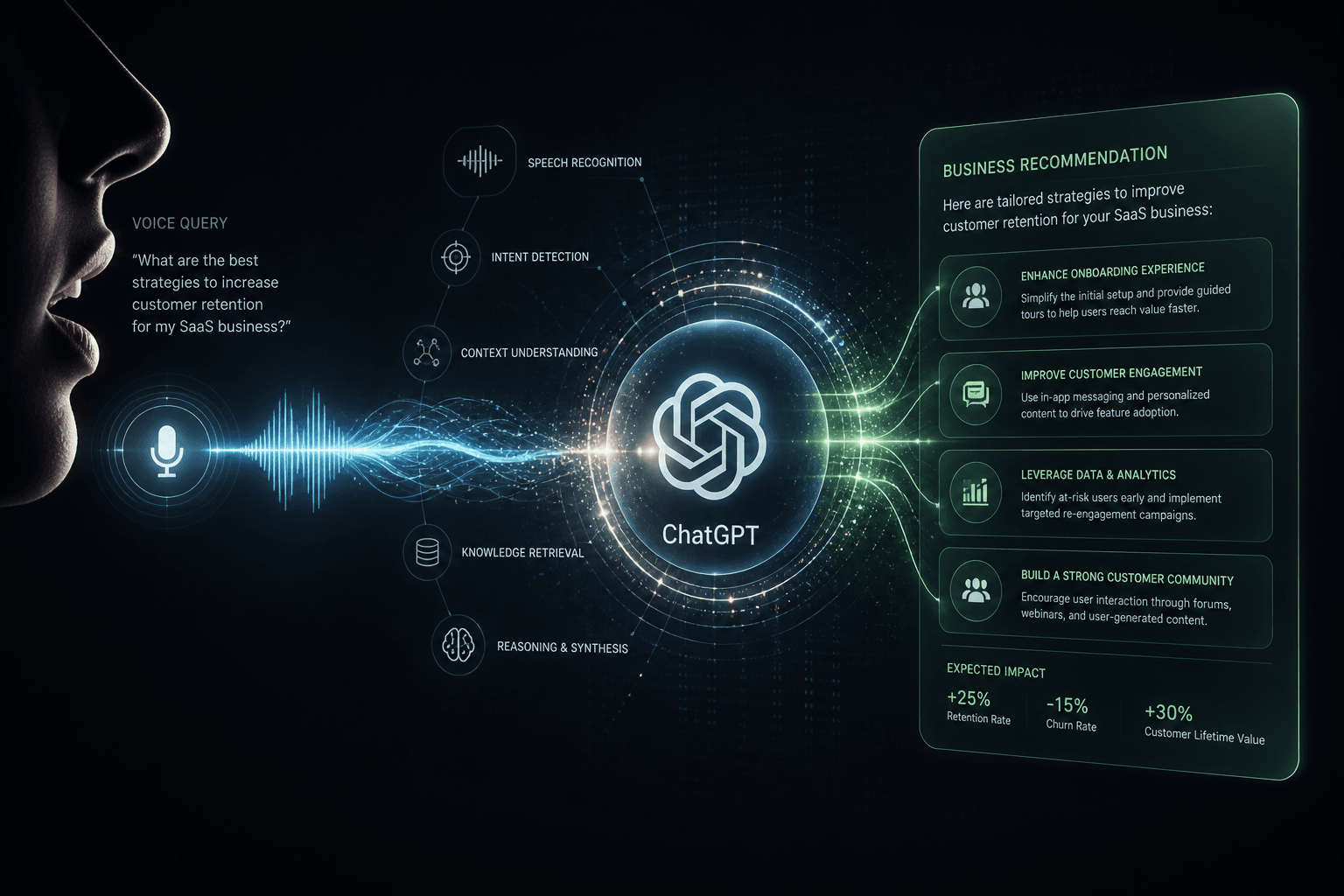
Can Your Business Show Up When Someone Asks ChatGPT Out Loud?

Table of Contents
Yes — your business can show up when someone asks ChatGPT a question out loud, but only if ChatGPT already has a name it can pronounce and a reason it can say in one breath. Spoken ChatGPT is not a second website. It is a shorter recommendation channel sitting on top of the same evidence pile as typed ChatGPT. If that pile never names you, the voice does not invent you.
I'm William Spurlock, an AI Solutions Architect and Fractional AI CTO. I have spent 20,000+ hours inside agentic systems and I have been SEO-certified since 2021; the work now sits under AEO, AIO, and GEO. I do not invent client names or fake citation lifts. I do tell owners when they are optimizing the wrong interface.
This spoke sits under how to get ChatGPT and Perplexity to recommend your business. That pillar is the typed recommend-me playbook: third-party proof, entity consistency, answer-ready pages, a 30/60/90 plan. I am not rewriting it. I own one job the pillar leaves open: ChatGPT Voice as a recommendation channel — the moment a buyer talks into the ChatGPT app, chatgpt.com, or a phone line and hears a shortlist spoken back.
The typed test is "does my name appear in the reply?" The spoken test is "can a driver, a homeowner, or a tired ops lead hear my name, keep it, and act on it before the next sentence?" Those are not the same pass/fail.
Can my business show up when someone asks ChatGPT a question out loud? #
Yes. ChatGPT Voice can name a real business out loud when the model can retrieve or remember enough consistent evidence to put you on a short spoken list. It will not reserve a slot because you bought ads, added a microphone icon, or marked a paragraph as "voice friendly." The spoken answer is still a synthesis. If the open web never treats you as an option, the mouth has nothing honest to say.
OpenAI made that channel large enough that owners should stop treating it as a toy. On July 8, 2026, OpenAI's ChatGPT release notes said ChatGPT Voice is now powered by GPT-Live-1 for paid users and GPT-Live-1 mini for Free users. Both models can listen and speak at the same time. GPT-Live-1 works inside a ChatGPT chat, speaks while text streams, and can use web search and memory. OpenAI's Voice help page lists three options — Live, Advanced, and Standard — and says Live can use web search and memory. Availability still depends on plan, region, and app version.
That last sentence is the whole business case. Spoken ChatGPT is not a closed trivia mode. When search is available, it can look things up. When search is available, it can name you — or name your competitor.
TechCrunch, July 8, 2026, reporting OpenAI's briefing, wrote that more than 150 million people talk to ChatGPT using features like Voice and Dictation. Treat that as a company-reported figure, not a census I audited. The useful takeaway is scale: enough buyers already talk to this product that "we only optimize for typed ChatGPT" is a staffing choice, not a strategy.
What "show up" means when the answer is spoken #
A typed recommendation can hide in a list of eight names, a table, and three citations. A spoken recommendation has to survive ears.
| Spoken outcome | What the buyer actually hears | What it is worth |
|---|---|---|
| Named with a reason | "I'd look at [Your Name] — they do commercial HVAC in Grand Rapids" | The money event |
| Named in a pile | Three names, no distinction, already forgotten | Weak |
| Category only | "A licensed plumber in your area" | You lost |
| Competitor shortlist | Two rivals, one national chain | You donated the lead |
| Refusal / hedge | "I don't have enough local information" | The category is still open — fix evidence |
Being named is the event. Being linked is nice. Being described as "a local contractor" without a name is almost worthless in a car.
The three conditions I use before I tell an owner they can win this #
- A sayable identity. Same legal-facing name on the site, Google Business Profile, and the two directories a buyer in your category already trusts. If I cannot say the name once and have a stranger repeat it, ChatGPT Voice will not do better.
- A one-breath reason. Category + place + specialty that fits in one spoken clause. "Emergency plumber for older homes in Ann Arbor" survives. "Full-service solutions partner delivering excellence" dies mid-sentence.
- Third-party proof the model can retrieve. Directories, reviews, a "best of" page, an association listing. The typed pillar already covers how to earn those. Spoken ChatGPT consumes the same pile — it just reads less of it out loud.
If you fail the first two, I do not start a voice content calendar. I start a name-and-reason cleanup.
What I am not claiming #
I am not claiming ChatGPT Voice has a public business-placement API. I am not claiming GPT-Live-1 "ranks" pages the way Google Search does. I am not claiming a spoken mention equals a booked job. I am claiming this: as of August 22, 2026, enough people ask ChatGPT out loud that an unnamed business is losing a referral channel it cannot see in Search Console.
If you want the retrieval mechanics behind why a name gets picked in the first place, read how ChatGPT and Perplexity actually decide which businesses to recommend. This post stays on the spoken channel: what changes when the answer has to be heard. #
How is a spoken ChatGPT recommendation different from a typed one? #
A typed ChatGPT recommendation is a reading problem. A spoken ChatGPT recommendation is a memory problem. Same evidence pile. Different budget. The buyer is often driving, walking, cooking, or standing in a flooded basement. They hear two or three names. They keep one. Everything else is audio wallpaper.
The typed pillar still wins the evidence war: get named on third-party pages, keep NAP identical, publish pages a model can extract. Spoken ChatGPT changes the output shape. TechCrunch's July 8, 2026 report said OpenAI's new voice models send the query to latest text models such as GPT-5.5 for search, reasoning, or agentic work while the spoken conversation continues. That is the split I want owners to hear: the voice is the channel; the text model still does the homework.
Channel vs surface vs playbook #
I keep these three words separate so teams stop arguing past each other:
| Term | What I mean | Who owns it on this site |
|---|---|---|
| Typed playbook | Get ChatGPT and Perplexity to name you in a written answer | The recommend-your-business pillar |
| Spoken channel | That name has to survive being said in ChatGPT Voice, including follow-ups | This post |
| Multimodal surfaces | Image, video, and voice interfaces as a group | A different August post — I am not rewriting that map here |
If your agency says "we already do voice SEO," ask which row they mean. Most of them mean Google Assistant featured-snippet habits from 2018. That is not ChatGPT Voice.
What actually changes when the answer is spoken #
- Length. A Live answer that also streams text can be long on screen and still short in the ear. The buyer may never look down. Write the first spoken clause as if the screen is off.
- Order. First name spoken is first name remembered. If you only appear as "also consider," you lost.
- Follow-ups. Full-duplex voice, per OpenAI's July 8, 2026 notes, lets people interrupt. "Who is closer?" "Who is open now?" "Who does commercial?" is the real sales call. Your public facts have to survive those cuts.
- Widgets. The same notes say GPT-Live-1 can show visual results through supported widgets. A map card can save you if the spoken sentence was thin. Do not count on the buyer staring at it.
- Tools the voice cannot use. OpenAI's Voice FAQ says Live does not initially support video, screen sharing, connected apps, or plugins. Your fancy GPT action is not the path. Your public entity is.
A side-by-side I use with owners #
| Test | Typed ChatGPT (GPT-5.5 / GPT-5.4 mini class) | ChatGPT Voice (GPT-Live-1 / GPT-Live-1 mini) |
|---|---|---|
| Buyer posture | Reading, comparing, screenshotting | Hands busy, one-ear attention |
| Winning output | Named + cited + skimmable | Named + one reason + easy to repeat |
| Failure mode | You are buried in a long list | You are never said |
| Follow-up | They scroll | They interrupt |
| Your job | Be extractable | Be extractable and sayable |
I still run both tests. I do not let a pretty typed screenshot excuse a spoken miss. The revenue moment is the name the buyer can still pronounce at a red light. #
Why do spoken answers name fewer businesses? #
Spoken answers name fewer businesses because ears have a smaller working memory than a scrollable chat, and the model is trained to sound helpful, not exhaustive. ChatGPT Voice will happily give you a clean three-name shortlist and skip the fourth company that would have survived a typed table. That is not a conspiracy. It is audio.
I treat this as shortlist economics, not a ranking dashboard. There is still no official "ChatGPT Voice impressions" report. You measure names heard, not positions earned.
The ear budget #
A buyer who asked out loud usually wants a decision, not a literature review. In practice I hear the same compression every time I test Voice:
- One category noun. Plumber, not "home comfort specialists."
- One place noun. The city they said, or a "near you" hedge.
- Two or three names. Rarely more, unless the buyer asks "give me five."
- One reason each, if you are lucky. Specialty, hours, review summary, or "known for."
- A closer. "Want me to compare two of them?"
If your public pages never supply a reason that fits in clause 4, you get dropped so the sentence can finish.
Why good companies get cut #
| Reason you get omitted | What it sounds like from the model | Fix |
|---|---|---|
| Your name is hard to say | It skips to a cleaner brand | Publish a pronunciation and a short alias people already use |
| Your category language is poetic | It cannot match "bookkeeper" to "fractional finance alchemist" | Use the buyer's noun on the homepage and GBP |
| Your geography is implied | It cannot defend "near you" | Name cities and service areas in plain text |
| Your proof is only on your site | It prefers names other pages already repeat | Earn one third-party mention that uses your exact name |
| You are the fourth-best documented option | Audio has no page two | Become one of the first three documented options |
The last row is the one owners hate. Spoken ChatGPT is a top-three sport. Typed ChatGPT can still mention you as a runner-up. Voice often will not.
The P&L version, without a fake ROI #
You do not need a fantasy spreadsheet. You need a napkin:
- Estimate how many category questions in your market now happen out loud in ChatGPT — even a rough guess.
- Assume the spoken shortlist is two or three names, not eight.
- Assume one of those names gets a call, a site visit, or a "text me the number."
- Apply your normal close rate and job value.
When you are never in those two or three spoken names, your share of that contact stream is zero. When a competitor is always first, they are collecting a referral you will not see in Google Analytics as "chatgpt / voice." How to track when AI tools cite or recommend your business is the measurement spoke. This post is the channel: if the name is not said, the tracker has nothing to count.
I would rather an owner win one boring, sayable specialty than publish twelve blog posts that Voice will never read aloud. #
What spoken prompts do buyers actually use? #
Buyers who talk to ChatGPT do not dictate your keyword list. They ask full questions the way they would ask a person in the passenger seat. If your site only answers "plumber Grand Rapids," you will miss the spoken prompt that actually spends money: "Who can replace a water heater today on the west side and won't wreck the drywall?"
I inventory spoken prompts the same way I inventory typed ones — then I make them longer, more situational, and more interruptible. Vanity tests ("Tell me about my brand") still fail here. They fail louder, because Voice will compliment you and name nobody.
A spoken prompt worksheet #
| Buyer situation | What they say out loud | The revenue moment | The page that has to exist |
|---|---|---|---|
| Emergency, hands dirty | "Who can fix a [broken thing] near [place] today?" | Same-day job | Service + hours + service area, in the first screen |
| New in town | "Best [category] in [city] that locals actually use" | First hire | Third-party reviews + a city page that names the city |
| Constraint | "[Category] who does [specialty] for [building type]" | Premium specialty | One page that states the specialty in a sentence |
| Comparison | "Is [competitor] any good, or who else should I call?" | Displacement | Honest comparison facts, not a smear |
| Logistics | "Who is open Saturday and can text an estimate?" | Friction kill | Hours, response method, what happens after the form |
| Trust check | "Who do people recommend for [job] around here?" | Reputation pick | Review surfaces that agree on your name |
Read that table out loud. If a stranger cannot finish the "page that has to exist" column from your homepage, ChatGPT Voice cannot either.
How I collect the real sentences #
- Listen to the last 20 sales calls or intake notes. Write the question the way the human said it, not the way your CRM labeled the job.
- Watch the receptionist or the after-hours voicemail. Those scripts are spoken prompts with a phone number attached.
- Ask three customers how they would ask ChatGPT, not Google. You will get longer sentences than your keyword tool.
- Add the interrupt. After the first answer, say "who is closer," "who is cheaper," "who does commercial," "who can come today." Your facts have to survive the cut.
Prompts I refuse to treat as the test #
- "What do you know about [my exact legal name]?"
- "Write a paragraph about our award-winning culture."
- "Are we the best [category] in the world?"
Those prompts measure ego. They do not measure whether a stranger asking ChatGPT out loud hears you when they are ready to spend. The typed pillar already said this for written tests. Spoken tests make it more expensive to ignore, because the buyer will not scroll back to find you.
If you are local, pair this worksheet with how to get your local business into AI-generated recommendations. That spoke owns NAP, GBP, and local citations. This one owns the sentences people say once those citations exist. #
How do I make my business easy to say and remember out loud? #
Make the name short, consistent, and paired with one reason a stranger can repeat after hearing it once. ChatGPT Voice cannot save a brand that humans already mangle. If your staff, your Google listing, and your invoices disagree on the words, the spoken channel will pick a cleaner competitor.
This is not a jingle project. It is identity hygiene for ears.
The say-aloud test I run in the first meeting #
I read the homepage H1, the Google Business Profile title, and the Yelp or Apple Business Connect name out loud, back to back. If I hear two different companies, we stop the content conversation.
Checklist:
- One primary name. The words you want Voice to say. Put them in the homepage title, the Organization / LocalBusiness
name, and the GBP title. - One allowed short form. If people already say "Riverside" instead of "Riverside Mechanical Contracting LLC," publish the short form next to the legal name so the model does not treat them as cousins.
- A pronunciation hint in text. Not a phonetic schema hack. A plain sentence: "We are called KEEN HVAC — that's K-E-E-N." If Voice already mis-says you in tests, this is the cheapest page edit you will make this year.
- A one-breath reason. Category + place + specialty. Write it so it can be spoken after your name without a second inhale.
- A callback noun. The thing a buyer can tell a spouse: "the radiant-floor people," "the Saturday clinic," "the commercial-only shop."
Name patterns that die in Voice #
| Pattern | Why it fails out loud | What I change |
|---|---|---|
| Legal soup | "Northshore Premier Integrated Solutions Group LLC" | Lead with the name humans already use |
| Unrelated DBA | Site says one brand, GBP says another | Pick one public name and migrate the other |
| Initialisms | "NPSG" with no expansion | Expand once, then allow the short form |
| Pun-only names | Clever, category-free | Keep the pun, add the category noun in the same sentence |
| City stuffed five times | Sounds like spam when spoken | One clear city, then a service-area list |
I am opinionated here: I would rather you be slightly boring and sayable than clever and unrepeatable. Clever is a billboard problem. Sayable is a referral problem.
Write the sentence you want spoken #
Owners ask me for "voice copy." I ask them to finish this template and put it on the homepage, the about page, and the service page that makes money:
[Sayable name] is a [buyer-noun category] in [city / area] that [one specialty or constraint].
Examples of the shape — not fabricated client results:
- "Harbor Dental is a family dentist in Traverse City that takes Saturday emergency exams."
- "Keyline Bookkeeping is a bookkeeper for restaurants in Columbus that closes the month in ten business days."
If that sentence is not true, do not publish it. If it is true and unpublished, Voice has to guess, and guessing is how you get skipped.
Entity consistency — same name, address, phone, category across surfaces — is the load-bearing work. How brand consistency and NAP schema build entity authority for AI is the deep spoke. Here I only care about the part you can hear: the model will not say a name it is not sure is one company. #
What proof does ChatGPT Voice need before it names you? #
The same proof typed ChatGPT needs — repeated third-party mentions, consistent facts, and extractable pages — plus a reason short enough to say. ChatGPT Voice does not keep a separate "voice citations" index you can feed with podcasts. When Live search is on, it retrieves. When search is off, it falls back to whatever it already knows. Either way, it prefers names the public web already treats as real options.
OpenAI's July 8, 2026 release notes are explicit that GPT-Live-1 can use web search and memory. The Voice FAQ repeats that Live can use web search and memory. That is your on-ramp. It is also why a "voice landing page" with no third-party footprint fails: search still has to find someone else saying your name.
Proof Voice can actually use #
I rank evidence by how easily a spoken sentence can cite it without sounding made up:
- Other sites naming you as a category option. Industry lists, chambers, "best [category] in [city]" pages, association directories. Exact name, not "a local contractor."
- Review surfaces that agree. Google, Yelp, industry boards — same name, recent-enough reviews, a category a buyer would say.
- Your own page that answers the spoken prompt in the first two sentences. Who, what, where, for whom, proof, next step.
- Structured facts that match the visible page. Organization or LocalBusiness JSON-LD with the same name, phone, address, and URL a human sees. Machines read that faster than a brand manifesto.
- A specialty the model can attach to the name. Without it, you are "another plumber." With it, you are "the slab-leak people."
If you only do item 3, you are polishing the wrong layer. The typed pillar already said third-party proof is the biggest lever. Spoken ChatGPT makes that lever heavier, because Voice has fewer words to spend on an undocumented brand.
Proof that does not get you named #
| Thing owners buy | Why Voice still skips them |
|---|---|
| A microphone icon in the header | Not evidence |
| Speakable markup on a marketing paragraph | That is a Google Assistant news hint — see the later section |
| A 40-minute podcast with no transcript and no name-on-page | The model cannot quote audio it did not retrieve as text |
| Stock photos of headsets | Irrelevant |
| A press release that never uses the legal-facing name | Un-citable |
| "As seen in ChatGPT" badges | Circular, and usually false |
What "good enough to say" looks like on a retrieved page #
When search pulls a URL during a Voice session, pages that help you get spoken usually have:
- Your exact name in the title or first screen
- A category noun the buyer just said
- A place noun
- One reason that can follow an em dash
- A phone number or clear next step a listener can act on without a mouse
That last bullet is channel-specific. Typed ChatGPT can dump a link. Spoken ChatGPT often has to tell someone what to do with their hands. If your page hides the phone number behind a form-only culture, the spoken answer gets vaguer, and vague answers name someone else.
I still will not sell you a guarantee. Retrieval varies by phrasing, location signals, whether search is on, and which sources come back that hour. Treat this like reputation work with a monthly spoken test — not like buying a radio spot. #
How do I test whether ChatGPT Voice recommends my business? #
Test it the way a buyer uses it: open ChatGPT Voice, ask the money questions out loud, interrupt once, and write down whether your name was said. Screenshots of typed ChatGPT are not a Voice audit. The channel is audio. Score the audio.
I run this as a monthly panel, not a one-off stunt. Plans, regions, and app versions change what Voice can do — OpenAI says so in the Voice FAQ. GPT-Live-1 was still rolling out across consumer plans in July 2026 and was not available in ChatGPT Business, Enterprise, or Edu workspaces at launch, per the July 8, 2026 release notes. Log the mode you used (Live, Advanced, or Standard) or you will compare two different products next month.
A 20-minute spoken panel #
- Update the app. Stale clients lie.
- Note the mode. Settings → Voice. Write Live / Advanced / Standard and the plan (Free vs paid).
- Use a buyer account posture. Not your brand's logged-in memory if you can avoid it. Memory can flatter you. A cold test is meaner and more useful.
- Ask five spoken prompts from the worksheet. Same wording every month. Include at least one emergency, one specialty, one "near [city]."
- Interrupt once per prompt. "Who is closer?" or "Who can come today?" You are testing follow-up facts, not the first paragraph.
- Score each run. Named with reason / named in a pile / omitted / competitor-only / hedge.
- Capture proof. Screen recording or a transcript if Voice shows streamed text. Date it.
Scorecard I actually keep #
| Date | Mode / plan | Spoken prompt | Name said? | Reason said? | First name spoken | Notes |
|---|---|---|---|---|---|---|
| 2026-08-22 | Live / Plus | "best emergency plumber in [city] today" | ||||
| 2026-08-22 | Live / Plus | "[specialty] for [building type] near [city]" | ||||
| 2026-08-22 | Live / Plus | "[competitor] alternatives in [city]" | ||||
| 2026-08-22 | Live / Plus | "who is open Saturday for [job]" | ||||
| 2026-08-22 | Live / Plus | "who do locals recommend for [job]" |
Fill the blanks. Do not write "we did pretty well." Pretty well is how you donate another quarter.
How I interpret the grid #
- Never named, competitors named. Evidence problem. Go back to third-party proof and NAP. Do not record a podcast.
- Named in typed ChatGPT, omitted in Voice. Sayability or shortlist problem. Shorten the reason. Check pronunciation. You may be the fourth documented option.
- Named without a reason. You are a noun with no hook. Add the specialty sentence to the pages search is likely to pull.
- Named only after a follow-up. Your first-screen facts are weak. The interrupt saved you this time. The next buyer may not ask.
- Hedge / "I don't have enough info." The category-location pair is under-documented, or search did not run. Retry once, then treat it as missing public facts.
For a broader cite/recommend tracker across engines, use how to track when AI tools cite or recommend your business. Keep Voice as its own column. Mixing typed and spoken scores is how teams convince themselves they are "in ChatGPT" when no buyer has ever heard the name. #
Does Speakable schema or old voice SEO get me into ChatGPT Voice? #
No. Speakable schema is a Google Assistant news hint. Old voice SEO was a featured-snippet habit. Neither is a ChatGPT Voice placement system. I still want your pages to be short, clear, and sayable. I do not want you to spend a sprint marking CSS selectors and calling it "ChatGPT voice optimization."
Google Search Central still documents Speakable as BETA (page last updated 2025-12-10). The speakable property marks Article or WebPage sections suited for text-to-speech. Google's own words: the Google Assistant uses it for topical news queries on smart speaker devices and returns up to three articles. Documented availability is U.S. users with Google Home set to English, publishers in English. Google recommends about 20–30 seconds, or roughly two to three sentences, per speakable section.
schema.org/speakable defines the property as sections particularly appropriate for text-to-speech, located by id, CSS selector, or XPath. That is a markup vocabulary. It is not OpenAI's retrieval API.
Three jobs people keep mixing up #
| Job | Surface | What "winning" looks like | Markup that actually matters |
|---|---|---|---|
| Old voice SEO | Google Assistant / Alexa snippets | A short spoken snippet, often from Position Zero habits | Featured snippet craft; sometimes Speakable for news |
| Speakable (BETA) | Google Assistant news on eligible Home devices | Up to three news articles read aloud | speakable on Article/WebPage |
| ChatGPT Voice recommendations | ChatGPT Live / Advanced / Standard, plus the phone line | Your business name said in a shortlist | Public entity proof + extractable pages + search, not Speakable |
If someone sells you "Speakable for ChatGPT," ask them to show the OpenAI document. I have not seen one. Until OpenAI publishes a speakable-equivalent for Voice, I treat Speakable as optional news-publisher work.
What I still steal from old voice SEO #
The craft transfers. The product does not.
- Answer in the first two sentences. Google recommended this for Speakable because TTS cuts off. ChatGPT Voice does the same thing for a different reason: the buyer stops listening.
- Two to three sentences per idea. That 20–30 second guidance is a good spoken-reason length even if you never add the schema.
- Do not mark datelines, captions, or legal soup as the thing to say. Google says those sound confusing in voice-only situations. They also sound confusing when GPT-Live-1 reads your hero.
What I will not let you prioritize over a nameable entity #
- Implementing
speakableon a service-business homepage that is not news - Rewriting for "conversational keywords" while GBP still uses a different brand name
- Buying an Alexa skill and calling it ChatGPT Voice strategy
- Assuming Siri or Google Assistant visibility will teach ChatGPT your name
AEO still applies to spoken questions — the buyer is asking an answer engine. The difference is the delivery. For the three-job map of GEO vs AEO vs AIO, use GEO vs AEO vs AIO. This section is only the hard no: Speakable is not how you get named when someone asks ChatGPT out loud. #
What should I fix this week if I am invisible in spoken answers? #
This week: run the spoken panel, fix the name collisions, publish one sayable reason, and pick five third-party places that already should have your exact name. Do not start a "voice content calendar." Invisible in Voice is almost always identity and proof, not a missing podcast.
I time-box this to five working days so it cannot become a rebrand.
Five-day spoken-visibility sprint #
| Day | Job | Done looks like |
|---|---|---|
| 1 | Baseline Voice | Five spoken prompts, scored. Mode and plan logged. Competitors who got named written down. |
| 2 | Name collision hunt | Homepage, GBP, two directories, schema name — four strings that match, or a ticket to make them match. |
| 3 | One-breath reason | The template sentence live on the homepage and the money service page. A human can repeat it. |
| 4 | Third-party gaps | Five targets: GBP cleanup, two directories, one review push, one list/association page. Owner assigned to each. |
| 5 | Retest + one interrupt | Same five prompts. Note whether the reason is now said. If still omitted, you have an evidence problem, not a copy-tweak problem. |
The only edits I want on the site this week #
- Put the sayable name in the H1 or the first sentence, not only in the logo file.
- Put hours, service area, and the phone number in visible text. Hidden-in-the-footer is how spoken answers go vague.
- Add a five-question FAQ that uses the buyer's spoken wording. The renderer on this site turns
### Question?headings into FAQPage JSON-LD. Your CMS should do the equivalent for real questions, not invented ones. - Delete the paragraph that says you are a solutions partner. Replace it with the buyer noun.
What I tell the team out loud #
- We are not buying ChatGPT ads. There is no placement product to buy.
- We are not implementing Speakable unless we are a U.S. English news publisher chasing Assistant news.
- We are not judging success by a typed screenshot.
- We are judging success by name said / reason said / first name spoken on a fixed prompt list.
If day 5 still shows a clean competitor shortlist and your silence, the next month is third-party work, not another homepage pass. The typed pillar already has the 30/60/90 for that. Use it. Keep Voice as the monthly exam, not a separate religion. #
How should a site be built for spoken ChatGPT recommendations? #
Build a site a text model can extract and a voice model can quote: one entity, question-shaped money pages, facts in the first screen, and schema that matches what humans see. ChatGPT Voice does not need a "voice theme." It needs the same AI-visibility-ready site I already build for typed ChatGPT, Perplexity, and Google AI Overviews — with the extra constraint that the lead answer has to sound like a sentence a person would say.
This is AEO delivered through a speaker. GEO still owns whether you get cited in the synthesis. AIO still owns Google's AI surfaces. You need the three jobs; Voice just fails faster when any job is empty.
Site requirements I will not waive #
- One public name, everywhere. Logo, H1, title tag, Organization/LocalBusiness
name, footer, GBP. - Question-shaped service pages. The H2 is the spoken prompt. The first two sentences are the answer. Then the table or list.
- Visible NAP and hours. Not only in schema. Voice listeners need a number they can ask ChatGPT to repeat.
- Specialty in plain language. The one-breath reason lives on the page, not in a brand book.
- FAQ that uses real spoken wording. Eight or more real questions beat two marketing FAQs.
- Matching JSON-LD. If the page says Saturday hours, the schema says Saturday hours. Mismatches make models timid.
- Third-party links that are true. If you claim a chamber listing, the listing must use the same name.
- Fast, crawlable HTML. A text-shaped page. Not a canvas the crawler cannot read.
What I add because the channel is spoken #
| Site choice | Why Voice cares |
|---|---|
| Lead answer ≤ two spoken sentences | The buyer may never see the rest |
| Phone and "what happens next" above the fold | Hands-busy next step |
| City and service area as words, not a map-only widget | Search and speech both need nouns |
| Pronunciation sentence if the name is regularly mangled | Reduces skip risk |
| Comparison facts you can defend | "Who else?" is the default Voice follow-up |
| No hero that is only a video | If search cannot read it, Voice cannot quote it |
I use current models when I build and review this work — Claude Opus 4.8 / Claude Sonnet 5 for hard page passes, Gemini 3.1 Pro / Gemini 3.5 Flash for research synthesis, GPT-5.5 / GPT-5.4 mini for outline and extraction checks, Llama 4 when cost matters. Humans still own the reason you want said out loud. A model will happily write "trusted local experts" until you stop it.
If the foundation is a theme that hides the body, a five-name identity, or money pages that never answer a question, stop buying content packs. Get the site rebuilt so ChatGPT Voice has something it can say without guessing. That is the ai-visibility track: an AI-visibility-ready site, then a monthly spoken panel so you know whether the name survived.
#
FAQ #
Does ChatGPT Voice use the same sources as typed ChatGPT? #
When Live search is on, ChatGPT Voice can retrieve the open web the same way typed ChatGPT can — it just says less of what it finds. OpenAI's July 8, 2026 release notes and the Voice FAQ both say Live can use web search and memory. TechCrunch's same-day report added that the voice models send work to text models such as GPT-5.5 for search and reasoning while the conversation continues. I still test typed and spoken separately, because the shortlist you hear is shorter than the list you can read.
Can I buy a placement in ChatGPT Voice answers? #
No. OpenAI does not sell a public "recommend my business in Voice" slot. You cannot buy a guaranteed spoken mention. What you can do is become one of the two or three names the retrieved evidence already supports. Treat anyone selling Voice placement as if they were selling a secret Google homepage button.
Do I need a different website for spoken ChatGPT recommendations? #
No. You need the same AI-visibility-ready site, with lead answers short enough to say. A second "voice site" splits your entity and makes the model less sure you are one company. Put the sayable name, the one-breath reason, hours, and the next step on the pages you already want retrieved. If the current theme hides that text, rebuild the site — do not clone it.
Will showing up in Google Assistant or Siri teach ChatGPT Voice to name me? #
No. Those are different products with different retrieval stacks. Winning an Assistant snippet or a Siri suggestion does not write your name into ChatGPT's evidence pile. Some directory and review surfaces feed more than one assistant, which is why GBP and consistent NAP still matter. That overlap is shared proof, not a transfer of rankings.
How long should a spoken-ready answer on my site be? #
Two or three sentences for the lead answer — roughly the 20–30 seconds Google suggests for Speakable sections, used here as a length habit, not as ChatGPT markup. Google's Speakable documentation (updated 2025-12-10) gives that range for Assistant news TTS. I use it as a ceiling for the sentence I want Voice to steal. The rest of the page can be longer. The first breath cannot.
Does listing a phone number in schema help ChatGPT Voice? #
It helps when the visible page and the schema agree, because a spoken answer often needs a next step a listener can use without a mouse. Schema alone does not get you named. A LocalBusiness telephone that matches the number on the page reduces "is this the same shop?" doubt. If the number is only in JSON-LD and missing from the HTML, you trained machines and hid the fact from people.
Should I record a podcast to show up in ChatGPT Voice? #
Not as your first move. Voice recommendations run on retrieved text and known entities, not on the fact that you own a microphone. A podcast helps if it produces a transcript, a named guest page, and third-party show notes that use your exact name. Audio with no text is a weak retrieval target. Fix the sayable entity first. Record later if you have something worth quoting.
How often should I retest spoken prompts? #
Monthly on a fixed five-prompt list, plus an extra run after you change the name, the reason, or a major third-party listing. Voice options and rollouts move — Live was still rolling out in July 2026 by plan and region. Log the mode. If you only retest when you feel anxious, you will compare different products and call the noise a trend.
What if ChatGPT Voice mispronounces my business name? #
Publish the pronunciation in plain text next to the name, and make sure every profile uses the same spelling. If humans already say a short form, print that short form. A model that is unsure how to say you will often skip you for a cleaner brand. I do not have an official OpenAI "phoneme" field to sell you. I have a sentence on the page and a monthly listen.
Does calling 1-800-CHATGPT count as the same recommendation channel? #
It is the same company and a spoken interface, but it is a different door: experimental phone access, often without an account, with its own limits. OpenAI's 1-800-ChatGPT help article describes an experimental feature: call 1-800-CHATGPT (1-800-242-8478) from a U.S. or Canadian number in supported countries, no account required, 30 minutes per month free for US and CA, carrier fees possible. I still score app/web Voice and the phone line as separate rows. A buyer on a flip phone is not the same test as GPT-Live-1 inside the iOS app. For the 2024 launch recap, see 1-800-CHATGPT: OpenAI launches a phone number for voice access — limits have changed since that post.
Get an AI-visibility-ready site that can be named out loud #
If ChatGPT Voice already names two competitors when a buyer asks for your category out loud, you do not have a microphone problem. You have an evidence-and-extractability problem that gets worse when the answer has to be heard.
I run AI-visibility audits and I build AI-visibility-ready sites for operators who want AIO / AEO / GEO wired into the pages — question-shaped money pages, one public name, schema that matches the HTML, and a prompt panel that includes spoken ChatGPT, not only typed screenshots. The $500 audit fee credits toward a build when the foundation is the bottleneck.
The typed playbook still lives in how to get ChatGPT and Perplexity to recommend your business. This post is the exam you run after that work: does a stranger hear your name?
Book the audit or the site conversation. Bring the five sentences your buyers already say out loud. I will tell you whether the gap is pronunciation, a missing reason, thin third-party proof, or a site that cannot be quoted — before anyone sells you Speakable markup as a ChatGPT strategy.
Related Posts

What a Winning AI Visibility Agency Proposal Looks Like
I scope AI visibility work by a closed query bank, hard exclusions, and the December report a client has to see. Quote after discovery, never a rate card.

What to Include in an AI Visibility Monthly Retainer
What should I include in an AI visibility monthly retainer? I keep one operating card for what ships, what day 90 means, and the report that repeats it.

Why Voice Search and Multimodal AI Change How Customers Find You
How are voice search and multimodal AI changing how customers find local and online businesses? I use a three-door card so the same name comes back now.