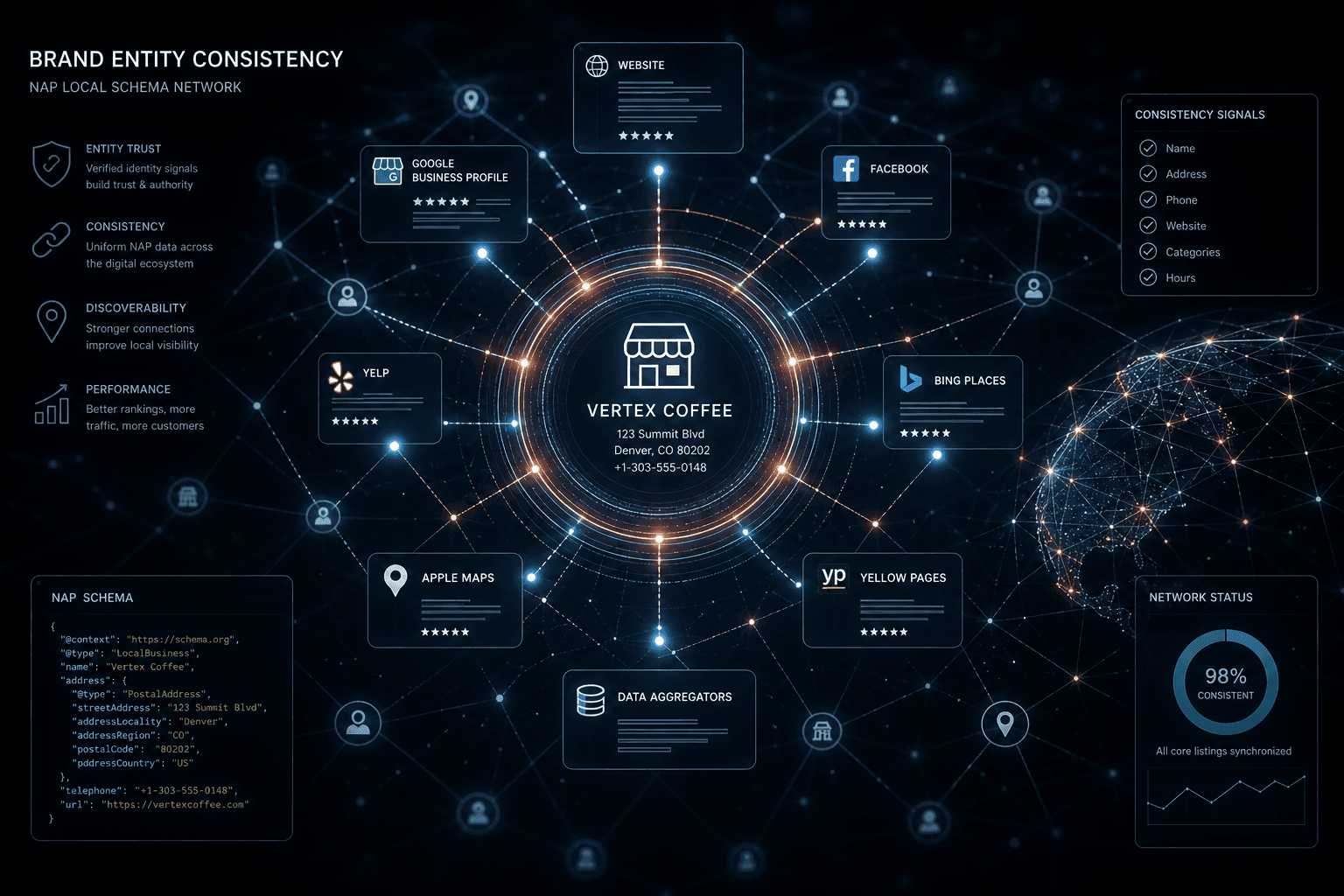
How Brand Consistency and NAP Schema Build Entity Authority for AI

Table of Contents
How Brand Consistency and NAP Schema Build Entity Authority for AI #
AI search does not reward the loudest brand. It rewards the brand whose name, address, phone, and category look like the same business everywhere the model looks. If your Google Business Profile says one legal name, your website footer says another, and your Yelp listing still shows an old suite number, engines like ChatGPT, Perplexity, and Google AI Overviews do not "sort of know" who you are. They treat you as conflicting records — and conflicting records lose the recommendation.
I am William Spurlock. I build AI-visibility-ready sites and schema systems for operators who need citations, not vanity rankings. This spoke sits under my pillar on schema, structured data, and entity SEO as the technical core of AI visibility. Here I stay tactical: brand consistency as an entity signal, authority-building without a PR budget, and the exact NAP schema local businesses should ship.
Does brand consistency across the web affect my entity authority? #
Yes. Brand consistency is one of the strongest non-paid inputs into entity authority — AI engines reconcile your business by matching name, address, phone, URL, and category across sources, and mismatches drop confidence hard.
Entity authority is not a vibes score. It is the model's confidence that the node labeled "your business" is the same real-world organization across your site, directories, social profiles, and review platforms. When those surfaces agree, reconciliation succeeds. When they disagree, the engine either splits you into weak duplicate nodes or refuses to cite you at all. That is the same mechanism I cover in entity SEO: how to make your brand something AI actually knows — consistency is the cheap half of that system.
What "consistency" means to a machine #
Humans forgive "Spurlock AI," "William Spurlock LLC," and "williamspurlock.com" as the same shop. Models do not. They score string similarity, address tokens, phone normalization, and category overlap. Small drifts compound:
| Signal | Consistent (high confidence) | Inconsistent (low confidence) |
|---|---|---|
| Legal / DBA name | Same string on site, GBP, schema name |
"Acme HVAC" vs "Acme Heating & Air LLC" vs "ACME hvac atlanta" |
| Address | Identical street, suite, city, ZIP, country | Suite missing on Yelp; old ZIP on Apple Maps |
| Phone | One E.164-style number everywhere | Main line on site; owner's cell on directories |
| URL | Canonical HTTPS homepage | www vs bare domain; staging URL in a citation |
| Category | Primary category matches service reality | GBP says "Marketing agency"; site says "AI automation studio" |
| Hours | Same weekly pattern in schema + GBP | Seasonal hours updated in one place only |
If three of those six conflict, you are not "a little messy." You are teaching the model that your entity is unreliable.
How AI engines use consistency in practice #
When a buyer asks GPT-5.5, Claude Opus 4.8, Gemini 3.1 Pro, or Perplexity for a provider in a city, the stack roughly does this:
- Resolve the query into entities (service type, geo, brand candidates).
- Pull candidate nodes from knowledge graphs, search indexes, and live web fetches.
- Score each candidate on agreement across sources (NAP + category + reviews + site schema).
- Prefer high-agreement nodes for the answer; demote or omit low-agreement ones.
That is why a brand with modest links but perfect NAP often beats a brand with a press hit and a broken address footprint. Authority for AI is agreement under scrutiny, not logo size.
The consistency audit I run before schema work #
Before I touch JSON-LD, I force a single source-of-truth row:
- Canonical name — the string that will appear in
Organization/LocalBusinessname, the<title>brand segment, and the About page H1. - Canonical NAP — street address (or service-area policy if you are SAB), phone, email.
- Canonical URL — final HTTPS homepage with preferred host.
- Primary category — one plain-language category you can defend in GBP and on-page copy.
- sameAs list — LinkedIn, X, GBP, Apple Maps, industry directories, Wikidata if you have it.
Then I diff that row against every live listing. Fixes go to the listings first. Schema that invents a cleaner story than the open web is a trap — crawlers will still see the dirty citations.
Consistency vs. "branding refresh" chaos #
Rebrands kill entity confidence when you leave ghosts. If you changed DBA names, phone numbers, or offices in the last 24 months, treat cleanup as infrastructure:
- Update GBP, Apple Business Connect, Bing Places, and Yelp in the same week.
- 301 the old domain paths; do not leave the old brand as a live competing homepage.
- Keep the old name in
alternateNameonly when it still appears in the wild and you need reconciliation help — not as a creative flourish. - Refresh Organization / LocalBusiness schema the day the public name changes.
Brand consistency across the web affects entity authority because it is the reconciliation feature. Everything else in this post assumes you fixed that first.
Consistency failure modes I see on client sites #
These patterns show up constantly when I audit AI visibility:
- Legal-name vs. marketing-name split — the LLC is on the contract, the DBA is on ads, and schema mixes both without
alternateName. - Phone farming — every campaign gets a new tracking number that leaks into citations; the entity phone becomes a lottery.
- Moved offices, zombie listings — the site is current; Apple Maps and three aggregators still show the warehouse from 2022.
- Franchise / multi-location bleed — city pages share one phone and one address in the footer while schema pretends each page is unique.
- Category cosplay — GBP primary category chosen for search volume instead of operational truth, so models cannot map you to the service buyers ask for.
If two or more of those are live, pause content production. Another blog post will not reconcile a broken identity graph.
How consistency shows up in AI answers #
When consistency is high, brand prompts return stable facts: correct city, correct service line, correct URL. When consistency is low, you get:
| Prompt type | Healthy entity response | Broken entity response |
|---|---|---|
| "[Brand] what do they do?" | Clear service summary + homepage | Vague guess, wrong category, or "limited information" |
| "best [service] in [city]" | You appear with accurate NAP cues | Competitors with cleaner graphs win the slot |
| "[Brand] phone number / address" | Matches GBP and site | Hallucinated suite, old number, or refusal |
| "Is [Brand] legit / trustworthy?" | Corroborated across reviews + site | Hedged answer or silence |
I test those four prompt families after every NAP cleanup. You should too — weekly until the answers stabilize.
How do I build entity authority without a PR budget? #
You build entity authority without PR by controlling the sources you already own — schema, About page facts, directory NAP, review platforms, and a short list of high-trust sameAs profiles — then earning citations through useful, extractable pages instead of press releases.
PR helps when it creates third-party corroboration. Most small and mid-size operators do not need a retainer to get cited by AI. They need a clean entity home, consistent NAP, and content that answer engines can quote. Paid media and vanity awards are optional. Data hygiene is not.
The no-PR authority stack (ranked by cost vs. impact) #
| Move | Cost | Impact on entity confidence | Owner |
|---|---|---|---|
| Align NAP across top 10 listings | Low (time) | Very high | Ops / you |
| Ship Organization or LocalBusiness JSON-LD | Low–medium | Very high | Dev / site builder |
| Harden About page with subject-predicate-object facts | Low | High | You |
| Claim + complete GBP / Apple / Bing | Low | High (local) | Ops |
| Collect first-party reviews on platforms AI already trusts | Low–medium | High | Ops |
| Publish FAQ + service pages with clear answers | Medium | High for citations | You / writer |
| Wikidata item (when notability allows) | Low–medium | High if accepted | You |
| Guest posts / HARO-style pitches | Medium–high | Variable | Optional |
| Paid PR wire / awards mills | High | Often low for AI | Skip first |
I put PR near the bottom on purpose. A wire blast that invents quotes does less for ChatGPT or Perplexity than a correct LocalBusiness block and a Google Business Profile that matches your footer.
Own-surface authority: what to ship this month #
Focus on surfaces you control end-to-end:
- Entity home — homepage or About URL with legal name, founder, founding year, services, and geography in plain sentences.
- JSON-LD — Organization for digital brands; LocalBusiness (or a subtype) for physical / local service businesses. Include
@id,url,logo,sameAs, and contact fields. - sameAs discipline — only URLs that are truly you. Bad sameAs (dead socials, wrong LinkedIn) hurts more than an empty array.
- Author entity — Person schema + real bylines on money pages. Models already reason about who wrote the claim.
- Internal identity graph — link services ↔ About ↔ contact with descriptive anchors so the site itself explains relationships. That pattern pairs with the broader technical core in the schema and entity SEO pillar.
Third-party authority without buying headlines #
You still need corroboration. Steal these low-cash channels:
- Industry directories that require a real address and phone (not junk citation blasts).
- Chamber / association memberships where the listing is crawlable and matches NAP.
- Podcast or newsletter mentions that include your canonical URL — one accurate mention beats ten spun articles.
- Customer case blurbs on your site with named companies only when you have permission — fabricated logos are a trust nuke.
- GitHub, product Hunt, or app store pages if your product lives there — treat them as sameAs candidates.
What not to waste money on #
Skip these until the consistency audit is clean:
- Award badges that exist only to sell trophies.
- "100+ media placements" packages that dump your name on PBNs.
- Rewriting the homepage into slogan soup while the GBP still has the old phone.
- Schema generators that inject every type under the sun (
Product,Event,FAQPageon every URL) without matching visible content — validators may pass while AI trust drops.
A 30-day no-PR plan #
Use this as an operator checklist:
Week 1 — Truth table
- Lock canonical name, NAP, URL, category.
- Export current GBP data; screenshot Yelp / Apple / Bing.
- Diff and fix the worst five mismatches.
Week 2 — Entity home + schema
- Rewrite About page into fact sentences.
- Deploy Organization / LocalBusiness JSON-LD with
@idandsameAs. - Validate with Rich Results Test and Schema Markup Validator (see FAQ).
Week 3 — Citation hygiene
- Claim remaining major local profiles.
- Remove or update outdated listings you control.
- Add review ask to post-purchase email (one ask, one link).
Week 4 — Citation-ready pages
- Ship 2–3 service or city pages with lead-answer openings and FAQ blocks.
- Add FAQPage schema only where FAQs are visible (details in the FAQ section below).
- Re-test AI prompts: "best [service] in [city]" and your brand name — note whether models describe you accurately.
Entity authority without a PR budget is mostly plumbing: one identity, repeated correctly, wrapped in schema machines can read. Press is a multiplier after that, not a substitute.
Content that builds authority without sounding like PR #
You do not need a newsroom. You need pages answer engines can quote:
- Definition pages — "What is [service] for [buyer type]?" with a bold lead answer and a comparison table.
- Process pages — numbered steps with time ranges operators can verify.
- Local proof pages — city or neighborhood pages that state service area, response norms, and licensing where real.
- FAQ hubs — questions copied from sales calls, not keyword tools alone.
- Author bios — Person-level credentials that match LinkedIn and bylines.
Avoid thin "ultimate guides" that never state a fact. Models already have fluff. They need attributable claims tied to a clear brand node.
Measurement without vanity dashboards #
Track entity work with boring, repeatable checks:
- Monthly prompt battery (brand + category+city) logged in a sheet.
- GBP insights for calls / direction requests (local).
- Search Console queries that include your brand + service modifiers.
- Schema validation status after each deploy.
- Citation accuracy spot-checks on the top five directories.
If those trend cleaner, entity authority is rising — even if Domain Rating barely moved.
What NAP schema should local businesses use for AI visibility? #
Local businesses should use a LocalBusiness (or precise subtype) JSON-LD block that mirrors their Google Business Profile — identical name, PostalAddress, telephone, geo, openingHoursSpecification, and url — then keep that NAP string-identical across directories.
NAP means Name, Address, Phone. For AI visibility, NAP is not a footer tradition. It is the join key between your website entity and every local graph Google, Apple, and answer engines consult. Wrong NAP schema is worse than no schema: you are asserting a conflicting record in machine-readable form.
If you are optimizing for local recommendations specifically, pair this section with AI visibility for local businesses: getting recommended in your city.
Choose the right @type
#
| Business pattern | Prefer @type |
Why |
|---|---|---|
| Single storefront / clinic / office | LocalBusiness or subtype (HVACBusiness, Dentist, Restaurant, etc.) |
Adds geo + hours expectations |
| Multi-location brand | Parent Organization + child LocalBusiness per location |
Prevents one blob address for every city |
| Service-area business (no public storefront) | LocalBusiness with areaServed; careful with fake storefront addresses |
Do not invent a lobby you do not have |
| Pure SaaS / national digital brand | Organization (not forced LocalBusiness) |
Geo NAP is optional; identity still matters |
Use the most specific Schema.org subtype you can defend. Specificity helps categorization; lying about being a Restaurant when you are a SaaS tool does not.
Required NAP fields I ship on local sites #
Minimum viable LocalBusiness for AI + local search:
@context:https://schema.org@type:LocalBusinessor subtype@id: stable fragment on your domain, e.g.https://example.com/#localbusinessname: exact public nameurl: canonical homepage or location pagetelephone: one primary number in a consistent formataddress: nestedPostalAddresswithstreetAddress,addressLocality,addressRegion,postalCode,addressCountrygeo:GeoCoordinateswithlatitude/longitudeopeningHoursSpecificationoropeningHours: match GBPimage/logo: absolute URLssameAs: GBP URL plus other verified profilespriceRangewhen it is honestly shown on-site
Optional but useful:
hasMappointing to your Google Maps URLareaServedfor SABs (City / GeoCircle)departmentor separate location pages for multi-locationparentOrganizationwhen a local node sits under a national brand
Example LocalBusiness JSON-LD (pattern, not copy-paste fiction) #
Adapt this shape to your real NAP. Do not invent coordinates.
{
  "@context": "https://schema.org",
  "@type": "HVACBusiness",
  "@id": "https://example.com/#localbusiness",
  "name": "Example HVAC Co",
  "url": "https://example.com/",
  "telephone": "+1-404-555-0148",
  "image": "https://example.com/images/storefront.jpg",
  "logo": "https://example.com/images/logo.png",
  "priceRange": "$$",
  "address": {
    "@type": "PostalAddress",
    "streetAddress": "123 Peachtree St NE Suite 400",
    "addressLocality": "Atlanta",
    "addressRegion": "GA",
    "postalCode": "30303",
    "addressCountry": "US"
  },
  "geo": {
    "@type": "GeoCoordinates",
    "latitude": 33.7590,
    "longitude": -84.3880
  },
  "openingHoursSpecification": [
    {
      "@type": "OpeningHoursSpecification",
      "dayOfWeek": [
        "Monday",
        "Tuesday",
        "Wednesday",
        "Thursday",
        "Friday"
      ],
      "opens": "08:00",
      "closes": "18:00"
    }
  ],
  "sameAs": [
    "https://www.google.com/maps?cid=YOUR_CID",
    "https://www.yelp.com/biz/example-hvac-co-atlanta",
    "https://www.linkedin.com/company/example-hvac"
  ]
}
NAP matching rules that actually matter #
Follow these like deployment checklists:
- One primary phone — tracking numbers can exist in ads; schema + GBP + footer should share the number you want associated with the entity.
- Suite / unit tokens — "Suite 400", "Ste 400", and "#400" are different strings. Pick one and reuse it.
- Directional abbreviations — "Northeast" vs "NE" should match GBP, not your designer's preference that week.
- Hours timezone honesty — if you close for holidays, update schema and GBP together.
- Location pages — each physical location gets its own URL + its own LocalBusiness
@id, not one mega-block with three addresses stuffed intostreetAddress.
NAP schema vs. Organization-only sites #
Digital brands still need consistency — but forcing a fake storefront into LocalBusiness to "win local" is a mistake. If you have no public address, do not publish one in schema. Use Organization, state areaServed if you truly serve geos, and keep name + URL + sameAs tight. AI visibility for local intent still favors businesses with verifiable geo nodes; inventing one is how you earn distrust.
Rollout order for local NAP schema #
- Fix GBP to the canonical NAP.
- Mirror that NAP on the contact page and footer.
- Deploy LocalBusiness JSON-LD on the homepage or location page.
- Align Apple Business Connect and Bing Places.
- Re-crawl / request indexing; re-test "near me" and city prompts in ChatGPT, Perplexity, and Google AI Mode.
NAP schema is not a plugin toggle. It is a contract between your site and every other database that claims to know your business. Keep the contract identical, or AI will not pick a side — it will skip you.
Multi-location NAP pattern #
For brands with more than one public address, I use this hierarchy:
| Layer | Schema role | URL pattern | NAP rule |
|---|---|---|---|
| Corporate | Organization with @id #organization |
/ or /about |
Brand name + HQ or corporate contact only |
| Location A | LocalBusiness @id #location-atlanta |
/locations/atlanta |
Atlanta-only NAP |
| Location B | LocalBusiness @id #location-nashville |
/locations/nashville |
Nashville-only NAP |
Each location block sets parentOrganization to the corporate @id. Each location page shows only that location's NAP in the visible HTML. Shared footers that dump every address on every URL confuse both users and extractors — put the full location list on a /locations index, not in the global footer of blog posts.
Service-area businesses (SABs) #
If technicians come to the customer and you have no public retail counter:
- Do not publish a residential address as a storefront unless you want visitors and models treating it like one.
- Prefer
areaServedwith named cities or aGeoCircleyou can defend. - Keep the phone and name identical everywhere; address fields should match whatever GBP policy you use for SABs.
- Still ship LocalBusiness or a subtype — geo intent queries need a local-shaped node — but honesty beats fake pin drops.
Common NAP schema bugs #
| Bug | Symptom in AI / search | Fix |
|---|---|---|
| Relative logo URLs | Logo dropped from graph | Absolute https:// URLs |
| Multiple competing LocalBusiness blocks | Duplicate / conflicting nodes | One primary @id per location URL |
| Hours in text only, wrong in schema | Voice/AI states closed when open | Sync openingHoursSpecification to GBP |
telephone with words ("call now") |
Failed normalization | Digits + country code only |
| Schema on site, GBP unclaimed | Weak local corroboration | Claim and verify GBP first |
Ship NAP schema only after the public listings tell the same story. Markup is not a rewrite layer for reality.
FAQ: Brand Consistency, NAP Schema, and Entity Authority #
How does structured data differ from unstructured content for AI indexing? #
Structured data is explicit machine-readable statements (usually JSON-LD using Schema.org types); unstructured content is the human prose crawlers must infer meaning from. Both matter: prose supplies quotable answers and E-E-A-T context, while structured data reduces ambiguity about name, address, phone, products, and FAQs. As of mid-2026, answer engines still read both — but when they conflict, models tend to distrust the messy side. I treat schema as the labeled columns and on-page copy as the narrative proof, the same split I outline in how structured data helps AI understand and cite your business.
What is the difference between on-page structured data and entity authority? #
On-page structured data is a signal you publish on your domain; entity authority is the model's overall confidence in your brand node across the whole web. Perfect JSON-LD on a site with contradictory Yelp and GBP data still loses reconciliation fights. Schema is necessary infrastructure; authority is schema plus consistent third-party corroboration plus extractable proof pages. Fix on-page markup early, then spend the next sprint on citation and NAP hygiene so the graph agrees with your @id.
Does FAQ schema still matter for AI visibility in 2026? #
Yes — when the FAQ content is visible on the page and written as real buyer questions, FAQPage schema still helps answer engines locate extractable Q&A pairs. Empty or hidden FAQ markup is a liability, and Google has tightened rich-result eligibility over time; treat schema as a mirror of on-page FAQs, not a cheat code. For the citation-focused playbook, see FAQ schema and AEO as a high-impact move for AI citation. Ship fewer, better FAQs that match how customers actually ask GPT-5.5 or Gemini 3.5 Flash.
How do I do an entity SEO audit for my website? #
Start with a canonical identity row (name, NAP, URL, category, sameAs), then score every major surface against it and validate your JSON-LD. Practically: export GBP, crawl your homepage/About for Organization or LocalBusiness, run Rich Results Test, list top 10 citations, and prompt ChatGPT / Perplexity / Google AI Overviews with your brand name and a category+city query. Log mismatches in a spreadsheet — name drift, phone drift, missing @id, thin About facts — and fix in that order. An entity audit is a reconciliation audit, not a keyword density report.
What tools do I use to test my schema markup? #
I validate with Google's Rich Results Test, the Schema Markup Validator from schema.org, and a live view-source check that the JSON-LD on production matches staging. Rich Results Test catches Google eligibility issues; Schema Markup Validator catches vocabulary mistakes; neither replaces comparing schema NAP to GBP by eye. For local entities, also open the GBP listing side-by-side with your PostalAddress block before you call it done. If you use a tag manager, confirm the block still renders for bot user-agents, not only for logged-in preview.
How does internal linking affect entity relationships for AI? #
Internal links are how your site declares relationships between brand, services, locations, and authors — descriptive anchors help models map those edges. Orphan service pages with no path to the About/entity home look like disconnected content blobs. Link location pages to the parent Organization story, author pages to the articles they wrote, and product or service nodes to the brand @id you care about. Internal linking will not invent third-party authority, but it stops your own domain from contradicting itself.
What is knowledge graph optimization and is it worth doing? #
Knowledge graph optimization means making your brand easy to reconcile as a single node in graphs like Google's Knowledge Graph and open bases such as Wikidata — and yes, it is worth doing once basic NAP and schema are clean. It is not a separate mystic channel; it is entity SEO with clearer vocabulary: stable @id, sameAs links, accurate categories, and third-party corroboration. For most local and SMB brands, GBP + LocalBusiness + citation cleanup delivers more than chasing a Wikipedia page you will not keep. Pursue Wikidata when you can support statements with references; skip vanity graph hacks.
What is Speakable schema and does it affect AI or voice search? #
Speakable schema (speakable) marks page sections intended for text-to-speech / voice playback; as of mid-2026 it is a narrow, mostly Google-centric hint — not a primary lever for ChatGPT or Perplexity citations. Reports and Google documentation have long framed it for specific news/publisher contexts rather than every local service site. I would not prioritize Speakable over LocalBusiness NAP, FAQPage on real FAQs, or entity consistency. If you already have clean article structure and want to experiment on news-like content, mark short, self-contained summary paragraphs — and keep expectations modest.
Get an AI-visibility-ready site built #
If AI engines cannot reconcile your brand, you do not have a content problem — you have an identity problem. Brand consistency, NAP schema, and a factual entity home are the foundation. Press, posts, and campaigns only amplify a node that already exists.
I build premium AIO/AEO websites and AI visibility systems where Organization / LocalBusiness schema, About-page facts, and local listings agree on purpose. If you want a site that answer engines can cite and customers can trust:
Get an AI-visibility-ready site built →
Bring your Google Business Profile login, a list of live directories, and the ten questions buyers ask about you in ChatGPT. I will map the reconciliation gaps and ship the schema + site structure that closes them.
Related Posts

Is Your Business Invisible to AI? How to Run a 15-Minute AI Visibility Audit
Run a 15-minute AI visibility audit to see if ChatGPT, Perplexity, and Google AI Overviews know your brand — then decide if you need the deeper 12-check dive.

How Long GEO Takes to Work, and How to Measure It
GEO usually shows first citation signals in weeks, not days. Measure progress at 30/60/90 days — and see how B2B, services, and clusters change the clock.

How to Sell AI Visibility Services: Packaging, Pricing, and Positioning
How agencies package, price, and position AI visibility (GEO/AEO) for SEO clients — offer tiers, objection scripts, and pricing ranges I have seen in 2026.