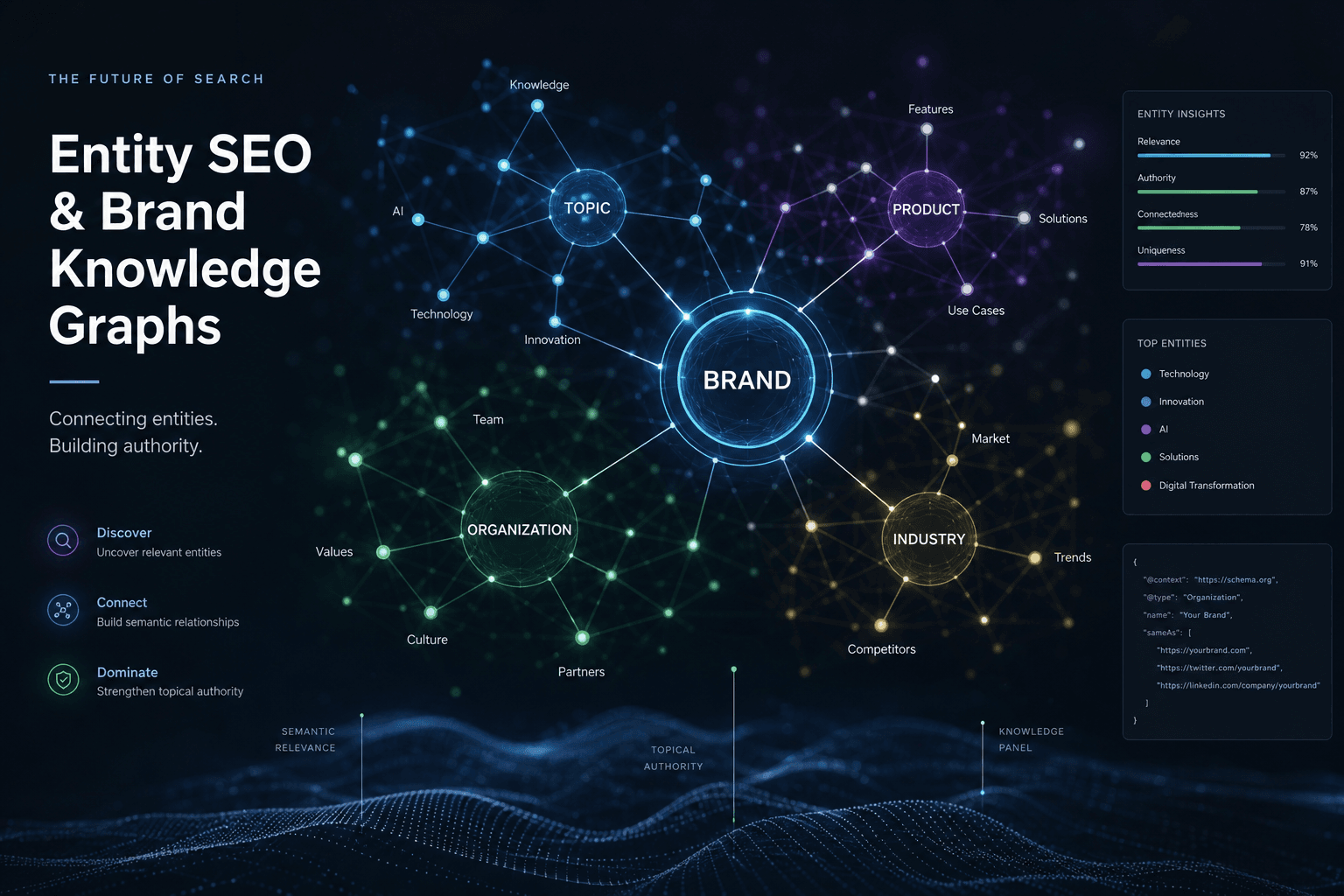
Entity SEO: How to Make Your Brand Something AI Actually Knows

Table of Contents
Entity SEO: How to Make Your Brand Something AI Actually Knows #
Beyond Keywords: Why AI Engines Reason About Entities, Not Search Queries #
AI engines do not match text strings; they map relationships between real-world concepts, people, and brands. By organizing information into distinct entities with defined attributes, AI can synthesize direct answers instead of merely serving a list of blue links.
Traditional search engines spent decades indexing text strings. If a user searched for "best commercial HVAC installer in Atlanta," Google matched those exact words against the text on your website. AI search engines like ChatGPT with Search, Perplexity, and Google AI Overviews operate on an entirely different architecture. They do not scan web pages in real-time to match keywords. Instead, they query a massive, multi-dimensional database called a knowledge graph, which organizes the world's information into distinct concepts, people, places, and brands.
This shift represents a fundamental change in how search systems compute relevance. In the PageRank era, search engines relied on keyword-matching algorithms, counting term frequency and analyzing hyperlink structures to determine authority. Modern AI engines replace this string-matching approach with dense vector spaces and semantic indexing. When a user enters a query, the system uses an embedding model to map the user's intent into a high-dimensional vector. This query vector is then compared against entity embeddings in a shared vector space, measuring semantic similarity through mathematical distance. Instead of looking for matching keyword tokens, the engine identifies the underlying concepts and entities that align with the user's intent, even if the searcher used completely different terminology.
Within these dense vector spaces, relationships between nodes are represented mathematically through Knowledge Graph Embeddings (KGE). Algorithms like TransE or RotatE treat relationships as translation vectors in the embedding space. For instance, if the head entity is 'William Spurlock' and the relation is 'foundedBy', the vector sum of the head embedding and the relation embedding should closely approximate the tail entity embedding of 'William Spurlock LLC'. This geometric representation allows the AI to perform complex relational reasoning. When a user asks ChatGPT or Perplexity about companies founded by a specific expert, the engine does not just search for text documents containing both names; it performs vector arithmetic to traverse the graph and retrieve the correct node with high mathematical certainty.
In this new environment, keyword SEO is obsolete. Keyword SEO is about matching text; Entity SEO is about proving your brand exists as a coherent concept. When an AI receives a query, it translates the user's intent into a set of required entity attributes. It then searches its knowledge graph for nodes that possess those attributes. If your brand is just a collection of unlinked keywords scattered across the web, the AI cannot verify your identity, and you will be left out of the generated answer entirely.
This means that traditional search engine optimization techniques, such as keyword stuffing and exact-match anchor text, are no longer effective. Instead, search systems focus on the semantic coherence of your entire digital footprint. They analyze how frequently and consistently your brand is mentioned in relation to specific topics, industries, and other recognized entities.
As an AI Solutions Architect who has shipped hundreds of production sites and 500+ automations, and who has been SEO-certified since 2021, I have witnessed this transition firsthand. I build systems that feed these models, and I know that they demand structured, relational data. To win in this era, you must stop optimizing for strings and start optimizing for things. This is the exact mechanism behind how ChatGPT and Perplexity actually decide which businesses to recommend, relying on verified database connections rather than raw keyword density.
From Keyword Strings to Knowledge Graph Nodes: What is an Entity? #
A brand entity is a unique, well-defined concept or object that exists independently of the language used to describe it. In a knowledge graph, your brand is a node, and its connections to other nodes—like its founder, products, and location—define its meaning to an AI.
To understand entity SEO, you must understand the underlying data structure of modern AI. In computer science, a knowledge graph is made of two primary components: nodes and edges. A node represents an entity—a real-world person, place, organization, or concept. An edge represents the relationship between those nodes. For example, "William Spurlock" is a person node, "williamspurlock.com" is an organization node, and the edge connecting them is "foundedBy."
To define a node in a machine-readable format, Schema.org uses specific properties that act as standard keys. These attributes allow AI crawlers to index your brand with zero ambiguity:
@type: Defines the specific category of the entity (such asOrganization,LocalBusiness, orPerson). This tells the engine which schema rules and expected properties apply to the node.@id: The globally unique, canonical URI (Uniform Resource Identifier) for the entity. This acts as the node's permanent address, preventing the engine from confusing it with other entities that share similar names.name: The official, legal, or primary name of the entity. This is the primary text label associated with the node in the knowledge graph.url: The authoritative web address of the entity's home. This serves as the primary digital location where the entity's attributes are officially published and maintained.sameAs: A list of URLs pointing to other highly authoritative pages that represent the exact same entity (such as Wikidata, Wikipedia, or official social profiles). This is the primary property used by AI engines for identity reconciliation.logo: The URL of the official brand logo. This associates a specific visual asset with the entity node, allowing AI search engines to display the correct imagery in search cards and brand summaries.contactPoint: A structured contact channel (such as customer service email or phone number) associated with the organization. This defines the official communication edges for the brand node.
Unlike keyword strings, which are subject to spelling variations, synonyms, and language translations, an entity node is unique and language-independent. It is assigned a unique alphanumeric identifier in databases like Wikidata. This identifier allows an AI to know that "William Spurlock," "W. Spurlock," and "William Spurlock, AI Solutions Architect" all refer to the same singular entity, regardless of how the name is written in a specific article.
When an AI engine tries to understand your brand, it maps these nodes and edges to construct a web of facts. If the AI finds a node for your business, it looks at the outgoing edges: Who is the founder? What products do they sell? Which industries do they serve? Where is their physical office? The strength and clarity of these edges determine how well the AI understands your business. If these connections are missing or broken, the AI cannot reason about your brand, leaving your business invisible when users ask relational questions.
Where AI Gets Entity Knowledge: The Five Core Data Ingestion Channels #
AI engines build their brand databases by crawling structured web schema, reading authoritative public registries like Wikidata, indexing news and press coverage, scanning social profiles, and analyzing user reviews. These five channels feed the training sets and real-time search indexes that shape your AI visibility.
AI models do not guess who you are; they ingest data from specific, verifiable pipelines. The first channel is static training data, primarily sourced from massive web crawls like Common Crawl. During pre-training, models ingest billions of web pages, learning about brands, people, and concepts by analyzing how often they are mentioned together. The second channel is real-time search APIs, used by engines like Perplexity to fetch live web content. These APIs retrieve current pages, which the AI then analyzes to extract fresh facts and update its temporary context.
The third and most authoritative channel is structured data, specifically Schema.org markup deployed directly on your website. This code provides a direct, machine-readable feed of your brand's attributes. The fourth channel consists of highly trusted public registries and knowledge bases, such as Wikidata, Wikipedia, and official government business registries. Because these databases require human verification and strict moderation, AI models treat them as absolute ground truth. The fifth channel is the web of consistent mentions across social media profiles, industry-specific directories, and customer review platforms.
To determine if a fact is true, the AI calculates a confidence score based on database overlap. If Wikidata says your business was founded in 2021, your LinkedIn profile says 2021, and your website's Schema markup says 2021, the AI assigns a high confidence score to that relationship. However, if these sources contradict each other—or if the information is missing from key channels—the AI's confidence score drops. When confidence is low, the AI will refuse to recommend your brand, preferring competitors with cleaner, more consistent data footprints.
The Mechanics of Entity Reconciliation: How AI Decides Who You Actually Are #
Entity reconciliation is the process where an AI compares scattered web mentions to determine if they refer to the exact same business. Inconsistent names, addresses, or founder details force the AI to split your brand into weak, separate profiles, destroying your search rankings.
Entity reconciliation is the algorithmic process of matching different records or web mentions to a single, unique entity node. When an AI crawler indexes the web, it encounters thousands of references to businesses. It must decide if "Company A" mentioned on a blog is the same as "Company A" listed on a local map. To do this, the AI uses probabilistic record linkage, comparing attributes like name, address, phone number, founder, and website URL.
Behind this reconciliation process lies complex mathematical modeling and probabilistic record linkage. When comparing text strings like business names, algorithms compute a similarity score using metrics like Jaro-Winkler distance, which measures the edit distance between two strings while giving more weight to matching prefixes. For unstructured text, engines use TF-IDF (Term Frequency-Inverse Document Frequency) or cosine similarity between high-dimensional vector embeddings to determine if two descriptions refer to the same entity. The system combines these individual attribute scores into an overall confidence level. If the calculated confidence exceeds a specific threshold (for example, 0.85), the engine merges the records into a single node. If the score falls below the threshold due to conflicting data, the engine treats the mentions as separate entities, lowering the visibility of both.
To resolve ambiguities when multiple entities share similar names, the reconciliation algorithm also performs co-citation and co-occurrence analysis. If two web pages mention 'William Spurlock', the algorithm looks at the surrounding context words and neighboring entities. If one page mentions 'AI solutions', 'n8n automation', and 'williamspurlock.com', while the other mentions 'classical piano' and 'juilliard', the algorithm recognizes that these are two distinct entity nodes despite the identical name string. The engine uses these contextual signals to calculate a conditional probability, ensuring that your brand's authority is not accidentally merged with or diluted by an unrelated namesake.
Consider a real-world example. Suppose my business is officially named "Spurlock AI Solutions." On LinkedIn, the profile is set up as "Spurlock AI." On a local business registry, it is registered under the legal entity name "William Spurlock LLC." To make matters worse, the LinkedIn profile lists a virtual office address in New York, the local registry lists a home office in Atlanta, and the website lists no physical address at all. To a human, these might seem like minor administrative discrepancies. To an AI, this is a catastrophic data conflict.
Instead of reconciling these records into a single, highly authoritative brand node, the AI's reconciliation algorithm fails. It concludes that these are three separate, unverified entities, or worse, it treats them as low-confidence noise. The parent node is split, diluting your brand's authority across multiple fragmented profiles. When a user asks ChatGPT for a trusted AI Solutions Architect, the model bypasses my business entirely because it cannot reconcile the conflicting data to verify that my business is legitimate and active.
Your About Page is Now Infrastructure, Not Marketing Filler #
Your About page serves as the primary source of truth where AI crawlers verify the relationships between your company, its leadership, and its core offerings. Structuring this page with clear, factual statements allows AI to index your brand node with absolute certainty.
For years, companies treated their About page as a creative writing exercise. Copywriters filled these pages with vague, flowery marketing copy, using phrases like "we are a synergy-driven team of innovators pushing boundaries." To an AI crawler, this text is useless filler. It contains no extractable facts, no defined relationships, and no entity data. Today, your About page is not a marketing brochure; it is critical technical infrastructure.
Your About page must function as your brand's official "entity home." This is the single, authoritative URL where AI search bots anchor all other scattered facts they find about you across the web. When a bot crawls your site, it looks to the About page to verify the core attributes of your business node. It wants to know: Who owns this company? What is its legal name? What specific services does it offer? By presenting these facts clearly, you allow the AI to build a high-confidence map of your brand.
To ensure AI engines can access this critical infrastructure, your robots.txt configuration must be aligned to permit AI crawlers to fetch your entity home. Many website owners block user-agents like GPTBot, ClaudeBot, or PerplexityBot out of fear of content scraping or traffic loss. However, blocking these bots prevents AI search systems from indexing your canonical About page, directly harming your entity validation. If an AI engine cannot crawl your designated entity home, it cannot verify your Schema markup or reconcile your brand attributes. This lack of direct verification drops your entity confidence score to zero, ensuring your business is excluded from AI-generated answers. You must configure your robots.txt to allow these specific crawlers access to your primary informational pages, treating crawl budget and bot access as essential visibility channels.
In addition to robots.txt alignment, the semantic HTML structure of your About page must be optimized for relationship extraction. Natural language processing models parse web pages by analyzing the document object model (DOM) tree. Using clear semantic tags like <main>, <article>, and <section> helps the parser identify the primary content area. Headings should follow a strict hierarchical structure, with a single <h1> containing your primary brand entity name, followed by <h2> elements that introduce specific relational attributes (such as 'Our Leadership', 'Our Core Services', and 'Our History'). Within these sections, using <address> tags for physical locations and <ul> or <ol> lists for structured attributes allows the parser's entity-attribute-value extraction algorithms to index your brand with high confidence and minimal processing overhead.
To optimize this page for AI engines, you must write in clear, declarative, subject-predicate-object sentences. Instead of writing "Our passion lies in crafting digital experiences," write "William Spurlock founded William Spurlock LLC in 2021." Instead of writing "We serve clients globally," write "The company provides AI automation and web design services to businesses in the United States." This structured, factual prose makes it incredibly easy for natural language processing models to extract relationships and update their knowledge graphs without error.
Establishing Your Entity Home: Organization and LocalBusiness Schema #
You establish your entity home by deploying structured Schema.org markup on your homepage or About page, explicitly linking your business to its official social channels and registries. This code acts as a direct map for AI crawlers, defining your business type, location, and key brand relationships.
Schema.org markup is the closest thing to a direct API for search bots. When I build websites, I do not expect AI crawlers to guess what my page is about. I explicitly tell them. By embedding a JSON-LD Organization block on your homepage or About page, you establish a definitive anchor. This tells engines like Google and Perplexity: "This is the primary authority on this entity."
To build high-confidence connections, your Schema must link to third-party databases. This is handled through the sameAs property, which maps your website node to existing records on Wikidata, LinkedIn, Twitter, and GitHub. The crawler reads this structured list, compares it to what it already knows, and reconciles the identity. If you skip this, you force AI engines to guess, which leads to fragmented and low-confidence profiles.
Below is the exact JSON-LD Organization block I use to anchor my brand, William Spurlock LLC. Note how the sameAs array provides explicit pointers to external entities:
{
  "@context": "https://schema.org",
  "@type": "Organization",
  "@id": "https://williamspurlock.com/#organization",
  "name": "William Spurlock LLC",
  "url": "https://williamspurlock.com",
  "logo": "https://williamspurlock.com/images/logo.png",
  "founder": {
    "@type": "Person",
    "name": "William Spurlock",
    "sameAs": "https://williamspurlock.com/about"
  },
  "sameAs": [
    "https://www.wikidata.org/wiki/Q115862892",
    "https://www.linkedin.com/in/creativewill",
    "https://x.com/creativewill",
    "https://github.com/creativewill"
  ],
  "contactPoint": {
    "@type": "ContactPoint",
    "contactType": "customer service",
    "email": "william@williamspurlock.com"
  }
}
By deploying this code on your designated entity home, you give AI models an unambiguous map. This directly underpins how structured data helps AI understand and cite your business by establishing machine-readable relationships that require zero interpretation.
When deciding between Organization and LocalBusiness schema, you must consider the geographic nature of your operations. While Organization is ideal for global brands, software companies, or digital-only service providers, LocalBusiness is required for any brand with a physical footprint. LocalBusiness schema includes unique spatial and temporal properties that do not exist in the generic Organization type. For example, it requires geo coordinates (latitude and longitude), a structured address (using the PostalAddress type), and openingHours specifications. AI engines rely heavily on these spatial and temporal attributes to answer local search queries. When a user asks an AI for a service provider 'near me' or within a specific city, the engine filters its knowledge graph using these exact coordinates and address fields, matching the user's location with your physical node.
For enterprises with multiple physical locations, you must establish a clear parent-child relationship in your structured data. This is achieved by nesting your LocalBusiness nodes within your main Organization node, or by using the parentOrganization property on each local branch schema. By explicitly linking each local branch to the parent brand entity, you prevent AI engines from treating your locations as disconnected, independent businesses. This hierarchical mapping ensures that the topical authority of the parent brand flows down to every local node, while the geographic validation of each local branch strengthens the overall footprint of the parent organization. When an AI search engine processes a query, it can traverse these parent-child edges to recommend the nearest verified branch of your trusted brand.
Wikidata and Wikipedia: Seeding the Ultimate Trusted Data Sources #
Wikidata and Wikipedia are the foundational databases that AI models use to ground their factual knowledge of the world. Securing a verified Wikidata item establishes an immutable identifier for your brand, making it instantly recognizable across ChatGPT, Perplexity, and Google.
If you want to know what LLMs consider ground truth, look at where they source their facts. ChatGPT, Claude, and Google Gemini do not treat random blogs as fact engines; they rely on curated, highly moderated open databases. Wikidata and Wikipedia are the ultimate reference points. They sit at the core of almost every model's training data. If your brand is not recorded there, you are missing a permanent ID in the global index.
Wikidata is a relational, machine-readable database where every concept is assigned a unique alphanumeric ID (like Q115862892). It is structured, database-driven, and highly objective. You do not write a story; you input clear triples: "William Spurlock LLC (Subject) -> instance of (Predicate) -> business (Object)." Because Wikidata relies on structured data, getting your brand registered here is a repeatable, technical process. Once registered, that unique ID becomes the primary link in your Schema.org sameAs array, allowing every AI search crawler to reconcile your brand instantly.
To successfully establish your brand node on Wikidata, you must populate specific, actionable properties that AI engines use to verify your identity. The most important property to set is P31 (instance of), which should point to Q4830453 (business) or Q43229 (organization) to define the nature of the node. Next, you must link your official web presence using property P856 (official website), which connects your Wikidata ID directly to your domain. To strengthen the entity's social graph, add property P2002 (Twitter username) and link your official social handles. Finally, establish leadership relationships using property P112 (founder) to connect your business node to your personal Wikidata node. These structured properties serve as machine-readable keys that AI engines query directly, allowing them to verify your brand's legitimacy and reconcile your digital footprint with absolute certainty.
When adding these properties, you should also include qualifiers and references to maximize their trust score. On Wikidata, a statement without a reference is considered low-confidence. You can back up your statements by adding a reference pointing to an official government business registry (such as the SEC or state registry) or an authoritative news publication. For example, when setting the founder property P112, adding a reference with the URL of a major press profile or official corporate filing verifies the claim. This structured referencing system prevents Wikidata's community editors from flagging or deleting your entries, while providing AI crawlers with a transparent, verifiable audit trail of your brand's claims.
Wikipedia is the absolute peak of entity authority, but it is notoriously difficult to secure. Its community enforces strict and sometimes impossible notability guidelines. If you try to write your own page, it will be deleted for conflict of interest. However, if your brand has received heavy, sustained coverage in major media, securing a Wikipedia node is the holy grail. It creates a high-trust reference point that almost guarantees your brand will show up in AI search queries. Focus on Wikidata first; its structured nature means you can establish your node without navigating Wikipedia's complex editorial politics.
The Effort vs. Impact Matrix of Entity Signal Sources #
Prioritize entity optimization by first securing high-impact, low-effort assets like Schema.org markup and official social profiles before pursuing high-effort sources like Wikipedia. This matrix balances immediate technical fixes with long-term authority building to maximize your visibility.
You cannot optimize everything at once. In my consulting, I use an effort-to-impact matrix to help brands focus on actions that yield the highest return. Some sources are instant wins that you can deploy in an afternoon; others require months of digital PR.
Here is the exact breakdown of how I evaluate these sources:
| Signal Source | Effort | Impact | Primary Value |
|---|---|---|---|
| Schema.org JSON-LD | Low | High | Provides direct, machine-readable facts directly to search bots. |
| Verified Social Profiles | Low | Medium | Establishes brand consistency and aids in entity reconciliation. |
| Wikidata Entry | Medium | Very High | Generates an immutable database ID that LLM training sets trust. |
| Google Business Profile | Medium | High | Serves as the primary node for local search and maps integration. |
| Authority Backlinks & PR | High | High | Increases co-citation frequency and raises semantic trust scores. |
| Wikipedia Article | High | Very High | The absolute standard of brand validation and authority in AI engines. |
I recommend starting with Schema.org markup and social alignment. These are fully within your control. You do not need an editor's approval to write clean JSON-LD on your own site. From there, move to Wikidata. Only once your basic footprint is verified and reconciled should you spend resources on high-effort PR campaigns or Wikipedia creation.
E-E-A-T and Author Entities: Why AI Demands Human Proof #
AI engines verify content authority by linking articles to established author entities who have proven expertise and real-world credentials. Building strong author nodes with consistent bylines and schema markup prevents AI from dismissing your content as generic, low-quality text.
AI search engines do not just evaluate what is written; they evaluate who wrote it. With generative AI creating millions of generic blog posts every day, trust has become the scarcest commodity on the web. AI search models use E-E-A-T (Experience, Expertise, Authoritativeness, and Trustworthiness) as an architectural filter. If a piece of content is published under an anonymous or generic "admin" byline, AI engines will disregard it. They want human proof.
To establish authority, you must build a distinct author entity node. When I write a blog post, I ensure the crawler can trace the text back to a real-world person with verifiable expertise. This is done by implementing explicit Author Schema that connects the article to the author's personal entity home—typically an About page or a professional portfolio. This page should host sameAs links pointing to their academic profiles, industry certifications, and social channels.
When an AI engine crawls an article, its reconciliation algorithm looks at the author property. It matches that author name against its existing database of recognized experts. If the author entity has a high topical authority score—built from writing on the same subject across other reputable sites—the AI assigns a high trust score to the new article. If you want your content to be recommended by AI, you must stop treating bylines as a styling choice and start treating them as cryptographic signatures of human expertise.
A Step-by-Step Playbook to Registering Your Brand Entity in AI Repositories #
To register your brand entity, you must first define your entity home, deploy Schema.org markup, align all web directories, and claim your Wikidata entry. Following this systematic sequence ensures AI engines can successfully reconcile and recommend your brand.
Establishing a brand entity is not a creative process. It is a technical sequence. If you want ChatGPT and Perplexity to recognize your business with absolute certainty, you must complete these five sequential steps:
- Designate and Optimize Your Entity Home: Choose your homepage or About page to serve as your brand's single source of truth. Ensure it contains clear, factual declarations of your legal name, founder, services, and location in direct, declarative prose.
- Deploy Structured Schema.org JSON-LD: Embed clean Organization schema directly in your entity home's HTML. Be sure to populate the
sameAsarray with links to your main social media profiles and business registrations. - Audit and Align Your Web Footprint: Search for all existing mentions of your brand on platforms like LinkedIn, Crunchbase, Twitter, and local directories. Your business name, address, and founder details must match your Schema markup exactly. Any discrepancies will break the entity reconciliation process.
- Build Topical Co-Citations and External Validation: Get mentioned on authoritative third-party websites in your industry. When independent publications cite your brand alongside your primary services, they strengthen the semantic edges in the AI's knowledge graph. This is the foundation of digital PR for AI visibility: getting mentioned where AI reads.
- Secure Your Wikidata Node: Create a structured entry on Wikidata once you have sufficient external citations to prove notability. Ensure you populate properties like "instance of," "official website," and links to your social profiles to lock in your immutable ID.
By following this checklist, you remove any margin for error. AI models will no longer have to guess who you are or what you do. They will have a verified, machine-readable map of your brand, ready to be served in direct recommendations.
FAQ: Frequently Asked Questions About Entity SEO #
What is the difference between a keyword and an entity? #
A keyword is a simple text string, while an entity is a distinct, real-world concept or object with defined relationships in a database. While traditional search engines match literal characters on a page, modern systems like Claude 4.8 and GPT-5.5 interpret queries as connections within a structured knowledge base. By anchoring your content around verified entities in Wikidata, you ensure that search crawlers can resolve your identity and recommend your brand for relational queries.
How do I find out if Google already knows my brand entity? #
You can check if Google recognizes your brand by searching for your business name and looking for a dedicated Knowledge Panel on the right side of the search results page. If a panel does not appear, you can query Google's official Knowledge Graph Search API using your business name to find your unique identifier (typically starting with g/ or kg/). A returned score above 0.5 indicates that Google's algorithm has reconciled your brand and assigned it an independent node in its database.
What is Schema.org markup, and how does it help AI? #
Schema.org is a standardized vocabulary of structured data tags that you add to your HTML to explicitly tell search engines what your content means. When you deploy JSON-LD markup on your website, you provide crawlers with machine-readable relationships that require zero interpretation. This structured feed directly boosts your visibility scores across search engines, as detailed in the official Schema.org documentation used by modern AI crawlers.
Can a small local business have a brand entity? #
Yes, any small business can and should establish a brand entity by using LocalBusiness schema and claiming local directory profiles. By aligning your Name, Address, and Phone (NAP) data across your Google Business Profile and Apple Maps, you build a consistent geographic node. AI models like Gemini 3.5 Flash rely on these unified data coordinates to recommend local service providers for near-me search queries.
How does Wikidata influence ChatGPT and Claude? #
Wikidata serves as a primary, open-license knowledge base that foundation models use during their pre-training and fine-tuning phases to learn real-world facts. Because Wikidata entries are strictly moderated, LLMs like Claude 4.8 and GPT-5.5 treat them as verified ground truth. Linking your website to a registered Wikidata item establishes your brand as a recognized global entity, ensuring you are recommended rather than hallucinated.
What is the "Entity Home" of a business? #
The Entity Home is the single webpage that a brand designates as the authoritative source of truth for its identity, typically the homepage or About page. I recommend using your About page as this anchor, deploying Organization schema to map your brand's relationships. AI engines visit this designated URL to reconcile all secondary web mentions, turning a disjointed digital footprint into a singular, high-confidence brand node. By establishing a clear, machine-readable anchor on your About page, you make it incredibly easy for search bots to verify your company's core details. This direct verification eliminates any ambiguity, ensuring that your brand is accurately represented in AI search results.
How does E-E-A-T relate to entity SEO? #
E-E-A-T (Experience, Expertise, Authoritativeness, and Trustworthiness) is evaluated by AI engines by analyzing the entity profiles of the content creators and the publishing brand. AI crawlers assess these signals by cross-referencing your author byline with external databases to verify your credentials. If the creator's node does not show active, trusted connections on platforms like LinkedIn and official registries, the AI will discount the content's authority, directly impacting its search visibility.
How long does it take for AI engines to recognize a new brand entity? #
It typically takes between two weeks and three months for AI engines to reconcile new structured data and update their knowledge graphs. While traditional search indexing can happen in hours, updating the deep relational indexes of AI models requires consistent cross-citations over a sustained period. You can expedite this process by securing press coverage on high-authority sites and immediately aligning all your primary web directories. Once the initial reconciliation is complete, you will notice your brand being cited more frequently in direct answers. Maintaining consistent updates to your schema and external profiles will ensure this recognition remains stable through subsequent model updates.
Ready to Audit and Build Your Brand Entity for the AI Era? #
Your brand either exists as a verified node in the knowledge graphs that ChatGPT and Perplexity query, or it is completely invisible to the systems answering your buyers' questions. Optimizing this data footprint is a precise, technical process that requires aligning your schema, securing database records, and reconciling your entity home to maximize confidence scores.
If you are ready to stop guessing and secure your brand's placement in AI recommendations, let me do the heavy lifting. I will run a complete diagnostic of your current digital footprint, deploy optimized JSON-LD schema, and build the relational connections needed to get your business recommended. Book an AI visibility audit with me today, and let's construct an authoritative brand node that AI search models can actually trust.
Building a visible brand entity is not a one-time project; it is an ongoing commitment to data integrity and semantic clarity. As search engines continue to evolve, those with the cleanest and most connected nodes will own the future of digital discovery.
Related Posts

How to Track When AI Tools Cite or Recommend Your Business
No engine gives you a complete citation feed. Here is the weekly method: freeze a prompt panel, score cite versus recommend, then read GSC and GA4 data.

GEO vs AEO vs AIO: What Each One Means and Why Your Business Needs All Three
GEO, AEO, and AIO are three jobs, not three names for SEO. Here's what each owns, why buyers bounce across all three, and why your business needs all of them.

Spurlock Studios LLC Is Live. This Site Stays the Operator Blog.
Spurlock Studios LLC is live at spurlockstudios.com. This site stays the operator blog. Four lanes, published floors, and which site to use when you book.