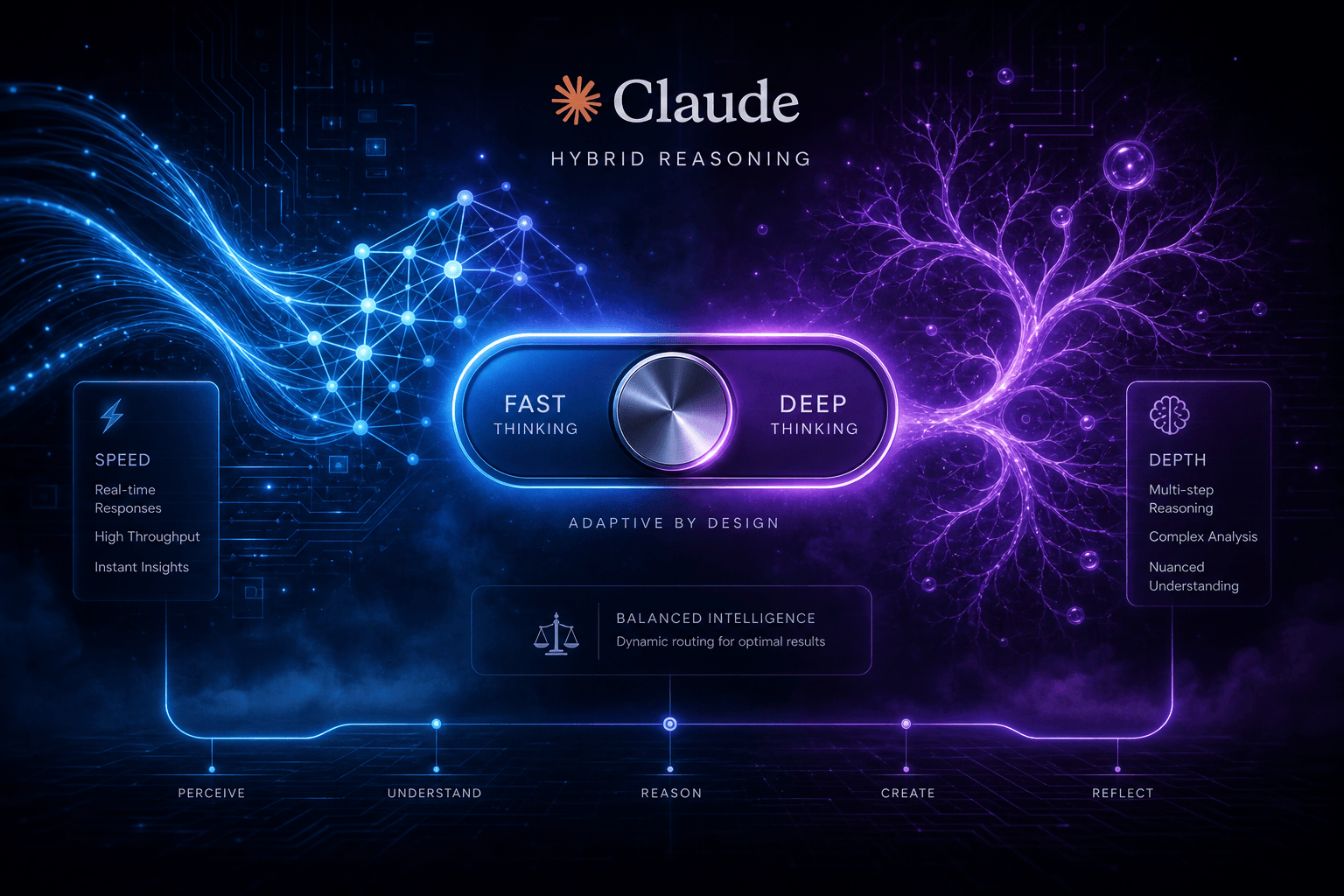
Claude 3.7 Sonnet + Claude Code: The Hybrid Reasoning Era Begins

Table of Contents
Claude 3.7 Sonnet + Claude Code: The Hybrid Reasoning Era Begins #
Today, Anthropic releases Claude 3.7 Sonnet — the first hybrid reasoning model that lets developers toggle deep chain-of-thought reasoning on demand. Alongside it comes Claude Code, a terminal-native agentic coding tool that competes directly with Cursor's agent mode. GitHub Copilot ships Claude 3.7 Sonnet support the same day. This is Anthropic's answer to OpenAI's o-series reasoning models, but with a critical difference: you get fast responses when you don't need reasoning, and deep reasoning when you do — all from the same model.
William Spurlock is an AI automation engineer and custom web designer who tracks production AI tooling. In this post, I break down exactly what Claude 3.7 Sonnet delivers, how Claude Code positions against Cursor, and what hybrid reasoning means for your stack.
| Launch Component | Release Date | Core Innovation |
|---|---|---|
| Claude 3.7 Sonnet | February 24, 2025 | Hybrid reasoning with extended thinking toggle |
| Claude Code | February 24, 2025 | Terminal-native agent with skills + hooks |
| GitHub Copilot integration | February 24, 2025 | Same-day model availability in Copilot Chat |
The timing is strategic. OpenAI's o1 and o3 models established that chain-of-thought reasoning boosts accuracy on complex tasks, but they force a binary choice: you either pay for a reasoning model or you don't. Claude 3.7 Sonnet collapses that distinction. One model, two modes, zero context switching.
What Is Hybrid Reasoning and Why Does It Matter? #
Hybrid reasoning lets a single model switch between fast, direct responses and deep, step-by-step chain-of-thought reasoning based on a simple toggle. This eliminates the need to choose between separate reasoning and non-reasoning models, reducing context-switching overhead and giving developers granular cost control.
OpenAI's approach requires you to pick: gpt-4o for speed or o1/o3 for reasoning. Each is a different model with different context windows, pricing structures, and API parameters. Anthropic's insight is that reasoning is a mode, not a model — and Claude 3.7 Sonnet proves it.
| Architecture | OpenAI o1/o3 | Claude 3.7 Sonnet |
|---|---|---|
| Model separation | Separate reasoning-only models | Single model, dual modes |
| Toggle mechanism | Model selection at request time | thinking parameter per request |
| Cost structure | Higher fixed rate for reasoning | Same pricing, you control token budget |
| Visibility | Hidden chain-of-thought | Visible reasoning stream (optional) |
| Context window | 200K input, 32K output | 200K input, 128K output |
The practical impact is immediate. When you're iterating quickly on UI components or writing straightforward utility functions, you keep extended thinking off and get near-instant completions. When you're debugging a distributed systems issue or architecting a database migration, you toggle it on and get methodical step-by-step analysis. Same model, same context, same API — no model switching, no re-authentication, no context loss.
Cost control is the hidden advantage. Claude 3.7 Sonnet charges $3 per million input tokens and $15 per million output tokens regardless of mode. In extended thinking, "thinking tokens" are billed as output tokens — but you set the budget. The API accepts a thinking.budget_tokens parameter up to 128,000 tokens, letting you cap reasoning depth per request. For a quick refactor, you might budget 4,000 thinking tokens. For a complex architectural review, you might allocate 32,000. You're not locked into a reasoning model's flat rate; you dial precision up or down based on task complexity.
This architecture also preserves context continuity. Because you're not switching models, you don't lose conversation history or tool state. If Claude has already read your repository structure, created a plan, and started implementation, flipping extended thinking on mid-stream doesn't reset anything — it just deepens the reasoning quality for subsequent steps.
Claude 3.7 Sonnet: Full Specifications and Benchmarks #
Claude 3.7 Sonnet ships with a 200,000 token input window, 128,000 token output maximum, and knowledge cutoff of November 2024. Pricing is $3 per million input tokens and $15 per million output tokens — identical across standard and extended thinking modes. Cache reads cost $0.30 per million tokens; cache writes cost $3.75 per million.
The benchmark results tell a clear story: Claude 3.5 Sonnet was already the strongest coding model for production work. Claude 3.7 Sonnet extends that lead.
Standard Mode Performance vs. Claude 3.5 Sonnet:
| Benchmark | Claude 3.5 Sonnet | Claude 3.7 Sonnet | Improvement |
|---|---|---|---|
| MMLU (general knowledge) | 88.7% | 89.4% | +0.7% |
| HumanEval (coding) | 93.7% | 95.2% | +1.5% |
| SWE-bench Verified (software engineering) | 49.0% | 52.4% | +3.4% |
| Chatbot Arena Elo | 1269 | 1274 | +5 points |
These gains are meaningful. SWE-bench Verified measures real-world software engineering — the kind of multi-file refactoring, bug fixing, and test writing that developers actually do. A 3.4 percentage point jump on an already-strong 49.0% base is significant in absolute terms.
Extended Thinking Mode — Competitive Positioning:
| Benchmark | Claude 3.7 Sonnet (Extended) | OpenAI o1-preview | Winner |
|---|---|---|---|
| MATH 500 (mathematics) | 96.2% | 96.4% | Tie |
| GPQA Diamond (graduate-level reasoning) | 74.8% | 73.3% | Claude +1.5% |
| HumanEval (coding) | 96.8% | 93.7% | Claude +3.1% |
| LiveCodeBench (competitive programming) | 70.1% | 63.4% | Claude +6.7% |
The GPQA Diamond result is particularly notable. This benchmark tests PhD-level reasoning across biology, physics, and chemistry. Claude 3.7 Sonnet with extended thinking achieves 74.8% — higher than o1-preview's 73.3% — while maintaining the flexibility to drop back to fast mode for simpler queries.
Full Technical Specifications:
| Specification | Value |
|---|---|
| Model ID | claude-3-7-sonnet-20250219 |
| Input context window | 200,000 tokens |
| Output maximum | 128,000 tokens (including thinking tokens) |
| Thinking budget maximum | 128,000 tokens |
| Knowledge cutoff | November 2024 |
| Input price | $3.00 / million tokens |
| Output price | $15.00 / million tokens |
| Cache read price | $0.30 / million tokens |
| Cache write price | $3.75 / million tokens |
| Extended thinking availability | Pro, Max, API, Enterprise |
| Claude.ai availability | All tiers (extended thinking requires Pro+) |
How Extended Thinking Actually Works Under the Hood #
Extended thinking exposes the model's chain-of-thought reasoning as a visible token stream that you can control via API parameters. When enabled, Claude 3.7 Sonnet generates an internal reasoning trace before producing its final response — and you decide how many tokens to allocate to that trace.
The API structure is straightforward. You pass a thinking object alongside your standard message parameters:
{
  "model": "claude-3-7-sonnet-20250219",
  "max_tokens": 128000,
  "thinking": {
    "type": "enabled",
    "budget_tokens": 32000
  },
  "messages": [
    {"role": "user", "content": "Refactor this authentication middleware to use JWT instead of session cookies"}
  ]
}
The budget_tokens parameter caps reasoning depth. Claude generates thinking tokens up to this limit, then synthesizes the final answer. If the reasoning completes before hitting the budget, it stops early — you're only charged for tokens actually generated.
The thinking stream appears in API responses as a distinct block type:
{
  "content": [
    {
      "type": "thinking",
      "thinking": "Let me analyze this authentication middleware. First, I need to identify where session handling currently occurs...",
      "signature": "..."
    },
    {
      "type": "text",
      "text": "Here's the refactored middleware using JWT..."
    }
  ]
}
The thinking block contains the step-by-step reasoning. The signature field enables verification that the thinking content hasn't been tampered with — critical for applications that need audit trails or reproducible reasoning.
What actually happens during extended thinking:
- Problem decomposition — Claude breaks the request into sub-tasks: identify requirements, analyze existing code, plan changes, verify edge cases
- Working memory — The model maintains intermediate calculations and partial solutions in its context
- Self-correction loops — It checks its own reasoning, catches errors, and revises conclusions
- Synthesis — Final output is generated after reasoning completes, incorporating insights from the thinking phase
Critically, thinking tokens count against your max_tokens allocation. If you set max_tokens: 64000 and budget_tokens: 32000, you have 32,000 tokens remaining for the actual response. For tasks requiring both deep reasoning and long outputs, you need higher max_tokens — which means higher cost. This is the trade-off: you control depth, but depth plus verbosity increases token consumption.
Standard vs. Extended Mode Flow:
| Phase | Standard Mode | Extended Thinking Mode |
|---|---|---|
| Input processing | Immediate | Immediate |
| Reasoning generation | None (single-pass) | Chain-of-thought trace |
| Output generation | Direct completion | Post-reasoning synthesis |
| Total latency | Lower | Higher (proportional to budget) |
| Cost structure | Input + output only | Input + thinking + output |
| Best for | Simple queries, high-volume | Complex analysis, edge cases |
Anthropic's documentation notes that extended thinking is particularly effective for multi-step mathematics, complex code analysis, and strategic planning tasks where intermediate verification matters. For straightforward code completion or simple Q&A, standard mode delivers faster responses at lower cost.
Claude Code: A Terminal-Native Coding Agent #
Claude Code is a terminal-native agentic coding tool built on top of Claude 3.7 Sonnet, featuring a skill system, hook framework, subagent execution, and persistent project memory. It launched in research preview on February 24, 2025, and is included with Claude Pro ($20/month) and Max ($100-200/month) subscriptions.
Unlike Cursor, which operates as an AI-first code editor, Claude Code runs in your terminal. You invoke it with the claude command and interact through natural language. The architecture reflects Anthropic's philosophy: the agent should work with your existing toolchain, not replace your editor.
Core Architecture Components:
| Component | Function | Technical Implementation |
|---|---|---|
| Skills | Reusable knowledge/workflows | Markdown files with YAML frontmatter |
| Hooks | Lifecycle automation | Shell commands, HTTP endpoints, or LLM prompts |
| Subagents | Parallel task execution | File-based subagent definitions |
| Project Memory | Cross-session context | Automatic file tracking and state persistence |
| Tool Integration | File system, shell, editing | Native filesystem access, bash execution, code editing |
The Skill System lets you codify repeatable procedures. Skills are markdown files with YAML frontmatter describing when to invoke them. You can trigger them explicitly (/deploy, /debug) or Claude can load them automatically when relevant. Skills follow the Agent Skills open standard and extend it with subagent execution and dynamic context injection.
Bundled skills include:
/simplify— Reduces code complexity/batch— Executes operations across multiple files/debug— Systematic error diagnosis/loop— Iterative refinement workflows
Hooks are the automation layer. They fire at lifecycle events — SessionStart, UserPromptSubmit, PreToolUse, PostToolUse, Stop — and can execute shell commands, HTTP requests, or LLM prompts. Example use case: automatically run ESLint after every file edit to catch style violations before Claude proceeds.
# Example hook firing after file edits
hook:
  event: PostToolUse
  condition: tool_name == "edit_file"
  action:
    type: shell
    command: "npm run lint -- --fix"
Subagents enable parallel work. You define subagents as separate files with specific scopes — a documentation subagent, a testing subagent, a refactoring subagent. The parent agent can dispatch work to subagents and integrate their results. This is Claude Code's answer to multi-agent orchestration, implemented without the complexity of full multi-agent frameworks.
Project memory is automatic. Claude Code tracks which files it has read, what decisions it has made, and what state exists across sessions. Unlike stateless API calls, a Claude Code session builds up context that persists through multiple interactions — similar to how a human developer maintains mental state while working on a feature.
Availability and Pricing:
| Plan | Claude Code Access | Extended Thinking | Cost Model |
|---|---|---|---|
| Free | Web, iOS, Android chat only | No | $0 |
| Pro ($20/mo) | Full terminal access | Yes | Included in subscription |
| Max ($100-200/mo) | Full terminal access | Yes | Higher rate limits |
| Enterprise | Full terminal access | Yes | Custom pricing |
| API | Not available (use Claude 3.7 directly) | Yes | Per-token billing |
For API-only users, Claude Code's functionality isn't directly accessible — you get the underlying model (Claude 3.7 Sonnet) but not the agentic wrapper, skill system, or hook framework. Those are proprietary to Anthropic's hosted interface.
Claude Code vs Cursor: Head-to-Head Comparison #
Cursor wins for in-editor pair programming with real-time tab completion; Claude Code wins for long-horizon agent workflows that run outside an open editor session. The choice depends on where you want the AI to live — inside your editor or alongside it in the terminal.
| Factor | Cursor | Claude Code |
|---|---|---|
| Primary interface | AI-first code editor (VS Code fork) | Terminal-native agent |
| Tab completion | Yes, predictive inline suggestions | No (conversational only) |
| Agent mode | Yes, Composer with agent capabilities | Yes, native agent architecture |
| MCP support | Native (Model Context Protocol) | Native |
| Custom rules | .cursorrules files |
Skills (markdown-based) |
| Lifecycle hooks | Limited | Full hook framework |
| Subagents | Limited (via custom modes) | Native, file-based |
| Multi-file refactoring | Excellent (Composer) | Excellent (batch operations) |
| Terminal integration | Built-in terminal panel | Native terminal environment |
| Model support | Multiple (GPT-4, Claude, etc.) | Claude models only |
| Pricing | $20/mo Pro, $40/mo Business | $20/mo Pro, $100-200/mo Max |
| Best for | Daily coding, refactors, exploration | Long agent loops, automation, CLI workflows |
Architectural differences drive the use case split:
Cursor is an editor. It shines when you're actively coding — writing functions, refactoring classes, exploring codebases. The tab model provides immediate, inline assistance. Composer's agent mode can handle multi-file changes, but it's designed around the editing experience. You open Cursor, you work inside it, you close it when done.
Claude Code is an agent. It shines when you want to describe a task and let it run — "set up a new Next.js project with shadcn/ui, configure Tailwind, add authentication, and deploy to Vercel." The terminal-native design means it integrates with your shell history, your aliases, your existing CLI tools. It can run for hours, maintaining context across dozens of operations.
Skills vs. .cursorrules:
Cursor's .cursorrules files are project-specific instructions that shape how the AI responds. They're effective but static — a set of guidelines Claude Code's Skills are dynamic, invocable procedures. A Skill can contain full workflows, reference external documentation, or trigger subagents. The mental model: .cursorrules is a style guide; Skills are executable playbooks.
MCP Integration:
Both tools support MCP, but the implementation differs. Cursor exposes MCP tools within the editor interface, letting you query databases or call APIs through chat. Claude Code exposes MCP tools at the terminal level, where they can interact with shell commands and file operations. If your MCP servers wrap internal CLI tools, Claude Code has the edge. If they wrap APIs you call during coding, Cursor is more natural.
When to choose which:
- Choose Cursor if: You want AI assistance while you code, prefer visual interfaces, need tab completion, or work primarily in an IDE
- Choose Claude Code if: You want to delegate tasks and review results, prefer terminal workflows, need long-running agent loops, or want programmable automation through hooks
Many developers will use both: Cursor for active development sessions, Claude Code for scaffolding, automation, and complex multi-step tasks that don't require constant human input.
GitHub Copilot + Claude 3.7 Sonnet: Same-Day Integration #
GitHub Copilot added Claude 3.7 Sonnet support in public preview on February 24, 2025 — the same day as Anthropic's launch. This is the fastest third-party model integration Copilot has ever done, and it signals a strategic shift in how Microsoft positions its AI coding stack.
The integration is available across the full Copilot ecosystem:
| Platform | Claude 3.7 Sonnet Availability | Extended Thinking |
|---|---|---|
| VS Code Copilot Chat | Yes (public preview) | Yes |
| Visual Studio | Yes (public preview) | Yes |
| JetBrains IDEs | Yes (public preview) | Yes |
| GitHub.com immersive chat | Yes | Yes |
| Copilot Free tier | No | N/A |
| Copilot Pro | Yes | Yes |
| Copilot Business | Yes (admin enablement required) | Yes |
| Copilot Enterprise | Yes (admin enablement required) | Yes |
Organization administrators must enable Claude 3.7 Sonnet for Business and Enterprise users through Copilot settings policies. This is standard for new model rollouts — IT teams can review before wide deployment.
What works in Copilot's Claude 3.7 integration:
- Extended thinking toggle in chat interface
- Code generation and explanation
- Multi-file editing through Copilot Edits
- Test generation and debugging assistance
- Inline chat and quick fixes
Pricing implications: Copilot subscriptions are flat-rate ($10-39/user/month depending on tier). You don't pay per-token for Claude 3.7 Sonnet usage within Copilot — it's included in your subscription. This makes Copilot potentially cost-effective for heavy Claude 3.7 users, though with limitations: you're capped by Copilot's rate limits, not your own API budget, and you can't use Claude Code's skill/hook architecture.
Strategic significance: Microsoft integrating Claude 3.7 Sonnet same-day is a notable shift. Historically, Copilot prioritized OpenAI models — it launched with Codex, expanded to GPT-4, and only recently added Gemini. Fast-tracking Claude 3.7 suggests Microsoft recognizes Anthropic's technical lead in coding tasks and wants Copilot to remain competitive regardless of which model wins.
For developers, this means choice without switching tools. You can keep your Copilot workflow and access Claude 3.7's hybrid reasoning, or you can go direct to Anthropic for Claude Code's agent features. The model layer is decoupling from the interface layer — a trend that benefits users.
What This Launch Means for the AI Coding Assistant Market #
Anthropic just established a new product category: the terminal-native coding agent with programmable automation. Claude Code isn't competing with Cursor directly — it's competing with a different workflow entirely. This launch forces every player to clarify their positioning.
The market now has three distinct AI coding tool categories:
| Category | Leader | Core Value Prop | Target User |
|---|---|---|---|
| AI-first editor | Cursor | In-editor pair programming with tab completion | Developers who want AI while they code |
| Terminal-native agent | Claude Code | Long-horizon automation with hooks and skills | Developers who want to delegate and review |
| IDE plugin | GitHub Copilot | AI in your existing IDE without switching | Teams with standardized toolchains |
What Cursor needs to respond with:
Cursor's advantage is the editing experience. Composer with agent mode handles multi-file work, but it's still editor-centric. To compete with Claude Code's automation layer, Cursor needs deeper lifecycle hooks and a skill system that works outside the editor context. The challenge: adding these without losing the simplicity that made Cursor popular.
Anthropic vs. OpenAI tooling strategy:
OpenAI is building vertically — Codex CLI, the Operator research preview, and ChatGPT's canvas mode all point toward an integrated but closed ecosystem. Anthropic is building horizontally — Claude 3.7 Sonnet as a model available everywhere (API, Bedrock, Vertex AI, GitHub Copilot), with Claude Code as one interface option among many.
The difference matters. OpenAI's approach optimizes for control and consistency. Anthropic's approach optimizes for reach and developer choice. If Claude 3.7 Sonnet becomes the default model for coding tasks across multiple interfaces, Anthropic wins the model layer even when they don't own the interface layer.
Hybrid reasoning as the new baseline:
Claude 3.7 Sonnet establishes that reasoning should be a toggle, not a model choice. This puts pressure on OpenAI's o-series architecture. If the market adopts hybrid reasoning as standard, separate reasoning models look like legacy design. OpenAI will likely respond with a hybrid GPT-5 or o-series revision.
Market trajectory:
- Model commoditization — Claude 3.7 Sonnet available same-day in GitHub Copilot shows models becoming interchangeable infrastructure
- Interface specialization — Different tools for different workflows (editor vs. terminal vs. IDE plugin)
- Automation layer competition — Skills, hooks, and agent frameworks become the differentiation, not model access
- Enterprise purchasing shifts — Teams will buy workflows, not models; the underlying LLM becomes a implementation detail
For developers, this is positive. The decoupling of models from interfaces means you can optimize your workflow without being locked to a single provider's ecosystem.
Practical Migration: Adding Claude 3.7 Sonnet to Your Stack #
Upgrading from Claude 3.5 Sonnet requires a simple model ID change in API calls, but production adoption needs testing across standard and extended thinking modes. The migration path is straightforward — the model is backward-compatible at the API level — but validating performance on your specific workloads is essential.
API Migration Steps:
Update model identifiers:
# Old
model="claude-3-5-sonnet-20241022"

# New
model="claude-3-7-sonnet-20250219"
Add extended thinking (optional):
response = anthropic.messages.create(
    model="claude-3-7-sonnet-20250219",
    max_tokens=64000,
    thinking={
        "type": "enabled",
        "budget_tokens": 16000  # Adjust based on task complexity
    },
    messages=[{"role": "user", "content": "Your prompt here"}]
)
Handle thinking blocks in responses:
for block in response.content:
    if block.type == "thinking":
        # Log or process reasoning trace
        print(f"Reasoning: {block.thinking}")
    elif block.type == "text":
        # Process final output
        print(f"Output: {block.text}")
Testing Strategy:
| Test Category | Standard Mode | Extended Thinking |
|---|---|---|
| Simple code completion | Baseline latency | Not needed |
| Multi-file refactoring | Compare accuracy vs. 3.5 | Test with 8K-16K budget |
| Complex debugging | Verify speed | Test with 16K-32K budget |
| Mathematical analysis | Verify baseline | Test with 32K+ budget |
| Edge case handling | Document failures | Measure improvement |
Claude Code Integration:
To add Claude Code alongside your existing editor:
- Install Claude Code: Available through Anthropic's CLI installer (requires Pro/Max subscription)
- Configure skills: Create a
.skills/directory in your project root with markdown skill files - Set up hooks: Define hooks in
.claude/hooks.yamlfor automated workflows - Test workflows: Run parallel with your existing editor for one week, comparing outcomes
Cost Monitoring:
Enterprise deployments average $13 per developer per active day and $150-250 per developer per month. 90% of users stay below $30 per active day. Set up budget alerts through Anthropic's dashboard.
Fallback Strategy:
Keep Claude 3.5 Sonnet as a fallback in your code. If Claude 3.7 encounters issues, the API model ID swap is instant:
FALLBACK_MODEL = "claude-3-5-sonnet-20241022"
PRIMARY_MODEL = "claude-3-7-sonnet-20250219"

def generate_with_fallback(prompt):
    try:
        return call_claude(prompt, model=PRIMARY_MODEL)
    except RateLimitError:
        return call_claude(prompt, model=FALLBACK_MODEL)
Hybrid Workflow Recommendation:
For most teams, the optimal setup is:
- Cursor or VS Code + Copilot for daily coding, inline assistance, and tab completion
- Claude Code for project scaffolding, complex refactors, and automated workflows
- API with Claude 3.7 Sonnet for production pipelines, custom agents, and automated code review
This three-layer approach gives you speed where you need it (editor), automation where you want it (terminal agent), and programmability where it matters (API).
FAQ: Claude 3.7 Sonnet and Claude Code #
What is Claude 3.7 Sonnet's hybrid reasoning capability? #
Hybrid reasoning lets a single model toggle between fast responses and deep chain-of-thought analysis. Claude 3.7 Sonnet uses the same model weights for both modes — you control behavior through the thinking API parameter rather than selecting a different model. Standard mode delivers immediate completions; extended thinking generates a visible reasoning trace before the final answer. This eliminates context-switching between separate reasoning and non-reasoning models.
How does Claude Code compare to Cursor's agent mode? #
Cursor wins for in-editor pair programming; Claude Code wins for terminal-native automation. Cursor is an AI-first editor with tab completion and visual interfaces. Claude Code is a terminal agent with skills, hooks, and subagent support designed for long-horizon workflows. Cursor's Composer handles multi-file edits within the editor context; Claude Code handles automation that runs outside any editor session.
What benchmarks does Claude 3.7 Sonnet achieve on SWE-bench? #
Claude 3.7 Sonnet achieves 52.4% on SWE-bench Verified in standard mode, up from Claude 3.5 Sonnet's 49.0%. In extended thinking mode, it hits 96.8% on HumanEval (coding tasks) and 74.8% on GPQA Diamond (graduate-level reasoning). These scores place it at or above OpenAI's o1-preview on most coding and reasoning benchmarks.
How much does extended thinking cost compared to standard mode? #
Pricing is identical: $3 per million input tokens and $15 per million output tokens. In extended thinking, "thinking tokens" are billed as output tokens, but you control the budget via the budget_tokens parameter (up to 128,000 tokens). Cache reads cost $0.30 per million; cache writes cost $3.75 per million.
Can I use Claude 3.7 Sonnet through the Anthropic API today? #
Yes, Claude 3.7 Sonnet is available via API immediately. Use model ID claude-3-7-sonnet-20250219. Extended thinking requires passing the thinking parameter in your API request. The model is also available through Amazon Bedrock and Google Cloud Vertex AI.
What is the context window for Claude 3.7 Sonnet? #
200,000 tokens input maximum; 128,000 tokens output maximum. The thinking budget (for extended reasoning) consumes part of the output allocation. If you set max_tokens: 64000 and budget_tokens: 32000, you have 32,000 tokens remaining for the final response.
Does Claude Code support MCP servers? #
Yes, Claude Code has native Model Context Protocol (MCP) support. You can configure MCP servers in the Claude Code settings, and they'll be available as tools during agent sessions. This matches Cursor's MCP capabilities, though the interface differs — Claude Code exposes MCP tools at the terminal level rather than within an editor panel.
How does Claude 3.7 Sonnet compare to OpenAI's o1 and o3 models? #
Claude 3.7 Sonnet's extended thinking matches or beats o1-preview on key benchmarks. It achieves 74.8% on GPQA Diamond (vs. o1-preview's 73.3%) and 70.1% on LiveCodeBench (vs. o1-preview's 63.4%). The critical difference is architecture: o1/o3 are separate reasoning-only models, while Claude 3.7 is a single hybrid model that toggles reasoning on demand.
Is Claude Code available for free or only with a subscription? #
Claude Code requires a Pro ($20/month) or Max ($100-200/month) subscription. The free tier of Claude.ai does not include terminal access to Claude Code. Enterprise deployments average $150-250 per developer per month based on usage patterns.
Can I switch between standard and extended thinking on a per-request basis? #
Yes, the thinking parameter is set per API request. You can omit it for standard mode, include it with a specific budget_tokens value for extended mode, or vary the budget based on task complexity. There's no model switching or context loss when changing modes mid-conversation.
Does GitHub Copilot's Claude 3.7 Sonnet integration include extended thinking? #
Yes, Copilot's Claude 3.7 Sonnet integration supports extended thinking. It's available in VS Code, Visual Studio, JetBrains IDEs, and GitHub.com immersive chat for Pro, Business, and Enterprise users (Business/Enterprise require admin enablement). Not available on the free Copilot tier.
What programming languages does Claude Code support best? #
Claude Code supports all major programming languages with particular strength in TypeScript, Python, Go, Rust, and Java. The underlying Claude 3.7 Sonnet model excels at code generation across languages. Claude Code's tool integration (file editing, bash execution) is language-agnostic — it can work with any codebase that has a standard project structure.
Getting Started with Hybrid Reasoning in Production #
The hybrid reasoning era changes how teams architect AI workflows. Instead of forcing a binary choice between fast and deep, you now have a dial. Start with standard mode for the 80% of tasks that don't need reasoning depth. Toggle extended thinking for the 20% where step-by-step analysis prevents errors. Measure the difference in your production metrics.
My recommendation for production adoption:
- Week 1: Migrate API calls from Claude 3.5 Sonnet to 3.7 Sonnet (standard mode only). Validate latency and output quality match expectations.
- Week 2: Enable extended thinking for your highest-error-rate tasks. Document the improvement.
- Week 3: Evaluate Claude Code for automation workflows that currently consume engineering time.
- Week 4: Integrate skills and hooks for your most common repetitive tasks.
The teams that gain advantage from Claude 3.7 Sonnet won't be the ones who adopt it first — they'll be the ones who measure its impact and tune their usage patterns accordingly.
Ready to implement hybrid reasoning in your AI workflows?
I build custom AI automation systems that leverage Claude 3.7 Sonnet, Claude Code, and the broader agent ecosystem to automate complex development workflows. Whether you need help migrating your stack, designing Claude Code skills for your team, or architecting multi-agent pipelines, I can accelerate your implementation.
Book an AI automation strategy call to discuss your specific use case and get a roadmap for integrating Claude 3.7 Sonnet into production.
Related Reading #
- OpenAI o1 Preview: The Era of Reasoning Models Begins — Compare Anthropic's hybrid approach to OpenAI's original reasoning model launch
- Anthropic MCP Launch: The Model Context Protocol Explained — Understand the MCP standard that powers tool integration in both Claude Code and Cursor
- Claude 3.5 Sonnet Artifacts: Interactive AI Outputs — See the evolution of Claude's interface capabilities leading to today's agent tools
Related Posts

Google I/O 2026 Action List: How I Prompted Gemini 3.5 Flash and Antigravity Workflows
Google I/O 2026 just reset the AI tooling landscape. Here's the 9-action checklist for builders who want to ship this week, not just watch the keynote.
Anthropic vs. OpenAI vs. Google: The State of the Frontier in May 2026
A head-to-head breakdown of the three AI giants in May 2026: Claude Opus 4.6, GPT-5.3 and 5.4, Gemini 3.1 Pro. Real specs, real pricing, and what actually matters for builders.

Kimi K2 Open Weights: How I Prompted Moonshot's Frontier Model for Agentic Tool Use
How I direct Kimi K2 by Moonshot AI for agentic workflows, long-context tool calling, and workflow automation. A 1 trillion parameter MoE model with competitive benchmarks at 5-17x lower cost than GPT-5 and Claude.