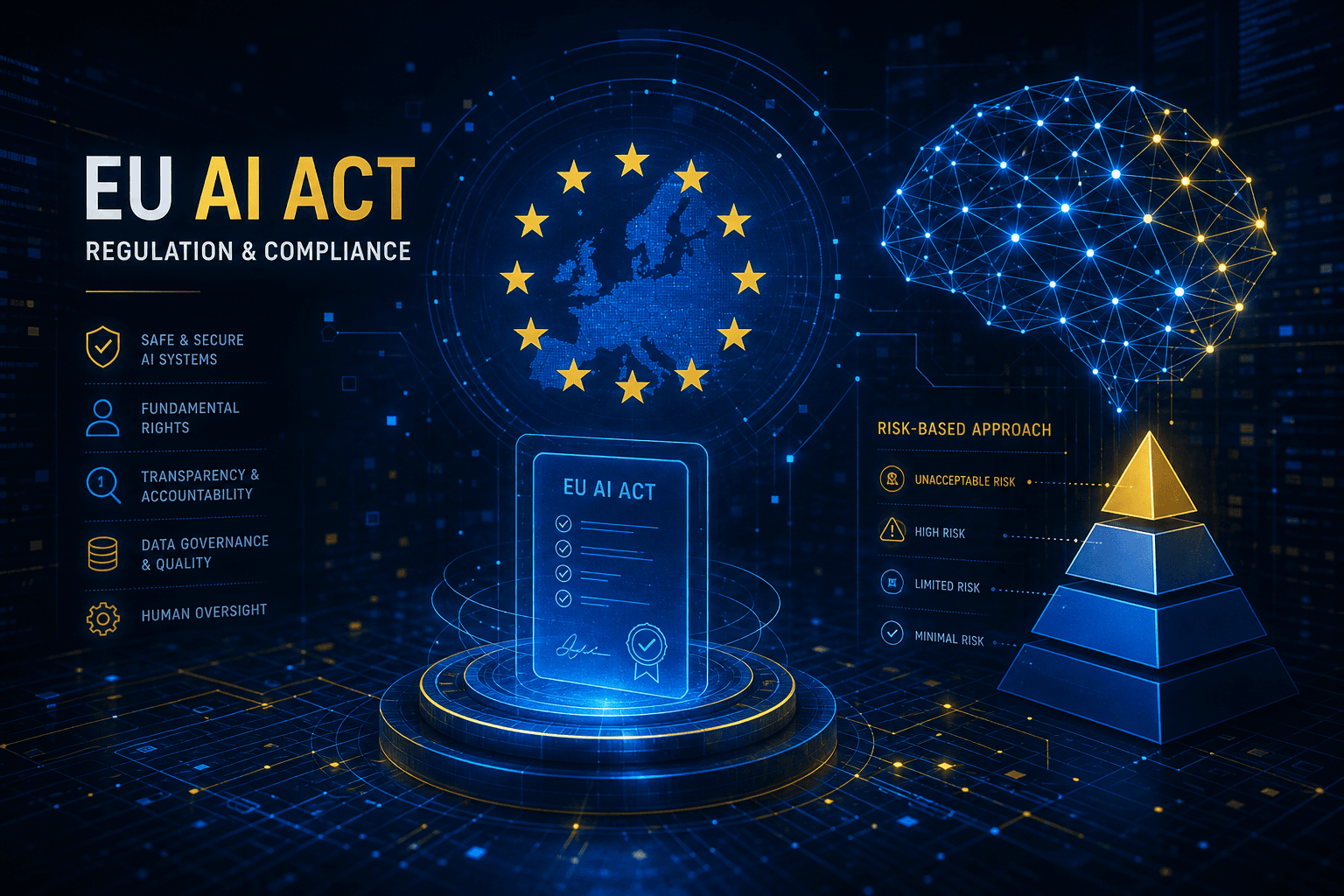
EU AI Act Implementation Begins: What Businesses Must Know for February 2025

Table of Contents
EU AI Act Implementation Begins: What Businesses Must Know for February 2025 #
The EU AI Act officially entered into force on August 1, 2024, marking the beginning of the world's first comprehensive artificial intelligence regulation. While no compliance obligations are immediately enforceable, the clock is now ticking toward February 2, 2025 — when the first wave of prohibited AI practices becomes illegal across the European Union. Companies deploying or developing AI systems face potential fines of up to €35 million or 7% of global annual turnover for non-compliance. Here's everything businesses need to know about the implementation timeline, risk classifications, and the specific actions required before enforcement begins.
Table of Contents #
- What Just Happened: The EU AI Act Enters Into Force — The August 1, 2024 milestone and what it means for businesses today
- The Complete Implementation Timeline: Key Dates Through 2027 — Full phased rollout schedule with enforcement milestones
- Prohibited AI Practices: What Becomes Illegal in February 2025 — The eight categories of unacceptable-risk AI systems that must cease operation
- The Four Risk Tiers: How the EU Classifies AI Systems — Unacceptable, high, limited, and minimal risk classifications explained
- High-Risk AI Requirements: Preparing for August 2026 — Conformity assessments, CE marking, and technical documentation obligations
- General-Purpose AI Models: GPAI Obligations Starting August 2025 — Transparency requirements and systemic risk evaluations for foundation models
- AI Literacy Requirements: The Overlooked February 2025 Deadline — Mandatory staff training obligations that apply to all organizations
- What Companies Should Do Now: The September 2024 Action Plan — Immediate steps for compliance readiness before the first enforcement deadline
- Penalties and Enforcement: Understanding the Financial Risks — Fine structures, enforcement mechanisms, and national authority designations
- The AI Pact: Voluntary Early Compliance Opportunities — How businesses can get ahead through the European Commission's voluntary pledge program
- Global Implications: How the EU AI Act Reshapes Worldwide Standards — The Brussels Effect and what this means for non-EU businesses
- FAQ: Essential Questions About EU AI Act Compliance — Quick answers to the most critical compliance questions
What Just Happened: The EU AI Act Enters Into Force #
The EU AI Act officially entered into force on August 1, 2024, twenty days after its publication in the EU Official Journal on July 12, 2024. This milestone makes the Act legally binding across all twenty-seven EU member states, but critically, no specific compliance obligations are immediately enforceable today in September 2024. Instead, businesses are in a transition period where the law is "live" but enforcement of substantive requirements follows a carefully staggered timeline over the next three years.
Key facts about the current status:
| Aspect | Status as of September 2024 |
|---|---|
| Legal force | ✅ Active across all EU member states |
| Prohibited practices | ⚠️ Defined but not yet enforced (February 2025) |
| High-risk obligations | ⚠️ Defined but not yet enforced (August 2026) |
| GPAI rules | ⚠️ Defined but not yet enforced (August 2025) |
| National authorities | 🔄 Being designated by Member States |
| AI Office | ✅ Operational within European Commission |
What "entry into force" actually means: The August 1, 2024 date starts the countdown clocks for staggered implementation. Article 113 of the Act specifies exactly when each set of obligations becomes enforceable, measured from the entry into force date. This gives businesses predictable preparation time — but also means the time to act is now, not later.
The European Commission's AI Office is now operational and actively preparing implementation guidance, codes of practice for general-purpose AI models, and templates for compliance documentation. The AI Office will coordinate with national supervisory authorities as Member States designate them over the coming months. By November 2024, all EU countries must notify the Commission of their designated national competent authorities who will handle enforcement at the member state level.
For businesses, September 2024 represents a critical preparation window. The six-month grace period until February 2025 is when companies should conduct AI inventories, classify their systems by risk tier, identify any prohibited practices that must be discontinued, and begin building AI literacy programs. Organizations that treat this as a "wait and see" period will face rushed compliance efforts — and significantly higher risk of violations when enforcement begins.
The Complete Implementation Timeline: Key Dates Through 2027 #
The EU AI Act deploys through a carefully phased implementation schedule spanning three years, with different obligations activating at six-month to one-year intervals. Understanding this timeline is essential for compliance planning — rushing to meet every requirement by February 2025 would be wasteful, while missing a key date could be catastrophic.
Full Implementation Timeline #
| Date | Milestone | Obligations Activated | Article Reference |
|---|---|---|---|
| August 1, 2024 | Entry into force | Act becomes legally binding; countdown begins | Article 113 |
| November 2024 | Authority designation deadline | Member States must notify Commission of competent authorities | Article 70(6) |
| February 2, 2025 | First enforcement wave | Prohibited AI practices banned; AI literacy obligations active | Article 113(1)(a) |
| May 2, 2025 | Codes of practice deadline | Commission finalizes codes for GPAI systemic risk | Article 113(1)(b) |
| August 2, 2025 | GPAI model obligations | Transparency rules for new GPAI models; authority notification complete | Article 113(1)(c) |
| February 2, 2026 | High-risk AI enforcement | Annex III high-risk system obligations apply | Article 113(1)(d) |
| August 2, 2026 | General application | Remaining rules apply (except Article 6(1) GPAI rules) | Article 113(1)(e) |
| August 2, 2027 | Full GPAI compliance | Legacy GPAI models (pre-Aug 2025) must comply | Article 113(1)(f) |
The February 2, 2025 deadline is the most urgent because it brings immediate criminal liability for prohibited practices. Unlike later phases that involve documentation and process requirements, the February deadline makes certain AI uses flatly illegal — operating them after this date exposes organizations to fines of up to €35 million or 7% of global turnover.
What Activates When: Detailed Breakdown #
February 2, 2025 (6 months post-entry):
- Prohibited AI practices under Chapter II, Article 5 become enforceable
- AI literacy obligations under Article 4 become mandatory
- Provisions on penalties for prohibited practices (Article 99) activate
- National authorities must be ready to receive complaints and conduct investigations
August 2, 2025 (12 months post-entry):
- General-purpose AI model transparency requirements apply to models placed on the market after this date
- Codes of practice for systemic risk GPAI models must be finalized
- Legacy GPAI models (already on market) receive extended compliance timeline until 2027
February 2, 2026 (18 months post-entry):
- High-risk AI system requirements for Annex III systems become enforceable
- Conformity assessments, CE marking, risk management systems required
- EU database registration for high-risk systems opens
- Post-market monitoring obligations begin
August 2, 2026 (24 months post-entry):
- Remainder of Act applies including full enforcement procedures
- Annex II high-risk systems (safety components in regulated products) obligations begin
- National sandbox frameworks must be operational
August 2, 2027 (36 months post-entry):
- General-purpose AI models placed on market before August 2025 must comply with all obligations
- Full implementation complete across all AI system categories
Planning Implications for Businesses #
Immediate priorities (September 2024 – February 2025):
- Identify and sunset any prohibited AI practices
- Launch AI literacy training programs for all staff touching AI systems
- Begin AI inventory and risk classification
- Join the AI Pact for early compliance recognition
Medium-term priorities (February 2025 – August 2026):
- Implement high-risk AI system governance
- Develop technical documentation templates
- Establish human oversight procedures
- Create post-market monitoring systems
Long-term priorities (August 2026 – August 2027):
- Maintain compliance documentation
- Conduct regular conformity assessments
- Update systems for evolving GPAI requirements
- Optimize compliance through regulatory sandboxes
Prohibited AI Practices: What Becomes Illegal in February 2025 #
Chapter II of the EU AI Act bans eight categories of "unacceptable risk" AI systems entirely — using, deploying, or placing these systems on the EU market becomes a criminal offense on February 2, 2025. These prohibitions apply to all organizations regardless of size, sector, or location (if serving EU users). The penalties are severe: up to €35 million in fines or 7% of global annual turnover, whichever is higher.
The Eight Prohibited AI Practices #
| Prohibition | Article 5 Reference | What It Covers | Examples |
|---|---|---|---|
| 1. Subliminal manipulation | Article 5(1)(a) | AI using subliminal techniques to distort behavior, causing harm | Undetectable audio/visual prompts in ads; hidden messages in content |
| 2. Exploitation of vulnerabilities | Article 5(1)(b) | AI exploiting age, disability, or socioeconomic status to distort behavior | Targeting children or cognitively impaired users with manipulative design |
| 3. Social scoring by governments | Article 5(1)(c) | State-run social scoring systems evaluating trustworthiness | China's social credit system; government trust scores based on behavior |
| 4. Real-time biometric ID in public spaces | Article 5(1)(d) | Live remote biometric identification in publicly accessible spaces | Facial recognition in public squares, train stations, protests (with narrow exceptions) |
| 5. Untargeted facial image scraping | Article 5(1)(e) | Creating facial recognition databases by untargeted image scraping | Scraping social media photos to build face databases without consent |
| 6. Emotion recognition at work/school | Article 5(1)(f) | Inferring emotions in workplaces or educational institutions | Monitoring employee stress levels via AI; tracking student engagement by emotion |
| 7. Biometric categorization for sensitive traits | Article 5(1)(g) | Using biometrics to infer race, political beliefs, union membership, religion, sex life | Inferring sexual orientation from facial features; detecting political affiliation |
| 8. Individual predictive policing | Article 5(1)(h) | Assessing risk of natural persons committing criminal offenses based on profiling | Predictive policing based on demographic profiling; "pre-crime" risk scoring |
Detailed Analysis of Key Prohibitions #
Real-Time Biometric Identification in Public Spaces
The ban on live facial recognition in public areas is the most widely discussed prohibition. Article 5(1)(d) prohibits placing or using AI systems for "real-time" remote biometric identification in publicly accessible spaces for law enforcement purposes — but includes narrow exceptions that require judicial authorization:
- Targeted victim search: Finding missing children, kidnapped persons, or human trafficking victims
- Prevention of imminent threats: Terrorist attacks or serious harm to life
- Criminal prosecution: Identifying suspects of serious crimes (carrying 5+ year sentences)
Critically, law enforcement must obtain judicial authorization before deployment except in genuine emergencies, and must register each use in the EU database. Non-law enforcement uses (retail analytics, private security, marketing) are flatly prohibited in public spaces without any exceptions.
Emotion Recognition in Workplaces and Education
Article 5(1)(f) bans AI systems that infer emotions in workplace or educational contexts. This prohibition applies broadly:
- Employee monitoring: Systems that track stress, engagement, or emotional states during work
- Job interviews: AI analyzing facial expressions or voice tones to assess candidates
- Classroom surveillance: Monitoring student attention or emotional reactions during lessons
- Virtual meeting analysis: AI "engagement scores" based on facial expressions
Exceptions exist for medical or safety purposes — emotion recognition is permitted for health monitoring with proper consent, or for safety systems in transportation where drowsiness detection is legitimate.
Social Scoring by Governments
Article 5(1)(c) prohibits government-conducted social scoring — evaluating or classifying people based on social behavior or personal characteristics over time, leading to detrimental treatment. This directly targets systems like China's Social Credit System and similar government trustworthiness scores.
Private sector credit scoring (FICO, Schufa) is not prohibited — the ban specifically targets government-run systems that aggregate multiple unrelated social contexts into a single "trustworthiness" score affecting rights.
Individual Predictive Policing
Article 5(1)(h) bans assessing the risk of natural persons committing criminal offenses based solely on profiling or personality traits. This targets "pre-crime" prediction systems that forecast who might commit crimes without specific suspicion.
Not prohibited: Risk assessment for specific crimes already committed; geographic crime prediction; re-offending risk for convicted persons (with safeguards). The prohibition focuses on profiling individuals as potential future criminals based on demographics, location history, or social connections.
What Companies Must Do Before February 2025 #
- Audit all AI systems for prohibited practices — especially emotion recognition, biometric categorization, and any real-time facial recognition
- Sunset prohibited systems or modify them to comply (e.g., remove real-time biometric components)
- Review third-party services — many SaaS products include emotion recognition or biometric features that may violate Article 5
- Document decision-making showing compliance review before the deadline
- Train staff on prohibited practice recognition — AI literacy requirements also activate February 2025
The Four Risk Tiers: How the EU Classifies AI Systems #
The EU AI Act applies a risk-based regulatory approach, categorizing AI systems into four tiers with corresponding compliance obligations. This framework determines everything from documentation requirements to human oversight mandates. Every AI system your organization uses or develops must be classified into one of these tiers.
The Four Risk Tiers Explained #
| Risk Tier | Definition | Examples | Compliance Level |
|---|---|---|---|
| Unacceptable Risk | AI systems violating fundamental rights or using prohibited techniques | Social scoring by governments, real-time biometric ID in public, emotion recognition at work, subliminal manipulation | Prohibited — cannot be deployed |
| High Risk | AI systems affecting safety, fundamental rights, or critical decisions | Credit scoring, hiring algorithms, medical devices, law enforcement AI, education assessment, biometric identification | Strict compliance — conformity assessment, CE marking, risk management, technical documentation, human oversight, accuracy testing |
| Limited Risk | AI systems with transparency obligations due to human interaction | Chatbots, deepfakes, AI-generated content, emotion recognition systems (outside prohibited contexts) | Transparency only — disclosure that users are interacting with AI |
| Minimal Risk | AI systems with minimal or no impact on rights/safety | Spam filters, recommendation systems, video game AI, smart appliances | No specific obligations — voluntary codes of conduct encouraged |
High-Risk AI: The Heavy Compliance Tier #
High-risk AI systems face the most extensive requirements, occupying most of the AI Act's operational provisions (Articles 8-15). The Act defines high-risk AI in two ways:
Annex II: AI as Safety Components in Regulated Products
- AI systems that are safety components of products already regulated under EU harmonization legislation
- Applies to aviation, vehicles, medical devices, lifts, toys, machinery, and more
- Enforcement: August 2, 2026 (24 months post-entry)
Annex III: Standalone High-Risk AI Systems
- Biometric identification and categorization (not real-time public space)
- Management of critical infrastructure (transport, utilities, internet)
- Education and vocational training (admissions, assessments, proctoring)
- Employment and worker management (hiring, promotion, termination, task allocation)
- Access to essential services (credit scoring, insurance, benefits)
- Law enforcement (evidence evaluation, risk assessment, polygraphs)
- Migration and border control (asylum applications, visa processing)
- Administration of justice (case research, recommendation systems)
- Enforcement: February 2, 2026 (18 months post-entry)
Classification Decision Framework #
START: AI System Analysis
    ↓
Is it a prohibited practice under Article 5?
    ↓ YES → UNACCEPTABLE RISK → Cannot deploy in EU
    ↓ NO
Is it listed in Annex II or Annex III?
    ↓ YES → HIGH RISK → Full compliance required
    ↓ NO
Does it interact with humans in ways that could deceive?
    ↓ YES → LIMITED RISK → Transparency obligations
    ↓ NO
Is it a minimal risk application?
    ↓ YES → MINIMAL RISK → Voluntary codes encouraged
High-Risk Requirements at a Glance #
High-risk AI systems must comply with eight core obligations under Articles 8-15:
- Risk management system (Article 9) — Continuous identification and mitigation of risks throughout lifecycle
- Data governance (Article 10) — Training data must be relevant, representative, error-free, and complete
- Technical documentation (Article 11) — Comprehensive documentation for authorities and conformity assessment
- Record-keeping (Article 12) — Automatic logging of events for traceability and monitoring
- Transparency (Article 13) — Clear information to deployers about capabilities, limitations, and risks
- Human oversight (Article 14) — Effective oversight by natural persons to prevent or minimize risks
- Accuracy and robustness (Article 15) — Appropriate levels for intended purpose, including cybersecurity
- Conformity assessment (Article 43) — Third-party assessment or self-assessment before CE marking
Limited Risk: Transparency Obligations #
Limited risk AI systems face lighter touch regulation focused on transparency and disclosure:
- Chatbots and conversational AI: Must disclose that users are interacting with AI (not a human)
- Deepfakes and AI-generated content: Must be clearly labeled as artificially generated or manipulated
- Emotion recognition systems (where not prohibited): Must inform users that emotion recognition is occurring
- Biometric categorization (where not prohibited): Must disclose categorization is happening
These transparency requirements apply immediately to limited-risk systems — there is no grace period because the obligations are disclosure-based rather than requiring system redesign.
Minimal Risk: Voluntary Framework #
Minimal risk AI systems face no mandatory requirements under the AI Act. The legislation encourages voluntary codes of conduct for:
- Environmental sustainability of AI systems
- Accessibility for persons with disabilities
- Stakeholder participation in AI development
- Diverse development teams
While optional, these codes may become market differentiators as EU customers increasingly expect responsible AI practices.
High-Risk AI Requirements: Preparing for August 2026 #
High-risk AI systems face the most extensive compliance regime under the EU AI Act, with eight core obligation categories applying from February 2, 2026 (Annex III) and August 2, 2026 (Annex II). These requirements transform how organizations design, deploy, and monitor AI systems — demanding governance structures that most companies currently lack.
The Eight Core High-Risk Obligations #
| Obligation | Article | What It Requires | Lead Time Needed |
|---|---|---|---|
| Risk management system | Article 9 | Continuous identification, assessment, and mitigation of risks throughout AI lifecycle | 6–12 months to implement processes |
| Data governance | Article 10 | Relevant, representative, error-free training data with bias testing | 3–6 months for data audits |
| Technical documentation | Article 11 | Comprehensive documentation for conformity assessment and authority review | 2–4 months to prepare |
| Record-keeping | Article 12 | Automatic logging of inputs, outputs, and system events | 3–6 months for engineering |
| Transparency | Article 13 | Clear instructions for deployers on capabilities, limitations, and risks | 1–2 months to draft |
| Human oversight | Article 14 | Effective oversight measures to prevent or minimize risks | 3–6 months for process design |
| Accuracy and robustness | Article 15 | Appropriate performance levels with cybersecurity measures | 2–4 months for testing |
| Conformity assessment | Article 43 | Third-party or self-assessment before CE marking | 1–3 months for assessment |
Risk Management Systems (Article 9) #
High-risk AI requires a continuous risk management process — not a one-time assessment at deployment. The risk management system must:
- Identify and analyze known and foreseeable risks throughout the AI lifecycle
- Evaluate emerging risks based on post-deployment monitoring
- Implement mitigation measures that are proportionate to risk severity
- Test residual risks for acceptability
- Ensure risks to health, safety, and fundamental rights are minimized
Practical implementation requires:
- Risk assessment framework — standardized templates for evaluating AI system risks
- Cross-functional risk committee — legal, technical, and domain experts reviewing AI deployments
- Continuous monitoring infrastructure — systems that track AI performance and flag anomalies
- Incident response procedures — clear protocols for when AI systems behave unexpectedly
Technical Documentation (Article 11) #
High-risk AI must have comprehensive technical documentation demonstrating compliance and enabling authority review. The documentation must include:
- General description of the AI system including intended purpose
- Description of system architecture and design choices
- Description of training methodologies and training data characteristics
- Information on computational resources used
- Detailed description of system capabilities and limitations
- Description of performance metrics and test results
- Information on human oversight measures
- Description of expected lifetime and maintenance requirements
Documentation must be maintained throughout the system lifecycle — not just at deployment. Every update, retraining, or modification requires documentation updates.
Human Oversight (Article 14) #
High-risk AI must include effective human oversight measures to prevent or minimize risks to health, safety, and fundamental rights. The AI Act specifies that oversight must be:
- Meaningful — humans must have sufficient information to understand AI capabilities and limitations
- Effective — humans must be able to intervene when necessary
- Timely — oversight must occur at appropriate decision points
- Documented — oversight procedures must be recorded
For employment AI (hiring, promotion, termination): Human reviewers must have authority to override AI decisions and must be trained to recognize AI limitations and potential biases.
For credit scoring: Loan officers must be able to explain AI-influenced decisions to applicants and must review cases where AI recommendations are contested.
For law enforcement AI: Officers must understand system confidence levels and must not rely solely on AI output for high-stakes decisions.
Conformity Assessment and CE Marking #
Before placing high-risk AI on the EU market, providers must undergo conformity assessment and affix the CE marking. The assessment process varies by system type:
| System Type | Assessment Method | Timeline |
|---|---|---|
| Annex II systems (safety components) | Third-party notified body assessment | 3–6 months |
| Annex III systems with harmonized standards | Self-assessment with internal controls | 1–2 months |
| Annex III systems without harmonized standards | Third-party notified body assessment | 3–6 months |
| Biometric identification | Always third-party notified body | 3–6 months |
CE marking signifies that the AI system complies with all applicable requirements — similar to CE marking for physical products. The marking must be affixed visibly and accompanied by a declaration of conformity.
EU Database Registration (Article 49) #
High-risk AI providers must register their systems in the EU database managed by the European Commission before placing them on the market. Registration includes:
- System identification and intended purpose
- Risk classification and justification
- Conformity assessment details
- Contact information for provider and authorized representative
- Date of market placement
The database is publicly accessible for transparency — meaning competitors, journalists, and civil society can see which AI systems are deployed in high-risk contexts.
Post-Market Monitoring (Article 72) #
Providers must establish post-market monitoring systems to track AI performance throughout the system lifetime. This includes:
- Automatic logging of inputs, outputs, and system events
- Performance metrics tracking against benchmarks established at deployment
- Incident reporting — serious incidents must be reported to national authorities within 15 days
- Periodic review — systems must be reassessed if performance degrades or new risks emerge
Deployers (the organizations using high-risk AI) must also implement monitoring and must cooperate with providers on data sharing for post-market surveillance.
General-Purpose AI Models: GPAI Obligations Starting August 2025 #
General-purpose AI models (GPAI) — foundation models like GPT-4, Claude, Gemini, and Llama — face a separate regulatory track with obligations starting August 2, 2025. These rules apply to the model providers (OpenAI, Anthropic, Google, Meta) rather than downstream deployers, but impact every organization building on these platforms.
GPAI Definition and Scope #
GPAI models are defined as AI models trained with a large amount of data using self-supervision at scale, displaying significant generality and capable of performing a wide range of tasks. The Act specifically covers:
- Large language models (GPT-4, Claude, Llama, Gemini)
- Multimodal foundation models (GPT-4V, Gemini Pro Vision)
- Generative AI models (Stable Diffusion, Midjourney, DALL-E)
- Scientific foundation models (AlphaFold, weather prediction models)
GPAI obligations do NOT apply to:
- Models released before August 2, 2025 (until August 2, 2027)
- Models exclusively for research before market release
- Models with fully open weights where training is reproducible
- Narrow AI systems designed for single tasks
Tiered GPAI Obligations #
| Model Category | Threshold | Obligations | Effective Date |
|---|---|---|---|
| All GPAI models | Any GPAI model | Transparency documentation; compliance with copyright law; summary of training data | August 2, 2025 |
| Systemic risk GPAI | >10^25 FLOPs training compute | Risk assessment; red-teaming; incident reporting; cybersecurity; energy efficiency | August 2, 2025 |
| Legacy models | Released before Aug 2025 | Same as above but delayed | August 2, 2027 |
All GPAI Models: Transparency Requirements (Article 53) #
Every GPAI provider must prepare and maintain technical documentation including:
- Training data summary — general description of data sources, main characteristics, and any known limitations
- Model capabilities description — what the model can and cannot do
- Known risks and limitations — including foreseeable misuse scenarios
- Performance evaluation results — benchmark results and testing methodologies
- Energy consumption data — computational costs of training and inference
Providers must also implement policies to respect EU copyright law, including:
- Identifying and respecting rights holders' opt-outs from text and data mining
- Maintaining documentation of compliance efforts
- Cooperating with rights holders on content disputes
Systemic Risk GPAI: Enhanced Obligations (Article 55) #
GPAI models trained with more than 10^25 FLOPs (floating point operations) are presumed to present systemic risk and face enhanced obligations. For context, this threshold captures models like:
- GPT-4 (estimated ~2×10^25 FLOPs)
- Claude 3 Opus (estimated >10^25 FLOPs)
- Gemini Ultra (estimated >10^25 FLOPs)
- Llama 3 405B (estimated ~10^25 FLOPs)
Systemic risk obligations include:
Risk assessment and mitigation — continuous evaluation of systemic risks including:
- Risk of major accidents
- Risk of misuse for cyberattacks or disinformation
- Risk of serious impact on democratic processes
- Risk of serious harm to public health or safety
Red-teaming and adversarial testing — regular testing by qualified independent experts
Serious incident reporting — reporting major incidents to AI Office within 48 hours
Current-generation cybersecurity — protecting model weights, infrastructure, and data
Energy efficiency evaluation — assessing and reporting energy consumption
Codes of Practice for GPAI (Article 56) #
The European Commission AI Office will develop codes of practice for GPAI providers, expected to be finalized by May 2025. These codes will provide:
- Detailed technical guidance on transparency documentation
- Standardized risk assessment methodologies
- Common approaches to red-teaming and testing
- Templates for incident reporting
- Best practices for copyright compliance
Until codes are finalized, GPAI providers must make "reasonable efforts" to comply with the Act's general principles. The codes will become the benchmark for assessing compliance.
Impact on Downstream Deployers #
Organizations building on GPAI platforms should prepare for:
- Documentation requests — your provider may ask for deployment information for their transparency reporting
- Model availability changes — systemic risk obligations may affect model access or capabilities
- Incident reporting coordination — serious incidents involving GPAI may need to be reported through the provider
- Contract updates — terms of service will likely change to reflect GPAI obligations
Downstream deployers do NOT inherit GPAI obligations directly — the Act places these on model providers. However, high-risk AI systems built on GPAI platforms must still comply with the full high-risk requirements discussed above.
AI Literacy Requirements: The Overlooked February 2025 Deadline #
Article 4 of the EU AI Act imposes mandatory AI literacy requirements that activate on February 2, 2025 — the same date as prohibited practice enforcement. This often-overlooked provision applies to all providers and deployers of AI systems, regardless of risk classification. Every organization using AI in the EU must ensure staff have sufficient AI literacy to operate systems responsibly.
What AI Literacy Requirements Cover #
Article 4 requires that providers and deployers of AI systems ensure a sufficient level of AI literacy for staff and other persons dealing with AI system operations. The provision considers:
- Technical knowledge of AI systems and their capabilities
- Understanding of AI limitations and potential errors
- Awareness of risks and harms AI can cause
- Ability to interpret AI outputs correctly
- Knowledge of when and how to exercise human oversight
Who Needs AI Literacy Training #
| Role | Training Requirements | Depth Level |
|---|---|---|
| AI system operators | Full training on specific systems they use | Deep — system-specific |
| Human oversight personnel | Comprehensive training on AI limitations, override procedures | Deep — risk-focused |
| Technical staff | Model capabilities, failure modes, technical constraints | Technical — implementation |
| Managers and decision-makers | Strategic understanding of AI risks and governance | Broad — leadership |
| Procurement staff | How to evaluate AI vendors for compliance | Practical — purchasing |
| Legal and compliance teams | Full AI Act requirements and enforcement | Comprehensive — regulatory |
AI Literacy Content Requirements #
Training programs should cover at minimum:
AI capabilities and limitations
- What AI can and cannot do reliably
- Understanding confidence scores and uncertainty
- Recognizing AI hallucinations and errors
Risk awareness
- Potential harms from AI errors
- Bias and fairness issues
- Privacy and security implications
Human oversight procedures
- When and how to intervene
- Override mechanisms
- Decision documentation requirements
System-specific training
- How the specific AI system works
- Expected performance characteristics
- Known failure modes
Regulatory compliance basics
- Prohibited practices to recognize and avoid
- High-risk system requirements
- Reporting obligations
Compliance Implementation Timeline #
September 2024 – November 2024:
- Assess current AI literacy levels across organization
- Identify gaps in staff knowledge
- Design training curriculum aligned with roles
November 2024 – January 2025:
- Develop training materials or procure external training
- Schedule training sessions for all relevant staff
- Create documentation of training completion
February 2025 onwards:
- Training must be complete for all staff operating AI systems
- New hires must receive training before operating AI systems
- Ongoing refresher training annually or when systems change
Documentation Requirements #
Organizations must maintain records of AI literacy training including:
- Training curriculum and materials used
- Staff attendance records
- Assessment results (if applicable)
- Dates of training and refreshers
- Staff roles and training levels received
Documentation should be available for inspection by national supervisory authorities upon request. Non-compliance with AI literacy requirements can result in fines of up to €7.5 million or 1.5% of global annual turnover.
Practical Training Approaches #
For small organizations:
- Online AI literacy courses (EU AI Office expected to provide resources)
- Vendor-provided training from AI system suppliers
- Industry association training programs
For large organizations:
- Custom-developed training programs
- Dedicated AI literacy training platforms
- Integration with existing compliance training (GDPR, security)
- Role-specific modules for different staff categories
For AI providers:
- Customer training as part of product onboarding
- Technical documentation designed for AI literacy
- Regular webinars on AI capabilities and limitations
What Companies Should Do Now: The September 2024 Action Plan #
September 2024 marks the beginning of the compliance preparation window — organizations that act now will avoid the rush and reduce violation risks when enforcement begins. This action plan breaks down what companies should accomplish in each phase leading to the key February 2025 and August 2026 deadlines.
Immediate Actions: September – November 2024 #
1. Conduct Complete AI Inventory
Every compliance journey starts with knowing what you have. Create a comprehensive inventory of:
| Inventory Category | What to Document | Why It Matters |
|---|---|---|
| AI systems in use | All AI tools, models, and platforms | Risk classification and compliance tier determination |
| AI systems in development | Projects in pipeline | Prohibited practice screening before February 2025 |
| Third-party AI services | SaaS products with AI features | Many include prohibited capabilities you may not realize |
| Data flows | Where AI processes personal data | GDPR overlap and high-risk system identification |
| Decision points | Where AI influences consequential decisions | High-risk system classification |
Use the EU AI Act Compliance Checker (available at artificialintelligenceact.eu) to rapidly classify systems by risk tier. Document the classification rationale for each system — authorities will want to see your decision-making process.
2. Identify and Plan Removal of Prohibited Practices
Priority one is eliminating any Article 5 prohibited practices before February 2, 2025. Common violations to check for:
- Employee emotion recognition systems
- Real-time biometric identification in public spaces
- Untargeted facial image scraping
- AI systems exploiting vulnerabilities of children or vulnerable groups
- Individual predictive policing systems
- Biometric categorization inferring sensitive attributes
For each prohibited system identified:
- Document current use and business justification
- Plan either complete discontinuation or modification to comply
- Set hard deadline of January 15, 2025 for final shutdown
- Notify affected users if discontinuing customer-facing features
- Document compliance decision trail
3. Join the AI Pact
The European Commission's AI Pact offers a voluntary pledge program for early compliance. Benefits include:
- Recognition as an AI Act pioneer
- Early guidance from the AI Office
- Potential simplified compliance pathways
- Market differentiation as a responsible AI leader
To join: Submit a pledge letter to the European Commission AI Office committing to early implementation of key obligations. The pledge template is available through the Commission's digital strategy portal.
Short-Term Actions: November 2024 – February 2025 #
4. Launch AI Literacy Training
- Develop or procure training curriculum covering AI Act basics, prohibited practices, and risk awareness
- Schedule training for all staff who operate, manage, or make decisions based on AI systems
- Prioritize high-risk system operators and human oversight personnel
- Document completion records for compliance evidence
5. Establish AI Governance Structure
| Role | Responsibility | Organization Size |
|---|---|---|
| AI Compliance Officer | Overall AI Act compliance, authority liaison | All organizations with high-risk systems |
| Risk Assessment Committee | Reviews AI risk classifications and mitigation plans | Medium to large organizations |
| Legal/Compliance Lead | Interprets requirements, manages documentation | All organizations |
| Technical Lead | Implements technical requirements (logging, oversight) | Organizations with in-house AI |
| Procurement Lead | Vets AI vendors for compliance | All organizations buying AI services |
6. Begin Technical Documentation Templates
For anticipated high-risk systems, start preparing documentation templates:
- Risk management procedures
- Data governance protocols
- Technical specification formats
- Human oversight procedure documents
- Post-market monitoring plans
Medium-Term Actions: February 2025 – August 2026 #
7. Implement High-Risk System Compliance
- Complete conformity assessments for Annex III systems
- Establish post-market monitoring infrastructure
- Implement automatic logging systems
- Create incident reporting procedures
- Prepare EU database registration submissions
8. Review and Update Contracts
- AI vendor contracts must include compliance warranties
- Customer contracts must clarify AI system limitations
- Data processing agreements must address AI Act requirements
- Liability allocation for AI Act violations
9. Prepare for GPAI Obligations (if applicable)
If your organization develops foundation models:
- Begin calculating training compute to determine systemic risk tier
- Prepare transparency documentation templates
- Establish red-teaming capabilities
- Create incident response procedures for model-level issues
Compliance Readiness Checklist #
| Task | Deadline | Status |
|---|---|---|
| AI inventory complete | October 2024 | ⬜ |
| Prohibited practices identified and removal planned | November 2024 | ⬜ |
| AI Pact pledge submitted | November 2024 | ⬜ |
| AI literacy training curriculum ready | December 2024 | ⬜ |
| Governance structure established | January 2025 | ⬜ |
| AI literacy training complete for all relevant staff | February 2, 2025 | ⬜ |
| Prohibited practices fully discontinued | February 2, 2025 | ⬜ |
| High-risk system documentation underway | May 2025 | ⬜ |
| Conformity assessments initiated | August 2025 | ⬜ |
| Full high-risk compliance achieved | February 2026 | ⬜ |
Penalties and Enforcement: Understanding the Financial Risks #
The EU AI Act establishes a three-tier penalty structure with maximum fines reaching €35 million or 7% of global annual turnover — whichever is higher. These penalties apply across the EU through national supervisory authorities, with enforcement beginning February 2, 2025 for prohibited practices.
Penalty Structure by Violation Type #
| Violation Category | Maximum Fine | Article | Examples |
|---|---|---|---|
| Prohibited AI practices | €35 million or 7% global turnover | Article 99(3) | Deploying banned social scoring, real-time biometric ID in public spaces, emotion recognition at work |
| High-risk AI non-compliance | €15 million or 3% global turnover | Article 99(4) | Missing conformity assessment, inadequate risk management, lack of human oversight |
| Documentation/accuracy failures | €7.5 million or 1.5% global turnover | Article 99(5) | False statements to authorities, incorrect technical documentation, incomplete AI literacy records |
"Whichever is higher" rule: The Act specifies that penalties are calculated as the greater of the fixed amount or the percentage of global annual turnover. For large tech companies, the percentage typically exceeds the fixed amount. For smaller companies, the fixed amount may be the effective maximum.
Enforcement Mechanisms #
National Supervisory Authorities:
Each EU Member State must designate one or more national supervisory authorities by November 2024. These authorities will:
- Receive and investigate complaints about AI Act violations
- Conduct market surveillance and compliance checks
- Issue orders to cease prohibited practices
- Impose fines and penalties for violations
- Coordinate with authorities in other Member States
The European Commission AI Office coordinates enforcement for GPAI models and handles cross-border cases where multiple Member States are involved.
Enforcement Powers:
| Power | When Used | Procedure |
|---|---|---|
| Information requests | During investigations | Written request for documents, data, or explanations |
| On-site inspections | Suspected violations | Access to premises, equipment, and data |
| Interim measures | Imminent risk of harm | Order to suspend AI system operation |
| Corrective orders | Confirmed violations | Mandated compliance actions with deadlines |
| Fines | Serious or repeated violations | Administrative monetary penalties |
Violation Escalation Pathway #
Complaint or Detection
    ↓
Preliminary Investigation (30 days)
    ↓
Formal Investigation (if evidence found)
    ↓
Opportunity to Respond (written submissions)
    ↓
Decision on Violation
    ↓
    ├─ No violation found → Case closed
    ├─ Minor violation → Corrective order
    └─ Serious violation → Fines + corrective order
    ↓
Appeal to National Courts (available)
Aggravating and Mitigating Factors #
Factors that may increase penalties:
- Intentional or negligent nature of violation
- Previous violations by the same entity
- Financial benefits gained from violation
- Duration of violation
- Number of persons affected
- Level of cooperation with authorities
Factors that may reduce penalties:
- First-time violation with prompt corrective action
- Self-reporting of violations before detection
- Implementation of effective compliance programs
- Cooperation with investigation
- Steps taken to mitigate harm
Cross-Border Enforcement #
For violations affecting multiple EU countries:
- Lead authority principle — one authority takes primary responsibility
- One-stop-shop mechanism for providers (single point of contact)
- Mutual assistance between national authorities
- Joint investigations for systemic violations
For non-EU companies:
- Obligations apply if AI systems are used in the EU market
- Must designate authorized representative in EU
- Enforcement actions can include market access restrictions
- Fines enforceable through international agreements
Practical Risk Assessment #
Highest risk activities:
- Deploying prohibited AI practices after February 2025
- Operating high-risk AI without conformity assessment
- False statements or misrepresentation to authorities
- Failure to report serious incidents within 15 days
Medium risk activities:
- Incomplete technical documentation
- Inadequate AI literacy training
- Missing post-market monitoring procedures
- Late EU database registration
Lower risk activities:
- Minor documentation errors with prompt correction
- Technical non-compliance with no harm caused
- First-time violations with immediate remediation
Insurance and Liability Considerations #
Organizations should review:
- Cyber insurance coverage for AI-related incidents
- Professional liability insurance for AI services
- Directors and officers coverage for AI governance failures
- Contractual liability allocation with AI vendors
The AI Act works alongside existing liability frameworks — product liability, GDPR, and sector-specific regulations all remain applicable. AI Act violations may trigger claims under multiple legal theories.
The AI Pact: Voluntary Early Compliance Opportunities #
The AI Pact is the European Commission's voluntary pledge initiative enabling organizations to demonstrate early commitment to EU AI Act compliance before enforcement deadlines. Launched alongside the Act's entry into force, the Pact offers companies a pathway to signal responsible AI leadership while preparing for formal requirements.
What Is the AI Pact? #
The AI Pact is a voluntary commitment framework where organizations pledge to implement key AI Act obligations ahead of mandatory deadlines. It serves multiple purposes:
- For the Commission: Gathers real-world implementation experience to refine guidance
- For participants: Early compliance recognition and potential regulatory advantage
- For the market: Creates visible examples of responsible AI implementation
- For authorities: Establishes best practices and industry standards
The Pact is NOT legally binding — participation is voluntary and pledges are commitments, not contracts. However, the Commission tracks participation and may reference it in enforcement contexts.
AI Pact Pledge Categories #
Organizations can commit to different levels of early implementation:
| Pledge Level | Commitments | Best For |
|---|---|---|
| Foundational | Prohibited practices assessment; AI literacy planning; governance structure | All organizations starting compliance journey |
| Intermediate | Implementation of selected high-risk requirements; technical documentation; post-market monitoring | Organizations with high-risk systems |
| Advanced | Full high-risk compliance before deadline; GPAI transparency; codes of practice participation | AI providers and large deployers |
Specific Pledge Commitments #
Common commitments organizations make:
Risk assessment completion
- Document all AI systems and their risk classifications
- Identify any prohibited practices for removal
- Establish risk management procedures
AI literacy program launch
- Develop training curriculum for relevant staff
- Complete initial training wave before February 2025
- Create ongoing training schedule
Governance structure establishment
- Designate AI compliance responsible person
- Create oversight committee
- Establish reporting lines for AI issues
Technical documentation preparation
- Develop templates for high-risk system documentation
- Begin documentation for existing systems
- Create maintenance procedures for ongoing updates
Transparency commitment
- Publish AI use disclosures where appropriate
- Implement user notification for AI interactions
- Create explainability resources for affected individuals
Benefits of AI Pact Participation #
Reputational benefits:
- Public recognition as responsible AI leader
- Marketing differentiation in competitive markets
- Trust building with customers and partners
- Positive signal to investors and board members
Operational benefits:
- Early access to Commission guidance and clarifications
- Networking with other responsible AI practitioners
- Input opportunity to shape implementation guidance
- Reduced compliance risk through early preparation
Potential regulatory benefits:
- May receive consideration in enforcement discretion
- Possible simplified compliance pathways
- Recognition in public procurement contexts
- Advantage in regulatory sandbox applications
How to Join the AI Pact #
Application process:
- Review pledge template available on European Commission digital strategy portal
- Select commitments appropriate to your organization's AI maturity and risk profile
- Submit pledge letter to AI Office with company details and selected commitments
- Receive acknowledgment and guidance resources from Commission
- Implement commitments and report progress as agreed
- Maintain documentation of implementation for verification
Who can join:
- Companies of any size developing or deploying AI
- Public sector organizations using AI
- Industry associations on behalf of members
- Research institutions developing AI systems
AI Pact vs. Formal Compliance #
| Aspect | AI Pact | Formal AI Act Compliance |
|---|---|---|
| Legal status | Voluntary pledge | Legally mandatory |
| Enforcement | None — reputation only | Fines up to €35M or 7% turnover |
| Timing | Anytime before deadlines | Specific dates in legislation |
| Scope | Selected commitments | Full requirements for risk tier |
| Documentation | Internal records | Regulatory submissions |
| Verification | Self-reported | Authority inspection |
The AI Pact complements but does not replace formal compliance. Organizations that complete Pact commitments still must meet all formal AI Act requirements by the statutory deadlines. However, early implementation through the Pact makes formal compliance smoother.
Success Stories and Case Studies #
Early adopters include:
- Major tech companies demonstrating commitment to responsible AI
- Financial institutions preparing for high-risk credit scoring requirements
- Healthcare organizations implementing medical AI governance
- Manufacturing companies establishing AI risk management for safety systems
The Commission periodically publishes case studies of effective Pact implementations, providing templates for other organizations to follow.
Global Implications: How the EU AI Act Reshapes Worldwide Standards #
The EU AI Act is triggering the "Brussels Effect" — the phenomenon where EU regulations become de facto global standards as companies adjust their worldwide operations to meet the strictest regulatory requirements. Just as GDPR reshaped global data protection, the AI Act is setting the template for AI governance worldwide.
The Brussels Effect Explained #
The Brussels Effect occurs when three conditions align:
- Market size — The EU's 450 million consumers make it economically irrational to abandon
- Regulatory stringency — EU requirements are stricter than alternatives, making compliance "upward harmonization"
- Non-divisibility — Products/services cannot easily be customized per jurisdiction
For AI systems, all three conditions apply:
- The EU represents the world's second-largest economy
- The AI Act is the most comprehensive AI regulation globally
- AI systems are digital and inherently borderless — building separate "EU-compliant" versions is costly
How EU Standards Become Global Standards #
The mechanism works through economic rationality:
Global Company Strategy
    ↓
Option A: Build EU-compliant version + different version for elsewhere
    ↓
Higher development costs, operational complexity, compliance fragmentation
    ↓
Option B: Build single EU-compliant version for global deployment
    ↓
Lower costs, simpler operations, meets all jurisdictions
    ↓
EU standards become the global floor
Real-world precedents:
- GDPR → Global privacy standards (even US companies adopted GDPR practices globally)
- EU vehicle emissions → Global automotive standards
- EU chemical regulations (REACH) → Global chemical safety standards
- EU food safety standards → Global food industry practices
Impact on Non-EU Businesses #
US Companies:
- Must comply when serving EU customers or face market exclusion
- Many are adopting EU-compliant practices US-wide for efficiency
- Washington is watching EU implementation to inform potential US AI regulation
- Tech giants (OpenAI, Google, Microsoft) already implementing EU-compliant AI governance globally
UK Companies:
- Post-Brexit, the UK is not automatically covered but heavily influenced
- UK AI regulations likely to align closely with EU for market access
- The UK ICO has already referenced the AI Act in guidance documents
- British companies serving EU customers must comply directly
Asian Companies:
- Chinese AI companies seeking EU market access must comply
- Japanese and Korean tech companies adopting EU standards for exports
- Singapore positioning as regional compliance hub for EU-aligned AI governance
- India's AI strategy references the EU AI Act as a model
Regulatory Spillover Effects #
Countries actively harmonizing with EU AI Act:
| Country/Region | Approach | Timeline |
|---|---|---|
| United Kingdom | Observing EU implementation; likely alignment | 2025–2026 expected legislation |
| United States | Executive orders on AI safety; potential federal legislation | Uncertain; watching EU outcomes |
| China | Existing AI regulations; may harmonize select provisions | Ongoing refinement |
| Brazil | Draft AI law explicitly references EU AI Act | Expected 2025–2026 |
| Canada | AIDA (Artificial Intelligence and Data Act) influenced by EU | 2025 expected |
| Japan | Soft law approach likely to incorporate EU principles | Ongoing |
| Singapore | Voluntary framework likely to align with EU standards | Ongoing |
| Australia | Reviewing AI governance; EU Act as reference model | Expected 2025–2026 |
Strategic Implications for Global AI Deployment #
For multinational organizations:
- Single global standard is emerging — EU compliance is becoming the de facto floor
- First-mover advantage in compliance — early adopters gain operational experience
- Competitive differentiation — EU-compliant AI systems signal quality and responsibility
- Supply chain compliance — vendors will be vetted for AI Act alignment
For AI providers:
- Must design systems for EU compliance from the ground up
- Non-compliant systems face shrinking addressable market
- Documentation and transparency requirements affect all customers
- Systemic risk obligations for GPAI create global governance implications
The Race to the Top vs. Regulatory Fragmentation #
Two competing dynamics are emerging:
Race to the top (most likely):
- EU standards become global baseline
- Other jurisdictions adopt similar or identical frameworks
- Multinational compliance becomes simpler
- AI quality and safety improve globally
Regulatory fragmentation (possible):
- US, China, and others develop divergent standards
- Companies must maintain multiple compliance versions
- Compliance costs increase
- Innovation incentives shift by jurisdiction
Current indicators point toward harmonization — the economic and operational costs of fragmentation appear higher than the political benefits of divergence for most jurisdictions.
What Global Businesses Should Do #
Immediate actions for non-EU companies:
- Assess EU market exposure — any EU customers or users triggers compliance
- Evaluate global standardization — is building EU-compliant globally cost-effective?
- Monitor regulatory developments — your home jurisdiction may adopt similar rules
- Engage with EU implementation — early involvement shapes practical guidance
- Build compliance capabilities — regardless of jurisdiction, comprehensive AI governance is becoming standard
The strategic insight: Even if your organization has no EU presence today, the EU AI Act is reshaping what "responsible AI" means globally. Compliance capabilities built for the EU will likely serve you well as other jurisdictions adopt similar frameworks.
FAQ: Essential Questions About EU AI Act Compliance #
Q: When does the EU AI Act start being enforced? #
The first enforceable provisions take effect on February 2, 2025, six months after the Act's August 1, 2024 entry into force. This date activates prohibitions on unacceptable-risk AI practices and AI literacy requirements. High-risk system obligations follow on February 2, 2026, and general-purpose AI model rules begin August 2, 2025.
Q: What AI systems are prohibited under the EU AI Act? #
Article 5 bans eight categories of unacceptable-risk AI: social scoring by governments, real-time biometric identification in public spaces (with narrow exceptions for law enforcement), emotion recognition in workplaces and schools, subliminal manipulation techniques, exploitation of vulnerable populations, untargeted facial image scraping, biometric categorization for sensitive traits, and individual predictive policing based on profiling.
Q: What are the penalties for violating the EU AI Act? #
Penalties follow a three-tier structure: up to €35 million or 7% of global turnover for prohibited AI practices; up to €15 million or 3% of turnover for high-risk AI non-compliance; and up to €7.5 million or 1.5% of turnover for documentation failures or providing false information to authorities.
Q: Does the EU AI Act apply to companies outside the EU? #
Yes — the Act applies to any organization placing AI systems on the EU market or putting them into service in the EU, regardless of where the provider is established. Non-EU companies must either comply directly or designate an authorized representative within the EU. The Act also applies to AI system outputs used in the EU.
Q: What is a high-risk AI system under the AI Act? #
High-risk AI includes two categories: (1) AI systems that are safety components of products regulated under EU harmonization legislation (Annex II), and (2) standalone AI systems in critical domains including biometrics, critical infrastructure, education, employment, credit scoring, law enforcement, migration, and justice administration (Annex III). High-risk systems face strict compliance requirements including conformity assessments and CE marking.
Q: When do high-risk AI system requirements take effect? #
Annex III high-risk system obligations take effect February 2, 2026 (18 months after entry into force). Annex II high-risk obligations (safety components in regulated products) take effect August 2, 2026 (24 months after entry). Both require conformity assessments, risk management systems, technical documentation, human oversight, and post-market monitoring.
Q: What are the AI literacy requirements? #
Article 4 requires all AI providers and deployers to ensure staff operating AI systems have sufficient AI literacy, including understanding of AI capabilities and limitations, awareness of potential risks and harms, and ability to exercise appropriate human oversight. Training must be complete by February 2, 2025, with documentation maintained for authority inspection.
Q: What is the AI Pact? #
The AI Pact is the European Commission's voluntary pledge program enabling organizations to commit to early implementation of AI Act requirements before mandatory deadlines. Participants pledge to specific compliance actions and receive recognition as responsible AI leaders. The Pact is voluntary but offers reputational benefits and potential regulatory advantages.
Q: How do I know if my AI system is prohibited? #
Conduct a risk classification assessment using the EU AI Act Compliance Checker (artificialintelligenceact.eu) or similar tools. Review Article 5 for the eight prohibited categories. Check for emotion recognition in workplace contexts, real-time biometric identification in public spaces, and any government-conducted social scoring. When in doubt, consult legal counsel — the penalties for prohibited practices are the Act's highest.
Q: What documentation is required for high-risk AI? #
High-risk AI requires comprehensive technical documentation including system description and intended purpose, training data characteristics and governance procedures, risk management documentation, technical specifications, performance evaluation results, human oversight measures, and post-market monitoring plans. Documentation must be maintained throughout the system lifecycle and provided to authorities upon request.
Q: Do general-purpose AI models like GPT-4 fall under the AI Act? #
Yes — GPAI models face specific obligations starting August 2, 2025, including transparency documentation and copyright compliance. Models trained with more than 10^25 FLOPs (including GPT-4, Claude Opus, Gemini Ultra) are presumed to present systemic risk and face additional requirements for risk assessment, red-teaming, incident reporting, and cybersecurity. These obligations apply to model providers, not downstream users.
Q: What should companies do to prepare for AI Act compliance? #
Immediate priorities include: conducting a complete AI inventory to classify systems by risk tier; identifying and planning removal of any prohibited practices before February 2025; establishing AI governance structures; launching AI literacy training programs; and considering joining the AI Pact for early compliance recognition. Organizations with high-risk systems should begin preparing technical documentation and conformity assessment procedures.
The Bottom Line: Compliance Is a Competitive Advantage #
The EU AI Act isn't just a regulatory burden — it's an opportunity to build trust, differentiate your brand, and future-proof your AI investments. Organizations that treat compliance as a strategic priority starting now will avoid the February 2025 rush, demonstrate leadership through the AI Pact, and establish governance frameworks that serve them as AI regulation spreads globally.
The phased implementation is a gift — six months to address prohibited practices, eighteen months to prepare high-risk systems, and ongoing guidance from the AI Office as requirements clarify. Companies that use this runway wisely will enter the enforcement era with confidence. Those that wait will face rushed implementations, higher costs, and greater violation risks.
The Brussels Effect means EU compliance is becoming global compliance. Whether you're building AI systems, deploying them for business advantage, or advising clients on technology strategy, understanding the AI Act's requirements is now essential knowledge. The frameworks established in Europe will shape how AI is developed and used worldwide.
Need help navigating AI Act compliance for your organization?
I help teams assess AI risk classifications, implement governance frameworks, and build compliance automation workflows that make ongoing adherence sustainable. Whether you're a startup deploying your first AI features or an enterprise managing hundreds of AI systems, having the right compliance architecture from the start saves costs and reduces risk.
Book a consultation to discuss your AI Act compliance strategy and implementation roadmap.
Related reading:
- California SB 1047: US Frontier AI Regulation Explained
- OpenAI Anthropic AI Safety Institute Partnership
- n8n Beginner Guide: Building AI Automation Workflows
The EU AI Act implementation begins now. The organizations that move decisively during this preparation window will turn compliance from a cost center into a competitive moat.
William Spurlock is an AI automation engineer and custom web designer helping founders and teams build production-grade AI workflows and premium digital experiences. For more on AI regulation and compliance automation, explore the AI Agents and Automations category or get in touch.
Related Posts

Anthropic Constitutional Classifiers Paper: Safety Research Continues
Anthropic's January 2025 Constitutional Classifiers paper introduces a new defense mechanism against universal jailbreaks, with thousands of hours of red teaming validation.

Trump EO 14179: Removing Barriers to American Leadership in AI — Biden's 2023 AI EO Rescinded
President Trump signed Executive Order 14179 today, rescinding Biden's 2023 AI EO and establishing a new policy focused on sustaining America's global AI dominance. Here's what builders need to know.
Final Pre-Inauguration AI Policy Recaps: What the Biden EO Meant
Three days before Trump's inauguration, a complete recap of Biden's Executive Order 14110: what it required, what got implemented, and what might survive the transition.