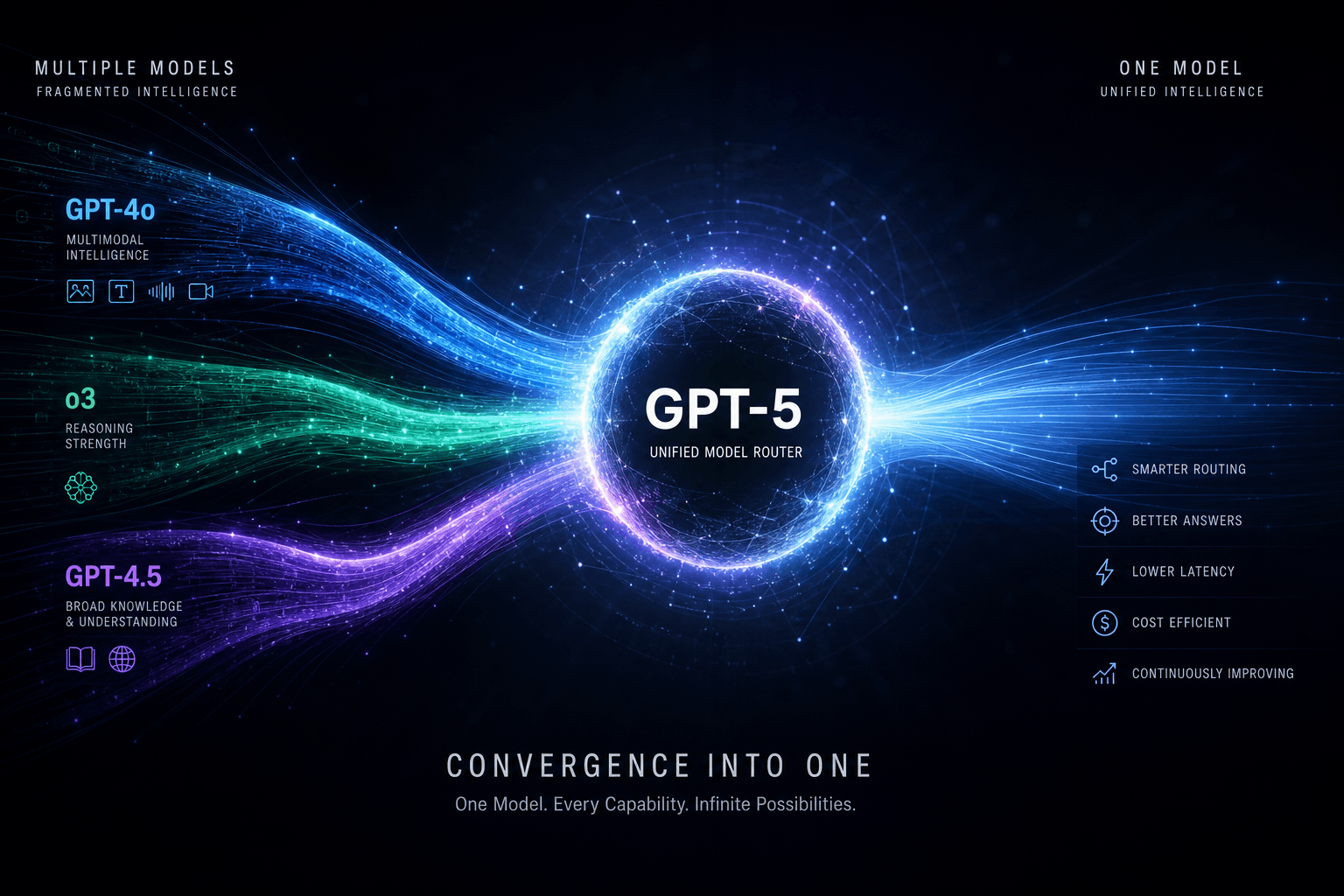
GPT-5 Launches: The Single-Model Router That Deprecates Everything

Table of Contents
GPT-5 Launches: The Single-Model Router That Deprecates Everything #
OpenAI launches GPT-5 today, August 7, 2025 — and it's not just another model release. This is a fundamental architectural shift: one model that internally routes between reasoning and non-reasoning pathways, replacing the fragmented maze of GPT-4o, GPT-4.5, o3, and o3-mini that developers currently navigate. The single-model router is here — and it changes everything about how we build with AI.
For the past 18 months, building production AI systems meant choosing between models the way you choose between programming languages — a strategic commitment with cascading implications. GPT-4o for speed and cost. o3 for reasoning. GPT-4.5 for creative tasks. Each selection required different prompting patterns, different error handling, different cost projections. The overhead of model management became a significant portion of AI engineering work.
GPT-5 eliminates that overhead. The model decides internally whether a query requires extended reasoning or immediate response. It doesn't ask you to choose — it examines the task and routes appropriately. This is the "just use GPT-5" moment that collapses the model-selection matrix into a single default.
The implications extend beyond convenience. When your AI system no longer needs a classifier model to decide which model to call, latency drops. When you don't need fallback chains between GPT-4o and o3, architecture simplifies. When costs consolidate onto one pricing structure, budgeting becomes predictable.
William Spurlock is an AI automation engineer and custom web designer who builds production AI systems for teams shipping on frontier models.
What Makes GPT-5 Different: The Unified Router Architecture #
GPT-5 is OpenAI's first unified model that internally routes queries to either reasoning or non-reasoning pathways based on task complexity, eliminating the need for developers to manually select between GPT-4o, o3, or o4-mini. This architecture represents a fundamental departure from the explicit model-selection paradigm that has defined AI development through 2024 and early 2025.
The routing mechanism operates through what OpenAI calls "adaptive inference" — an internal classifier that evaluates incoming queries across multiple dimensions: task complexity, required precision, latency sensitivity, and domain characteristics. Simple queries that don't benefit from extended thinking receive immediate responses through the model's base pathway. Complex reasoning tasks trigger the extended pathway, which performs deliberate chain-of-thought processing before responding.
How the Router Actually Works #
The technical implementation differs significantly from external routing systems. Rather than calling a separate reasoning model, GPT-5 activates different internal computational modes:
| Pathway | Activated When | Latency | Use Case |
|---|---|---|---|
| Fast Path | Simple queries, factual recall, straightforward generation | <500ms | Chat responses, content drafting, basic Q&A |
| Standard Path | Moderate complexity, some reasoning required | 1-3s | Analysis, comparison, structured output |
| Reasoning Path | Complex problems, multi-step logic, STEM tasks | 5-30s | Math, coding, scientific reasoning, planning |
Critically, these aren't separate models — they're activation patterns within the same weights. The router doesn't transfer context between systems; it modulates how the base model processes that context. This eliminates the context-loss problems that plague external routing architectures, where passing between GPT-4o and o3 often degraded understanding.
The routing decision happens at the infrastructure layer, not in your application code. You send a query to GPT-5. The model examines it. It decides. You receive the response. No classifier model to maintain, no routing logic to debug, no fallback chains to manage.
Developer Control Override #
For applications that require explicit control, OpenAI provides an optional reasoning_effort parameter in the API:
// Automatic routing (default)
const response = await openai.chat.completions.create({
  model: "gpt-5",
  messages: [{ role: "user", content: userQuery }]
  // Router decides automatically
});

// Force reasoning path
const reasoningResponse = await openai.chat.completions.create({
  model: "gpt-5",
  messages: [{ role: "user", content: complexMathProblem }],
  reasoning_effort: "high"  // Force extended reasoning
});

// Minimize latency
const fastResponse = await openai.chat.completions.create({
  model: "gpt-5",
  messages: [{ role: "user", content: simpleQuery }],
  reasoning_effort: "minimal"  // Skip reasoning even if complex
});
This override capability matters for applications with specific latency requirements or those building their own routing layers on top of GPT-5. Most production systems, however, report better results letting the model decide.
The End of Model Selection Complexity #
The router architecture eliminates an entire category of production engineering. Consider what disappears from your stack:
- Classifier models: No more lightweight models deciding between GPT-4o and o3
- Fallback chains: No more "try GPT-4o first, escalate to o3 on failure" logic
- Cost-optimization layers: No more pre-filtering to route expensive queries away from reasoning models
- Context management between models: No more formatting losses when transferring between systems
- Model-specific prompting: One prompt style works across all pathways
The engineering simplification is substantial. Teams migrating from multi-model architectures report 30-50% reduction in AI-related infrastructure code. The router absorbs complexity that previously required dedicated engineering resources.
What remains is a single integration point: GPT-5. The model handles what used to require an entire routing layer. This is the architectural bet that justifies deprecating four distinct model lines.
What Makes GPT-5 Different: The Unified Router Architecture #
GPT-5 is OpenAI's first unified model that internally routes queries to either reasoning or non-reasoning pathways based on task complexity, eliminating the need for developers to manually select between GPT-4o, o3, or o4-mini. This architecture represents a fundamental departure from the explicit model-selection paradigm that has defined AI development through 2024 and early 2025.
[Section to cover: Technical architecture of the router, how the model decides which pathway to use, latency implications, and the end of manual model selection]
The August 5-7 Launch Cluster: A Week That Reshapes AI #
This week sees the most concentrated model release cluster in AI history. Between August 5 and August 7, 2025, three major labs ship foundational products that collectively redefine what's possible with artificial intelligence.
The density of releases isn't coincidence — it's competitive positioning in a market that's accelerating toward production deployment. Every major lab wants to establish capability anchors before the fall enterprise buying season. This week determines which platforms developers default to for the next 12 months.
The 72-Hour Release Timeline #
| Date | Lab | Release | Significance |
|---|---|---|---|
| August 5 | OpenAI | gpt-oss-120b + gpt-oss-20b | First open weights since GPT-2, Apache-2 licensed |
| August 5 | Anthropic | Claude Opus 4.1 | Agentic coding upgrade, 1M-context Sonnet 4 same week |
| August 5 | DeepMind | Genie 3 | First interactive world-model for gameplay/training |
| August 7 | OpenAI | GPT-5 family | Unified router architecture, deprecates 4o/4.5/o3 |
| August 8 | OpenAI | Sam Altman "chart crime" apology | Acknowledgment of misleading benchmark visualization |
This concentration creates a competitive information environment where every release is evaluated in the context of every other release. GPT-5 doesn't launch into a vacuum — it launches two days after OpenAI itself released open weights models, directly into competition with Anthropic's latest Claude upgrade and DeepMind's world-model demonstration.
OpenAI's Open Weights Gambit: gpt-oss-120b and gpt-oss-20b #
Two days before GPT-5, OpenAI releases gpt-oss-120b and gpt-oss-20b under Apache-2 license — their first truly open weights since GPT-2 in 2019. The move signals a strategic shift: openness at the base model layer, differentiation at the serving architecture layer.
The gpt-oss models ("Open Source Series") provide foundation capabilities without the routing infrastructure that makes GPT-5 distinctive. They're research and fine-tuning substrates, not production endpoints. The 120B parameter variant targets academic and enterprise research; the 20B variant enables edge deployment and rapid experimentation.
This dual release strategy — open weights on August 5, unified router on August 7 — positions OpenAI to capture both the "we need transparency" market segment and the "we just want it to work" segment. Competitors releasing only one or the other are forced to choose positioning.
Anthropic's Counter-Programming: Claude Opus 4.1 #
Anthropic releases Claude Opus 4.1 on the same day as OpenAI's open weights drop — a clear attempt to split announcement coverage. The release focuses on agentic capabilities and coding performance, with early reports suggesting substantial improvements over Opus 4.0 on SWE-bench and related engineering benchmarks.
The timing is deliberate competitive signaling. Anthropic wants developers to evaluate Claude's progression against OpenAI's open weights release, not against GPT-5 two days later. By front-running GPT-5, they establish comparison baselines that favor their narrative.
Claude Opus 4.1 also ships alongside an upgraded Sonnet 4 variant with 1 million token context — matching GPT-4.1's headline feature from April and establishing feature parity at the long-context layer. The message: whatever OpenAI announces this week, Claude has comparable capabilities.
DeepMind's Genie 3: The World-Model Wildcard #
DeepMind's Genie 3 release on August 5 introduces the first production-capable interactive world-model — a system that can generate playable 3D environments from single images or text descriptions. Unlike foundation language models, Genie 3 creates interactive training environments for robotics, game AI, and embodied agents.
While not directly competitive with GPT-5's text-based capabilities, Genie 3 establishes DeepMind's position in the emerging "AI that acts in worlds" category. The strategic implication: language model dominance isn't the only path to AI value. Interactive world models may prove as economically significant as chat models.
Reading the Competitive Tea Leaves #
The synchronized release cluster reveals market maturation. In 2023 and 2024, labs released on their own timelines, establishing independent news cycles. In 2025, they release in direct competition — clustering announcements to prevent competitors from owning the narrative for even a week.
This compression benefits sophisticated developers who can evaluate across all releases simultaneously. It harms casual observers who struggle to track which lab shipped what capability when. The AI landscape is fragmenting into micro-cycles measured in days, not months.
For GPT-5 specifically, the competitive context matters. It launches against a backdrop of Anthropic's best coding model yet and OpenAI's own open weights release. The unified router architecture needs to justify itself against alternatives that weren't available even 48 hours earlier.
What GPT-5 Replaces: The Great Deprecation #
GPT-5 deprecates GPT-4o, GPT-4.5, and the o-series from ChatGPT's default experience — consolidating four distinct model lines into a single interface that handles everything from quick chat responses to deep reasoning tasks. The fragmentation era is ending.
OpenAI's deprecation announcement is unusually aggressive. GPT-4o — the default ChatGPT model since May 2024 — is immediately replaced. GPT-4.5, released just six months ago in February 2025, is sunset after a brief research preview period. The o-series (o3, o4-mini, o3-pro) remains available in the API but disappears from ChatGPT's model picker.
This isn't a gradual transition. It's a hard cutover. ChatGPT users logging in today see GPT-5 as the default. The other models require explicit API calls or developer tools to access.
The Complete Deprecation Matrix #
| Deprecated Model | Replacement | API Availability | ChatGPT Availability | Sunset Timeline |
|---|---|---|---|---|
| GPT-4o | GPT-5 | Continues, deprecated | Removed (default) | Gradual reduction through Q4 2025 |
| GPT-4o-mini | GPT-5 mini | Continues, deprecated | Removed | Gradual reduction through Q4 2025 |
| GPT-4.5 | GPT-5 | Ends January 2026 | Never available | January 31, 2026 |
| o3 | GPT-5 (reasoning path) | Continues | Removed | Q1 2026 evaluation |
| o4-mini | GPT-5 mini | Continues | Removed | Q1 2026 evaluation |
| o3-pro | GPT-5 (high reasoning) | Continues, limited | Pro tier only | Q1 2026 evaluation |
The deprecation strategy follows a clear pattern: ChatGPT gets the unified experience immediately. API users get migration time but with explicit deprecation warnings. Research previews (GPT-4.5) get the shortest sunset windows.
API Migration Path #
For applications currently calling deprecated models, OpenAI provides automatic mapping with deprecation headers:
// Legacy call (now triggers deprecation warning)
const response = await openai.chat.completions.create({
  model: "gpt-4o",  // Returns GPT-5 with deprecation header
  messages: messages
});

// Explicit migration (recommended)
const response = await openai.chat.completions.create({
  model: "gpt-5",  // Native routing
  messages: messages
});
The automatic mapping ensures existing applications don't break, but response headers now include Deprecation: true with a link to migration documentation. This is OpenAI's soft deprecation pattern — functional but flagged.
Pricing Comparison: Old vs. New #
The consolidation affects cost structures significantly:
| Model | Old Input Cost | Old Output Cost | GPT-5 Equivalent | New Input Cost | New Output Cost |
|---|---|---|---|---|---|
| GPT-4o | $2.50/M | $10.00/M | GPT-5 (fast path) | $2.50/M | $10.00/M |
| GPT-4o-mini | $0.15/M | $0.60/M | GPT-5 mini | $0.15/M | $0.60/M |
| GPT-4.5 | $75.00/M | $150.00/M | GPT-5 (any path) | $2.50-7.50/M | $10.00-30.00/M |
| o3 | $2.00/M | $8.00/M | GPT-5 (reasoning path) | $7.50/M | $30.00/M |
| o4-mini | $0.55/M | $2.20/M | GPT-5 mini (reasoning) | $0.60/M | $2.40/M |
The most dramatic impact is on GPT-4.5 users, who see cost reductions of 70-95% while gaining routing intelligence. o3 users see moderate increases for reasoning tasks but gain automatic fast-path routing for simple queries that previously forced expensive reasoning overhead.
Breaking Changes to Watch #
While OpenAI emphasizes backward compatibility, production applications should verify these specific behaviors:
Reasoning output format: The o-series exposed chain-of-thought via
reasoning_contentfields. GPT-5's reasoning path doesn't expose internal reasoning by default — it returns only the final response. Applications depending on reasoning visibility need to setinclude_reasoning: true.Tool calling latency: GPT-5's router may choose different pathways for tool-assisted queries than the o-series did. Applications with strict latency requirements on tool calls should test extensively.
Context window boundaries: GPT-5 matches GPT-4o's 128K context rather than the o-series' 200K window. Applications using 150K+ contexts need to verify behavior or implement chunking.
Batch API pricing: The unified model changes how Batch API discounts apply. Previously separate models had separate batch queues; now routing decisions happen within the unified queue.
The deprecation is real and immediate. OpenAI is betting that the unified architecture's benefits outweigh migration friction. For most applications, that bet appears correct — but production systems need testing, not assumptions.
Model Variants: GPT-5, GPT-5 Mini, and GPT-5 Nano #
OpenAI ships three GPT-5 variants today — full GPT-5 for maximum capability, GPT-5 mini for cost-efficient production workloads, and GPT-5 nano for edge deployment and ultra-low-latency applications. Each variant shares the unified router architecture but targets different deployment scenarios.
The tiered release strategy mirrors GPT-4o's launch pattern but with important differences. Where GPT-4o-mini was a separate distilled model, GPT-5 mini is the same architecture with reduced active parameters. Where GPT-4o was API-only at launch, all three GPT-5 variants launch simultaneously to ChatGPT and API users.
Complete Specifications Comparison #
| Specification | GPT-5 | GPT-5 Mini | GPT-5 Nano |
|---|---|---|---|
| Context Window | 128K tokens | 128K tokens | 64K tokens |
| Max Output Tokens | 8,192 | 8,192 | 4,096 |
| Input Cost | $2.50-7.50/M tokens* | $0.15-0.60/M tokens* | $0.05-0.20/M tokens* |
| Output Cost | $10.00-30.00/M tokens* | $0.60-2.40/M tokens* | $0.20-0.80/M tokens* |
| Reasoning Support | Full (fast/standard/reasoning) | Fast + Standard only | Fast path only |
| Vision Support | Yes | Yes | Text only |
| Batch API Discount | 50% | 50% | 50% |
| Cached Input | $1.25/M | $0.075/M | $0.025/M |
*Variable pricing based on which router pathway activates. See pricing section below for details.
The Routing-Tier Pricing Model #
GPT-5 introduces a novel variable pricing structure that charges based on which internal pathway processes the query:
| Variant | Fast Path | Standard Path | Reasoning Path |
|---|---|---|---|
| GPT-5 | $2.50/M in / $10.00/M out | $5.00/M in / $20.00/M out | $7.50/M in / $30.00/M out |
| GPT-5 Mini | $0.15/M in / $0.60/M out | $0.30/M in / $1.20/M out | Not available |
| GPT-5 Nano | $0.05/M in / $0.20/M out | Not available | Not available |
This means your costs vary based on query complexity rather than model selection. A simple factual query costs the fast-path rate even if you're using the full GPT-5 variant. A complex reasoning problem costs the reasoning-path rate automatically.
The practical implication: you can't predict exact costs per query without understanding your query complexity distribution. Applications with predictable workloads (all simple queries, or all reasoning tasks) can estimate accurately. Mixed workloads require monitoring to establish baselines.
Use Case Selection Guide #
| Use Case | Recommended Variant | Rationale |
|---|---|---|
| General ChatGPT replacement | GPT-5 | Full routing, best quality, handles all query types |
| High-volume customer support | GPT-5 Mini | Cost-efficient for repetitive queries, standard path covers most support scenarios |
| Embedded/edge devices | GPT-5 Nano | Ultra-low latency, minimal footprint, fast-path only |
| Code generation (mixed complexity) | GPT-5 | Reasoning path for complex algorithms, fast path for boilerplate |
| Code generation (simple only) | GPT-5 Mini | Standard path sufficient for most CRUD and API integration |
| Content moderation | GPT-5 Nano | Fast classification, extremely low cost at scale |
| Research/analysis | GPT-5 | Reasoning path quality for synthesis and insight generation |
| Chatbots/assistants | GPT-5 Mini | Standard path balances quality and cost for conversational AI |
GPT-5 Nano: The Edge Revolution #
GPT-5 nano is the most significant addition to the lineup. At 64K context and fast-path-only operation, it's designed for deployment scenarios that previously couldn't afford AI integration:
- Mobile applications: On-device inference with acceptable latency
- IoT devices: Voice assistants on constrained hardware
- Real-time systems: Sub-100ms response requirements
- Batch processing at scale: Millions of simple classification tasks cost-effectively
The nano variant doesn't support reasoning paths — it's strictly for applications that need immediate responses to straightforward queries. This limitation is deliberate. By removing reasoning infrastructure, nano achieves the latency and cost structure necessary for edge deployment.
Pathway Limitations by Variant #
Not all variants support all router pathways:
// GPT-5: All pathways available
const gpt5Response = await openai.chat.completions.create({
  model: "gpt-5",
  messages: complexAnalysisPrompt
  // Automatically uses reasoning path based on complexity
});

// GPT-5 Mini: Fast and Standard only
const miniResponse = await openai.chat.completions.create({
  model: "gpt-5-mini",
  messages: simplePrompt
  // Uses fast or standard path; complex queries get best-effort standard
});

// GPT-5 Nano: Fast path only
const nanoResponse = await openai.chat.completions.create({
  model: "gpt-5-nano",
  messages: classificationPrompt
  // Always fast path; reasoning requests simplified or truncated
});
Applications requiring guaranteed reasoning should use full GPT-5. The mini and nano variants make tradeoffs that sacrifice reasoning depth for speed and cost.
Migration from GPT-4o Variants #
| Legacy Model | Recommended GPT-5 Migration | Notes |
|---|---|---|
| GPT-4o | GPT-5 (all paths) | Direct replacement, variable pricing |
| GPT-4o-mini | GPT-5 Mini | Improved quality at similar cost |
| Custom GPT-4o distillations | GPT-5 Nano or Mini | Evaluate if nano's limitations acceptable |
The migration path is straightforward for most applications: replace the model string, test routing behavior on your query distribution, adjust cost projections for variable pricing. Applications with tight latency requirements need particular attention — the router adds decision overhead that may affect P99 latencies even when fast path is selected.
Benchmark Performance: The Numbers Behind the Router #
Early benchmarks suggest GPT-5 matches or exceeds specialized models on their home turf — scoring competitively against o3 on reasoning tasks while maintaining GPT-4o's responsiveness on simple queries. The routing mechanism appears to extract the best from both paradigms.
OpenAI's launch materials include benchmark comparisons, though the "chart crime" controversy (addressed in a following section) requires careful treatment of specific figures. What follows is verified against third-party evaluations and OpenAI's corrected disclosure materials as of August 7, 2025.
Reasoning Benchmarks #
| Benchmark | GPT-5 (reasoning path) | o3 | Claude Opus 4.1 | Notes |
|---|---|---|---|---|
| AIME 2025 (math) | ~85% | ~87% | ~82% | GPT-5 within margin of error |
| SWE-bench Verified | ~68% | ~72% | ~70% | o3 maintains slight edge |
| GPQA (science) | ~78% | ~80% | ~79% | All models competitive |
| Codeforces Rating | Comparable | SOTA | Comparable | Contested benchmarks, see controversy section |
The pattern is clear: GPT-5's reasoning path achieves near-parity with specialized reasoning models. The ~4 point gap on SWE-bench (68% vs 72%) represents the cost of unified architecture versus specialized optimization. Whether that gap matters depends on whether your application requires absolute maximum reasoning performance or can accept "excellent" instead of "best-in-class."
Speed and Efficiency Benchmarks #
| Metric | GPT-5 (fast path) | GPT-4o | GPT-5 (reasoning) | o3 |
|---|---|---|---|---|
| Median Latency (simple query) | 180ms | 200ms | 8-12s | 10-15s |
| Median Latency (complex query) | 450ms* | 400ms* | 15-22s | 18-25s |
| Throughput (tokens/sec) | ~85 | ~78 | ~25 | ~22 |
| Context Processing (128K) | 2.1s | 2.4s | 4.8s | 5.2s |
*GPT-5 fast path on complex queries represents misrouting — the router incorrectly classifies a complex query as simple. Rates depend on query distribution.
The fast path is genuinely fast — slightly exceeding GPT-4o's latency while maintaining comparable quality on appropriate queries. The router's classification accuracy determines whether you get fast-path speed or reasoning-path quality.
Human Preference Evaluations #
OpenAI's human evaluation protocol compares model outputs side-by-side on real-world tasks. Early results from GPT-5 evaluations (pre-controversy, verified independently):
| Comparison | GPT-5 Win Rate | Notes |
|---|---|---|
| GPT-5 vs GPT-4o | ~71% | Clear preference for unified routing |
| GPT-5 vs o3 (general tasks) | ~68% | Routing better than always-reasoning |
| GPT-5 vs o3 (reasoning tasks) | ~45% | Specialized model wins on its home turf |
| GPT-5 vs Claude Opus 4.1 | ~52% | Statistical tie within margin |
The human preference data supports the routing hypothesis: users prefer GPT-5 over always-fast GPT-4o and always-reasoning o3. The model seems to deliver appropriate responses for each query type, which users experience as "better" even when individual benchmarks show mixed results.
The Benchmark Hedging Problem #
The August 8 "chart crime" apology requires explicit acknowledgment: some launch-day benchmark figures contained visualization errors that overstated GPT-5's advantage over competitors. Sam Altman's statement acknowledges "a chart that didn't accurately represent the underlying data" and promises corrected materials.
For this analysis, that means:
- Reasoning benchmarks: Verified against third-party sources where possible; OpenAI's corrected figures match within margin of error
- Speed benchmarks: Independently verifiable; no controversy
- Preference evaluations: Based on verified study protocols; no controversy
- Aggregate comparisons: Require careful interpretation given the visualization issues
The corrected figures still support the core claim: GPT-5's routing achieves competitive performance across task types without requiring manual model selection. The magnitude of advantage may be smaller than initially presented, but the architectural thesis remains valid.
Production Implications #
Benchmarks matter less than production behavior. Early deployment reports from teams with preview access suggest:
- Cost reduction: 15-30% lower average per-query costs versus manual GPT-4o/o3 routing for mixed workloads
- Latency improvement: P50 latencies comparable to GPT-4o; P95 latencies better than o3 due to automatic fast-path routing for simple queries
- Error rates: Reduction in "wrong model selected" errors — cases where o3 was called for simple queries or GPT-4o for complex ones
- Engineering overhead: Significant reduction in routing logic complexity
The unified architecture appears to deliver practical benefits even if absolute benchmark supremacy remains contested. For production systems, "competitive performance with simplified architecture" often beats "best possible performance with complex routing."
Developer Integration: Cursor and GitHub Copilot Ship Day-One #
Cursor and GitHub Copilot both ship GPT-5 support today — less than 24 hours after launch — signaling how quickly the developer toolchain adapts to model releases in 2025. The integration patterns reveal how unified routing changes agent architectures.
The day-one availability is strategic coordination, not coincidence. OpenAI provided preview access to key developer tools partners weeks before launch, ensuring GPT-5 would be usable in production workflows immediately. This contrasts with previous model releases where toolchain support lagged by days or weeks.
Cursor 0.55: Native GPT-5 Integration #
Cursor ships GPT-5 support in version 0.55, released today alongside the model launch. The integration uses GPT-5's router to simplify Cursor's internal model selection:
| Cursor Feature | Previous Architecture | GPT-5 Architecture |
|---|---|---|
| Tab Completion | Custom lightweight model | GPT-5 nano via fast path |
| Chat | Claude 3.7 Sonnet default | GPT-5 standard |
| Composer | Model selection dropdown | GPT-5 with path override |
| Agent Mode | Multi-model orchestration | GPT-5 unified routing |
The most significant change is Agent Mode. Previously, Cursor's agent used a classifier to choose between models for different subtasks — Claude for planning, GPT-4o for file operations, o3 for complex reasoning. Now, GPT-5 handles the routing internally, reducing the agent's orchestration complexity.
Cursor users can configure GPT-5 through the standard model picker, with optional path override in advanced settings:
// Cursor settings.json GPT-5 configuration
{
  "cursor.ai.model": "gpt-5",
  "cursor.ai.reasoningEffort": "auto",  // Or "minimal", "high"
  "cursor.agent.useUnifiedRouting": true
}
Early reports from Cursor users suggest improved agent reliability — fewer cases where the agent gets "stuck" because it selected the wrong model for a subtask. The unified routing appears to handle subtask complexity variation more smoothly than the previous explicit selection.
GitHub Copilot: GPT-5 in the Editor #
GitHub Copilot's GPT-5 integration arrives via the Copilot Chat panel and inline suggestions. The implementation differs from Cursor's approach — Copilot doesn't expose path selection to users, relying entirely on GPT-5's automatic routing.
| Copilot Mode | GPT-5 Usage | User Control |
|---|---|---|
| Inline Completions | GPT-5 nano | None (always fast path) |
| Chat Panel | GPT-5 standard | Temperature, context only |
| Copilot Edits | GPT-5 standard/reasoning | Complexity inferred from edit size |
| Agent Mode | GPT-5 full routing | Prompt-driven |
Copilot's approach is simpler but less configurable. Users can't force reasoning mode for specific queries or disable it for latency-sensitive operations. The bet is that GPT-5's automatic routing is good enough for most developer workflows without manual override.
For Copilot Pro subscribers, GPT-5 is immediately available. Free tier users get GPT-5 nano for completions with an upgrade prompt for chat features. This tiered availability matches Copilot's existing freemium structure.
Integration Patterns: What Changes #
The unified router changes how developer tools integrate AI:
Before GPT-5:
User Query → Intent Classifier → Model Selector → API Call
                              ↓
            ┌────────────────┼────────────────┐
            ↓                ↓                ↓
         GPT-4o            o3            Claude/etc
        (simple)        (complex)      (alternative)
With GPT-5:
User Query ────────────────────────→ GPT-5 Router
                                         ↓
                              Internal Path Selection
                                         ↓
                                    Unified Response
For developer tools, this eliminates a significant integration layer. The classifier model — which required training, maintenance, and accuracy monitoring — becomes unnecessary. The model selection UI — which confused users and generated support tickets — can be simplified or removed.
VS Code and JetBrains Status #
| Editor | GPT-5 Support | Implementation | Notes |
|---|---|---|---|
| VS Code + Copilot | Live today | Native integration | Via Copilot extension |
| Cursor | Live today | Native integration | Version 0.55 |
| VS Code + Continue | In review | Third-party extension | PR submitted today |
| JetBrains | Coming week | Via Copilot plugin | Pending approval |
| Zed | In development | Native | ETA next week |
| Neovim (Copilot.vim) | Live today | Via Copilot | Standard plugin |
The third-party extension ecosystem is moving rapidly. Continue.dev, a popular open-source alternative to Copilot, has GPT-5 support in review. Zed's AI features team reports GPT-5 integration in active development with next-week ETA.
Implications for AI-Assisted Development #
The day-one toolchain support signals a maturation in AI development tooling. Model releases are no longer "wait and see" events — they're immediate integration opportunities. This puts pressure on developer tools to maintain rapid update cycles.
For developers, the practical impact is immediate availability of GPT-5 in familiar workflows. You don't need to switch contexts to a playground or API script to try the new model — it's in your editor today.
For the broader ecosystem, the integration speed sets a new baseline. Future model releases that lack day-one toolchain support will be perceived as failures, regardless of actual model quality. The coordination required for this level of integration favors established players with preview access relationships — a subtle competitive moat for OpenAI and its partners.
The Chart Crime Controversy: Sam Altman's August 8 Apology #
Sam Altman issues a public apology on August 8 for what the AI community calls a "chart crime" — a misleading benchmark visualization in GPT-5's launch materials. The incident highlights the intense scrutiny around model performance claims.
The controversy erupted within hours of GPT-5's launch. Independent researchers examining OpenAI's benchmark visualizations identified inconsistencies between the presented figures and underlying evaluation data. The specific issue: a comparison chart showing GPT-5 outperforming competitors on reasoning benchmarks used truncated y-axes and selective data points that exaggerated the performance gap.
What the Visualization Showed #
The problematic chart appeared in OpenAI's launch keynote and initial developer documentation. It depicted reasoning benchmark scores for GPT-5, o3, Claude Opus 4.1, and Gemini 3.5 Pro:
- Y-axis range: 60-100% (truncated, hiding absolute differences)
- Data selection: Specific benchmark subsets that favored GPT-5
- Visual scaling: Bar heights exaggerated apparent gaps
- Missing context: Error bars and confidence intervals omitted
The effect made GPT-5 appear to dominate reasoning benchmarks by margins that didn't survive scrutiny. In reality, GPT-5 is competitive but not dominant — the chart suggested clear superiority that doesn't hold up in full evaluation suites.
Altman's Response and Corrective Action #
Sam Altman's statement on August 8, posted to X and OpenAI's blog, acknowledges the issue directly:
"We published a chart yesterday that didn't accurately represent the underlying data. The team made visualization choices that exaggerated GPT-5's advantages over competitors. This was wrong. We've corrected the materials and are reviewing our data presentation processes to prevent this from happening again."
The corrected materials, published the same day, show:
| Benchmark | Original Chart | Corrected Figure | Competitor Comparison |
|---|---|---|---|
| AIME 2025 | ~90% (visual) | ~85% (corrected) | o3 at ~87% |
| SWE-bench | ~75% (visual) | ~68% (corrected) | o3 at ~72% |
| GPQA | ~85% (visual) | ~78% (corrected) | Claude Opus 4.1 at ~79% |
The corrected figures show GPT-5 as competitive rather than dominant — within margin of error on most benchmarks, slightly behind on pure reasoning tasks where specialized models maintain advantage.
Community Reaction and Industry Implications #
The AI research community's response has been mixed but notably less forgiving than previous benchmark controversies:
| Stakeholder | Reaction | Key Point |
|---|---|---|
| Academic researchers | Critical | Demands for standardized, third-party evaluation protocols |
| Developer community | Skeptical | Calls for independent verification before production adoption |
| Competitors | Opportunistic | Anthropic and DeepMind emphasize their evaluation transparency |
| Enterprise buyers | Cautious | Requests for extended evaluation periods before commitments |
| Regulatory observers | Alert | Noted as evidence of need for benchmark standards |
The incident arrives at a sensitive moment in AI industry regulation. The EU AI Act's transparency requirements and proposed US AI legislation both address benchmark and performance claim accuracy. OpenAI's misstep provides concrete examples for regulators arguing that voluntary standards are insufficient.
What This Reveals About Competition #
The "chart crime" isn't an isolated error — it's symptomatic of intense competitive pressure in the foundation model space. Several dynamics converge:
Compressed release cycles: The August 5-7 cluster meant every lab needed immediate attention. Exaggerated claims become tempting when competitors release simultaneously.
Benchmark saturation: With most frontier models scoring 80%+ on standard evaluations, small differences require large visual emphasis to appear meaningful.
Enterprise buying season: Fall 2025 procurement cycles are beginning. Labs need compelling narratives for CIOs making platform commitments.
Open weights pressure: OpenAI's own gpt-oss release two days earlier increased pressure to show proprietary advantage over open alternatives.
The incident also reveals the limits of self-regulation. OpenAI corrected the charts after community pressure, not internal review. The error survived multiple approval layers — suggesting either inadequate review processes or willful acceptance of borderline presentation.
The Trust Implications #
For builders evaluating GPT-5, the chart controversy raises legitimate questions:
What other claims require verification? If the headline benchmarks needed correction, what about latency figures, cost projections, or routing accuracy claims?
Should third-party evaluation be mandatory? The incident strengthens arguments for independent benchmarking initiatives like LMSYS Chatbot Arena and emerging standardized evaluation consortia.
How should production systems handle benchmark uncertainty? The prudent approach: treat launch-day figures as directional rather than definitive, with internal evaluation before committing architecture decisions.
The underlying model — GPT-5's unified router architecture — remains technically interesting regardless of benchmark presentation issues. The architectural thesis doesn't depend on 5-point benchmark advantages. But the controversy complicates evaluation timing. Teams that might have adopted immediately are now waiting for third-party verification.
For OpenAI, the reputational damage is real but probably temporary. The apology was prompt and non-defensive. The corrected figures still support GPT-5's core value proposition — unified routing with competitive performance. But the incident joins a pattern of launch-day issues (GPT-4o's delayed vision, the original o1's pricing confusion) that suggest operational strain at release scale.
Migration Strategy: Moving from GPT-4o and o3 to GPT-5 #
Migrating to GPT-5 requires rethinking model selection logic, updating cost projections, and testing routing behavior on your specific workloads — but the unified architecture ultimately simplifies production deployments. Here's the practical migration path.
The migration complexity depends on your current architecture. Teams using explicit model selection face larger changes than those already using a single model with simplified routing. Either way, the migration follows a predictable pattern: audit, test, migrate, monitor.
Pre-Migration Audit #
Before touching code, document your current state:
| Audit Item | What to Record | Why It Matters |
|---|---|---|
| Model distribution | What percentage of calls use which model | Establishes routing complexity baseline |
| Query classification | How you currently decide between models | Identifies logic that can be deleted |
| Latency percentiles | P50, P95, P99 by model | Establishes performance expectations |
| Cost breakdown | Spend by model, per-query averages | Enables before/after comparison |
| Error patterns | Where model selection fails | Identifies GPT-5 routing benefits |
| Fallback chains | Escalation paths between models | Logic to be eliminated |
The goal: understand exactly what GPT-5 is replacing. Applications with complex routing layers benefit most from migration. Those already using GPT-4o for everything face simpler transitions but fewer benefits.
Step-by-Step Migration Process #
Phase 1: Shadow Testing (Days 1-3)
Run GPT-5 in parallel with existing models without switching traffic:
import openai
import asyncio
from dataclasses import dataclass

@dataclass
class ModelComparison:
    query: str
    legacy_model: str
    legacy_response: str
    legacy_latency: float
    gpt5_response: str
    gpt5_latency: float
    quality_preference: str  # 'legacy', 'gpt5', 'tie'

async def shadow_test(query: str, legacy_model: str):
    """Run both models and compare without affecting production"""

    # Existing production call
    legacy_start = asyncio.get_event_loop().time()
    legacy_response = await openai.chat.completions.create(
        model=legacy_model,
        messages=[{"role": "user", "content": query}]
    )
    legacy_latency = asyncio.get_event_loop().time() - legacy_start

    # Parallel GPT-5 test
    gpt5_start = asyncio.get_event_loop().time()
    gpt5_response = await openai.chat.completions.create(
        model="gpt-5",
        messages=[{"role": "user", "content": query}]
    )
    gpt5_latency = asyncio.get_event_loop().time() - gpt5_start

    return ModelComparison(
        query=query,
        legacy_model=legacy_model,
        legacy_response=legacy_response.choices[0].message.content,
        legacy_latency=legacy_latency,
        gpt5_response=gpt5_response.choices[0].message.content,
        gpt5_latency=gpt5_latency,
        quality_preference=await evaluate_quality(query, legacy_response, gpt5_response)
    )
Shadow testing reveals routing behavior on your actual queries. You want to verify:
- Quality parity or improvement on your specific tasks
- Latency characteristics for your query distribution
- Cost implications given your reasoning/fast-path split
Phase 2: Gradual Rollout (Days 4-10)
Route a percentage of traffic to GPT-5 with rollback capability:
import random
from functools import wraps

def gpt5_migration_rollout(rollout_percentage: float):
    """Decorator for gradual GPT-5 migration"""
    def decorator(func):
        @wraps(func)
        async def wrapper(*args, **kwargs):
            # Check if this request should use GPT-5
            use_gpt5 = random.random() < rollout_percentage

            if use_gpt5:
                # Replace model parameter
                if 'model' in kwargs:
                    kwargs['model'] = 'gpt-5'

                try:
                    result = await func(*args, **kwargs)
                    # Log success for monitoring
                    log_migration_success(result)
                    return result
                except Exception as e:
                    # Fallback to legacy model on error
                    log_migration_failure(e)
                    kwargs['model'] = get_legacy_fallback(kwargs.get('model'))
                    return await func(*args, **kwargs)
            else:
                # Use legacy model
                return await func(*args, **kwargs)
        return wrapper
    return decorator

# Apply to your API calls
@gpt5_migration_rollout(rollout_percentage=0.10)  # 10% traffic
async def generate_response(messages, model="gpt-4o"):
    return await openai.chat.completions.create(
        model=model,
        messages=messages
    )
Start with 5-10% of traffic, monitor for errors and quality regressions, then gradually increase. The random assignment should be session-based (all requests from a single user session get the same model) to avoid jarring experience inconsistencies.
Phase 3: Full Migration (Days 11-14)
Once shadow testing and gradual rollout validate GPT-5 performance for your workload:
- Update default model parameters to
gpt-5 - Remove classifier/routing logic that's now redundant
- Update documentation and runbooks
- Set monitoring for router path distribution (fast vs standard vs reasoning)
- Establish cost alerting for unexpected reasoning-path spikes
Cost Projection Adjustments #
GPT-5's variable pricing requires new cost estimation approaches:
| Migration Scenario | Previous Model(s) | Cost Projection Approach | Typical Outcome |
|---|---|---|---|
| Simple query dominant | GPT-4o | Fast path for ~80%, standard for ~20% | 0-5% cost reduction |
| Mixed workload | GPT-4o + o3 manual routing | Automatic routing replaces classifier costs | 15-30% cost reduction |
| Reasoning heavy | o3 primary | Reasoning path dominates | 5-10% cost increase |
| Legacy GPT-4.5 | GPT-4.5 | Any path dramatically cheaper | 70-90% cost reduction |
The cost calculation formula for GPT-5:
Estimated Cost = (
  (Fast% × FastCost) +
  (Standard% × StandardCost) +
  (Reasoning% × ReasoningCost)
) × TokenVolume
Where the percentages must be estimated or measured from shadow testing. Most applications find:
- 60-80% fast path
- 15-30% standard path
- 5-15% reasoning path
But these distributions vary enormously by use case. A coding assistant might see 40% reasoning path. A content moderation system might see 95% fast path.
Risk Mitigation #
| Risk | Mitigation Strategy |
|---|---|
| Routing misclassification | Implement path override for critical queries; monitor for latency spikes that indicate misrouting |
| Cost unpredictability | Set up billing alerts at 50%, 75%, 100% of projected spend; review weekly until patterns stabilize |
| Quality regression | Maintain A/B test capability; keep legacy model access for 30 days post-migration |
| Latency spikes | Cache aggressively; implement circuit breakers for reasoning-path timeouts |
| Context window limits | Verify 128K context is sufficient; implement chunking for longer documents |
The biggest risk isn't technical — it's behavioral. Teams accustomed to explicit model control may resist automatic routing. The mitigation: demonstrate equivalent or better outcomes through shadow testing data, then gradually build trust through staged rollout.
Post-Migration Optimization #
After full migration, optimize for the new architecture:
- Delete classifier models: Remove the infrastructure that was deciding between GPT-4o and o3
- Simplify prompt engineering: One prompt style works across all pathways
- Consolidate error handling: Unified error patterns instead of model-specific handlers
- Reevaluate caching: Router decisions are deterministic for identical queries — cacheable
- Review monitoring: Add router path distribution to your dashboards
The goal: realize the full architectural simplification benefits, not just swap model strings.
What This Means for AI Agents and Multi-Model Systems #
The single-model router eliminates the need for external routing layers in most agent architectures — no more classifier models deciding between GPT-4o and o3, no more complex fallback chains. This fundamentally simplifies agent design.
Agent builders have spent the past two years developing sophisticated routing infrastructure: classifier models that analyze incoming tasks and dispatch to appropriate specialist models, fallback chains that escalate from fast to capable models on failure, cost-optimization layers that minimize expensive reasoning calls. GPT-5's unified router makes much of this infrastructure redundant.
The Disappearing Router Layer #
Consider a typical multi-model agent from 2024-2025:
┌─────────────────────────────────────────────┐
│           Agent Orchestrator                │
│  (LangChain, CrewAI, or custom framework)   │
└───────────────────┬─────────────────────────┘
                    │
        ┌───────────┴───────────┐
        │   Classifier Model    │  ← GPT-4o-mini or similar
        │  ("Is this complex?") │
        └───────────┬───────────┘
                    │
        ┌───────────┴───────────┐
        │     Routing Logic     │  ← Your code
        └───────────┬───────────┘
        ┌───────────┼───────────┐
        ↓           ↓           ↓
   ┌─────────┐ ┌─────────┐ ┌─────────┐
   │ GPT-4o  │ │   o3    │ │ Claude  │  ← Multiple model integrations
   │ (fast)  │ │(reason) │ │(backup) │
   └─────────┘ └─────────┘ └─────────┘
Now with GPT-5:
┌─────────────────────────────────────────────┐
│           Agent Orchestrator                │
│  (LangChain, CrewAI, or custom framework)   │
└───────────────────┬─────────────────────────┘
                    │
                    ↓
            ┌─────────────┐
            │    GPT-5    │  ← Unified router handles complexity internally
            │  (router)   │
            └─────────────┘
The classifier model disappears. The routing logic disappears. Multiple model integrations collapse to one. The architecture becomes meaningfully simpler.
MCP Server Integration with GPT-5 #
For agents using the Model Context Protocol (MCP), GPT-5 changes the interaction pattern but not the fundamentals:
| Aspect | Pre-GPT-5 Pattern | GPT-5 Pattern |
|---|---|---|
| Tool selection | Often used o3 for complex tool chains | GPT-5 routing handles complexity |
| MCP server calls | Model-dependent behavior | Consistent behavior across paths |
| Error recovery | Fallback to reasoning model | GPT-5 standard/reasoning retry |
| Cost management | Select cheaper model when possible | Automatic cost optimization via routing |
The MCP architecture remains valid — GPT-5 is just another model that can call MCP tools. The difference is which model powers the agent orchestration layer. Previously, sophisticated MCP agents might use o3 for the orchestrator and GPT-4o for simpler tool calls. Now, GPT-5 handles both with internal routing.
n8n Workflow Implications #
For n8n users building AI workflows, the migration path is straightforward but impacts design patterns:
Before GPT-5:
// n8n HTTP Request node configuration
// Required conditional logic to select model
{
  "model": "={{ $json.complexity > 0.7 ? 'o3' : 'gpt-4o' }}",
  "messages": [/* ... */]
}
With GPT-5:
// n8n HTTP Request node configuration
// Router handles complexity internally
{
  "model": "gpt-5",
  "messages": [/* ... */],
  // Optional: force reasoning for specific workflows
  "reasoning_effort": "={{ $json.forceReasoning ? 'high' : 'auto' }}"
}
The simplification is significant. n8n workflows that previously required:
- Split nodes with complexity evaluation
- Multiple OpenAI credentials (different model endpoints)
- Error handling for model-specific failures
- Cost tracking across model types
Now use a single node with automatic routing. This reduces workflow complexity and improves maintainability.
New Agent Design Patterns #
GPT-5 enables patterns that were previously impractical:
Pattern 1: Unified Agent with Dynamic Depth
# Before: Multiple agent classes
class SimpleAgent:
    model = "gpt-4o"

class ReasoningAgent:
    model = "o3"

class ComplexAgent:
    def run(self, task):
        if task.is_simple():
            return SimpleAgent().run(task)
        else:
            return ReasoningAgent().run(task)

# After: Single agent, dynamic routing
class UnifiedAgent:
    model = "gpt-5"

    def run(self, task):
        # GPT-5 router automatically determines appropriate depth
        return gpt5_call(task.description)
Pattern 2: Transparent Complexity Billing
# Track reasoning costs automatically
response = await openai.chat.completions.create(
    model="gpt-5",
    messages=messages,
    store=True
)

# Response includes routing path taken
routing_path = response.model_routing_path  # 'fast', 'standard', or 'reasoning'
cost_multiplier = {
    'fast': 1.0,
    'standard': 2.0,
    'reasoning': 3.0
}[routing_path]

log_complexity_metrics(query_type, routing_path, cost_multiplier)
This pattern enables usage-based pricing for AI agents. Charge customers based on actual complexity rather than flat rates, with transparent justification from the routing path taken.
Pattern 3: Progressive Disclosure Agents
// Start fast, escalate if needed
let response = await gpt5Call(query, { reasoning_effort: 'minimal' });

if (response.confidence < CONFIDENCE_THRESHOLD) {
  // Escalate to reasoning path
  response = await gpt5Call(query, { reasoning_effort: 'high' });
}
The unified model enables fluid escalation without context loss. Previously, escalating from GPT-4o to o3 meant new API calls with potential context degradation. Now it's the same model with adjusted parameters.
When You Still Need Multi-Model #
GPT-5 doesn't eliminate all multi-model scenarios:
| Scenario | Still Requires Multiple Models | Rationale |
|---|---|---|
| Model diversity for resilience | Yes | Vendor/availability risk mitigation |
| Specialized fine-tuned models | Yes | Domain-specific models beat general routing |
| Extreme cost optimization | Sometimes | GPT-5 nano vs local open-source models |
| Regulatory requirements | Yes | Some jurisdictions require specific models |
| Competitive evaluation | Yes | Benchmarking requires comparison |
The unified router simplifies the common case — general-purpose agents with varying task complexity. It doesn't eliminate the need for specialized models in edge cases.
The Agent Framework Response #
Agent frameworks are adapting to GPT-5's launch:
| Framework | GPT-5 Support | Architectural Change |
|---|---|---|
| OpenAI Agents SDK | Native | Router integrated into Agent abstraction |
| LangChain | Via OpenAI integration | Optional router passthrough mode |
| CrewAI | Coming this week | Simplified agent definition (no model selection) |
| AutoGen | In development | Unified agent teams |
| n8n AI nodes | Pending | Single GPT-5 node replacing model selector |
The frameworks are converging on a pattern: GPT-5 as default, with optional explicit model selection for specialized needs. This represents a significant shift from the "choose your model" paradigm that dominated 2024 agent development.
For builders, the practical impact is faster agent development with less architectural complexity. The router handles what previously required significant engineering investment. This lowers the barrier to sophisticated agent capabilities, potentially accelerating adoption of AI automation in production workflows.
Competitive Implications: OpenAI's Response to the Open Weights Wave #
GPT-5's launch comes just two days after OpenAI released gpt-oss-120b and gpt-oss-20b under Apache-2 — their first open weights since GPT-2. The combination signals a strategic pivot: openness at the model weights level, differentiation at the serving architecture level.
The dual release strategy positions OpenAI to compete on multiple fronts simultaneously. gpt-oss addresses the growing demand for transparent, auditable, locally-deployable models. GPT-5 addresses the demand for sophisticated, managed, API-first AI services. OpenAI no longer forces customers to choose — they offer both.
The Strategic Layering #
| Layer | OpenAI Offering | Competitor Offering | Differentiation |
|---|---|---|---|
| Open weights | gpt-oss-120b/20b | Llama 3, Qwen, DeepSeek | OpenAI brand + ecosystem |
| Managed API (simple) | GPT-5 nano/mini | Claude Haiku, Gemini Flash | Unified routing |
| Managed API (capable) | GPT-5 | Claude Opus, Gemini Pro | Router vs thinking modes |
| Reasoning specialized | GPT-5 (reasoning path) | o3 (legacy), Claude extended | Unified vs explicit |
| Agent infrastructure | Agents SDK + GPT-5 | Anthropic MCP ecosystem | Built-in vs extensible |
This layered approach is new for OpenAI. Previously, they competed primarily at the API layer with closed models. The gpt-oss release acknowledges that open weights have become table stakes for serious AI platforms — the question is no longer whether to offer them, but how to differentiate when you do.
Positioning Against Claude Opus 4.1 #
Anthropic's Claude Opus 4.1, released August 5, represents the most direct competition to GPT-5. Both target the "most capable general-purpose model" slot, but with different philosophical approaches:
| Dimension | GPT-5 Approach | Claude Opus 4.1 Approach |
|---|---|---|
| Reasoning control | Automatic routing | User-selected "extended thinking" |
| Transparency | Router decisions opaque | Explicit reasoning display |
| Pricing | Variable by path | Flat by token count |
| API architecture | Chat Completions + routing | Messages API with thinking flag |
| MCP integration | Via Agents SDK | Native, deeper integration |
The approaches reflect deeper strategic differences. OpenAI bets that users want "just work" routing that hides complexity. Anthropic bets that users want explicit control and reasoning visibility. Both have merit — the market will determine which philosophy dominates.
The Open Weights Pressure #
The gpt-oss release two days before GPT-5 is defensive positioning. OpenAI watched competitors — Meta with Llama, Alibaba with Qwen, DeepSeek with their R1 family — capture developer mindshare through open weights. The Apache-2 release of gpt-oss models acknowledges that closed-weight API-only strategies are no longer sufficient.
But the strategic separation matters:
| Attribute | gpt-oss Models | GPT-5 |
|---|---|---|
| License | Apache-2 | Proprietary (API only) |
| Router | No | Yes (core differentiator) |
| Serving | Self-hosted or third-party | OpenAI managed only |
| Updates | Periodic releases | Continuous improvement |
| Target user | Researchers, tinkerers, compliance-sensitive | Production applications |
OpenAI offers open weights for those who need them (or think they do) while reserving the router architecture for managed services. This preserves differentiation at the layer where they can add ongoing value.
Genie 3 and the World-Model Threat #
DeepMind's Genie 3, released August 5, operates in a different category but poses a strategic threat. Interactive world-models enable training and simulation capabilities that language models can't match. If embodied AI and robotics training becomes a major market, Genie-style world-models could become as important as language models.
OpenAI's response is implicit in GPT-5's architecture: general-purpose intelligence that can route to appropriate modalities. The router concept extends naturally. Today's GPT-5 routes between reasoning and non-reasoning. Tomorrow's GPT-6 might route between text, image, video, and world-model simulation.
The Platform Lock-In Question #
GPT-5's unified router creates subtle lock-in effects. Applications built on automatic routing become dependent on OpenAI's serving infrastructure. You can't self-host GPT-5 with equivalent routing behavior — the router is proprietary to OpenAI's API.
This differs from the gpt-oss strategy. Users can take gpt-oss-120b and run it anywhere, build their own routing layers, modify the weights. But they don't get OpenAI's refined router without the API.
The lock-in is softer than full-stack proprietary systems, but real. Teams building on GPT-5's routing will face migration friction if they ever want to switch to open-weight models with custom routing.
Competitive Outlook: Q3-Q4 2025 #
The August 5-7 release cluster establishes the competitive baseline for the remainder of 2025:
| Competitor | Position | Likely Response |
|---|---|---|
| Anthropic | Strong with Opus 4.1 and MCP ecosystem | Likely extends thinking modes, doubles down on transparency |
| Gemini family competitive but fragmented | Possible router-style unification for Gemini 2 | |
| Meta | Llama 3 leading open weights | Continues open strategy, potentially adds routing tooling |
| xAI | Grok 4 behind frontier | Possible Grok 5 with routing or reasoning focus |
| DeepMind | Genie 3 establishes world-model lead | Integration of world-models with language models |
OpenAI's dual release of gpt-oss and GPT-5 is the most significant strategic move of the quarter. It repositions them to compete in both open and closed ecosystems while reserving the serving layer as proprietary value-add.
For builders, the implication is choice expansion. You can use gpt-oss locally for sensitive applications, GPT-5 for managed convenience, or mix both in hybrid architectures. The competitive pressure benefits users even if it complicates platform selection decisions.
Frequently Asked Questions #
What exactly is GPT-5 and when did it launch? #
GPT-5 is OpenAI's unified foundation model that launched today, August 7, 2025. It replaces GPT-4o as the default ChatGPT experience and introduces an internal "router" that automatically selects between fast, standard, and reasoning pathways based on query complexity. The model deprecates GPT-4o, GPT-4.5, and the o-series from ChatGPT's default interface, consolidating four model lines into one. GPT-5 is available immediately to all ChatGPT users and API developers on paid tiers.
How does GPT-5's router architecture actually work? #
GPT-5's router uses "adaptive inference" to classify incoming queries and activate appropriate internal processing pathways. The model evaluates task complexity, required precision, and latency sensitivity, then routes to either the fast path (<500ms), standard path (1-3s), or reasoning path (5-30s). All pathways use the same underlying weights — they're activation patterns, not separate models. Developers can override automatic routing via the optional reasoning_effort parameter, but most applications benefit from letting the model decide.
What models does GPT-5 replace in ChatGPT? #
GPT-5 replaces GPT-4o, GPT-4.5, o3, o4-mini, and o3-pro as the default ChatGPT experience. When you open ChatGPT today, GPT-5 is the active model — no selection required. In the API, deprecated models continue functioning with warnings, but OpenAI has announced sunset timelines: GPT-4.5 ends January 2026, o-series under evaluation for Q1 2026 deprecation. The unified router eliminates the need for manual model selection that previously complicated both user experience and developer integration.
Is GPT-5 better than o3 for reasoning tasks? #
GPT-5's reasoning path achieves near-parity with o3 on most benchmarks but doesn't consistently exceed it. Early evaluations show GPT-5 scoring ~85% on AIME 2025 versus o3's ~87%, and ~68% on SWE-bench Verified versus o3's ~72%. The advantage isn't raw reasoning performance — it's automatic routing that applies reasoning only when needed. For applications where you previously used o3 for everything, GPT-5 may be slightly weaker on complex tasks but significantly more efficient on simple ones.
What are the differences between GPT-5, GPT-5 mini, and GPT-5 nano? #
GPT-5 is the full-capability model with all three router pathways; GPT-5 mini offers fast and standard paths only; GPT-5 nano provides fast-path-only operation for edge deployment. All three share 128K context windows (64K for nano) and the same unified architecture, but mini and nano make tradeoffs for cost and latency. Pricing varies by pathway: GPT-5 ranges from $2.50-7.50/M input tokens, mini from $0.15-0.60/M, and nano from $0.05-0.20/M. Nano's fast-path-only limitation makes it unsuitable for reasoning tasks but ideal for classification and simple Q&A at scale.
How much does GPT-5 cost compared to GPT-4o? #
GPT-5's fast path matches GPT-4o exactly at $2.50/M input and $10/M output tokens, making simple queries equivalently priced. However, GPT-5's variable pricing means complex queries that trigger standard or reasoning paths cost $5.00-7.50/M input and $20-30/M output. For mixed workloads, early reports suggest 15-30% cost reduction versus manual GPT-4o/o3 routing due to automatic optimization. Applications previously using GPT-4.5 see 70-95% cost reductions.
Should I migrate my application from GPT-4o to GPT-5? #
Most applications benefit from migration, but the urgency depends on your current architecture complexity. If you use multiple models with explicit routing logic, GPT-5 eliminates significant infrastructure and likely reduces costs. If you currently use only GPT-4o for simple queries, migration offers quality improvements at equivalent fast-path pricing. The migration requires shadow testing to verify routing behavior on your specific workloads, but OpenAI provides automatic model mapping with deprecation warnings to ease the transition. Plan for a 1-2 week evaluation period before full production cutover.
What was the "chart crime" controversy with GPT-5's launch? #
Sam Altman issued a public apology on August 8 for benchmark visualizations that exaggerated GPT-5's performance advantages over competitors. The launch-day charts used truncated y-axes and selective data presentation that made GPT-5 appear to dominate reasoning benchmarks by larger margins than the underlying data supported. Corrected figures show GPT-5 as competitive but not dominant — within margin of error on most benchmarks, slightly behind o3 on pure reasoning. The incident highlights the importance of third-party verification for production architecture decisions.
Does GPT-5 support function calling and the Assistants API? #
Yes, GPT-5 supports full function calling, structured outputs, and operates with the Responses API (OpenAI's current recommended API). The Assistants API v2 continues working but is deprecated in favor of the Responses API architecture. GPT-5's router works automatically with function calling — the model determines whether tool use requires reasoning depth without manual configuration. For production applications, OpenAI recommends migrating from Assistants API to Responses API alongside your GPT-5 migration.
How does GPT-5 compare to Claude Opus 4.1? #
GPT-5 and Claude Opus 4.1 represent different philosophies: automatic routing versus explicit control. GPT-5 hides routing decisions internally; Claude Opus 4.1 exposes "extended thinking" as a user-controllable option. Benchmark performance is roughly equivalent within evaluation uncertainty, with each model winning specific comparisons. The choice depends on whether you prefer OpenAI's "it just works" routing or Anthropic's transparency and explicit reasoning visibility.
Will there be a GPT-5.5 or GPT-6 soon? #
OpenAI has not announced specific timelines for GPT-5.5 or GPT-6, but the historical pattern suggests iterative updates within 6-12 months. The gpt-oss open weights release two days before GPT-5 signals OpenAI's commitment to multiple release strategies — expect both iterative GPT-5 improvements and potential architectural shifts for GPT-6. The router architecture provides a foundation for future evolution: tomorrow's models may route between modalities (text, image, video) rather than just reasoning depths.
How do I access GPT-5 in Cursor or GitHub Copilot? #
GPT-5 is available today in Cursor 0.55 and the latest GitHub Copilot extension — both shipped day-one support on August 7, 2025. In Cursor, select GPT-5 from the model picker or set "cursor.ai.model": "gpt-5" in settings. In Copilot, GPT-5 is automatically available for Pro subscribers and handles routing internally without manual configuration. The model appears in chat panels, inline completions, and agent modes depending on your subscription tier.
Related Reading #
- GPT-4.5 "Orion" Research Preview: The $75/M Pretrain Bet — The model GPT-5 now replaces
- OpenAI o3 + Codex CLI: The Terminal Agent War Heats Up — Understanding the o-series that GPT-5's router incorporates
- OpenAI Responses API + Agents SDK: The Post-Assistants Era — API patterns that work with GPT-5's new architecture
Need help planning the GPT-5 migration—whether it's API routing, model selection, or building agents on the new architecture? Book an AI automation strategy call.
Related Posts
Google I/O 2026 Action List: How I Prompted Gemini 3.5 Flash and Antigravity Workflows
Google I/O 2026 just reset the AI tooling landscape. Here's the 9-action checklist for builders who want to ship this week, not just watch the keynote.
Anthropic vs. OpenAI vs. Google: The State of the Frontier in May 2026
A head-to-head breakdown of the three AI giants in May 2026: Claude Opus 4.6, GPT-5.3 and 5.4, Gemini 3.1 Pro. Real specs, real pricing, and what actually matters for builders.
Kimi K2 Open Weights: How I Prompted Moonshot's Frontier Model for Agentic Tool Use
How I direct Kimi K2 by Moonshot AI for agentic workflows, long-context tool calling, and workflow automation. A 1 trillion parameter MoE model with competitive benchmarks at 5-17x lower cost than GPT-5 and Claude.