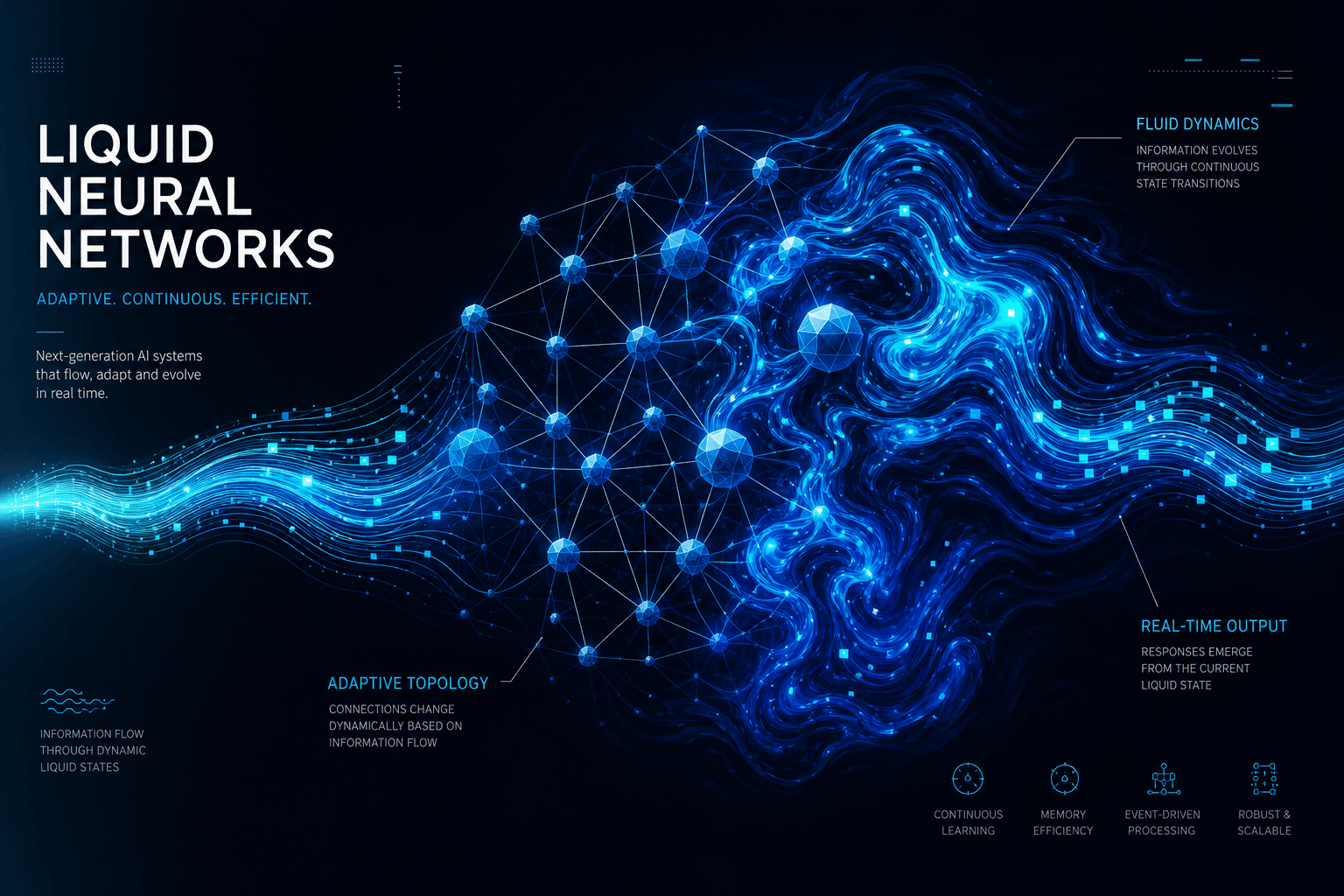
Liquid AI's LFM Family: Non-Transformer Architectures Challenge Transformer Dominance

Table of Contents
Liquid AI's LFM Family: Non-Transformer Architectures Challenge Transformer Dominance #
The Transformer Monopoly Faces Its First Serious Challenger #
Liquid AI, the MIT spinoff founded by CSAIL researchers, just launched the Liquid Foundation Models (LFM) family — and it's the first time a non-transformer architecture has achieved state-of-the-art performance against GPT-based models. This launch represents a genuine architectural inflection point for the AI industry. While every major generative AI model released since 2017 has been built on the transformer architecture from Google's "Attention Is All You Need" paper, Liquid AI's LFMs are built on liquid neural networks rooted in dynamical systems theory, signal processing, and numerical linear algebra.
Since the transformer architecture debuted, we've seen countless variations — bigger models, longer context windows, multimodal extensions — but every single production-grade foundation model has shared the same fundamental building blocks: attention mechanisms, encoder-decoder stacks, and the same scaling laws. Liquid AI is the first team to demonstrate that you can build competitive foundation models using a completely different architectural foundation.
The implications are significant. For builders and engineers making long-term bets on AI infrastructure, this launch proves that transformer dominance isn't inevitable. There's room for architectural diversity, and different approaches may win on different dimensions — efficiency, interpretability, multimodal capability, or long-context handling.
Table of Contents #
- What Makes LFMs Different: Beyond the Transformer — The architectural philosophy behind liquid neural networks and why they depart from attention mechanisms
- The LFM Model Family: Three Sizes for Different Use Cases — LFM-1.3B, LFM-3.1B, and LFM-40.3B MoE specifications and targets
- Benchmark Performance: Where LFMs Beat Transformers — MMLU and other benchmark results showing state-of-the-art performance
- Memory Efficiency: The Real Competitive Advantage — How LFMs achieve dramatically lower memory footprints than comparable transformer models
- Multimodal by Design: Beyond Text — Native support for video, audio, time series, and signals
- Technical Architecture: Liquid Neural Networks Explained — The math and mechanisms powering LFMs
- Availability and Access — Where to test LFMs: Liquid playground, Lambda Chat, Perplexity Labs
- Implications for AI Builders — What non-transformer state-of-the-art means for production AI systems
- FAQ — Common questions about Liquid Foundation Models
- The Bottom Line — Service track CTA and closing thoughts
What Makes LFMs Different: Beyond the Transformer #
LFMs represent the first principled alternative to transformer architectures to achieve production-grade performance. For seven years, the AI industry has operated on the assumption that the transformer architecture — introduced in Google's seminal 2017 paper "Attention Is All You Need" — was the only viable foundation for large language models. Every major release, from GPT-2 through GPT-4, from Llama through Claude, has been a variation on the transformer theme.
Liquid AI's approach is fundamentally different. Instead of iterating on attention mechanisms, the team built LFMs from "first principles...the same way engineers built engines, cars, and airplanes." The architecture combines computational units rooted in dynamical systems theory, signal processing, and numerical linear algebra — domains with decades of theoretical advancement that haven't been fully exploited in neural network design.
| Aspect | Transformers | Liquid Neural Networks |
|---|---|---|
| Core mechanism | Attention mechanisms | Dynamical systems + signal processing |
| Mathematical foundation | Matrix multiplication, softmax | Differential equations, linear algebra |
| Scaling paradigm | Add more parameters, more layers | Optimize neuron efficiency through math |
| Context handling | Fixed attention window | Efficient sequential data processing |
| Interpretability | Black-box attention weights | White-box dynamical system design |
The key insight from Liquid AI's research is that transformer architectures may be over-parameterized. Traditional deep learning models require thousands of neurons to perform complex tasks, but liquid neural networks demonstrate that fewer neurons — combined with more sophisticated mathematical formulations — can achieve comparable or superior results.
This matters because architectural diversity creates a healthier ecosystem. When every model shares the same fundamental constraints, the entire industry moves in lockstep — chasing the same scaling laws, hitting the same memory bottlenecks, struggling with the same long-context limitations. A genuinely different architecture opens up new solution spaces.
The LFM Model Family: Three Sizes for Different Use Cases #
Liquid AI launched three model variants targeting different deployment scenarios, from edge devices to enterprise workloads. The LFM family follows the industry trend of offering multiple sizes for different use cases, but with a key difference: every model in the family leverages the same liquid neural network architecture, not transformer-based cores.
LFM-1.3B: Edge-Optimized Dense Model #
The smallest model in the family, LFM-1.3B, is designed for resource-constrained environments where inference efficiency matters more than raw capability. Despite its modest parameter count, this model achieves state-of-the-art performance in the 1B category — marking what Liquid AI calls "the first time a non-GPT architecture significantly outperforms transformer-based models" on major benchmarks.
Target use cases include mobile applications, embedded systems, and real-time inference on consumer hardware. The model's efficiency makes it viable for deployment scenarios where even Llama 3.2-1B would be too memory-intensive.
LFM-3.1B: The Sweet Spot #
The mid-tier LFM-3.1B represents the optimal balance between performance and efficiency for most production applications. With only 16GB memory requirement compared to the 48GB+ required by Meta's Llama-3.2-3B, this model opens up high-quality inference on hardware that would struggle with comparable transformer models.
LFM-3.1B outperforms Google's Gemma-2, Microsoft's Phi-3, and Meta's Llama-3.2 on efficiency-adjusted benchmarks while requiring significantly less memory. For teams running inference at scale, the memory savings translate directly to cost reduction.
LFM-40.3B: Enterprise Mixture-of-Experts #
The flagship LFM-40.3B uses a Mixture-of-Experts (MoE) architecture similar to Mistral's Mixtral models. With 40.3 billion total parameters but efficient expert routing, this model targets complex enterprise tasks in financial services, biotechnology, and consumer electronics where maximum capability justifies higher computational requirements.
The MoE approach aligns with the broader industry trend — only activating relevant parameter subsets per inference — while maintaining the liquid neural network foundation that distinguishes LFMs from transformer-based alternatives.
| Model | Parameters | Architecture | Target Memory | Best For |
|---|---|---|---|---|
| LFM-1.3B | 1.3B | Dense | Edge devices | Mobile, embedded, real-time |
| LFM-3.1B | 3.1B | Dense | 16GB | Production servers, mid-scale |
| LFM-40.3B | 40.3B | Mixture-of-Experts | Enterprise GPU clusters | Complex reasoning, enterprise |
Benchmark Performance: Where LFMs Beat Transformers #
The LFM-1.3B and LFM-3.1B models achieve state-of-the-art results in their respective parameter categories, validating Liquid AI's architectural bet. This isn't marginal improvement — it's the first time a non-transformer architecture has reached the top of widely accepted leaderboards.
MMLU: The Standard Academic Benchmark #
The Massive Multitask Language Understanding (MMLU) benchmark has become the industry standard for comparing foundation model capabilities. It consists of 57 tasks spanning mathematics, history, computer science, law, and more — designed to test broad knowledge and reasoning rather than narrow task optimization.
On MMLU and related benchmarks, LFM-1.3B outperforms:
- Meta Llama 3.2-1B — Meta's newest small model, released just weeks before LFMs
- Microsoft Phi-1.5 — Microsoft's efficiency-focused small model
This is significant because these aren't outdated baselines — they're current-generation transformer models from well-funded labs with years of optimization experience. For a first-generation non-transformer architecture to lead this quickly suggests the liquid neural network approach has genuine advantages.
LFM-3B: Efficiency-Adjusted Leadership #
The LFM-3.1B model doesn't just compete on raw benchmarks — it dominates on efficiency-adjusted metrics. While it outperforms Google Gemma-2, Microsoft Phi-3, and Meta Llama-3.2 on standard academic benchmarks, the real story is the performance-per-watt and performance-per-GB ratios.
When you normalize for memory footprint and inference cost, LFM-3B extends its lead significantly. A model that achieves 95% of a competitor's benchmark scores while using 33% of the memory represents a better production choice for most applications.
What "State-of-the-Art" Means Here #
It's worth being precise about what these benchmarks validate and what they don't:
- Validated: LFMs can compete on standard academic benchmarks measuring knowledge and reasoning
- Not validated: LFMs outperform transformers on every dimension (we don't know their long-context behavior, code generation quality, or agentic task performance yet)
- Not validated: Liquid architectures scale to 100B+ parameters competitively (LFM-40B is promising but early)
What we can say is that non-transformer architectures are now a viable path to production-grade performance. The transformer monopoly has been broken — not in theory, but in measured, reproducible benchmark results.
Memory Efficiency: The Real Competitive Advantage #
While benchmark performance grabs headlines, the memory efficiency of LFMs may be their most important feature for production deployment. Liquid AI's architectural choices result in dramatically lower memory footprints than comparable transformer models — and the gap widens as context length increases.
The Numbers: LFM-3B vs. Competitors #
The most striking comparison is between LFM-3.1B and Meta's Llama-3.2-3B:
| Model | Memory Requirement | Relative Efficiency |
|---|---|---|
| LFM-3.1B | 16 GB | Baseline |
| Llama-3.2-3B | 48+ GB | 3x more memory |
| Microsoft Phi-3 | 24+ GB | 1.5x more memory |
| Google Gemma-2 | 20+ GB | 1.25x more memory |
This isn't a minor optimization — it's a fundamental architectural advantage. The liquid neural network design handles sequential data more efficiently than attention mechanisms, which suffer from quadratic memory scaling with sequence length.
Context Length Scaling #
Where transformer models experience sharp increases in memory usage for long-context processing, LFMs maintain a flatter scaling curve. This makes them particularly well-suited for:
- Document analysis — Processing entire research papers, legal contracts, or technical manuals
- Chatbots with conversation memory — Maintaining context across extended multi-turn conversations
- Time series analysis — Handling long sequences of financial, sensor, or operational data
- Multimodal processing — Working with video and audio sequences that naturally extend to millions of tokens
Liquid AI reports that LFMs can handle up to 1 million tokens efficiently while maintaining minimal memory growth — a capability that would require exponentially more resources with standard transformer architectures.
Production Cost Implications #
For teams running inference at scale, memory efficiency translates directly to cost:
- Hardware requirements: 16GB GPUs are standard and affordable; 48GB GPUs are specialized and expensive
- Batch processing: Lower memory per instance enables higher batch sizes and better throughput
- Edge deployment: Models that fit in 16GB can run on consumer hardware, cloud instances, and mobile devices
Maxime Labonne, Head of Post-Training at Liquid AI, emphasized this point when announcing the launch: the core advantage of LFMs is their ability to outperform transformer-based models while using significantly less memory. In production environments, this efficiency advantage may matter more than marginal benchmark improvements.
Multimodal by Design: Beyond Text #
LFMs were architected as multimodal models from the ground up, not retrofitted to handle non-text data. While many transformer models add vision or audio capabilities through separate encoders and adapters, the liquid neural network foundation naturally extends to any sequential data type — video, audio, time series, and signals.
Sequential Data as a Universal Interface #
The dynamical systems and signal processing foundations of liquid neural networks make them inherently suited to sequential data of any kind. This isn't an afterthought or an add-on module — it's a core design principle:
- Text — Token sequences (the standard LLM input)
- Audio — Waveform sequences and spectrograms
- Video — Frame sequences with temporal dependencies
- Time series — Financial data, sensor readings, IoT streams
- Signals — Scientific measurements, telemetry, control systems
Each of these data types shares a common structure: values changing over time, with patterns and dependencies that can be modeled using the same mathematical tools. Where transformers needed vision encoders, audio encoders, and complex fusion mechanisms to handle multiple modalities, LFMs treat them as variations on the same sequential modeling problem.
Industry Target Applications #
Liquid AI is explicitly targeting industries where non-text sequential data dominates:
| Industry | Data Type | LFM Application |
|---|---|---|
| Financial Services | Time series, market data | Predictive modeling, anomaly detection |
| Biotechnology | Genomic sequences, protein data | Pattern recognition, structure prediction |
| Consumer Electronics | Audio, video, sensor streams | Real-time processing, on-device inference |
| Autonomous Systems | Sensor fusion, telemetry | Decision-making from multi-source inputs |
| Scientific Research | Experimental measurements | Signal processing, data analysis |
The Retrofitting Problem #
Most multimodal transformers are essentially text models with peripheral encoders bolted on. GPT-4V adds a vision encoder to GPT-4. Gemini adds audio and video processing through separate pathways. These approaches work, but they're architecturally inelegant — different data types flow through different processing paths before being merged, often with lossy compression or information bottlenecks.
LFMs offer a more unified approach. The same liquid neural network architecture processes any sequential input, learning patterns and dependencies without modality-specific preprocessing. This could yield better cross-modal understanding — the ability to truly integrate insights from video, audio, and text rather than processing them in isolation and combining results.
For builders working on applications that naturally combine modalities — video analysis with audio transcription, sensor data with textual annotations, time series with descriptive metadata — this unified architecture may prove more capable than retrofitted multimodal transformers.
Technical Architecture: Liquid Neural Networks Explained #
Liquid Foundation Models are built on Liquid Neural Networks (LNNs), an architecture developed at MIT's Computer Science and Artificial Intelligence Laboratory (CSAIL) that fundamentally reimagines how neural networks process sequential data. Understanding LNNs helps explain why LFMs can achieve transformer-competitive performance with such different resource requirements.
From MIT Research to Production Models #
The liquid neural network architecture emerged from research at MIT CSAIL focused on making neural networks more efficient and adaptable. The core insight: traditional deep learning models use fixed architectures with thousands of neurons performing static transformations. LNNs instead model neurons as dynamical systems that can change their behavior based on input — hence "liquid."
Key characteristics of the LNN approach:
- Dynamical systems theory — Neurons are modeled as continuous-time systems described by differential equations, not discrete feedforward units
- Signal processing principles — Information flows through the network using techniques borrowed from digital signal processing
- Numerical linear algebra — Efficient computation through optimized matrix operations and factorizations
- Adaptive behavior — Network parameters can adjust during inference based on input characteristics
Efficiency Through Mathematical Sophistication #
Traditional neural networks solve complexity by adding scale — more layers, more neurons, more parameters. LNNs solve complexity through better mathematics:
Traditional approach: 1,000 simple neurons
LNN approach: 100 sophisticated neurons with dynamical equations
The result is that liquid neural networks can achieve comparable or superior results with significantly fewer parameters. This isn't just compression — it's a different way of representing and processing information that leverages decades of theoretical advances in control theory and signal processing that haven't been fully exploited in deep learning.
Real-Time Adaptability #
A unique capability of liquid neural networks is real-time adjustment during inference. While transformer weights are fixed after training, LNNs can adapt their behavior based on the specific input they're processing. This means:
- Contextual optimization — The network can adjust to the characteristics of the specific sequence it's processing
- Continual learning — Potential for on-the-fly adaptation without full retraining
- Robustness — Better handling of out-of-distribution inputs through dynamic adjustment
White-Box Design and Explainability #
Transformer architectures are famously opaque — even researchers struggle to interpret what specific attention heads are doing. The dynamical systems foundation of LNNs offers better interpretability:
- Mathematical equations governing behavior are explicit and analyzable
- State transitions can be tracked and visualized
- The relationship between input changes and output changes is more traceable
For applications requiring explainability — financial modeling, medical diagnosis, legal analysis — this "white-box" characteristic may be a significant advantage over black-box transformers.
Availability and Access #
LFMs are available today through multiple channels, though Liquid AI is positioning this as a preview phase ahead of a full production launch. The company is actively soliciting feedback from early adopters and has announced a formal launch event at MIT on October 23, 2024.
Where to Test LFMs #
| Platform | Access URL | Notes |
|---|---|---|
| Liquid AI Playground | playground.liquid.ai | Official testing environment, requires login |
| Lambda Chat | lambda.chat | Cloud GPU inference platform |
| Perplexity Labs | labs.perplexity.ai | AI research and testing environment |
These platforms provide different interfaces for testing LFMs. The Liquid AI playground offers the most direct access to the models and their full capabilities, while Lambda Chat and Perplexity Labs provide integration into broader AI testing workflows.
Hardware Platform Support #
Liquid AI is optimizing LFMs for deployment across multiple hardware platforms:
- NVIDIA — Standard datacenter GPU deployment
- AMD — Alternative GPU platform support
- Apple — Apple Silicon optimization for Mac and iOS deployment
- Qualcomm — Mobile and edge device support
- Cerebras — Wafer-scale AI accelerator integration
This cross-platform strategy is smart. By supporting everything from mobile Qualcomm chips to datacenter NVIDIA clusters to Cerebras' specialized hardware, Liquid AI maximizes the addressable market for their architecture and allows customers to deploy on their preferred infrastructure.
The October 23 MIT Launch Event #
Liquid AI has announced a formal launch event on October 23, 2024, at MIT's Kresge Auditorium in Cambridge, Massachusetts. This event will likely include:
- Detailed technical presentations on the LFM architecture
- Customer and partner announcements
- Roadmap for future model releases
- Expanded API and enterprise deployment options
The company is accepting RSVPs for in-person attendance, suggesting they expect significant industry interest. For a startup to command this level of attention with their first major product launch speaks to the technical credibility they've established through their MIT connections and benchmark results.
Not Open Source — Strategic Choice #
Unlike Meta's Llama models or many other foundation model releases, LFMs are not open source. Users access them through Liquid AI's hosted platforms and approved partner integrations. This is a strategic choice that prioritizes:
- Quality control — Preview phase allows refinement before wide release
- Commercial positioning — Hosted API model with clear monetization path
- Safety considerations — Controlled rollout enables red-teaming and safety testing
The company has committed to releasing technical blog posts detailing their architecture and training methodology, balancing transparency with their closed-model commercial strategy.
Implications for AI Builders #
The LFM launch changes the strategic calculus for teams building AI-powered products. For years, the decision was simple: use transformers, because that's the only architecture that works. Now there's a genuine alternative — and that changes how we think about architecture selection, vendor relationships, and long-term technical strategy.
When to Consider LFMs Over Transformers #
Based on what we know today, LFMs should be on your evaluation list if:
- Memory efficiency matters — You're deploying on constrained hardware or running at high scale where memory costs dominate
- Multimodal is core to your product — Your application naturally combines video, audio, text, and time series data
- Explainability is a requirement — You need interpretable model behavior for regulatory or trust reasons
- Edge deployment is critical — You need capable models running on consumer hardware or mobile devices
- You're building for specific verticals — Financial services, biotech, or consumer electronics where LFMs have demonstrated focus
Conversely, transformers still make sense if:
- Ecosystem integration matters — You need compatibility with the vast library of transformer-based tools and fine-tuning methods
- Proven scale is required — You're building applications requiring 100B+ parameter models (LFMs top out at 40B currently)
- You need specific capabilities — Code generation, long-context retrieval, or agentic workflows where transformer behavior is well-understood
The Architecture Diversity Argument #
There's a broader strategic reason to pay attention to LFMs: architectural diversity makes the AI ecosystem more robust. If every production model shares the same fundamental architecture, the entire industry shares the same weaknesses:
- Attention mechanism vulnerabilities — Quadratic scaling, context window limitations, specific failure modes
- Training instability — The challenges every transformer model faces during pre-training
- Inference optimization ceilings — The limits of what can be achieved through quantization and distillation
A healthy ecosystem has multiple viable architectures competing and cross-pollinating ideas. Even if LFMs don't become dominant, their existence validates that alternatives are possible and creates competitive pressure that drives innovation across all approaches.
Practical Next Steps for Teams #
For teams already in production:
- Add LFMs to your evaluation pipeline — Test LFM-3B on your specific use cases alongside your current models
- Monitor the October 23 launch — Expect more details on pricing, API stability, and enterprise features
- Consider pilot programs — For applications where memory efficiency or multimodal capability is critical, LFMs merit a dedicated evaluation
- Don't rewrite your architecture yet — This is still early; transformers remain the safe, proven choice for most applications
The LFM launch doesn't mean transformers are obsolete. It means the monopoly has ended, and builders now have meaningful choices — which is exactly how a mature technology ecosystem should work.
FAQ #
What are Liquid Foundation Models? #
Liquid Foundation Models (LFMs) are a family of generative AI models developed by Liquid AI, an MIT spinoff. Unlike the vast majority of production AI models, LFMs are not built on transformer architecture. Instead, they use liquid neural networks — an architecture based on dynamical systems theory, signal processing, and numerical linear algebra. The LFM family includes three models: LFM-1.3B and LFM-3.1B (dense architectures) and LFM-40.3B (Mixture-of-Experts). They represent the first non-transformer architecture to achieve state-of-the-art performance on major benchmarks like MMLU.
How do liquid neural networks differ from transformers? #
Liquid neural networks model neurons as dynamical systems rather than static feedforward units. Where transformers rely on attention mechanisms to relate different positions in a sequence, LNNs use differential equations and signal processing techniques to model how information flows and changes over time. This allows them to achieve comparable or superior results with fewer parameters and significantly lower memory requirements. LNNs can also adapt their behavior during inference based on input characteristics — something transformer architectures cannot do.
What benchmarks has Liquid AI published for LFMs? #
LFM-1.3B achieves state-of-the-art performance in the 1B parameter category on MMLU (Massive Multitask Language Understanding), outperforming Meta Llama 3.2-1B and Microsoft Phi-1.5. LFM-3.1B also leads its parameter class, beating Google Gemma-2, Microsoft Phi-3, and Meta Llama-3.2-3B on efficiency-adjusted metrics. Liquid AI emphasizes that this marks the first time a non-GPT architecture has significantly outperformed transformer-based models on these widely accepted academic benchmarks.
How memory-efficient are LFMs compared to transformer models? #
LFMs require dramatically less memory than comparable transformer models. LFM-3.1B runs in 16GB of memory versus the 48GB+ required by Meta's Llama-3.2-3B — a 3x improvement. This efficiency advantage widens with longer context lengths, as LFMs maintain a flatter memory scaling curve compared to transformers' quadratic scaling. For production deployment, this translates to lower hardware costs, higher throughput through larger batch sizes, and viability on consumer-grade hardware.
Are LFMs open source? #
No, LFMs are not open source. Unlike Meta's Llama models or many other foundation model releases, Liquid AI has chosen a closed-model strategy with hosted API access. Users can access LFMs through Liquid AI's playground, Lambda Chat, and Perplexity Labs, but cannot download model weights for local modification or fine-tuning. The company has committed to releasing technical blog posts explaining their architecture, balancing transparency with their commercial model.
Where can I access and test LFM models? #
LFMs are available through three primary channels during the preview phase: (1) Liquid AI's official playground at playground.liquid.ai, (2) Lambda Chat at lambda.chat, and (3) Perplexity Labs at labs.perplexity.ai. Each platform offers different interfaces and capabilities for testing the models. The Liquid AI playground provides the most direct access to LFM-specific features and capabilities.
What hardware platforms support LFM deployment? #
Liquid AI is optimizing LFMs for NVIDIA, AMD, Apple, Qualcomm, and Cerebras hardware. This cross-platform strategy enables deployment across the full spectrum from mobile devices (Qualcomm) to consumer laptops (Apple Silicon) to datacenter GPUs (NVIDIA, AMD) to specialized AI accelerators (Cerebras). The company is actively working with hardware partners to ensure efficient inference across these diverse platforms.
Can LFMs handle multimodal inputs like video and audio? #
Yes, LFMs are natively multimodal and can process video, audio, text, time series, and signals. Unlike many transformer models that add multimodal capabilities through separate encoders and adapters, LFMs were designed from the ground up to handle any sequential data type. The dynamical systems and signal processing foundations make them naturally suited to audio waveforms, video frame sequences, time series data, and other non-text inputs. This positions them particularly well for applications in financial services, biotechnology, and consumer electronics.
Who founded Liquid AI? #
Liquid AI was founded by researchers from MIT's Computer Science and Artificial Intelligence Laboratory (CSAIL). The team includes researchers who developed liquid neural networks at MIT before commercializing the technology. Maxime Labonne, Head of Post-Training at Liquid AI, has been a prominent public voice for the company, announcing the LFM launch and emphasizing the architectural breakthroughs they represent. The company's MIT pedigree has contributed significantly to its credibility in the AI research community.
When is the full LFM production launch? #
Liquid AI has announced a formal launch event on October 23, 2024, at MIT's Kresge Auditorium in Cambridge, Massachusetts. This event follows the October 4 preview announcement and is expected to include detailed technical presentations, customer announcements, and roadmap information. The company is currently in a preview phase, accepting feedback from early adopters to refine the models before full production release. They are also conducting red-teaming efforts to test model limits and improve safety before wide deployment.
The Bottom Line #
Liquid AI's LFM launch proves that transformer dominance isn't inevitable. For the first time since 2017, we have a credible, production-ready alternative architecture achieving state-of-the-art results. The liquid neural network approach delivers superior memory efficiency and native multimodal capabilities that matter for real-world deployment.
For AI builders, this is a reminder to avoid architecture monoculture. The best teams will evaluate LFMs alongside transformers for their specific use cases — testing memory efficiency on their hardware, validating multimodal performance on their data, and comparing inference costs at their scale. The winner isn't predetermined; it depends on your constraints.
I'm watching the October 23 MIT launch event closely. Liquid AI has teased technical deep-dives, potential customer announcements, and expanded API access. If they deliver on the preview promise, LFMs could become a serious option for production AI systems by year-end.
The era of transformer alternatives has begun. Whether LFMs become the next major platform or simply prove that alternatives exist, they've already changed the conversation. And that's healthy for the entire ecosystem.
Want to explore how new AI architectures could optimize your workflows? I help teams build custom AI automation systems — from evaluating emerging models like LFMs to implementing production-grade n8n workflows and multi-agent architectures. If you're thinking about how to leverage the latest AI capabilities for real business impact, book a 15-minute AI automation strategy call and let's talk through your use case.
Related reading: Claude 3.5 Sonnet Production Agent Tutorial · n8n vs Make: When to Choose Each Platform · MCP Servers: The Complete Guide
Related Posts

Google I/O 2026 Action List: How I Prompted Gemini 3.5 Flash and Antigravity Workflows
Google I/O 2026 just reset the AI tooling landscape. Here's the 9-action checklist for builders who want to ship this week, not just watch the keynote.
Anthropic vs. OpenAI vs. Google: The State of the Frontier in May 2026
A head-to-head breakdown of the three AI giants in May 2026: Claude Opus 4.6, GPT-5.3 and 5.4, Gemini 3.1 Pro. Real specs, real pricing, and what actually matters for builders.
Kimi K2 Open Weights: How I Prompted Moonshot's Frontier Model for Agentic Tool Use
How I direct Kimi K2 by Moonshot AI for agentic workflows, long-context tool calling, and workflow automation. A 1 trillion parameter MoE model with competitive benchmarks at 5-17x lower cost than GPT-5 and Claude.