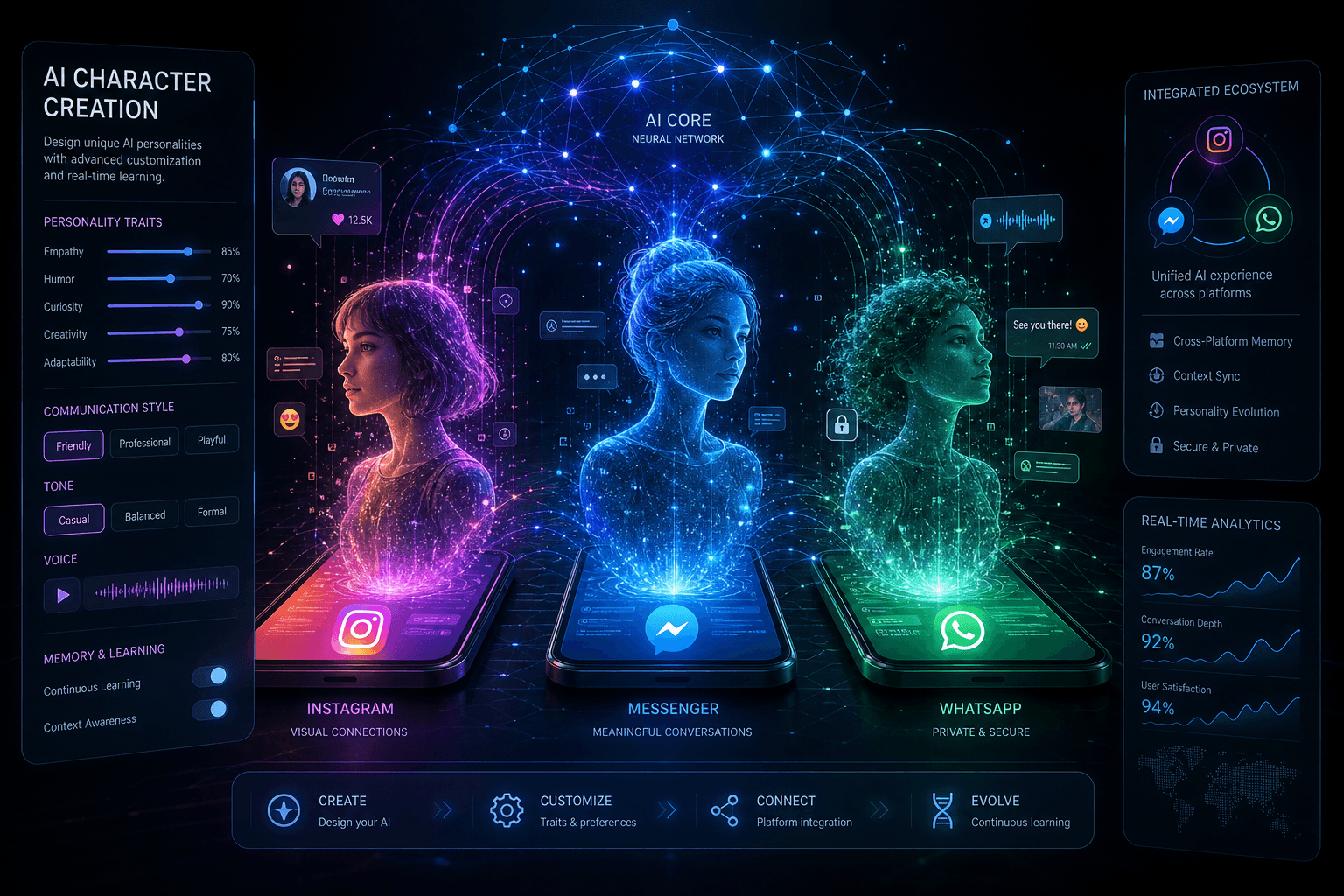
Meta AI Studio Launches: The No-Code Platform for Creating Custom AI Characters

Table of Contents
Meta AI Studio Launches: The No-Code Platform for Creating Custom AI Characters #
Meta AI Studio arrives this month as the most accessible platform yet for building custom AI characters—and it's already changing how creators scale their audience engagement across Instagram, Messenger, and WhatsApp. Built on Llama 3.1, this no-code tool lets anyone create AI personalities that answer DMs, generate content, and interact with followers 24/7.
Table of Contents #
- What Is Meta AI Studio?
- How AI Studio Works: The Technical Architecture
- Creating Your First AI Character: Step-by-Step
- Creator Tools: AI as Your 24/7 Extension
- Platform Integration: Where AI Characters Live
- Real-World Use Cases and Early Adopters
- Meta Connect 2024: New AI Features Announced
- Implications for Creators and Businesses
- Limitations and Considerations
- What's Next for Meta AI Studio
- Frequently Asked Questions
- Building AI-Powered Workflows for Your Business
What Is Meta AI Studio? #
Meta AI Studio is Meta's new platform that enables anyone to create, share, and discover custom AI characters without writing code. It represents Meta's most significant push yet into democratized AI creation, positioning the company as the first major platform to offer no-code AI character creation tightly integrated with social media messaging infrastructure.
The platform launched initially in the United States in July, with broader expansion continuing through September and October 2024. AI Studio sits at the intersection of several converging trends: the mainstreaming of large language models, creator economy infrastructure, and platform-native AI experiences that don't require users to leave their existing workflows.
What distinguishes AI Studio from standalone chatbot builders like Character.AI or Poe is its native integration with Instagram, Messenger, and WhatsApp. Users don't need to direct their audience to a separate website or app—the AI characters exist exactly where conversations already happen. This distribution advantage cannot be overstated: Meta's messaging platforms collectively serve over 3 billion users globally, creating an unprecedented addressable market for AI character creators.
The platform serves two distinct use cases with the same underlying technology:
| Use Case | Target User | Primary Value |
|---|---|---|
| General AI Characters | Anyone | Entertainment, utility, advice, meme generation |
| Creator Extension AIs | Instagram creators with 10K+ followers | Automated DM replies, story responses, fan engagement at scale |
Meta built AI Studio on Llama 3.1, released earlier this year as their most capable open-weights model. This matters for creators because it means the underlying AI can handle complex reasoning, maintain context across longer conversations, and generate responses that feel genuinely helpful rather than obviously robotic. The 405B parameter variant of Llama 3.1 powers the most demanding character interactions, while smaller variants handle simpler queries efficiently.
The timing of AI Studio's launch is strategic. Meta faces increasing competition from OpenAI's ChatGPT, Google's Gemini, and Anthropic's Claude for consumer AI mindshare. By embedding AI Studio directly into Instagram—where creators already spend hours managing audience relationships—Meta is betting that convenience and distribution will win over pure technical capability.
How AI Studio Works: The Technical Architecture #
AI Studio runs on Llama 3.1, Meta's most capable open-weights model, with a no-code interface that abstracts away the complexity of prompt engineering and API management. The technical stack underneath is sophisticated, but Meta has done the heavy lifting of turning raw model capabilities into accessible creator tools.
At the core, AI Studio operates as a prompt-orchestration layer sitting above Llama 3.1. When you create an AI character, you're essentially building a persistent system prompt that defines the character's personality, knowledge boundaries, response style, and behavioral constraints. The platform handles:
- Context window management — Maintaining conversation history across sessions
- Response generation — Routing queries to appropriate Llama 3.1 variants based on complexity
- Safety filtering — Applying Meta's content policies before responses reach users
- Multi-platform formatting — Adapting responses for Instagram DMs, WhatsApp chats, or Messenger threads
For builders who care about the mechanics, here's how the architecture breaks down:
User Input → Platform Layer (Instagram/Messenger/WhatsApp)
         ↓
    AI Studio Orchestrator
         ↓
    Safety/Policy Filters
         ↓
    Llama 3.1 (405B/70B/8B variants)
         ↓
    Response Formatting
         ↓
    Labeled Output → User
The "labeled output" step is critical for creator transparency. When an AI responds on behalf of a creator, the response includes clear labeling indicating it came from the AI, not the creator personally. This maintains trust while still delivering value.
AI Studio also implements what Meta calls "personality persistence"—the character maintains consistent traits across conversations without users needing to re-establish context each time. This is achieved through:
| Component | Function |
|---|---|
| System Prompt | Defines core personality, background knowledge, response constraints |
| Knowledge Base | Creator-provided facts, links, preferred responses |
| Topic Filters | Explicitly excluded subjects the AI should avoid discussing |
| Tone Parameters | Controls formality, humor level, response length |
Unlike building a custom GPT on OpenAI's platform, AI Studio handles the infrastructure entirely. There's no API key management, no rate limit anxiety, no infrastructure costs. Meta absorbs the compute expense in exchange for keeping creators locked into their platform ecosystem.
The tradeoff is reduced flexibility. You can't wire your AI Studio character to external APIs, custom knowledge bases beyond Meta's interface, or third-party tools. For creators who need deeper integrations, a custom n8n workflow with Claude or GPT-4 remains the more powerful—though more complex—option.
Creating Your First AI Character: Step-by-Step #
Building an AI character in AI Studio takes minutes using either prompt templates or a blank canvas approach. The platform is accessible at ai.meta.com/ai-studio or directly within the Instagram app, eliminating friction for creators who spend most of their time on mobile.
Here's the complete workflow for creating your first character:
Step 1: Access AI Studio #
Navigate to ai.meta.com/ai-studio in your browser or start a new message in Instagram and tap "AI chats." The web interface offers more screen real estate for configuration, while the mobile flow is optimized for quick character generation during commutes or between content shoots.
Step 2: Choose Your Starting Point #
AI Studio presents two paths:
| Approach | Best For | Time Required |
|---|---|---|
| Prompt Templates | Quick experiments, utility AIs | 2-3 minutes |
| Start from Scratch | Brand-aligned characters, creator extensions | 10-15 minutes |
The template library includes starting points for cooking advisors, travel guides, meme generators, caption assistants, and creative writing companions. Each template is pre-configured with effective system prompts you can customize.
Step 3: Define Core Attributes #
Every AI character requires five core elements:
- Name — How users address and discover the character
- Personality — The character's behavioral baseline (professional, humorous, supportive, sarcastic)
- Tone — How the personality manifests in language (formal, casual, Gen Z slang, expert authority)
- Avatar — Visual identity for the character across platforms
- Tagline — One-line description that appears in discovery surfaces
Step 4: Configure Knowledge and Boundaries #
For creator extension AIs, this step is critical. You define:
- Content to reference — Links to your Instagram posts, preferred brands, past videos
- Topics to avoid — Explicitly excluded subjects (politics, medical advice, controversial opinions)
- Response preferences — How to handle questions outside your knowledge base
Step 5: Set Sharing Permissions #
AI Studio offers granular visibility controls:
- Private — Only you can chat with the AI (useful for testing or personal utility)
- Followers/Friends — Limited to your existing social graph
- Public — Discoverable by anyone on Meta's platforms
Step 6: Test and Iterate #
Before publishing, conduct extensive testing. Try edge-case questions, adversarial prompts, and ambiguous requests. Meta provides a step-by-step handbook with expert tips, but real-world testing reveals gaps no documentation covers.
The character creation process is designed to be approachable for non-technical users while still offering enough depth for creators who want fine-grained control over their AI extension.
Creator Tools: AI as Your 24/7 Extension #
The most significant opportunity for creators is AI Studio's ability to create an AI extension of themselves that handles common DM questions and story replies automatically. This addresses one of the most persistent pain points in the creator economy: scaling audience engagement without scaling time investment linearly.
The creator AI feature is currently available to Instagram creators and represents a fundamental shift in how influencer-audience relationships operate. Here's how the system works in practice:
The Creator AI Workflow #
When a follower sends a DM or replies to a story, the AI evaluates whether to respond automatically based on rules the creator configures through Instagram's professional dashboard:
Incoming DM/Story Reply
         ↓
    Creator AI Evaluation
    - Is this a common question?
    - Do I have relevant knowledge?
    - Is auto-reply enabled?
         ↓
    YES → Generate AI Response (labeled)
    NO  → Queue for creator review
The labeling requirement is non-negotiable. Every AI-generated response includes clear indication that it came from the AI, maintaining transparency with followers. Meta implemented this after lessons learned from earlier AI chatbot controversies where undisclosed automation damaged user trust.
What Creator AIs Can Handle #
Based on early adopter implementations, creator AIs excel at:
- FAQ responses — "What's your workout routine?" "Where did you get that jacket?" "What camera do you use?"
- Content recommendations — Linking to relevant past posts or videos based on the question context
- Brand mentions — Sharing affiliate links or brand partnerships when followers ask about products
- Scheduling context — Answering questions about upcoming content, events, or availability
Control and Oversight #
Creators retain full control through the professional dashboard:
| Control | Description |
|---|---|
| Auto-reply toggle | Enable or disable AI responses entirely |
| Audience targeting | Choose which followers get AI responses (all, selected, none) |
| Content customization | Update knowledge base, add new links, modify response style |
| Transparency settings | Configure how AI responses are labeled |
The dashboard also provides analytics on AI conversation volume, response quality ratings from followers, and flagged conversations that might need human review.
Real-World Impact #
Early creators using the feature report significant time savings. A lifestyle creator with 500K followers might receive thousands of DMs weekly. Before AI Studio, they either ignored most messages (damaging audience relationships) or spent hours each day on repetitive responses. Now, the AI handles 70-80% of routine queries, with the creator stepping in only for complex or high-value conversations.
The feature is currently limited to Instagram, but Meta's stated roadmap includes expansion to other platforms and deeper integration with creator monetization tools.
Platform Integration: Where AI Characters Live #
AI Studio characters distribute across Meta's entire ecosystem, creating a unified AI presence that follows users across platforms. This multi-platform availability is AI Studio's most compelling differentiator compared to standalone AI chatbot services.
Supported Platforms #
| Platform | Access Method | Experience Type |
|---|---|---|
| DMs, AI chats, profile buttons | Native messaging integration | |
| Messenger | Direct chat, group threads | Conversational AI companion |
| Individual and group chats | Global messaging reach | |
| Web | ai.meta.com/ai-studio | Discovery and management interface |
The Instagram integration is particularly sophisticated. Users can discover AI characters through:
- Story stickers — Creators can share their AI in stories with tap-to-chat links
- Profile buttons — Message buttons with sparkle icons indicate creator AI availability
- DM search — Users can search for and start AI chats directly from Instagram's messaging interface
- AI discovery — Browsing interface for finding new characters by category or popularity
Cross-Platform Conversation Sync #
A key architectural decision: AI Studio conversations sync across platforms. If a user starts chatting with an AI character on Instagram, they can continue that same conversation thread on WhatsApp or Messenger. The context persists, creating continuous conversations regardless of which Meta app the user opens.
This sync capability matters for creators building utility-focused AIs. A cooking advice AI can help someone meal plan in the morning on Instagram, then follow up with recipe suggestions later on WhatsApp when they're at the grocery store. The platform friction disappears.
Discovery and Distribution #
Meta has built multiple discovery mechanisms into the AI Studio ecosystem:
- In-app promotion — Featured characters in Instagram's AI discovery tab
- Social sharing — Direct links that open in the appropriate app
- Profile integration — Creator AIs displayed prominently on Instagram profiles
- Searchability — AI characters indexed and searchable by topic, creator, or capability
For creators, this built-in distribution is invaluable. Launching an AI character on Character.AI or Poe requires driving traffic from external sources. On AI Studio, the audience already lives on the platform—they just need to know your AI exists.
Technical Implications #
From a technical perspective, this multi-platform distribution requires sophisticated message routing and state management. Meta's infrastructure handles:
- Platform-specific formatting — WhatsApp's message constraints differ from Instagram's
- Notification orchestration — Managing push notifications across multiple apps without overwhelming users
- State synchronization — Ensuring conversation context remains consistent across platforms
- Rate limiting — Preventing spam while maintaining responsive AI interactions
Creators don't interact with this complexity directly, but it enables the frictionless experience that makes AI Studio viable for mainstream adoption.
Real-World Use Cases and Early Adopters #
Early creators are already demonstrating AI Studio's potential across entertainment, utility, and education use cases. Meta highlighted several launch partners who represent the breadth of applications possible with custom AI characters.
Entertainment and Personality AIs #
Flip Pawsitive Affirmation Dog — Created by actor and pet advocate Rocky Kanaka, this AI delivers personalized positive affirmations tailored to the user's current mood and needs. The character leverages Kanaka's existing brand around pet adoption positivity, extending his message into interactive AI form.
Sammy The Stress Ball — Meme creator "Assistants vs. Agents" built an AI character that helps users decompress during stressful workdays. The character embodies the account's absurdist humor while providing genuine stress-relief interactions.
Expert Advisor AIs #
Eat Like You Live There! — Chef Marc Murphy created an AI offering personalized tips for embracing local dining customs while traveling. The character draws on Murphy's culinary expertise and travel experience, making restaurant recommendations feel authoritative rather than generic.
What Lens Bro — Photographer and videographer Angel Barclay built an AI that offers tips on finding the perfect lens for specific shots. This represents a utility-focused AI that delivers genuine technical value to photography enthusiasts.
Creator Extension Implementations #
Several Instagram creators have launched AI extensions handling their audience engagement:
| Creator | Focus Area | AI Function |
|---|---|---|
| Chris Ashley | Lifestyle, fashion | FAQ responses, product recommendations |
| Violet Benson | Comedy, entertainment | Humorous interactions, content promotion |
| Don Allen | Tech, reviews | Tech advice, gear recommendations |
| Kane Kallaway | Fitness, wellness | Workout tips, motivation, supplement guidance |
These creator AIs handle the repetitive aspects of audience engagement—answering "what camera do you use?" for the thousandth time—while the creators focus on content creation and high-value fan interactions.
Business and Brand Applications #
While primarily positioned for creators, brands are beginning to experiment with AI Studio for:
- Product advisors — AI characters that help customers select between product variants
- FAQ handlers — Automated responses to common customer service questions
- Brand personality extensions — Embodying brand voice in interactive form
The limitation is clear: AI Studio doesn't integrate with e-commerce platforms, CRMs, or support ticketing systems. A brand serious about AI-powered customer service would still need a custom implementation using tools like n8n with Claude or GPT-4.
Emerging Use Case Patterns #
Three patterns are emerging from early AI Studio usage:
- Knowledge surrogates — Creators encoding their expertise into accessible AI form
- Engagement multipliers — Handling audience scale that would otherwise be unmanageable
- Utility companions — Task-specific AIs (cooking, photography, travel) that users treat as specialized advisors
These patterns suggest AI Studio is finding product-market fit faster than Meta's previous standalone AI experiments.
Meta Connect 2024: New AI Features Announced #
At Meta Connect this month, Meta announced significant expansions to its AI capabilities, including voice interaction, photo understanding, and automatic translation tools. While these features extend beyond AI Studio specifically, they signal Meta's broader AI strategy and hint at where AI Studio capabilities are heading.
Voice Interaction Capabilities #
Meta AI now supports voice conversations across Messenger, Facebook, WhatsApp, and Instagram DM. Users can speak to the AI naturally and receive spoken responses. The feature launched with celebrity voice options including Awkwafina, Dame Judi Dench, John Cena, Keegan Michael Key, and Kristen Bell.
For AI Studio creators, voice capabilities present an obvious future expansion. Creator AIs that currently text responses could eventually speak in the creator's style or a branded voice. This would be particularly powerful for:
- Podcasters and voice-focused creators — Extending their audio brand into interactive form
- Educational content — Explaining complex topics through spoken conversation
- Accessibility — Serving users who prefer voice interaction over text
Photo Understanding and Editing #
Meta AI can now analyze photos users share and answer questions about them. Examples include:
- Identifying objects or landmarks in travel photos
- Suggesting recipes based on ingredients visible in a photo
- Explaining historical context for photographed artifacts
The photo editing capabilities extend further: users can ask Meta AI to add, remove, or modify elements in images, or generate custom backgrounds for Instagram Stories.
For AI Studio characters, this multimodal capability opens new use cases:
| Use Case | Application |
|---|---|
| Style advisors | Users share outfit photos for feedback |
| Interior design | Room photos analyzed for decoration suggestions |
| Fitness coaching | Form checks from workout videos |
| Cooking assistance | Ingredient identification and recipe suggestions |
These capabilities require Llama 3.2, Meta's newly announced multimodal model that processes both text and images natively.
Automatic Translation Tools #
Meta is testing an automatic translation feature that dubs and lip-syncs Reels content. The tool translates between English and Spanish initially, targeting creators in Latin America and the United States.
This is particularly relevant for AI Studio because it hints at future multilingual capabilities for creator AIs. An English-speaking creator could eventually offer AI interactions in Spanish, Portuguese, or other languages without speaking them personally.
Integration Implications #
These Connect announcements reveal Meta's strategy: AI Studio isn't a standalone product but part of a comprehensive AI layer across all Meta properties. Features announced at Connect typically flow into creator tools within months, suggesting AI Studio characters will gain voice, vision, and multilingual capabilities through 2024 and into 2025.
For creators evaluating AI Studio, the question isn't just what it does today, but what Meta's platform investment trajectory implies for future capability.
Implications for Creators and Businesses #
AI Studio represents a fundamental shift in how creators can scale audience engagement without scaling their time investment linearly. This has profound implications for both individual creators and businesses operating in the attention economy.
For Individual Creators #
The creator economy has long faced a scaling paradox: as audiences grow, the time required to maintain authentic engagement grows proportionally. A creator with 10,000 followers might respond to every DM personally. At 1 million followers, that's impossible without hiring a team—which then introduces brand voice consistency challenges.
AI Studio offers a third path: encode your knowledge, personality, and engagement style into an AI that maintains your voice at any scale. The implications:
| Before AI Studio | After AI Studio |
|---|---|
| Linear time scaling with audience growth | Sub-linear time investment regardless of scale |
| Missed DMs damage audience relationships | All routine queries answered automatically |
| Brand partnerships limited by response capacity | Unlimited capacity for product recommendations |
| Geographic/timezone constraints on engagement | 24/7 availability without burnout |
The creators who benefit most are those in categories with repetitive inquiries: fitness (workout advice), fashion (product sourcing), tech (gear recommendations), food (recipe substitutions), and travel (destination tips).
For Businesses and Brands #
While AI Studio is creator-focused, businesses are already exploring applications:
- Influencer marketing at scale — Brands can partner with creators whose AIs recommend their products
- Customer research — AI conversations generate structured data on what customers ask most frequently
- Brand safety testing — Controlled AI environments to test messaging before human deployment
However, businesses should understand AI Studio's limitations. Without API access, CRM integration, or analytics export, it remains a consumer tool rather than an enterprise platform. Businesses needing robust AI automation should consider production-grade alternatives like custom n8n workflows with Claude, API-based GPT implementations, or dedicated customer service AI platforms.
Competitive Dynamics #
AI Studio intensifies competition in the creator economy. Early adopters gain significant advantages:
- First-mover discovery — Early AI characters appear in discovery surfaces before saturation
- Training data accumulation — More conversations means better-tuned responses over time
- Audience habit formation — Followers accustomed to AI interactions are stickier
Creators who delay AI adoption risk being outcompeted by those who deploy effectively. The question isn't whether to use AI Studio, but how to use it authentically without alienating the human connection that built their audience.
Platform Risk Consideration #
A critical caveat: building on AI Studio means accepting Meta's platform control. The company sets the rules, controls distribution, and could modify or sunset features. Creators should treat AI Studio as a channel, not a core asset—valuable while it lasts, but not something to build an entire business upon exclusively.
Limitations and Considerations #
While AI Studio democratizes AI character creation, several limitations exist that creators should understand before building their strategy around it. No platform is perfect, and AI Studio's convenience comes with tradeoffs.
Technical Limitations #
| Limitation | Impact | Workaround |
|---|---|---|
| No API access | Can't integrate with external tools or data sources | Accept as consumer-only tool, or build custom solution alongside |
| Platform lock-in | AI character can't migrate to other platforms | Treat as Meta-specific channel, not universal asset |
| Limited customization depth | Can't fine-tune model or modify system prompts deeply | Work within Meta's guardrails, focus on content quality |
| No conversation export | Can't analyze conversation data for business insights | Manual review of analytics dashboard only |
| Llama 3.1 constraints | Inherits model limitations (knowledge cutoff, reasoning boundaries) | Redirect questions beyond AI capabilities to human creator |
The lack of API access is particularly significant for businesses. A creator AI that could query inventory systems, book appointments, or process transactions would be transformational. AI Studio offers none of these capabilities natively.
Content and Policy Constraints #
Meta applies its standard content policies to AI Studio characters. Creators cannot build AIs that:
- Provide medical, legal, or financial advice (despite common user requests)
- Discuss certain political topics
- Generate content that violates Meta's community standards
- Impersonate real people without authorization
The topic filters allow some customization, but Meta's safety systems operate at the platform level and may override creator preferences in edge cases.
Geographic Availability #
As of September 2024, AI Studio is available primarily in the United States. Meta announced expansion plans for October 2024 into Brazil, the UK, and additional markets, but global availability remains limited. Creators with international audiences may find the feature inaccessible to significant portions of their follower base.
Authenticity and Audience Trust #
The most subtle limitation is reputational. Creators must balance automation efficiency with authentic connection:
- Over-automation risk — Followers who realize they're always talking to AI may feel devalued
- Quality variance — AI responses occasionally miss context or provide unhelpful answers
- Creator skill dependency — The AI is only as good as the knowledge and personality encoded into it
Successful creators treat AI Studio as a filter, not a replacement—handling routine inquiries automatically while personally engaging with high-value interactions.
Comparison to Custom Solutions #
For creators and businesses considering whether AI Studio meets their needs, here's how it compares to building a custom AI workflow:
| Capability | AI Studio | Custom n8n + Claude/GPT |
|---|---|---|
| Setup time | Minutes | Hours to days |
| Technical skill required | None | Some (or hire developer) |
| Platform integration | Native to Meta | Flexible (any platform with API) |
| External tool connections | None | Unlimited (CRM, calendar, database) |
| Cost | Free | Variable (API costs, infrastructure) |
| Control | Limited (Meta's platform) | Complete (your infrastructure) |
The choice depends on priorities: convenience and distribution versus flexibility and control.
What's Next for Meta AI Studio #
Meta's roadmap for AI Studio points toward deeper creator monetization, expanded platform capabilities, and broader international availability. While Meta hasn't published a formal product roadmap, announcements at Meta Connect and industry patterns suggest several near-term developments.
Near-Term Expansion (Late 2024) #
International Rollout — Meta confirmed AI Studio expansion to additional markets beginning in October 2024. The company is methodically launching in markets with strong Instagram creator ecosystems, starting with Brazil, the UK, Bolivia, Guatemala, Paraguay, and the Philippines. By year-end, coverage should extend to 21+ countries.
Creator Monetization Integration — The most anticipated feature is direct monetization for AI interactions. Meta is reportedly exploring:
- Sponsored AI responses — Brand partnerships integrated into AI conversations with disclosure
- Premium AI tiers — Followers pay for enhanced AI access or exclusive character variants
- Revenue sharing — Creators earn from AI engagement metrics similar to Reels bonuses
These features would transform AI Studio from an efficiency tool into a direct revenue stream.
Medium-Term Evolution (2025) #
Based on Meta's AI investments and competitive positioning, expect:
Multimodal Characters — Integration of voice (from the Connect announcements), image understanding, and potentially video generation into AI Studio characters. A cooking AI that can both text recipes and analyze photos of your refrigerator contents is technically feasible with Llama 3.2.
Deeper Platform Integration — Expansion beyond Instagram to WhatsApp Business, Facebook Pages, and potentially Meta Business Suite for enterprise applications.
Analytics and Insights — Enhanced creator dashboards showing not just conversation volume but sentiment analysis, topic clustering, and follower behavior patterns derived from AI interactions.
Competitive Response #
AI Studio's launch pressures competitors to respond:
- TikTok — Likely to accelerate its own AI character initiatives
- Snapchat — Already has AI features, but may expand creator-specific tools
- YouTube — Google has AI capabilities, but lacks tight messaging integration
- OpenAI — GPTs are more flexible but lack Meta's distribution advantage
The winner in creator AI will be whichever platform balances capability, distribution, and monetization most effectively.
Strategic Implications #
For creators watching these developments, the strategic consideration is timing. Early adoption offers discovery advantages, but the platform will evolve significantly over the next 12 months. Creators should:
- Experiment now — Learn the interface, understand follower reactions, refine approach
- Invest moderately — Don't build entire businesses on AI Studio given platform risk
- Monitor monetization — Be ready to capitalize when revenue features launch
- Maintain optionality — Continue building owned channels (email lists, websites) alongside Meta dependencies
AI Studio is not the final form of creator AI—it's the beginning. The creators who thrive will be those who adapt as the platform evolves while building sustainable, platform-independent value.
Frequently Asked Questions #
What is Meta AI Studio and when did it launch? #
Meta AI Studio is a no-code platform for creating custom AI characters that launched in the United States in July 2024, with continued rollout through September and October. It enables anyone to build AI personalities for Instagram, Messenger, and WhatsApp without technical skills. The platform represents Meta's most significant push into democratized AI creation, built on the Llama 3.1 model and integrated directly into Meta's messaging infrastructure serving over 3 billion users.
Do I need coding skills to create an AI character? #
No coding is required to create AI characters in Meta AI Studio. The platform offers a visual interface accessible via web browser or the Instagram app. Users can start from pre-built prompt templates covering common use cases (cooking advice, travel tips, meme generation) or build characters from scratch using natural language descriptions. The system abstracts away all technical complexity including API management, prompt engineering, and infrastructure scaling.
Which platforms support AI Studio characters? #
AI Studio characters work across Instagram, Messenger, WhatsApp, and the web. This multi-platform availability is AI Studio's key differentiator—characters exist natively within each platform's messaging interface rather than requiring users to visit external websites. Conversations sync across platforms, so a user can start a chat on Instagram and continue on WhatsApp with full context preservation.
How does the creator AI auto-reply feature work? #
Creator AIs automatically respond to Instagram DMs and story replies based on rules configured in the professional dashboard. The AI evaluates each incoming message against the creator's knowledge base and topics to avoid, then generates responses clearly labeled as AI-generated. Creators control which followers receive AI responses, can toggle auto-replies on/off, and manually review flagged conversations. The system handles routine FAQ responses while reserving complex or sensitive inquiries for human attention.
What AI model powers Meta AI Studio? #
AI Studio runs on Meta's Llama 3.1 model family, specifically utilizing the 405B, 70B, and 8B parameter variants depending on query complexity. Llama 3.1 is Meta's most capable open-weights model, released earlier this year with strong performance on reasoning, instruction following, and conversational tasks. The model's open-weights status means Meta can deploy it at scale without per-query API costs, enabling the free AI Studio offering.
Can I monetize my AI character on Instagram? #
Direct monetization features for AI Studio are not yet available as of September 2024, but Meta has signaled they're in development. Currently, creator AIs drive indirect monetization through improved audience engagement, faster brand partnership response handling, and automated affiliate link sharing when followers ask about products. Industry reports suggest Meta is exploring sponsored AI responses, premium AI tiers, and revenue sharing models expected to launch in late 2024 or early 2025.
Is there a cost to use Meta AI Studio? #
Meta AI Studio is currently free for all users in supported markets. Meta absorbs the compute costs as a strategic investment in platform lock-in and creator ecosystem growth. Unlike OpenAI's GPTs (which require ChatGPT Plus for advanced features) or Poe's monetization model, AI Studio offers full functionality without subscription fees. This may change if premium features launch, but the core character creation and distribution capabilities remain free.
How do AI Studio characters handle privacy and data? #
AI Studio applies Meta's standard privacy policies, with AI conversations subject to the same data handling as other Meta platform interactions. Creators configure what information their AI can access and share, and Meta's safety filters prevent AI characters from revealing sensitive creator data. All AI-generated responses are clearly labeled for transparency. However, as with any AI system, users should avoid sharing personal information in conversations, and creators should be thoughtful about what knowledge they encode into publicly accessible characters.
What's the difference between Meta AI and AI Studio? #
Meta AI is Meta's general-purpose AI assistant (similar to ChatGPT or Gemini), while AI Studio is the platform for creating custom AI characters. Meta AI answers questions, generates content, and assists users across Meta platforms as a single, unified AI. AI Studio enables creators and users to build specialized AI personalities with custom knowledge, tones, and purposes that operate independently from Meta AI. Think of Meta AI as the default assistant and AI Studio characters as custom apps built on similar underlying technology.
Can businesses use AI Studio for customer service? #
While businesses can technically create AI Studio characters for FAQ handling and brand engagement, the platform lacks enterprise features needed for serious customer service operations. There's no CRM integration, ticketing system connection, conversation analytics export, or API access for custom tool connections. Small businesses might find AI Studio sufficient for basic inquiry handling, but organizations needing robust customer service AI should consider custom implementations using n8n, dedicated customer service platforms, or enterprise AI solutions with proper integration capabilities.
Building AI-Powered Workflows for Your Business #
Meta AI Studio is compelling for creators who need quick audience engagement at scale, but it's only the surface of what's possible with AI automation. The platform's limitations—no API access, no external integrations, no conversation exports—make it unsuitable for serious business operations that need to connect with CRMs, process transactions, or handle complex workflows.
For businesses and creators ready to move beyond platform constraints, custom AI automation is the next level. Imagine an AI that:
- Books appointments directly into your calendar while qualifying leads
- Processes e-commerce orders by integrating with Shopify or Stripe
- Pulls customer data from your CRM to personalize every interaction
- Escalates complex issues to human team members with full context
- Generates weekly analytics reports on conversation patterns
These capabilities require more than AI Studio can offer—they need orchestration layers like n8n, integration with models like Claude or GPT-4, and custom workflow design.
If your business needs AI automation that goes beyond what Meta's walled garden allows, let's talk. I build custom AI workflows that connect your tools, automate your repetitive work, and scale without platform lock-in.
Book an AI automation strategy call and we'll map out how AI can actually work for your specific operations—not just handle DMs, but transform how your business functions.
Related articles: n8n and Claude 3.5 Sonnet Production Agent Tutorial · AI Agents and Multi-Agent Systems · Workflow Automation Platforms
Related Posts

How to Stop Client-Facing AI Agents From Hallucinating
Client-facing AI agents hallucinate when they answer without grounding. Here's the layered guardrail stack I use to keep agents accurate and on-script.

AI Sales Systems vs Traditional CRM Automation
Traditional CRM automation fires rules; AI sales systems reason about each lead. Here's how they differ, where each wins, and how to combine them.

The Manual Workflows With the Highest ROI When Replaced by AI Agents
Not every task is worth automating. Here are the manual workflows with the highest ROI when you replace them with AI agents, ranked by payback speed.