LangGraph 0.1 + CrewAI v0.30: The Agent Framework Wars Before MCP Existed

Table of Contents
LangGraph 0.1 + CrewAI v0.30: The Agent Framework Wars Before MCP Existed #
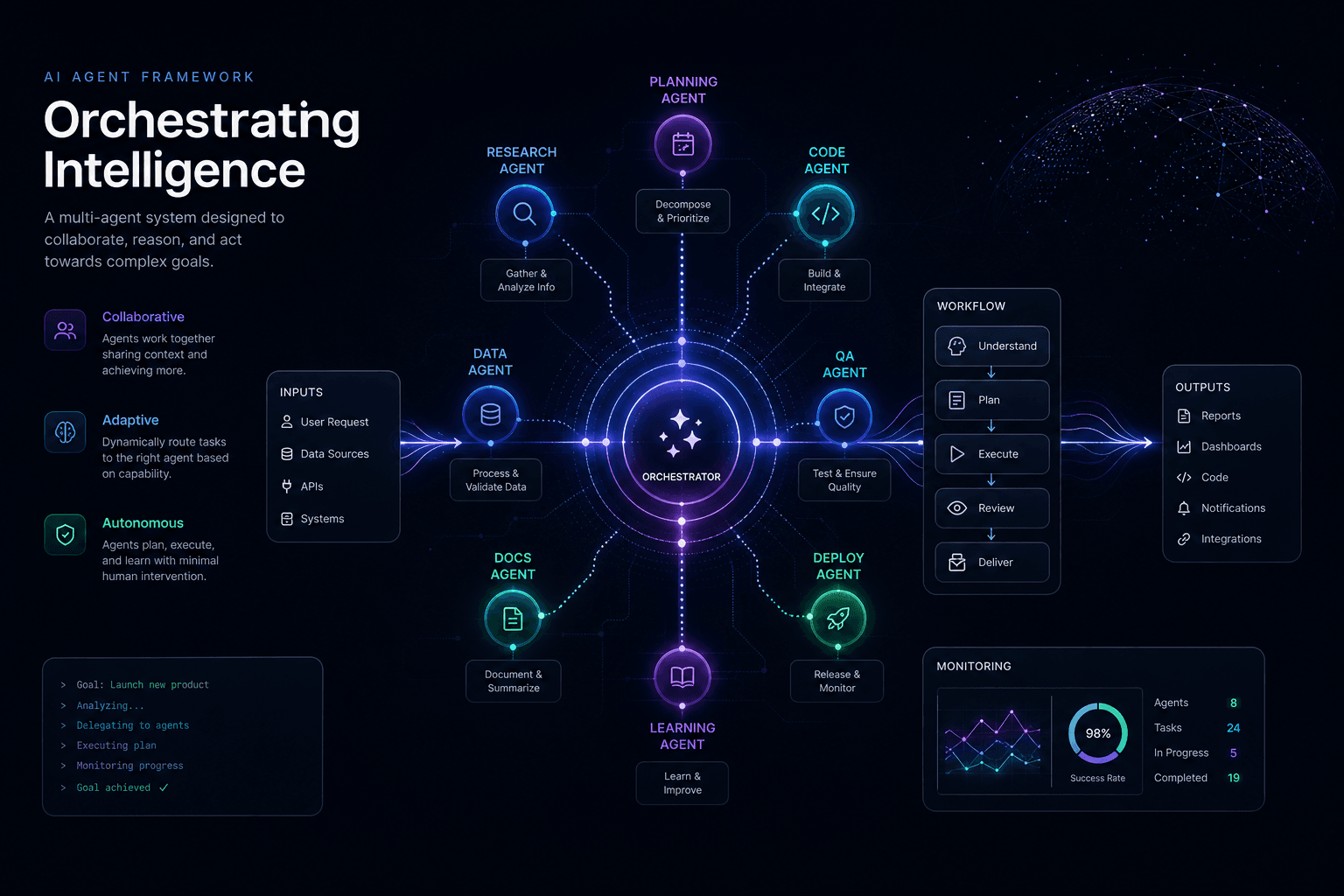
LangGraph and CrewAI represent the two dominant approaches to building AI agents in mid-2024. LangGraph 0.1, released by the LangChain team, offers stateful graph-based orchestration with cycles and persistence. CrewAI v0.30, led by João Moura, provides a role-based multi-agent system that abstracts agent interactions through crews, roles, and tasks. Both frameworks solve the same problem—coordinating multiple AI agents—but from fundamentally different architectural perspectives.
Table of Contents #
- The Agent Framework Landscape in June 2024
- What Is LangGraph 0.1?
- What Is CrewAI v0.30?
- Architecture Comparison: Graph-Based vs Role-Based
- Code Example: Building a Simple Agent Workflow in LangGraph
- Code Example: The Same Workflow in CrewAI
- When to Choose LangGraph
- When to Choose CrewAI
- Feature Comparison: Side-by-Side Analysis
- The Missing Piece: What These Frameworks Still Need
The Agent Framework Landscape in June 2024 #
The AI agent space has consolidated around two major approaches: LangChain/LangGraph's stateful graph model and CrewAI's role-based orchestration. AutoGPT and BabyAGI have faded from production consideration, replaced by frameworks that offer better control, debugging, and composability. This section maps where we are right now and what's driving adoption.
Why AutoGPT and BabyAGI Lost the Plot #
AutoGPT and BabyAGI captured massive attention in April 2023—attracting over 50,000 developers in a single month—but they failed to deliver production reliability. The core problems were structural: weak long-term memory using basic vector databases, poor planning strategies that produced inefficient or irrelevant task chains, and cost spiraling from self-looping architectures that required frequent LLM calls. Agents frequently got stuck in infinite loops with unpredictable behavior, and one bad decision could trigger cascading failures.
The fundamental lesson from this first wave: fully autonomous agents without human-defined boundaries are not viable for production. AutoGPT has since pivoted to a visual workflow builder where humans design boundaries and AI executes within them. This shift—from unpredictable autonomy to deterministic, human-controlled execution—defines the current generation of frameworks.
The Rise of Controlled Agent Frameworks #
LangGraph 0.1 and CrewAI v0.30 represent the response to early agent failures. Both frameworks prioritize control, observability, and composability over pure autonomy. They differ in their abstraction level:
| Framework | Abstraction | Mental Model | Best For |
|---|---|---|---|
| LangGraph 0.1 | Low-level graph control | Nodes, edges, state machines | Complex branching, long-running workflows |
| CrewAI v0.30 | High-level role orchestration | Roles, tasks, crews | Rapid prototyping, team-like delegation |
Production adoption is accelerating. LangGraph 0.1—announced June 27, 2024—is already in use at Klarna, Replit, Ally Financial, Elastic, and Norwegian Cruise Line. CrewAI has become the default entry point for developers building their first multi-agent system.
What Builders Actually Need Today #
Based on where the frameworks are investing their engineering effort, builders need three capabilities above all else:
State management and persistence — Agents must remember context across long-horizon tasks without losing track of objectives. LangGraph's built-in persistence layer and CrewAI's task-based memory both address this, though with different architectures.
Human-in-the-loop integration — The most sensitive tasks still require human collaboration. LangGraph 0.1 enables explicit wait states for human approval, state editing before execution, and "time travel" debugging. CrewAI supports human input on execution through its
Human-Input-on-Executionfeature.Debugging and observability — When agents fail, you need visibility. LangGraph Cloud (currently in closed beta) includes LangGraph Studio—a playground for visualizing agent trajectories, adding breakpoints, and inspecting state. CrewAI offers verbose logging levels and task output inspection.
The frameworks are converging on the same production requirements, just from different starting points. LangGraph began with maximum control and is adding higher-level abstractions. CrewAI began with maximum approachability and is adding more sophisticated process orchestration.
What Is LangGraph 0.1? #
LangGraph is LangChain's stateful agent framework that represents agent workflows as directed graphs with cycles. Released as a stable v0.1 on June 27, 2024, it enables persistence, human-in-the-loop interactions, and complex branching logic through its graph structure. The framework exists as a separate package from LangChain (langgraph, not langchain) and replaces the legacy AgentExecutor abstraction that developers found too limiting for real-world complexity.
Core Concepts: Nodes, Edges, and State #
LangGraph's fundamental building blocks are nodes, edges, and state schemas. Every workflow is a graph where:
- Nodes are Python functions that receive the current state, perform work (usually an LLM call or tool execution), and return state updates
- Edges define the flow between nodes—either unconditional transitions or conditional branching based on state
- State is a typed dictionary (typically Pydantic) that persists across the entire graph execution
from typing import TypedDict
from langgraph.graph import StateGraph, END

# Define your state schema
class AgentState(TypedDict):
    messages: list
    next_step: str
    iteration_count: int

# Create the graph
workflow = StateGraph(AgentState)

# Add nodes
workflow.add_node("research", research_node)
workflow.add_node("write", write_node)
workflow.add_node("review", review_node)

# Add edges
workflow.set_entry_point("research")
workflow.add_edge("research", "write")
workflow.add_conditional_edges(
    "review",
    lambda state: "approve" if state["quality_score"] > 0.8 else "revise",
    {"approve": END, "revise": "write"}
)
Stateful Graphs with Memory and Persistence #
LangGraph's persistence layer enables human-in-the-loop interactions and debugging capabilities that are impossible with stateless agent frameworks. By default, state is checkpointed after every node execution using a configurable checkpointer (PostgreSQL for production, in-memory for development).
This persistence enables three critical patterns:
- Human approval gates — Design agents that explicitly pause and wait for human input before continuing
- State editing and time travel — Inspect, modify, and resume execution from any checkpoint
- Long-horizon workflows — Run agents that span hours or days without losing context
Replit uses this capability for their coding agents. As Michele Catasta, VP of AI at Replit, notes: "It's easy to build the prototype of a coding agent, but deceptively hard to improve its reliability. LangGraph is giving us the control and ergonomics we need to build and ship powerful coding agents."
LangGraph's Killer Feature: Conditional Edges #
Conditional edges separate LangGraph from simpler DAG-based workflow tools. They allow the LLM—or any logic—to dynamically determine the next step based on the current state:
from langgraph.graph import StateGraph

def route_based_on_intent(state: AgentState):
    """Dynamic routing based on LLM classification"""
    last_message = state["messages"][-1].content

    if "research" in last_message.lower():
        return "research_node"
    elif "write" in last_message.lower():
        return "write_node"
    else:
        return "clarify_node"

workflow.add_conditional_edges(
    "classifier",
    route_based_on_intent,
    {
        "research_node": "research_node",
        "write_node": "write_node",
        "clarify_node": "clarify_node"
    }
)
This enables agent behaviors like moderation loops, quality gates, and adaptive research strategies. At Norwegian Cruise Line, granular control over the agent's thought process enables data-driven decisions to meet diverse guest needs across their AI-powered guest-facing solutions.
What Is CrewAI v0.30? #
CrewAI is a role-based multi-agent framework that organizes agents into "crews" with specific roles, goals, and tasks. Version 0.30.0 arrived on May 11, 2024 (with v0.30.4 following on May 13), solidifying the framework's position as the most approachable entry point for multi-agent systems. Created by João Moura, CrewAI abstracts away graph complexity in favor of a team-like metaphor where agents collaborate like human colleagues.
The Role-Task-Crew Abstraction #
CrewAI's core mental model mirrors human team structure. Every agent has:
- Role — A job title that shapes the agent's perspective (e.g., "Senior Research Analyst")
- Goal — A specific objective the agent works toward
- Backstory — Context that informs the agent's approach and voice
- Tools — Capabilities the agent can use (search, APIs, custom functions)
from crewai import Agent, Task, Crew, Process
from crewai_tools import SerperDevTool

# Define an agent with role and personality
researcher = Agent(
    role='Senior Research Analyst',
    goal='Uncover cutting-edge developments in AI and data science',
    backstory="""You work at a leading tech think tank.
    Your expertise lies in identifying emerging trends.
    You have a knack for dissecting complex data.""",
    verbose=True,
    allow_delegation=False,
    tools=[SerperDevTool()]
)

# Create a task assigned to this agent
task = Task(
    description="""Conduct a comprehensive analysis of the latest
    advancements in AI in 2024. Identify key trends and breakthrough
    technologies.""",
    expected_output="Full analysis report in bullet points",
    agent=researcher
)
Crews assemble agents and define how they work together. The Process enum controls the orchestration pattern—Process.sequential for step-by-step handoffs or Process.hierarchical for manager-led delegation.
Agent Delegation and Collaboration #
CrewAI v0.30 enables agents to delegate tasks and inquire amongst themselves. When allow_delegation=True, agents can pass work to colleagues with relevant expertise:
writer = Agent(
    role='Tech Content Strategist',
    goal='Craft compelling content on tech advancements',
    backstory="""You are a renowned Content Strategist, known for
    insightful and engaging articles. You transform complex
    concepts into compelling narratives.""",
    verbose=True,
    allow_delegation=True  # Can ask researcher for clarification
)

# The writer can now delegate research sub-tasks back to the researcher
This delegation happens automatically based on the task requirements and agent capabilities. The framework handles the routing without explicit graph wiring.
CrewAI's Killer Feature: Process Orchestration #
CrewAI's process abstraction distinguishes it from conversational agent frameworks like AutoGen. While AutoGen excels at chat-based collaboration, it lacks an inherent concept of process—coordinating agents requires additional programming that becomes cumbersome at scale.
CrewAI v0.30 offers two process types:
| Process | Pattern | Use Case |
|---|---|---|
| Sequential | Linear task chain (agent A → agent B → agent C) | Assembly line workflows, content pipelines |
| Hierarchical | Manager agent coordinates workers via delegation | Complex projects requiring adaptive task allocation |
The hierarchical process—introduced in the v0.30 series—automatically assigns a manager to coordinate planning and execution through delegation and validation of results. You can also set a custom manager agent instead of relying on the default auto-created one.
# Hierarchical process with custom manager
manager = Agent(
    role='Project Manager',
    goal='Coordinate the team efficiently',
    backstory='Experienced PM skilled at task allocation',
    allow_delegation=True
)

crew = Crew(
    agents=[researcher, writer, editor],
    tasks=[research_task, write_task, edit_task],
    process=Process.hierarchical,
    manager_agent=manager,  # Custom manager (v0.30+)
    verbose=2
)
CrewAI v0.30 also added template customization for better compatibility with open-source and smaller models—a critical feature as more developers experiment with Llama 3, Mistral, and local Ollama deployments.
Architecture Comparison: Graph-Based vs Role-Based #
LangGraph and CrewAI differ fundamentally in how they model agent interactions. LangGraph uses explicit graph structures where every transition is defined and visualizable. CrewAI uses implicit process flows based on role relationships and task definitions. This architectural difference shapes everything from debugging to scaling to reasoning about agent behavior.
Visualizing LangGraph: Explicit Graphs #
In LangGraph, the execution path is a first-class citizen. You define nodes as functions, edges as transitions, and conditional logic as branching points. The result is a directed graph that can be visualized, analyzed, and debugged:
[START] → [Research Node] → [Write Node] → [Review Node]
                              ↑                 |
                              |                 | quality < 0.8
                              └─────────────────┘
This explicitness provides three advantages:
- Deterministic debugging — When something fails, you know exactly which node was executing and what state it received
- Static analysis — You can analyze the graph structure without running it to detect unreachable nodes or potential loops
- Visual reasoning — Teams can whiteboard the workflow and translate it directly to code
The tradeoff is boilerplate. Even simple workflows require explicit node definitions, edge wiring, and state schema declarations. You're building the control plane from primitives.
Visualizing CrewAI: Implicit Workflows #
In CrewAI, the execution path emerges from role relationships. You don't define edges—instead, you define:
- Which agent has which expertise
- What tasks need completion
- Whether the crew operates sequentially or hierarchically
The framework then determines routing:
Researcher (role) ─┐
                   ├──[Crew Process]──> Output
Writer (role) ─────┘
This implicitness provides three advantages:
- Rapid prototyping — Define agents and tasks in minutes without thinking about graph structure
- Natural abstraction — The role/task metaphor matches how humans organize teams
- Delegation flexibility — Hierarchical processes allow runtime adaptation based on intermediate results
The tradeoff is opacity. When a CrewAI workflow behaves unexpectedly, understanding why requires tracing through the framework's internal orchestration logic. You can't simply look at the graph—you have to reason about how roles interact under the current process.
State Management: Centralized vs Distributed #
LangGraph uses centralized state; CrewAI uses distributed agent memory. This distinction affects how you handle context across multi-step workflows:
| Aspect | LangGraph | CrewAI |
|---|---|---|
| State location | Single typed dictionary passed between nodes | Agent-level memory + task outputs |
| Persistence | Checkpointed after every node (DB-backed) | Task results + optional file outputs |
| State shape | Explicit schema (Pydantic TypedDict) | Implicit, derived from agent/task definitions |
| Human editing | Full state inspection and modification | Limited to task outputs |
| Time travel | Resume from any checkpoint | Restart from task boundaries |
LangGraph's centralized approach excels when:
- Workflows have complex branching where decisions depend on multiple previous steps
- You need to pause execution and let humans inspect or modify state
- State shape matters—you want TypeScript-level type safety across your workflow
CrewAI's distributed approach excels when:
- Workflows naturally decompose into discrete handoffs (researcher → writer → editor)
- Each agent's internal memory is sufficient for its assigned tasks
- You want to save intermediate outputs as files for human review
Code Example: Building a Simple Agent Workflow in LangGraph #
This section shows a complete, runnable LangGraph workflow for a research and writing task. The example demonstrates nodes, edges, conditional routing, and state persistence—the core patterns you'll use in production LangGraph applications.
Setting Up the State Schema #
Defining Nodes and Their Functions #
Wiring the Graph with Conditional Edges #
Running and Persisting the Workflow #
Code Example: The Same Workflow in CrewAI #
This section implements the identical research-and-writing workflow using CrewAI's role-based approach. The comparison highlights where CrewAI reduces boilerplate and where it hides complexity that might matter for your use case.
Defining Agents with Roles and Goals #
Creating Tasks and Assigning Agents #
Assembling the Crew and Running It #
Comparing the Implementation Effort #
When to Choose LangGraph #
LangGraph excels when you need explicit control over agent transitions, debugging capabilities, and integration with existing LangChain infrastructure. It is the framework of choice for complex, long-running workflows that require precise state management.
Use Cases: Long-Horizon Workflows with Branching #
Integration with LangChain Ecosystem #
Debugging and Observability Advantages #
When to Choose CrewAI #
CrewAI excels when you want rapid prototyping, intuitive agent definitions, and a team-like mental model for multi-agent systems. It prioritizes developer ergonomics over explicit control, making it ideal for proof-of-concepts and straightforward delegation patterns.
Use Cases: Research Teams, Content Generation, Analysis #
Rapid Prototyping and Iteration Speed #
When CrewAI's Abstractions Help vs Hinder #
Feature Comparison: Side-by-Side Analysis #
This section provides a comprehensive comparison table covering features, capabilities, and ecosystem factors. Use this to make an objective decision based on your specific requirements.
Core Feature Matrix #
Ecosystem and Community Comparison #
Production Readiness Assessment #
The Missing Piece: What These Frameworks Still Need #
Both LangGraph and CrewAI are missing a standardized protocol for tool discovery and invocation. Today's frameworks require manual tool wiring, custom schemas, and per-agent configuration. The industry is converging on the need for something like the emerging Model Context Protocol—but that is a conversation for later in 2024.
The Tool Integration Problem #
The Vision for Standardized Agent Communication #
What's Coming Next in Agent Frameworks #
Frequently Asked Questions #
Q: What is LangGraph used for? #
Q: What is CrewAI used for? #
Q: Can LangGraph and CrewAI be used together? #
Q: Which agent framework is easier to learn? #
Q: Does LangGraph require LangChain knowledge? #
Q: How does CrewAI handle agent communication? #
Q: Are these frameworks production-ready in June 2024? #
Q: What models work best with LangGraph and CrewAI? #
Q: Can I use these frameworks with local LLMs? #
Q: How do these frameworks compare to n8n for automation? #
Q: What's the main difference between graph-based and role-based agents? #
Q: Will there be a standard protocol for agent tool use? #
Related Posts #
- n8n vs Make: The Non-Code AI Workflow Showdown (2024 Retrospective)
- Claude 3.5 Sonnet + Artifacts: The Day Anthropic Beat GPT-4o
- n8n Beginner Guide: Building Your First AI Workflow
Let's Build Your First Production Agent System #
The agent framework landscape is moving fast. Whether LangGraph's explicit control or CrewAI's role-based abstraction fits your project, the window for building competitive advantage with AI agents is right now.
I design and deploy custom AI agent systems that automate real business workflows—from research pipelines to content generation to multi-step decision processes. If you are evaluating agent frameworks for a production deployment, book a strategy call and let's architect your first crew.
Related Posts
How to Stop Client-Facing AI Agents From Hallucinating
Client-facing AI agents hallucinate when they answer without grounding. Here's the layered guardrail stack I use to keep agents accurate and on-script.
AI Sales Systems vs Traditional CRM Automation
Traditional CRM automation fires rules; AI sales systems reason about each lead. Here's how they differ, where each wins, and how to combine them.

The Manual Workflows With the Highest ROI When Replaced by AI Agents
Not every task is worth automating. Here are the manual workflows with the highest ROI when you replace them with AI agents, ranked by payback speed.