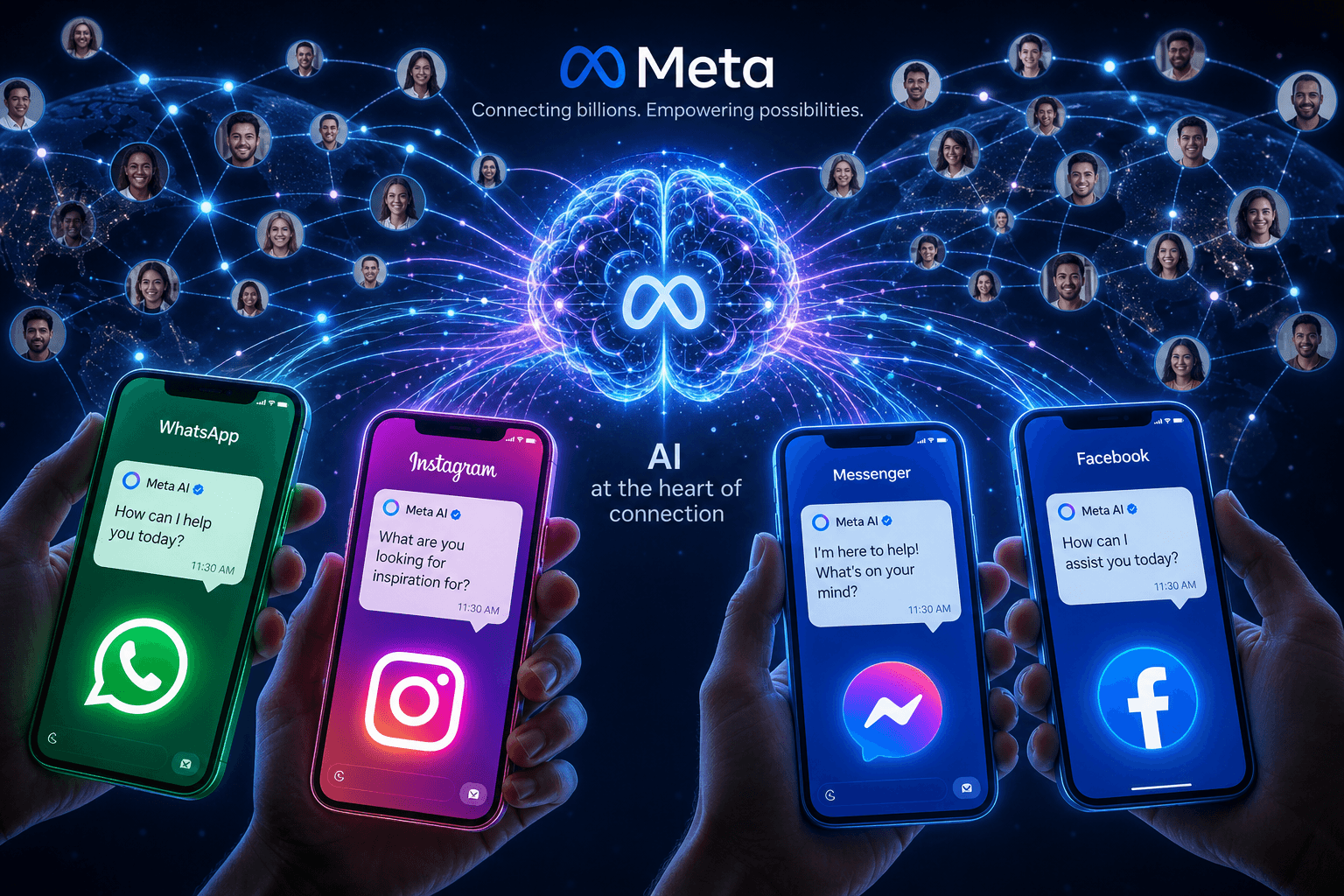
Meta AI Goes Mainstream: WhatsApp, Instagram, Messenger Integration Explained

Table of Contents
Meta AI Goes Mainstream: WhatsApp, Instagram, Messenger Integration Explained #
Meta just made the boldest distribution move in the AI race. While OpenAI fights for ChatGPT downloads and Google chases Gemini integration across its products, Meta did something neither of them can easily replicate: they pushed Llama 3-powered AI to the 3.2 billion people already using their apps.
This rollout — live now across WhatsApp, Instagram, Messenger, and Facebook — is not just a product launch. It's a strategic statement about where Meta thinks the AI war will be decided. Not in API leaderboards. Not in benchmark charts. In the daily habit loops of the apps people already have on their phones.
Here's what Meta AI actually does in each app, what the privacy situation looks like, and what this moment means for the broader AI landscape.
Table of Contents #
- What Is Meta AI?
- Meta AI in WhatsApp: Group Chat Intelligence
- Meta AI in Instagram: Search Bar and DMs
- Meta AI in Messenger: Conversational Assistant
- Meta AI in Facebook: Feed Context and Search
- The Llama 3 Connection: What's Under the Hood
- Privacy: What Meta Knows and What It Shares
- What This Means for the AI Wars
What Is Meta AI? {#what-is-meta-ai} #
Meta AI is a conversational assistant powered by Llama 3, integrated directly into WhatsApp, Instagram, Messenger, and Facebook. You interact with it through the search bars, in-app chat interfaces, and — in some apps — by tagging it in group conversations.
It's also available as a standalone web app at meta.ai and through Meta's Ray-Ban smart glasses.
The capabilities across all surfaces:
- General Q&A and reasoning — Llama 3 70B powering the core responses
- Real-time web search — Meta AI pulls live results from Google and Bing, not just its training data
- Image generation — An internal image model (not Llama 3) for creating AI images from text prompts via the "Imagine" command
- Creative writing, recipes, travel planning — Standard assistant tasks
What it's NOT doing, at least today:
- Accessing your personal DMs or browsing history to personalize responses
- Connecting to external services or taking actions (no "book this flight" capability)
- Operating as an agent across multiple steps
Think of it as a capable chatbot — closer to an embedded ChatGPT than an autonomous AI agent.
Meta AI in WhatsApp: Group Chat Intelligence {#meta-ai-whatsapp} #
Meta AI in WhatsApp is accessible by typing @Meta AI in any chat — individual or group — or through the search bar at the top of the app.
The group chat integration is the most distinctive feature. You can bring Meta AI into an existing conversation by mentioning it, and it can see the recent context of the conversation to inform its response. Planning a trip with friends in a group chat? Tag Meta AI to get hotel recommendations, weather, or restaurant suggestions without leaving WhatsApp.
What it does in WhatsApp:
- Answer questions inline within any chat
- Provide real-time information (flight times, business hours, current events) via web search
- Generate images with the
/imaginecommand - Help draft messages or replies (on request — it doesn't auto-suggest)
- Suggest activities, recipes, or recommendations based on conversation context
What's interesting about the group chat model: WhatsApp's end-to-end encryption (E2EE) means Meta itself cannot read your private messages. But when you explicitly tag Meta AI in a conversation, the messages you share with it are sent to Meta's servers for processing — they're not covered by the E2EE guarantee for that interaction. Meta is transparent about this: the @MetaAI messages leave the encrypted container.
For most WhatsApp users who want a quick fact check or city recommendation in a group travel planning chat, this tradeoff is invisible and acceptable. For users who treat WhatsApp as their primary secure communication channel, it's worth understanding.
Meta AI in Instagram: Search Bar and DMs {#meta-ai-instagram} #
On Instagram, Meta AI appears primarily in the search bar and in DMs. Tap the search bar at the top of the app and you'll see a Meta AI text input. You can ask it questions and get answers without leaving Instagram — but the integration is more surface-level than WhatsApp's.
Key Instagram use cases:
- Searching for accounts, topics, or content with AI-enhanced results
- Getting travel or lifestyle recommendations contextually (e.g., after viewing a travel post)
- Image generation: type
/imagine [prompt]in DMs with Meta AI to generate images you can share - Real-time information lookup while browsing the feed
The feed integration is where Instagram's version gets interesting. If you're looking at a post about a hiking trail, you can ask Meta AI about the trail, get difficulty ratings, best seasons to visit, nearby camping — all without leaving the post view. This contextual awareness of the content you're currently viewing is something ChatGPT can't replicate without screenshots.
The image generation in Instagram is noticeably fast. Meta has built a real-time generation model ("Imagine") that creates and animates images as you're typing the prompt. You see the image forming before you've finished your sentence. It's a UX trick as much as a technical one, but it's impressive in context.
Meta AI in Messenger: Conversational Assistant {#meta-ai-messenger} #
Messenger has the most traditional chatbot integration — Meta AI lives as a contact you can message directly, like an AI DM buddy. You can also tag it in group conversations, similar to WhatsApp.
The Messenger experience is the most ChatGPT-like of the four apps. You get a clean chat interface, persistent conversation history within the session, and the full range of Meta AI capabilities: Q&A, web search, creative writing, image generation.
Messenger's integration also supports AI "personas" — Meta has experimented with celebrity-voiced AI characters in Messenger. These are separate from the main Meta AI assistant and have been controversial. The main Meta AI in Messenger uses a standard, non-persona voice.
Where Messenger's AI stands out: Multi-step conversation flow. Because Messenger is more conversation-native than Instagram (where you're interrupted by content), it's easier to have a back-and-forth dialogue with Meta AI across multiple turns. If you need to iterate on a response or follow up with clarifying questions, Messenger's format supports that better than Instagram's search bar integration.
Meta AI in Facebook: Feed Context and Search {#meta-ai-facebook} #
On Facebook, Meta AI integrates into the search bar and appears as an option in Marketplace, Groups, and feeds. The Facebook integration is the most commercially oriented — Meta AI can help with local business searches, marketplace queries, and event planning.
Use cases in Facebook:
- Finding local businesses with AI-augmented search
- Getting recommendations in Groups (e.g., asking for restaurant suggestions in a local community group)
- Help with Facebook Marketplace listings and searches
- Event planning assistance
The Facebook integration also connects to Meta AI's Bing/Google web search more visibly — Facebook's search has always been primarily for finding people and content within Facebook, and now Meta AI adds a general web search layer on top.
Importantly: Facebook is the surface where Meta's data advantages are most visible. Meta knows your interests, your location, your friend network, and your activity patterns more deeply than any other platform. Whether Meta AI uses this to personalize responses — or will in the future — is the central question around which all the privacy concerns orbit.
The Llama 3 Connection: What's Under the Hood {#llama3-connection} #
All four apps are powered by the same Llama 3 models Meta released publicly this week. The 8B and 70B instruction-tuned models serve the actual conversation, with additional fine-tuning applied to optimize for consumer assistant tasks.
This creates a genuinely unusual situation: you can pull the same model weights that power the Meta AI assistant running on 3+ billion devices, run it locally on your own machine with Ollama, and get essentially the same output quality. The public weights are the consumer product.
Meta's moat in this deployment is not the model itself — it's the infrastructure, the distribution, and the data flywheel. Billions of interactions per day will teach Meta things about how people actually use AI assistants that no benchmark can capture. Those learnings feed into future model improvements, which feed into better assistants, which generate more interactions.
The web search integration (Bing + Google) is a separate layer built on top of Llama 3 — Meta doesn't have its own search index, so they're licensing real-time web results and using Llama 3 to synthesize and answer from them. This is the same approach Microsoft uses with Copilot (Bing + GPT-4).
Privacy: What Meta Knows and What It Shares {#privacy-implications} #
The privacy picture with Meta AI is nuanced — better in some ways than the fear-driven takes suggest, concerning in others.
What Meta AI does NOT do:
- Read your private encrypted WhatsApp messages (E2EE protects them)
- Access your browsing history outside Meta's platforms
- Sell your AI conversations to third parties (per their stated policy)
What Meta AI DOES do:
- Process any message you send to Meta AI on Meta's servers (leaving E2EE)
- Use your interactions to improve the models
- Apply Meta's existing data practices — which include substantial user profiling — to contextualize AI features over time
- Share data across Meta's family of apps (Instagram, Facebook, WhatsApp, Messenger)
The cross-platform data sharing is the most significant concern. Meta's data sharing practices across its app portfolio are established (and have been fined for in the EU). Adding AI interactions to that data pool, combined with Meta's existing behavioral profiles, is a meaningful expansion of what Meta knows about you.
Meta has deployed Llama Guard 2 as a content moderation layer — a classifier that screens both inputs and outputs for harmful content. They've also been transparent about the hallucination risk (there are in-app disclaimers noting responses may be inaccurate).
For most consumer use cases — "what's a good pizza place nearby," "help me write a birthday message" — the privacy tradeoff is indistinguishable from using Google Search or Siri. For sensitive conversations, the same rule applies as with all AI assistants: don't share what you wouldn't want stored.
What This Means for the AI Wars {#ai-wars} #
Meta's distribution play changes the competitive dynamics of the AI race in a way that benchmark comparisons don't capture.
OpenAI has ~100 million ChatGPT users. Google has Gemini across its products. But Meta has 3.2 billion monthly active users across WhatsApp, Instagram, Facebook, and Messenger — an order of magnitude larger than any AI-native product. And unlike Google Search (where AI answers are supplementary) or Gemini (which requires users to deliberately switch products), Meta AI is embedded inside habits people already have.
The strategic logic:
- Distribution beats capability at the margin. A "good enough" model used by 3 billion people generates more value than a better model used by 100 million.
- The data flywheel is the real prize. 3 billion users generating AI interactions creates training signal no research lab can buy.
- Open weights is the differentiator. By releasing Llama 3 publicly, Meta gets the ecosystem to build tooling, fine-tune variants, and advance the technology — all while Meta captures the consumer distribution.
For OpenAI and Google, this is a real threat — not to their technical leadership (both are still ahead on the capability frontier) but to their monetization path. If Meta AI becomes the default AI for billions of people who've never tried ChatGPT, the "switch to a paid AI" proposition gets harder to make.
For builders and automation teams, this matters for a different reason: it normalizes AI interaction patterns for billions of non-technical users faster than any other approach. The cultural familiarity with "ask the AI assistant" that ChatGPT built among tech workers is about to reach a much wider audience via apps they already use daily.
Frequently Asked Questions #
What is Meta AI?
Meta AI is a conversational assistant powered by Llama 3, integrated into WhatsApp, Instagram, Messenger, and Facebook as of April 2024. It handles Q&A, real-time web search (via Google/Bing), and image generation across all four apps plus a standalone web interface at meta.ai.
How do I access Meta AI in WhatsApp?
Type @Meta AI in any WhatsApp chat — individual or group — or use the search bar at the top of the app. It's rolling out to English-speaking users in the US and over a dozen countries including Australia, Canada, and the UK.
Does Meta AI read my private WhatsApp messages?
No — your private WhatsApp messages are end-to-end encrypted and Meta cannot read them. However, when you explicitly tag @Meta AI in a conversation, those messages are sent to Meta's servers for processing and are not covered by E2EE.
What model powers Meta AI?
Meta AI is powered by Llama 3 — specifically the instruction-tuned variants of the 8B and 70B models released April 18, 2024. The image generation feature ("Imagine") uses a separate internal model, not Llama 3.
Can Meta AI search the web?
Yes. Meta AI integrates with Google and Bing search to provide real-time information. When you ask about current events, business hours, flight prices, or other time-sensitive queries, it pulls live web results rather than relying solely on its training data.
Is Meta AI available in all countries?
As of April 2024, Meta AI is available in English across the US, Australia, Canada, New Zealand, South Africa, and several other countries. It's in testing in India. Other countries and language support are rolling out over the coming months.
How is Meta AI different from ChatGPT?
The core AI capability is comparable — both are large language models with web search integration. The key difference is distribution: ChatGPT requires users to go to chat.openai.com or download an app. Meta AI is embedded in WhatsApp, Instagram, Messenger, and Facebook, which billions of people already use daily.
What are the privacy concerns with Meta AI?
The main concern is that AI interactions are processed on Meta's servers (outside WhatsApp's E2EE) and may be used to improve models. Meta's cross-app data sharing practices also mean AI interaction data could be combined with existing user profiles across its platforms. For general consumer use, the privacy profile is similar to using Google or Siri.
What This Means for Your Business #
Meta's distribution play isn't just a story about consumer AI — it's a signal about where AI-driven customer interactions are heading. Businesses that aren't thinking about how their customers will use AI assistants to research, evaluate, and engage with them are going to find themselves behind.
Whether that means optimizing your brand's presence for AI-mediated search, building automation workflows that meet customers where they are, or integrating AI assistants into your own product surfaces — these are the questions worth working on now.
If you want help thinking through the AI strategy for your business — where automation creates real leverage, what to build, and how to build it — let's talk.
Book an AI automation strategy call →
Related reading:
Related Posts
Google I/O 2026 Action List: How I Prompted Gemini 3.5 Flash and Antigravity Workflows
Google I/O 2026 just reset the AI tooling landscape. Here's the 9-action checklist for builders who want to ship this week, not just watch the keynote.
Anthropic vs. OpenAI vs. Google: The State of the Frontier in May 2026
A head-to-head breakdown of the three AI giants in May 2026: Claude Opus 4.6, GPT-5.3 and 5.4, Gemini 3.1 Pro. Real specs, real pricing, and what actually matters for builders.
Kimi K2 Open Weights: How I Prompted Moonshot's Frontier Model for Agentic Tool Use
How I direct Kimi K2 by Moonshot AI for agentic workflows, long-context tool calling, and workflow automation. A 1 trillion parameter MoE model with competitive benchmarks at 5-17x lower cost than GPT-5 and Claude.