Microsoft Phi-3 Mini 3.8B: The Small Model That Benchmarked Like a 70B Beast

Table of Contents
Microsoft Phi-3 Mini 3.8B: The Small Model That Benchmarked Like a 70B Beast #
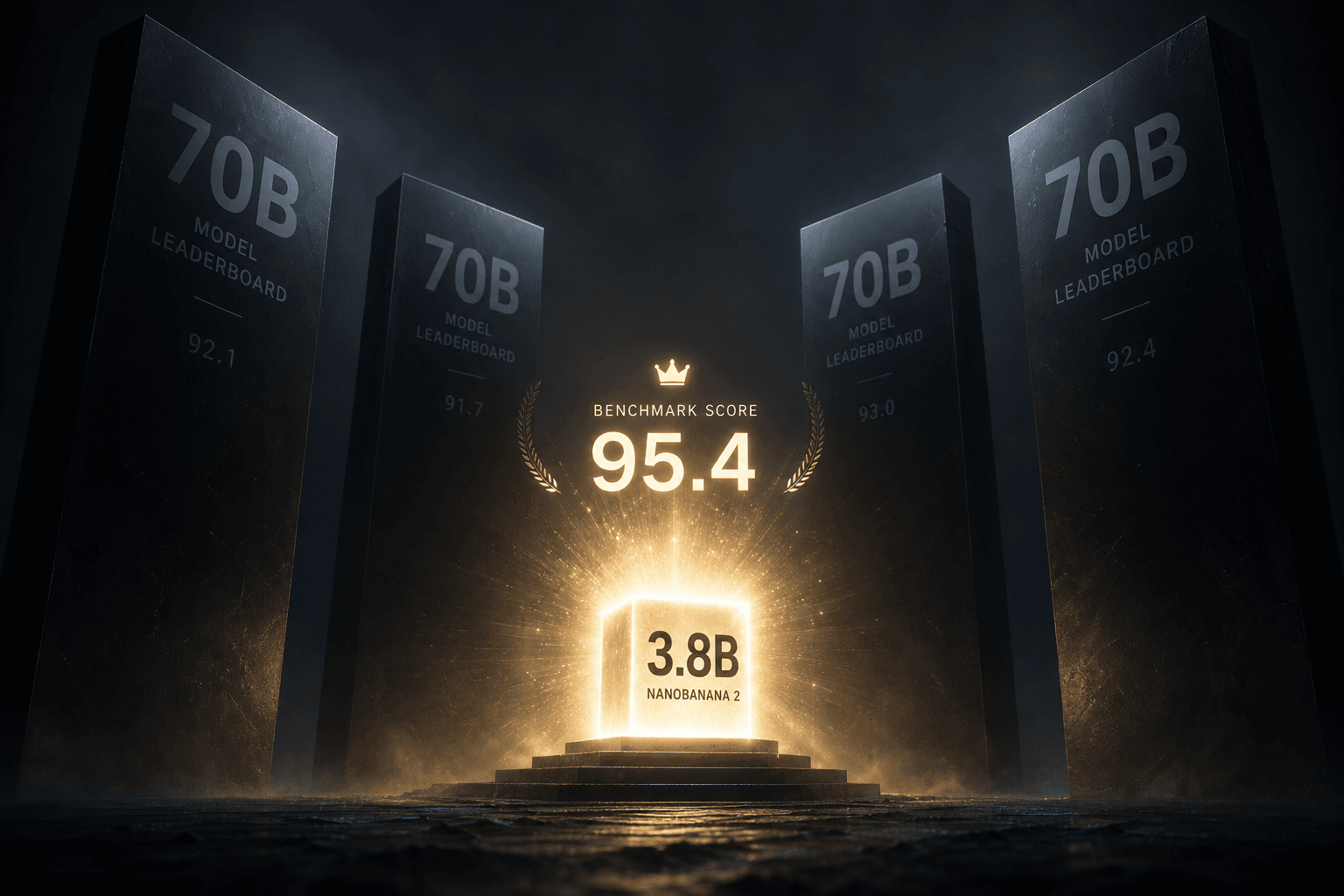
Microsoft just dropped a 3.8B parameter model that scores 69% on MMLU — the same benchmark territory as models 10–20x its size. Phi-3 Mini shipped April 23, 2024, and it's making every AI team rethink whether "bigger is always better" actually holds.
Here's the full breakdown: what Microsoft changed, what the numbers actually say, and whether any of this translates to real-world use.
What Is Phi-3 Mini? A 30-Second Primer #
Phi-3 Mini is a 3.8 billion parameter dense language model from Microsoft, released April 23, 2024. It's the smallest model in a new Phi-3 family that also includes Phi-3 Small (7B) and Phi-3 Medium (14B).
The model targets two things most large models can't do: run on-device (think mobile and embedded hardware) and run cheaply in cloud inference at scale. It comes in two context-window flavors — 4K tokens for standard deployments and 128K tokens for extended-context workloads.
| Spec | Value |
|---|---|
| Parameters | 3.8 billion |
| Architecture | Dense transformer, grouped-query attention |
| Context window (standard) | 4,096 tokens |
| Context window (extended) | 128,000 tokens |
| Layers | 32 |
| Attention heads | 32 (8 key-value heads) |
| Hidden dimension | 3,072 |
| Position embedding | RoPE |
| Training tokens | 3.3 trillion |
| Knowledge cutoff | October 2023 |
| License | MIT |
Available on Azure AI Model Catalog, Hugging Face, Ollama, and as an NVIDIA NIM microservice. MIT license — meaning you can use it commercially without the usual restrictions.
The Benchmark Results: How Does 3.8B Score Like a 70B? #
Phi-3 Mini's MMLU score of 69% rivals Mixtral 8x7B and is competitive with GPT-3.5 — both of which are 10–20x larger by parameter count.
This is genuinely unusual. A 3.8B dense model matching 46B effective-parameter MoE systems on academic benchmarks isn't the norm. Here's the numbers side by side:
| Model | Params | MMLU | MT-Bench | Notes |
|---|---|---|---|---|
| Phi-3 Mini | 3.8B | 69% | 8.38 | Dense, MIT license |
| Mixtral 8x7B | 46.7B (8x7B) | ~70% | 8.3 | MoE, open weights |
| GPT-3.5 Turbo | ~175B | ~70% | 8.32 | Closed API |
| Phi-3 Small | 7B | 75% | — | Same family |
| Phi-3 Medium | 14B | 78% | — | Same family |
| Llama 3 8B | 8B | ~66% | — | Meta, same week |
The critical comparison: Phi-3 Mini at 3.8B beats Llama 3 8B at 66% MMLU despite having less than half the parameters. That's not a marginal win — that's a different curve entirely.
MT-Bench at 8.38 is the number I'd actually pay attention to for practical use. MT-Bench tests multi-turn instruction following across eight task types. Phi-3 Mini's 8.38 sits in GPT-3.5 territory. For most real-world assistant tasks, that's more predictive than MMLU.
The "Textbook Quality" Data Philosophy Behind Phi-3 #
The reason Phi-3 Mini outperforms models much larger than it comes down to training data quality, not scale. Microsoft's core thesis: a smaller model trained on denser, higher-quality data beats a larger model trained on noisier internet-scale text.
Microsoft calls this the "textbook quality" philosophy — inspired by their earlier research paper "Textbooks Are All You Need." The Phi series has been refining this approach since Phi-1 (1.3B, coding-focused) and Phi-2 (2.7B, reasoning-focused). Phi-3 takes the same ideas to 3.8B with 3.3 trillion training tokens.
The dataset architecture works like this:
- Heavily filtered public web data — aggressive quality filtering, not random Common Crawl ingestion. Think: prioritize high-reasoning content (textbooks, academic papers, code repositories, structured explanations) over social media and forum noise.
- Synthetic data generation — Microsoft generates additional training examples using larger models (likely GPT-4 variants) to create reasoning chains, instructional examples, and edge-case coverage that doesn't naturally appear in public data at sufficient density.
- Post-training alignment — Supervised Fine-Tuning (SFT) + Direct Preference Optimization (DPO) for instruction following, robustness, and safety. This is standard for modern aligned models, but the combination running on top of a high-quality base makes the instruction adherence noticeably sharper than you'd expect at 3.8B.
The implication: data curation is compressing more capability into fewer parameters. If the "textbook quality" thesis holds at 7B and 14B (Phi-3 Small and Medium), we're looking at a new efficiency frontier that rewrites the cost/capability tradeoffs for the whole industry.
Where Small Models Actually Win: Edge, Mobile, and Cost #
Small models win three specific scenarios: edge deployment without reliable internet, mobile hardware with strict memory limits, and cloud inference at scale where per-token cost compounds.
The "bigger is better" assumption only holds when you have unlimited compute and latency isn't a constraint. That's almost never true in production.
On-Device Deployment #
Phi-3 Mini at 3.8B fits in the working memory of devices that can't run a 70B model at any speed. Microsoft specifically tested iPhone 14 performance: approximately 12 tokens per second on-device. That's workable for interactive use cases — assistant flows, local summarization, offline document Q&A.
| Device Class | Runs 3.8B? | Runs 13B? | Runs 70B? |
|---|---|---|---|
| iPhone 14 (6GB RAM) | ✅ ~12 tok/s | ❌ | ❌ |
| Laptop with 16GB RAM | ✅ Fast | ✅ Slow | ❌ |
| Edge server (32GB RAM) | ✅ Fast | ✅ Fast | ⚠️ Marginal |
| Cloud GPU (A100 80GB) | ✅ Very fast | ✅ Very fast | ✅ Fast |
Cloud Inference Cost #
When you're running millions of inference calls per day, the difference between a 3.8B and a 70B model isn't just latency — it's cost per token. At typical Azure/Hugging Face hosted pricing, a 3.8B model runs 10–20x cheaper than a 70B. If your task genuinely doesn't need GPT-4-level reasoning (and most tasks don't), routing to Phi-3 Mini is a real cost optimization.
Latency-Sensitive Applications #
For applications where p99 latency matters — real-time coding suggestions, live chat, streaming completions — smaller models respond faster per token. Phi-3 Mini can serve responses in time windows that would cause timeouts with larger models on shared inference infrastructure.
What Phi-3 Doesn't Beat (Being Honest About Limits) #
Phi-3 Mini is not a replacement for GPT-4, Claude Opus, or any frontier model on tasks requiring deep reasoning, long context recall, or complex multi-step logic.
MMLU measures breadth of knowledge. It doesn't capture depth of reasoning on hard problems. A 3.8B model is going to struggle with:
- Multi-step math and logic — GSM8K and MATH benchmark performance drops significantly vs. larger models
- Long-context faithfulness — Even with 128K extended context, recall accuracy at full context length lags larger models
- Complex instruction chains — Five-step task plans with interdependencies show brittleness at 3.8B that you don't see at 70B+
- Nuanced safety edge cases — The alignment surface area is harder to cover with fewer parameters
The Phi-3 Mini sweet spot: well-defined tasks with clear formats, shorter context, and predictable output structure. Code completion, entity extraction, classification, summarization, Q&A over structured documents. Outside that zone, route to a larger model.
How to Run Phi-3 Mini Right Now #
The fastest path to running Phi-3 Mini today is Ollama on any laptop with 8GB+ RAM.
# Install Ollama first: https://ollama.ai
ollama pull phi3

# Run interactive session
ollama run phi3

# Or call via API (Ollama runs a local server on :11434)
curl http://localhost:11434/api/generate -d '{
  "model": "phi3",
  "prompt": "Explain the difference between MoE and dense transformer architectures in 3 sentences.",
  "stream": false
}'
For the 128K context version:
ollama pull phi3:3.8b-mini-128k-instruct-q4_K_MFor production use via Azure:
# Azure AI Model Catalog — Phi-3 Mini endpoint
import requests

endpoint = "https://your-phi3-endpoint.eastus.inference.ai.azure.com"
headers = {
    "Authorization": f"Bearer {api_key}",
    "Content-Type": "application/json"
}

payload = {
    "messages": [{"role": "user", "content": "Classify this support ticket: ..."}],
    "max_tokens": 512,
    "temperature": 0.1
}

response = requests.post(f"{endpoint}/v1/chat/completions", json=payload, headers=headers)
NVIDIA NIM also provides a containerized Phi-3 Mini endpoint if you're running your own GPU infrastructure.
Phi-3 Mini in Real AI Automation Workflows #
For AI automation pipelines where you're making hundreds of thousands of inference calls, Phi-3 Mini is a serious routing target for the 80% of tasks that don't need frontier-model intelligence.
The practical architecture I'm building around models like this:
[Task Router]
     ↓
Task complexity score?
     ↓
Simple (classification, extraction, formatting) → Phi-3 Mini  ($$$  low)
Medium (summarization, Q&A, short generation) → Phi-3 Small / Llama 3 8B
Complex (reasoning, code, analysis) → Claude Opus / GPT-4o  ($$$  high)
In an n8n workflow, this looks like a simple HTTP node calling a complexity scorer, followed by a switch node routing to different model endpoints. The cost reduction on high-volume pipelines is significant — you're only paying frontier rates for the tasks that genuinely need it.
For on-device automation specifically (mobile apps, browser extensions, local tools), Phi-3 Mini is the first model in the 3-4B range that I'd actually trust with real tasks rather than toy demos.
What the Phi-3 Release Means for the "Bigger Is Better" Narrative #
The Phi-3 Mini release is evidence that data quality compounds — and that the efficiency gains from better training data are outpacing the gains from raw parameter scaling.
The scaling laws that drove the GPT-3 → GPT-4 era assumed you needed exponentially more parameters to get linearly more capability. Phi-3 Mini challenges that assumption directly: 3.8B parameters trained on 3.3 trillion tokens of high-quality data performs like a model trained naively on 10x the parameters.
What this means practically:
- Smaller teams can now fine-tune capable models. 3.8B models are fine-tunable on a single A100 in a reasonable time window. That opens specialized fine-tuning to organizations that can't afford to fine-tune 70B+.
- The edge AI opportunity is real. Phi-3 Mini running on-device at usable speeds means genuinely offline-capable AI applications are now buildable.
- Model routers become a real architecture pattern. When a 3.8B model can handle 70–80% of your tasks at 1/10th the cost, smart routing becomes the highest-ROI optimization in your inference stack.
This doesn't mean frontier models are irrelevant — the gap in complex reasoning is still real. But the floor just rose significantly. Tasks that felt like they required GPT-3.5 last year can now run on a model that fits in your phone.
FAQ: Microsoft Phi-3 Mini Answered #
What is Microsoft Phi-3 Mini?
Phi-3 Mini is a 3.8 billion parameter dense language model from Microsoft, released April 23, 2024. It scores 69% on MMLU and runs on-device hardware as constrained as an iPhone 14, achieving ~12 tokens per second.
How does Phi-3 Mini compare to GPT-3.5?
On MMLU and MT-Bench, Phi-3 Mini performs comparably to GPT-3.5 despite having roughly 50x fewer parameters. For well-scoped tasks (summarization, classification, structured extraction), the gap is minimal. For complex multi-step reasoning, GPT-3.5 and larger models still have the edge.
Can Phi-3 Mini run on a laptop?
Yes — any laptop with 8GB+ RAM can run Phi-3 Mini locally via Ollama. The 4-bit quantized version (Q4_K_M) runs comfortably on 6–8GB RAM and delivers interactive generation speeds on consumer hardware.
What is the Phi-3 training data philosophy?
Microsoft trained Phi-3 Mini on heavily filtered, "textbook quality" web data plus synthetic data generated by larger models. The core thesis: a smaller model trained on denser, reasoning-rich data outperforms larger models trained on unfiltered internet text.
What context window does Phi-3 Mini support?
Phi-3 Mini ships in two variants: 4K token context (standard) and 128K token context (extended). The 128K version is available on Hugging Face and Azure for long-document tasks.
Is Phi-3 Mini open source?
Phi-3 Mini is released under the MIT license, which permits commercial use, fine-tuning, and redistribution. Weights are available on Hugging Face.
What benchmarks does Phi-3 Mini excel at?
Phi-3 Mini performs strongest on MMLU (69%), MT-Bench (8.38), and structured reasoning tasks. It competes with Mixtral 8x7B on general knowledge despite being 12x smaller by active parameter count.
When should I use Phi-3 Mini instead of a larger model?
Use Phi-3 Mini for on-device deployment, high-volume inference where cost is constrained, or tasks with well-defined formats — classification, extraction, structured summarization, short-form Q&A. Route to larger models for complex multi-step reasoning, long-document analysis, or nuanced creative generation.
What is Phi-3 Small and Phi-3 Medium?
Phi-3 Small (7B) scores 75% on MMLU, and Phi-3 Medium (14B) scores 78%. All three ship in the same April 2024 release wave, with the same "textbook quality" training data approach scaled to more parameters.
Does Phi-3 Mini support fine-tuning?
Yes — at 3.8B parameters, Phi-3 Mini is fine-tunable on a single A100 GPU with standard LoRA or QLoRA techniques. This makes domain-specific adaptation feasible for teams that can't afford to fine-tune 70B+ models.
What This Means for Your AI Automation Stack #
The pattern I keep seeing in April 2024: the gap between "small model" and "useful model" is closing fast. Phi-3 Mini is the clearest data point yet that inference efficiency is becoming the main competitive variable in AI infrastructure.
For teams building AI automation workflows, the immediate practical implication: build your inference routing layer now. Set up a classifier that scores task complexity, and route cheap tasks to cheap models. Phi-3 Mini is a serious option for that second tier — especially if on-device, offline, or cost-per-token is a real constraint in your architecture.
If you're ready to build that kind of intelligent, cost-optimized AI automation system for your business, let's talk about what a custom agent architecture would look like for your specific use case.
Related posts: Mistral 8x22B Torrent Drop — The New Open-Source Frontier · n8n vs Make for Non-Code AI Workflows
Related Posts
Google I/O 2026 Action List: How I Prompted Gemini 3.5 Flash and Antigravity Workflows
Google I/O 2026 just reset the AI tooling landscape. Here's the 9-action checklist for builders who want to ship this week, not just watch the keynote.
Anthropic vs. OpenAI vs. Google: The State of the Frontier in May 2026
A head-to-head breakdown of the three AI giants in May 2026: Claude Opus 4.6, GPT-5.3 and 5.4, Gemini 3.1 Pro. Real specs, real pricing, and what actually matters for builders.
Kimi K2 Open Weights: How I Prompted Moonshot's Frontier Model for Agentic Tool Use
How I direct Kimi K2 by Moonshot AI for agentic workflows, long-context tool calling, and workflow automation. A 1 trillion parameter MoE model with competitive benchmarks at 5-17x lower cost than GPT-5 and Claude.