OpenAI Raises $6.6 Billion at $157B Valuation—The Largest VC Round in History
Table of Contents
OpenAI Raises $6.6 Billion at $157B Valuation—The Largest VC Round in History #
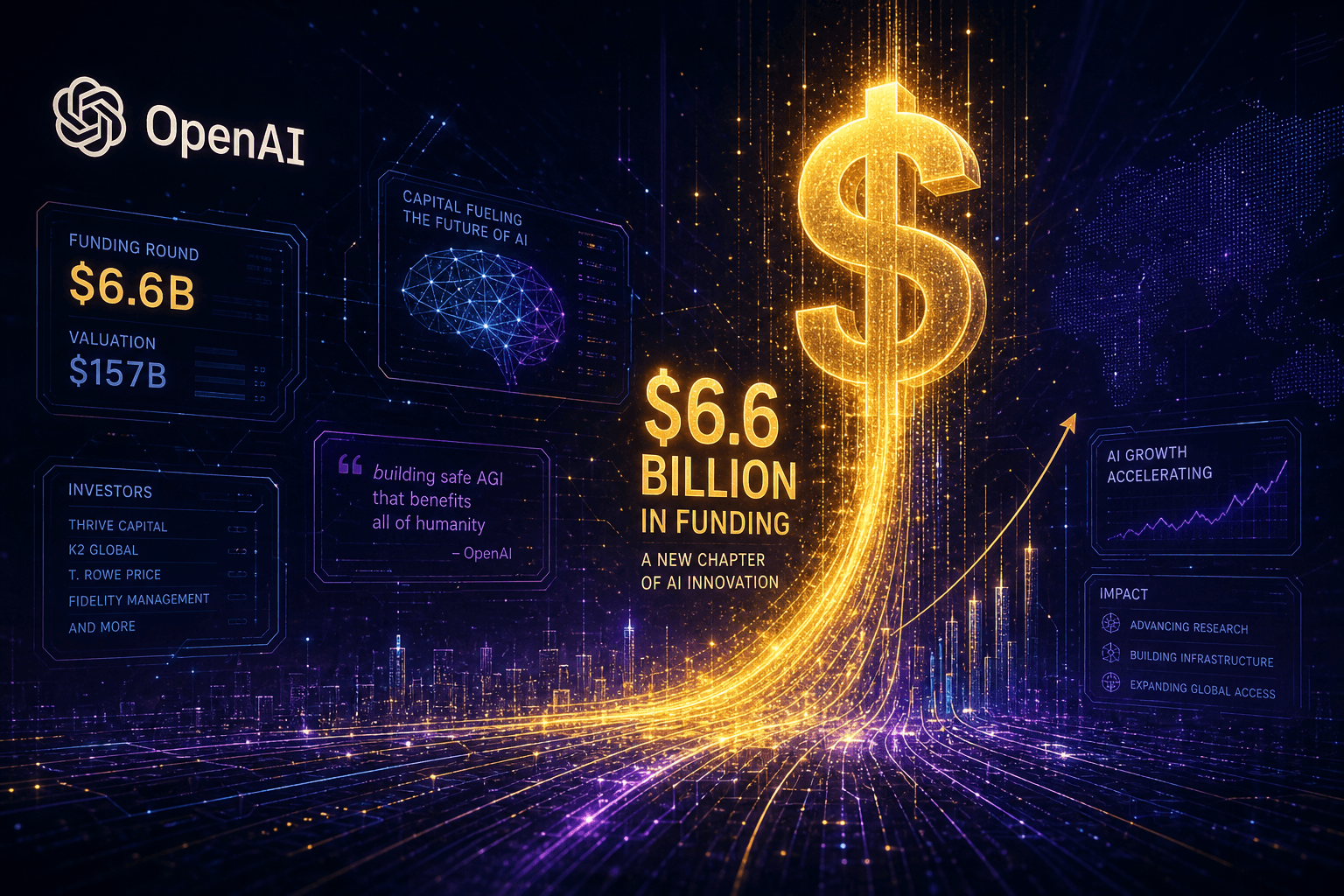
OpenAI just closed the largest venture capital funding round in history. Today, the company announced it has raised $6.6 billion at a $157 billion post-money valuation, cementing its position as the most valuable private AI company on Earth. This round, led by Thrive Capital with strategic participation from Microsoft, NVIDIA, SoftBank, and a consortium of top-tier investors, represents a pivotal moment—not just for OpenAI, but for the entire technology industry.
As someone who builds with AI tools daily and tracks the industry obsessively, I'm breaking down what just happened, who's betting billions on OpenAI's future, and what this funding round actually means for builders, businesses, and the broader AI landscape in late 2024.
Table of Contents #
- The Numbers: Breaking Down OpenAI's Historic $6.6B Round
- Who Invested? The Power Players Betting on OpenAI
- Thrive Capital's Billion-Dollar Bet and Future Option
- Microsoft's Continued Strategic Partnership
- Why NVIDIA and SoftBank Joined the Cap Table
- The For-Profit Conversion Ultimatum
- The Anti-Competition Investor Clause
- How OpenAI Plans to Deploy $6.6 Billion
- What This Valuation Means for the AI Industry
- Competitive Landscape: Anthropic, xAI, and the Rest
- Implications for AI Builders and Enterprises
- FAQ: OpenAI's $6.6 Billion Funding Round
- What's Next for OpenAI
The Numbers: Breaking Down OpenAI's Historic $6.6B Round #
OpenAI's $6.6 billion raise represents the single largest venture capital funding round ever completed, surpassing every previous tech mega-round including the previous record held by Stripe and others. This isn't just a big round—it's a historic inflection point that redefines what "scale" means in private markets.
The Raw Numbers #
| Metric | Value | Context |
|---|---|---|
| Amount Raised | $6.6 billion | Largest VC round in history |
| Post-Money Valuation | $157 billion | 2x from $80B in early 2024 |
| Pre-Money Valuation | ~$150.4 billion | Implied from post-money math |
| Total Funding to Date | $17.9 billion | Across all rounds since 2015 |
| Year Founded | 2015 | As a nonprofit AI research lab |
To put this in perspective, OpenAI's $157 billion valuation places it in the same league as publicly traded giants:
- Uber: ~$155 billion market cap
- AT&T: ~$160 billion market cap
- Verizon: ~$165 billion market cap
- Netflix: ~$280 billion market cap
OpenAI is now worth more than most Fortune 100 companies despite remaining private and being just nine years old. The valuation represents a doubling from the roughly $80 billion valuation set during the tender offer and secondary transactions earlier in 2024.
Historical Context: The Funding Trajectory #
OpenAI's funding evolution tells the story of AI's mainstream explosion:
- 2015-2018: Founded as nonprofit with $1B pledge from Sam Altman, Elon Musk, Peter Thiel, Reid Hoffman, Jessica Livingston, and others
- 2019: Created capped-profit subsidiary, raised $1 billion from Microsoft
- 2021: Raised additional funding at ~$14 billion valuation
- 2023: Microsoft's reported $10 billion multi-year investment (though structured as Azure credits + cash)
- January 2024: Tender offer at $80 billion valuation
- October 2024: $6.6 billion at $157 billion valuation
The 2024 valuation jump—from $80B to $157B in under a year—reflects ChatGPT's continued growth, GPT-4's enterprise dominance, and the market's conviction that OpenAI remains the clear leader in foundation model development despite mounting competition from Anthropic, Google, and xAI.
Who Invested? The Power Players Betting on OpenAI #
Thirteen of the world's most aggressive tech investors just collectively bet $6.6 billion on one thesis: OpenAI wins the AGI race. The participant list reads like a who's who of venture capital, strategic tech investors, and sovereign wealth—each bringing different motivations beyond pure financial returns.
The Complete Investor Roster #
| Investor | Estimated Investment | Type | Strategic Angle |
|---|---|---|---|
| Thrive Capital | $1.25-1.3 billion | Lead VC | AGI conviction + exclusive option |
| Microsoft | ~$1 billion | Strategic | Azure cloud lock-in, AI integration |
| SoftBank | $500 million | Strategic/VC | Vision Fund 2 AI thesis |
| NVIDIA | $100 million | Strategic | GPU infrastructure dominance |
| Altimeter Capital | Undisclosed | VC | Multi-billion dollar commitment |
| Fidelity | Undisclosed | Institutional | Long-term tech exposure |
| Tiger Global | Undisclosed | Growth equity | Momentum AI bet |
| Khosla Ventures | Undisclosed | Early backer | Continued 2019 support |
| MGX | Undisclosed | Sovereign | UAE AI strategy |
| Others | Balance | Mixed | Secondary participants |
Strategic vs. Financial Investors: Different Playbooks #
Not all $6.6 billion is created equal. The investor mix reveals three distinct motivations:
Strategic Investors (Microsoft, NVIDIA) are paying for ecosystem lock-in. Microsoft's investment secures Azure as OpenAI's exclusive cloud provider and deepens the Copilot integration across Office 365, Windows, and GitHub. NVIDIA's $100 million is essentially a marketing expense—ensuring OpenAI continues training on NVIDIA GPUs while validating the H100/H200 infrastructure story for other customers.
Growth Equity (SoftBank, Tiger Global) are making momentum bets. Masayoshi Son has been vocal about AI as the next platform shift, and SoftBank's $500 million represents Vision Fund 2's largest pure-play AI foundation model investment to date.
Pure Financial VC (Thrive, Altimeter, Fidelity) are betting on OpenAI becoming the world's most valuable company. Josh Kushner's Thrive Capital, in particular, has established itself as the most aggressive growth-stage investor in AI—having already backed Anthropic and now leading OpenAI's mega-round.
The Apple Question: Why the World's Most Valuable Company Sat This Out #
Apple was in discussions to participate but ultimately did not invest, according to multiple reports. The dynamics here are fascinating:
- Apple is integrating ChatGPT into Apple Intelligence for iOS 18, iPadOS 18, and macOS Sequoia—announced at WWDC 2024
- Yet Apple reportedly opted out of the capital table, suggesting strategic partnership without equity entanglement
- This aligns with Apple's historical pattern: preferring supplier relationships over minority equity stakes in strategic partners
The absence of Google and Amazon is equally notable. Both have competing foundation models (Gemini for Google, internal models plus Anthropic backing for Amazon), making direct OpenAI investment strategically impossible. The competitive landscape is now so heated that even investment dollars are factionalized.
Thrive Capital's Billion-Dollar Bet and Future Option #
Josh Kushner's Thrive Capital just wrote the largest check in venture capital history. The New York-based firm is investing approximately $1.25-1.3 billion as the lead investor in OpenAI's $6.6 billion round—an amount that dwarfs typical lead checks by an order of magnitude. Most Series A leads write $3-5 million. Most Series C leads write $50-100 million. Thrive just led with over a billion.
The Exclusive Sweetener: A $1 Billion Option Through 2025 #
Thrive negotiated something virtually unheard of in venture deals: an exclusive option to invest up to an additional $1 billion at the same $157 billion valuation through 2025. This isn't pro-rata rights. This isn't a follow-on preference. This is a locked-in strike price on the world's hottest asset, regardless of whether OpenAI's valuation climbs to $200 billion or higher in the interim.
The mechanics matter here:
- Thrive can deploy up to $1 billion more at today's valuation
- The option expires at the end of 2025
- If OpenAI's valuation rises (likely), Thrive buys in at a discount
- If OpenAI somehow falls (unlikely), Thrive can pass without penalty
This is heads-I-win-tails-you-lose economics, and it reflects the leverage Thrive commanded as the only firm willing and able to lead at this scale.
Thrive's AI Portfolio Concentration #
Thrive Capital is rapidly becoming the most concentrated AI bet in venture capital. The firm's disclosed AI investments now include:
- OpenAI: $1.25-2.25 billion total potential exposure (today's round + option)
- Anthropic: Led the Series C at ~$4.1 billion valuation in 2023
- Character.AI: Participated in growth rounds
- Robin: AI infrastructure plays
This portfolio strategy reveals Kushner's conviction: bet on the foundation layer, not the application layer. Thrive isn't picking which AI writing tool or AI video generator wins. They're betting that OpenAI and Anthropic become the new AWS and Azure of the AI era—the infrastructure that everything else runs on.
The Signal to the Market #
When Thrive writes a $1.3 billion lead check, other investors pay attention. The signal effects cascade:
- LP Validation: Thrive's limited partners (endowments, foundations, family offices) see the conviction and follow on
- Competitive FOMO: Other growth funds that passed on earlier OpenAI rounds now face career risk if they miss again
- Founder Signaling: For other AI founders, Thrive's OpenAI bet validates the entire sector's investability
Thrive Capital is now functionally the index fund for frontier AI, and Josh Kushner has positioned himself as the primary allocator of institutional capital into the AGI race.
Microsoft's Continued Strategic Partnership #
Microsoft is investing approximately $1 billion in OpenAI's October 2024 round, reinforcing what has become the most consequential technology partnership of the AI era. Satya Nadella's company isn't just an investor—it's OpenAI's exclusive cloud provider, its primary compute infrastructure partner, and the distribution channel that puts GPT-4 into the hands of hundreds of millions through Copilot.
The Microsoft-OpenAI Relationship: A Timeline #
| Year | Development | Strategic Significance |
|---|---|---|
| 2019 | $1 billion investment in capped-profit entity | Microsoft becomes preferred partner |
| 2020 | GPT-3 exclusive licensing deal | Microsoft gets GPT-3 model access |
| 2022 | Expanded partnership, Azure integration | ChatGPT runs on Azure infrastructure |
| 2023 | Reported $10 billion multi-year commitment | 49% stake + Azure revenue guarantees |
| 2024 | Copilot rollout across Office, Windows, GitHub | Full Microsoft product integration |
| Oct 2024 | ~$1 billion new investment | Continued capital commitment |
Microsoft's total exposure to OpenAI now includes:
- Equity stake: Significant minority position (exact % undisclosed, estimated ~49% cap)
- Azure revenue: All OpenAI training and inference runs on Azure
- Copilot licensing: GPT-4 powers Microsoft 365 Copilot, GitHub Copilot, Windows Copilot
- GitHub integration: GitHub Copilot has over 1.3 million paid subscribers
Why Microsoft Keeps Writing Checks #
The ~$1 billion investment isn't charity—it's defensive positioning. Microsoft faces three existential threats that OpenAI partnership neutralizes:
Google's AI dominance: Gemini and Google's native AI integration threaten Microsoft's productivity moat. Copilot powered by GPT-4 is Microsoft's counter-move.
AWS's cloud lead: Amazon Web Services holds ~32% cloud market share vs Azure's ~23%. If OpenAI ran multi-cloud, Microsoft would lose the AI inference workload race. The exclusive Azure partnership forces AI workloads onto Microsoft's infrastructure.
Search disruption: Bing Chat (powered by GPT-4) hasn't dethroned Google Search, but it has positioned Microsoft as the "AI-native" search alternative—valuable for long-term relevance.
Microsoft's OpenAI investment thesis: Pay billions now to own the infrastructure layer of the next computing platform, even if it means subsidizing OpenAI's growth at Azure's expense.
The Copilot Revenue Engine #
Microsoft 365 Copilot—the GPT-4 powered assistant for Word, Excel, PowerPoint, Outlook, and Teams—represents the commercialization proof point:
- Pricing: $30/user/month on top of existing Microsoft 365 subscriptions
- Uptake: Microsoft reports "hundreds of thousands" of Copilot seats deployed across enterprises
- Expansion: Copilot Studio lets enterprises build custom GPT-4 agents on their data
Every dollar OpenAI raises for bigger models is a dollar Microsoft can monetize through Copilot subscriptions. The $1 billion investment is essentially R&D funding for Microsoft's own product roadmap.
Why NVIDIA and SoftBank Joined the Cap Table #
NVIDIA and SoftBank represent two different flavors of strategic investment in OpenAI's October 2024 round. NVIDIA's reported $100 million check is about validating its hardware dominance. SoftBank's $500 million is about riding the AI wave that Masayoshi Son has been predicting for years. Both tell us something important about the broader AI infrastructure landscape.
NVIDIA: The Infrastructure Validation Play #
NVIDIA is investing $100 million to ensure OpenAI keeps training on its chips. This isn't primarily a financial bet—it's a marketing and ecosystem play with massive strategic upside:
- Validation signal: When the world's leading AI lab takes your money, it signals your chips are the industry standard
- Early access: Strategic investors often get insight into roadmap priorities, model architectures, and compute requirements
- Customer lock-in: OpenAI's training runs on NVIDIA H100s and H200s. The investment deepens that relationship.
NVIDIA's AI investment strategy spans the entire ecosystem:
- OpenAI ($100M)
- CoreWeave (cloud infrastructure partner)
- Databricks (enterprise AI platform)
- SoundHound (voice AI)
- Recursion (AI drug discovery)
Jensen Huang's playbook: Invest in the companies that create demand for NVIDIA GPUs. OpenAI's $6.6 billion will largely flow to compute infrastructure—which means NVIDIA silicon.
SoftBank: The Vision Fund AI Thesis #
SoftBank's $500 million investment comes from Vision Fund 2, the successor to the controversial Vision Fund 1 that made oversized bets on WeWork, Uber, and other growth-stage companies. Masayoshi Son has been publicly predicting an AI revolution for years, and OpenAI represents the purest play on that thesis.
SoftBank's broader AI portfolio includes:
- ARM Holdings (chip architecture for AI devices)
- ByteDance (TikTok parent, AI recommendation algorithms)
- Cruise (autonomous vehicles, AI perception)
- Ke Holdings (Chinese proptech, AI applications)
The $500 million OpenAI bet aligns with Son's 300-year vision—he's explicitly stated that AI will be "10x bigger than the internet" and is positioning SoftBank as the primary capital allocator for that transition.
Strategic Investment Math: Why the $100M/$500M Checks Matter #
Unlike financial investors seeking financial returns, NVIDIA and SoftBank are buying:
| Investor | Primary Return | Secondary Benefit |
|---|---|---|
| NVIDIA | GPU sales to OpenAI | Market validation for AI infrastructure |
| SoftBank | Financial upside if OpenAI succeeds | "AI revolution" thesis validation |
| Microsoft | Azure revenue, Copilot growth | Product integration, ecosystem lock-in |
The total strategic capital in this round (~$1.6 billion from Microsoft, NVIDIA, SoftBank) subsidizes OpenAI's compute costs while validating each investor's broader AI thesis. It's a circular ecosystem: OpenAI needs compute, investors need OpenAI to succeed, everyone benefits from the perception of inevitability.
The For-Profit Conversion Ultimatum #
OpenAI's investors secured a rare and powerful protection: the right to reclaim their capital if OpenAI doesn't convert from its nonprofit governance structure to a for-profit entity within two years. This clause, reported by multiple outlets, reveals the deep tension at the heart of OpenAI's corporate structure—and the investors' determination to resolve it.
The Nonprofit-to-Capped-Profit History #
OpenAI's governance evolution has been messy and controversial:
| Year | Structure | Governance |
|---|---|---|
| 2015 | Pure 501(c)(3) nonprofit | Board of directors with no equity |
| 2019 | "Capped-profit" subsidiary created | OpenAI LP with 100x return cap for investors |
| 2023 | Board turmoil | Sam Altman fired then reinstated, board reshuffled |
| 2024 | Pressure to convert | Investors push for full for-profit structure |
The fundamental conflict: OpenAI was founded as a nonprofit with the mission to ensure AGI "benefits all of humanity." But building AGI requires capital—more capital than donations can provide. The capped-profit structure (OpenAI LP) was the compromise: investors could earn returns up to 100x their investment, with excess returns flowing to the nonprofit parent.
The Investor Protection Clause #
The October 2024 funding round reportedly includes an option for investors to reclaim their investments if OpenAI fails to convert to a for-profit structure by late 2026. The mechanics:
- Deadline: Approximately 24 months from October 2024
- Trigger: Failure to complete for-profit conversion
- Remedy: Investors can demand return of capital (likely with some return)
- Implication: OpenAI must solve its governance structure or face potential capital flight
This clause is virtually unheard of at this scale. It reflects investor concern that OpenAI's unusual structure—where a nonprofit board ultimately controls a for-profit subsidiary—creates unacceptable risk. The Sam Altman firing/reinstatement saga of November 2023 demonstrated this risk vividly: a nonprofit board fired the CEO of the world's most important AI company, nearly destroying billions in value overnight.
Why Conversion Matters #
Converting to a for-profit entity would mean:
- Standard governance: Shareholders elect a board, board hires/fires management
- Capital access: Ability to raise public market capital via IPO
- Retention: Ability to offer competitive equity compensation to AI researchers
- Strategic clarity: Single profit motive instead of dual mission/commercial tension
The conversion is expected to value OpenAI at substantially more than $157 billion, potentially $200 billion or higher, generating enormous paper returns for early investors and employees. The two-year deadline puts pressure on Sam Altman and the board to execute this transition—while navigating regulatory, tax, and operational complexity.
The Stakes for AGI Development #
OpenAI's governance structure isn't just a corporate formality—it shapes what gets built. The nonprofit mission clause (ensuring AGI benefits humanity) theoretically constrains the for-profit subsidiary. Converting to a pure for-profit would remove that constraint, though OpenAI has stated it would maintain safety commitments regardless of structure.
The next two years will determine whether OpenAI becomes a standard Silicon Valley mega-cap company—or remains an unprecedented hybrid that attempts to balance profit motives with existential safety concerns.
The Anti-Competition Investor Clause #
OpenAI reportedly required investors to choose sides. According to multiple reports, the company asked funding participants to agree not to back rival AI startups—specifically naming Anthropic and xAI as competitors off-limits for future investment. This clause, while not uncommon in venture deals, is remarkable at this scale and reveals how fiercely OpenAI is fighting to corner the capital markets for foundation model development.
The Exclusivity Report #
The reported restrictions include:
- Prohibited competitors: Anthropic (Claude), xAI (Grok), and potentially other foundation model labs
- Scope: Future investments, not existing holdings
- Duration: Likely tied to the investment period or longer
- Enforcement: Unclear, but typically contractual with clawback provisions
This is aggressive even by venture standards. Most exclusive investment clauses apply to board seats or information rights—not to an investor's entire portfolio strategy. Thrive Capital, for instance, had previously invested in Anthropic. The new OpenAI round may require them to pause or cease that parallel track.
Why OpenAI Is Playing Hardball #
The anti-competition clause makes strategic sense from OpenAI's perspective:
- Capital scarcity: Every dollar that flows to Anthropic or xAI is a dollar not available for OpenAI's compute budget
- Talent competition: Investors often help portfolio companies recruit—OpenAI wants those connections exclusive
- Market signaling: If top-tier investors must choose, OpenAI believes they'll choose OpenAI
- Acquisition defense: Prevents investors from funding competitors that might acquire OpenAI talent or technology
The AI funding landscape has become factionalized. In 2023, an investor could plausibly back OpenAI, Anthropic, and a dozen AI application startups simultaneously. In 2024, the major labs are forcing capital to pick winners—and OpenAI just flexed its dominance to secure the largest pool.
The Competitive Landscape Impact #
This clause has immediate effects on OpenAI's rivals:
| Competitor | Recent Funding | OpenAI Exclusivity Impact |
|---|---|---|
| Anthropic | Amazon $4B, Google $2B | Less independent VC access |
| xAI | $6B raised (June 2024) | Valuation pressure, less VC interest |
| Cohere | $500M raised | Categorized as competitor? |
| Mistral | $640M raised | European independence narrative |
Anthropic is most affected. The company raised $4 billion from Amazon and $2 billion from Google, but those are strategic partnerships more than pure venture capital. Independent VC dollars—Thrive, Tiger, Altimeter—are now more likely to flow to OpenAI exclusively.
The Legal and Ethical Questions #
Anti-competitive investment clauses raise eyebrows with regulators. While not inherently illegal, they can become problematic if they:
- Constitute market allocation agreements
- Prevent competitors from accessing necessary capital
- Create de facto monopolies through investment control
OpenAI's $157 billion valuation and capital dominance already attracts antitrust scrutiny. Adding explicit non-compete clauses for investors increases that attention—though the private nature of these deals makes enforcement difficult for regulators.
For AI builders and customers, the question is: Do you want a single dominant AI provider, or a competitive landscape? OpenAI's funding strategy clearly aims for the former.
How OpenAI Plans to Deploy $6.6 Billion #
OpenAI will spend the $6.6 billion on three priorities: compute infrastructure, research talent, and model development. In that order. The overwhelming majority of this capital will flow to NVIDIA GPUs, data center construction, and the energy contracts required to power them. Building AGI, it turns out, is primarily an infrastructure scaling problem—and OpenAI just secured the capital to scale faster than any competitor.
Priority 1: Compute Infrastructure (Estimated 60-70% of Round) #
Most of the $6.6 billion will purchase GPUs and build data centers. The economics of foundation model training are brutal:
- GPT-4 training: Estimated $100+ million in compute costs
- Next-generation models: Likely $500 million to $1+ billion per training run
- Inference scaling: ChatGPT serves hundreds of millions of users, requiring constant compute expansion
OpenAI's infrastructure spending breaks down:
| Infrastructure Category | Estimated Allocation | Purpose |
|---|---|---|
| NVIDIA GPUs | $2-3 billion | H100, H200, and next-gen training clusters |
| Data centers | $1-2 billion | Custom facilities, likely near cheap energy |
| Energy contracts | $500M-1 billion | Power purchase agreements for 24/7 training |
| Networking | $300-500 million | InfiniBand, fiber, interconnect for distributed training |
Microsoft's Azure partnership means OpenAI isn't starting from scratch—but Azure capacity constraints reportedly forced OpenAI to seek additional compute sources, including potential CoreWeave partnerships and dedicated facilities.
Priority 2: Research and Talent (Estimated 15-20%) #
OpenAI will use a portion of the funding to hire and retain the world's best AI researchers. The talent war is intense:
- Research scientists: $500K-$2M+ total compensation packages
- Engineers: $300K-$800K for ML infrastructure roles
- Retention bonuses: Existing employees have massive paper gains; keeping them through the for-profit conversion is critical
Research priorities funded by this round:
- GPT-5 development: The next major model generation
- Multimodal expansion: Better vision, audio, video capabilities
- Reasoning improvements: Longer context chains, better tool use
- Safety research: Alignment, interpretability, red-teaming
- AGI pathfinding: The theoretical work toward general intelligence
Priority 3: ChatGPT and Product Expansion (Estimated 10-15%) #
Commercialization infrastructure gets the remaining allocation:
- ChatGPT scaling: Serving the 200+ million weekly active users
- API infrastructure: Enterprise and developer API reliability
- Enterprise sales: Building out the go-to-market team
- International expansion: Regulatory compliance and localization
The AGI Bet #
Sam Altman has been explicit: OpenAI is building toward artificial general intelligence, and this funding accelerates that timeline. The $6.6 billion isn't about incremental improvements to ChatGPT—it's about reaching the "gpt-5" and "gpt-6" generations that might approach AGI capabilities.
The implicit timeline: OpenAI's investors are betting that $17.9 billion in total funding (this round plus previous capital) buys the compute and talent necessary to achieve AGI before competitors. If they're right, the $157 billion valuation looks cheap. If they're wrong, the entire bet evaporates.
What This Valuation Means for the AI Industry #
OpenAI's $157 billion valuation is simultaneously a validation of the AI boom and a stress test for its sustainability. At this price, OpenAI is worth more than Uber, AT&T, or Goldman Sachs. It's worth roughly half of Tesla. The valuation implies investors believe OpenAI will generate tens of billions in annual revenue within years—not eventually, but soon. This either signals a new epoch in technology economics, or the peak of an extraordinary bubble.
Valuation Comparisons: Where OpenAI Ranks #
| Company | Valuation/Market Cap | Comparison to OpenAI |
|---|---|---|
| OpenAI | $157 billion (private) | The benchmark |
| Uber | ~$155 billion | Comparable market cap |
| AT&T | ~$160 billion | Comparable market cap |
| Intel | ~$100 billion | OpenAI worth 57% more |
| AMD | ~$220 billion | OpenAI at 71% of AMD |
| Netflix | ~$280 billion | OpenAI at 56% of Netflix |
| Tesla | ~$350 billion | OpenAI at 45% of Tesla |
| Microsoft | ~$3.2 trillion | OpenAI at 5% of Microsoft |
OpenAI is now the most valuable private company in the world, surpassing previous record-holders like ByteDance (TikTok parent, $225B but disputed), SpaceX ($150B), and Stripe (~$50B). Only a handful of public companies exceed its valuation.
The Revenue Multiple Question #
Valuation analysis requires comparing price to fundamentals. OpenAI's reported financials:
- 2023 revenue: ~$1.6 billion (Bloomberg estimate)
- 2024 revenue projection: ~$3.7-5 billion
- 2025 revenue projection: ~$10+ billion
- Current valuation: $157 billion
This implies valuation multiples:
- 42x projected 2024 revenue
- 16x projected 2025 revenue
- 98x estimated 2023 revenue
For context, high-growth SaaS companies typically trade at 10-20x forward revenue. AI companies with "AI premium" might justify 30-50x. OpenAI at 42x 2024 revenue is expensive but not unprecedented for a company growing 100%+ annually with market dominance.
The Bubble vs. Fundamentals Debate #
Bull case: OpenAI has product-market fit at massive scale. ChatGPT has 200+ million weekly users. The API powers thousands of applications. Enterprise adoption is accelerating. If OpenAI achieves AGI first, the valuation is a bargain.
Bear case: $157 billion for a company with ~$3-5 billion in revenue, significant losses, and mounting competition is classic bubble behavior. The anti-competitive investor clauses suggest desperation, not confidence. The for-profit conversion deadline reveals governance risk.
My take as someone building with these tools daily: OpenAI's product dominance is real but not unassailable. Claude 3.5 Sonnet beats GPT-4o on many coding tasks. Gemini 1.5 Pro matches it on context windows. The $157 billion valuation prices in continued leadership, but the AI landscape shifts monthly. Today's advantage is tomorrow's legacy.
Industry-Wide Effects #
OpenAI's mega-round triggers cascade effects across the AI ecosystem:
- Valuation inflation: Every AI startup now claims "OpenAI comparable" multiples
- Talent wars: Compensation packages escalate as paper wealth creates expectations
- Compute scarcity: More capital chasing limited GPU supply drives up prices
- Competitive pressure: Anthropic, xAI, and others must raise similar amounts or fall behind
- Regulatory attention: $157 billion private valuations attract antitrust scrutiny
The funding arms race is now existential. OpenAI's competitors can't afford to let it achieve AGI first—so they must raise comparable capital, spend it on comparable compute, and pray their models converge on similar capabilities. The entire industry is now a $100+ billion bet on AGI arriving within the decade.
Competitive Landscape: Anthropic, xAI, and the Rest #
OpenAI's $6.6 billion round forces every competitor to recalculate their strategy. Anthropic, xAI, Google DeepMind, and the open-source movement now face a rival with virtually unlimited capital, exclusive investor relationships, and the market power to shape capital flows. The AI arms race just escalated from "expensive" to "historically unprecedented."
Anthropic: The Rival with Strategic Backers #
Anthropic has raised approximately $8.2 billion total, including $4 billion from Amazon and $2 billion from Google. This sounds substantial until you compare it to OpenAI's $17.9 billion cumulative funding and $157 billion valuation.
| Metric | OpenAI | Anthropic | Ratio |
|---|---|---|---|
| Total Funding | $17.9 billion | ~$8.2 billion | 2.2x |
| Valuation | $157 billion | ~$18 billion | 8.7x |
| Latest Round | $6.6 billion | N/A recently | — |
| Strategic Backers | Microsoft | Amazon, Google | Different |
Anthropic's challenge: Amazon and Google provide cloud credits and strategic partnership, but they don't generate the same momentum signal as Thrive's billion-dollar lead. Anthropic needs a comparable "largest VC round ever" moment to maintain parity—or risk being perceived as the clear #2.
Anthropic's advantages (currently):
- Claude 3.5 Sonnet leads on many coding benchmarks
- 100K+ context windows matched GPT-4's capabilities earlier
- Constitutional AI safety approach attracts enterprise buyers
- Less drama: No governance crises, no board coups
But funding gaps compound: Anthropic can't afford to train models at OpenAI's scale without comparable capital. The next generation may diverge in capability simply due to compute budget differences.
xAI: Elon Musk's Answer #
xAI raised $6 billion in June 2024 at a $24 billion valuation, with a second $6 billion tranche reportedly planned. Elon Musk's company has advantages OpenAI can't match:
- Twitter/X data: Real-time training data from hundreds of millions of users
- Tesla compute: Dojo supercomputer plus Tesla's AI infrastructure
- Starlink: Potential global distribution network
- Musk's capital: Personal wealth that can backstop fundraising
But xAI's Grok models lag on most benchmarks compared to GPT-4o and Claude 3.5. The $6 billion buys time and compute, but closing the capability gap requires more than money—it requires the research talent OpenAI has already accumulated.
Google DeepMind: The Sleeping Giant #
Google doesn't need to raise external capital—it has $100+ billion in cash reserves and generates $20+ billion in quarterly free cash flow. DeepMind and Google AI represent the only competitor with comparable resources to OpenAI's war chest.
Google's Gemini models are competitive:
- Gemini 1.5 Pro matches GPT-4o on most benchmarks
- 2 million token context windows exceed OpenAI's offering
- Native integration with Google Workspace, Search, Android
But Google's integration challenges—organizational silos, product committee decisions, regulatory caution—slow execution. OpenAI's startup speed versus Google's institutional mass is the central competitive dynamic.
The Open Source Alternative #
Meta's Llama 3.1 405B, Mistral's offerings, and the broader open-source ecosystem provide an alternative to the closed foundation model oligopoly. But the funding dynamics here are inverted:
| Model | Cost to Train | Availability |
|---|---|---|
| GPT-4 | ~$100M+ | Closed API |
| Claude 3.5 | ~$100M+ | Closed API |
| Llama 3.1 405B | ~$100M+ | Open weights |
| Mistral Large 2 | ~$20-50M | Open weights |
Open source models allow customization and self-hosting, but they require expertise most enterprises lack. OpenAI's funding advantage translates to API simplicity that open source can't easily match.
Market Structure Prediction #
The most likely outcome: A duopoly or oligopoly of foundation model providers, with OpenAI as the clear leader and Anthropic as the enterprise-friendly alternative. xAI captures the Elon/Tesla ecosystem. Google remains ubiquitous through Android and Search. Open source satisfies the long tail of developers and privacy-conscious enterprises.
OpenAI's $6.6 billion round doesn't end the competition—but it raises the price of admission to levels only a handful of players can afford.
Implications for AI Builders and Enterprises #
For the developers and enterprises building on OpenAI's platform, this funding round means three things: continued infrastructure investment, potential pricing pressure, and heightened vendor lock-in risk. OpenAI now has the capital to maintain API reliability, reduce latency, and potentially lower prices to undercut competitors—but it also has the market power to raise prices once the competitive threat subsides.
API Reliability and Performance #
The $6.6 billion round directly benefits builders through infrastructure investment. ChatGPT and the OpenAI API have suffered notable outages and rate limit constraints over the past year, particularly during major product launches. With this funding:
- Rate limits will increase: More GPU capacity means higher throughput for API customers
- Latency will improve: Additional inference infrastructure reduces response times
- Uptime will stabilize: Redundancy investments improve reliability
For production AI applications, this translates to more predictable performance. An e-commerce site using GPT-4 for customer service can't afford outages during Black Friday. OpenAI's capital enables the infrastructure to support enterprise SLAs.
Pricing Dynamics: Race to the Bottom or Price Hikes? #
The funding creates mixed pricing signals:
Downward pressure: OpenAI has the capital to subsidize prices to win market share. GPT-4o's pricing already undercuts Claude 3.5 Sonnet and Gemini 1.5 Pro. More funding enables continued price wars.
Upward risk: Once OpenAI achieves market dominance, the incentive reverses. A $157 billion valuation requires eventual profitability. API pricing may increase once Anthropic and xAI are marginalized.
Enterprise contract leverage: Large enterprise customers negotiating multi-year API contracts should consider:
- Locking in current pricing for extended terms
- Building abstraction layers that support multiple model providers
- Negotiating rate limit guarantees and uptime SLAs
The Vendor Lock-in Question #
Building on OpenAI's API creates dependency—and OpenAI's funding dominance makes diversification harder. If Anthropic struggles to raise comparable capital and falls behind on model capabilities, enterprises have fewer viable alternatives.
Mitigation strategies for CTOs and technical leaders:
- Multi-model architecture: Abstract model calls behind an interface that supports GPT-4, Claude, and Gemini
- Open source fallback: Maintain capability to self-host Llama or Mistral for critical workflows
- Prompt portability: Document and version control prompts to enable model switching
- Data export discipline: Ensure training data and conversation history can migrate
The concentration risk is real. If OpenAI achieves AGI first—or simply achieves unassailable market dominance—customers face the classic monopoly dynamics: higher prices, less choice, and take-it-or-leave-it terms.
Enterprise Adoption Acceleration #
OpenAI's funding validates AI as an enterprise priority. The $6.6 billion round sends a signal to Fortune 500 boards: AI isn't experimental anymore—it's the next computing platform. This drives:
- Budget allocation: CIOs get approval for AI transformation projects
- Talent acquisition: Enterprises compete for AI engineers and product managers
- Partnership commitments: System integrators and consultancies build OpenAI practices
The enterprise AI stack is consolidating around a few foundation model providers, with OpenAI capturing the lion's share of new deployments. For businesses, this means faster time-to-value (proven technology, abundant tooling) but higher long-term risk (vendor concentration).
What I'm Telling Clients #
As an AI automation engineer and web designer, I'm advising clients to:
- Ship now on OpenAI: GPT-4o and GPT-4 are proven, well-documented, and have the richest ecosystem
- Monitor Claude: Anthropic's safety focus appeals to regulated industries; maintain dual capability
- Track open source: Llama 3.1 is approaching closed-model quality for self-hosted use cases
- Avoid premature optimization: Build for today on OpenAI's stack; abstraction layers can come later
The funding round changes the timeline. OpenAI isn't going anywhere, and its platform will remain viable for years. The risk isn't OpenAI failing—it's OpenAI becoming so dominant that switching costs become prohibitive.
FAQ: OpenAI's $6.6 Billion Funding Round #
Q: How much did OpenAI raise in October 2024? #
A: OpenAI raised $6.6 billion in October 2024, closing the largest venture capital funding round in history. This brings OpenAI's total funding raised to approximately $17.9 billion across all rounds since its founding in 2015. The round represents a doubling of the company's valuation from approximately $80 billion earlier in 2024.
Q: What is OpenAI's valuation after this funding round? #
A: OpenAI is now valued at $157 billion on a post-money basis. This places OpenAI among the most valuable private companies in history and gives it a valuation comparable to public companies like Uber ($155B) and AT&T ($160B). The valuation represents an 8.7x premium over rival Anthropic's estimated $18 billion valuation.
Q: Who led OpenAI's $6.6 billion funding round? #
A: Thrive Capital led the round, investing approximately $1.25-1.3 billion—the largest single lead check in venture capital history. Thrive also negotiated an exclusive option to invest up to an additional $1 billion at the same valuation through 2025, giving the firm significant leverage over other investors.
Q: Which investors participated in OpenAI's October 2024 round? #
A: Major investors include Thrive Capital (lead), Microsoft (~$1 billion), SoftBank ($500 million), NVIDIA ($100 million), Altimeter Capital, Fidelity, Tiger Global, Khosla Ventures, and MGX (UAE sovereign wealth). Apple was reportedly in discussions but did not participate. Each investor brings strategic value beyond capital—Microsoft provides cloud infrastructure, NVIDIA supplies GPUs, and SoftBank brings AI sector expertise.
Q: Is this the largest VC funding round ever? #
A: Yes, OpenAI's $6.6 billion round is the largest venture capital funding round in history. It surpasses previous mega-rounds including Stripe's $600+ million raises, ByteDance's early funding, and other large private company financings. The round is also unique for combining venture capital, strategic investment, and sovereign wealth in a single transaction.
Q: What are the conditions attached to OpenAI's funding? #
A: Two major conditions have been reported: First, OpenAI must convert from its nonprofit governance structure to a for-profit entity within two years (by late 2026), or investors can reclaim their capital. Second, investors reportedly agreed to avoid backing competitor AI startups including Anthropic and xAI—an unusual anti-competition clause at this scale that restricts capital allocation to rival labs.
Q: Did Apple invest in OpenAI's October 2024 round? #
A: No, Apple did not invest in the round despite being in discussions. This is notable because Apple is integrating ChatGPT into Apple Intelligence for iOS 18, iPadOS 18, and macOS Sequoia through a partnership agreement. Apple's decision to partner without taking equity aligns with its historical preference for supplier relationships over minority stakes, even in strategic partners.
Q: How much did Microsoft invest in OpenAI's latest round? #
A: Microsoft invested approximately $1 billion in the October 2024 round, adding to its existing multi-billion dollar commitment to OpenAI. Microsoft is OpenAI's exclusive cloud provider (Azure) and the primary distribution channel for GPT-4 through Copilot integration in Office 365, Windows, and GitHub. Microsoft's total OpenAI exposure now includes equity, Azure revenue guarantees, and strategic product integration.
Q: Why is OpenAI requiring investors to avoid backing competitors? #
A: OpenAI is reportedly requiring exclusivity to corner the capital market for foundation model development. By restricting investors from backing Anthropic and xAI, OpenAI reduces the capital available to competitors and consolidates investor relationships. This strategy aims to starve rivals of funding while ensuring OpenAI has privileged access to the world's most aggressive AI investors. The clause reflects the high-stakes competitive dynamics in the AI arms race.
Q: What will OpenAI use the $6.6 billion for? #
A: OpenAI will deploy the capital across three priorities: compute infrastructure (60-70%, primarily NVIDIA GPUs, data centers, and energy contracts), research and talent (15-20%, hiring top AI researchers and funding model development), and product expansion (10-15%, scaling ChatGPT, API infrastructure, and enterprise sales). The primary use case is training next-generation models, including GPT-5 and beyond, which require massive computational resources.
Q: How does OpenAI's valuation compare to other tech companies? #
A: At $157 billion, OpenAI is valued comparably to Uber ($155B) and AT&T ($160B), and exceeds Intel ($100B). OpenAI is worth approximately 45% of Tesla ($350B) and 5% of Microsoft ($3.2T). Among private companies, OpenAI is now the most valuable globally, surpassing SpaceX ($150B) and ByteDance (disputed, ~$225B). This valuation assumes OpenAI will achieve tens of billions in annual revenue within years.
Q: What happens if OpenAI doesn't convert to for-profit within 2 years? #
A: Investors have the option to reclaim their investments if OpenAI fails to complete its for-profit conversion by late 2026. This clause protects investors from being permanently locked into OpenAI's unusual nonprofit-controlled structure, which creates governance risk (as demonstrated by the November 2023 board crisis). The conversion to for-profit would standardize governance, enable eventual IPO access, and allow competitive equity compensation—but faces complex tax, regulatory, and mission-alignment challenges.
What's Next for OpenAI #
OpenAI now has two years and $6.6 billion to achieve two critical milestones: convert to a for-profit structure and maintain its lead in the AGI race. The October 2024 funding round doesn't guarantee victory—competitors have capital, talent, and motivation—but it does buy OpenAI time and compute at a scale no rival can currently match.
The timeline ahead:
- Late 2024: GPT-4o improvements, ChatGPT feature expansion
- 2025: GPT-5 development and (likely) release, for-profit conversion process
- 2026: Conversion deadline, potential IPO preparation, AGI milestone claims
For builders and businesses, the message is clear: OpenAI isn't going anywhere, and its platform will remain dominant for the foreseeable future. The funding validates the AI transformation as the defining technology shift of this decade. Whether you're automating workflows with GPT-4 or building customer-facing AI features, the infrastructure just got significantly more durable.
The broader question—whether $157 billion valuations and $6.6 billion funding rounds represent a new normal or a bubble peak—will be answered by what OpenAI ships over the next two years. The capital is deployed. The compute is being purchased. The researchers are being hired. Now we wait for the models.
Building with AI? Let's Talk #
OpenAI's funding round confirms what I've seen in production: AI automation is the highest-leverage investment businesses can make right now. Whether you need custom AI agents built on GPT-4, n8n workflow automations that scale, or a premium website with AI-powered features, I help companies ship production-grade AI systems.
If you're looking to:
- Automate repetitive business processes with AI agents
- Build custom n8n workflows that integrate GPT-4, Claude, or Gemini
- Create an immersive, AI-enhanced website or digital experience
- Implement AI-powered lead generation, customer service, or content pipelines
Book a 15-minute discovery call and let's discuss your AI automation or web design project.
Related Reading #
- Cursor vs. Claude Code vs. Antigravity: The AI Coding Assistant Showdown — How the top AI coding tools compare for production development
- Anthropic Computer Use Beta Launch — Anthropic's answer to agentic AI capabilities
- n8n + Claude 3.5 Sonnet Production Agent Tutorial — Building production AI agents with n8n workflows
- xAI Colossus Supercomputer Launch — How Elon Musk's xAI is competing with OpenAI's infrastructure
Written by William Spurlock, AI automation engineer and custom web designer helping businesses ship production AI systems and premium digital experiences.
Related Posts
Google I/O 2026 Action List: How I Prompted Gemini 3.5 Flash and Antigravity Workflows
Google I/O 2026 just reset the AI tooling landscape. Here's the 9-action checklist for builders who want to ship this week, not just watch the keynote.
Anthropic vs. OpenAI vs. Google: The State of the Frontier in May 2026
A head-to-head breakdown of the three AI giants in May 2026: Claude Opus 4.6, GPT-5.3 and 5.4, Gemini 3.1 Pro. Real specs, real pricing, and what actually matters for builders.
Kimi K2 Open Weights: How I Prompted Moonshot's Frontier Model for Agentic Tool Use
How I direct Kimi K2 by Moonshot AI for agentic workflows, long-context tool calling, and workflow automation. A 1 trillion parameter MoE model with competitive benchmarks at 5-17x lower cost than GPT-5 and Claude.