Snowflake Arctic 480B vs Apple OpenELM: Enterprise vs Edge in the Small Model Wars

Table of Contents
Snowflake Arctic 480B vs Apple OpenELM: Enterprise vs Edge in the Small Model Wars #
April 2024 is the week the "small model wars" officially started — and it didn't come from just one release. The same week Microsoft shipped Phi-3 Mini, Snowflake dropped Arctic (a 480B MoE model targeting enterprise data tasks) and Apple quietly released OpenELM (a family of on-device models from 270M to 3B parameters). Three completely different bets on what "efficient AI" means, all landing within days of each other.
This is my take on what each model is actually solving, who each one is for, and why the convergence of these releases in one week matters more than any individual announcement.
The Week That Changed the Model Efficiency Narrative #
By April 26, 2024, three major organizations had shipped "efficient" open models in the same 96-hour window — each targeting a completely different definition of efficiency.
Let me put the releases in timeline context:
| Date | Model | Org | Param Count | Target |
|---|---|---|---|---|
| Apr 18 | Llama 3 8B / 70B | Meta | 8B / 70B | General purpose |
| Apr 23 | Phi-3 Mini | Microsoft | 3.8B | On-device, cost |
| Apr 24 | Arctic | Snowflake | 480B (17B active) | Enterprise SQL/data |
| Apr 25 | OpenELM | Apple | 270M–3B | On-device, Apple silicon |
Four major model families in one week. Each one represents a different answer to the question: "What does a useful, deployable AI model actually look like?"
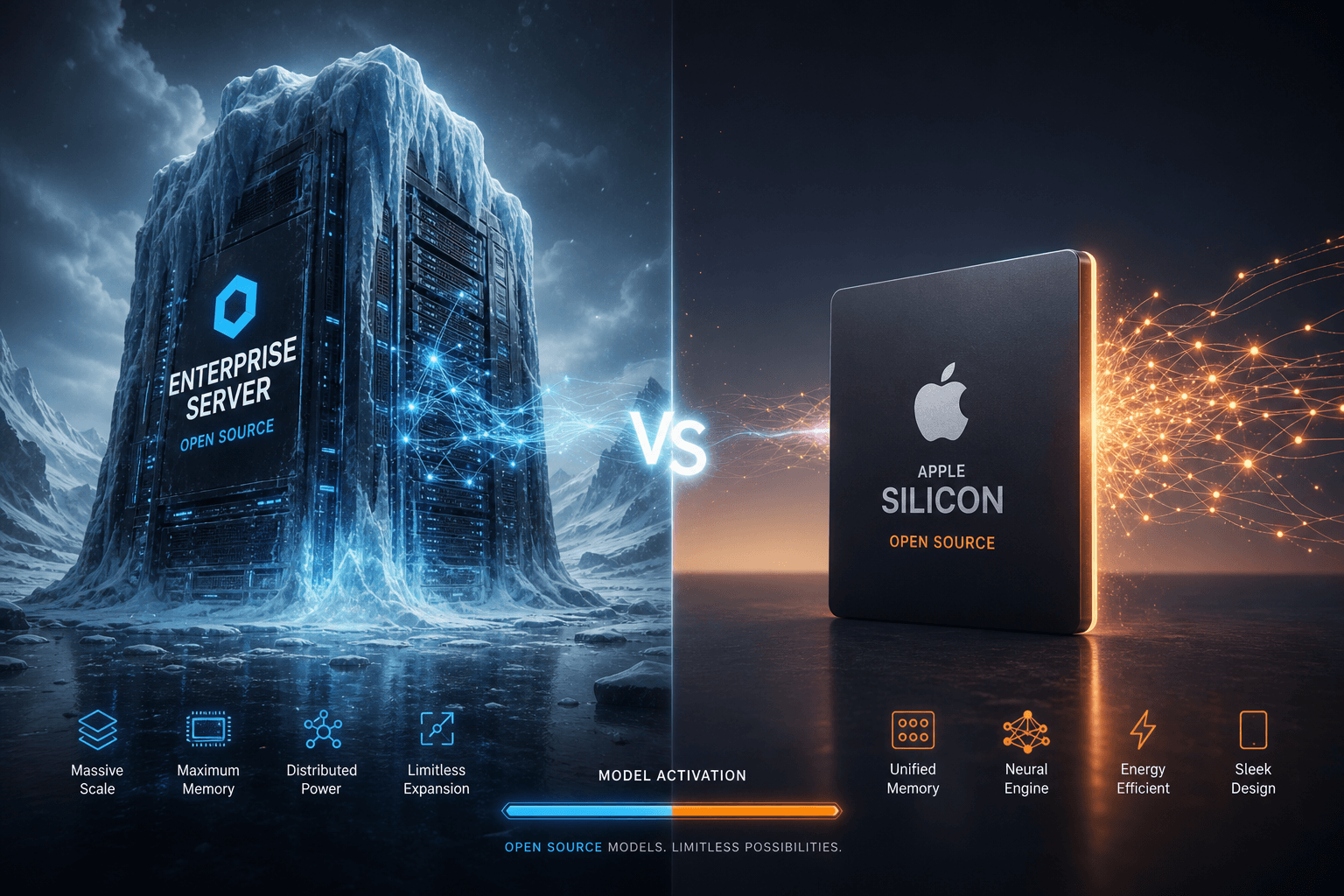
The contrast between Arctic and OpenELM is the sharpest in this cluster. Arctic says efficiency means activating fewer parameters in a massive model to hit enterprise-grade accuracy at lower inference cost. OpenELM says efficiency means fitting a capable model into the memory envelope of a phone. Same word — "efficient" — completely different architectures, completely different customers.
Snowflake Arctic: The Enterprise Data Model #
Snowflake Arctic is a 480B parameter Mixture of Experts model released April 24, 2024, under Apache 2.0 — built specifically for enterprise SQL, code generation, and data tasks.
This is not a general-purpose assistant model. Snowflake is a data cloud company, and Arctic reflects exactly that focus. The model is designed to be the AI layer that sits on top of your Snowflake data warehouse and actually understands what you're asking for in business terms.
Architecture: Dense-MoE Hybrid #
Arctic uses a hybrid architecture that's worth understanding because it explains the efficiency claim:
- 10B dense transformer base — handles general language understanding
- 128 × 3.66B MoE MLP experts — top-2 gating activates only 2 experts per token, keeping active parameters at ~17B
- Total parameters: 480B. Active parameters per inference pass: ~17B
The implication: you get the capacity of a 480B model's expert coverage, but inference compute costs scale with the 17B active parameters. Snowflake claims this runs at 75% lower compute cost than Llama 3 70B and 50% lower than DBRX — while outperforming both on enterprise benchmarks.
| Model | Total Params | Active Params | Approx Relative Compute |
|---|---|---|---|
| Snowflake Arctic | 480B | ~17B | 1x (baseline) |
| DBRX | 132B | ~36B | ~2x |
| Llama 3 70B | 70B | 70B | ~4x |
| Mixtral 8x7B | 46.7B | ~12.9B | ~0.75x |
What Arctic Actually Targets #
Snowflake trained Arctic on a dataset weighted heavily toward SQL, code, and structured instruction following. The training run took approximately 3 months, used 1,000+ GPUs, and cost roughly $2 million — notably cheap for a 480B model, which is part of the Apache 2.0 open-source story.
The tasks Arctic is optimized for:
- Text-to-SQL — converting natural language questions to accurate SQL queries over enterprise schemas
- Code generation — particularly Python and SQL-adjacent data processing code
- Instruction following on structured data — parsing, transforming, classifying business records
- Enterprise Q&A — grounded responses over business documents with low hallucination tolerance
This is not the model you reach for when you need creative writing, nuanced reasoning, or complex multi-step logic. This is the model you reach for when you need your data warehouse to answer business questions reliably at scale.
Where to Access Arctic #
Arctic weights are open on GitHub (Snowflake-Labs/snowflake-arctic) and Hugging Face. Hosted inference is available through Microsoft Azure, Together AI, and Lamini — meaning you don't have to stand up your own GPU cluster to use it. Snowflake's own platform is obviously the natural home for the use case it's designed around.
Apple OpenELM: The On-Device Bet #
Apple OpenELM is a family of four open-source language models (270M, 450M, 1.1B, 3B parameters) released April 25, 2024, under Apache 2.0 — built for on-device inference on Apple silicon.
This one is worth paying attention to specifically because of who released it and where they're going. Apple doesn't release open-source models often. OpenELM signals a direct investment in the on-device AI stack that Apple will eventually ship in iPhones and Macs.
The OpenELM Architecture: Layer-Wise Scaling #
OpenELM uses a design pattern called layer-wise scaling — rather than using the same attention head count and feed-forward dimension throughout the entire model, it varies them layer by layer. Early layers use narrower configurations; later layers (where richer representations form) use wider configurations.
The claim: this gets better parameter efficiency than uniform architectures of the same parameter count. Apple's published research shows OpenELM models outperforming OLMo models of comparable size on language benchmarks despite fewer total parameters.
| OpenELM Model | Params | MMLU | Notes |
|---|---|---|---|
| OpenELM-270M | 270M | — | Smallest, minimal hardware |
| OpenELM-450M | 450M | — | Balanced for very constrained devices |
| OpenELM-1.1B | 1.1B | — | Primary on-device target |
| OpenELM-3B | 3B | ~60%+ | Near Phi-3 Mini territory |
Why Apple is Open-Sourcing Models #
Apple doesn't have a cloud AI services business the same way OpenAI, Google, or Microsoft do. Their incentive for open-sourcing OpenELM is research community engagement and on-device ecosystem building — not competing for API revenue.
OpenELM is explicitly designed to run on Apple silicon: M-series chips (M1, M2, M3) and the A-series chips in iPhones and iPads. This is clearly foundational work for Apple Intelligence features that are coming to the Apple ecosystem. Open-sourcing it accelerates the research feedback loop and lets third-party iOS/macOS developers build on the same architecture.
OpenELM vs Phi-3 Mini: Which On-Device Model Wins? #
Both OpenELM 3B and Phi-3 Mini 3.8B target on-device deployment with roughly similar parameter counts. Key differences:
| Factor | OpenELM 3B | Phi-3 Mini 3.8B |
|---|---|---|
| Params | 3B | 3.8B |
| MMLU | ~60% (est) | 69% |
| MT-Bench | — | 8.38 |
| Context | Standard 2K | 4K / 128K |
| Architecture | Layer-wise scaling | Standard dense |
| Hardware focus | Apple silicon | Cross-platform |
| License | Apache 2.0 | MIT |
| Availability | HF, research | Azure, HF, Ollama, NVIDIA NIM |
Phi-3 Mini has the edge on benchmark performance and ecosystem availability right now. OpenELM's advantage is Apple silicon optimization — if you're building iOS or macOS apps, OpenELM is the model Apple wants you to build on. For everything else, Phi-3 Mini is currently stronger.
The "Small Model Wars" Narrative: What April 2024 Actually Kicked Off #
April 2024 is the week where "you need a 70B+ model to do useful AI work" stopped being true — and multiple major organizations all proved it simultaneously.
The framing shift happening in real time: for most production AI tasks, the bottleneck is no longer model capability — it's inference cost, latency, and deployment constraints. Once model quality crosses "good enough" for your specific task, every dollar you spend on extra parameters is waste.
The three competing philosophies on display this week:
Philosophy 1: Efficiency Through Data Quality (Microsoft / Phi-3) #
Train a smaller dense model on dramatically higher-quality data. 3.3 trillion tokens of filtered, reasoning-rich content produces a 3.8B model that competes with 46B parameter MoE systems. The bet: the quality of your training data compounds faster than the quantity of your parameters.
Philosophy 2: Efficiency Through Sparse Activation (Snowflake / Arctic) #
Build a massive model with an MoE architecture so you activate only a fraction of it per token. 480B total parameters, 17B active — you get breadth of expert coverage at a fraction of the inference compute. The bet: sparse activation closes the efficiency gap on large models without sacrificing capability.
Philosophy 3: Efficiency Through Hardware Co-Design (Apple / OpenELM) #
Build a model architecture specifically optimized for the hardware it will run on (Apple silicon), accept a capability ceiling, and make on-device inference genuinely fast. The bet: vertical integration wins when hardware control is absolute.
All three bets are rational. They just serve different customers with different constraints.
Who Should Build With Each Model Right Now #
The right model for your use case depends entirely on your deployment target and task type — not on which benchmark headline is biggest.
Here's my straightforward routing guide:
| Scenario | Best Choice | Why |
|---|---|---|
| Enterprise text-to-SQL on Snowflake | Arctic | Purpose-built, Apache 2.0, best SQL benchmarks |
| On-device iOS / macOS app | OpenELM | Apple silicon optimized, Apple's preferred stack |
| Cross-platform on-device (Android, Windows) | Phi-3 Mini | Strongest general benchmarks, widest deployment support |
| General cloud inference, cost-constrained | Phi-3 Mini / Phi-3 Small | Best cost/performance ratio for general tasks |
| Complex enterprise reasoning | Llama 3 70B or larger | None of these handle deep reasoning at frontier level |
| Fine-tuning on domain data | Phi-3 Mini | MIT license, fits on single A100, strong base |
The mistake I see teams making right now: treating all "small models" as interchangeable. Arctic is not competing with OpenELM. OpenELM is not competing with Phi-3 Mini for enterprise SQL. Each of these is purpose-built for a specific deployment context.
The Apache 2.0 Licensing Pattern: Why It Matters #
Both Arctic and OpenELM ship under Apache 2.0 — and that's a deliberate signal from both companies about their commercial strategy.
Apache 2.0 permits commercial use, modification, distribution, and patent use. Compared to Llama 2's custom license (which restricted commercial use above 700M monthly active users), Apache 2.0 is genuinely open with no usage cap surprises.
The reason Snowflake chose Apache 2.0 is straightforward: they want enterprises to adopt Arctic for their data workflows. Putting it under a restrictive license would undermine the enterprise adoption play. Apple chose Apache 2.0 for research openness — they want the academic community building on OpenELM's architecture.
| Model | License | Commercial Use | Fine-Tune? | Redistribute? |
|---|---|---|---|---|
| Snowflake Arctic | Apache 2.0 | ✅ Unrestricted | ✅ | ✅ |
| Apple OpenELM | Apache 2.0 | ✅ Unrestricted | ✅ | ✅ |
| Microsoft Phi-3 | MIT | ✅ Unrestricted | ✅ | ✅ |
| Meta Llama 3 | Custom | ✅ (with limits) | ✅ | ⚠️ |
| Mistral 7B / 8x7B | Apache 2.0 | ✅ Unrestricted | ✅ | ✅ |
This week's three major drops — Phi-3 (MIT), Arctic (Apache 2.0), OpenELM (Apache 2.0) — are all genuinely commercial-friendly. That matters more than the benchmark headlines for teams trying to build production AI systems.
What the Convergence Means for AI Automation Builders #
If you're building AI automation systems in April 2024, the week's releases collectively validate a multi-tier inference architecture — and give you the open-source components to build it.
The architecture I'm now confident in:
[Task Ingestion]
      ↓
[Complexity + Type Classifier]
      ↓
┌─────────────────────────────────────────────────┐
│ Task Type Router                                │
│                                                 │
│ SQL / Data Query ──────────→ Arctic             │
│ On-Device (Apple) ─────────→ OpenELM 3B         │
│ General (cheap, fast) ─────→ Phi-3 Mini         │
│ General (medium complexity) → Phi-3 Small / 7B  │
│ Complex reasoning ─────────→ Claude / GPT-4     │
└─────────────────────────────────────────────────┘
In n8n, this is a Switch node after an HTTP classifier call. Each branch routes to a different model endpoint. You're only paying frontier API rates for the 15–20% of tasks that actually need it.
The critical insight from this week: the model ecosystem just gave us the pieces for this architecture in fully open, commercially licensed form. We now have strong options for every tier.
My Hot Take: April 2024 Is the "Cambrian Moment" for Efficient AI #
Here's my actual read on what this week means: we've entered the phase where model capability commoditizes and deployment efficiency becomes the real moat.
For the past two years, the AI story was about frontier capability — who has the biggest MMLU score, the longest context window, the best coding benchmark. That era isn't over, but a second front has opened: can you make AI work in the places it actually needs to work?
On-device. In enterprise data pipelines. At billions of inference calls per day without burning the infrastructure budget.
Arctic, OpenELM, and Phi-3 are all bets that this second front is where the practical value creation is. And they're all dropping in the same week — not because of coordination, but because the problem is obvious to anyone who's tried to actually deploy AI at scale.
The "bigger is better" narrative still applies to frontier capability benchmarks. But for production systems making real decisions in real infrastructure, the game is changing. Data quality, architecture efficiency, and hardware co-design are becoming the primary differentiators. This week is the clearest evidence yet.
FAQ: Snowflake Arctic and Apple OpenELM Answered #
What is Snowflake Arctic?
Snowflake Arctic is a 480B parameter Mixture of Experts model released April 24, 2024, under Apache 2.0. It activates only ~17B parameters per inference pass via top-2 gating across 128 experts, making it efficient to run despite its massive total size. It's purpose-built for enterprise SQL, code generation, and structured data tasks.
What is Apple OpenELM?
Apple OpenELM is a family of four open-source language models (270M, 450M, 1.1B, 3B) released April 25, 2024, under Apache 2.0. They use layer-wise scaling for better parameter efficiency and are designed primarily for on-device inference on Apple silicon (M-series and A-series chips).
Is Snowflake Arctic actually 480B active parameters?
No — Arctic activates approximately 17B parameters per token during inference, not all 480B. The 480B is the total model size across all 128 experts. The top-2 gating means only 2 experts are active for any given token, keeping inference compute costs aligned with the ~17B active parameter count.
How does Snowflake Arctic compare to DBRX and Llama 3?
Arctic outperforms DBRX and Llama 3 70B on enterprise benchmarks (SQL, code, instruction following) while using roughly 50–75% less compute. Snowflake claims Arctic achieves this on approximately 7x less compute than DBRX required in training.
What license does Snowflake Arctic use?
Apache 2.0 — fully open for commercial use, fine-tuning, and redistribution with no usage caps. This makes it a genuinely viable option for enterprise teams that need to deploy, customize, or redistribute the model without licensing complexity.
What is Apple's reason for open-sourcing OpenELM?
Apple open-sourced OpenELM to engage the research community and accelerate on-device AI development on Apple silicon. It's foundational work for Apple Intelligence features and gives third-party iOS/macOS developers access to the same model architecture Apple is building on.
Which is better: OpenELM or Phi-3 Mini?
Phi-3 Mini has stronger general benchmark scores (69% MMLU vs ~60% est. for OpenELM 3B) and wider deployment support. OpenELM's advantage is Apple silicon optimization — if you're building specifically for iOS or macOS, OpenELM is the more natural fit. For cross-platform or cloud use, Phi-3 Mini is currently stronger.
What is "layer-wise scaling" in OpenELM?
Layer-wise scaling varies the attention head count and feed-forward width across the model's layers rather than using a uniform dimension throughout. Early layers use narrower configurations; later layers use wider ones. Apple claims this improves parameter efficiency compared to uniform architectures of the same size.
Can Snowflake Arctic run on a single GPU?
No — at 480B total parameters, Arctic requires a multi-GPU setup for full inference. However, together with its 17B active parameter count, it's more memory-efficient than a fully dense 70B model. For most teams, using a hosted endpoint (Azure, Together AI, Lamini) is the practical path rather than self-hosting.
What does the "small model wars" mean for AI builders?
The small model wars represent a shift from raw capability maximization to deployment efficiency optimization. For builders, it means a multi-tier inference architecture (cheap models for simple tasks, expensive models for complex ones) is now practical and well-supported with open-source options across every tier.
Building Your AI Stack Around the New Open Model Landscape #
April 2024 just handed you a genuinely strong set of open-source, commercially licensed models that cover every tier of a production AI inference stack. Arctic for enterprise data. OpenELM for Apple on-device. Phi-3 for general-purpose efficient inference. Llama 3 70B for medium-complexity general tasks.
The teams that will win in this environment aren't the ones waiting for the next frontier model drop. They're the ones building the routing infrastructure, the fine-tuning pipelines, and the evaluation frameworks that let them actually deploy this stack in production.
If you want to build that kind of intelligent, cost-optimized AI automation architecture for your business — with the right model at each tier and the workflows to connect them — let's talk about what it looks like for your specific operations.
Related posts: Microsoft Phi-3 Mini: The Small Model That Benchmarked Like a 70B Beast · Mistral 8x22B Torrent Drop — The New Open-Source Frontier
Related Posts

Google I/O 2026 Action List: How I Prompted Gemini 3.5 Flash and Antigravity Workflows
Google I/O 2026 just reset the AI tooling landscape. Here's the 9-action checklist for builders who want to ship this week, not just watch the keynote.
Anthropic vs. OpenAI vs. Google: The State of the Frontier in May 2026
A head-to-head breakdown of the three AI giants in May 2026: Claude Opus 4.6, GPT-5.3 and 5.4, Gemini 3.1 Pro. Real specs, real pricing, and what actually matters for builders.
Kimi K2 Open Weights: How I Prompted Moonshot's Frontier Model for Agentic Tool Use
How I direct Kimi K2 by Moonshot AI for agentic workflows, long-context tool calling, and workflow automation. A 1 trillion parameter MoE model with competitive benchmarks at 5-17x lower cost than GPT-5 and Claude.