Stable Diffusion 3 API vs Midjourney: Stability AI's 2024 Developer Play

Table of Contents
Stable Diffusion 3 API vs Midjourney: Stability AI's 2024 Developer Play #
Stability AI launched the Stable Diffusion 3 API on April 17, 2024 — a day before Llama 3 dropped and in the middle of the most active week in open-source AI history. SD3's timing was either confident or unfortunate, depending on how much attention you were paying to the model news cycle.
The headline improvement: SD3 can render readable text in images. If you've used SD2 or SDXL for anything requiring logos, labels, or typographic elements, you know how bad the old situation was. SD3 doesn't just improve on this — it closes the gap with DALL-E 3, which has had this capability for months.
Here's the full breakdown: what changed architecturally, how the API works, pricing vs Midjourney, and which tool fits which workflow.
Table of Contents #
- What Is Stable Diffusion 3?
- The MMDiT Architecture: Why It Matters
- Typography and Text Rendering: The Main Upgrade
- SD3 API: How It Works
- Pricing: SD3 API vs Midjourney Subscription
- SD3 vs Midjourney v6: Quality Comparison
- When to Use SD3 API vs Midjourney
- Limitations and What's Still Missing
What Is Stable Diffusion 3? {#what-is-sd3} #
Stable Diffusion 3 is Stability AI's third-generation text-to-image model, now available via API in partnership with Fireworks AI. It's the first major architecture change since SDXL — a shift from the U-Net diffusion backbone to a Multimodal Diffusion Transformer (MMDiT).
The API launched April 17, 2024. Two variants are available immediately:
- Stable Diffusion 3 — the full model, highest quality
- Stable Diffusion 3 Turbo — faster inference, slightly lower quality
The weights are not publicly released yet. Unlike SD1/SD2/SDXL (which were open weights from day one), SD3 is API-only at launch. Stability AI has stated they plan to release weights for self-hosting at some point through their membership program — but as of today, API is the only path.
The MMDiT Architecture: Why It Matters {#mmdit-architecture} #
SD3 replaces the U-Net backbone with a Multimodal Diffusion Transformer (MMDiT) — a fundamentally different approach that treats image data and text data as separate learned representations that interact throughout the diffusion process.
Previous SD models used a U-Net denoising network that received text embeddings as conditioning through cross-attention. The text encoder was separate and somewhat static. The image generation network was the primary component; text was more of a steering signal.
MMDiT changes this by:
- Maintaining separate learned representations for image patches and text tokens
- Allowing bidirectional information flow between image and text throughout all denoising steps
- Using transformer blocks (rather than convolutional U-Net layers) as the core computation
The practical result: the model has a much richer understanding of the relationship between text tokens and spatial regions of the image. When you prompt for "red text on a white background," the model understands that the word "red" should be associated with a specific color property of a specific spatial element — not just as a general conditioning signal.
This is why the typography improves so dramatically. Text rendering in images is fundamentally a spatial-semantic alignment problem, and MMDiT's architecture is better suited to it.
Typography and Text Rendering: The Main Upgrade {#typography-upgrade} #
SD3 can render legible, correctly spelled text in generated images. This is the single most important practical improvement for developers using image generation in workflows.
Before SD3, every SD model had the same problem: ask it to generate an image with text, and you'd get something that looked like letters but was almost always garbled. "HELLO WORLD" might come out as "H3LLO WORID" or vaguely letter-shaped marks. Fixing this required inpainting workarounds or post-processing.
DALL-E 3 (OpenAI) addressed this months ago and it became a key selling point. Midjourney v6 improved significantly but still struggles with longer text strings. SD3 is entering this competition with architecture designed specifically for this capability.
What SD3 handles well:
- Short phrases (1–5 words) — near-100% accuracy
- Logos and wordmarks with simple typography
- Labels and captions in scene context
- Stylized lettering (neon, chalkboard, etc.)
What still trips it up:
- Long sentences or multiple lines of text
- Unusual fonts or heavily stylized letterforms
- Very small text within complex compositions
For automated image generation workflows — generating product thumbnails, social card images, or templated marketing assets via API — SD3's text rendering is now good enough to use without a manual QA step for simple text elements.
SD3 API: How It Works {#sd3-api} #
The SD3 API uses Stability AI's Developer Platform, with inference handled by Fireworks AI for 99.9% uptime. You get an API key from Stability AI and make HTTP requests to their endpoint.
Basic API call:
import requests
import base64

response = requests.post(
    "https://api.stability.ai/v2beta/stable-image/generate/sd3",
    headers={
        "authorization": f"Bearer {STABILITY_API_KEY}",
        "accept": "image/*"
    },
    files={"none": ""},
    data={
        "prompt": "A clean product photo of a coffee mug with the text 'Morning Ritual' on it, white background, studio lighting",
        "model": "sd3",           # or "sd3-turbo"
        "aspect_ratio": "1:1",   # 16:9, 2:3, 3:2, etc.
        "output_format": "png",
        "seed": 42               # optional, for reproducibility
    }
)

# Save the image
with open("output.png", "wb") as f:
    f.write(response.content)
Supported aspect ratios: 16:9, 1:1, 21:9, 2:3, 3:2, 4:5, 5:4, 9:16, 9:21
Output formats: PNG, JPEG, WebP
SD3 Turbo has the same API interface but generates faster with slightly lower quality. For high-volume, cost-sensitive workflows, Turbo is the better default.
For n8n integration, use the HTTP Request node with multipart/form-data content type and the Stability API key in the Authorization header. The response is the raw image binary — pipe it to a file node or S3 upload.
Pricing: SD3 API vs Midjourney Subscription {#pricing-comparison} #
SD3 is priced per image via API; Midjourney is a subscription with limited monthly images. The right comparison depends entirely on your volume.
| Plan | Cost | Images/Month | Cost per Image |
|---|---|---|---|
| Midjourney Basic | $10/mo | ~200 (fast hours limited) | ~$0.05 |
| Midjourney Standard | $30/mo | ~900 (unlimited relaxed) | ~$0.03 |
| Midjourney Pro | $60/mo | ~1,800 (unlimited relaxed) | ~$0.033 |
| SD3 API (estimate) | Pay-per-use | Unlimited | ~$0.065/img |
| SD3 Turbo API | Pay-per-use | Unlimited | ~$0.040/img |
Note: SD3 API pricing as of launch isn't fully published — the ~$0.065/image figure is an estimate based on credit pricing from the platform and comparable services. Together AI has listed SD3 Medium at $0.0019/megapixel post-launch.
The break-even analysis:
- Under ~500 images/month: Midjourney Standard ($30) is cheaper
- 500–1,500 images/month: comparable cost
- Above 1,500 images/month: SD3 API scales more linearly; Midjourney subscriptions cap out
The real cost difference isn't just price-per-image — it's workflow integration. Midjourney requires Discord for generation; it has no public API. That means human-in-the-loop workflows only. SD3 API is fully automatable — you can wire it into n8n, trigger it from a webhook, upload results to S3, and never touch a UI.
SD3 vs Midjourney v6: Quality Comparison {#quality-comparison} #
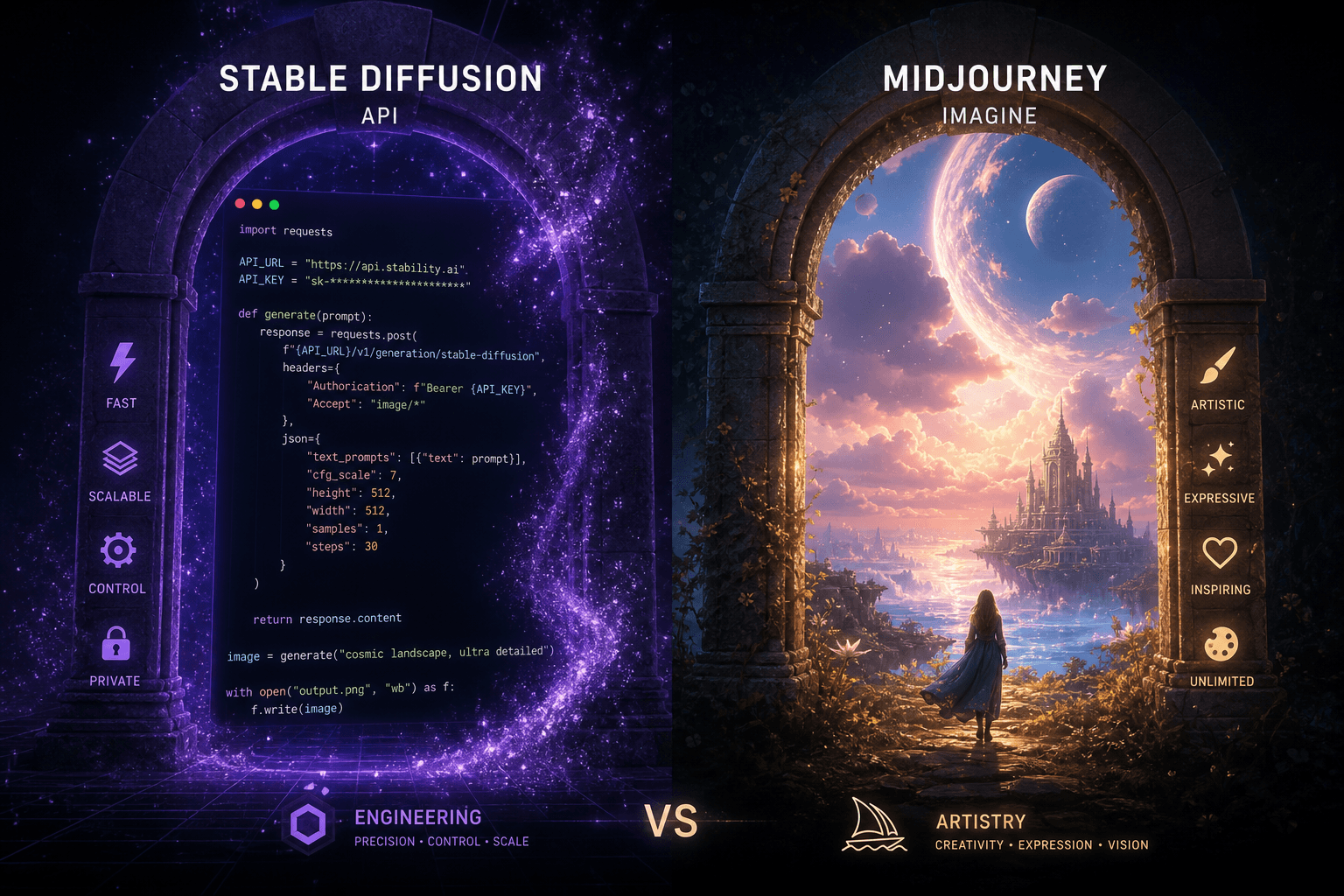
Midjourney v6 wins on artistic quality and aesthetic coherence for creative work. SD3 wins on text rendering and API accessibility for developer workflows.
| Capability | SD3 | Midjourney v6 |
|---|---|---|
| Text rendering in images | ✅ Excellent | 🟡 Good (struggles at length) |
| Prompt adherence | ✅ Strong | ✅ Strong |
| Photorealistic portraits | 🟡 Good | ✅ Excellent |
| Abstract/artistic styles | 🟡 Good | ✅ Excellent |
| API access | ✅ Yes | ❌ No (Discord only) |
| Self-hostable | ❌ Not yet | ❌ No |
| Speed | 🟡 10–20s (SD3) / 5–8s (Turbo) | 🟡 20–60s (varies) |
Stability AI claims SD3 equals or outperforms DALL-E 3 and Midjourney v6 in their human preference evaluations. Based on my first-day testing: that's accurate for structured prompts with text elements. For open-ended creative generation, Midjourney v6's aesthetic sensibility is still a step above what SD3 produces by default.
When to Use SD3 API vs Midjourney {#when-to-use} #
Use SD3 API for: automated pipelines, images requiring readable text, developer workflows, high-volume generation, anything that needs to run without human oversight.
Use Midjourney for: creative direction, art direction, high-quality marketing visuals, anything where aesthetic judgment matters and a human is in the loop.
| Use Case | Recommendation |
|---|---|
| Automated thumbnail generation | SD3 API |
| Social media content pipeline | SD3 API (if text needed) / Midjourney (if high aesthetic bar) |
| Product mockups with labels | SD3 API |
| Logo concepts | Midjourney |
| Illustration and concept art | Midjourney |
| n8n / automation workflow | SD3 API |
| One-off creative projects | Midjourney |
The key question: does a human need to approve every image, or does this run automatically? If it's automated, SD3 API. If a creative director is reviewing outputs, Midjourney still has the better aesthetic ceiling.
Limitations and What's Still Missing {#limitations} #
SD3 is a meaningful improvement but has real limitations today:
- API-only, no weights released. You can't self-host for cost efficiency or privacy. For sensitive use cases, this matters.
- Pricing not fully transparent. The credit system isn't as clear as OpenAI's per-image pricing.
- No image-to-image via API at launch. SDXL's img2img capabilities aren't in the initial SD3 API.
- Inpainting not yet available via API. Coming later.
- Still struggles with complex scenes + text. Typography wins are real but limited to relatively simple compositions.
The no-weights situation is the biggest miss for the open-source community. Part of what made SD1 and SD2 so influential was the ability to fine-tune, merge, and modify the models freely. SD3 as API-only loses that ecosystem advantage entirely. Stability AI is betting the developer platform strategy is worth more than the open-weights community trust — it's a gamble.
Frequently Asked Questions #
What is Stable Diffusion 3?
Stable Diffusion 3 is Stability AI's third-generation text-to-image model, launched via API on April 17, 2024. It uses a Multimodal Diffusion Transformer (MMDiT) architecture that significantly improves text rendering, prompt adherence, and image quality.
How does the SD3 API work?
You make HTTP POST requests to api.stability.ai/v2beta/stable-image/generate/sd3 with your API key, a text prompt, and parameters like aspect ratio and output format. The response is the generated image as binary. It integrates directly with n8n, Python scripts, or any HTTP client.
Is Stable Diffusion 3 better than Midjourney?
It depends on the use case. SD3 beats Midjourney v6 on text rendering within images and is the only option if you need API access for automation. Midjourney v6 generally produces higher aesthetic quality for artistic and creative work.
Does SD3 have better text rendering than DALL-E 3?
Stability AI claims SD3 equals or outperforms DALL-E 3 on text rendering in their human preference evaluations. Both are significantly better than any previous SD model for typography in images.
What is the MMDiT architecture in SD3?
MMDiT (Multimodal Diffusion Transformer) is SD3's core architecture, replacing the U-Net backbone of previous SD versions. It maintains separate learned representations for image patches and text tokens with bidirectional information flow — which is why text rendering and spatial understanding improve dramatically.
Can I self-host Stable Diffusion 3?
Not yet. SD3 launched as API-only. Stability AI has committed to making weights available through their membership program in the future, but no timeline has been given.
How much does the SD3 API cost?
Pricing is per image via Stability AI's credit system. Estimated cost is roughly $0.04–0.065 per image depending on the variant (Turbo vs full SD3). This makes it cost-competitive with Midjourney subscriptions at moderate volumes and more economical at high volume.
What's the difference between SD3 and SD3 Turbo?
SD3 Turbo is a distilled, faster version that generates images in roughly half the time of the full SD3. Quality is slightly lower, particularly on fine details. For high-volume automated workflows where speed matters, Turbo is the better choice.
Wire Image Generation Into Your Automation Stack #
SD3's API-first approach is the right move for developers building automated content pipelines. If you're generating images at scale — product thumbnails, social cards, marketing assets — SD3 gives you a text-rendering-capable model that connects directly to n8n or any HTTP-accessible workflow.
If you want to architect an end-to-end content generation pipeline — AI writing, AI imagery, automated publishing, CMS integration — that's exactly what I build.
Book an AI automation strategy call →
Related reading:
Related Posts
Google I/O 2026 Action List: How I Prompted Gemini 3.5 Flash and Antigravity Workflows
Google I/O 2026 just reset the AI tooling landscape. Here's the 9-action checklist for builders who want to ship this week, not just watch the keynote.
Anthropic vs. OpenAI vs. Google: The State of the Frontier in May 2026
A head-to-head breakdown of the three AI giants in May 2026: Claude Opus 4.6, GPT-5.3 and 5.4, Gemini 3.1 Pro. Real specs, real pricing, and what actually matters for builders.
Kimi K2 Open Weights: How I Prompted Moonshot's Frontier Model for Agentic Tool Use
How I direct Kimi K2 by Moonshot AI for agentic workflows, long-context tool calling, and workflow automation. A 1 trillion parameter MoE model with competitive benchmarks at 5-17x lower cost than GPT-5 and Claude.