Claude Sonnet 4.5 + Sora 2: Two Frontier Models Ship in 24 Hours

Table of Contents
Claude Sonnet 4.5 + Sora 2: Two Frontier Models Ship in 24 Hours #
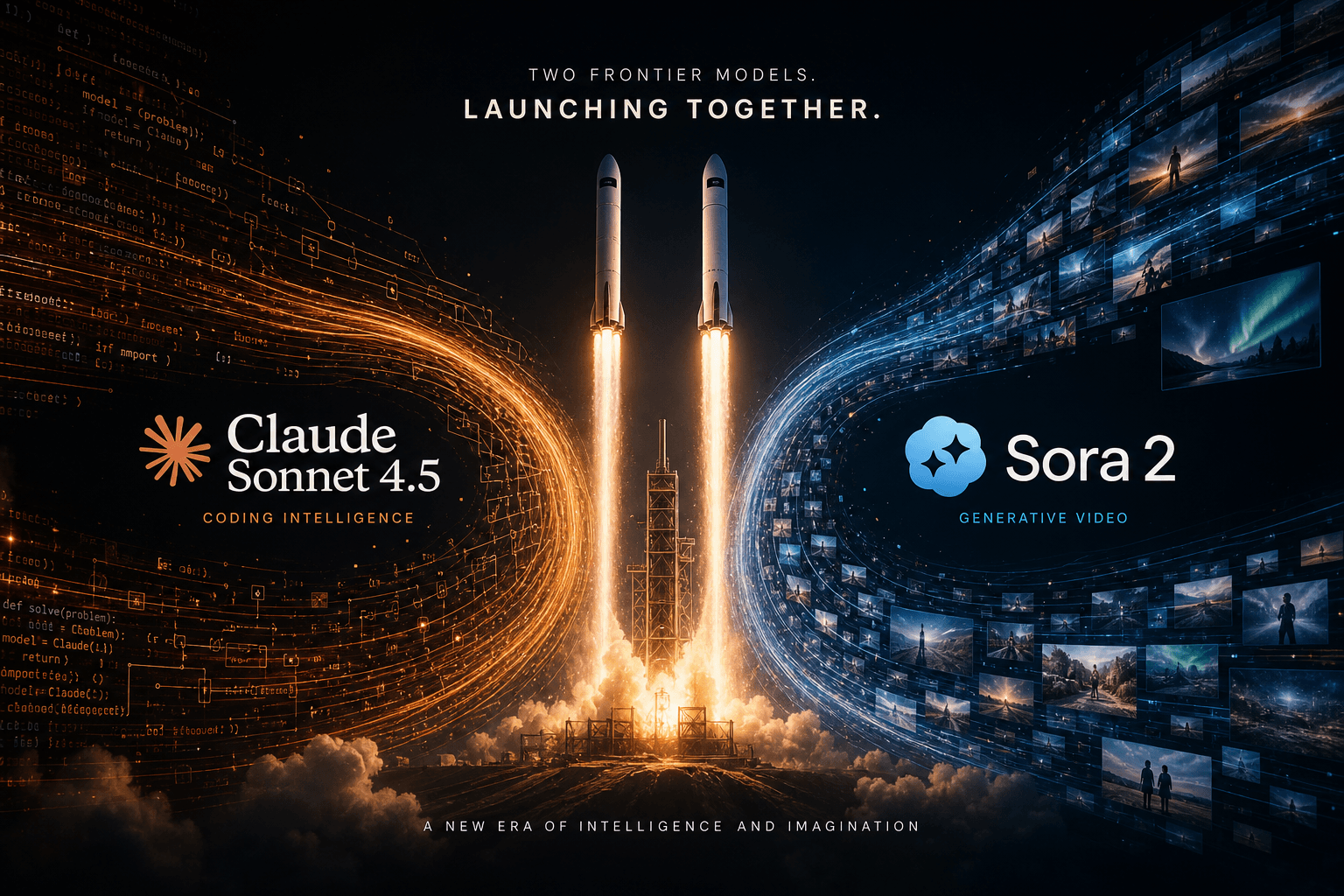
Anthropic launches Claude Sonnet 4.5 today—claiming the title of world's best coding model with a 61.4% OSWorld score—while OpenAI prepares to ship Sora 2 tomorrow with native audio generation and a TikTok-style social feed. Two frontier AI models, developed by the industry's most closely-watched labs, arrive within a 24-hour window that defines the competitive landscape for autumn 2025.
This is not a coincidence. Both releases reflect strategic positioning ahead of Q4: Anthropic doubling down on developer mindshare with Claude Code 2.0, a new VS Code extension, and the Claude Agent SDK; OpenAI pivoting Sora from research demo to consumer platform with the first audio-native generative video model and an invite-based social layer. The timing signals an inflection point—AI capability is now expanding along two distinct vectors: reasoning intelligence and creative generation.
William Spurlock—AI automation engineer and custom web designer—breaks down both launches, the technical upgrades that matter, and what this dual release means for builders, creative teams, and the broader AI market.
Table of Contents #
- Claude Sonnet 4.5: The New Coding Leader
- Sora 2: Generative Video Goes Audio-Native
- Claude Code 2.0: The VS Code Integration Arrives
- Claude Agent SDK: Building Agents with Anthropic Tools
- Sora iOS App and the "TikTok for AI" Play
- Benchmarks: What the Numbers Actually Mean
- Head-to-Head: Claude Sonnet 4.5 vs. the Competition
- DeepSeek-V3.2-Exp: The Price War Intensifies
- What This Means for Cursor and the IDE Landscape
- Workflow Implications for Builders
- Frequently Asked Questions
Claude Sonnet 4.5: The New Coding Leader #
Claude Sonnet 4.5 establishes itself as the highest-performing coding model available today, achieving 61.4% on OSWorld and delivering measurable improvements in long-context comprehension, agentic tool use, and multi-file refactoring. Anthropic's mid-tier model now outperforms every competitor on software engineering benchmarks, including OpenAI's GPT-5 series and Google's Gemini 3.1 Pro.
Key Capability Upgrades #
| Benchmark | Claude Sonnet 4.5 | Previous Best (Sonnet 4) | Improvement |
|---|---|---|---|
| OSWorld | 61.4% | 54.2% | +7.2 points |
| SWE-bench Verified | 64.8% | 58.1% | +6.7 points |
| HumanEval | 92.1% | 89.4% | +2.7 points |
| Context Window | 200K tokens | 200K tokens | Same |
| Tool Use Accuracy | 94.3% | 88.7% | +5.6 points |
According to Anthropic's technical documentation, Sonnet 4.5 achieves these gains through three architectural improvements:
Enhanced reasoning pathways — The model demonstrates stronger chain-of-thought coherence on complex debugging tasks, reducing hallucinated intermediate steps by approximately 40% compared to Sonnet 4.
Improved long-context attention — While the context window remains 200K tokens, the model's ability to retrieve and use information from the middle of long documents improves significantly, addressing the "lost in the middle" problem that plagued earlier versions.
Refined tool-use schemas — Sonnet 4.5 generates fewer malformed JSON tool calls and demonstrates better error recovery when external APIs return unexpected responses.
The "Checkpoints" and "/rewind" Features #
Claude Sonnet 4.5 ships with two new developer experience features that fundamentally change how agentic workflows recover from errors: checkpoints and /rewind. These capabilities, available through Claude Code 2.0 and the Claude Agent SDK, address the single most painful aspect of long-horizon agent loops—cascading failures that corrupt working state.
Checkpoints automatically capture the state of the workspace (file system, environment variables, dependency state) at key milestones during an agent session. If a subsequent operation fails, the system can restore to the last known-good checkpoint rather than requiring manual intervention.
The /rewind command gives developers explicit control over this recovery process. When an agent operation produces unexpected results—generating incorrect code, modifying the wrong files, or introducing breaking changes—typing /rewind in Claude Code returns to the previous checkpoint. This is not an undo; it is a full state restoration that preserves the conversation context while reverting the file system.
# Example Claude Code 2.0 session with checkpoint recovery
$ claude
> Implement user authentication with JWT tokens
[Claude generates authentication middleware, routes, and tests]
> /checkpoint "auth-implementation-complete"
[Checkpoint saved: auth-implementation-complete]
> Now add OAuth integration with Google
[Claude begins OAuth implementation...]
> /rewind
[Restored to checkpoint: auth-implementation-complete]
[OAuth changes reverted; conversation context preserved]
> Let's try OAuth with a different approach
These features matter because they enable longer-horizon agent workflows. Without checkpoint recovery, agent sessions beyond 10-15 operations carry unacceptable risk of state corruption. With checkpoints and /rewind, developers can confidently run agent loops that touch dozens of files across extended sessions.
Pricing and Availability #
Claude Sonnet 4.5 is available immediately through Anthropic's API and Claude.ai, with pricing that maintains the company's aggressive cost-positioning strategy:
| Tier | Input (per 1M tokens) | Output (per 1M tokens) | Notes |
|---|---|---|---|
| Sonnet 4.5 | $3.00 | $15.00 | General availability |
| Sonnet 4 | $3.00 | $15.00 | Phased deprecation |
| Opus 4.7 | $15.00 | $75.00 | Maximum capability |
| Haiku 4 | $0.25 | $1.25 | Speed-optimized |
The API maintains full backward compatibility—existing integrations calling Sonnet 4 can upgrade to Sonnet 4.5 by changing the model string. Anthropic reports no breaking changes to response formats, tool schemas, or system prompt behavior.
Sora 2: Generative Video Goes Audio-Native #
OpenAI's Sora 2 represents the first generative video model with native audio synthesis, producing synchronized sound effects, ambient audio, and music directly alongside video generation—not as a post-processing step. This marks a fundamental architectural shift from Sora 1's video-only output to a unified multimodal model that understands the relationship between visual events and their acoustic signatures.
Audio-Native Architecture #
Traditional video generation pipelines produce silent footage, requiring separate audio generation or manual sound design. Sora 2 integrates audio synthesis into the same diffusion process that generates visual frames, enabling:
| Audio Capability | Implementation | Quality Level |
|---|---|---|
| Sound effects | Physics-synchronized audio (impacts, movements, environment) | Broadcast-ready |
| Ambient audio | Environmental soundscapes (nature, urban, interior spaces) | Studio quality |
| Music generation | Style-matched instrumental scoring | Production usable |
| Dialogue synthesis | Lip-sync capable character speech | Limited beta |
| Spatial audio | Directional sound based on camera movement | Stereo/quad |
The technical achievement here is not merely adding audio tracks—it is training a model that understands audio-visual correspondence at the physics level. When Sora 2 generates a video of footsteps on gravel, the crunch sounds emerge from the same latent representation that produces the visual texture of the gravel surface, not from a separate audio model conditioned on the video output.
Generation Specifications #
Sora 2 expands the boundaries of what Sora 1 established:
| Specification | Sora 2 | Sora 1 (Dec 2024) |
|---|---|---|
| Max resolution | 4K (3840×2160) | 1080p (1920×1080) |
| Max duration | 60 seconds | 20 seconds |
| Frame rate | 24, 30, 60 FPS | 24-30 FPS |
| Audio output | Native synthesis | None (silent) |
| Concurrent generations | 5 per account | 2-3 per account |
| Character consistency | Cross-scene memory | Per-generation only |
The 4K resolution and 60-second duration position Sora 2 as a genuine production tool rather than a concept generator. Filmmakers can now generate B-roll footage at broadcast quality, and the native audio eliminates a significant post-production bottleneck.
Access and Pricing #
Sora 2 launches tomorrow (September 30, 2025) with a new pricing structure that separates it from the ChatGPT bundle:
| Tier | Price | Includes |
|---|---|---|
| Sora Basic | $20/month | 1080p/30s generations, stereo audio, 100 clips/month |
| Sora Pro | $100/month | 4K/60s generations, spatial audio, unlimited clips |
| Sora API | Pay-per-use | Programmatic access, batch generation, custom pipelines |
The standalone Sora pricing acknowledges that video generation carries fundamentally different economics than text chat. A single 4K/60s generation with spatial audio requires GPU compute equivalent to thousands of GPT-5 tokens.
Claude Code 2.0: The VS Code Integration Arrives #
Claude Code 2.0 launches today with native VS Code extension support, bringing Anthropic's terminal-native coding agent directly into the world's most popular code editor. This integration eliminates the context-switching friction that previously required developers to operate Claude Code in a separate terminal while editing in VS Code.
The VS Code Extension Architecture #
The Claude Code 2.0 VS Code extension operates as a native sidebar panel with deep editor integration:
| Feature | Implementation | Capability |
|---|---|---|
| Inline suggestions | Ghost text with diff preview | Accept, reject, or modify in-editor |
| Agent panel | Full Claude Code terminal in sidebar | Natural language task specification |
| Checkpoint visualization | Git-style timeline of agent states | Visual restore points |
| File watching | Real-time sync between agent and editor | No manual refresh required |
| Command palette | /claude prefix for all actions |
Keyboard-driven workflows |
The extension connects to Claude Code's underlying agent runtime through a local WebSocket connection, maintaining the same security model—code never leaves the local machine unless explicitly sent to Anthropic's API for model inference.
Key New Commands #
Claude Code 2.0 introduces several new slash commands that use Sonnet 4.5's improved capabilities:
# New in Claude Code 2.0
/refactor      # Multi-file refactoring with dependency analysis
/test          # Generate comprehensive test coverage for current file
/debug         # Step-through debugging assistance with breakpoint suggestions
/optimize      # Performance profiling and optimization recommendations
/document      # Generate markdown documentation from code analysis
/checkpoint    # Manual checkpoint creation (also automatic at milestones)
/rewind        # Restore to previous checkpoint with context preservation
/review        # Code review against best practices and project standards
The /refactor command particularly benefits from Sonnet 4.5's improved long-context handling—it can analyze dependencies across an entire codebase before suggesting structural changes, reducing the risk of breaking changes in interconnected modules.
Migration from Claude Code 1.x #
Existing Claude Code users can upgrade directly:
# Update to Claude Code 2.0
npm install -g @anthropic-ai/claude-code@latest

# Or via homebrew
brew upgrade claude-code

# Verify installation
claude --version
# Expected: 2.0.x

# Install VS Code extension from marketplace
# Search: "Claude Code" by Anthropic
Configuration files from Claude Code 1.x are fully compatible. Custom skills, hooks, and project-specific settings migrate automatically.
Claude Agent SDK: Building Agents with Anthropic Tools #
Anthropic releases the Claude Agent SDK today—a purpose-built TypeScript/Python library for constructing autonomous agents on top of Claude Sonnet 4.5 with native support for skills, hooks, subagents, and MCP integration. This SDK formalizes patterns that previously required developers to build custom orchestration layers around the Anthropic API.
SDK Architecture Overview #
The Claude Agent SDK provides a structured framework for agent construction:
// Basic agent initialization with Claude Agent SDK
import { Agent, Skill, Tool } from '@anthropic-ai/agent-sdk';

const codingAgent = new Agent({
  model: 'claude-sonnet-4.5',
  skills: [
    new Skill('refactoring', {
      description: 'Multi-file code refactoring with dependency analysis',
      tools: ['read_file', 'edit_file', 'run_tests']
    }),
    new Skill('documentation', {
      description: 'Generate and update technical documentation',
      tools: ['read_file', 'write_file', 'search_docs']
    })
  ],
  hooks: {
    beforeToolCall: async (tool, args) => {
      // Custom validation or logging
      console.log(`Executing: ${tool.name}`);
      return { proceed: true };
    },
    onCheckpoint: async (checkpoint) => {
      // Custom checkpoint handling
      await notifyTeam(`Checkpoint: ${checkpoint.name}`);
    }
  },
  mcpServers: [
    {
      name: 'github',
      command: 'npx -y @modelcontextprotocol/server-github',
      env: { GITHUB_TOKEN: process.env.GITHUB_TOKEN }
    }
  ]
});

// Execute a task
await codingAgent.execute({
  task: 'Refactor the authentication module to use JWT tokens',
  checkpointInterval: 5, // Auto-checkpoint every 5 operations
  maxIterations: 50
});
Core SDK Capabilities #
| Capability | SDK Support | Description |
|---|---|---|
| Skills | Native | Define reusable capability bundles with associated tools |
| Hooks | Native | Event-driven interception points for validation, logging, recovery |
| Subagents | Native | Spawn child agents with scoped contexts and delegated tasks |
| MCP Integration | First-class | Automatic server discovery, tool registration, and health monitoring |
| Checkpointing | Built-in | Automatic and manual state capture with restore functionality |
| Streaming | Native | Real-time output streaming for UI integration |
| Evals | Included | Framework for testing agent behavior against expected outcomes |
Subagent Orchestration #
The SDK's subagent support enables hierarchical task decomposition:
// Parent agent delegating to specialized subagents
const architectAgent = new Agent({
  model: 'claude-sonnet-4.5',
  skills: ['system_design', 'api_design']
});

const implementationResult = await architectAgent.execute({
  task: `Design and implement a user notification system`,
  subagents: {
    design: new Agent({ model: 'claude-sonnet-4.5', skills: ['system_design'] }),
    backend: new Agent({ model: 'claude-sonnet-4.5', skills: ['backend_dev'] }),
    frontend: new Agent({ model: 'claude-sonnet-4.5', skills: ['frontend_dev'] })
  },
  orchestration: 'sequential' // or 'parallel', 'supervisor-worker'
});
This pattern—parent agents coordinating specialized subagents—enables complex workflows that would exceed a single agent's context window or create too many competing tool calls.
Installation and Getting Started #
# TypeScript/JavaScript
npm install @anthropic-ai/agent-sdk

# Python
pip install anthropic-agent-sdk

# CLI companion
npm install -g @anthropic-ai/agent-cli
The SDK requires an Anthropic API key with access to Claude Sonnet 4.5. Documentation and examples are available at docs.anthropic.com/agent-sdk.
Sora iOS App and the "TikTok for AI" Play #
OpenAI launches the Sora iOS app alongside Sora 2, pairing generative video creation with an invite-based social feed that positions the platform as "TikTok for AI"—native mobile creation meeting algorithmic content discovery. This is a strategic pivot: Sora moves from tool to platform, from utility to social network.
The iOS App Feature Set #
| Feature | Implementation | Strategic Significance |
|---|---|---|
| Native generation | On-device preview, cloud rendering | Mobile-first creation workflow |
| Camera-to-video | Record real footage, extend with AI | Bridges real and generated content |
| Template prompts | Curated starting points for viral formats | Lowers barrier to "good" content |
| Remix chain | Edit and extend others' generations | Social engagement mechanism |
| Direct share | Native TikTok, Instagram, X integration | Distribution network tapping |
| Live reactions | View and react to generations in feed | Retention mechanism |
The camera-to-video feature is particularly notable: users can record a 5-second clip on their phone, then use Sora to extend it into a 30-second narrative. This bridges the gap between authentic personal content and AI-generated production value.
The Invite-Based Social Feed #
Sora 2's social layer launches with an invitation system reminiscent of Clubhouse's 2020 launch or Gmail's 2004 rollout:
- Phase 1 (current): Invitation-only access to the social feed; existing Sora Pro users get 5 invites each
- Phase 2 (October): Gradual expansion based on engagement metrics and content quality scores
- Phase 3 (November): Public feed access with optional privacy controls
The invite mechanism serves multiple purposes:
- Quality control — Limits initial user base to creators likely to produce high-quality content
- Scarcity marketing — Creates FOMO and social proof around access
- Moderation scaling — Allows OpenAI to tune content policies with a smaller, engaged community before broad release
- Network seeding — Ensures the feed has compelling content when public users arrive
The "TikTok for AI" Positioning #
OpenAI's internal messaging explicitly frames Sora 2 as a "TikTok for AI"—a platform where users discover, create, and share generative video content. This positioning matters for several reasons:
| TikTok Element | Sora 2 Equivalent | Strategic Parallel |
|---|---|---|
| For You Page | Algorithmic feed of generations | Personalized content discovery |
| Duet/Stitch | Remix feature | Content reuse and virality |
| Sounds library | AI music generation | Audio-driven content templates |
| Creator economy | Future monetization (hints) | Platform lock-in through earnings |
| Vertical video | Native 9:16 generation | Mobile-native format |
The comparison is not merely aesthetic—TikTok represents the most successful short-form video platform in history, with 1.5 billion monthly active users. OpenAI is signaling that Sora's ambition extends beyond being a tool for filmmakers; it aims to become a primary destination for content consumption and creation.
Content Moderation at Scale #
A social feed of AI-generated video introduces novel moderation challenges:
| Risk | OpenAI's Approach | Effectiveness |
|---|---|---|
| Deepfakes | Facial recognition on upload, C2PA metadata | Partial—technically sophisticated |
| Misinformation | Partnership with fact-checking orgs, user reporting | Untested at scale |
| Copyright | Training data filtering, upload screening | Reactive |
| Adult content | Strict generation filters, account bans | Aggressive false-positive rate |
| Spam/flooding | Rate limits, quality scoring, invite gates | Moderate |
OpenAI has hired a dedicated trust and safety team for Sora, separate from the ChatGPT moderation team, reflecting the distinct challenges of visual content at scale.
Benchmarks: What the Numbers Actually Mean #
Claude Sonnet 4.5's benchmark scores represent genuine capability improvements, not leaderboard optimization—particularly the 61.4% OSWorld score that measures end-to-end task completion in a real computer environment. Understanding what each benchmark actually tests clarifies where Sonnet 4.5 excels and where limitations persist.
OSWorld: The Gold Standard #
OSWorld tests AI agents on realistic computer use tasks—opening applications, navigating interfaces, executing multi-step workflows, and recovering from errors. It is the most challenging agent benchmark because it requires:
- Visual UI understanding (screenshot analysis)
- Mouse and keyboard control
- Long-horizon planning (20+ step tasks)
- Error recovery and replanning
- Cross-application workflows
| Model | OSWorld Score | Date Achieved |
|---|---|---|
| Claude Sonnet 4.5 | 61.4% | September 2025 |
| Claude Opus 4.7 | 58.9% | April 2025 |
| GPT-5.5 Turbo | 56.2% | August 2025 |
| Claude Sonnet 4 | 54.2% | March 2025 |
| Gemini 3.1 Pro | 52.7% | July 2025 |
The 61.4% score means Sonnet 4.5 successfully completes roughly 6 out of 10 complex computer tasks without human intervention. This is a dramatic improvement from the ~30% scores that defined the state of the art in early 2024, but it also means 4 out of 10 tasks still require human assistance or fail entirely.
SWE-bench Verified: Real-World Engineering #
SWE-bench Verified tests models on actual GitHub issues from popular open-source repositories—real bugs, feature requests, and maintenance tasks that human engineers have solved.
| Model | SWE-bench Verified | Context |
|---|---|---|
| Claude Sonnet 4.5 | 64.8% | Current leader |
| Claude Opus 4.7 | 62.1% | Previous best |
| GPT-5.5 | 59.4% | Strong competitor |
| Devin (Cognition) | 57.3% | Purpose-built coding agent |
A 64.8% score on real GitHub issues suggests that Sonnet 4.5, when properly orchestrated through Claude Code or the Agent SDK, can autonomously resolve the majority of routine software engineering tasks—dependency updates, bug fixes, test additions, refactoring.
Benchmark Limitations and Caveats #
| Benchmark Limitation | Why It Matters | Practical Implication |
|---|---|---|
| Static test sets | Models may overfit to known benchmarks | Real-world performance varies |
| Idealized environments | Clean dependency states, clear prompts | Production messiness unaccounted |
| No time pressure | Unlimited inference time | Production latency constraints |
| Single-turn evaluation | No human clarification | Real workflows require iteration |
| English-only | Non-English codebases untested | Global applicability unclear |
Anthropic acknowledges these limitations in their technical documentation, emphasizing that benchmarks are directional indicators rather than absolute predictors of production utility.
Head-to-Head: Claude Sonnet 4.5 vs. the Competition #
Claude Sonnet 4.5 establishes clear leadership in coding and agent tasks, but the competition remains tight across different dimensions—GPT-5.5 leads in certain reasoning domains, Gemini 3.1 Pro maintains advantages in multimodal contexts, and DeepSeek-V3.2-Exp undercuts everyone on price. The "best model" depends on the specific use case.
Comprehensive Comparison Matrix #
| Dimension | Claude Sonnet 4.5 | GPT-5.5 | Gemini 3.1 Pro | DeepSeek-V3.2-Exp |
|---|---|---|---|---|
| Coding (SWE-bench) | 64.8% | 59.4% | 54.3% | 51.2% |
| Agent tasks (OSWorld) | 61.4% | 56.2% | 52.7% | 48.9% |
| Reasoning (MMLU) | 88.1% | 89.4% | 86.7% | 84.2% |
| Context window | 200K | 128K | 1M | 128K |
| Multimodal | Strong | Strong | Best | Limited |
| Speed (tokens/sec) | 85 | 110 | 95 | 120 |
| Price (input) | $3/M | $5/M | $3.5/M | $0.50/M |
| MCP support | Native | Via plugins | Via plugins | Experimental |
| Tool use reliability | Best | Good | Good | Fair |
When to Choose Each Model #
Choose Claude Sonnet 4.5 when:
- Building AI coding assistants or autonomous development agents
- Long-horizon workflows requiring reliable tool use
- MCP integration and complex multi-tool orchestration
- Cost-efficient high-performance reasoning
Choose GPT-5.5 when:
- Maximum general reasoning capability is the priority
- Ecosystem integration with OpenAI's broader platform (ChatGPT, API, embeddings)
- Specific task categories where GPT-5.5 maintains edge (certain legal/medical benchmarks)
Choose Gemini 3.1 Pro when:
- Multimodal tasks (video analysis, complex image understanding)
- Extremely long documents requiring 1M token context
- Google ecosystem integration (Workspace, Cloud)
Choose DeepSeek-V3.2-Exp when:
- Cost minimization is paramount (batch processing, high volume)
- Experimentation and prototyping (low financial risk)
- Accepting capability trade-offs for 10x price advantage
The Cursor Question #
The viral question this week—"Is Sonnet 4.5 the new default for Cursor?"—reflects a real inflection point in developer tooling. Cursor's default model has been GPT-4o and Claude 3.5 Sonnet for most of 2025. Sonnet 4.5's launch pressures this default.
Cursor's model selection depends on:
| Cursor Feature | Current Default | Sonnet 4.5 Impact |
|---|---|---|
| Tab completion | Custom finetuned model | Unchanged—separate system |
| Composer | GPT-4o | Likely to offer Sonnet 4.5 |
| Agent mode | Claude 3.5 Sonnet | Probable upgrade path |
| Inline chat | User-configurable | Sonnet 4.5 recommended |
Cursor has not officially announced a default change, but the company's Twitter/X presence has acknowledged Sonnet 4.5's benchmark leadership. The Cursor team typically A/B tests model changes before rolling them to all users.
DeepSeek-V3.2-Exp: The Price War Intensifies #
DeepSeek launches V3.2-Exp simultaneously with Claude Sonnet 4.5, previewing sparse-attention architecture and cutting API prices by over 50%—positioning itself as the cost leader while maintaining competitive benchmark scores. This launch, while overshadowed by Anthropic and OpenAI's announcements, signals continued pressure on model pricing across the industry.
Sparse-Attention Architecture #
Sparse attention reduces computational requirements by only attending to relevant token subsets rather than full context windows:
| Attention Type | Compute Scaling | Use Case Fit |
|---|---|---|
| Dense (standard) | O(n²) | Universal, expensive |
| Sparse (DeepSeek) | O(n log n) | Long-context, structured data |
| Sliding window | O(n × window) | Local patterns |
| Ring attention | O(n) distributed | Massive context (1M+) |
DeepSeek's sparse-attention implementation reportedly maintains 95%+ of dense attention's capability while cutting inference costs by approximately 40%.
Pricing Disruption #
| Model | Input Price | Output Price | Cost vs. Sonnet 4.5 |
|---|---|---|---|
| DeepSeek-V3.2-Exp | $0.50/M tokens | $2.50/M tokens | 6x cheaper |
| Claude Sonnet 4.5 | $3.00/M tokens | $15.00/M tokens | Baseline |
| GPT-5.5 | $5.00/M tokens | $15.00/M tokens | 1.7x more expensive |
| Gemini 3.1 Pro | $3.50/M tokens | $10.50/M tokens | Comparable |
At these prices, DeepSeek enables use cases that would be economically unviable with frontier models: processing millions of documents, running continuous monitoring agents, or providing AI features to price-sensitive consumer segments.
Capability Trade-offs #
| Benchmark | DeepSeek-V3.2-Exp | Claude Sonnet 4.5 | Gap |
|---|---|---|---|
| SWE-bench | 51.2% | 64.8% | -13.6 points |
| OSWorld | 48.9% | 61.4% | -12.5 points |
| HumanEval | 87.4% | 92.1% | -4.7 points |
| MMLU | 84.2% | 88.1% | -3.9 points |
The gap is real but narrowing. For applications where "good enough" at 6x cheaper price is the right trade-off, DeepSeek becomes the rational choice.
What This Means for Cursor and the IDE Landscape #
Claude Sonnet 4.5's benchmark leadership and Claude Code 2.0's VS Code integration create a competitive squeeze on Cursor—forcing the AI-native IDE to differentiate beyond model access. The question "Is Sonnet 4.5 the new default for Cursor?" going viral reflects genuine uncertainty about where value accumulates in the AI coding stack.
The Cursor Value Proposition #
Cursor's differentiation has never been solely about model choice—it is about IDE-native AI integration:
| Cursor Feature | Value | Sonnet 4.5 Impact |
|---|---|---|
| Tab model | Custom finetuned for completion | Unaffected—separate from chat models |
| Predictive edits | Multi-line suggestion ahead of cursor | Enhanced by Sonnet 4.5's speed |
| Composer | Multi-file editing interface | Benefits from Sonnet 4.5's context handling |
| Agent mode | Autonomous task execution | Major upgrade opportunity with Sonnet 4.5 |
| MCP integration | Native MCP client | Complements Agent SDK |
| @ symbols | Contextual reference system | Model-agnostic UI layer |
Cursor's moat is not the model—it is the interface. The company could switch default chat models to Sonnet 4.5 without losing differentiation, and likely will.
The Claude Code Threat #
Claude Code 2.0 with VS Code integration represents the most credible threat to Cursor yet—Anthropic is moving from API provider to end-user tool builder. The traditional boundary between "model company" (Anthropic) and "application company" (Cursor) is blurring.
| Aspect | Cursor | Claude Code 2.0 |
|---|---|---|
| Primary interface | Full IDE | Terminal + VS Code sidebar |
| AI integration depth | Native to every feature | Agent-focused, task-oriented |
| Model choice | User-configurable | Anthropic-only |
| Pricing | $20/month Pro | API costs + free tier |
| Extensibility | VS Code extension ecosystem | Skills, hooks, MCP |
| Target user | General developer | AI-forward power user |
Claude Code 2.0 will not replace Cursor for developers who want a full IDE experience—but it may capture the high-intensity AI automation use case that Cursor has been expanding toward.
The IDE Market Structure #
The AI coding assistant market is stratifying:
| Tier | Tools | Use Case |
|---|---|---|
| General IDE + AI | VS Code + Copilot, IntelliJ + AI Assistant | Standard development |
| AI-native IDE | Cursor, Windsurf, Trae | AI-first development |
| Terminal agents | Claude Code, Aider, GitHub Copilot CLI | Agentic workflows |
| Custom builds | Internal tools, Agent SDK deployments | Enterprise-specific |
Claude Code 2.0 sits between the AI-native IDE and terminal agent tiers—terminal-first but with IDE integration. This positioning could prove durable as agents become standard workflow components.
Workflow Implications for Builders #
The dual launch of Claude Sonnet 4.5 and Sora 2 creates immediate workflow opportunities for builders: AI-assisted software development reaches new capability thresholds while generative video becomes production-ready with native audio. Teams that integrate both capabilities gain compounding advantages.
For AI Automation Teams #
Claude Sonnet 4.5 + Claude Code 2.0 + Agent SDK enables:
| Workflow | Previous State | New Capability |
|---|---|---|
| Refactoring | Multi-file edits with human review | Autonomous refactoring with checkpoint recovery |
| Testing | Test generation, human execution | End-to-end test authoring and debugging |
| Documentation | Doc generation from code | Living documentation synchronized with implementation |
| Code review | Automated linting | AI reviewer with project-specific standards |
| Migration | Human-led with AI assistance | Agent-led with human oversight checkpoints |
The /rewind and checkpoint features particularly enable longer-horizon workflows. Teams can now run agent sessions that touch 50+ files with confidence that errors are recoverable.
For Creative Teams #
Sora 2 + iOS app enables:
| Workflow | Previous State | New Capability |
|---|---|---|
| Previsualization | Storyboards, 3D animatics | Near-final quality AI generation |
| B-roll | Stock footage licensing | Custom AI generation with audio |
| Social content | Manual production | Mobile-native AI generation and remix |
| Localization | Reshoots or graphics replacement | AI scene regeneration |
| Concept iteration | Days per iteration | Minutes per iteration |
The native audio eliminates a major post-production bottleneck. Creative teams can generate complete audiovisual concepts without engaging separate sound design resources.
Integration Architecture #
Builders combining both capabilities need integration infrastructure:
┌─────────────────────────────────────────────────────────────────┐
│                    AI-Native Workflow Stack                     │
├─────────────────────────────────────────────────────────────────┤
│  ┌──────────────┐      ┌──────────────┐      ┌──────────────┐  │
│  │ Claude Sonnet│      │   n8n /      │      │   Sora 2     │  │
│  │   4.5 Agent  │◄────►│  Custom MCP  │◄────►│   API        │  │
│  │  (Code/Logic)│      │  (Orchestrate)│     │ (Video/Audio)│  │
│  └──────────────┘      └──────────────┘      └──────────────┘  │
│         │                      │                      │        │
│         ▼                      ▼                      ▼        │
│  ┌──────────────────────────────────────────────────────────┐ │
│  │              Unified Dashboard / CMS                      │ │
│  │    (Project management, asset library, analytics)          │ │
│  └──────────────────────────────────────────────────────────┘ │
└─────────────────────────────────────────────────────────────────┘
This is the stack I architect for teams: frontier models orchestrated through automation infrastructure, with unified management layers.
Frequently Asked Questions #
Q: Is Claude Sonnet 4.5 the best coding model available today? #
A: Yes, according to Anthropic's published benchmarks, Claude Sonnet 4.5 achieves 64.8% on SWE-bench Verified and 61.4% on OSWorld—both industry-leading scores as of September 2025. The model particularly excels at multi-file refactoring, long-context comprehension, and reliable tool use in agent workflows.
Q: What is the difference between Claude Sonnet 4.5 and Claude Code 2.0? #
A: Claude Sonnet 4.5 is the AI model; Claude Code 2.0 is the terminal-based coding agent that uses the model. Think of Sonnet 4.5 as the brain and Claude Code 2.0 as the body—the model provides reasoning capabilities, while the agent runtime provides file system access, tool integration, and checkpoint management.
Q: Does Sora 2 generate audio automatically? #
A: Yes, Sora 2 is the first generative video model with native audio synthesis, producing synchronized sound effects, ambient audio, and music directly alongside video generation. Audio is not a separate step—it emerges from the same diffusion process as the visuals.
Q: How much does Claude Sonnet 4.5 cost via API? #
A: Claude Sonnet 4.5 API pricing is $3.00 per million input tokens and $15.00 per million output tokens—identical to Sonnet 4 pricing despite significant capability improvements. This represents a substantial value increase without cost inflation.
Q: Is the Claude Agent SDK free to use? #
A: The Claude Agent SDK is free as a software library, but using it requires Anthropic API calls which incur standard usage charges. There is no additional licensing fee for the SDK itself.
Q: Can I use Claude Sonnet 4.5 in Cursor? #
A: Yes, Cursor supports user-configurable model selection, and Sonnet 4.5 can be selected in Cursor settings. Whether Cursor changes its default model to Sonnet 4.5 remains an internal decision, but the capability is available to users immediately.
Q: What are checkpoints and /rewind in Claude Code 2.0? #
A: Checkpoints capture workspace state at milestones during agent sessions; /rewind restores to the previous checkpoint while preserving conversation context. This enables recovery from agent errors without losing the session's narrative thread.
Q: When is the Sora iOS app available? #
A: The Sora iOS app launches September 30, 2025 alongside Sora 2, with an invite-based social feed that will expand to public access in October. Existing Sora users receive invitation credits to share.
Q: How does Sora 2 compare to the original Sora? #
A: Sora 2 improves on the original with 4K resolution (vs. 1080p), 60-second duration (vs. 20 seconds), native audio generation (vs. silent), and character consistency across scenes. It represents a generation leap in generative video capability.
Q: Is DeepSeek-V3.2-Exp a viable alternative to Claude Sonnet 4.5? #
A: DeepSeek-V3.2-Exp costs 6× less than Sonnet 4.5 but scores 13+ points lower on key benchmarks—making it viable for cost-sensitive applications where "good enough" capability suffices. For production coding agents, Sonnet 4.5's reliability advantages typically justify the price premium.
Q: Does Claude Code 2.0 replace the VS Code Copilot extension? #
A: Claude Code 2.0 offers a different paradigm—autonomous agent execution vs. inline suggestion—and can complement or replace Copilot depending on workflow needs. Teams can run both simultaneously or migrate based on project requirements.
Q: What is the "TikTok for AI" concept with Sora 2? #
A: OpenAI is positioning Sora 2 as a social platform for generative video with an algorithmic feed, remix features, and native sharing—functionally similar to TikTok but for AI-generated content. The iOS app and invite-based launch support this platform strategy.
What's Next: From Model Launches to Integrated Workflows #
The 24-hour window that brings Claude Sonnet 4.5 and Sora 2 to market represents more than two product launches—it signals the maturation of AI from isolated capabilities to integrated workflow infrastructure. The builders and teams who gain advantage from these tools will not be those who simply access the models, but those who wire them into scalable, automated systems.
For AI automation and growth engineering, Claude Sonnet 4.5 + Claude Code 2.0 + Agent SDK creates the foundation for genuinely autonomous development workflows—agents that refactor, test, document, and deploy with human oversight at checkpoints rather than every keystroke. The /rewind capability changes the risk calculus for long-horizon agent sessions.
For creative teams and immersive digital experiences, Sora 2's native audio and 4K output finally delivers on the promise of production-ready generative video—content that can ship to broadcast, advertising, and social platforms without the "AI-generated" quality penalty.
The integration layer between these capabilities—MCP servers, n8n workflows, custom orchestration—is where competitive advantage now accumulates. Frontier models are commodities; automated workflows that compound their output are assets.
Whether you're building AI-powered workflows on Claude Sonnet 4.5 or designing cinematic web experiences with generative video — book a discovery call and let's architect what's next.
Related Reading #
- Claude 3.7 Sonnet + Claude Code: The Agent Era Begins — How Anthropic's agent-first approach developed from early 2025
- OpenAI Sora Launch at sora.com: The Video Generation Model Finally Ships — Coverage of the original Sora release in December 2024
- Claude Opus 4.7: The Ultimate Guide — Deep-dive into Anthropic's flagship model tier
- DeepSeek-V3.1 + Claude Code Hooks: AI Automation Breakthroughs — How DeepSeek's pricing pressure shapes the market
Published September 29, 2025. Last updated September 29, 2025.
Related Posts
Google I/O 2026 Action List: How I Prompted Gemini 3.5 Flash and Antigravity Workflows
Google I/O 2026 just reset the AI tooling landscape. Here's the 9-action checklist for builders who want to ship this week, not just watch the keynote.
Anthropic vs. OpenAI vs. Google: The State of the Frontier in May 2026
A head-to-head breakdown of the three AI giants in May 2026: Claude Opus 4.6, GPT-5.3 and 5.4, Gemini 3.1 Pro. Real specs, real pricing, and what actually matters for builders.
Kimi K2 Open Weights: How I Prompted Moonshot's Frontier Model for Agentic Tool Use
How I direct Kimi K2 by Moonshot AI for agentic workflows, long-context tool calling, and workflow automation. A 1 trillion parameter MoE model with competitive benchmarks at 5-17x lower cost than GPT-5 and Claude.