Google I/O 2024: The 'AI' Count, Project Astra, and Gemini 1.5 Flash Explained

Table of Contents
Introduction: The AI Onslaught Is Here #
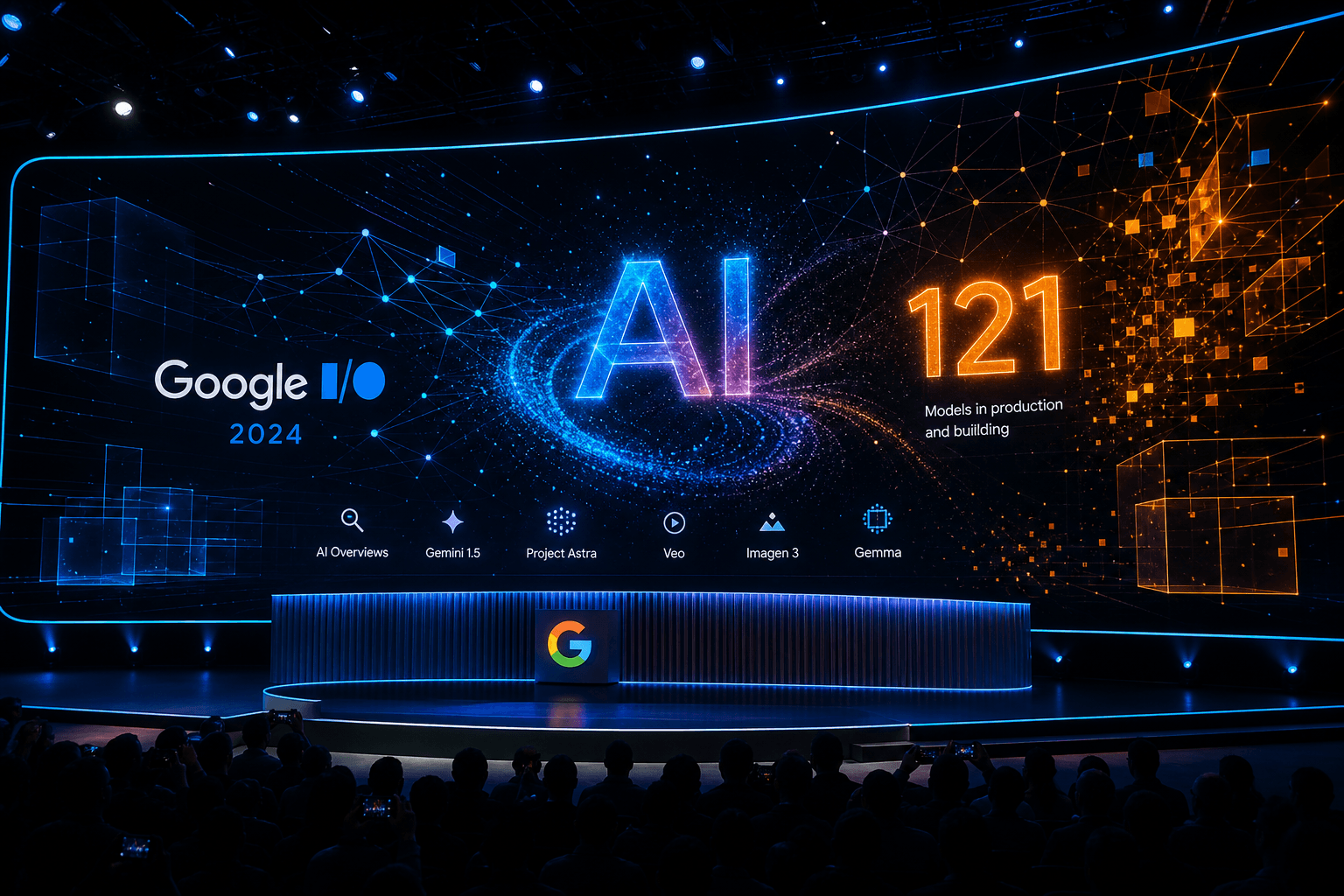
Google I/O 2024 just redefined what a developer conference keynote looks like. In 110 minutes, Google executives uttered the word "AI" 121 times — a statistic so staggering that CEO Sundar Pichai had Gemini count it in real-time, displaying the final tally on screen to close the presentation. The message wasn't subtle: Google is no longer a search company that does AI on the side. It is now an AI company that happens to run the world's largest search engine.
This morning's keynote marks the most significant strategic pivot in Google's public-facing identity since the mobile-first era. Where previous I/O events devoted substantial time to Android version numbers, Pixel hardware specs, and developer tool updates, today's presentation was dominated by Gemini, Project Astra, and an ecosystem-wide AI integration that touches every Google product line from Search to Workspace to Chrome itself.
For builders and engineers watching the livestream, the sheer volume of announcements creates a parsing problem. Not every demo represents a shipping product. Not every capability is available via API today. And buried beneath the marketing gloss are genuine technical advances that will reshape how we build applications for the next 18 months.
This post cuts through the keynote chaos. I'll break down what actually shipped today, what's still experimental, and what the competitive positioning against OpenAI's GPT-4o — announced just yesterday — means for developers choosing a foundation model stack.
The "AI" Count: 121 Mentions and What It Signals #
Breaking Down the Numbers #
Google executives said "AI" 121 times during the 110-minute I/O 2024 keynote — a rate of more than one mention per minute. Sundar Pichai revealed this figure at the end of his closing remarks, noting that Gemini had done the "hard work" of counting for the audience. The statistic itself became a meme within minutes of the announcement, but it reflects something deeper than marketing enthusiasm.
To understand the significance, compare today's count to previous years. While Google has always been AI-forward, the 121 mentions represent a quantitative leap. In 2023's I/O keynote, AI appeared in roughly half as many utterances. The difference isn't just volume — it's centrality. In 2023, AI was a feature layer on top of Google's existing product stack. In 2024, AI is the product stack.
The 121 count also serves as a competitive signal. OpenAI has dominated the AI narrative for the past 18 months. Today's keynote was Google's attempt to reclaim the conversation — not through subtlety, but through sheer overwhelming volume of announcements. The subtext: whatever OpenAI can do, Google can deploy at scale across a billion-user ecosystem.
From Mobile-First to AI-First: The Narrative Shift #
The transformation of Google I/O's core narrative mirrors the company's internal reorganization. Where previous keynotes anchored around Android version releases and hardware announcements, today's presentation centered entirely on the Gemini ecosystem. Android 15 received minimal stage time. Pixel hardware was mentioned in passing. Even Chrome — the browser that powers the web — was discussed primarily as a delivery vehicle for Gemini Nano.
This shift reflects a broader industry reality. Mobile devices are now mature platforms. The differentiation battleground has moved to AI capabilities — who can process multimodal inputs fastest, who can maintain the longest context windows, who can deploy intelligent agents across the most touchpoints. Google's strategy is clear: use its unparalleled distribution (Search, Android, Chrome, Workspace, Maps) to make Gemini the default AI layer for billions of users, regardless of which underlying model they might otherwise prefer.
For developers, this means the I/O announcements are less about new Android APIs and more about new surfaces for AI integration. The Firebase Genkit framework, the Gemini API expansions, and the Chrome-integrated Nano model represent Google's bet that developers will build AI-first applications on Google's infrastructure — not because the models are categorically superior, but because the distribution is unmatched.
Gemini 1.5 Flash: Speed Meets Efficiency #
What Makes Flash Different from Pro #
Gemini 1.5 Flash represents Google's answer to the lightweight model tier — a purpose-built variant optimized for high-frequency, latency-sensitive tasks. Where Gemini 1.5 Pro prioritizes maximum capability and context length, Flash sacrifices some reasoning depth for dramatic speed improvements and cost efficiency.
The architectural differences are significant. Flash uses a more efficient attention mechanism and reduced parameter count to achieve throughput that Pro cannot match. Google hasn't disclosed exact parameter numbers, but the model behaves like a distilled version — faster token generation, lower memory footprint, and substantially reduced per-token costs. The trade-off is evident in complex reasoning benchmarks: Flash won't outperform Pro on multi-step logic tasks or creative writing evaluations, but it doesn't need to for its intended use cases.
What distinguishes Flash from competitors in the lightweight tier is Google's commitment to maintaining the same 1 million token context window across both Pro and Flash variants. While OpenAI's GPT-3.5 Turbo remains capped at 16K tokens and even GPT-4o tops out at 128K, Gemini 1.5 Flash offers a context window eight times larger than GPT-4o's maximum. This is a strategic differentiator — Google is betting that context length, not just raw intelligence, is the battleground for developer adoption.
Context Window and Pricing: The Competitive Edge #
Gemini 1.5 Flash ships with a 1 million token context window and a pricing structure that undercuts every comparable model on the market. Google's announcement today positions Flash as the economically rational choice for high-volume applications.
| Model | Input (per 1M tokens) | Output (per 1M tokens) | Context Window | Speed (tokens/sec) |
|---|---|---|---|---|
| Gemini 1.5 Flash | $0.15 | $0.60 | 1 million | ~150 |
| GPT-4o | $2.50 | $10.00 | 128K | ~132 |
| GPT-3.5 Turbo | $0.50 | $1.50 | 16K | ~80 |
| Claude 3 Haiku | $0.25 | $1.25 | 200K | ~120 |
The pricing differential is stark. Flash processes input tokens at roughly 94% lower cost than GPT-4o. For applications processing high volumes of text — content moderation, document analysis, classification tasks — this pricing changes the economics from experimental to production-viable. A workload that costs $100 on GPT-4o drops to approximately $6 on Flash.
The 1 million token context window enables use cases that remain impossible on competing platforms. Developers can now pass entire codebases, lengthy legal contracts, or hours of transcript data in a single API call without chunking, embeddings, or retrieval-augmented generation overhead. For RAG-heavy applications, this simplifies architecture dramatically — the context window is the retrieval system.
Real-World Use Cases for Flash #
Gemini 1.5 Flash excels in three primary domains: high-throughput data processing, real-time user-facing applications, and cost-sensitive batch workloads. The model's architecture optimizations make it the rational choice when latency and economics matter more than maximum reasoning capability.
Consider these production scenarios where Flash dominates:
Document processing pipelines: Classifying, summarizing, or extracting structured data from thousands of documents per hour. The 1M context window accepts entire PDFs without preprocessing, and the $0.15 per 1M input tokens pricing makes large-scale processing economically viable.
Chatbot and assistant backends: First-line customer support, FAQ handling, and conversational interfaces where response speed matters more than creative writing ability. Flash's ~150 tokens/second throughput delivers snappy user experiences.
Content moderation at scale: Analyzing user-generated content across social platforms, marketplaces, or community sites. The cost efficiency enables real-time screening of every submission rather than sampling.
Preprocessing and routing: Using Flash as an intelligent load balancer — analyze incoming requests with Flash, then route complex queries to Pro or GPT-4o. This hybrid architecture optimizes both cost and capability.
The availability model is immediate: Gemini 1.5 Flash is accessible today through the Gemini API and Google AI Studio in over 200 countries and territories, including the European Economic Area, EU, UK, and Switzerland. Unlike experimental releases with waitlist access, Google has pushed Flash to general availability alongside today's announcement.
Gemini 1.5 Pro: The 2 Million Token Monster #
The Context Window Arms Race #
Google announced a private preview of Gemini 1.5 Pro with a 2 million token context window — the largest commercially available context capacity of any foundation model. This doubles the previous 1 million token maximum and establishes a new benchmark that competitors will struggle to match in the near term.
To understand the scale: 2 million tokens equates to approximately 1.5 hours of video, 60,000 lines of code, or roughly 1.4 million words of text. For context, the average novel runs 80,000–100,000 words. Gemini 1.5 Pro can now ingest the entire Lord of the Rings trilogy, the complete works of Shakespeare, or a full-day conference transcript in a single prompt.
The competitive implications are significant. Anthropic's Claude 3 Opus offers 200K tokens. OpenAI's GPT-4o caps at 128K. Google's 2M token window is 10x larger than Claude and 16x larger than GPT-4o. For use cases requiring analysis across entire documents or media files without chunking, this isn't an incremental advantage — it's a categorical difference that changes what's technically possible.
Google demonstrated the capability with a live demo processing the entire 402-page transcript of the Apollo 11 moon landing mission, answering specific questions about conversations between astronauts and ground control. The model maintained coherence across the full document, referencing specific timestamps and speakers without losing track of the broader narrative.
Multimodal Capabilities in Practice #
Gemini 1.5 Pro's native multimodal architecture processes text, images, audio, and video through a unified model rather than separate pipelines. This morning's keynote emphasized demonstrations that showcase genuine cross-modal reasoning — not just image captioning or audio transcription, but integrated understanding across modalities.
The multimodal capabilities enable several concrete use cases that were previously impossible or required complex multi-model orchestration:
| Use Case | Input Type | Output | Traditional Approach |
|---|---|---|---|
| Video QA | 30-minute video + question | Natural language answer | Separate transcription + frame extraction + LLM |
| Code documentation | Screenshot of UI + codebase | Contextual code comments | Manual correlation or multiple API calls |
| Audio analysis | 2-hour podcast | Structured summary with timestamps | Transcription → segmentation → summarization |
| Visual debugging | Error screenshot + logs | Root cause analysis | Manual investigation across tools |
For agent architectures, this multimodal integration is transformative. A single Gemini 1.5 Pro instance can process a screen recording of a user workflow, correlate it with application logs, and generate a comprehensive bug report — all in one inference pass. Previously, this required chaining Whisper for audio, a vision model for frames, and a language model for synthesis, with latency and error accumulation at each handoff.
The technical implementation relies on Google's proprietary training approach that treats video frames as token sequences similar to text tokens. Rather than using a separate vision encoder (like CLIP) and audio encoder (like Whisper) that feed into a language model, Gemini processes all modalities through the same transformer architecture. This unified approach eliminates the modality-switching latency and coherence loss that plague pipeline-based systems.
When to Choose Pro Over Flash #
The choice between Gemini 1.5 Pro and Flash depends on three primary factors: context requirements, reasoning complexity, and budget constraints. Pro commands a price premium that is justified only when its unique capabilities are actually needed.
Choose Gemini 1.5 Pro when:
- Processing documents or media longer than 1 million tokens
- Maximum reasoning quality is essential (complex analysis, creative tasks, multi-step problem solving)
- Native multimodal understanding across video, audio, and text is required
- Budget permits higher per-token costs for capability gains
Choose Gemini 1.5 Flash when:
- Processing high volumes of shorter content (<1M tokens)
- Latency and throughput are primary concerns
- Cost efficiency outweighs maximum reasoning quality
- Use case involves classification, extraction, or summarization rather than complex generation
For many production applications, the optimal architecture is hybrid: use Flash as a fast classifier and router, then escalate complex queries to Pro. A preliminary Flash pass can analyze whether a customer support ticket requires simple FAQ handling (Flash) or complex investigation (Pro), optimizing both cost and response quality.
The 2 million token Pro variant is currently in private preview with limited availability. Google has not announced pricing for the expanded context window, but expect a significant premium over the standard 1M token pricing. For most developers, the 1M token window available in Flash and standard Pro remains sufficient until the 2M variant reaches general availability.
Project Astra: Google's Answer to Real-Time AI Assistants #
The Demo That Stole the Show #
Project Astra emerged as the most visually compelling demonstration of Google's I/O 2024 keynote — a real-time, multimodal AI assistant that sees what you see, hears what you hear, and responds conversationally without the latency that plagues current voice interfaces. Sundar Pichai and DeepMind CEO Demis Hassabis showcased the prototype running on both a Pixel phone and prototype AR glasses, creating the most convincing "Her-like" AI assistant demo since the film itself.
The demonstration featured two continuous, unedited takes — a deliberate choice to prove the demo wasn't cherry-picked or pre-rendered. In the first sequence, a user pointed their phone camera at various objects around a workspace. Astra identified a speaker component by its driver and tweeter configuration, provided creative alliteration on request ("creative crayons color cheerfully"), analyzed code visible on a screen, and identified a King's Cross location through the window.
The second demonstration showcased memory and recall. After being shown a pair of glasses on a desk, the user asked "Where did I leave my glasses?" several minutes later. Astra correctly identified their location, demonstrating that the system maintains a working memory of previously observed objects and contexts.
Most impressively, the interaction was genuinely conversational. Users interrupted Astra mid-sentence to ask clarifying questions. The model adapted its speech patterns in real-time. There was no perceptible delay between the user finishing a question and Astra beginning its response — a stark contrast to the 2–3 second latency typical of current voice assistants.
Under the Hood: How Astra Works #
Project Astra is built on Gemini's multimodal foundation, but the innovation lies in how it handles continuous, real-time streams of audio and video rather than discrete inputs. DeepMind's technical implementation represents a significant architecture evolution beyond standard API-based model interactions.
The system continuously encodes video frames from the device camera and combines them with speech input on a unified timeline of events. Rather than processing individual screenshots or audio clips as separate API calls, Astra maintains a persistent session where visual and auditory streams are interleaved as a coherent sequence. This temporal awareness enables the memory capabilities demonstrated — the system doesn't just see objects, it tracks them across time.
Key technical components include:
- Continuous encoding: Video frames are processed at regular intervals without requiring user-triggered captures, creating a persistent visual context stream
- Event timeline: Audio and visual inputs are synchronized on a shared temporal axis, enabling cross-references like "the red object I showed you three minutes ago"
- Streaming inference: The model generates responses without waiting for complete silence or explicit submission triggers, reducing perceived latency
- Caching and recall: Previously observed information is maintained in working memory, allowing the assistant to answer questions about past observations
The speech engine represents a separate advancement from standard text-to-speech systems. Google described it as delivering "more consistent, emotionally expressive and realistic multi-turn dialogue." In the demo, Astra laughed, modulated tone based on conversational context, and handled interruptions gracefully — capabilities that suggest a more sophisticated prosody model than traditional concatenative or neural TTS approaches.
Critically, the prototype runs partially on-device using Gemini Nano for low-latency responses, with cloud fallback for complex reasoning. This hybrid architecture explains the responsiveness — simple queries hit local silicon, while harder problems route to datacenter GPUs.
From Demo to Product: The Road Ahead #
Project Astra is explicitly positioned as a "future vision" rather than a shipping product. Google has not announced release timelines, pricing, or even a definitive product name. The demos ran on prototype hardware including modified glasses that may never reach consumer markets in their current form.
However, pieces of Astra are shipping immediately. The Gemini Live feature announced today for the Gemini mobile app represents a subset of Astra's capabilities — voice conversations with real-time adaptation, though without the continuous video understanding. This suggests a gradual rollout strategy where Astra's components appear across Google's product line before the complete integrated experience launches.
The competitive positioning is unmistakable. OpenAI demonstrated similar multimodal voice capabilities in the GPT-4o launch yesterday — fluid conversations, emotional range, low latency. Google is signaling that it can match these capabilities while adding the visual dimension that GPT-4o's voice mode lacks. The glasses demo, in particular, suggests Google views AR as a key differentiator, building on its existing hardware investments (Pixel, Nest) and Android ecosystem.
For developers, the immediate implication is that truly conversational, multimodal AI assistants are entering the productizable phase. The underlying models — Gemini 1.5 Pro, the streaming inference infrastructure, the on-device optimization — are all available or approaching availability. Building Astra-like experiences is no longer science fiction; it's a matter of integrating existing components with appropriate UX design.
The timeline question remains open. Based on Google's historical patterns for research-to-product transitions, expect partial Astra capabilities (enhanced Gemini Live, better vision integration) within 6–12 months, with a fuller integrated experience potentially launching alongside new hardware announcements in 2025.
AI Overviews: Google Search's AI Transformation #
What AI Overviews Actually Do #
AI Overviews began rolling out to all US Google Search users today, representing the most significant change to Google's search results page since the introduction of featured snippets. The feature generates AI-powered summaries that appear at the top of search results for complex queries, synthesizing information from multiple sources into a concise answer with inline citations.
The technology behind Overviews represents an evolution of the Search Generative Experience (SGE) that Google has been testing in Labs for the past year. Unlike SGE, which required explicit user opt-in, Overviews appear automatically when Google's systems determine they can provide value — primarily for informational queries with multiple valid perspectives or complex how-to questions.
The generation process works as follows:
- Query classification: Google's systems evaluate whether the query would benefit from an AI summary or is better served by traditional blue links
- Source retrieval: The system identifies authoritative sources from the search index, applying the same quality signals that power traditional ranking
- Synthesis: A Gemini model generates a summary that combines information from retrieved sources, with explicit links back to the originating pages
- Safety filtering: Additional layers check for harmful, inaccurate, or controversial content before display
The citations are crucial — each Overview includes clearly labeled source links, and Google states that traffic to cited sources increases when Overviews appear. This addresses the primary publisher concern: that AI summaries would eliminate the need to click through to original sources.
The SEO Implications Nobody Is Talking About #
AI Overviews fundamentally alter the traffic distribution dynamics that have governed SEO for two decades. The change isn't just cosmetic — it redistributes user attention and click-through rates in ways that will force content strategy recalibration.
The immediate impact varies by query type:
| Query Type | Overview Frequency | Traffic Impact |
|---|---|---|
| Simple factual | High | Reduced clicks — answer satisfies query |
| Complex informational | High | Redistributed clicks — citations drive traffic to sources |
| Commercial | Low | Minimal change — product research still requires browsing |
| Navigational | None | No change — users want specific sites |
| Local | Moderate | Mixed — some queries satisfied, others need exploration |
For publishers and content creators, the strategic response requires understanding what makes content Overview-citable. Google's systems prioritize sources that provide:
- Comprehensive coverage: Content that thoroughly addresses a topic, not surface-level summaries
- Clear structure: Headings, lists, and tables that facilitate extraction and citation
- Authoritative signals: E-E-A-T factors (experience, expertise, authoritativeness, trust) weigh heavily in source selection
- Fresh information: Recency matters, particularly for rapidly evolving topics
The AIO/AEO (AI Overview Optimization / Answer Engine Optimization) implications are substantial. Content that answers specific questions completely and authoritatively is more likely to be cited in Overviews, driving qualified traffic even if the direct ranking position shifts. This creates an incentive for deeper, more substantive content rather than SEO-optimized thin pages designed to capture long-tail queries.
Google also introduced a "Web" filter alongside Overviews, allowing users to view only traditional text-based link results. This filter appears at the top of results pages and explicitly acknowledges that some users will want to bypass AI summaries entirely. The coexistence suggests Google recognizes Overviews aren't universally preferred and is maintaining the traditional search experience as an option.
Rolling Out to the US: Timeline and Availability #
AI Overviews began rolling out to all US Google Search users today, May 14, 2024. The launch represents one of the fastest product expansions in Google's history — from Labs experiment to default user experience in under a year.
The rollout is phased by query category. Overviews appear most frequently for:
- Health and wellness information
- Educational and how-to queries
- Travel planning and recommendations
- Shopping research and comparisons
- Technical troubleshooting
Google has not announced specific international expansion timelines beyond "coming to more countries soon." The EU launch will likely face additional scrutiny given regulatory attention on AI-generated content and the Digital Services Act's transparency requirements.
Users cannot currently disable Overviews entirely, though the "Web" filter provides an opt-out per search. Google has indicated that user feedback on individual Overviews (thumbs up/down buttons that appear below each summary) will influence both the feature's evolution and which sources get cited.
For publishers monitoring impact, Google Search Console now includes AI Overview impression and click data in the Search Performance report, allowing site owners to track when their content appears as a citation source. This transparency addresses a key criticism of the SGE beta period, where publishers had no visibility into whether their content was being used in AI-generated responses.
Veo: Google's Entry into AI Video Generation #
Capabilities and Quality Benchmarks #
Veo is Google's answer to OpenAI's Sora — a text-to-video generation model capable of producing 1080p video clips approximately one minute in length. DeepMind CEO Demis Hassabis positioned Veo as a synthesis of Google's extensive research in video generation, combining techniques from prior experiments like the VideoPoet project and the Phenaki video generation system.
The technical capabilities demonstrated today include:
- 1080p resolution output: Professional-quality video suitable for broadcast and commercial use
- Extended duration: Clips up to roughly 60 seconds, significantly longer than most competing models
- Visual fidelity: Realistic physics, consistent object permanence, and coherent motion across frames
- Cinematic control: Support for various aspect ratios, camera movements, and visual styles
- Editing capabilities: The ability to extend, modify, and adjust already-generated footage
Google showed several example videos during the keynote that demonstrate Veo's strengths and limitations. A drone shot flying through a canyon maintained consistent geological features and natural lighting. A time-lapse of a flower blooming showed realistic organic motion. These outputs match or exceed the quality benchmarks OpenAI established with Sora's preview in February.
However, Veo shares the same fundamental limitations as all current video generation models. Physics simulation remains imperfect — objects may clip through each other, fluids behave unnaturally, and complex interactions between multiple subjects often break coherence. Text rendering within generated videos remains problematic, with signage and labels frequently appearing garbled or nonsensical. These aren't Veo-specific issues; they're unsolved research challenges across the entire field.
The competitive comparison with Sora is inevitable but premature. OpenAI has not released Sora publicly, limiting access to select artists and researchers. Veo's VideoFX experimental sandbox opens to a broader waitlist audience today, giving Google a distribution advantage even if technical parity is roughly equivalent. The model that ships first to real users often wins regardless of benchmark superiority.
The Creative Workflow Integration #
Veo launches within VideoFX — an experimental Google Labs sandbox designed for creative professionals rather than direct API access. This positioning reflects Google's understanding that raw video generation is only valuable when integrated into creative workflows.
The YouTube integration is particularly significant. Google announced that select YouTube creators gain Veo access for Shorts generation, enabling AI-assisted background generation, B-roll creation, and conceptual visualization. This isn't about replacing videographers; it's about reducing production friction for creators who need quick visual assets without full production pipelines.
The announced use cases include:
- B-roll generation: Creating supplementary footage to intercut with primary video content
- Storyboard visualization: Converting written scene descriptions into rough visual drafts
- Background replacement: Generating environment plates for green screen compositing
- Stock footage alternative: Creating custom clips that match specific creative requirements without licensing concerns
For filmmakers and creative agencies, Veo represents a pre-production tool rather than a final output solution. The current generation quality supports rough cuts, concept pitches, and placeholder assets — workflows where "good enough" and "fast" outweigh pixel-perfect fidelity. Professional productions will still require traditional cinematography for principal footage, but Veo can accelerate the iterative phases where visualization speed matters.
Google's historical pattern suggests eventual Workspace integration. Imagine Docs generating video summaries of written reports, or Slides creating motion backgrounds from presentation themes. These integrations would follow the same trajectory as Imagen's gradual expansion across Google's product suite.
Availability and Access Models #
Veo is available today through the VideoFX experimental sandbox, but access is waitlist-gated rather than open to all developers. Google has not announced API availability, pricing tiers, or commercial licensing terms — a clear signal that Veo remains in the research-to-product transition phase.
The VideoFX access model mirrors Google's cautious rollout for prior generative media products. Imagen 2 followed a similar path: limited Labs preview, gradual expansion to trusted testers, eventual Vertex AI API access with enterprise pricing. Expect Veo to follow this same trajectory over the next 6–12 months.
For developers building video generation into applications, this means Veo isn't a viable production option today. The waitlist approach prioritizes Google's ability to manage compute costs and monitor for misuse over rapid ecosystem adoption. Competitors like Runway ML, Pika Labs, and HeyGen offer immediately available APIs with established pricing — trade-offs that Veo's eventual superiority will need to overcome.
The pricing question remains unanswered. Video generation is computationally expensive — significantly more so than image generation. If Google follows OpenAI's DALL-E 3 pricing model, expect per-second costs that make Veo economical for short clips but prohibitive for lengthy content. Enterprise customers with Vertex AI commitments may receive preferential access and pricing when commercial availability arrives.
Imagen 3: Next-Generation Image Synthesis #
What's New in Version 3 #
Imagen 3 represents Google's third-generation text-to-image model, announced today with specific emphasis on prompt understanding accuracy, creative detail generation, and text rendering quality. Demis Hassabis highlighted three primary advances over Imagen 2: more precise interpretation of complex prompts, richer creative detail in generated outputs, and dramatically improved text legibility within images.
The prompt understanding improvements address a persistent weakness in image generation models — the gap between what users describe and what models produce. Imagen 3 reportedly handles complex compositional instructions more reliably: "a red cat sitting on a blue bicycle next to a yellow house" should produce each element in correct spatial relationships rather than blending colors or omitting objects. Google demonstrated this with examples showing accurate rendering of intricate prompt elements that earlier models would simplify or ignore.
Text rendering within images has been a notorious challenge for diffusion models. Imagen 3 claims significant progress here — signage, labels, and integrated text appear more legible and correctly spelled than in previous generations. The keynote showed examples of generated book covers, street signs, and product labels with readable text, though not perfectly accurate in every instance. This capability is crucial for commercial applications where generated images need to include branding, captions, or interface elements.
The model also demonstrates improved handling of diverse artistic styles. From photorealistic renders to watercolor paintings to architectural sketches, Imagen 3 adapts output style based on prompt specification without requiring style reference images or negative prompts. This versatility reduces the need for prompt engineering expertise — users can describe the desired aesthetic directly rather than learning style-specific keyword patterns.
Competition with Midjourney and DALL-E 3 #
Imagen 3 enters a crowded competitive landscape where Midjourney dominates aesthetic quality and DALL-E 3 holds the integration advantage with ChatGPT. Google's path to differentiation runs through enterprise reliability and platform integration rather than raw creative superiority.
The competitive positioning breaks down across three axes:
| Factor | Imagen 3 | Midjourney v6 | DALL-E 3 |
|---|---|---|---|
| Image quality | Strong | Exceptional | Good |
| Prompt adherence | Improved | Moderate | Strong |
| Text rendering | Improved | Poor | Moderate |
| API availability | Vertex AI | Limited (via API) | OpenAI API |
| Integration depth | Deep Google Workspace | Discord only | ChatGPT native |
| Enterprise governance | Strong content filtering | Limited | Moderate |
Midjourney remains the choice for artists and designers prioritizing aesthetic quality. The platform's community features, style diversity, and consistent "beauty" in outputs haven't been matched by corporate models. Imagen 3 doesn't attempt to compete on pure creative expression — it's positioned as the reliable workhorse for business applications where consistency and safety matter more than artistic breakthroughs.
DALL-E 3's advantage is conversational integration. Within ChatGPT, users refine images through dialogue rather than iterative prompt rewriting. Google's response is the ImageFX interface, which offers similar conversational refinement through a dedicated UI. The long-term question is whether Imagen 3 will integrate directly into Gemini conversations the way DALL-E 3 lives in ChatGPT — today's announcement suggests this integration is planned but not yet active.
The enterprise angle is where Imagen 3 may win regardless of benchmark comparisons. Organizations already using Vertex AI for other Google Cloud services can add image generation to unified billing, security policies, and governance frameworks. For Fortune 500 companies navigating AI procurement, this integration value often outweighs raw quality metrics. The model that's already approved by legal, procurement, and security teams beats the technically superior model that requires new vendor onboarding.
The Bigger Picture: Google's AI Strategy Unpacked #
The Gemini Ecosystem Vision #
Google's I/O 2024 announcements coalesce around a single strategic thesis: Gemini is becoming the universal intelligence layer across every Google product and surface. The company is executing a brand consolidation that mirrors Microsoft's Copilot strategy, but with the distribution advantage of owning the world's most-used search engine, mobile operating system, and web browser.
The unified Gemini approach is technically significant. Rather than maintaining separate models for Search (formerly Bard), Assistant, Workspace, and Cloud APIs, Google is converging on a shared foundation. Gemini 1.5 Flash and Pro power the API. Gemini Nano runs on-device in Pixel phones and Chrome. Gemini Advanced (the consumer subscription) provides access to Pro capabilities with higher rate limits. The same underlying model architecture, fine-tuned for different latency and cost constraints, drives every experience.
This consolidation delivers engineering advantages that fragmented model strategies cannot match:
- Shared improvements: Enhancements to the base Gemini model propagate across all surfaces automatically
- Simplified evaluation: Quality benchmarks and safety testing apply uniformly rather than per-product
- Developer familiarity: Skills transfer between building on the API and configuring Workspace extensions
- Unified branding: Users understand "Gemini" as Google's AI, reducing confusion from multiple product names
The strategic risk is centralization — if Gemini has a fundamental safety failure or quality regression, it impacts Google's entire product ecosystem simultaneously. The company is betting that the efficiency gains outweigh this systemic risk, and that their safety investments (the "responsible AI" commitments mentioned throughout today's keynote) are sufficient to prevent catastrophic failures.
Integration Across the Google Stack #
The depth of today's AI integration announcements reveals Google's intent to make AI assistance unavoidable across its product ecosystem. Each major product line received Gemini-powered updates:
Search: AI Overviews become the default experience for US users, representing the most aggressive AI integration in Google's flagship product. The Web filter maintains traditional results as an option, but the default has shifted.
Workspace: Gmail gains Gemini-powered email summarization, draft generation, and action capabilities (like processing e-commerce returns by finding receipts and filling forms). Docs, Sheets, and Drive receive similar AI assistance layers announced in previous months but reinforced today as core capabilities.
Android: Gemini replaces Google Assistant as the default AI companion on Android devices. Deep OS integration enables drag-and-drop of AI-generated images into any app, context-aware assistance within apps, and on-device processing via Gemini Nano for privacy-sensitive tasks.
Chrome: Gemini Nano (the lightweight model) ships built into Chrome starting with version 126, enabling on-device AI features like the existing "help me write" tool without cloud round-trips. This client-side AI architecture reduces latency and privacy concerns for browser-based assistance.
Cloud: Vertex AI gains access to all new Gemini models (Flash, Pro with 2M context, Imagen 3, Veo when available) alongside enterprise governance, monitoring, and deployment tools. Firebase Genkit launches as an open-source framework for building AI-powered applications with JavaScript/TypeScript (Go support coming).
This cross-product integration creates switching costs that individual AI products cannot match. A company building on GPT-4 gets excellent language modeling. A company building on Gemini gets language modeling that integrates with their email, documents, search presence, and mobile applications through unified APIs and shared authentication.
The OpenAI Competition Dynamics #
Google's I/O timing — the day immediately following OpenAI's GPT-4o launch — is unmistakably competitive. The industry has witnessed a two-day demonstration of the AI arms race's current state: OpenAI shipping first with consumer-focused demos, Google responding with ecosystem-scale distribution.
The technical comparison yields no clear winner. GPT-4o's unified multimodal architecture and native audio capabilities match or exceed Gemini's current API offerings. Gemini 1.5 Pro's 2 million token context window remains unmatched. Flash's pricing undercuts GPT-4o dramatically for high-volume use cases. Project Astra's real-time video understanding exceeds GPT-4o's voice-only interaction. Each company holds specific advantages.
The strategic difference is distribution versus frontier capability:
| Dimension | OpenAI | |
|---|---|---|
| Model sophistication | Leading on unified multimodal | Leading on context length |
| Consumer reach | 100M+ ChatGPT users | 2B+ Search, Android, Chrome users |
| Developer platform | Excellent API, limited enterprise tools | Comprehensive cloud ecosystem |
| Enterprise integration | Growing, but limited legacy presence | Deep Workspace, Cloud penetration |
| Hardware integration | None | Pixel, Nest, potential AR glasses |
| Research brand | Perceived leader | Playing catch-up in public perception |
OpenAI wins when the conversation centers on model benchmarks and research breakthroughs. Google wins when the conversation shifts to practical deployment at scale, enterprise compliance, and ubiquitous availability. Today's keynote was designed to move the narrative from "who has the best model?" to "who can deliver AI everywhere you already work?"
The competitive pressure benefits developers and users. Pricing falls (Flash's $0.15 per 1M tokens is unsustainable without competitive pressure). Capabilities expand (2M context windows, real-time assistants). Integration improves (APIs, Workspace tools, mobile SDKs). The two companies are forcing each other to ship faster and price more aggressively than either would in a monopoly position.
Ilya Sutskever Leaves OpenAI: Timing Is Everything #
The Departure Announcement #
On the same morning as Google's I/O keynote, OpenAI co-founder and chief scientist Ilya Sutskever announced his departure from the company. The timing — coinciding with Google's biggest AI announcement day of the year — muted the news cycle impact but amplified the symbolic weight. While Google demonstrated its unified AI vision on stage, OpenAI lost the researcher most associated with its technical foundations.
Sutskever's departure statement was diplomatic: "I am excited for what comes next — a project that is very personally meaningful to me about which I will share details in due time." Jan Leike, who co-led the Superalignment team with Sutskever, simultaneously announced his resignation. The dual departures effectively dissolve the Superalignment team that OpenAI had positioned as critical to safe AGI development.
The departure follows months of speculation about Sutskever's status at OpenAI. Following the November 2023 board dispute — where Sutskever initially supported Altman's firing before reversing position — his role appeared diminished. He had been removed from the board and his research focus shifted to technical work with reduced executive visibility. Today's announcement formalizes a separation that industry observers had anticipated.
What This Means for the AI Landscape #
Sutskever's departure removes one of the most respected technical voices from OpenAI's leadership and raises questions about the company's research trajectory. As a co-founder and the director who led GPT-1, GPT-2, GPT-3, and InstructGPT development, Sutskever's technical judgment shaped OpenAI's model architecture decisions. His absence creates a leadership gap in fundamental research direction.
The immediate competitive implication is perceptual. Google's I/O keynote showcased a unified, coordinated, and clearly led AI strategy. OpenAI's same-day news — however unrelated to product development — reinforces a narrative of internal turmoil and leadership churn. In the battle for enterprise trust and developer confidence, stability signals matter as much as benchmark scores.
For the broader AI ecosystem, Sutskever's next move is consequential. If he launches a new research organization focused on safe AGI development — the implied direction given his Superalignment focus — it could redirect talent and funding toward alternative approaches to AI safety. His reputation would attract top researchers and potentially create a counterweight to both OpenAI's commercial focus and Google's scale-driven strategy.
Superalignment and the Future #
The dissolution of OpenAI's Superalignment team through Sutskever and Leike's simultaneous departures eliminates the company's dedicated safety research capacity. OpenAI had committed 20% of its compute resources to the team's work on aligning superintelligent systems. That commitment now appears abandoned.
The superalignment problem — ensuring that AI systems significantly smarter than humans remain aligned with human values — was Sutskever's stated research priority for the past year. In a departure statement, he expressed confidence that "OpenAI will build AGI that is both safe and beneficial" under the current leadership, but his resignation from the safety-focused role suggests otherwise.
This development creates space for Google to position itself as the more safety-conscious AI leader, however ironic given the company's history of AI ethics controversies. DeepMind's established safety research program, now under Hassabis's continued leadership, contrasts with OpenAI's apparent deprioritization of dedicated safety teams. Expect Google to emphasize this distinction in enterprise sales conversations where AI safety concerns increasingly influence procurement decisions.
For developers and businesses building on these platforms, the lesson is structural: no AI provider's leadership, priorities, or safety commitments are permanent. Engineering choices should assume provider diversity — never build architecture that depends entirely on OpenAI's continued existence in its current form, or Google's, or any single vendor.
What Builders Should Actually Care About #
The Developer Tools That Matter #
Cutting through the keynote spectacle, four developer-facing announcements from I/O 2024 are immediately actionable for production builds. The rest — Project Astra, Veo, Imagen 3 in VideoFX — remain experimental or waitlist-gated.
Ship Today:
Gemini 1.5 Flash via API: Available now in 200+ countries. The pricing ($0.15/$0.60 per 1M tokens) and 1M context window make this the most cost-effective option for high-volume text processing. Direct replacement opportunity for GPT-3.5 Turbo workloads at significantly lower cost.
Firebase Genkit: Open-source framework (Apache 2.0) for building AI-powered applications in JavaScript/TypeScript. Provides structured abstractions for LLM integration, vector search, and deployment to Google Cloud. Think of it as Google's answer to LangChain but with tighter Firebase/Cloud integration.
Gemini Nano in Chrome: Starting with Chrome 126, the on-device model enables client-side AI without API calls or privacy concerns. Experimental but stable enough for "help me write" features and similar text assistance.
AI Overviews tracking in Search Console: Publishers can now monitor when their content appears as citations in AI-generated search summaries. Critical for understanding traffic impact and optimizing for the new search paradigm.
Wait or Experiment:
- Gemini 1.5 Pro 2M context: Private preview only; wait for GA unless you have a specific use case requiring >1M tokens and existing Google Cloud partnership
- Project Astra: No API access; watch for Gemini Live feature in consumer app as a preview of eventual capabilities
- Veo: Waitlist-gated in VideoFX sandbox; no production timeline announced
- Imagen 3: ImageFX and Vertex AI access rolling out; stable for experimentation but pricing not finalized
Integration Opportunities for AI Automations #
For builders working with AI agents and workflow automation platforms, today's announcements create new integration points worth exploring immediately. The combination of Gemini 1.5 Flash's cost efficiency and expanded context windows enables automation patterns that were previously uneconomical.
n8n + Gemini Integration Opportunities:
The Gemini API is a standard HTTP interface that integrates cleanly with n8n's HTTP Request node. For production n8n workflows, consider these patterns:
Document ingestion pipelines: Pass entire PDFs or document batches to Gemini 1.5 Flash for structured extraction. The 1M token window eliminates the chunking complexity required with smaller-context models. A single API call can process a 300-page contract and return structured JSON with key terms, parties, and obligations.
Email classification and routing: Use Flash as a fast classifier to categorize incoming emails by urgency, topic, and required action. The low latency (~150 tokens/second) supports real-time processing without workflow bottlenecks.
Content moderation workflows: Process user-generated content at scale economically. Flash's pricing enables screening every submission rather than sampling, with acceptable accuracy for most moderation use cases.
Multi-model routing: Implement an intelligent router that uses Flash for initial analysis, then escalates complex queries to Pro or GPT-4o based on confidence scores. This hybrid architecture optimizes both cost and quality.
Code Example — n8n HTTP Request Node for Gemini Flash:
{
  "url": "https://generativelanguage.googleapis.com/v1beta/models/gemini-1.5-flash:generateContent",
  "method": "POST",
  "headers": {
    "Content-Type": "application/json",
    "x-goog-api-key": "{{$credentials.googleGeminiApiKey}}"
  },
  "body": {
    "contents": [
      {
        "role": "user",
        "parts": [
          {
            "text": "{{$json.prompt}}"
          }
        ]
      }
    ],
    "generationConfig": {
      "temperature": 0.2,
      "maxOutputTokens": 2048
    }
  }
}
The key configuration: use gemini-1.5-flash as the model identifier, keep temperature low for deterministic automation outputs, and use the 1M token context window by passing full documents rather than summaries.
Pricing and Access: The Reality Check #
The headline pricing announcements require careful parsing — not everything announced is available, and availability doesn't imply production readiness.
Available Now (Production Ready):
| Service | Status | Pricing | Recommendation |
|---|---|---|---|
| Gemini 1.5 Flash | GA in 200+ countries | $0.15/$0.60 per 1M tokens | Production-ready for cost-sensitive, high-volume workloads |
| Gemini 1.5 Pro (1M context) | GA | Standard Vertex AI pricing | Production-ready for complex reasoning needs |
| Gemini Nano (Chrome) | Chrome 126+ | Free (client-side) | Experimental but stable for on-device features |
| Firebase Genkit | Open source | Free (compute costs only) | Ready for new project scaffolding |
Limited Access (Evaluate, Don't Deploy):
| Service | Status | Availability | Recommendation |
|---|---|---|---|
| Gemini 1.5 Pro (2M context) | Private preview | Waitlist | Apply if you have specific >1M token use cases |
| Project Astra | Research preview | No API access | Monitor for Gemini Live consumer release |
| Veo | VideoFX sandbox | Waitlist | Experiment only; no production timeline |
| Imagen 3 | Rolling rollout | Labs + Vertex AI | Safe for experimentation; watch pricing |
Pricing Strategy Recommendation:
For teams currently using OpenAI APIs, Gemini 1.5 Flash presents a compelling cost-reduction opportunity for classification, summarization, and extraction workloads. The 94% cost reduction versus GPT-4o ($0.15 vs $2.50 input) makes it economical to process 10x the volume at the same budget — or maintain current volume at 6% of the cost.
The migration path is straightforward: Gemini's API structure mirrors OpenAI's chat completions format closely enough that adapter code is minimal. The primary friction is credential management (Google Cloud API keys versus OpenAI keys) and rate limit differences. Expect to adjust request batching and retry logic to accommodate Google's rate limiting patterns.
For new projects, a hybrid architecture makes sense: use Gemini 1.5 Flash as the default for volume, escalate to Gemini 1.5 Pro for complexity, and maintain OpenAI integration as a fallback for capabilities Google hasn't matched (native audio processing, certain reasoning patterns). This multi-provider approach insulates against single-vendor pricing changes and availability issues.
Looking Ahead: The Rest of 2024 #
Predicted Launch Timelines #
Based on Google's historical patterns and today's announcement specifics, here's the projected rollout schedule for major I/O 2024 features:
Immediate (Available Today - June 2024):
- Gemini 1.5 Flash general availability (✅ shipped)
- AI Overviews US rollout (✅ in progress)
- Gemini Nano in Chrome 126 (✅ starting rollout)
- Firebase Genkit open beta (✅ available)
- AI Overviews in Search Console reporting (✅ live)
Near Term (July - September 2024):
- Gemini 1.5 Pro 2M context window public preview (private preview active, GA expected Q3)
- Imagen 3 Vertex AI general availability (rolling out now, full GA by July)
- Enhanced Gemini Live features in mobile app (consumer rollout planned)
- Additional AI Overviews international markets (EU regulatory approval pending)
Medium Term (October - December 2024):
- Veo API availability for enterprise customers (subject to compute capacity scaling)
- Project Astra component features in consumer products (Gemini Live expansion)
- Trillium TPU availability in Google Cloud (announced for "later this year")
- Gemini integration expansion across Workspace applications
Longer Term (2025):
- Full Project Astra product launch (requires hardware partnerships or Pixel device integration)
- Potential AR glasses product using Astra technology (prototype stage only)
- Next-generation Gemini model announcement (historical pattern suggests 6-12 month cycles)
The critical dependency for video generation (Veo) and advanced assistant capabilities (Astra) is compute infrastructure. Google must scale TPU capacity to support these workloads at API scale. The Trillium TPU announcement (4.7x performance improvement) addresses this, but chip deployment timelines suggest production-scale API access won't arrive until late 2024 or early 2025.
The Competitive Response #
Today's announcements reset competitive baselines across multiple AI capability dimensions. Expect rapid responses from OpenAI, Anthropic, and emerging players over the next 90 days.
OpenAI's Likely Moves:
OpenAI cannot ignore Gemini 1.5 Flash's pricing. Expect a GPT-4o price reduction or a new "mini" model announcement within weeks. OpenAI has historically responded to competitive pricing pressure within 30–60 days. The company may also accelerate GPT-5 development timeline announcements to reclaim the research narrative.
The context window gap (Gemini's 2M vs GPT-4's 128K) is a clear vulnerability. OpenAI has been testing longer context variants internally; expect a 500K–1M token announcement for GPT-4o or its successor. Claude 3's 200K window already exceeded GPT-4o; Gemini 2M makes the gap untenable for OpenAI's positioning.
Anthropic's Position:
Claude 3 Opus maintains benchmark leadership for complex reasoning, but Google's ecosystem integration threatens Anthropic's enterprise traction. Expect Claude 3.5 or a new model iteration emphasizing enterprise features — better tool use, more reliable structured outputs, expanded context — to maintain differentiation.
Anthropic's safety-first positioning gains strength as OpenAI's Superalignment team dissolves. Look for marketing emphasizing Claude's constitutional AI training and Anthropic's independent governance structure as competitive advantages for risk-conscious enterprises.
Emerging Players:
The pricing pressure from Gemini Flash and GPT-4o squeezes mid-tier providers (Cohere, AI21 Labs) and challenges open-source model economics. Expect consolidation — either acquisition by larger cloud providers or pivot to specialized vertical applications where general-purpose models don't compete directly.
For Builders:
The competitive dynamics create a buyer's market. With multiple world-class providers racing to offer better capabilities at lower prices, the optimal strategy is multi-provider architecture. Build abstractions that can route to Gemini, GPT-4o, or Claude based on the specific task, optimizing for cost, quality, and availability rather than committing to a single platform.
The pace of change also demands defensive engineering. Any code written against today's APIs will need updates within 6–12 months as model versions iterate. Design systems assume provider churn — version pinning, graceful degradation, and capability detection are essential production practices.
Frequently Asked Questions #
How many times did Google say "AI" at I/O 2024? #
Google executives said "AI" 121 times during the 110-minute I/O 2024 keynote. Sundar Pichai revealed the count at the end of the presentation, noting that Gemini had done the counting. The figure represents more than one mention per minute and signals Google's strategic shift from a search company to an AI-first organization. By comparison, previous I/O keynotes featured roughly half as many AI mentions.
What is the difference between Gemini 1.5 Flash and Pro? #
Gemini 1.5 Flash is optimized for speed and cost efficiency while Pro maximizes reasoning quality and context length. Flash offers the same 1 million token context window as standard Pro but at dramatically lower pricing ($0.15 vs. higher Pro rates). Flash processes approximately 150 tokens per second versus Pro's slower rate, making it ideal for high-volume applications. Pro maintains advantages in complex reasoning, creative writing, and multimodal understanding. Choose Flash for classification, summarization, and extraction; choose Pro for sophisticated analysis and generation tasks.
When will Project Astra be available to the public? #
Project Astra has no announced release date and remains in research preview status. Google demonstrated the real-time multimodal assistant today as a "future vision" rather than a shipping product. Components of Astra's technology appear immediately in Gemini Live, which launches enhanced voice conversations in the Gemini mobile app. Expect gradual Astra capability rollouts across 2024–2025, with a fuller product launch potentially coinciding with new hardware announcements. The AR glasses prototype shown may never reach consumer markets in its current form.
What is the context window size for Gemini 1.5 Pro? #
Gemini 1.5 Pro offers two context window tiers: 1 million tokens in general availability and 2 million tokens in private preview. The 2M token window — announced today — represents the largest commercially available context capacity of any foundation model, approximately 16x larger than GPT-4o's 128K maximum. This enables processing of 1.5 hours of video, 60,000 lines of code, or roughly 1.4 million words in a single prompt. The 2M variant is currently waitlist-gated; expect broader availability in Q3 2024.
How do AI Overviews work in Google Search? #
AI Overviews appear at the top of Google Search results for complex informational queries, providing AI-generated summaries with inline citations. The system uses Gemini to synthesize information from multiple web sources, creating concise answers that link back to original pages. Overviews roll out today to all US users and appear automatically when Google's systems determine they add value. Users can access traditional text-only results via the new "Web" filter. Publishers can track citation performance through updated Google Search Console reporting.
Is Veo available now or is it just a research preview? #
Veo is available through the VideoFX experimental sandbox but requires waitlist approval. Google has not announced API access, pricing, or production availability timelines. The model generates 1080p video clips up to approximately 60 seconds from text prompts. While the technology works today in controlled testing, developers cannot build production applications on Veo yet. Expect API availability in late 2024 or early 2025 following historical patterns for Google's generative media products (Imagen followed a similar Labs-to-API trajectory over 6–12 months).
How does Google's AI compare to OpenAI's GPT-4? #
Google's Gemini 1.5 Pro matches GPT-4o on most benchmarks while offering 10–16x larger context windows. Flash undercuts GPT-4o's pricing by approximately 94% for high-volume applications. GPT-4o maintains advantages in unified multimodal processing — particularly native audio capabilities that Gemini handles through separate models. Project Astra's real-time video understanding exceeds GPT-4o's current voice-only interaction mode. The choice depends on specific requirements: Gemini wins on context length and cost efficiency; GPT-4o wins on audio integration and certain reasoning patterns.
When can developers access Gemini 1.5 Flash? #
Gemini 1.5 Flash is available immediately via the Gemini API and Google AI Studio in over 200 countries and territories. No waitlist or private preview approval is required. The model launched alongside today's I/O keynote with full general availability status. Developers can access Flash using standard Google Cloud API credentials with the model identifier gemini-1.5-flash. Documentation and SDKs updated today reflect the new model capabilities and pricing structure.
What happened to Ilya Sutskever at OpenAI? #
Ilya Sutskever, OpenAI's co-founder and chief scientist, announced his departure today alongside Superalignment team co-lead Jan Leike. The resignations effectively dissolve OpenAI's dedicated AI safety research team. Sutskever indicated plans for a new "personally meaningful" project without specifying details. His departure follows months of reduced visibility after the November 2023 board dispute. The timing — simultaneous with Google's I/O keynote — muted news coverage but raises questions about OpenAI's research direction and safety commitments.
Will AI Overviews replace traditional search results? #
AI Overviews supplement rather than replace traditional search results, though they appear above blue links by default. Google introduced a "Web" filter that allows users to view only traditional text-based results, acknowledging that some queries are better served by standard links. Publishers retain the ability to appear as citation sources within Overviews, and Google reports that cited sources receive increased traffic. Overviews appear selectively — primarily for complex informational queries — rather than for all searches. The classic ten blue links remain available for users who prefer them.
How much does Gemini 1.5 Flash cost compared to GPT-3.5 Turbo? #
Gemini 1.5 Flash costs $0.15 per million input tokens and $0.60 per million output tokens — significantly less than GPT-3.5 Turbo's $0.50/$1.50 pricing. Flash is 70% cheaper on input and 60% cheaper on output compared to GPT-3.5 Turbo. The gap widens further against GPT-4o ($2.50/$10.00), where Flash delivers 94% cost savings. Additionally, Flash offers a 1 million token context window versus GPT-3.5 Turbo's 16K limit — enabling use cases that previously required expensive chunking and retrieval architectures.
What devices will Project Astra work on? #
Project Astra demonstrated today ran on Google Pixel smartphones and prototype AR glasses. Google has not announced specific device support or hardware requirements for eventual product releases. The technology relies on a hybrid architecture — Gemini Nano for on-device processing with cloud fallback for complex queries — suggesting Astra-compatible devices will need sufficient local AI processing capability. Modern flagship Android devices (Pixel 8 Pro, Samsung Galaxy S24 series) include Gemini Nano support, indicating likely compatibility for these and similar devices when Astra capabilities ship to consumers.
From Watching Keynotes to Building the Future #
Google I/O 2024 delivered what 121 "AI" mentions promised: a comprehensive platform expansion that makes Gemini unavoidable across the Google ecosystem. For builders, the signal in the noise is clear — AI infrastructure is commoditizing faster than expected, and competitive advantage shifts from model access to implementation quality.
Gemini 1.5 Flash's pricing ($0.15 per million tokens) and 1 million token context window change the economics of AI automation. Use cases that required careful cost management six months ago are now economically trivial. The challenge isn't whether to integrate AI — it's how to architect systems that use Flash's speed for volume and Pro's depth for complexity, while maintaining portability across providers as the competitive landscape evolves.
For teams building AI agents and workflow automations, today's announcements create immediate opportunities. The n8n integration patterns I outlined above can reduce processing costs by 90%+ while expanding context capabilities. The Firebase Genkit framework provides structured scaffolding for AI-native applications. And the cross-model architecture — using Flash as a fast router, Pro for depth, with OpenAI as fallback — creates resilient systems that don't collapse when any single provider changes pricing or availability.
The broader lesson from I/O 2024 and yesterday's GPT-4o launch: we're in a buyer's market for intelligence. Pricing falls. Capabilities expand. Integration improves. The builders who thrive in this environment are those who ship now, measure ruthlessly, and iterate fast — not those who wait for the "perfect" model or the "stable" API. Today's Gemini 1.5 Flash is tomorrow's baseline. The window for competitive advantage through AI integration is closing; the new battleground is execution speed.
Related Reading:
- GPT-4o Launch Day: How OpenAI's Omni Model Changed the Free Tier Forever — Yesterday's announcement and how it compares to Google's response
- Google AI Overviews Launch: Why Publishers Are Panicking — Deep dive into how AI-powered search affects content strategy
- Anthropic's Claude iOS App and the Team Launch — How Anthropic positions against the Google-OpenAI duopoly
William Spurlock is an AI automation engineer and custom web designer helping founders and teams ship production-grade AI workflows and premium digital experiences. Need help integrating Gemini, GPT-4o, or Claude into your automation stack? Book an AI automation strategy call and let's architect your AI infrastructure.
Last updated: May 14, 2024
Related Posts

Anthropic Cyber Incidents: Computer Use Stays Off
After Anthropic's Sep 9 cyber-incident assessment I keep computer use off on production agents unless a human is watching. Threshold plus HITL stay live.

OpenAI Research Intern: What Operators Change After the Sep 7 Posts
After OpenAI's Sep 6 intern and Alien Mind posts, operators keep HITL, leave computer-use off, and refuse to treat intern-level agents as unattended staff.

September 2026 Frontier Routing: Astra, Fable, 3.8 Flash, Grok 4.6.
Astra for hard coding and attended computer use. Fable after Opus 5 fails. 3.8 Flash for cheap volume. Grok 4.6 under 200k. Grok Bot is ops, not a model.