GPT-4o Launch Day: How OpenAI's Omni Model Changed the Free Tier Forever

Table of Contents
GPT-4o Launch Day: How OpenAI's Omni Model Changed the Free Tier Forever #
OpenAI just dropped the most significant model release since ChatGPT itself. GPT-4o ("omni") launches today with native multimodal reasoning across text, vision, and audio — and for the first time, frontier AI capabilities are rolling out to free tier users. Here's what actually changed, what "omni" means technically, and why this matters for every builder working with AI.
Table of Contents #
- What Just Happened: The Spring Update in 60 Seconds — The executive summary of everything OpenAI announced this morning
- What Does "Omni" Actually Mean? Understanding Native Multimodality — Why GPT-4o is fundamentally different from GPT-4V or GPT-4 Turbo with vision tacked on
- The ChatGPT Desktop App: Mac-First, Plus Exclusive (For Now) — The native Mac application, voice mode improvements, and screenshot capabilities
- GPT-4o Capabilities Across All Three Modalities — What the model can do with text, vision, and audio inputs simultaneously
- The Free Tier Expansion: Frontier AI for Everyone — Rollout strategy, rate limits, and what free users actually get
- Benchmark Performance: How GPT-4o Compares — MMLU, HumanEval, MMMU, and real-world capability tests vs. GPT-4 Turbo and Claude 3 Opus
- Pricing Changes: API Costs Drop Dramatically — New token pricing, context window specs, and what this means for production apps
- The Technical Architecture: Single Model, Three Modalities — How OpenAI unified text, vision, and audio processing in one transformer stack
- Why This Matters for Accessibility of Frontier AI — The strategic shift from gated access to mass availability and competitive positioning
- What Builders Should Do Today — Immediate action items for developers, product teams, and AI operators
- The Bigger Picture: OpenAI's Platform Strategy — How GPT-4o fits into the broader competitive landscape with Google, Anthropic, and Meta
- FAQ: Everything You Need to Know About GPT-4o — Quick answers to the most common questions
What Just Happened: The Spring Update in 60 Seconds #
OpenAI's Spring Update delivered three major announcements that reshape the AI landscape today. Chief Technology Officer Mira Murati took the stage at OpenAI's headquarters this morning to unveil GPT-4o — the company's first truly native multimodal model — alongside a new ChatGPT desktop application for macOS and a dramatic expansion of free tier access to frontier AI capabilities.
Here's what launched today:
| Announcement | What It Is | Availability |
|---|---|---|
| GPT-4o ("omni") | Native multimodal model processing text, vision, and audio in a single architecture | Rolling out to ChatGPT users today; API access immediate |
| ChatGPT Desktop App | Native macOS application with screenshot capture, keyboard shortcuts, and voice mode | Plus subscribers get access first; free users following weeks later |
| Free Tier Expansion | GPT-4o capabilities available to non-paying ChatGPT users with usage limits | Phased rollout beginning today |
Sam Altman appeared briefly to emphasize the significance of the release, noting that GPT-4o represents OpenAI's vision for "the future of human-computer interaction" — where AI can reason across any combination of text, images, and audio without switching between separate models or processing pipelines.
The timing matters. Google I/O kicks off tomorrow, and this launch positions OpenAI ahead of whatever multimodal announcements Google has planned for Gemini. Anthropic's Claude 3 Opus, released in March, now faces direct competition from a model that matches its reasoning capabilities while adding true audio processing and significantly faster response times.
For builders and developers, three things change immediately:
- API costs drop 50% — GPT-4o costs half what GPT-4 Turbo charges while matching or exceeding its capabilities
- Multimodal becomes standard — Text-only models are now legacy; expect users to demand vision and audio capabilities in every AI interaction
- Free tier users get frontier access — The gating strategy shifts from "pay for access" to "pay for volume," fundamentally changing how products should be positioned
What Does "Omni" Actually Mean? Understanding Native Multimodality #
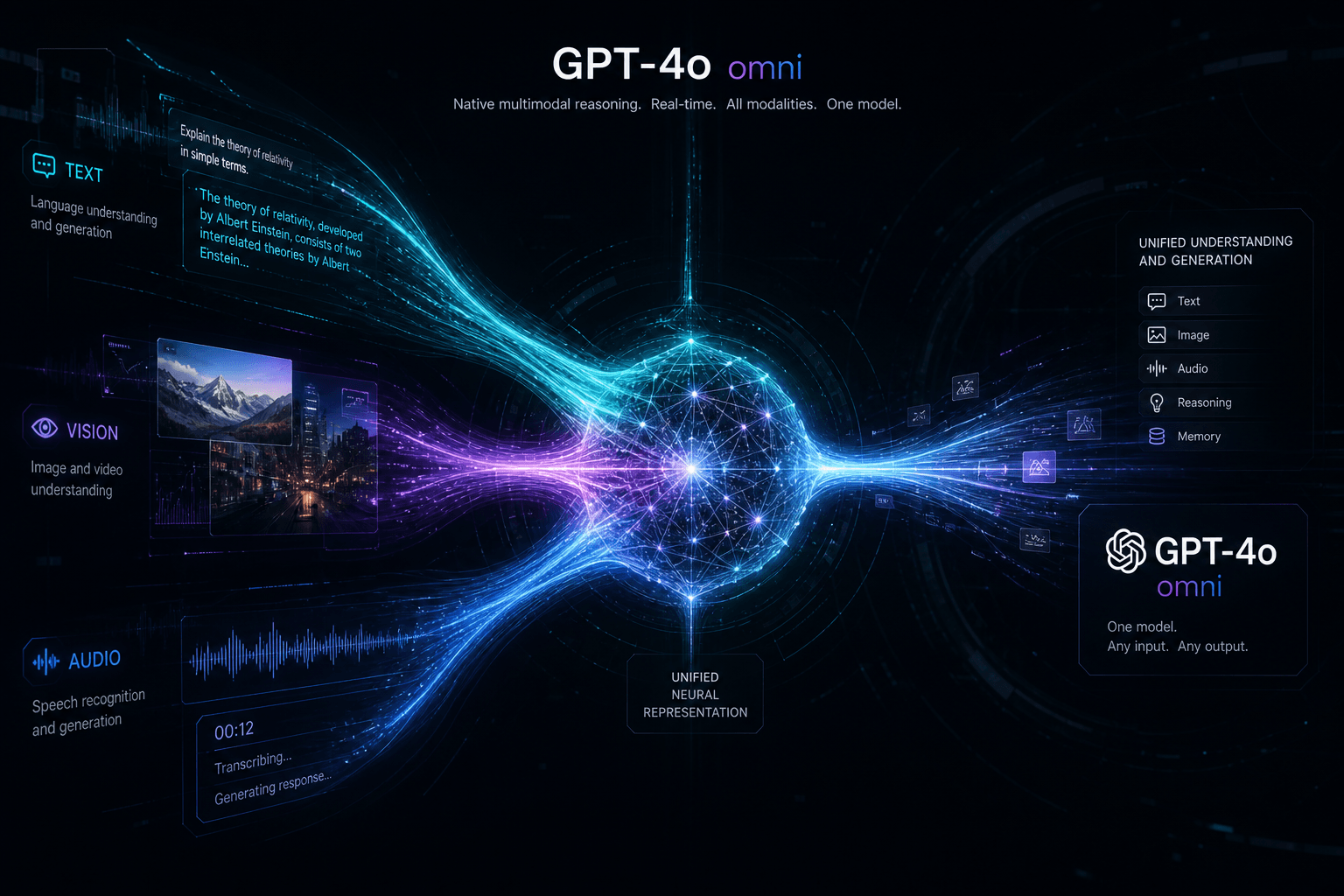
GPT-4o's "omni" designation signals a fundamental architectural shift from pipelined multimodality to end-to-end native processing. Previous approaches — including GPT-4 with Vision (GPT-4V) — handled different input types through separate subsystems: one model processed images into text descriptions, another model handled the actual reasoning, and audio required entirely separate speech-to-text and text-to-speech pipelines.
GPT-4o eliminates these boundaries. The same neural network processes text tokens, image patches, and audio waveforms within a single unified architecture. This isn't just a technical refinement — it enables capabilities that were impossible with the old pipeline approach.
The Pipeline Problem with Previous Multimodal AI #
GPT-4V, released in March 2024, demonstrated the limitations of stitched-together multimodality:
| Pipeline Stage | Limitation | Impact on Output |
|---|---|---|
| Vision encoding | Images converted to text descriptions via separate encoder | Lost spatial relationships, fine detail, and visual nuance |
| Audio processing | Whisper handled speech-to-text; separate TTS for output | Lost emotional tone, pauses, non-verbal cues; added latency |
| Context fragmentation | Each modality fed through different preprocessing | Broke coherence across mixed inputs (talking about an image while speaking) |
| Latency stacking | Multiple model calls in sequence | 2-5 second response delays for audio interactions |
The result: GPT-4V could "see" images and GPT-4 could "hear" audio via Whisper, but neither could truly reason across modalities simultaneously or generate native audio responses with appropriate emotional inflection.
How GPT-4o's Native Multimodality Works #
GPT-4o trains on interleaved text, image, and audio data from the ground up. The model learns to represent all three modalities in a shared embedding space — meaning the numerical representation of "a red circle" in text shares mathematical relationships with the pixel pattern of an actual red circle and the sound waveform of someone saying "red circle."
Key technical advantages:
- Unified attention mechanisms — When processing a screenshot with voice narration, the model attends to relevant pixels and audio segments simultaneously rather than processing them sequentially
- Native audio generation — GPT-4o outputs audio tokens directly, not text that gets passed to a TTS engine. This preserves emotional tone, can simulate laughter or singing, and enables real-time conversation pacing
- Cross-modal reasoning — The model can analyze a chart while listening to spoken questions about it, updating its understanding in real-time as the audio continues
- Reduced latency — Audio input to audio output averages 320 milliseconds (as low as 232ms), approaching human conversation response times
William Spurlock builds AI automation systems that use these capabilities. The shift from pipeline to native multimodality means agents can now handle complex workflows — like debugging code while viewing error screenshots and discussing solutions via voice — without the latency and context loss that made previous implementations feel robotic.
The ChatGPT Desktop App: Mac-First, Plus Exclusive (For Now) #
OpenAI released a native ChatGPT desktop application for macOS today, marking the first dedicated desktop client for the platform. The app ships with deep system integration that browser-based ChatGPT cannot match — and it's rolling out to ChatGPT Plus subscribers first, with free tier access following in the coming weeks.
The desktop launch signals OpenAI's strategic priority: move ChatGPT from a website you visit to a utility layer accessible from anywhere on your system. This is the first step toward the ambient AI assistant model that both OpenAI and Apple appear to be converging on.
Key Desktop App Features #
The macOS app (requires macOS 14+ with Apple Silicon) delivers several capabilities unavailable in the web interface:
| Feature | How It Works | Use Case |
|---|---|---|
| Option + Space shortcut | Global hotkey opens ChatGPT from any app | Instant access during coding, writing, or browsing |
| Screenshot capture | Take screenshots of full screen, window, or selected region | Debug UI issues, analyze charts, capture error messages |
| Direct IDE integration | ChatGPT can write code directly into supported editors | AI-assisted coding without copy-paste friction |
| Voice mode | Tap headphone icon for native voice conversation | Hands-free interaction, accessibility, rapid input |
| Refreshed UI | Cleaner interface optimized for desktop workflows | Reduced chrome, focus on content |
The screenshot capability represents a particularly significant workflow enhancement. Users can capture any portion of their screen — a code error, a data visualization, a design mockup — and immediately discuss it with GPT-4o. The model sees what you see, in context, without the friction of saving and uploading files.
Voice Mode on Desktop #
The desktop app carries over ChatGPT's existing voice mode with an important distinction: it's built for extended conversation. Four voice personalities are available (Breeze, Ember, Cove, and Juniper), and the desktop implementation supports longer, more natural dialogue sessions than the mobile app.
Later this month, OpenAI will roll out the full GPT-4o audio capabilities to the desktop app — including the native audio generation that can express emotion, adjust tone, and respond in real-time without the robotic cadence of traditional TTS systems.
Availability Timeline #
| User Tier | Desktop App Access | GPT-4o Access |
|---|---|---|
| ChatGPT Plus | Available today (May 13) | Immediate |
| ChatGPT Free | Rolling out "in coming weeks" | Phased by region, starting today |
| Windows users | "Later in 2024" announced | Web interface only until then |
The Windows delay is notable — especially with Microsoft's deep partnership with OpenAI — but macOS represents the primary developer and creative professional market that OpenAI appears to be targeting with this release.
GPT-4o Capabilities Across All Three Modalities #
GPT-4o doesn't just handle text, vision, and audio — it reasons across all three simultaneously within a single coherent context window. This unified capability opens use cases that were technically impossible with the pipelined approach of previous multimodal systems.
Text Capabilities: Matching GPT-4 Turbo, Faster and Cheaper #
On pure text benchmarks, GPT-4o matches or exceeds GPT-4 Turbo performance while operating at roughly double the speed. The improvements are most pronounced in non-English languages — where GPT-4o delivers substantial quality gains over its predecessor.
Text performance highlights:
- MMLU (Massive Multitask Language Understanding): 88.7% — competitive with Claude 3 Opus and ahead of GPT-4 Turbo's 86.5%
- HumanEval (coding): 90.2% — matching GPT-4 Turbo exactly and substantially ahead of Claude 3 Opus at 84.9%
- Latency: Approximately 2x faster response generation than GPT-4 Turbo for equivalent token counts
- Non-English quality: Significant improvements in tokenization efficiency and output quality across major world languages
Vision Capabilities: Beyond Description to Understanding #
GPT-4o's vision processing represents a leap from "describing what's in an image" to "understanding the meaning and implications of visual content." The model can analyze charts, read documents, interpret UI designs, and reason about spatial relationships.
Vision benchmark performance:
| Benchmark | GPT-4o | GPT-4 Turbo | Claude 3 Opus | What It Tests |
|---|---|---|---|---|
| MMMU (college-level multimodal reasoning) | 69.1% | 63.1% | 59.4% | Complex problem-solving across text and images |
| MathVista (mathematical reasoning in images) | 63.8% | — | — | Visual math problem solving |
| ChartQA (chart comprehension) | 85.7% | 78.5% | ~80% | Understanding data visualizations |
| DocVQA (document question answering) | 92.1% | 88.4% | 89.3% | Reading and extracting from documents |
The MMMU score deserves particular attention — it's a demanding benchmark testing college-level knowledge across subjects like mathematics, physics, chemistry, and medicine using diagrams, charts, and visual problem representations. GPT-4o's 69.1% substantially exceeds both competitors.
Audio Capabilities: The Most Significant Addition #
Audio is where GPT-4o breaks genuinely new ground. Previous ChatGPT voice interactions relied on three separate models: Whisper for speech-to-text, GPT-4 for reasoning, and a separate TTS system for output. GPT-4o handles all three stages natively.
Audio performance specifications:
- Response latency: 232-320 milliseconds (audio input to audio output)
- Emotional range: Can generate speech with laughter, whispering, singing, and emotional inflection
- Voice consistency: Maintains speaker characteristics across long conversations
- Noise robustness: Handles background noise, accents, and speech variations better than pipeline approaches
What this enables:
| Use Case | Previous Approach | GPT-4o Native |
|---|---|---|
| Customer service voice agent | 3-model pipeline, 3-5s latency | Single model, <1s latency |
| Language tutoring | Robotic TTS, no conversational nuance | Natural dialogue with emotional feedback |
| Accessibility tools | Text-focused workflows | Direct audio reasoning |
| Real-time translation | Sequential processing breaks flow | Simultaneous interpretation with tone preservation |
Cross-Modal Reasoning: The Killer Capability #
The true power of GPT-4o emerges in cross-modal tasks — where the model must reason across combined inputs to generate useful outputs. OpenAI demonstrated several examples today:
- Live coding assistance: The user shares their IDE screen via screenshot, speaks a question about the code, and GPT-4o responds by voice while referencing specific lines visible in the screenshot
- Data analysis: Uploading a spreadsheet screenshot and asking spoken questions about trends, receiving verbal answers that reference specific cells
- Visual debugging: Describing a UI bug by voice while showing the problematic interface, getting back specific CSS suggestions
This cross-modal fluency is what distinguishes GPT-4o from simply "a model that can do three things." It represents a step toward the unified AI assistant that can perceive and communicate through whatever channels humans naturally use.
The Free Tier Expansion: Frontier AI for Everyone #
OpenAI is fundamentally changing its access strategy today: GPT-4o's core capabilities roll out to ChatGPT's free tier users, not just paying subscribers. This represents the most significant democratization of frontier AI since ChatGPT itself launched in November 2022.
The move signals a strategic shift from gated access (pay to use the best model) to gated volume (pay for higher usage limits and premium features). It's a bet that wide distribution creates more value than subscription revenue from a smaller user base — and it puts immediate pressure on competitors who still gate their strongest models behind paid tiers.
What Free Users Get Today #
| Capability | Free Tier Access | Notes |
|---|---|---|
| GPT-4o text conversations | ✅ Available | Standard chat interface with GPT-4o |
| GPT-4o vision (image upload) | ✅ Available | Photo, screenshot, and document analysis |
| Web browsing | ✅ Available | Real-time information access |
| Data analysis | ✅ Available | File upload and processing |
| GPTs (custom chatbots) | ✅ Limited | Can use GPTs; cannot create them |
| Voice mode | ✅ Rolling out | Phased availability over coming weeks |
| Message limits | Restricted | Fewer messages per hour than Plus |
| Peak-time priority | ❌ No | GPT-4o may fall back to GPT-3.5 during high load |
Rate Limits: Free vs. Plus #
OpenAI has not published exact message caps, but early user reports suggest the free tier GPT-4o access is significantly more generous than previous free GPT-4 access — which was limited to roughly 40 messages per 3 hours. Free users should expect:
- Approximately 15-30 GPT-4o messages per 3-hour window (estimates based on early rollout)
- Automatic fallback to GPT-3.5 when GPT-4o quota exhausted or during peak demand
- Vision and file upload counts toward the same quota
Plus subscribers retain their existing GPT-4 rate limits (reportedly 5x higher than free tier) and gain priority access during high-traffic periods.
Geographic Rollout #
GPT-4o launches globally for both free and paid users, with one notable exception: voice capabilities roll out in phases by region due to regulatory requirements. The desktop app's voice mode and GPT-4o's native audio features will arrive in the United States and select markets first, expanding to additional countries as compliance review completes.
Strategic Implications #
This free tier expansion is a competitive weapon as much as a democratization effort:
- Pressure on Anthropic — Claude 3 Opus remains behind a $20/month paywall; free Claude users still get Claude 3 Sonnet as their top option
- Pressure on Google — With Google I/O tomorrow, Gemini's access strategy faces direct comparison
- Data flywheel acceleration — More users = more training signal = faster model improvement
- Ecosystem lock-in — Users building habits on free GPT-4o are more likely to upgrade or adopt API services
For builders: This changes the assumption that your users haven't experienced frontier AI. The baseline just shifted — free users now have access to a model that beats most paid alternatives from competitors.
Benchmark Performance: How GPT-4o Compares #
GPT-4o establishes new best-in-class results across multiple benchmarks while matching GPT-4 Turbo on the rest. The launch data shows OpenAI delivering on its promise of "GPT-4 level intelligence, but much faster and at half the cost" — with added multimodal capabilities that competitors haven't yet matched.
Standard Benchmark Suite #
| Benchmark | GPT-4o (May 2024) | GPT-4 Turbo (April 2024) | Claude 3 Opus (March 2024) | What It Measures |
|---|---|---|---|---|
| MMLU (understanding) | 88.7% | 86.5% | 86.8% | 57-subject knowledge test |
| HumanEval (coding) | 90.2% | 90.2% | 84.9% | Python function synthesis |
| MATH (mathematics) | 76.6% | 73.4% | — | Competition-level math |
| MGSM (multilingual math) | 90.3% | 88.1% | 90.7% | Grade-school math across languages |
| DROP (reading comprehension) | 83.4% | 80.9% | 83.1% | Complex reasoning over text |
The MMLU score deserves special attention: GPT-4o's 88.7% represents a meaningful advance over both GPT-4 Turbo and Claude 3 Opus, establishing it as the most broadly knowledgeable model available today. On HumanEval, the tie with GPT-4 Turbo at 90.2% confirms that GPT-4o maintains top-tier coding capabilities — while the substantial gap over Claude 3 Opus (5.3 percentage points) may influence developers choosing a primary coding assistant.
Multimodal Benchmarks: Where GPT-4o Dominates #
GPT-4o's native multimodal architecture produces particularly strong results on vision and audio benchmarks:
| Benchmark | GPT-4o | GPT-4V / Turbo | Claude 3 Opus | Test Focus |
|---|---|---|---|---|
| MMMU (college multimodal) | 69.1% | 63.1% | 59.4% | College-level problems with images |
| MathVista (math + vision) | 63.8% | — | — | Mathematical reasoning in visual contexts |
| AI2D (diagrams) | 94.2% | 90.1% | 88.1% | Grade-school science diagrams |
| ChartQA (charts/graphs) | 85.7% | 78.5% | ~80% | Understanding data visualizations |
| DocVQA (documents) | 92.1% | 88.4% | 89.3% | Reading documents and forms |
| OCR-VQA (text in images) | 81.3% | 78.5% | 80.3% | Reading text within images |
The MMMU (Massive Multi-discipline Multimodal Understanding) benchmark is the most demanding test in this suite — requiring college-level knowledge across mathematics, physics, chemistry, biology, medicine, and engineering, delivered through diagrams, charts, photographs, and mixed visual/text problems. GPT-4o's 69.1% substantially exceeds its closest competitor, representing genuine progress in AI's ability to reason about complex visual information.
Audio Benchmarks: First Comprehensive Results #
OpenAI published initial audio benchmarks that demonstrate GPT-4o's speech processing superiority:
| Task | GPT-4o | Whisper v3 (previous SOTA) | Improvement |
|---|---|---|---|
| Word Error Rate (English) | 2.0% | 4.2% | 52% reduction |
| Word Error Rate (multilingual) | 4.4% | 8.6% | 49% reduction |
| Audio transcription accuracy | 98.0% | 96.2% | 1.8% absolute gain |
| Response latency | 232-320ms | 2-5 seconds | 10x faster |
Most importantly, these benchmarks measure end-to-end audio quality — from spoken input through reasoning to spoken output. Previous approaches would concatenate separate ASR, LLM, and TTS benchmarks, masking the quality degradation and latency accumulation that occurred at each handoff.
Speed Benchmarks: Latency Comparison #
| Model | Time to First Token | Tokens/Second | Notes |
|---|---|---|---|
| GPT-4o | ~50-100ms | ~110+ | 2x faster than GPT-4 Turbo |
| GPT-4 Turbo | ~200-300ms | ~55 | Previous flagship |
| Claude 3 Opus | ~300-500ms | ~40 | Slower but thorough |
The speed improvements are consistent across input types — GPT-4o processes images roughly 2x faster than GPT-4V and delivers audio responses in a fraction of the time required by the Whisper→GPT-4→TTS pipeline.
What the Benchmarks Actually Mean for Builders #
Benchmarks don't tell the whole story, but today's release data confirms several practical claims:
- No capability regression — GPT-4o matches or exceeds GPT-4 Turbo on every standard benchmark
- Genuine multimodal advance — The vision and audio improvements aren't marginal; they represent new capability categories
- Speed without sacrifice — The 2x latency improvement comes without quality tradeoffs
- Cost efficiency — At 50% the API price of GPT-4 Turbo with equivalent or better performance, GPT-4o should become the default choice for most production applications
Pricing Changes: API Costs Drop Dramatically #
GPT-4o launches at 50% the API cost of GPT-4 Turbo — $5 per million input tokens and $15 per million output tokens compared to GPT-4 Turbo's $10/$30 pricing. This is not a promotional rate; it's the permanent pricing structure that makes GPT-4o the most cost-effective flagship model OpenAI has ever released.
For production applications, this cost reduction changes the economics of AI integration. Tasks that were marginally viable at GPT-4 Turbo pricing become profitable at GPT-4o rates — and the speed improvements (approximately 2x faster responses) compound the value by improving user experience while reducing infrastructure costs.
API Pricing Comparison (May 13, 2024) #
| Model | Input (per 1M tokens) | Output (per 1M tokens) | Context Window | Cost vs. GPT-4 Turbo |
|---|---|---|---|---|
| GPT-4o | $5.00 | $15.00 | 128K tokens | 50% cheaper |
| GPT-4 Turbo | $10.00 | $30.00 | 128K tokens | Baseline |
| Claude 3 Opus | $15.00 | $75.00 | 200K tokens | 3x more expensive |
| Claude 3 Sonnet | $3.00 | $15.00 | 200K tokens | Slightly cheaper input |
| Gemini 1.5 Pro | $3.50 | $10.50 | 1M tokens | Competitive pricing |
Cached input pricing (for repeated context in conversations): GPT-4o offers $1.25 per 1M cached tokens — a 75% discount for applications that maintain conversation state.
What This Means for Application Economics #
Consider a customer support application handling 1 million user messages per month:
| Metric | GPT-4 Turbo | GPT-4o | Monthly Savings |
|---|---|---|---|
| Average input tokens | 2,000 | 2,000 | — |
| Average output tokens | 500 | 500 | — |
| Cost per interaction | $0.0275 | $0.0175 | $0.01 |
| Monthly cost (1M interactions) | $27,500 | $17,500 | $10,000 |
The savings scale with volume. At enterprise scale (10M+ interactions), the $100,000+ monthly savings from switching to GPT-4o can fund additional engineering headcount or product development.
Context Window and Rate Limits #
| Specification | GPT-4o Value | Notes |
|---|---|---|
| Context window | 128,000 tokens | Same as GPT-4 Turbo |
| Max output tokens | 16,384 tokens | Sufficient for long-form content |
| Knowledge cutoff | October 1, 2023 | Same as GPT-4 Turbo |
| Training data | Up to October 2023 | No real-time knowledge without browsing |
Rate limits for API users depend on tier:
- Tier 1 (new developers): 30,000 TPM (tokens per minute)
- Tier 2 ($50+ paid): 450,000 TPM
- Tier 3 ($100+ paid): 1,000,000 TPM
- Tier 4 ($250+ paid): 2,000,000 TPM
- Tier 5 ($1,000+ paid): 10,000,000 TPM
These limits apply to GPT-4o at the same tiers as GPT-4 Turbo — meaning you get 2x the performance per token and 50% lower cost without sacrificing throughput.
When to Migrate from GPT-4 Turbo #
Migrate immediately:
- All new applications should default to GPT-4o
- Existing applications with cost concerns or user-perceived latency issues
- Applications requiring vision or audio capabilities
Consider staying on GPT-4 Turbo temporarily:
- Applications with extensive prompt engineering optimized specifically for GPT-4 Turbo responses
- Workflows depending on specific GPT-4 Turbo failure modes or quirks
- Systems with hardcoded response parsing that might be sensitive to subtle output differences
OpenAI has indicated GPT-4 Turbo will remain available "for the foreseeable future" but expect it to receive fewer updates as development focus shifts to the "o" model family.
The Technical Architecture: Single Model, Three Modalities #
GPT-4o represents a fundamental architectural evolution: a single end-to-end trained transformer that processes text, image, and audio tokens within the same unified representation space. This isn't a multimodal system — it's a multimodal model, and that distinction enables capabilities impossible with the pipeline architectures that preceded it.
Understanding this architecture matters for builders because it explains why GPT-4o can do things GPT-4V couldn't, why latency dropped so dramatically, and what new application patterns become possible when AI can truly reason across modalities rather than translating between them.
The Pipeline Architecture Problem #
Previous multimodal AI used a relay-race approach where different models passed batons:
Audio Input → Whisper (ASR) → Text → GPT-4 → Text → TTS Engine → Audio Output
                                              ↓
Image Input → Vision Encoder → Text Description → GPT-4 → Response
Each handoff introduced:
- Latency accumulation — Every model call added 100-500ms
- Information loss — Audio emotion, image spatial relationships, visual nuance got flattened to text
- Context fragmentation — The reasoning model never saw raw audio waveforms or image pixels
- Error compounding — A misheard word or misidentified object propagated through the chain
GPT-4o eliminates these handoffs entirely. The same neural network processes all three modalities natively.
How GPT-4o's Unified Architecture Works #
Tokenization across modalities:
| Modality | Tokenization Method | Token Efficiency |
|---|---|---|
| Text | Byte-pair encoding (BPE) | ~4 characters per token |
| Images | Patches → visual tokens | 1 token per ~16x16 pixel region |
| Audio | Raw waveform → audio tokens | Compressed representation of frequency/time features |
Images are divided into patches (small regions) that get embedded into the same high-dimensional space as text tokens. Audio waveforms are processed through a compression layer that extracts relevant acoustic features into audio tokens. All three token types flow through the same transformer layers, attended to by the same attention mechanisms.
The end-to-end training process:
GPT-4o was trained on interleaved multimodal data — sequences where text, image, and audio content naturally occur together. Examples include:
- Videos with transcripts and audio
- Screenshots paired with voice narration
- Documents with embedded diagrams
- Conversations about visual content
This training creates shared representations: the vector for "a red circle" in text space sits near the vector for the pixel pattern of a red circle and the acoustic signature of someone saying "red circle." The model learns concepts that transcend their original modality.
Technical Advantages of Native Multimodality #
1. Reduced Latency via Eliminated Pipeline Stages
| Architecture | Audio Round-Trip | Primary Latency Source |
|---|---|---|
| Pipeline (Whisper + GPT-4 + TTS) | 2,000-5,000ms | Sequential model calls |
| GPT-4o Native | 232-320ms | Single model inference |
The 10x latency improvement isn't from faster hardware — it's from eliminating the need to call three separate models in sequence.
2. Preserved Signal Through Raw Input Processing
In the pipeline architecture, Whisper had to commit to a specific transcription — "they're" vs. "their," "uh-huh" vs. silence, sarcastic vs. sincere tone. That commitment happened before GPT-4 ever saw the input. GPT-4o receives raw audio tokens and can resolve ambiguities using contextual reasoning across the full input.
3. Unified Context Window for Cross-Modal Reasoning
GPT-4o's 128K token context window holds mixed modalities simultaneously. A user can:
- Upload a 50-page PDF document
- Share a screenshot of a specific chart
- Ask a spoken question about the chart's relationship to the document
- Receive a spoken answer referencing both sources
All four elements exist in the same context window, attended to by the same reasoning pass.
4. Native Audio Generation
Previous TTS systems generated audio from text phonetically — producing correct pronunciation but losing emotional nuance, conversational pacing, and non-verbal communication. GPT-4o generates audio tokens directly, enabling:
- Emotional inflection (laughter, empathy, excitement)
- Whispering and tone modulation
- Singing and rhythmic speech
- Natural conversation dynamics (interjections, pauses, overlap)
Efficiency Gains #
Despite processing three modalities, GPT-4o is approximately 2x faster than GPT-4 Turbo on text-only tasks. This suggests architectural improvements beyond multimodal unification:
- Optimized inference stack — Better hardware utilization on NVIDIA H100 GPUs
- Improved attention mechanisms — Possibly incorporating techniques like multi-query attention or sliding window patterns
- Smaller active parameter count — Rumors suggest ~200B parameters vs. GPT-4's estimated ~1.8T MoE architecture
- Better batching efficiency — Unified model can batch mixed inputs more effectively than separate model pipelines
Implications for AI Engineering #
William Spurlock designs AI automation systems that exploit these architectural properties. The shift to native multimodality means:
- Voice agents become viable — 320ms latency hits the threshold for natural conversation
- Vision is now default — Applications should assume users want to share screenshots, photos, and documents
- Cross-modal prompts unlock new capabilities — "Explain this error message [screenshot] while I describe what I was trying to do [audio]"
- Cost structures simplify — One API call replaces three, with unified pricing
The architecture also suggests where OpenAI is heading: future models will likely add video (already supported for input), touch/gesture, and potentially other sensory modalities to the same unified framework. Building for GPT-4o's architecture today prepares applications for that expansion.
Why This Matters for Accessibility of Frontier AI #
Today's launch marks a philosophical inflection point: OpenAI has shifted from gating its best technology behind payment walls to distributing frontier AI capabilities as widely as possible. The strategic implications extend far beyond feature lists and benchmark scores — this is a bet that AI ubiquity creates more value than AI exclusivity.
For the past 18 months, the AI industry operated on a tiered access model: free users got competent but limited models (GPT-3.5, Claude 3 Sonnet), while paying subscribers accessed frontier capabilities. GPT-4o breaks that model by putting a top-tier model — one that beats most competitors' paid offerings — into free tier hands.
The Democratization Impact #
| Capability | Previous Access | GPT-4o Free Tier | Impact |
|---|---|---|---|
| College-level reasoning | $20/month subscriptions | Available to all | Students worldwide get tutoring assistance |
| Document analysis | API costs or paid tiers | Free with vision | Small businesses can process contracts, invoices |
| Code assistance | GitHub Copilot, Cursor, paid APIs | Free ChatGPT + desktop app | Developers in emerging markets get coding help |
| Voice interaction | Limited to paid tiers or separate apps | Rolling out free | Accessibility for visually impaired users |
| Multilingual fluency | Varies by model quality | Best-in-class non-English | Global knowledge work participation |
The rate limits on free tier usage (estimated 15-30 messages per 3 hours) are genuinely limiting for power users. But for the billions of people who need occasional access to frontier AI — a student checking homework, a small business owner drafting a contract, a developer debugging an error — those limits are sufficient. The ceiling just became the floor for AI access.
Competitive Pressure on the Industry #
OpenAI's free tier move immediately pressures every competitor's access strategy:
- Anthropic charges $20/month for Claude Pro with Opus access; free Claude users get Sonnet, which GPT-4o beats on most benchmarks
- Google launches Gemini improvements at I/O tomorrow — their access strategy will be measured against GPT-4o's free availability
- Meta offers open-weight models (Llama 3) for local running — but GPT-4o is easier to use and requires no technical setup
- Microsoft builds Copilot on OpenAI models — the free tier expansion benefits their ecosystem too
The industry dynamic shifts from "who has the best model?" to "who can afford to give away the best model?" OpenAI's partnership with Microsoft and its projected $3.4B revenue run rate give it the resources to play this game. Smaller competitors may be forced to find niches rather than compete on general capability distribution.
Educational and Global Equity Implications #
GPT-4o's non-English improvements deserve particular attention. While previous models were trained primarily on English text, GPT-4o demonstrates substantial quality gains across major world languages:
| Language | GPT-4 Turbo Quality | GPT-4o Improvement | Educational Impact |
|---|---|---|---|
| Spanish | Good | Significantly better | Latin American student access |
| Mandarin | Adequate | Major improvements | Chinese market penetration |
| Hindi | Limited | Substantially better | Indian education and business |
| Arabic | Limited | Major improvements | Middle East/North Africa access |
| Portuguese | Good | Better | Brazilian market expansion |
For educators and students in non-English-speaking regions, this is transformative. A student in Mumbai, Mumbai, or Mexico City now has access to an AI tutor that understands their language natively — not through a translation layer that loses nuance.
The Strategy Behind the Shift #
Why would OpenAI give away its best model? Several strategic calculations likely drive this decision:
- Data flywheel acceleration — More users generate more feedback, more edge cases, and more training signal for future models
- Ecosystem lock-in — Users building habits on free ChatGPT become customers for API, Enterprise, and future premium features
- Competitive moat building — Wide distribution creates switching costs; users with GPT-4o history are less likely to move to competitors
- Regulatory positioning — Demonstrating broad public benefit strengthens arguments against restrictive AI regulation
- Talent and mission — OpenAI's stated mission is "ensuring AGI benefits all of humanity" — free tier access aligns with that narrative
The bet: Free tier users will upgrade when they hit limits, adopt API for applications, and bring ChatGPT into their workplaces. The revenue model shifts from access fees to usage fees and enterprise conversion.
What Builders Should Do Today #
GPT-4o is available now — not in beta, not waitlisted, but in production APIs and rolling out to ChatGPT users as you read this. For builders and developers, the launch creates immediate action items ranging from simple API updates to strategic product reconsiderations.
Here's the priority-ordered checklist for responding to today's launch:
Immediate Actions (Today) #
1. Switch API calls to GPT-4o
If you're using the OpenAI API, change your model parameter:
# Before
response = client.chat.completions.create(
    model="gpt-4-turbo",
    messages=[...]
)

# After
response = client.chat.completions.create(
    model="gpt-4o",
    messages=[...]
)
That's it. The API interface is identical — same parameters, same response format, same SDK. You get 2x speed and 50% cost reduction instantly.
2. Test vision capabilities if you haven't already
If your application handles images, documents, or screenshots, test GPT-4o's vision input:
response = client.chat.completions.create(
    model="gpt-4o",
    messages=[
        {
            "role": "user",
            "content": [
                {"type": "text", "text": "What's in this image?"},
                {"type": "image_url", "image_url": {"url": "https://example.com/image.png"}}
            ]
        }
    ]
)
Vision is now core functionality, not an add-on. Consider where image inputs could improve your user experience.
3. Audit your prompt engineering
GPT-4o responds slightly differently than GPT-4 Turbo. Most prompts transfer cleanly, but test your critical paths:
- System prompts that rely on specific GPT-4 Turbo failure modes
- Parsing logic that expects exact output formatting
- Chain-of-thought prompts that depend on specific reasoning patterns
4. Update cost projections
With 50% lower API costs, recalculate your unit economics:
| Scenario | GPT-4 Turbo Monthly | GPT-4o Monthly | Savings |
|---|---|---|---|
| 100K API calls | $2,750 | $1,750 | $1,000 |
| 1M API calls | $27,500 | $17,500 | $10,000 |
| 10M API calls | $275,000 | $175,000 | $100,000 |
If you were previously using GPT-3.5 to save costs, re-evaluate — GPT-4o may now be affordable for use cases where you previously compromised on quality.
This Week Actions #
5. Download the ChatGPT desktop app (if you're Plus)
Test the desktop experience, particularly:
- Screenshot capture workflow (Option + Space, then screenshot)
- Voice mode quality and latency
- How GPT-4o handles mixed inputs (screenshot + typed question)
6. Plan your multimodal feature roadmap
GPT-4o enables new interaction patterns. Consider which make sense for your product:
| Feature | Implementation Complexity | User Value |
|---|---|---|
| Image upload for support tickets | Low — vision API available | High — users can share error screenshots |
| Voice input for mobile | Medium — requires audio handling | High — hands-free interaction |
| Document processing | Low — vision handles PDFs, images | High — automated data extraction |
| Real-time voice conversations | High — requires streaming architecture | Very High — conversational AI interface |
7. Test audio capabilities when available
GPT-4o's native audio isn't fully rolled out yet. When it becomes available in the API:
- Test speech-to-text accuracy with your target vocabulary
- Evaluate voice quality for your use case (customer service, tutoring, accessibility)
- Measure end-to-end latency for your infrastructure
Strategic Considerations #
8. Reassess your AI provider mix
If you were using multiple providers for different capabilities:
- Anthropic Claude for reasoning + OpenAI for vision → GPT-4o may handle both
- Whisper + GPT-4 + TTS for voice → GPT-4o replaces the entire pipeline
- GPT-3.5 for cost-sensitive tasks + GPT-4 for quality → GPT-4o may replace both
9. Prepare for user expectations to shift
Free ChatGPT users now have access to a model that beats many paid APIs. Your users will expect:
- Faster responses (GPT-4o sets the latency bar)
- Multimodal support ("why can't I upload a screenshot?")
- Cost efficiency (if you're charging for AI features)
10. Monitor for future GPT-4o variants
OpenAI typically releases model families:
gpt-4o— the flagship full capability modelgpt-4o-mini— likely coming, optimized for speed/cost- Fine-tuning availability — expected within weeks
Plan your architecture to switch between variants as they become available.
For William Spurlock AI Automation Clients #
William Spurlock is migrating client AI automations to GPT-4o this week. If you're running n8n workflows, custom agents, or API integrations built on GPT-4 Turbo, expect:
- 50% reduction in AI processing costs
- 2x improvement in response latency
- New multimodal capabilities (vision input for document processing)
- Simplified architecture (no more separate vision pipelines)
Contact for a migration assessment if you have complex prompt engineering or multi-model orchestration that needs review.
The Bigger Picture: OpenAI's Platform Strategy #
GPT-4o isn't just a model launch — it's a strategic move in the platform wars that will define AI's next phase. Today's release positions OpenAI ahead of Google's I/O conference (starting tomorrow), pressures Anthropic's paid-tier strategy, and signals how OpenAI plans to compete as AI becomes infrastructure rather than application.
Understanding this landscape matters for builders choosing where to invest integration effort, which models to depend on, and what capabilities to expect from the major labs over the next 12-18 months.
The Timing: Beating Google to the Punch #
Google I/O 2024 begins tomorrow (May 14). The conference is expected to showcase:
- Gemini 1.5 Pro with expanded capabilities
- Multimodal features for the Gemini ecosystem
- Android and Workspace AI integrations
By launching GPT-4o today, OpenAI accomplishes several tactical objectives:
- Sets the comparison baseline — Every Google announcement will be measured against GPT-4o's benchmarks and free tier availability
- Captures news cycle — Tech media will cover GPT-4o today and tomorrow, diluting Google I/O coverage
- Defines "frontier" — Google's announcements must beat GPT-4o's 88.7% MMLU and 69.1% MMMU to claim leadership
- Preempts narrative — OpenAI positions itself as the innovator, Google as the responder
The competitive dynamic is aggressive. OpenAI is running a classic "fast follower" defense — launching before the incumbent (Google) can consolidate its position, forcing Google to react to OpenAI's terms rather than setting its own agenda.
The Anthropic Challenge: Paid vs. Free Strategy #
Anthropic released Claude 3 Opus in March 2024, establishing itself as the reasoning leader with a 200K context window and strong benchmark performance. But Claude 3 Opus remains locked behind a $20/month Claude Pro subscription.
| Factor | OpenAI GPT-4o Strategy | Anthropic Claude Strategy |
|---|---|---|
| Best model access | Free tier gets GPT-4o | Free tier gets Claude 3 Sonnet only |
| Reasoning quality | 88.7% MMLU | 86.8% MMLU (Opus) |
| Context window | 128K tokens | 200K tokens (Opus) |
| Safety focus | Alignment via RLHF | Constitutional AI, more explicit safety research |
| Enterprise positioning | Broad consumer + API | Developer and enterprise focus |
Anthropic faces a dilemma: match OpenAI's free tier access and sacrifice subscription revenue, or maintain paid gating and lose user base. The company has historically prioritized safety and deliberate release over speed — but market pressure may force faster response.
Meta's Open Source Counterpressure #
While OpenAI and Anthropic compete on API access, Meta runs a different playbook with its Llama model family:
| Approach | OpenAI | Meta |
|---|---|---|
| Model access | API and ChatGPT only | Open weights, downloadable |
| Cost structure | Per-token pricing | Free to run locally |
| Customization | Limited (fine-tuning coming) | Full weights, fine-tunable |
| Data privacy | Sent to OpenAI servers | Runs locally, private |
| Capability | Leading (GPT-4o) | Competitive (Llama 3 70B) |
Meta's Llama 3 70B doesn't match GPT-4o's benchmarks, but it's "good enough" for many applications — and free to run without API calls. OpenAI's free tier expansion is partly a response to this pressure: if users can run capable open models locally, OpenAI needs to make its best models accessible without cost barriers.
The Consumer vs. API Strategy #
OpenAI runs two parallel businesses that occasionally conflict:
Consumer (ChatGPT):
- Revenue: Subscriptions ($20/month Plus, Teams, Enterprise)
- Goal: Maximum user adoption, habit formation, data collection
- Strategy: Free tier for awareness, paid tiers for power users
API Platform:
- Revenue: Per-token usage
- Goal: Become the infrastructure layer for AI-powered applications
- Strategy: Price competitively, integrate everywhere, enable startups
GPT-4o serves both strategies simultaneously:
- Free ChatGPT users get GPT-4o → expands consumer footprint
- Paid API users get 50% cost reduction → strengthens platform moat
- Desktop app → bridges consumer and developer use cases
The long-term bet: Consumer awareness drives API adoption. A developer who uses free ChatGPT becomes a developer who chooses OpenAI APIs for their product. The consumer business is marketing for the platform business.
What This Signals About AI's Future #
Today's launch reveals several trends that will shape the next 12-18 months:
Multimodal is the new default — Text-only models are legacy. Expect every major model release to include vision and audio capabilities.
Latency is the new moat — GPT-4o's 320ms audio response approaches human conversation speed. Competitors will be measured against this standard.
Price compression accelerates — 50% cost reduction in 12 months (GPT-4 Turbo launched March 2024 at $10/$30; GPT-4o at $5/$15). Expect continued pressure on pricing.
Free tier becomes battlefield — The competition shifts from "who has the best paid model?" to "who can afford to give away the best model?"
Desktop and ambient AI emerge — The macOS app signals a move from "website you visit" to "layer you access from anywhere." Expect similar moves from competitors.
Strategic Recommendations for Builders #
| Scenario | Recommendation |
|---|---|
| Building on OpenAI today | Default to GPT-4o; maintain GPT-4 Turbo fallback for edge cases |
| Multi-model architecture | Keep Claude 3 Opus for 200K context needs; GPT-4o for everything else |
| Cost-sensitive application | GPT-4o replaces GPT-3.5 for many use cases; re-evaluate your quality/cost tradeoff |
| Voice/audio application | Wait for GPT-4o audio API (rolling out in weeks), then migrate from Whisper+TTS |
| Long-term platform bet | Diversify across at least two providers; OpenAI's dominance isn't guaranteed |
The landscape shifts weekly. GPT-4o is the best available model today — but Google I/O starts tomorrow, Anthropic responds within weeks, and the next generation trains now. Build architectures that can switch models, not ones that depend on any single provider's current advantage.
FAQ: Everything You Need to Know About GPT-4o #
Q: What does "GPT-4o" stand for? #
A: The "o" stands for "omni" — referring to the model's omnimodal (or multimodal) capability to process text, vision, and audio natively within a single architecture. This distinguishes it from previous models that handled different modalities through separate pipelines.
Q: Is GPT-4o better than GPT-4 Turbo? #
A: Yes — GPT-4o matches or exceeds GPT-4 Turbo on every benchmark while being 2x faster and 50% cheaper. It achieves 88.7% on MMLU (vs. GPT-4 Turbo's 86.5%) and adds native vision and audio capabilities that GPT-4 Turbo lacked.
Q: Can free users access GPT-4o today? #
A: Yes — GPT-4o is rolling out to ChatGPT free tier users starting today (May 13, 2024). Free users get access to GPT-4o for text and image conversations with usage limits, while Plus subscribers get higher rate limits and priority access during peak times.
Q: What are the rate limits for GPT-4o on the free tier? #
A: OpenAI has not published exact numbers, but free users can expect approximately 15-30 GPT-4o messages per 3-hour window. After reaching the limit, conversations fall back to GPT-3.5 until the quota resets. Plus subscribers get approximately 5x higher limits.
Q: How much does GPT-4o cost on the API? #
A: GPT-4o API pricing is $5.00 per million input tokens and $15.00 per million output tokens — exactly 50% cheaper than GPT-4 Turbo's $10/$30 pricing. Cached input costs $1.25 per million tokens.
Q: What makes GPT-4o "multimodal" compared to GPT-4V? #
A: GPT-4o uses a single unified model that processes text, images, and audio end-to-end, while GPT-4V was GPT-4 with a separate vision encoder attached. GPT-4o can generate native audio responses with emotional tone, process audio and images simultaneously, and responds in 232-320ms versus 2-5 seconds for pipelined systems.
Q: Is the ChatGPT desktop app available for Windows? #
A: No — the ChatGPT desktop app launched today is macOS only (requires macOS 14+ with Apple Silicon). OpenAI has announced a Windows version is "coming later in 2024" but has not provided a specific date. Windows users can continue using the web interface.
Q: Can GPT-4o process audio files directly? #
A: Yes — GPT-4o accepts audio inputs directly without requiring separate speech-to-text processing. However, full audio API access is rolling out gradually. As of today, select developers have access; broader API audio support and desktop app voice features roll out over the coming weeks.
Q: What benchmarks did GPT-4o achieve? #
A: GPT-4o achieved 88.7% on MMLU, 90.2% on HumanEval, and 69.1% on MMMU — establishing new state-of-the-art results on the multimodal reasoning benchmark. It also scored 63.8% on MathVista and 85.7% on ChartQA, significantly exceeding GPT-4V's vision capabilities.
Q: Will GPT-4o replace GPT-4 Turbo entirely? #
A: Not immediately — OpenAI plans to keep GPT-4 Turbo available "for the foreseeable future," but GPT-4o is now the recommended default for new applications and most existing use cases. Developers should migrate to GPT-4o for cost and performance benefits, with GPT-4 Turbo as a fallback for edge cases.
Q: What is the context window for GPT-4o? #
A: GPT-4o has a 128,000 token context window (approximately 300 pages of text) with a maximum output of 16,384 tokens per request. This matches GPT-4 Turbo's context window but falls short of Claude 3 Opus's 200K tokens.
Q: When will voice mode with GPT-4o roll out to everyone? #
A: ChatGPT Plus subscribers get first access to GPT-4o voice capabilities beginning today, with broader rollout to free users and API access following "in the coming weeks." Geographic availability varies due to regulatory requirements — the US and select markets receive priority.
What's Next for AI Automation #
GPT-4o changes what's possible in AI automation. The 50% cost reduction makes large-scale AI operations economically viable for more businesses. The 2x speed improvement makes real-time AI agents feel responsive rather than sluggish. And the native multimodal capabilities enable entirely new automation patterns — agents that can read documents, analyze screenshots, and converse naturally.
William Spurlock designs and deploys AI automation systems for growth-focused teams. If you're considering how GPT-4o could transform your operations — whether through customer service agents, document processing pipelines, or voice-enabled workflows — let's discuss what becomes possible with today's capabilities.
Book a 30-minute AI automation strategy call to explore how GPT-4o fits into your automation roadmap.
Related Reading #
- ChatGPT Desktop Mac App Begins Rollout — The companion desktop application that puts GPT-4o one keyboard shortcut away
- Google I/O 2024: AI Count and Project Astra — How Google responded to GPT-4o at I/O 2024 (published May 14, 2024)
- Anthropic Claude iOS App and Team Launch — The competitive landscape for AI assistant access
William Spurlock is an AI automation engineer and custom web designer who ships production-grade AI systems and 5-figure immersive web experiences. This analysis was written on May 13, 2024, the day of GPT-4o's launch.
Related Posts
Google I/O 2026 Action List: How I Prompted Gemini 3.5 Flash and Antigravity Workflows
Google I/O 2026 just reset the AI tooling landscape. Here's the 9-action checklist for builders who want to ship this week, not just watch the keynote.
Anthropic vs. OpenAI vs. Google: The State of the Frontier in May 2026
A head-to-head breakdown of the three AI giants in May 2026: Claude Opus 4.6, GPT-5.3 and 5.4, Gemini 3.1 Pro. Real specs, real pricing, and what actually matters for builders.
Kimi K2 Open Weights: How I Prompted Moonshot's Frontier Model for Agentic Tool Use
How I direct Kimi K2 by Moonshot AI for agentic workflows, long-context tool calling, and workflow automation. A 1 trillion parameter MoE model with competitive benchmarks at 5-17x lower cost than GPT-5 and Claude.