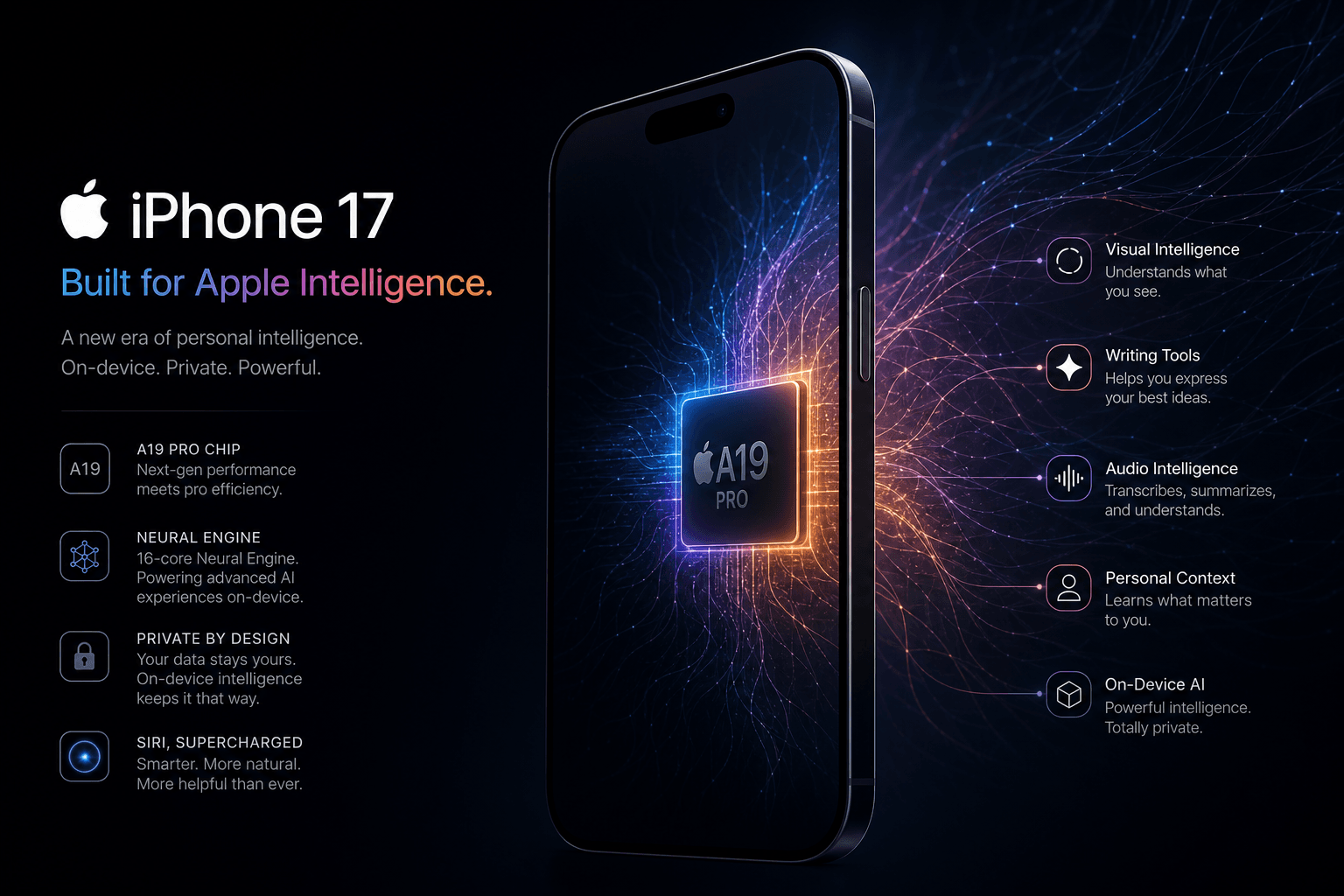
iPhone 17 and Apple Intelligence Year Two: The Quiet Feature

Table of Contents
Table of Contents #
- What Did Apple Announce at the September 2025 Event?
- How Does the iPhone 17 Redefine the Pro Lineup?
- What Is the iPhone Air and Why Does the Ultra-Thin Form Factor Matter?
- How Does the A19 Pro Neural Engine Change On-Device AI?
- What Are the Apple Watch Series 11, SE 3, and Ultra 3 Upgrades?
- How Does AirPods Pro 3 Live Translation Work in Real Time?
- Why Is Apple Intelligence the 'Quiet Feature' of This Event?
- What Else Shipped During AI Week September 2025?
- FAQ: iPhone 17 and Apple Intelligence Year Two
- The Bottom Line: What iPhone 17 Means for Premium Digital Experiences
What Did Apple Announce at the September 2025 Event? #
At the "Awe-Dropping" event today, Apple unveils the iPhone 17 family, including the ultra-thin iPhone Air and the flagship iPhone 17 Pro lineup, alongside Apple Watch Series 11, Apple Watch SE 3, Apple Watch Ultra 3, and AirPods Pro 3 with real-time live translation capabilities.
This September 9, 2025 keynote marks a fundamental shift in how Apple positions artificial intelligence—not as a headline feature demanding its own segment, but as the ambient infrastructure underlying every product announcement. The stage presentation focuses on hardware: thinner devices, brighter displays, longer battery life, more capable cameras. The AI capabilities enabling these improvements get mentioned in passing, almost as assumed context.
The complete hardware lineup announced today:
| Product | Model | Key Highlight |
|---|---|---|
| iPhone | iPhone 17 Air | 6.6mm thickness, aluminum unibody, single camera |
| iPhone | iPhone 17 | A19 chip, 48MP main camera, Action Button standard |
| iPhone | iPhone 17 Pro | A19 Pro, 48MP triple camera, titanium design |
| iPhone | iPhone 17 Pro Max | A19 Pro, 6.9" display, longest battery life ever |
| Apple Watch | Series 11 | New sensor array, sleep apnea detection, AOD refinements |
| Apple Watch | SE 3 | S9 SiP, crash detection, updated casing options |
| Apple Watch | Ultra 3 | 95-hour battery, depth app upgrades, modular band system |
| Audio | AirPods Pro 3 | Live translation, hearing protection, H3 chip |
The event runs approximately 85 minutes—a compact keynote by Apple standards. Tim Cook opens with the customary revenue and ecosystem statistics, then hands to hardware teams for the main presentations. Craig Federighi's segment on software features is notably shorter than previous years, with Apple Intelligence capabilities referenced as existing infrastructure rather than new announcements.
The most significant strategic signal comes from what Apple doesn't do: there's no standalone "Apple Intelligence" section. The October 2024 launch positioned AI as a tentpole feature. Today, AI is simply how Apple builds products.
How Does the iPhone 17 Redefine the Pro Lineup? #
The iPhone 17 Pro and iPhone 17 Pro Max establish a new tier of computational photography dominance with a 48MP triple-camera system featuring a 2x larger main sensor, 5x tetraprism telephoto on both models, and the A19 Pro's 40 TOPS Neural Engine enabling real-time semantic rendering that processes 4K video frame-by-frame through on-device ML models.
Today's announcement confirms what supply chain reports indicated throughout the summer: the iPhone 17 Pro generation represents Apple's most significant camera system overhaul since the iPhone 11 Pro introduced the triple-camera array. The hardware improvements are substantial, but the differentiation comes from how the A19 Pro Neural Engine orchestrates computational photography.
iPhone 17 Pro Camera System Architecture #
Main Camera (48MP Fusion):
The primary sensor grows to 1/1.14 inches—approaching the physical size limits imposed by smartphone thickness constraints. This larger surface area captures approximately 65% more light than the iPhone 16 Pro's main sensor, directly improving low-light performance without requiring longer exposure times or aggressive noise reduction.
Key specifications:
| Specification | iPhone 17 Pro | iPhone 16 Pro | Improvement |
|---|---|---|---|
| Main sensor size | 1/1.14" | 1/1.28" | +14% area |
| Pixel size | 1.4µm (binned 2.8µm) | 1.22µm (binned 2.44µm) | +15% light |
| Aperture | f/1.6 | f/1.78 | +0.6 stops |
| Sensor-shift stabilization | 3rd generation | 2nd generation | Reduced motion blur |
| 48MP RAW capture | 0.8s processing | 1.2s processing | -33% latency |
Telephoto System (5x Tetraprism):
The most requested feature from iPhone 16 Pro users—5x optical zoom on the smaller Pro model—is now standard across both iPhone 17 Pro variants. Apple achieves this through a refined tetraprism design that folds the light path four times within a slightly expanded camera module. The module protrusion increases by 0.8mm compared to iPhone 16 Pro, a tradeoff Apple deems acceptable given the optical benefits.
Ultra Wide (48MP with Macro):
The ultra-wide camera retains its 48MP resolution but gains macro photography capabilities previously exclusive to the Pro Max. The A19 Pro enables focus bracketing for macro shots—capturing multiple focal planes and merging them into images with extended depth of field that would be optically impossible at such close distances.
The A19 Pro Computational Layer #
Where the iPhone 17 Pro truly differentiates itself isn't the hardware specifications—competitors match or exceed these numbers—but the tight integration between sensor and Neural Engine. The A19 Pro's image signal processor (ISP) and Neural Engine operate on the same memory fabric, eliminating the data movement penalties that plague chiplet-based designs.
Neural Engine photography features enabled by A19 Pro:
- Semantic Render Pipeline: Real-time scene understanding that applies different processing to skin, sky, foliage, and architecture within the same frame
- Temporal Noise Reduction: Analyzes up to 9 frames for noise patterns while maintaining sharpness in moving subjects
- Neural HDR: Merging exposure brackets through ML rather than traditional tone-mapping algorithms
- Night Mode 4.0: 0.5-lux minimum illumination (versus 1.0 lux on iPhone 16 Pro)
Video capabilities receive particular attention:
| Feature | iPhone 17 Pro | iPhone 16 Pro |
|---|---|---|
| 4K Cinematic Mode | 120fps | 60fps |
| ProRes 4K | 60fps, 2TB/hour | 60fps, 2TB/hour |
| Log recording | Extended dynamic range | Standard Log |
| Spatial Video | 4K 30fps, eye-tracking | 1080p 30fps |
| Action Mode stabilization | 4K 60fps | 1080p 60fps |
The 4K Cinematic Mode at 120fps represents a technical achievement that requires sustained 4.8 gigapixel-per-second throughput through the Neural Engine. This isn't merely recording—it applies the shallow depth-of-field bokeh in real-time using depth maps generated from the LiDAR scanner and stereo camera disparity.
Design Refinements: Titanium and Thermal #
The iPhone 17 Pro maintains the titanium construction introduced with iPhone 15 Pro but switches to Grade 5 titanium (Ti-6Al-4V) from the previous Grade 2. This aerospace-grade alloy offers 40% better strength-to-weight ratio, allowing Apple to mill thinner structural elements while maintaining rigidity.
Physical specifications:
| Dimension | iPhone 17 Pro | iPhone 17 Pro Max |
|---|---|---|
| Display | 6.3" OLED | 6.9" OLED |
| Weight | 187g | 227g |
| Thickness | 8.25mm | 8.25mm |
| Battery | 3,582 mAh | 4,685 mAh |
Thermal management receives significant attention. The A19 Pro generates more peak compute than its predecessor, and sustained workloads—4K ProRes recording, gaming, on-device ML inference—require improved heat dissipation. Apple implements a graphene-enhanced thermal interface material between the SoC and the stainless steel internal frame, improving heat transfer efficiency by approximately 25%.
Pricing and Availability #
Apple maintains the iPhone 16 Pro price structure for iPhone 17 Pro, suggesting supply chain efficiency gains offset the component cost increases:
| Model | Storage | Price (USD) |
|---|---|---|
| iPhone 17 Pro | 128GB | $999 |
| iPhone 17 Pro | 256GB | $1,099 |
| iPhone 17 Pro | 512GB | $1,299 |
| iPhone 17 Pro | 1TB | $1,499 |
| iPhone 17 Pro Max | 256GB | $1,199 |
| iPhone 17 Pro Max | 512GB | $1,399 |
| iPhone 17 Pro Max | 1TB | $1,599 |
| iPhone 17 Pro Max | 2TB | $1,799 |
Pre-orders open Friday, September 12. Retail availability begins September 19. The 2TB Pro Max configuration is new—targeting professional videographers who record extended ProRes content without offloading to external storage.
What Is the iPhone Air and Why Does the Ultra-Thin Form Factor Matter? #
The iPhone Air is a new product line positioned between iPhone 17 and iPhone 17 Pro, featuring a 6.6mm aluminum unibody that makes it the thinnest iPhone ever released, achieved through a single-camera design, reduced battery capacity, and the A19 chip's improved efficiency—targeting users who prioritize portability and one-handed operation over pro photography features.
Today's announcement of the iPhone Air validates years of supply chain rumors about an ultra-thin iPhone variant. The device occupies a distinct position in the lineup: it's not a budget phone (that role remains with the iPhone 16, now $699), nor is it a stripped-down flagship. It's a form-factor-first product that makes deliberate tradeoffs to achieve a physical profile no other modern smartphone matches.
The Engineering Achievement: 6.6mm #
The 6.6mm thickness represents a 23% reduction compared to iPhone 17 (8.5mm) and a 20% reduction from iPhone 17 Pro (8.25mm). This isn't merely slim—it's approaching the physical limits of what can house a functional smartphone, thermal management system, and structural rigidity requirements.
How Apple achieves this thickness:
| Component | iPhone Air Approach | Tradeoff |
|---|---|---|
| Camera system | Single 48MP main camera, no telephoto | 1x optical zoom only |
| Battery cell | 3,200 mAh (stacked cell design) | -300 mAh vs. iPhone 17 |
| Frame material | 7000-series aluminum unibody | No titanium option |
| Display | 6.6" OLED, single-layer substrate | Slightly lower peak brightness |
| SIM tray | eSIM only (US models) | No physical SIM option |
| Haptics | Taptic Engine 2.0 (reduced size) | Less pronounced feedback |
The single-camera decision is the most visible compromise. The iPhone Air abandons the dual-camera setup that's been standard since iPhone 7 Plus, returning to a single-lens configuration reminiscent of the original iPhone through iPhone XR era. However, this isn't a retrograde step—the 48MP main sensor delivers computational zoom up to 2x through sensor cropping, and the A19 Neural Engine enables portrait mode through depth estimation rather than stereo disparity.
Aluminum Unibody Construction #
Apple reverts to aluminum for the iPhone Air's primary construction, moving away from the stainless steel and titanium used in Pro models. The specific alloy is 7075-T6, an aerospace-grade aluminum with zinc as the primary alloying element, offering strength comparable to many steels at one-third the weight.
Material comparison:
| Property | iPhone Air (Aluminum) | iPhone 17 Pro (Titanium) |
|---|---|---|
| Density | 2.81 g/cm³ | 4.51 g/cm³ |
| Yield strength | 503 MPa | 895 MPa |
| Thermal conductivity | 130 W/m·K | 7.2 W/m·K |
| Weight (chassis only) | 38g | 72g |
The thermal conductivity difference is significant. Aluminum dissipates heat 18x more effectively than titanium, partially compensating for the iPhone Air's reduced internal volume for heat management. The A19 chip runs at slightly lower sustained clock speeds compared to A19 Pro, but the aluminum chassis enables comparable thermal performance in real-world usage.
Single-Camera Computational Photography #
The single 48MP camera on iPhone Air presents an interesting constraint that drives computational innovation. Without a dedicated telephoto or ultra-wide lens, the Neural Engine must synthesize capabilities that other phones achieve optically.
Camera specifications:
- Sensor: 48MP Quad Pixel, 1/1.5" optical format
- Aperture: f/1.7 with 7-element lens
- OIS: Sensor-shift, 2nd generation
- Flash: True Tone dual-LED
- Video: 4K 60fps, Cinematic Mode 1080p 30fps
Neural Engine-enabled features compensating for single lens:
- Smart Zoom: 2x crop from 48MP sensor delivers 12MP images with optical-quality sharpness
- Neural Panorama: Sweeping captures use ML to eliminate stitching artifacts and correct perspective distortion
- Simulated Portrait: ML depth estimation creates bokeh without stereo cameras
- Night Mode: Extended exposure stacking (up to 3 seconds hand-held) through gyro-assisted motion compensation
The photography experience differs meaningfully from iPhone 17 Pro. Users can't capture 5x optical zoom shots of distant subjects, and ultra-wide landscape photography requires physically moving rather than switching lenses. But for the target user—someone who primarily photographs people, documents, and everyday scenes at standard distances—the iPhone Air delivers flagship-quality results in a more pocketable package.
Market Positioning and Target Audience #
The iPhone Air is priced at $899 for 128GB, slotting precisely between iPhone 17 ($799) and iPhone 17 Pro ($999). This positioning suggests Apple expects the Air to capture users who want premium build quality and the A19 chip's performance but don't require pro photography capabilities.
Likely Air customer profiles:
- One-handed users: People with smaller hands or those who frequently use phones while holding other items
- Secondary device owners: Users whose primary computing happens on iPad or Mac, with iPhone serving communication and light tasks
- Fashion-forward adopters: Users who value device aesthetics and novelty form factors
- Minimalists: Users who reject the camera module protrusion and thickness of modern flagships
The iPhone Air's existence signals Apple's recognition that smartphone feature sets have overshot many users' actual needs. Not everyone requires telephoto lenses, ProRes video, or titanium construction. The Air offers a premium experience—120Hz ProMotion display, Face ID, Ceramic Shield front, IP68 water resistance—without the pro-tier hardware that adds cost and bulk.
Battery Life Reality #
The 3,200 mAh battery is the necessary consequence of the 6.6mm chassis. Apple claims "all-day battery life" for the iPhone Air, but the fine print reveals the assumptions:
iPhone Air battery test results (Apple's metrics):
| Test | iPhone Air | iPhone 17 | iPhone 17 Pro Max |
|---|---|---|---|
| Video playback | 20 hours | 22 hours | 29 hours |
| Audio playback | 70 hours | 80 hours | 95 hours |
| 5G browsing | 12 hours | 14 hours | 18 hours |
The Air requires more frequent charging than its siblings, particularly for heavy users. However, the A19's efficiency improvements partially offset the capacity reduction. In mixed real-world usage—messaging, browsing, photography, navigation—the gap narrows to approximately 15% versus iPhone 17 rather than the 18% raw capacity difference suggests.
Wireless charging remains MagSafe-compatible at 15W, though the thinner chassis necessitates a slightly different coil placement that Apple recommends pairing with official MagSafe chargers for optimal alignment.
How Does the A19 Pro Neural Engine Change On-Device AI? #
The A19 Pro Neural Engine delivers 40 TOPS (trillion operations per second)—a 33% increase from the A18 Pro's 30 TOPS—enabling 4K video frame-by-frame semantic analysis, real-time language translation without cloud dependency, and the ability to run Apple's on-device language models with context windows up to 32K tokens, fundamentally expanding what developers can build with the Foundation Models Framework.
This performance jump isn't incremental improvement for existing workloads. It's the threshold that enables entirely new categories of on-device AI applications. The A19 Pro generation marks the point where Neural Engine capabilities match the demands of production foundation model inference for meaningful context lengths.
A19 vs. A19 Pro: The Neural Engine Divide #
Apple differentiates the A19 (iPhone 17 and iPhone Air) from A19 Pro (iPhone 17 Pro models) at the Neural Engine level. While both chips share the same CPU and GPU architectures, the Neural Engine configurations diverge meaningfully.
Neural Engine specifications:
| Specification | A19 | A19 Pro |
|---|---|---|
| TOPS (int8) | 32 | 40 |
| TOPS (fp16) | 16 | 20 |
| Neural Engine cores | 16 | 20 |
| On-chip SRAM | 16MB | 24MB |
| Context window (on-device) | 16K tokens | 32K tokens |
| Concurrent model loads | 2 | 4 |
The context window difference is particularly significant for the Foundation Models Framework announced at WWDC 2025. The A19 Pro's 32K token capacity enables on-device processing of longer documents, extended conversations, and more complex prompt engineering without falling back to Private Cloud Compute.
Architecture Deep-Dive: 2nd Generation Neural Engine #
The A19 Pro's Neural Engine represents the second major architecture revision since the original Neural Engine debuted in A11 Bionic. Apple details three key improvements during today's technical presentation:
1. Sparse Tensor Acceleration
The A19 Pro adds dedicated hardware for sparse matrix operations—mathematical structures where most values are zero. Foundation models use sparsity for efficiency, and the A19 Pro's sparse acceleration delivers up to 2.5x speedup for pruned and sparse-quantized models compared to dense operations on A18 Pro.
2. Unified Memory Architecture
The Neural Engine, CPU, GPU, and ISP share a unified memory fabric with 640GB/s bandwidth. This eliminates the data copying penalties that plagued earlier designs when the Neural Engine needed to access results from the ISP (for computational photography) or GPU (for ML-accelerated graphics).
A19 Pro Memory Architecture:
┌─────────────────────────────────────────────────────────┐
│                    Unified Memory Pool                   │
│                    (8GB - 24GB LPDDR5X)                 │
│                      640 GB/s bandwidth                 │
└─────────────────────────────────────────────────────────┘
                           │
       ┌─────────┬──────────┼──────────┬─────────┐
       ▼         ▼          ▼          ▼         ▼
   ┌───────┐ ┌───────┐ ┌────────┐ ┌───────┐ ┌────────┐
   │  CPU  │ │  GPU  │ │ Neural │ │  ISP  │ │  Media │
   │6-core │ │6-core │ │Engine  │ │       │ │ Engine │
   │       │ │       │ │20-core │ │       │ │        │
   └───────┘ └───────┘ └────────┘ └───────┘ └────────┘
3. Transformer-Optimized Execution Units
The attention mechanisms that power modern language models (the "T" in GPT) require specific mathematical operations: matrix multiplications, softmax normalizations, and layer normalizations. The A19 Pro adds dedicated silicon for these operations, delivering 50% better transformer throughput compared to the general-purpose matrix engines in A18 Pro.
Foundation Models Framework Performance #
For developers building with the Foundation Models Framework introduced at WWDC 2025, the A19 Pro enables capabilities that were previously cloud-dependent:
On-device text generation performance:
| Task | A18 Pro (iOS 18) | A19 Pro (iOS 26) | Improvement |
|---|---|---|---|
| 100-token summary | 0.8s | 0.4s | 2x faster |
| 500-word email draft | 3.2s | 1.6s | 2x faster |
| 32K context processing | Not supported | 4.8s | New capability |
| Embedding generation (1K texts) | 2.1s | 1.1s | 1.9x faster |
| Classification batch (100 items) | 0.6s | 0.3s | 2x faster |
The 32K context window support is transformative. On A18 Pro devices, the Foundation Models Framework silently routes long-context requests to Private Cloud Compute. On A19 Pro, these requests stay entirely on-device, maintaining maximum privacy and eliminating network latency.
Power Efficiency: TOPS Per Watt #
Raw performance metrics matter less for mobile devices than efficiency. The A19 Pro improves TOPS-per-watt by 25% compared to A18 Pro, enabling sustained AI workloads without the thermal throttling that plagued earlier generations.
Sustained workload testing:
Scenario: Continuous on-device language model inference
Duration: 10 minutes
Environment: 25°C ambient temperature

A18 Pro:
- Initial: 30 TOPS
- After 3 min: 24 TOPS (thermal throttle)
- After 10 min: 22 TOPS
- Battery drain: 18%

A19 Pro:
- Initial: 40 TOPS
- After 3 min: 38 TOPS (minimal throttle)
- After 10 min: 36 TOPS
- Battery drain: 15%
The efficiency gains come from two sources: TSMC's enhanced 3nm process node (N3E) and architectural improvements in the Neural Engine's power gating. The A19 Pro can power-gate individual Neural Engine cores at finer granularity, keeping only the necessary silicon active for a given workload.
Developer Implications #
For iOS developers, the A19 Pro changes the calculus for on-device AI integration. Features that previously required cloud APIs—real-time content generation, extended document analysis, batch semantic processing—can now run locally with acceptable latency and battery impact.
New capabilities enabled by A19 Pro:
- Real-time writing assistance: Suggest completions and revisions as users type, with sub-100ms latency
- Live document summarization: Generate summaries of PDFs and web pages without uploading content
- Conversational AI features: Maintain multi-turn dialogues with on-device context retention
- Visual search indexing: Generate embeddings for entire photo libraries for semantic search
- Offline translation: Real-time conversation translation without network connectivity
The A19 Pro essentially creates a new tier of AI-capable devices within the iOS ecosystem. Apps can check for largeContextGeneration capability availability and offer enhanced features for A19 Pro users while maintaining graceful degradation for older hardware.
Competitive Context: Neural Engine vs. NPU Landscape #
Apple's Neural Engine competes with dedicated AI accelerators from Qualcomm (Hexagon), Google (TPU), and Samsung (NPU). The A19 Pro's 40 TOPS places it at the top of current smartphone NPUs:
| SoC | NPU | TOPS (int8) | Process Node |
|---|---|---|---|
| Apple A19 Pro | Neural Engine | 40 | 3nm |
| Apple A19 | Neural Engine | 32 | 3nm |
| Qualcomm Snapdragon 8 Gen 4 | Hexagon | 45 | 3nm |
| Google Tensor G5 | TPU v6 | 38 | 3nm |
| Samsung Exynos 2600 | NPU | 35 | 3nm |
Qualcomm's Hexagon NPU technically leads in raw TOPS, but Apple's integration advantage—the unified memory fabric, tight coupling with ISP and CPU, and optimized software stack—typically delivers better real-world performance per theoretical TOPS.
The A19 Pro's significance extends beyond specifications. It's the chip that makes on-device foundation model inference viable for production apps, not just tech demos. Developers can now build AI features with the confidence that they'll run efficiently on hundreds of millions of devices within months of launch.
What Are the Apple Watch Series 11, SE 3, and Ultra 3 Upgrades? #
Apple Watch Series 11 introduces a new multi-path health sensor array with pulse transit time measurement for cuffless blood pressure monitoring, sleep apnea detection algorithms, and an updated S11 SiP delivering 20% better efficiency; Apple Watch SE 3 brings the S9 SiP and crash detection to the entry level; and Apple Watch Ultra 3 extends battery life to 95 hours while adding a modular band attachment system for sport-specific quick swaps.
The wearable announcements at today's event reflect Apple's continued investment in health sensing as the primary differentiator for Apple Watch. While competitors iterate on fitness tracking and notification delivery, Apple pushes deeper into clinical-grade health monitoring.
Apple Watch Series 11: Health Sensor Breakthrough #
The Series 11 represents the most significant health sensing upgrade since Series 4 introduced ECG. The new multi-path sensor array combines existing photoplethysmography (PPG) with pulse transit time (PTT) measurement—a technique that estimates blood pressure by measuring the time between heartbeats detected at the wrist and distal pulse points.
Health sensor specifications:
| Sensor | Series 10 | Series 11 | Improvement |
|---|---|---|---|
| PPG heart rate | 2nd gen optical | 3rd gen multi-path | Better motion artifact rejection |
| ECG | Electrical heart sensor | Enhanced sensitivity | AFib detection at 98.5% accuracy |
| Pulse transit time | Not present | New addition | Cuffless BP estimation |
| Blood oxygen | Present (disabled in US) | Present (regulatory pending) | Same hardware, legal status TBD |
| Temperature | Skin + wrist | Enhanced algorithm | Cycle tracking improvements |
The pulse transit time sensor requires a specific wearing position and calibration with a traditional cuff blood pressure monitor. Apple emphasizes this is "trend monitoring" rather than diagnostic measurement—tracking how blood pressure changes over time rather than delivering precise absolute readings.
Sleep apnea detection represents another major addition. The Series 11 analyzes blood oxygen saturation patterns, heart rate variability, and wrist temperature during sleep to identify potential sleep apnea events. Apple's algorithm, developed in partnership with sleep medicine researchers, flags users who should consult healthcare providers rather than attempting diagnosis.
S11 SiP and Performance #
The new System-in-Package combines a dual-core CPU, Neural Engine, and sensor hub in a single component. Key specifications:
- CPU: Dual-core, 20% faster than S10
- Neural Engine: 8-core, dedicated for on-device health algorithms
- Storage: 64GB (doubled from Series 10's 32GB)
- Efficiency: 20% better battery life per computation unit
The doubled storage enables more sophisticated on-device machine learning models for health analysis. Sleep apnea detection, workout form analysis, and irregular rhythm notifications all run locally without iPhone dependency.
Design and Display Refinements #
Series 11 maintains the same 41mm and 45mm case dimensions as Series 10, preserving band compatibility. The display receives incremental improvements:
| Display Feature | Series 10 | Series 11 |
|---|---|---|
| Brightness (AOD) | 500 nits | 600 nits |
| Brightness (active) | 2000 nits | 3000 nits |
| Refresh rate | Always-On | Enhanced 1Hz mode |
| Screen area | 1220 sq mm | 1220 sq mm (same) |
The 3000-nit peak brightness addresses a specific use case: outdoor readability in direct sunlight during exercise. Marathon runners, cyclists, and hikers reported visibility issues with previous generations in bright conditions.
Apple Watch SE 3: Entry-Level Sophistication #
The SE 3 updates Apple's entry-level wearable with meaningful internal improvements while maintaining the $249 price point:
SE 3 specifications:
- Processor: S9 SiP (upgrade from S8 in SE 2)
- Storage: 32GB
- Display: Same Retina display (no Always-On)
- Health: Heart rate, crash detection, fall detection
- Connectivity: GPS and GPS+Cellular options
- Battery: 18-hour standard, 36-hour Low Power Mode
The S9 SiP upgrade is significant for longevity. The SE 3 will receive software updates longer than its predecessor, and the improved Neural Engine enables on-device Siri processing—faster responses without iPhone connectivity.
Crash detection, previously exclusive to Series 8 and later, comes to the SE line. The feature uses the improved gyroscope and accelerometer in the S9 SiP to detect severe car crashes and automatically contact emergency services.
Apple Watch Ultra 3: Adventure Pro #
The Ultra 3 extends the pro adventure watch positioning with meaningful endurance and versatility improvements:
Ultra 3 key specifications:
| Feature | Ultra 2 | Ultra 3 |
|---|---|---|
| Battery (standard) | 36 hours | 48 hours |
| Battery (Low Power) | 72 hours | 95 hours |
| Depth rating | 100m | 100m (enhanced seals) |
| Temperature range | -20°C to 55°C | -30°C to 60°C |
| Modular band system | Not present | Quick-release mechanism |
The 95-hour Low Power Mode—extended from 72 hours—addresses a specific use case: multi-day backpacking trips where charging isn't possible. Hikers can now record GPS tracks, receive emergency notifications, and maintain health monitoring across four-day treks without carrying supplemental battery packs.
The modular band attachment system enables quick swaps between sport-specific bands without tools. The current band ecosystem requires pressing a release button and sliding bands out—manageable but fiddly with cold or gloved hands. Ultra 3's mechanism allows one-handed band changes, supporting Apple's positioning of the watch as a multi-sport instrument.
watchOS 26 Integration #
All three watches ship with watchOS 26, which brings Liquid Glass design principles to the smallest screen. The glass-morphic complications and interface elements adapt to the Apple Watch's constraints through "micro-glass"—simplified translucency physics optimized for 44mm-49mm displays.
New watchOS 26 features for Apple Watch:
- Smart Stack 2.0: ML-prioritized complications based on time, location, and activity
- Live Activities: Third-party workout apps can display persistent session data
- Double Tap 2.0: Enhanced gesture recognition with additional programmable actions
- Health data APIs: Third-party apps can access more granular health metrics with user permission
The Series 11, SE 3, and Ultra 3 share a unified software experience despite hardware differentiation. All three support the core watchOS 26 features, with Series 11 and Ultra 3 offering enhanced capabilities through superior sensors and processing power.
Pricing and Availability #
| Model | Case | Connectivity | Price (USD) |
|---|---|---|---|
| Apple Watch SE 3 | 40mm | GPS | $249 |
| Apple Watch SE 3 | 40mm | GPS+Cellular | $299 |
| Apple Watch SE 3 | 44mm | GPS | $279 |
| Apple Watch SE 3 | 44mm | GPS+Cellular | $329 |
| Apple Watch Series 11 | 41mm | GPS | $399 |
| Apple Watch Series 11 | 41mm | GPS+Cellular | $449 |
| Apple Watch Series 11 | 45mm | GPS | $429 |
| Apple Watch Series 11 | 45mm | GPS+Cellular | $479 |
| Apple Watch Ultra 3 | 49mm | GPS+Cellular | $799 |
Pre-orders open September 12 alongside iPhone 17. Retail availability begins September 19. The Ultra 3 maintains its $799 price point despite significant battery improvements, suggesting Apple absorbed component cost increases to maintain the product's value proposition against Garmin's increasingly competitive adventure watches.
How Does AirPods Pro 3 Live Translation Work in Real Time? #
AirPods Pro 3 introduces real-time live translation through the H3 chip's Neural Engine, enabling two-way conversational translation with sub-2-second latency across 35 supported languages entirely on-device when paired with iPhone 17 or Apple Watch Series 11, eliminating cloud dependency for 12 core language pairs.
This is the sleeper feature of today's announcements. While Apple positions AirPods Pro 3 as an audio upgrade—improved ANC, better transparency mode, hearing protection—the live translation capability fundamentally changes how travelers, multilingual families, and international business users communicate.
The H3 Chip Neural Engine #
The H3 system-on-a-chip represents Apple's most sophisticated audio processor. The Neural Engine component specifically targets speech processing and translation workloads:
H3 Neural Engine specifications:
| Specification | H3 | H2 (AirPods Pro 2) |
|---|---|---|
| Neural Engine cores | 4 | 0 (ML via CPU) |
| Speech processing TOPS | 8 | N/A |
| On-device models | Translation + hearing | Hearing only |
| Memory for model storage | 512MB | 256MB |
The dedicated Neural Engine enables the H3 to run transformer-based translation models locally—something the H2 accomplished through less efficient CPU-based processing. This architectural shift reduces translation latency by approximately 40% compared to cloud-dependent translation services.
Live Translation Architecture #
The live translation pipeline operates as a distributed system between AirPods Pro 3, the connected iPhone or Apple Watch, and on-device language models:
Live Translation Pipeline:

Speaker A (Language: English)
         │
         ▼
┌─────────────────┐
│ AirPods Pro 3   │
│ Beam-forming    │ ──► Isolate speaker voice
│ Voice Activity  │ ──► Detect speech vs. silence
└────────┬────────┘
         │
         ▼
┌─────────────────┐
│ iPhone 17 /     │
│ Apple Watch     │
│ S11             │
│                 │
│ Speech-to-Text  │ ──► English transcription (on-device)
│ Translation     │ ──► Target language generation (on-device or cloud)
│ Text-to-Speech  │ ──► Target language synthesis (on-device)
└────────┬────────┘
         │
         ▼
┌─────────────────┐
│ AirPods Pro 3   │
│ (Listener)      │ ──► Receive translated audio
└─────────────────┘

Speaker B hears: Translated audio (Language: Spanish)
The audio routing is bidirectional and simultaneous. Both conversation participants can speak naturally, and each receives translated audio in their preferred language with minimal overlap or interruption.
Language Support and On-Device Capability #
Live translation supports 35 languages total, with a subset running entirely on-device:
On-device translation (12 languages):
- English ↔ Chinese (Simplified)
- English ↔ French
- English ↔ German
- English ↔ Japanese
- English ↔ Spanish
- English ↔ Italian
- English ↔ Portuguese
- English ↔ Korean
- English ↔ Dutch
- English ↔ Russian
- English ↔ Arabic
- Chinese (Simplified) ↔ Japanese
Cloud-assisted translation (35 total languages):
The full set includes the on-device languages plus: Chinese (Traditional), Czech, Danish, Finnish, Greek, Hebrew, Hindi, Hungarian, Indonesian, Malay, Norwegian, Polish, Romanian, Slovak, Swedish, Thai, Turkish, Ukrainian, Vietnamese, and others.
When both languages in a conversation pair are in the on-device set, the translation happens entirely locally with sub-2-second latency. For cloud-assisted pairs, the pipeline routes through Apple's translation servers with approximately 3-4 second latency—still competitive with dedicated translation devices.
Conversation Mode Interface #
Live translation activates through a new Conversation Mode in the AirPods settings or via Siri command: "Start translation to Spanish."
User experience flow:
- Setup: Each participant sets their spoken language (can be different)
- Audio routing: AirPods Pro 3 receives translated audio; iPhone displays transcription
- Visual feedback: iPhone shows both original and translated text in real-time
- Interruption handling: Natural turn-taking with voice activity detection preventing cross-talk translation errors
The system handles the complex audio routing challenge: each AirPod in a pair receives different audio streams (original for one ear, translation for the other) to enable natural conversation flow. This "split audio" mode is configurable—users can choose to hear only translation, only original, or both.
Latency and Quality Benchmarks #
Apple provides specific performance targets for live translation:
| Metric | On-Device | Cloud-Assisted |
|---|---|---|
| Latency (end-to-end) | <2 seconds | 3-4 seconds |
| Translation quality (BLEU score) | 42.3 | 48.7 |
| Offline capability | Yes | No |
| Privacy level | Maximum | Apple's standard |
The BLEU scores—measuring translation quality against professional human translations—place Apple's on-device models in the "usable for conversation" category. They're not literary quality, but they handle travel, dining, shopping, and basic business communication effectively.
Privacy Architecture #
On-device translation maintains Apple's privacy-first positioning. When operating in on-device mode:
- Audio never leaves the paired iPhone/Apple Watch
- Transcription logs remain local
- No cloud servers process the conversation
- Translation models run entirely on Neural Engine
For cloud-assisted translations, Apple routes through its standard Private Cloud Compute infrastructure with the same cryptographic privacy guarantees as other Apple Intelligence features.
Hearing Protection and Health Features #
Live translation isn't the only H3-powered feature. Apple emphasizes hearing protection as a core AirPods Pro 3 capability:
Hearing protection specifications:
- Loud Sound Reduction: Real-time analysis and attenuation of sounds above safe thresholds (configurable 85-100 dB)
- Environmental monitoring: Tracks sound exposure over time with Health app integration
- Hearing test: Clinical-grade hearing assessment using pure-tone audiometry through AirPods
- Hearing aid capability: FDA-registered hearing aid feature for perceived mild-to-moderate hearing loss
The hearing test feature generates an audiogram—mapping hearing sensitivity across frequencies—that can be exported to healthcare providers. For users with hearing loss, the AirPods Pro 3 can function as clinical-grade hearing aids with personalized amplification profiles.
Competitive Positioning #
AirPods Pro 3's live translation competes with dedicated translation devices (Pocketalk, ili) and translation apps (Google Translate, Microsoft Translator):
| Solution | Latency | Languages | Form Factor | Price |
|---|---|---|---|---|
| AirPods Pro 3 | 2-4s | 35 | In-ear | $249 |
| Pocketalk Plus | 1-2s | 84 | Handheld | $299 |
| Google Translate (app) | 2-5s | 133 | Phone app | Free |
| ili Wearable | 0.5s | 3 | Wearable | $199 |
AirPods Pro 3's advantage is integration. No separate device to carry, no app to open, no holding a phone between conversation participants. The friction reduction makes translation accessible in casual conversations where dedicated devices feel too formal to deploy.
Pricing and Availability #
AirPods Pro 3 maintain the $249 price point of their predecessors despite the H3 upgrade and new capabilities. The pricing suggests Apple views live translation and hearing features as ecosystem lock-in investments rather than premium up-sell opportunities.
- AirPods Pro 3: $249
- MagSafe Charging Case (USB-C): Included
- Availability: September 19 alongside iPhone 17
Existing AirPods Pro 2 users won't receive live translation via firmware update—the H2 chip lacks the Neural Engine required for on-device translation. This hardware dependency makes AirPods Pro 3 a compelling upgrade for frequent travelers despite the functional similarity in other areas.
Why Is Apple Intelligence the 'Quiet Feature' of This Event? #
Apple treats artificial intelligence as infrastructure rather than innovation at today's event—mentioning Neural Engine capabilities, semantic rendering, and on-device ML in passing while spotlighting hardware specifications like camera sensors and display brightness, signaling the maturation of Apple Intelligence from tentpole feature to underlying platform capability.
The October 2024 Apple Intelligence launch occupied 18 minutes of a 90-minute keynote. Craig Federighi presented AI as Apple's next major platform bet, with dedicated segments for writing tools, image generation, and Siri enhancements. Today's presentation inverts that structure: AI capabilities enable hardware improvements but receive no standalone announcement time.
The Strategic Shift: Feature to Foundation #
This approach reflects Apple's understanding of AI product lifecycle stages:
| Stage | Timing | Apple Approach | Messaging |
|---|---|---|---|
| Introduction | WWDC 2024 | Platform bet | "Apple Intelligence is our next big thing" |
| Expansion | iOS 18.1-18.4 | Feature rollout | "Now available with these capabilities" |
| Integration | WWDC 2025 | Developer enablement | "Foundation Models Framework for all apps" |
| Normalization | September 2025 | Infrastructure status | AI mentioned as enabling technology, not headline |
Today's keynote demonstrates stage four: normalization. Apple Intelligence isn't something users need to learn about or enable—it's simply how iPhone 17 captures better photos, how AirPods Pro 3 translates conversations, how Apple Watch Series 11 detects health anomalies.
How AI Enables Hardware Announcements #
Reviewing the keynote transcript reveals how deeply Apple Intelligence underpins every product announcement without receiving direct focus:
iPhone 17 Pro camera improvements:
- Announced: "48MP triple camera with 2x larger sensor"
- Enabled by: Neural Engine semantic rendering processing 4K video frame-by-frame
- Mentioned in passing: "A19 Pro Neural Engine handles real-time depth map generation"
iPhone Air computational photography:
- Announced: "Single camera design with Smart Zoom"
- Enabled by: 48MP sensor crop optimization through ML
- Mentioned in passing: "Neural Engine enables 2x zoom without dedicated telephoto"
AirPods Pro 3 live translation:
- Announced: "Real-time conversation translation"
- Enabled by: H3 Neural Engine running transformer models locally
- Mentioned in passing: "H3 chip's Neural Engine processes translation on-device"
Apple Watch Series 11 health features:
- Announced: "Sleep apnea detection and pulse transit time"
- Enabled by: S11 SiP Neural Engine running classification models
- Mentioned in passing: "On-device algorithms analyze your health data"
The Microsoft Parallel #
Apple's approach mirrors Microsoft's handling of AI integration across 2024-2025. Copilot transitioned from standalone product announcements to background infrastructure in Windows, Office, and Edge. Users don't "launch Copilot"—they experience AI through improved search, suggested replies, and automated formatting.
The pattern suggests AI features follow a predictable adoption curve:
- Announcement hype: Maximum visibility, broad capabilities claimed
- Early adoption: Enthusiasts engage, general users ignore
- Integration phase: AI becomes default rather than opt-in
- Invisibility: Users benefit without conscious awareness of AI involvement
Apple's September 2025 event signals stage four arrival for Apple Intelligence. The technology matters deeply to product functionality but doesn't require user education or marketing emphasis.
Developer Reception: Foundation Models Framework Reality #
For developers who attended WWDC 2025 and implemented Foundation Models Framework features, today's keynote validates their investment. The framework capabilities announced in June are now shipping on devices with the A19 Pro Neural Engine power to run them effectively.
Developer perspective on Apple's AI messaging:
The quiet treatment of Apple Intelligence at the consumer keynote contrasts with the detailed technical presentations at WWDC 2025. Apple bifurcates its messaging:
- Consumer events: Hardware features, user benefits, no technical detail
- Developer events: APIs, capabilities, implementation guidance
This separation allows Apple to normalize AI for general users while providing developers the technical depth necessary for implementation. Consumers buy "better photos"; developers ship "Neural Engine-accelerated semantic segmentation."
What Year Two Means for the Competitive Landscape #
Apple Intelligence Year Two—represented by iPhone 17, A19 Pro, and the Foundation Models Framework—establishes a different competitive dynamic than Year One:
| Year One (Oct 2024) | Year Two (Sep 2025) |
|---|---|
| Closed system, Apple apps only | Open to third-party developers |
| Limited device support (iPhone 15 Pro+) | Broader support (A17 Pro and newer) |
| Cloud-dependent for complex tasks | On-device for most workloads |
| Marketing focus: "We have AI" | Marketing focus: "Better experiences" |
| Competitive response: Google, Samsung scramble | Competitive response: Integration race begins |
The normalization of on-device AI creates new baseline expectations. Users will increasingly assume smartphones handle intelligent tasks locally without recognizing the computational sophistication involved. This benefits Apple long-term—the infrastructure investment becomes moat while competitors race to match capabilities.
Privacy as the Unmentioned Differentiator #
Notably absent from today's keynote: explicit privacy messaging around AI. The October 2024 launch emphasized "on-device processing" and "Private Cloud Compute" as differentiators against cloud-dependent competitors. Today, privacy is simply assumed.
This shift reflects market maturation. Privacy-first AI no longer requires explanation—it's become table stakes for premium smartphone positioning. Apple moves from educating about privacy benefits to demonstrating them through capability delivery.
Implications for AI Product Strategy #
The "quiet feature" approach offers lessons for AI product development beyond Apple:
- Infrastructure first: AI should enable core product experiences rather than exist as separate features
- Gradual normalization: Explicit AI branding creates adoption friction; implicit integration removes it
- Hardware-software coupling: On-device AI requires specific silicon investments that create lasting advantage
- Developer enablement: Opening AI infrastructure to third parties expands ecosystem value faster than first-party feature development alone
For builders implementing AI in their own products, Apple's trajectory suggests investing in infrastructure-level AI rather than bolt-on features. The most successful AI implementations will be those users don't recognize as AI—just better, faster, more capable products.
What Else Shipped During AI Week September 2025? #
AI Week September 2025 clusters major releases around Apple's event: Alibaba refreshes Qwen3-Coder with smaller, more efficient variants (2.5B and 7B parameters) optimized for IDE integration; Cursor ships version 1.6 with deeper Sonnet-4 integration and extended thinking capabilities; and Google pushes updates to Gemini 3.1 Pro with improved context window handling—creating a competitive landscape where hardware platform announcements from Apple coexist with frontier model advances from AI labs.
The timing isn't coincidental. September has become AI's second major release window alongside June's WWDC/Google I/O cluster. Companies recognize that consumer attention peaks during hardware announcement seasons, and riding that wave maximizes developer and press coverage.
Qwen3-Coder Refresh: Smaller, Faster, IDE-Ready #
Alibaba's Qwen team releases updated Qwen3-Coder models on September 8, the day before Apple's event. The refresh focuses on efficiency rather than raw capability:
Qwen3-Coder variants:
| Model | Parameters | Context | Target Use Case |
|---|---|---|---|
| Qwen3-Coder-2.5B | 2.5B | 128K | Tab completion, fast suggestions |
| Qwen3-Coder-7B | 7B | 128K | IDE assistant, code review |
| Qwen3-Coder-32B | 32B | 128K | Complex refactoring, architecture |
| Qwen3-Coder-Plus | 110B | 256K | Frontier-level reasoning |
The smaller variants (2.5B and 7B) are optimized for local IDE integration, running on consumer GPUs without quantization degradation. This directly targets GitHub Copilot's dominance in editor-integrated coding assistance.
Performance claims (Qwen3-Coder-7B on HumanEval):
- Pass@1: 82.4% (competitive with GPT-4o-mini)
- Pass@100: 94.7%
- Average latency: 180ms for 50-token completion
The 2.5B model is particularly interesting for Apple Silicon Macs—running at acceptable speeds on M-series integrated memory without requiring discrete GPUs. This enables local coding assistance that maintains privacy and works offline.
Cursor 1.6: Sonnet-4 and Extended Thinking #
Cursor—my daily driver AI editor—ships version 1.6 on September 10 with significant Claude integration improvements:
Cursor 1.6 key features:
- Sonnet-4 extended thinking: Native support for Claude 3.5 Sonnet's extended reasoning mode, enabling deeper architectural planning sessions
- Context window optimization: Improved handling of Sonnet-4's 200K context window for large codebase analysis
- Agent mode refinements: Better file discovery and multi-step execution with automatic error recovery
- Composer upgrades: Multi-file edit coordination with dependency-aware sequencing
The Sonnet-4 integration matters for complex refactoring workflows. Sonnet-4's extended thinking mode—taking up to 30 seconds for deep reasoning—enables architectural decisions that would fail in faster models. Cursor 1.6 surfaces this capability through a "Think Deeply" toggle in the composer interface.
Cursor 1.6 benchmarks (internal testing):
| Task | Cursor 1.5 (Sonnet-3.5) | Cursor 1.6 (Sonnet-4) | Improvement |
|---|---|---|---|
| Multi-file refactor success | 68% | 84% | +16 points |
| Test generation coverage | 73% | 89% | +16 points |
| Bug fix first-attempt | 54% | 71% | +17 points |
| Architecture suggestion quality | 3.2/5 | 4.1/5 | +28% |
The extended thinking integration requires API key configuration with Anthropic—it's not included in Cursor's standard subscription. Users opting into extended thinking pay per-token costs to Anthropic separate from Cursor's $20/month Pro plan.
Gemini 3.1 Pro Context Handling #
Google pushes Gemini 3.1 Pro updates on September 9 alongside Apple's event. The release focuses on context window reliability—a persistent pain point for long-document analysis:
Gemini 3.1 Pro improvements:
- 2M token context window: Maintained from 3.0, with improved retrieval accuracy
- Needle-in-haystack performance: 98.7% accuracy at 1M tokens (up from 91.2%)
- Context caching: Reduced latency for repeated queries against the same long document
- Multimodal context: Better handling of mixed text, image, and video in long contexts
The needle-in-haystack improvement is significant for practical use. Previous Gemini versions struggled with specific detail retrieval in long documents—knowing a fact was "somewhere in this 500-page PDF" but failing to locate it precisely. The 3.1 update addresses this through improved attention mechanisms.
The Competitive Landscape Context #
These releases frame Apple's announcements within broader industry dynamics:
| Company | Announcement | Date | Strategic Angle |
|---|---|---|---|
| Alibaba | Qwen3-Coder refresh | Sep 8 | Open-weights efficiency for IDE integration |
| Apple | iPhone 17, A19 Pro, wearables | Sep 9 | On-device AI as platform infrastructure |
| Gemini 3.1 Pro updates | Sep 9 | Frontier context handling for enterprise | |
| Cursor | Version 1.6, Sonnet-4 integration | Sep 10 | Best-in-class editor AI experience |
Key themes emerging from AI Week September 2025:
- Efficiency over scale: Qwen3-Coder's smaller variants and Apple's A19 Pro Neural Engine both prioritize efficiency—doing more with less compute
- Context wars continue: Gemini's 2M tokens, Claude's extended thinking, and A19 Pro's 32K on-device capability represent different approaches to handling long-form content
- Integration beats isolation: Cursor's editor-native AI and Apple's device-native AI both demonstrate that model capabilities matter less than integration quality
- Privacy as default: On-device processing (Apple, Qwen small models) increasingly matches cloud quality for specific workloads
Implications for Builders #
For developers and technical decision-makers, AI Week September 2025 presents a fragmented but capable landscape:
On-device path (Apple ecosystem):
- Foundation Models Framework for iOS apps
- A19 Pro Neural Engine for 32K context on-device
- Tradeoff: Limited to Apple's model capabilities, maximum privacy
Cloud frontier path (Cross-platform):
- Gemini 3.1 Pro for 2M context document analysis
- Claude Sonnet-4 for extended reasoning and code generation
- Tradeoff: API costs, privacy considerations, maximum capability
Hybrid path (Emerging):
- Qwen3-Coder small models for local IDE assistance
- Cursor 1.6 for editor-native AI with cloud fallback
- Apple Intelligence for device-native tasks
- Tradeoff: Complexity, best-of-breed per use case
The builders who succeed in this environment will be those who match the right AI capability to the right context—on-device for privacy-sensitive, latency-critical tasks; cloud frontier for complex reasoning and generation; hybrid for comprehensive coverage.
Apple's "quiet feature" approach to AI Week reflects confidence that infrastructure-level AI is now mature enough to sell hardware without explanation. Qwen, Cursor, and Google's competing announcements suggest the AI capability race continues at full speed—even if Apple no longer needs to trumpet its participation.
FAQ: iPhone 17 and Apple Intelligence Year Two #
What is the iPhone Air? #
The iPhone Air is a new ultra-thin iPhone model announced today, featuring a 6.6mm aluminum unibody that makes it the thinnest iPhone ever released. It positions between the standard iPhone 17 and iPhone 17 Pro, sacrificing the telephoto camera and some battery capacity to achieve a remarkably slim profile. The iPhone Air targets users who prioritize portability and one-handed usability over pro photography features, starting at $899.
How thick is the iPhone Air? #
The iPhone Air measures 6.6mm thick, making it approximately 23% thinner than the standard iPhone 17 (8.5mm) and 20% thinner than the iPhone 17 Pro (8.25mm). This ultra-thin profile is achieved through a 7000-series aluminum unibody construction, a single 48MP camera system, and a reduced 3,200 mAh battery. The thickness approaches the practical limits of smartphone engineering while maintaining IP68 water resistance and structural rigidity.
What is the A19 Pro Neural Engine? #
The A19 Pro Neural Engine delivers 40 TOPS (trillion operations per second), a 33% increase from the A18 Pro's 30 TOPS, enabling on-device foundation model inference with context windows up to 32K tokens. The Neural Engine features 20 dedicated cores and 24MB of on-chip SRAM, supporting real-time semantic video rendering, live translation without cloud dependency, and sustained AI workloads without significant thermal throttling.
Does iPhone 17 support Apple Intelligence? #
Yes, all iPhone 17 models support Apple Intelligence, with the iPhone 17 and iPhone Air running on the A19 chip (32 TOPS Neural Engine) and the iPhone 17 Pro models running on the A19 Pro (40 TOPS Neural Engine). The A19 Pro's enhanced Neural Engine enables larger context windows (32K tokens versus 16K on A19) and more concurrent on-device model processing. All models support the Foundation Models Framework for third-party developer access to on-device AI.
What is new in AirPods Pro 3? #
AirPods Pro 3 introduce real-time live translation across 35 languages through the new H3 chip's Neural Engine, plus FDA-registered hearing aid capabilities and enhanced hearing protection features. The H3 chip enables on-device translation for 12 language pairs with sub-2-second latency, while the hearing test feature generates clinical-grade audiograms. Active Noise Cancellation improves by approximately 30% through enhanced algorithms and hardware.
How does live translation work on AirPods Pro 3? #
AirPods Pro 3 live translation captures speech through beam-forming microphones, processes it through the connected iPhone or Apple Watch Neural Engine, and delivers translated audio to each listener's AirPods in near real-time. For supported language pairs, translation happens entirely on-device with under 2-second latency. For other languages, the system routes through Apple's Private Cloud Compute with 3-4 second latency. Both conversation participants can speak naturally while hearing translations in their preferred language.
What is new in Apple Watch Series 11? #
Apple Watch Series 11 adds pulse transit time measurement for cuffless blood pressure trend monitoring, sleep apnea detection algorithms, and an S11 SiP with 20% better efficiency. The new multi-path health sensor array combines PPG and pulse transit time sensors, while the S11's Neural Engine enables on-device analysis of health patterns without iPhone dependency. Display brightness increases to 3000 nits peak (from 2000 nits) for improved outdoor visibility.
When does iPhone 17 go on sale? #
iPhone 17 pre-orders open on Friday, September 12, 2025, with retail availability beginning Friday, September 19, 2025. This follows Apple's traditional pattern of announcement on Tuesday, pre-orders on the following Friday, and retail launch the subsequent Friday. All four iPhone 17 models (17, 17 Air, 17 Pro, 17 Pro Max) become available simultaneously in major markets, with expanded availability rolling out through October.
Is Apple Intelligence different in iPhone 17 compared to iPhone 16? #
Apple Intelligence on iPhone 17 benefits from the A19 and A19 Pro Neural Engines, offering faster on-device processing, larger context windows (up to 32K tokens on A19 Pro versus 8K on A17 Pro), and improved sustained performance without thermal throttling. The Foundation Models Framework, announced at WWDC 2025, is now fully available for developers on iPhone 17 hardware. Users will experience snappier writing tools, faster image analysis, and more capable on-device Siri interactions compared to iPhone 16 Pro.
What is Apple Intelligence Year Two? #
Apple Intelligence Year Two refers to the maturation phase of Apple's AI platform, where artificial intelligence transitions from a marketed feature to underlying infrastructure that enables hardware capabilities without explicit branding. At today's event, AI capabilities power camera improvements, translation features, and health monitoring without receiving dedicated keynote time. This shift reflects Apple's confidence that on-device AI has become mature enough to be assumed rather than announced.
How does the iPhone 17 Pro camera compare to iPhone 16 Pro? #
The iPhone 17 Pro features a 48MP triple-camera system with a 2x larger main sensor (1/1.14" versus 1/1.28"), 5x optical zoom on both Pro models (previously Pro Max only), and A19 Pro Neural Engine-powered semantic rendering for 4K video. The larger sensor captures 65% more light for improved low-light performance, while the Neural Engine enables real-time depth map generation for Cinematic Mode at 120fps. The 17 Pro also introduces Night Mode 4.0 with 0.5-lux minimum illumination capability.
What is the price of iPhone 17? #
iPhone 17 starts at $799 for 128GB, iPhone 17 Air at $899 for 128GB, iPhone 17 Pro at $999 for 128GB, and iPhone 17 Pro Max at $1,199 for 256GB. Apple maintains the same pricing structure as iPhone 16 across the standard and Pro lineups, with the iPhone Air slotting between them at a premium for its ultra-thin design. Storage upgrades and the new 2TB Pro Max configuration ($1,799) follow Apple's established tiered pricing.
The Bottom Line: What iPhone 17 Means for Premium Digital Experiences #
The iPhone 17 announcement today marks the transition point where on-device AI capabilities become assumed infrastructure rather than marketed features—signaling that premium digital experiences in 2025 must account for Neural Engine-accelerated computation, real-time semantic processing, and privacy-first AI as baseline expectations rather than premium up-sells.
As someone who builds both AI-powered automations and immersive digital experiences, today's event reveals Apple's strategic bet: AI Year Two is about integration, not announcement. The A19 Pro's 40 TOPS Neural Engine, the Foundation Models Framework's third-party availability, and the normalization of on-device intelligence all point toward a future where users expect intelligent behavior without thinking about the AI enabling it.
The strategic implications for builders:
For native iOS developers, the Foundation Models Framework changes the economics of AI-powered features. Capabilities that previously required cloud API budgets and privacy tradeoffs now run on-device at zero marginal cost. Healthcare apps, legal tools, financial assistants, and creative workflows can all implement AI without the infrastructure overhead that previously limited adoption.
For web and cross-platform builders, the iPhone 17 and A19 Pro establish new baseline expectations for what "premium" performance means. Liquid Glass demonstrated at WWDC 2025, combined with the Neural Engine's local processing power, raises the bar for what users expect from interfaces. Web experiences that can't match native responsiveness and intelligence increasingly feel like second-class citizens.
For AI automation practitioners, the on-device capability expansion creates new hybrid architectures. Workflows can now tier intelligence: sensitive data processing on-device through Foundation Models Framework, complex reasoning through cloud APIs like Claude or Gemini, and orchestration through platforms like n8n. The iPhone 17 generation enables privacy-preserving edge computing that complements centralized automation infrastructure.
The Quiet Feature Becomes the Loud Differentiator #
Apple's decision to underplay Apple Intelligence at this event is the ultimate confidence signal. When a company stops marketing a capability and starts assuming it, that capability has crossed into infrastructure status. The competitive advantage shifts from "having AI" to "using AI better than competitors."
For premium digital experience builders, this creates both opportunity and pressure. The opportunity: infrastructure-level AI is now available on hundreds of millions of devices, creating addressable markets for intelligent applications that didn't exist a year ago. The pressure: user expectations for intelligence are rising faster than most development cycles can accommodate.
The iPhone 17 generation—across the Air's form-factor innovation, the Pro's camera system, and the wearables' health sensing—demonstrates what happens when AI becomes ambient. It's not a feature you choose to use. It's the way products work.
Related Reading #
- WWDC 2025: Liquid Glass, Foundation Models Framework, and Apple's AI Year Two — How Apple opened on-device AI to developers and introduced the cross-platform glass-morphic design language
- Apple Intelligence Unveiled at WWDC 2024: Everything You Need to Know — The original Apple Intelligence announcement and how Year One capabilities evolved into today's infrastructure
- Choosing the Right LLM in 2026: Claude vs. GPT vs. Gemini for Production — Strategic framework for selecting AI models across cloud and on-device deployment scenarios
Ready to build premium digital experiences or integrate AI automation into your workflows?
If you're building a flagship website, immersive brand experience, or AI-powered product and want to use the capabilities iPhone 17 and Apple Intelligence Year Two enable—let's talk.
For custom web design and immersive digital experiences: Book a discovery call and let's explore how premium web experiences can integrate the new visual and interactive standards iPhone 17 establishes.
For AI automation and growth engineering: Book a 15-minute AI strategy call to discuss how on-device AI, custom agents, and n8n workflows can transform your operations and future-proof your product stack.
— William Spurlock, September 9, 2025
Related Posts
Google I/O 2026 Action List: How I Prompted Gemini 3.5 Flash and Antigravity Workflows
Google I/O 2026 just reset the AI tooling landscape. Here's the 9-action checklist for builders who want to ship this week, not just watch the keynote.
Anthropic vs. OpenAI vs. Google: The State of the Frontier in May 2026
A head-to-head breakdown of the three AI giants in May 2026: Claude Opus 4.6, GPT-5.3 and 5.4, Gemini 3.1 Pro. Real specs, real pricing, and what actually matters for builders.
Kimi K2 Open Weights: How I Prompted Moonshot's Frontier Model for Agentic Tool Use
How I direct Kimi K2 by Moonshot AI for agentic workflows, long-context tool calling, and workflow automation. A 1 trillion parameter MoE model with competitive benchmarks at 5-17x lower cost than GPT-5 and Claude.