AI Wins Big at the 2024 Nobel Prizes: Physics and Chemistry Recognize the Architects of Modern Machine Learning

Table of Contents
AI Wins Big at the 2024 Nobel Prizes #
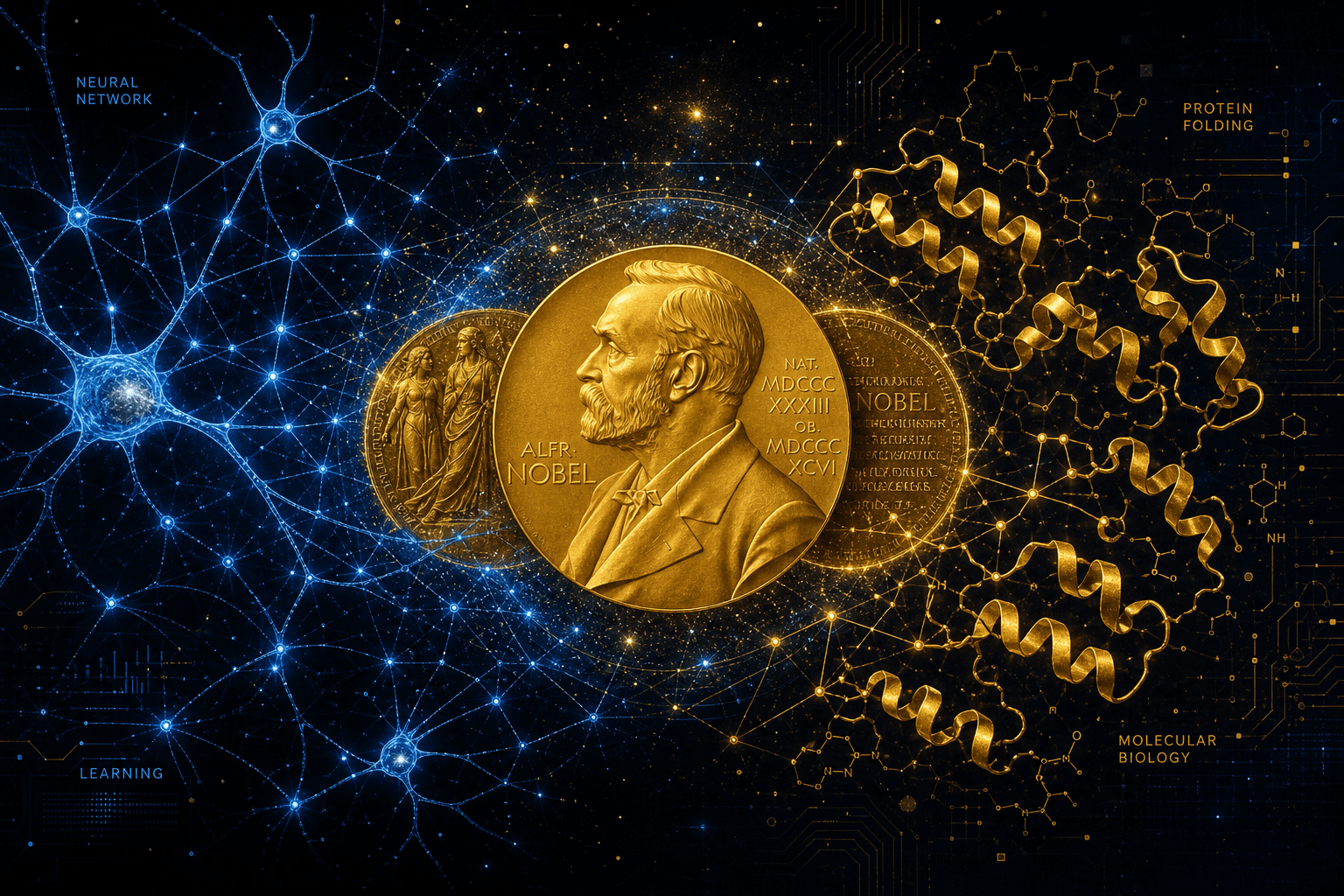
This week, artificial intelligence achieved its highest scientific honor yet. The 2024 Nobel Prizes in Physics and Chemistry have been awarded to the architects of modern machine learning — recognizing breakthroughs that transformed theoretical physics into practical intelligence and solved biology's greatest computational challenge. John J. Hopfield and Geoffrey E. Hinton share the Physics prize for foundational neural network work; Demis Hassabis and John Jumper share half the Chemistry prize for AlphaFold's protein-folding revolution.
This isn't just a recognition of individual achievement — it's a validation that AI research has become fundamental science. The Physics prize specifically honors work from the 1980s that laid the mathematical foundations for every neural network in production today, from GPT-4 to Claude to the models running in your phone. The Chemistry prize recognizes how those same neural network principles solved a problem that stumped biologists for half a century: predicting how proteins fold into their three-dimensional structures.
William Spurlock here. I build AI automation systems and custom web experiences, and I've been tracking these developments as they unfold this week. What strikes me most is the speed of recognition: Hopfield published his seminal paper in 1982, Hinton developed Boltzmann machines through the 1980s, and AlphaFold2 launched just four years ago in 2020. The Nobel Committee is acknowledging that AI has transitioned from theoretical curiosity to transformative science — and it's happening fast.
Here's what each prize recognizes and why it matters for anyone building with AI today.
Table of Contents #
- The Physics Prize: Neural Networks as Physics — How Hopfield and Hinton's statistical mechanics approach birthed modern AI
- John Hopfield and the Associative Memory Revolution — The Hopfield network's biophysics-inspired architecture
- Geoffrey Hinton: From Boltzmann Machines to Deep Learning — Backpropagation and the foundations of learning
- The Chemistry Prize: AlphaFold Conquers Protein Folding — Solving the 50-year grand challenge
- Hassabis, Jumper, and the AlphaFold2 Breakthrough — How transformer architecture cracked the biological code
- The Significance of Back-to-Back AI Nobels — What two AI Nobel Prizes in 48 hours signals to science
- From Theory to Impact: What These Wins Mean for Builders — Practical implications for AI practitioners
- What's Next After the AI Nobel Era — The road ahead for AI in science
The Physics Prize: Neural Networks as Physics #
The 2024 Nobel Prize in Physics recognizes artificial neural networks as a legitimate branch of physics. The Royal Swedish Academy of Sciences awarded the prize to John J. Hopfield of Princeton University and Geoffrey E. Hinton of the University of Toronto for "foundational discoveries and inventions that enable machine learning with artificial neural networks." This marks the first time the Physics Nobel has explicitly honored AI research — and it establishes that the field's intellectual roots lie in statistical mechanics and condensed matter physics.
The committee's citation is precise about why this work deserves physics recognition: Hopfield and Hinton used "tools from physics to develop methods that are the foundation of today's powerful machine learning." They applied concepts from statistical physics — specifically the behavior of spin glasses and energy landscapes — to create computational systems that could learn from data. This wasn't just computer science; it was physics applied to information processing.
The significance extends beyond the laureates themselves. Every modern AI system traces its lineage to these 1980s breakthroughs:
| Component | Hopfield/Hinton Contribution | Modern Descendant |
|---|---|---|
| Learning mechanism | Energy-based models and Boltzmann machines | Loss functions in PyTorch, TensorFlow |
| Information storage | Associative memory networks | Vector databases, embeddings |
| Training method | Unsupervised learning principles | Self-supervised learning in LLMs |
| Network architecture | Recurrent connections | Transformer attention mechanisms |
The timing matters. This prize arrives as neural networks are transforming every scientific discipline — from materials discovery to climate modeling to drug development. By recognizing the physics foundations now, the Nobel Committee is acknowledging that AI isn't merely applied engineering but a fundamental scientific advance comparable to quantum mechanics or relativity in its potential impact.
The prize also carries a pointed reminder: breakthrough research often takes decades to achieve practical impact. Hopfield's seminal paper appeared in 1982. Hinton's work on backpropagation and deep learning developed through the 1980s and 1990s. Only now, with large language models and protein-folding AI in production, has the full scope of their contribution become undeniable.
John Hopfield and the Associative Memory Revolution #
John Hopfield's 1982 neural network paper introduced a radical idea: computers could remember like brains. At Princeton University, Hopfield drew on his background in physics and biology to create what became known as the Hopfield network — a form of recurrent neural network that stores patterns as energy states and retrieves them through energy minimization. This wasn't just an algorithm; it was a physical model of memory that happened to run on silicon.
The core insight came from spin glasses — materials where magnetic spins frustrate each other into complex energy landscapes. Hopfield realized that neural networks could be modeled similarly, with neurons as spins and connection weights as interactions. When you present a partial or corrupted pattern to the network, it dynamically settles into the nearest stored memory state, minimizing its "energy" through the update process. This is associative memory: the ability to recall complete patterns from partial cues.
The Hopfield network architecture is deceptively simple but profound:
- Binary neurons (later extended to continuous values) that activate based on weighted inputs from other neurons
- Symmetric connections between neurons with weights determined by the patterns you want to store
- Energy function (E = -½ Σᵢⱼ wᵢⱼ sᵢ sⱼ) that the network minimizes as it converges to a stored pattern
- Asynchronous updates that let the network settle into stable states representing memories
What made this significant was the connection to biology. Hopfield wasn't just building a computer memory system — he was modeling how biological neural networks might store and retrieve information. The "energy" metaphor maps to physical processes in actual neurons; the convergence to stable states mirrors how brains complete partial information. This biophysical grounding is why the Physics Nobel recognizes the work: it applied rigorous statistical mechanics to understand neural computation.
Hopfield's network could store approximately 0.15N patterns reliably, where N is the number of neurons. For a 100-neuron network, that's about 15 distinct memories — small by today's standards, but unprecedented in 1982. More importantly, the network was content-addressable: you didn't need to know where a memory was stored, only something about its content. Present "apple" and the network retrieves the complete concept even from partial input.
The practical impact took decades to materialize. Hopfield networks themselves are rarely used in modern AI — they have limited capacity and can converge to spurious states. But the concepts they introduced became foundational: energy-based models, recurrent dynamics, associative memory, and the idea that neural computation could be understood through physics. Every modern embedding system, from word vectors to image latent spaces, descends from this insight that information can be stored in continuous energy landscapes and retrieved through dynamics.
Hopfield's later work extended these ideas to continuous-time dynamics and explored how similar principles might operate in actual biological circuits. The Nobel recognition this week validates what the physics community has long understood: this was fundamental theoretical work that opened an entirely new field of science.
Geoffrey Hinton: From Boltzmann Machines to Deep Learning #
Geoffrey Hinton took Hopfield's energy-based foundation and built the learning algorithms that power modern AI. Working at the University of Toronto and Carnegie Mellon before that, Hinton developed the Boltzmann machine — a neural network that could actually learn from data without explicit programming. Then he helped pioneer backpropagation, the algorithm that makes training deep networks possible. Without these contributions, GPT-4, AlphaFold, and every other modern AI system simply wouldn't exist.
The Boltzmann machine (1985, developed with Terrence Sejnowski and others) extended Hopfield's energy model into a probabilistic framework. Unlike Hopfield's deterministic updates, Boltzmann machines use stochastic binary units with probabilities determined by energy differences. They have visible units (data) and hidden units (latent features), connected in a network that can learn representations through a clever training procedure involving "wake" and "sleep" phases.
The training algorithm was mathematically elegant but computationally brutal:
- Clamp visible units to a training example and let hidden units settle to equilibrium — this is the "positive phase" that captures data correlations
- Unclamp everything and let the whole network settle — this is the "negative phase" that captures the model's current beliefs
- Update weights based on the difference between these two phases, pushing the model toward data-like configurations
The math required running the network to equilibrium thousands of times per training step. In 1985, this meant Boltzmann machines were theoretically powerful but practically limited. But the concepts were transformational: unsupervised learning, distributed representations, and the idea that networks could discover their own features from raw data.
Hinton's work on backpropagation (1986, with David Rumelhart and Ronald Williams) was equally foundational. Backpropagation — short for "backward propagation of errors" — provides an efficient way to compute gradients in multi-layer networks. Instead of running to equilibrium, you compute how much each weight contributed to the error and adjust accordingly. This made training deep networks feasible and set the stage for the deep learning revolution that would come three decades later.
The trajectory from these 1980s papers to 2024's AI systems follows a clear thread:
| Era | Hinton's Contribution | Impact |
|---|---|---|
| 1985-86 | Boltzmann machines, backpropagation | Established that networks could learn complex representations |
| 2006 | Deep belief networks | Showed how to pre-train deep architectures layer by layer |
| 2012 | ImageNet breakthrough (AlexNet) | Proved deep learning dominates computer vision |
| 2012-2023 | Capsule networks, GLOM | Continued theoretical advances on representation learning |
| 2024 | Nobel Prize in Physics | Recognition of foundational contributions to machine learning |
Hinton has become increasingly vocal about AI risks even as he accepts the Nobel. In his December 2024 Nobel banquet speech, he noted that "this new form of AI excels at modeling human intuition" — a capability that makes it powerful but also potentially dangerous if misused. He left his position at Google in 2023 specifically to speak more freely about AI safety concerns.
This dual legacy — building the technology and warning about its risks — makes Hinton's Nobel particularly significant. The committee isn't just honoring past achievements; it's acknowledging that the founder of modern AI now sees that power as potentially transformative in ways that require careful governance.
For builders working with AI today, Hinton's trajectory offers a lesson: the mathematical foundations you establish can enable capabilities far beyond what you initially imagine. His 1980s work on energy-based models and gradient descent seemed theoretical then. Now it powers every production AI system on Earth.
The Chemistry Prize: AlphaFold Conquers Protein Folding #
The 2024 Nobel Prize in Chemistry recognizes how AI solved a problem that stumped biologists for 50 years. The Royal Swedish Academy split the prize: half to David Baker of the University of Washington for computational protein design, and half jointly to Demis Hassabis and John Jumper of Google DeepMind for protein structure prediction using AlphaFold2. This marks the moment when AI transitioned from assisting science to making fundamental discoveries that unlock new understanding of life itself.
The protein folding problem is deceptively simple to state but brutally complex to solve. Proteins are chains of amino acids — typically 100 to 1,000 residues long — that spontaneously fold into precise three-dimensional structures. This 3D shape determines everything a protein does: how it catalyzes reactions, binds to other molecules, transmits signals, or forms cellular structures. The sequence of amino acids contains all the information needed to determine the folded structure, but predicting that structure from the sequence proved extraordinarily difficult.
Why was this so hard? The combinatorial explosion is staggering. A protein with 100 amino acids has billions of possible conformations. The Levinthal paradox (1969) noted that if a protein tried every possible fold, it would take longer than the age of the universe to find the right one. Yet proteins fold in milliseconds, guided by thermodynamics and evolutionary optimization. Understanding this folding process — the "second half of the genetic code" — became one of biology's grand challenges.
Scientists tried multiple approaches over five decades:
| Approach | Method | Limitations |
|---|---|---|
| X-ray crystallography | Experimental structure determination | Requires crystallization; slow; expensive |
| NMR spectroscopy | Solution structure measurement | Limited to small proteins; data-intensive |
| Cryo-electron microscopy | Direct imaging of frozen proteins | Requires specialized equipment; lower resolution |
| Template-based modeling | Compare to known structures | Fails for novel folds; limited by database coverage |
| Physics-based simulation | Molecular dynamics | Computationally prohibitive for most proteins |
| Fragment assembly | Piece together known substructures | Accuracy degrades for large or complex proteins |
The Critical Assessment of protein Structure Prediction (CASP) competition became the benchmark. Starting in 1994, CASP evaluated prediction methods blind — organizers released sequences but not structures, and groups submitted predictions. For decades, progress was incremental. The best methods achieved 60-70% accuracy on the Global Distance Test (GDT), a measure of structural similarity. The 90% threshold seemed impossibly distant.
Then came AlphaFold2 in 2020. At CASP14, DeepMind's system achieved median GDT scores above 90% — essentially solving the problem for single-chain proteins. The technique used a neural network architecture that incorporated attention mechanisms, evolutionary sequence data, and structural priors in ways no previous method had combined. The improvement wasn't marginal; it was transformational, jumping far ahead of the entire field in a single competition cycle.
The Nobel recognition this week acknowledges that AlphaFold2 didn't just incrementally improve protein prediction — it solved a fundamental problem that had resisted every previous approach. The 200 million protein structures now in the AlphaFold database (covering nearly every known protein) represent one of the largest expansions of biological knowledge in history. And it happened because neural networks — the same technology Hinton and Hopfield were recognized for — were applied to a problem with massive biological significance.
Hassabis, Jumper, and the AlphaFold2 Breakthrough #
Demis Hassabis and John Jumper built AlphaFold2 using the same neural network principles that won the Physics Nobel — and applied them to one of biology's hardest problems. Hassabis, DeepMind's CEO and co-founder, brought the resources and vision. Jumper, a senior staff scientist at DeepMind with a background in chemistry and physics, led the technical architecture. Together they created a system that uses transformer neural networks — the same attention-based architecture powering GPT and Claude — to predict protein structures with near-experimental accuracy.
AlphaFold2's architecture represents a fundamental departure from previous approaches. Where earlier methods relied heavily on template-based modeling or coarse physics simulations, AlphaFold2 uses an end-to-end neural network that learns directly from evolutionary and structural patterns. The key insight was treating protein folding as an information problem rather than a physics simulation problem — exactly the shift that neural networks excel at.
The AlphaFold2 pipeline works in distinct stages:
- Multiple Sequence Alignment (MSA) — Finds evolutionarily related protein sequences, revealing which amino acids vary together (suggesting they're physically close in 3D structure)
- Evoformer — The core neural network architecture, processing the MSA and pair representation through attention mechanisms that model relationships between residues
- Structure Module — Outputs the final 3D coordinates of each amino acid, including backbone positions and side chain orientations
- Recycling — Feeds predictions back through the network iteratively, refining the structure like an optimization loop
The Evoformer architecture is where the magic happens. It uses:
- MSA representation processing (rows = sequences, columns = positions) with attention across both dimensions
- Pair representation encoding the relationship between every pair of residues
- Attention-based updates that propagate information between the MSA and pair representations
- Triangle multiplicative updates enforcing geometric consistency in the pair representation
The attention mechanism is key — and directly descended from Hinton's energy-based thinking. Just as Hopfield networks use energy minimization to converge on stored memories, AlphaFold2 uses attention to focus on relevant sequence relationships and iteratively refine its prediction. The network learns to "attend" to the parts of the sequence that matter for each structural decision, dynamically adjusting its focus as the prediction improves.
The numbers tell the story of impact:
| Metric | AlphaFold2 Achievement |
|---|---|
| CASP14 GDT score | 92.4 (median) — near experimental accuracy |
| Proteins in database | ~200 million (covering UniProt reference proteomes) |
| Researcher access | Over 2 million researchers in 190 countries |
| Prediction time | Minutes per protein (vs. years for experimental methods) |
| Open source | Full code and weights released July 2021 |
DeepMind made the unprecedented decision to open-source everything. In July 2021, they released the AlphaFold2 code, trained model weights, and the entire structure database free to the scientific community. This wasn't just academic publication — it was infrastructure for global biology research. Within months, the AlphaFold database became the default starting point for structural biology work worldwide.
The practical applications are already transforming multiple fields:
- Drug discovery — Predicting how small molecules bind to protein targets, accelerating pharmaceutical development
- Antibiotic resistance — Understanding how bacteria evolve resistance by studying protein structure changes
- Enzyme design — Engineering proteins that degrade plastics, capture carbon, or catalyze novel reactions
- Crop improvement — Engineering plant proteins for better drought resistance or nutrient content
- Disease understanding — Interpreting genetic variants by predicting their structural effects
The Nobel recognizes not just technical achievement but scientific values. By open-sourcing AlphaFold2, Hassabis and Jumper demonstrated that AI research can serve humanity directly. The database isn't paywalled or patented — it's a public good, maintained by DeepMind and EMBL-EBI as core scientific infrastructure.
For AI builders, the AlphaFold story validates a critical principle: the same neural network architectures powering chatbots and image generators can solve hard scientific problems when applied with domain expertise and sufficient scale. Jumper brought deep knowledge of protein chemistry; Hassabis brought the resources and vision to deploy AI at massive scale. The combination produced a breakthrough that neither traditional biology nor pure AI research could have achieved alone.
The Significance of Back-to-Back AI Nobels #
Two Nobel Prizes recognizing AI within 48 hours signals a fundamental shift in how science views machine learning. The Physics prize was announced on October 8, 2024; the Chemistry prize followed on October 9. This sequential recognition — for foundational theory and applied breakthrough — establishes that AI is not merely a tool for science but a fundamental scientific discipline in its own right, with contributions spanning from theoretical physics to practical biochemistry.
The timing and pairing carry deliberate meaning. The Nobel Committee could have spaced these announcements or recognized AI achievements in different years. By awarding them consecutively, they've made a statement: AI research has matured enough to produce both fundamental theoretical advances and transformational applied science within the same recognition cycle. This is unprecedented — no other technology has achieved dual Nobel recognition this quickly.
What this means for AI's status as a scientific discipline:
| Traditional View | Nobel Recognition Signals |
|---|---|
| AI as applied computer science | AI as fundamental physics (energy landscapes, statistical mechanics) |
| AI as engineering/implementation | AI as theoretical breakthrough worthy of basic science prizes |
| AI tools assist scientists | AI systems make discoveries that merit Nobel-level recognition |
| Decades to practical impact | From theory (1980s) to Nobel-worthy application (2024) in 40 years |
| Narrow technical field | Cross-cutting discipline transforming multiple sciences |
The physics-chemistry pairing is particularly significant. Physics prizes historically recognize fundamental laws and theoretical frameworks; chemistry prizes recognize molecular understanding and practical synthesis. AI now spans both: the Hopfield-Hinton work provides theoretical foundations (physics), while AlphaFold provides molecular understanding and practical tools (chemistry). This dual nature — theoretical depth and practical power — is what makes AI transformative.
For researchers considering AI careers, this recognition changes the calculus. Machine learning is no longer a subspecialty of computer science that might lead to industry jobs. It's now a fundamental scientific discipline recognized at the highest level, capable of producing Nobel-worthy contributions. This will accelerate talent flows into the field and likely increase funding for basic AI research — not just applied product development.
The recognition also carries institutional weight. Universities will treat AI research more like physics or chemistry departments and less like software engineering programs. Funding agencies will see AI as basic science worthy of support. The cultural shift may be as significant as the specific achievements being recognized — AI research now has the same institutional legitimacy as quantum mechanics or molecular biology when those fields won their first Nobels.
From Theory to Impact: What These Wins Mean for Builders #
For AI practitioners building systems today, these Nobel Prizes offer several concrete lessons. The 40-year journey from Hopfield's 1982 paper to practical AI applications shows how foundational research eventually enables transformative products. The 4-year journey from AlphaFold2's release to Nobel recognition shows how quickly AI can move from research to impact when applied well. Both timelines matter for how we approach AI development now.
Lesson 1: Fundamental research matters, even when immediate applications aren't clear.
Hopfield networks and Boltzmann machines were largely impractical in the 1980s. The hardware didn't exist to run them at scale, and the training algorithms were too slow for real problems. Yet the mathematical foundations they established — energy-based models, distributed representations, gradient-based learning — became essential when compute caught up. Today's builders working on agent architectures, multimodal models, or new attention mechanisms may be laying groundwork that won't fully manifest for decades. That's not wasted effort; it's how science works.
Lesson 2: Cross-disciplinary expertise creates breakthroughs.
John Jumper didn't just know AI; he knew protein chemistry. Demis Hassabis didn't just know AI; he knew systems neuroscience and game-playing AI from his chess and Go work. The Nobel-winning AI breakthroughs came from people who understood both the technology and the domain problem deeply. For builders, this suggests that narrow AI expertise is less valuable than the ability to apply AI to hard problems in fields you understand.
Lesson 3: Open research accelerates impact.
DeepMind's decision to open-source AlphaFold2 was strategically significant. By releasing the model weights, code, and database freely, they turned a research achievement into global scientific infrastructure within months. The Nobel recognizes this public benefit. For AI builders, the takeaway is clear: closed models may capture short-term value, but open approaches can create more impact — and sometimes more recognition.
What this means for current development priorities:
| Area | Implication for Builders |
|---|---|
| Architecture research | Novel attention mechanisms, memory systems, and training approaches could be foundational for future applications |
| Domain expertise | The biggest wins come from applying AI to fields you understand deeply, not just fine-tuning generic models |
| Open vs. closed | Open research and models can achieve Nobel-level impact; consider whether your work serves broader science |
| Long-term thinking | What seems impractical now (new architectures, novel training methods) may enable everything in 20 years |
| Safety and ethics | Hinton's warnings remind us that building powerful systems carries responsibility |
For companies building AI products, these prizes validate a strategic shift. The winners weren't just productizing existing technology — they were creating new technology that enabled products. DeepMind invested years in basic research before AlphaFold. Hinton spent decades on theoretical advances before they became practical. Organizations that focus exclusively on application layers without investing in research foundations will always be following, not leading.
The 40-year vs. 4-year timeline difference matters. Hopfield and Hinton's work took decades to reach practical impact because the necessary compute and data didn't exist. AlphaFold2 reached impact in 4 years because modern AI infrastructure (GPUs, large datasets, distributed training) was already in place. For builders today, this means new AI architectures can achieve impact faster than ever — but only if they're built on solid theoretical foundations. The Hopfield-Hinton work enabled everything that followed; today's builders should consider what foundations they're creating for the next wave.
What's Next After the AI Nobel Era #
These 2024 prizes likely mark the beginning of AI's Nobel recognition, not the end. As AI systems tackle increasingly fundamental scientific problems, we can expect future Nobels recognizing AI-driven breakthroughs in medicine, materials science, physics, and mathematics. The question isn't whether AI will win more Nobels — it's which domains AI will transform next.
Several frontiers could produce Nobel-worthy AI achievements in the coming years:
Drug Discovery and Medicine
AI systems are already designing novel molecules, predicting clinical trial outcomes, and personalizing treatment protocols. An AI-designed drug that wins FDA approval and demonstrates superior efficacy could merit a Medicine Nobel. Insilico Medicine's AI-discovered drug candidates are already in clinical trials; the first successful approval could come within this decade.
Materials Science and Climate
AI is accelerating the discovery of superconductors, battery materials, and carbon capture catalysts. An AI-designed room-temperature superconductor or breakthrough battery chemistry could win a Physics or Chemistry Nobel. Google's GNoME system discovered 2.2 million new crystal structures in 2023; the practical applications are still emerging.
Mathematics and Theorem Proving
DeepMind's AlphaTensor discovered faster matrix multiplication algorithms — a 50-year open problem in mathematics. As AI systems tackle increasingly sophisticated theorem proving and conjecture generation, a pure mathematics Nobel (via the Abel Prize or Fields Medal) recognizing AI-assisted discovery seems plausible.
Fundamental Physics
AI is already analyzing particle collider data, searching for gravitational wave signals, and exploring string theory landscapes. An AI-assisted discovery — perhaps identifying a new particle or predicting novel cosmological phenomena — could win a Physics Nobel.
What the 2024 prizes suggest about future recognition:
| Pattern | Implication |
|---|---|
| Theory + Application pairing | Future Nobels may similarly pair fundamental AI advances with practical breakthroughs |
| Open-source impact | Systems released openly may be favored for recognition due to broader scientific benefit |
| Cross-disciplinary teams | Prizes may increasingly recognize collaborations between AI specialists and domain scientists |
| Rapid recognition possible | 4 years from AlphaFold release to Nobel suggests fast timelines for transformative AI |
For builders, the message is clear: we're entering an era where AI research can achieve the highest levels of scientific recognition. The work you do today — whether building new architectures, applying AI to hard scientific problems, or creating open research infrastructure — could be Nobel-worthy in the coming decades. The field is young, the problems are hard, and the recognition is now established.
The Hinton warning remains relevant even as we celebrate. In his Nobel remarks, Hinton emphasized that these powerful systems require careful stewardship. The same capabilities that let AI win Nobel Prizes for protein folding could enable misuse if not governed properly. The builders and researchers who will win future AI Nobels will need to balance breakthrough achievement with responsible development — ensuring that transformative science serves humanity's interests.
As we close out this remarkable week in AI history, the trajectory is clear. Neural networks have moved from theoretical curiosities to Nobel-winning science in four decades. AlphaFold moved from research code to global scientific infrastructure in four years. The next breakthroughs will likely move even faster, achieve even more, and reshape our understanding of what's possible when human ingenuity and machine intelligence collaborate on the hardest problems in science.
Frequently Asked Questions #
Q: Who won the 2024 Nobel Prize in Physics for AI? #
A: John J. Hopfield of Princeton University and Geoffrey E. Hinton of the University of Toronto shared the 2024 Nobel Prize in Physics. The Royal Swedish Academy of Sciences awarded them for "foundational discoveries and inventions that enable machine learning with artificial neural networks" — specifically recognizing their work applying statistical physics principles to create computational learning systems.
Q: What did Geoffrey Hinton win the Nobel Prize for specifically? #
A: Hinton won for developing the Boltzmann machine (with collaborators in 1985) and advancing backpropagation (1986) — the foundational algorithms that enable neural networks to learn from data. The Boltzmann machine introduced unsupervised learning through energy-based models, while backpropagation provided an efficient way to train multi-layer networks. Both became essential for modern deep learning systems like GPT-4, AlphaFold, and Claude.
Q: What is the Hopfield network and why was it important? #
A: The Hopfield network is a recurrent neural network that stores patterns as energy states and retrieves them through energy minimization. Published in 1982, it demonstrated that neural networks could function as content-addressable associative memory — recalling complete patterns from partial or corrupted inputs. It applied statistical physics concepts (spin glasses, energy landscapes) to computation, establishing the theoretical foundation for all modern neural network research. While rarely used directly today, its concepts underlie embeddings, vector databases, and attention mechanisms.
Q: Who won the 2024 Nobel Prize in Chemistry for AlphaFold? #
A: Demis Hassabis and John Jumper of Google DeepMind shared half the 2024 Nobel Prize in Chemistry for developing AlphaFold2, an AI system that predicts protein structures. The other half went to David Baker of the University of Washington for computational protein design. This marks the first time AI researchers have won a Nobel Prize for a specific AI application — recognizing how neural networks solved the 50-year protein folding problem.
Q: What is AlphaFold2 and what did it achieve? #
A: AlphaFold2 is a transformer-based neural network developed by DeepMind that predicts the 3D structure of proteins from their amino acid sequences. It achieved ~90% accuracy on the CASP14 competition in 2020, essentially solving the protein folding problem that had stumped biologists for five decades. The system has predicted structures for nearly all 200 million known proteins, creating a database used by over 2 million researchers in 190 countries. DeepMind open-sourced AlphaFold2 in July 2021.
Q: How accurate is AlphaFold2 at predicting protein structures? #
A: AlphaFold2 achieves median GDT scores above 90%, which is considered near-experimental accuracy. In the 2020 CASP14 competition, it achieved a median GDT score of 92.4 — approaching the accuracy of experimental methods like X-ray crystallography and cryo-EM. For single-chain proteins (the original design target), AlphaFold2 predictions are typically reliable enough to use for downstream research without experimental verification. The system also provides confidence scores to indicate prediction reliability.
Q: Why did AI win both Physics and Chemistry Nobels in the same year? #
A: The back-to-back AI Nobel Prizes (announced October 8-9, 2024) signal that AI has become a fundamental scientific discipline spanning multiple fields. The Physics prize recognized neural network theory rooted in statistical mechanics; the Chemistry prize recognized AI solving a major biological problem. This pairing demonstrates that AI is not merely an applied tool but a transformative approach generating both theoretical insights and practical breakthroughs across sciences.
Q: What is the significance of the Nobel Committee recognizing AI research? #
A: This recognition validates AI as fundamental science rather than applied engineering. By awarding the Physics prize to Hopfield and Hinton, the Nobel Committee established that neural network research has intellectual roots in statistical physics worthy of basic science recognition. By awarding the Chemistry prize to Hassabis and Jumper, they acknowledged that AI systems can make discoveries meriting the highest scientific honors. This will likely increase institutional support for basic AI research and attract more scientific talent to the field.
Q: How does AlphaFold2 use neural networks to predict protein structures? #
A: AlphaFold2 uses a transformer-based Evoformer architecture that processes multiple sequence alignments through attention mechanisms. The network learns relationships between amino acid positions from evolutionary data (related protein sequences), then outputs 3D coordinates through an iterative refinement process. Key components include the MSA representation, pair representation encoding residue relationships, and triangle multiplicative updates ensuring geometric consistency. The system "recycles" predictions through the network multiple times, progressively improving accuracy.
Q: What practical applications has AlphaFold enabled? #
A: AlphaFold has accelerated research across multiple fields: drug discovery (predicting how molecules bind to protein targets), antibiotic resistance (understanding bacterial protein evolution), enzyme design (engineering proteins that degrade plastics or capture carbon), crop improvement (optimizing plant proteins for agriculture), and disease research (interpreting genetic variants by their structural effects). Over 2 million researchers use the AlphaFold database, and the open-source model enables custom predictions for specific research needs.
Q: How long did it take from Hopfield's 1982 paper to practical AI applications? #
A: Approximately 40 years passed between Hopfield's foundational 1982 paper and practical large-scale AI applications like AlphaFold2 and GPT-4. Hopfield networks and Boltzmann machines were theoretically significant but computationally impractical in the 1980s — hardware couldn't run them at scale, and training data was limited. Practical deep learning required GPU computing (2010s), massive datasets, and architectural refinements. Geoffrey Hinton noted in his Nobel remarks that the "new form of AI" now excels at modeling human intuition — a capability that took four decades to realize from the initial theoretical foundations.
Q: What does Hinton's Nobel Prize mean for the future of AI safety? #
A: Hinton's Nobel carries dual significance for AI safety. On one hand, it validates that AI research produces Nobel-worthy scientific advances. On the other, Hinton has become increasingly vocal about AI risks — leaving Google in 2023 specifically to speak freely about safety concerns. His Nobel banquet speech emphasized that modern AI "excels at modeling human intuition," a capability that requires careful governance. The prize may elevate AI safety discourse, lending scientific authority to calls for responsible development and regulatory frameworks as these powerful systems become more capable.
Building the Next Generation of AI Systems #
These Nobel Prizes mark a turning point: AI is now fundamental science recognized at the highest level. For builders and organizations, this means the bar has been raised — and the opportunity has expanded. Whether you're developing AI agents, automating workflows, or creating AI-powered digital experiences, you're working with technology that's now Nobel-worthy in its capabilities.
If you're exploring how AI can transform your operations:
AI Automation + Growth — I build custom AI agents, n8n automation pipelines, and growth engineering systems that actually ship in production. From lead-gen automation to AI-powered analytics, I help teams tap into the same neural network principles these Nobel laureates pioneered. Book an AI automation strategy call to discuss your specific workflow challenges.
Custom Web Design + Digital Experiences — I design and build premium 5-figure websites that integrate AI capabilities — from intelligent chat interfaces to dynamic personalization engines. If your brand needs a flagship digital experience that uses current-generation AI, start a custom website project and let's build something worthy of this Nobel-winning moment in AI history.
Related articles from the archive:
- Claude 3.5 Sonnet Production Agent Tutorial — Building production AI agents with n8n
- Anthropic Computer Use Beta Launch — Claude's ability to control computers via AI
- DeepSeek Coder v2 236B MoE Launch — Open-source coding models pushing boundaries
About William Spurlock #
William Spurlock is an AI automation engineer and custom web designer building production-grade AI workflows and premium digital experiences. He writes about the intersection of frontier AI technology and practical implementation — from neural network architectures to immersive web experiences. For AI automation strategy or custom web projects, book a discovery call.
Related Posts
Google I/O 2026 Action List: How I Prompted Gemini 3.5 Flash and Antigravity Workflows
Google I/O 2026 just reset the AI tooling landscape. Here's the 9-action checklist for builders who want to ship this week, not just watch the keynote.
Anthropic vs. OpenAI vs. Google: The State of the Frontier in May 2026
A head-to-head breakdown of the three AI giants in May 2026: Claude Opus 4.6, GPT-5.3 and 5.4, Gemini 3.1 Pro. Real specs, real pricing, and what actually matters for builders.
Kimi K2 Open Weights: How I Prompted Moonshot's Frontier Model for Agentic Tool Use
How I direct Kimi K2 by Moonshot AI for agentic workflows, long-context tool calling, and workflow automation. A 1 trillion parameter MoE model with competitive benchmarks at 5-17x lower cost than GPT-5 and Claude.