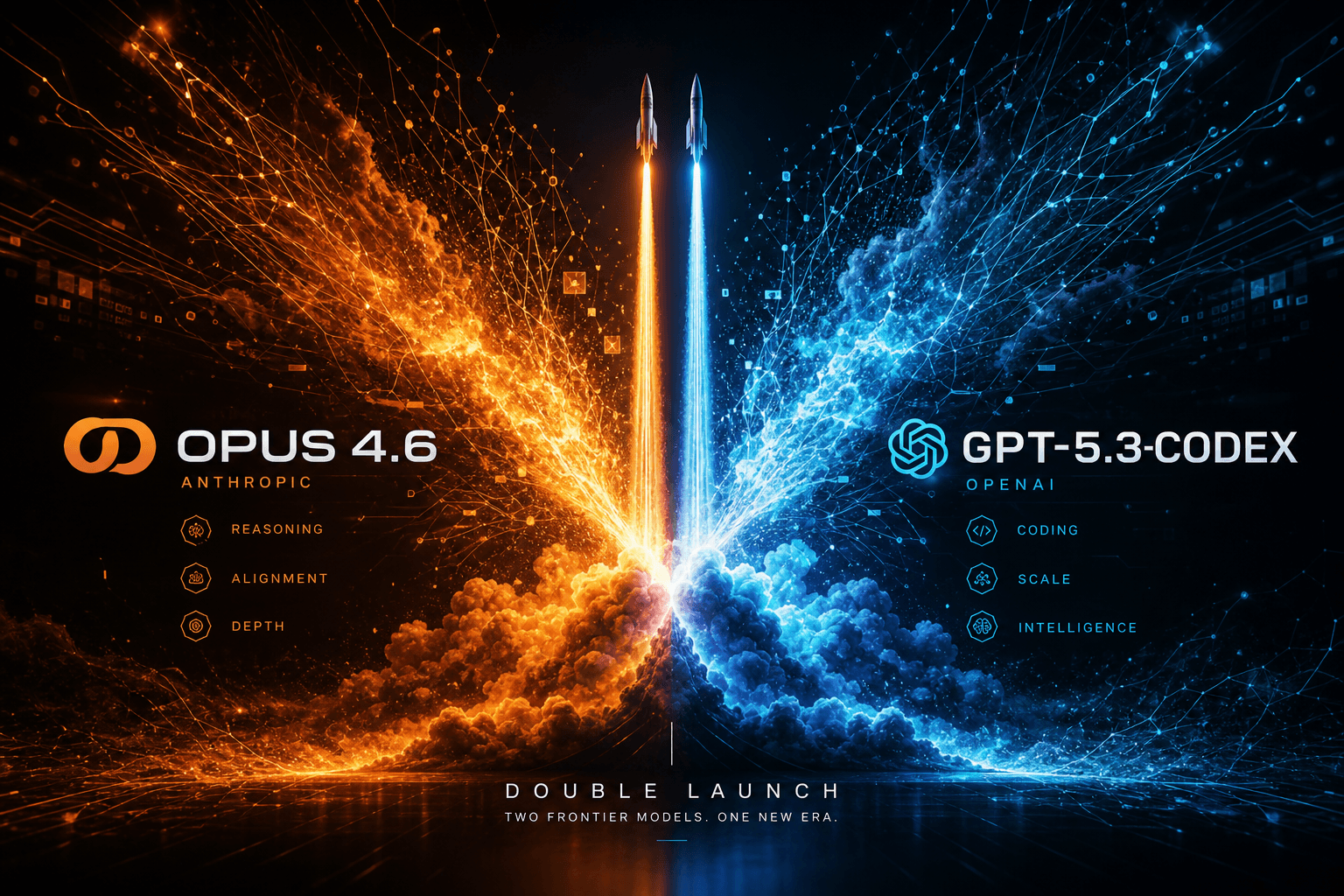
Opus 4.6 + GPT-5.3-Codex: The 10-Minute Frontier Double Launch

Table of Contents
Opus 4.6 + GPT-5.3-Codex: The 10-Minute Frontier Double Launch #
It happened at 6:40 PM ET. Anthropic drops Claude Opus 4.6. Ten minutes later, OpenAI responds with GPT-5.3-Codex. I've never seen two frontier labs release flagship models within the same quarter-hour. This isn't coincidence—this is the AI coding arms race hitting fever pitch.
Both models are live today. Both are accessible via API. Both claim state-of-the-art status on benchmarks that matter to working developers. And both are priced at premiums that signal these aren't commodity models—they're specialist tools for serious workloads.
The implications extend beyond individual developers. Enterprise teams evaluating AI automation infrastructure just watched the competitive landscape shift in real-time. The choice between Anthropic and OpenAI isn't theoretical anymore—it's an immediate architectural decision with cost and capability tradeoffs that materially impact project feasibility.
For the past six months, I've been tracking the convergence of coding-focused AI models. What started as specialized tools—GitHub Copilot for autocomplete, Claude Code for multi-file reasoning—has evolved into full-stack development agents capable of sustaining context across thousands of files. Today's simultaneous releases represent the maturation of that evolution.
The maturation is evident in the benchmark sophistication. Terminal-Bench 2.0, SWE-Bench Pro, and GDPval-AA represent evaluations designed by practitioners for practitioners. These aren't academic exercises; they measure capabilities that directly translate to production value. When Opus 4.6 scores 65.4% on Terminal-Bench or GPT-5.3-Codex hits 77.3%, these numbers mean something concrete about real-world performance.
What Just Happened: The 10-Minute Gap #
Anthropic announced Opus 4.6 at approximately 6:40 PM ET today. OpenAI announced GPT-5.3-Codex roughly 10-20 minutes later. I watched it unfold in real-time: Anthropic's blog post went live, Twitter exploded with benchmark screenshots, and before the threads could fully load, OpenAI's counter-announcement hit.
The timing is either the most aggressive product maneuvering in AI history, or both labs have been staring at each other's release calendars for weeks. Either way, the message is clear: neither Anthropic nor OpenAI is willing to cede the agentic coding market without a fight.
This isn't the first time these two have shadow-boxed. In September, Claude Sonnet 4.5 and Sora 2 landed within days of each other. In May 2025, Claude 4 and Cursor 1.0 built anticipation during the same I/O season. But ten minutes? That's new. That signals both labs view February 5, 2026 as a zero-day for mindshare in the developer ecosystem.
The developer community response has been immediate and vocal. Hacker News threads hit front page within minutes. Engineering Slack channels I've observed lit up with side-by-side comparisons. The consensus is clear: this level of competitive intensity produces better tools faster than either lab would produce in isolation.
Simon Willison captured the sentiment perfectly: "Two new models. Same day. Ten minutes apart. The AI coding wars are officially on." His blog post went live within the hour, documenting the release timeline with the precision of a historian chronicling a pivotal battle.
The competitive dynamics at play here reflect a broader shift in the AI landscape. Six months ago, frontier labs spaced their releases carefully, avoiding direct confrontation. Today, they released within ten minutes. This acceleration suggests both Anthropic and OpenAI view Q1 2026 as a decisive period for developer ecosystem lock-in.
The developer tooling market is consolidating around these two players. Cursor, Windsurf, Lovable, and other AI-native IDEs are making bets on which model ecosystem to prioritize. Today's releases will reshape those partnerships. A tool that integrates deeply with Claude Code's agent teams gains differentiated capability; a tool that optimizes for GPT-5.3-Codex's pricing gains economic advantage.
For engineering leaders, the takeaway is clear: evaluate both models now. The competitive pressure means capabilities will continue advancing rapidly, but the current state is already transformative for organizations that deploy effectively.
Claude Opus 4.6: The 1M Token Generalist #
Claude Opus 4.6 is Anthropic's most capable model to date—a general-purpose flagship with specific superpowers in coding, reasoning, and agentic workflows. The headline feature is the 1 million token context window, making it the first Opus-class model to break the million-token barrier.
Here's what Opus 4.6 actually delivers:
- 1M token context window (beta, Claude Platform only): First Opus model to hit this threshold. This isn't marketing fluff—it's a qualitative shift for analyzing multi-million-line codebases, research corpora spanning thousands of papers, and financial datasets that would have required chunking pipelines yesterday.
- Adaptive thinking: The model now decides when deeper reasoning is warranted, rather than requiring developers to toggle extended thinking manually. Four effort levels (low, medium, high, max) give granular control over the latency/cost/quality tradeoff.
- Context compaction: Long-running agents can now summarize and replace older context automatically, enabling tasks that would have hit token limits in previous versions.
- Agent teams in Claude Code: Multiple agents working in parallel, coordinating autonomously. Think codebase-wide refactors where one agent handles the data layer, another the API surface, and a third the frontend components—simultaneously.
- 128K output tokens: Complete large artifacts—full documentation sets, multi-file refactors, comprehensive test suites—in a single generation.
On Terminal-Bench 2.0 (the agentic coding evaluation that actually measures real-world performance), Opus 4.6 scores 65.4%—the highest of any model tested. On Humanity's Last Exam, it leads all frontier models on multidisciplinary reasoning. On GDPval-AA (economically valuable knowledge work), it outperforms GPT-5.2 by ~144 Elo points and its own predecessor Opus 4.5 by 190 points.
The ARC AGI 2 score is particularly notable: 68.8% versus Opus 4.5's 37.6%. That's an 83% improvement on abstract reasoning tasks designed to measure general intelligence capability.
Early partner feedback has been consistently strong. Notion reports it "feels less like a tool and more like a capable collaborator." Devin Review saw increased bug-catching rates. A cybersecurity firm running 40 investigations found Opus 4.6 produced best results in 38 of 40 blind comparisons against Opus 4.5.
Box's evaluation showed a 10% performance lift, reaching 68% versus a 58% baseline, with near-perfect scores in technical domains. Figma Make reported that Opus 4.6 generates complex interactive apps and prototypes with impressive creative range, translating detailed designs into code on the first try. These aren't isolated testimonials—they represent consistent performance gains across diverse use cases.
The 1M context capability deserves special attention. Anthropic's engineering team documented that on MRCR v2—a needle-in-a-haystack test with 1M tokens—Opus 4.6 scores 76% while Sonnet 4.5 manages only 18.5%. This represents a fundamental shift in how models handle extreme context, eliminating the "context rot" that plagued previous generations.
What does 1M tokens mean in practice? Approximately 750,000 lines of code, or roughly 1,500 pages of dense technical documentation, or the complete text of three novels. This is context at a scale that changes what's possible—entire dependency trees, complete research corpora, full financial datasets analyzed as coherent wholes rather than fragmented chunks.
GPT-5.3-Codex: The Coding Specialist #
GPT-5.3-Codex is OpenAI's most capable agentic coding model, purpose-built for software engineering workflows. It launched with two key differentiators: speed and pricing positioned aggressively against Anthropic's premium tier.
OpenAI's positioning is unambiguous. GPT-5.3-Codex is described as "the most capable agentic coding model to date." Here's the actual specification:
| Specification | Value |
|---|---|
| Context window | 400,000 tokens |
| Max output tokens | 128,000 |
| Input pricing | $1.75 / 1M tokens |
| Cached input | $0.175 / 1M tokens |
| Output pricing | $14.00 / 1M tokens |
| Reasoning effort | low, medium, high, xhigh |
| Speed improvement | ~25% faster than predecessor |
The 400K context window is substantial—double the previous Codex generation and enough for most production codebases. The 128K output capability matches Opus 4.6, enabling comprehensive multi-file generation in a single pass.
On benchmarks, GPT-5.3-Codex posts 56.8% on SWE-Bench Pro and 77.3% on Terminal-Bench 2.0. The Terminal-Bench score is particularly interesting—it's within striking distance of Opus 4.6's 65.4% while pricing significantly lower per token.
The Terminal-Bench 2.0 evaluation is worth understanding. It tests agentic coding capabilities in realistic terminal environments—exactly the scenarios developers face when debugging, deploying, and maintaining production systems. The 77.3% score indicates genuine competence for autonomous DevOps workflows.
The model is classified as "High capability" under OpenAI's Preparedness Framework for cybersecurity, with additional safeguards for elevated cyber-risk requests. Free-tier API users are explicitly excluded from access—a clear signal this is a production-grade tool for serious engineering teams, not experimentation.
OpenAI has been dogfooding this model internally. Early versions were used by OpenAI's own engineering teams for debugging and evaluation, producing specific optimizations for real-world software engineering workflows that show up in the Terminal-Bench performance.
The 25% speed improvement over previous Codex models is significant for iterative development workflows. When you're running a tight feedback loop—write prompt, generate code, test, refine—latency compounds. A 25% reduction in generation time translates to meaningful productivity gains over a full development day.
Consider a typical developer workflow: generating a feature implementation, testing it, iterating based on results. At 25% faster inference, a developer running 50 generation cycles per day saves substantial time. Over weeks and months, this compounds into real productivity differences.
The speed advantage compounds in CI/CD pipelines. When automated tests trigger model-based code review, faster inference means faster build times. For organizations running hundreds or thousands of builds daily, this latency reduction translates to real infrastructure savings and faster developer feedback loops.
OpenAI's positioning of GPT-5.3-Codex as a "multi-day" workflow enabler suggests architectural thinking about sustained autonomy. This isn't just about generating code—it's about maintaining state, tracking progress, and executing complex tasks that span hours or days of wall-clock time. The combination of 400K context, 128K output, and 25% faster inference creates a system capable of sustained, high-velocity code production.
Spec Sheet Showdown: Head-to-Head Comparison #
| Capability | Claude Opus 4.6 | GPT-5.3-Codex |
|---|---|---|
| Context window | 1,000,000 tokens | 400,000 tokens |
| Output tokens | 128,000 | 128,000 |
| Standard input pricing | $5.00 / 1M tokens | $1.75 / 1M tokens |
| Standard output pricing | $25.00 / 1M tokens | $14.00 / 1M tokens |
| Long-context pricing | $10.00 / 1M input | Not specified |
| Cached input pricing | Not specified | $0.175 / 1M tokens |
| Terminal-Bench 2.0 | 65.4% | 77.3% |
| SWE-Bench Pro | Not reported | 56.8% |
| Humanity's Last Exam | Leading score | Not reported |
| ARC AGI 2 | 68.8% | Not reported |
| Reasoning effort levels | 4 (via adaptive thinking) | 4 (low/medium/high/xhigh) |
| Agentic features | Agent teams, context compaction | Codex CLI integration |
| Speed claim | Not specified | 25% faster |
| US-only inference | Available (1.1× pricing) | Not specified |
The pricing delta is striking. For a typical coding workflow consuming 2M input tokens and 500K output tokens monthly:
- Opus 4.6 cost: $22.50 (input) + $12.50 (output) = $35.00
- GPT-5.3-Codex cost: $3.50 (input) + $7.00 (output) = $10.50
That's a 3.3× cost difference for standard context workloads. Whether that cost premium is justified depends entirely on whether your use case exploits Opus 4.6's 1M context or requires its specific benchmark advantages.
The context window comparison deserves careful consideration. GPT-5.3-Codex's 400K tokens handles approximately 300,000 lines of code with room for documentation and conversation history. That's sufficient for most production systems. Opus 4.6's 1M tokens handles roughly 750,000 lines—enabling analysis of massive monorepos or complete dependency trees that would otherwise require chunking strategies.
The practical difference is stark. With GPT-5.3-Codex, a developer analyzing a 250,000-line codebase must be selective about what context to include. With Opus 4.6, the same developer can include the entire codebase, related documentation, dependency source code, and conversation history—all within the context window. This changes how developers approach complex tasks.
For teams working with microservices architectures, GPT-5.3-Codex's 400K context is likely sufficient for individual services. For monolithic applications or extensive monorepos, Opus 4.6's 1M context becomes a requirement, not a luxury. The chunking strategies required for 400K context add engineering overhead that 1M context eliminates.
Benchmark Battle: Who Wins on What #
Both models claim state-of-the-art status, but on different evaluations. This isn't a clean winner-take-all scenario—it's a segmentation of strengths that maps directly to use cases.
Opus 4.6 dominates knowledge work and reasoning:
- Humanity's Last Exam: Leads all frontier models on this deliberately adversarial multidisciplinary test
- GDPval-AA: Outperforms GPT-5.2 by 144 Elo points on economically valuable tasks across finance, legal, and professional domains
- BrowseComp: Highest score for agentic search and hard-to-find information retrieval
- ARC AGI 2: 68.8% versus GPT-5.2's unreported score—this measures general reasoning capability
- BigLaw Bench: 90.2% with 40% perfect scores on legal reasoning
- Finance Agent benchmark: 60.7%, a 5.47% improvement over Opus 4.5
GPT-5.3-Codex wins on pure coding velocity:
- Terminal-Bench 2.0: 77.3% versus Opus 4.6's 65.4%—a substantial lead on terminal-based agentic coding
- SWE-Bench Pro: 56.8% on real-world software engineering tasks
- Inference speed: 25% faster than previous Codex models, translating to shorter wait times for iterative development
The Terminal-Bench results are particularly instructive. GPT-5.3-Codex's 77.3% versus Opus 4.6's 65.4% suggests OpenAI has optimized specifically for terminal-driven workflows—the bread and butter of CI/CD automation, DevOps scripting, and infrastructure-as-code generation. Meanwhile, Opus 4.6's broader dominance on Humanity's Last Exam and GDPval-AA indicates Anthropic is optimizing for the full spectrum of knowledge work, not just code generation.
What emerges is a clear segmentation: GPT-5.3-Codex for pure coding tasks where terminal performance matters, Opus 4.6 for complex multidisciplinary work where reasoning breadth and extreme context are required.
The BigLaw Bench result—90.2% on legal reasoning with 40% perfect scores—deserves attention for enterprise use cases. Organizations with compliance, regulatory, or legal workflows may find Opus 4.6's reasoning capabilities justify the cost premium even when the primary use case isn't coding.
For software engineering specifically, the Terminal-Bench 2.0 results tell a nuanced story. GPT-5.3-Codex leads at 77.3%, but Opus 4.6's 65.4% is still state-of-the-art territory. The 12-point gap matters for competitive scenarios, but both models perform at levels that would have seemed impossible two years ago.
The SWE-Bench Pro results deserve specific attention. GPT-5.3-Codex's 56.8% on real-world software engineering tasks validates its positioning as a coding specialist. This benchmark measures performance on actual GitHub issues—tasks that require understanding existing code, identifying bugs, and implementing fixes. A score above 50% represents genuine capability for autonomous software engineering.
The BigLaw Bench and Finance Agent results for Opus 4.6 indicate where Anthropic is placing its bets. These aren't coding benchmarks—they're professional knowledge work evaluations. The 90.2% BigLaw score and 60.7% Finance Agent score suggest Opus 4.6 is targeting enterprise workflows beyond pure software development. This is a broader vision of AI automation than OpenAI's coding-focused positioning.
Pricing Reality Check: What These Models Actually Cost #
Opus 4.6 maintains the $5/$25 per million token pricing for standard context, with long-context premium pricing kicking in above 200K tokens. This pricing structure reflects Anthropic's bet that serious use cases will exploit the 1M context window—and they'll pay accordingly.
| Opus 4.6 Pricing Tier | Input | Output |
|---|---|---|
| Standard (≤200K) | $5.00 / 1M | $25.00 / 1M |
| Long-context (>200K) | $10.00 / 1M | $37.50 / 1M |
| US-only inference | 1.1× multiplier | 1.1× multiplier |
The long-context premium is significant: 2× on input, 1.5× on output. For workflows exploiting the full 1M token window, expect to pay accordingly. This is strategic pricing—Anthropic is extracting value from the capability that most clearly differentiates Opus 4.6.
GPT-5.3-Codex enters at a significantly more aggressive price point:
| GPT-5.3-Codex Pricing | Rate |
|---|---|
| Input tokens | $1.75 / 1M |
| Cached input | $0.175 / 1M |
| Output tokens | $14.00 / 1M |
The cached input pricing is a strategic differentiator for iterative workflows. If you're running the same codebase through multiple passes—which describes most refactoring and testing scenarios—GPT-5.3-Codex drops to nearly commodity pricing for the input side.
Consider a typical enterprise scenario: analyzing a 50,000-line codebase weekly with 10 iterative refinement passes. With cached input, the effective cost per run drops dramatically:
| Scenario | Opus 4.6 Cost | GPT-5.3-Codex Cost | Savings |
|---|---|---|---|
| Single analysis (50K lines) | ~$8.75 | ~$5.25 | 40% |
| 10-pass refinement | ~$87.50 | ~$17.50 | 80% |
For organizations running serious automation infrastructure, the math is stark:
| Monthly Volume | Opus 4.6 | GPT-5.3-Codex | Delta |
|---|---|---|---|
| 10M input / 2M output | $100K | $45.5K | 54% cheaper |
| 50M input / 10M output | $500K | $227.5K | 54% cheaper |
| 100M input / 20M output | $1M | $455K | 54% cheaper |
These aren't trivial differences. At scale, the pricing advantage alone could drive enterprise decisions, assuming GPT-5.3-Codex delivers adequate performance for the specific use case.
The pricing dynamics reveal strategic positioning. OpenAI is pursuing market share through aggressive unit economics. Anthropic is pursuing margin through capability differentiation. Both strategies are valid; which wins depends on whether the capability delta justifies the cost premium in production workflows.
Enterprise procurement teams will scrutinize these numbers carefully. At volume, the 54% cost advantage of GPT-5.3-Codex is compelling. But if Opus 4.6's 1M context eliminates the need for complex chunking infrastructure, or if its reasoning advantages reduce error rates, the total cost of ownership calculation shifts. The sticker price is only one variable in the economic equation.
For startups and smaller teams, GPT-5.3-Codex's lower barrier to entry is significant. At $10.50 per 2.5M tokens versus Opus 4.6's $35, early-stage companies can experiment with serious AI automation without budget strain. As usage scales, the economics evolve—but the entry point matters for adoption curves.
Developer Tooling: Code vs. Codex #
The choice between these models increasingly depends on your existing toolchain and workflow preferences. Anthropic and OpenAI are building distinct ecosystems around their flagship models.
Claude Code (Opus 4.6 integration):
- Agent teams: Research preview feature allowing multiple agents to work in parallel on independent subtasks. One agent analyzes the data layer, another refactors the API, a third updates documentation—all coordinated autonomously.
- Tmux integration: Take over any subagent directly using Shift+Up/Down or tmux, giving humans granular control over autonomous workflows.
- Context compaction: Automatic summarization and replacement of older context, enabling genuinely long-running tasks without manual intervention.
- Claude in Excel/PowerPoint: Beyond coding—financial modeling, presentation generation, and business document workflows.
- Cowork integration: Within the Cowork environment, Opus 4.6 can multitask autonomously on your behalf across the Microsoft 365 suite.
OpenAI Codex CLI (GPT-5.3-Codex integration):
- xhigh reasoning effort: Explicit control over reasoning depth via the CLI, allowing developers to trade latency for quality on complex tasks.
- Multi-day workflows: OpenAI explicitly positions GPT-5.3-Codex for "multi-day" development workflows, suggesting state persistence and long-horizon task management.
- Internal tooling: OpenAI's own engineering teams used early versions of GPT-5.3-Codex for debugging and evaluation—dogfooding that produced specific optimizations for real-world software engineering.
The ecosystem lock-in is real. If you're already using Claude Code for daily development, Opus 4.6 is a direct upgrade that extends your existing workflows with more capable reasoning and longer context. If you're integrated into OpenAI's API infrastructure or using the Codex CLI, GPT-5.3-Codex represents immediate capability gains at lower unit economics.
For teams without existing investment, the decision becomes more nuanced. Claude Code's agent teams offer genuinely novel parallelization capabilities. The Codex CLI's multi-day workflow positioning suggests different architectural assumptions about how AI agents integrate into development processes.
The Microsoft 365 integration announced for Claude—Excel and PowerPoint plugins—represents Anthropic's enterprise play. Organizations already embedded in Microsoft's ecosystem may find this integration path smoother than adopting new CLI tools.
The tooling divergence matters for organizational adoption. Teams evaluating AI automation must consider not just model capability, but integration complexity. A model that fits directly into existing workflows may deliver more value than a theoretically superior model requiring toolchain migration.
The IDE integration landscape is shifting rapidly. Claude Code's tmux integration and agent teams represent a terminal-centric philosophy that appeals to senior developers comfortable with Unix workflows. The Codex CLI's explicit reasoning controls appeal to developers who want clear knobs for quality/latency tradeoffs. Neither approach is objectively superior; they serve different workflow preferences.
Microsoft's role in this ecosystem deserves attention. The Claude in Excel and PowerPoint integrations, combined with the Cowork environment, suggest Anthropic is betting on Microsoft's enterprise dominance. For organizations already in the Microsoft 365 ecosystem, this integration path reduces friction. OpenAI's approach, by contrast, appears more agnostic—focused on API access and CLI tooling rather than deep office suite integration.
Which Model Should You Actually Use #
The decision framework depends on three factors: context requirements, cost sensitivity, and ecosystem integration.
Choose Opus 4.6 if:
- You're analyzing multi-million-line codebases where the 1M context window eliminates chunking complexity
- Your workflows span code + documents + financial data + research—true generalist workloads
- You need state-of-the-art reasoning on complex, multidisciplinary problems (Humanity's Last Exam leadership matters)
- You're already invested in Claude Code and agent teams fit your parallelization strategy
- Budget permits the premium for best-in-class capability
- US-only inference is required for compliance (available with 1.1× pricing)
Choose GPT-5.3-Codex if:
- Your codebase fits comfortably in 400K tokens (most production systems)
- Pure coding velocity matters more than general reasoning breadth
- Cost efficiency at scale is a primary concern (3×+ pricing advantage)
- You're running iterative workflows that benefit from aggressive cached input pricing
- Terminal-based agentic workflows dominate your use case (Terminal-Bench leadership)
- You're integrated into OpenAI's API ecosystem
The overlap zone: Both models handle standard software engineering tasks competently. For a typical Rails application with 100K lines of code, both will generate migrations, write tests, and refactor components effectively. The choice in the overlap zone comes down to: (1) which ecosystem you've already invested in, and (2) whether you anticipate needing the extreme context or reasoning capabilities where Opus 4.6 pulls ahead.
Consider the migration scenario: porting a 500K-line monorepo from Java to Kotlin. Opus 4.6's 1M context window can ingest the entire codebase, understand cross-module dependencies, and plan a coherent migration strategy. GPT-5.3-Codex would require chunking, orchestration, and careful dependency tracking—solvable, but complex. In this scenario, Opus 4.6's premium pricing is justified by the reduction in engineering overhead.
Consider the microservice scenario: generating 50 independent services from OpenAPI specs. GPT-5.3-Codex's Terminal-Bench performance and lower pricing make it the cost-effective choice. Each service fits comfortably in 400K tokens, and the iterative refinement benefits from cached input pricing.
For most teams, the decision isn't binary. The optimal architecture may involve both models—Opus 4.6 for complex analysis and refactoring tasks requiring extreme context, GPT-5.3-Codex for high-volume coding workflows where cost efficiency matters.
The hybrid approach makes sense for larger organizations. A platform team might use Opus 4.6 for architecture decisions and cross-system refactoring, while product teams use GPT-5.3-Codex for feature development within well-defined boundaries. This separation of concerns maximizes the strengths of each model while managing costs.
Migration paths also matter. If you're currently using GPT-4 or Claude 3.5 Sonnet, GPT-5.3-Codex offers a lower-cost upgrade with clear performance gains. If you're already on Opus 4.5, the 4.6 upgrade preserves your existing workflows while dramatically expanding context capability. The friction of switching ecosystems is real and should factor into planning.
What This Means for AI Automation Strategy #
The simultaneous release signals that both labs view agentic coding as the immediate battleground for frontier AI dominance. For organizations building AI automation infrastructure, this means capability convergence is happening faster than expected.
Three strategic implications emerge from today's double launch:
Context windows are becoming a primary differentiator. Opus 4.6's 1M context isn't just a spec-sheet brag—it enables genuinely new workflows: analyzing entire dependency trees, processing complete documentation corpora, and maintaining coherence across multi-day autonomous tasks. Expect OpenAI to respond with expanded context in the next Codex revision.
Pricing pressure is accelerating. GPT-5.3-Codex's aggressive pricing at $1.75/$14 suggests OpenAI is willing to sacrifice margin for market share in the developer tools space. Anthropic's premium positioning at $5/$25 only works if the capability delta justifies the cost—this is a bet that serious users will pay for best-in-class performance.
Tooling integration is the moat. Neither model exists in isolation. Claude Code's agent teams and GPT-5.3-Codex's CLI integration represent ecosystem plays designed to lock in developers. The model is becoming the engine; the tooling is becoming the product.
For my AI automation practice, today's launches mean I can now offer clients two genuinely capable options for autonomous coding workflows, each with distinct economic and capability profiles. The risk of betting on a single provider just dropped meaningfully.
The broader implication: if you're not already running AI automation pilots, you're now two generations behind. Opus 4.6 and GPT-5.3-Codex represent capabilities that were science fiction eighteen months ago. The window for competitive advantage through AI automation is closing—today's launches just accelerated that timeline.
The safety considerations also merit attention. Anthropic's extensive system card for Opus 4.6 documents comprehensive safety evaluations, including new cybersecurity probes and interpretability research. OpenAI's Preparedness Framework classification signals institutional seriousness about capability misuse. For enterprise deployments, these frameworks matter—regulators and compliance teams will ask about them.
For engineering leaders, today's launches demand immediate attention. The half-life of competitive advantage from AI automation is shrinking. Organizations that deployed GPT-4-based workflows six months ago are now two major generations behind. The imperative is clear: evaluate, pilot, and deploy rapidly, or risk competitive disadvantage.
The risk calculus has shifted. Six months ago, deploying AI automation in production involved genuine uncertainty about model capabilities and reliability. Today's models—Opus 4.6 and GPT-5.3-Codex—have been validated on benchmarks that correlate with real-world performance. Early partner testimonials from Notion, Devin, and others confirm production readiness. The question is no longer whether these models work; it's whether your organization can deploy them effectively before competitors do.
Security teams should note the divergent safety approaches. Anthropic's extensive system card and interpretability research represent a transparency-forward approach that compliance teams can engage with. OpenAI's Preparedness Framework classification provides a different but equally serious framework for risk assessment. Both approaches satisfy enterprise security requirements, but the documentation styles differ.
FAQ: Opus 4.6 and GPT-5.3-Codex #
What is the exact release timing of both models? #
Anthropic released Claude Opus 4.6 at approximately 6:40 PM ET today. OpenAI released GPT-5.3-Codex roughly 10-20 minutes later. Both announcements went live within the same hour, marking the closest same-day flagship releases in AI history. Both models are available via API immediately. Developer access is live; no waitlist is currently required for either model.
How does the 1M token context in Opus 4.6 actually perform? #
On MRCR v2 (needle-in-a-haystack for 1M tokens), Opus 4.6 scores 76% compared to Sonnet 4.5's 18.5%. This is a qualitative improvement—previous models experienced "context rot" where performance degraded as conversations grew. Opus 4.6 maintains retrieval capability across the full million-token window, enabling analysis of complete codebases, research corpora, and financial datasets without chunking pipelines. The 1M context is currently beta and available only on the Claude Developer Platform.
What is GPT-5.3-Codex's pricing compared to Opus 4.6? #
GPT-5.3-Codex is approximately 3× cheaper for equivalent token volumes. Opus 4.6 charges $5/$25 per million tokens (standard context); GPT-5.3-Codex charges $1.75/$14. For a workload consuming 2M input and 500K output monthly, that's $35 versus $10.50. Additionally, GPT-5.3-Codex offers cached input at $0.175/M, dropping costs further for iterative workflows. Long-context usage on Opus 4.6 (>200K tokens) increases to $10/$37.50 per million.
Which model is better for large codebase analysis? #
Opus 4.6 wins on raw context capacity with 1M tokens versus GPT-5.3-Codex's 400K. If your codebase plus relevant documentation exceeds 400K tokens, Opus 4.6 eliminates the complexity of chunking and context management. However, GPT-5.3-Codex's 400K window handles most production codebases, and its lower pricing makes it cost-effective for routine analysis tasks that fit within the limit. For monorepos exceeding 500K lines, Opus 4.6 is the clear choice.
What are "agent teams" in Claude Code? #
Agent teams allow multiple Claude agents to work in parallel on coordinated subtasks. Released as a research preview today, this feature enables splitting complex work into independent segments handled by separate agents that communicate autonomously. For example, a codebase-wide refactor can parallelize data layer, API surface, and frontend component updates. Humans can take over any subagent using Shift+Up/Down or tmux. Agent teams excel at read-heavy, parallelizable tasks like codebase reviews and multi-file refactors.
How does GPT-5.3-Codex reasoning effort settings work? #
GPT-5.3-Codex offers four reasoning levels: low, medium, high, and xhigh. These settings control the tradeoff between latency/cost and output quality. The xhigh setting enables maximum reasoning depth for complex architectural decisions, while low prioritizes speed for routine tasks. This gives explicit control over the quality/velocity tradeoff that Opus 4.6 handles via adaptive thinking. For CI/CD pipelines, low effort may suffice; for architecture decisions, xhigh delivers maximum capability.
Can these models replace senior developers? #
No—but they can significantly amplify senior developer productivity. Both models excel at code generation, refactoring, and analysis, but they lack organizational context, product judgment, and stakeholder communication. The realistic deployment pattern is a senior developer leveraging these models for implementation velocity while retaining control over architecture, code review, and strategic decisions. Claims of full replacement are marketing, not engineering reality. Early partner results show 2-3× productivity improvements, not headcount elimination.
What infrastructure do I need to run these models effectively? #
Both models run via API—no local infrastructure required. Opus 4.6 requires the Claude Platform API; GPT-5.3-Codex requires OpenAI API access (not available on free tier). For production workloads, implement retry logic, request batching, and token usage monitoring. The 128K output capability on both models means single responses can exceed 100KB—plan response handling accordingly. US-only inference for Opus 4.6 adds 1.1× pricing but ensures data residency compliance.
How do I choose between Claude Code and the Codex CLI? #
The choice maps to your existing toolchain and workflow style. Claude Code integrates deeply with the terminal and supports agent teams, making it ideal for developers who want AI assistance within their existing editor/terminal workflow. The Codex CLI is purpose-built for OpenAI's ecosystem and supports explicit reasoning effort controls. If you're already using VS Code with Claude extensions, Claude Code is the natural path. If you're embedded in OpenAI's API infrastructure, the Codex CLI fits better. Both support similar core capabilities—code generation, refactoring, and analysis—with different interface philosophies.
The Bottom Line #
Today, February 5, 2026, marks the most significant same-day launch in AI history. Two frontier labs released flagship models within ten minutes of each other. Both are capable. Both are expensive. Both are available now.
Claude Opus 4.6 is the choice when you need maximum context (1M tokens), best-in-class reasoning, and generalist capability across coding, analysis, and knowledge work. At $5/$25 per million tokens (standard), it's a premium tool for premium workflows. The 1M context window eliminates chunking complexity for massive codebases, and agent teams enable genuinely parallel development workflows.
GPT-5.3-Codex is the choice when you need cost-efficient coding velocity, 400K context is sufficient, and Terminal-Bench performance matters. At $1.75/$14 per million tokens, it delivers serious capability at serious savings. The 25% speed improvement and aggressive cached input pricing make it the economical choice for high-volume iterative workflows.
The real winner today isn't either model—it's developers who now have two genuinely capable options for AI-powered automation. The arms race between Anthropic and OpenAI is producing capability faster than any single organization could absorb.
This competition benefits the entire ecosystem. As these models improve, downstream tools—IDEs, CI/CD systems, code review platforms—gain capability through integration. The rising tide lifts all boats, but only for those who climb aboard. Organizations that delay adoption while waiting for "the next generation" will find themselves perpetually behind.
If you're building AI automation infrastructure and need help navigating these options—evaluating which model fits your specific workflows, integrating agent teams or Codex CLI, or building robust systems around 1M context windows—let's talk. The tooling just leaped forward. The strategy for deploying it productively matters more than ever.
The competitive pressure we've witnessed today will continue. Neither Anthropic nor OpenAI is going to cede this market. For practitioners, that means better tools, faster. For organizations, it means the window for establishing AI automation capabilities is narrowing. The question isn't whether to adopt—it's which model, which workflow, and how quickly you can deploy.
The velocity of advancement shows no signs of slowing. If today's releases are any indication, the next generation of models may arrive even sooner than expected. The organizations that thrive will be those that build adaptive infrastructure—systems that can absorb new models as they appear, rather than locking into a single provider.
For engineering leaders making build-vs-buy decisions, today's launches change the calculus. The capabilities now available via API rival what internal AI teams could build in months. The strategic question shifts from "can we build this?" to "should we build this when we can buy it?" The answer, increasingly, is to buy the capability and focus internal engineering on domain-specific differentiation.
The talent implications are significant. Organizations that previously needed large teams for code review, documentation, and refactoring can now achieve comparable results with smaller teams augmented by these models. This doesn't eliminate the need for senior engineers—it elevates their role from implementation to architecture and oversight. The engineers who thrive in this environment are those who can effectively direct and validate AI-generated work.
For my clients evaluating AI automation strategy, my recommendation today is straightforward: pilot both models immediately. Run representative workloads through Opus 4.6 and GPT-5.3-Codex. Measure not just output quality, but integration friction, cost at volume, and developer satisfaction. The theoretical comparison in this post is a starting point; empirical evaluation with your specific codebase and workflows will reveal the right choice for your organization.
The pilots should focus on production-adjacent tasks, not toy problems. Generate real features, refactor actual legacy code, analyze genuine security issues. The difference between benchmark performance and real-world utility often emerges only when models face the messy reality of production systems.
Related reading:
- My take on the GPT-5 launch and the single-model router architecture
- Claude Sonnet 4.5 and Sora 2 double launch analysis
- Claude 4, Cursor 1.0, and the I/O build week comparison
- Complete Claude Opus 4.6 implementation guide
Published February 5, 2026. All pricing and benchmark data current as of today's releases. Contact me for implementation support or enterprise AI automation strategy.
Want to discuss how these models fit your workflow? Book a consultation.
Related Posts
Google I/O 2026 Action List: How I Prompted Gemini 3.5 Flash and Antigravity Workflows
Google I/O 2026 just reset the AI tooling landscape. Here's the 9-action checklist for builders who want to ship this week, not just watch the keynote.
Anthropic vs. OpenAI vs. Google: The State of the Frontier in May 2026
A head-to-head breakdown of the three AI giants in May 2026: Claude Opus 4.6, GPT-5.3 and 5.4, Gemini 3.1 Pro. Real specs, real pricing, and what actually matters for builders.
Kimi K2 Open Weights: How I Prompted Moonshot's Frontier Model for Agentic Tool Use
How I direct Kimi K2 by Moonshot AI for agentic workflows, long-context tool calling, and workflow automation. A 1 trillion parameter MoE model with competitive benchmarks at 5-17x lower cost than GPT-5 and Claude.