Tesla's 'We, Robot' Event: Cybercab, Robovan, and Optimus Take Center Stage
Table of Contents
Tesla's "We, Robot" Event: Cybercab, Robovan, and Optimus Take Center Stage #
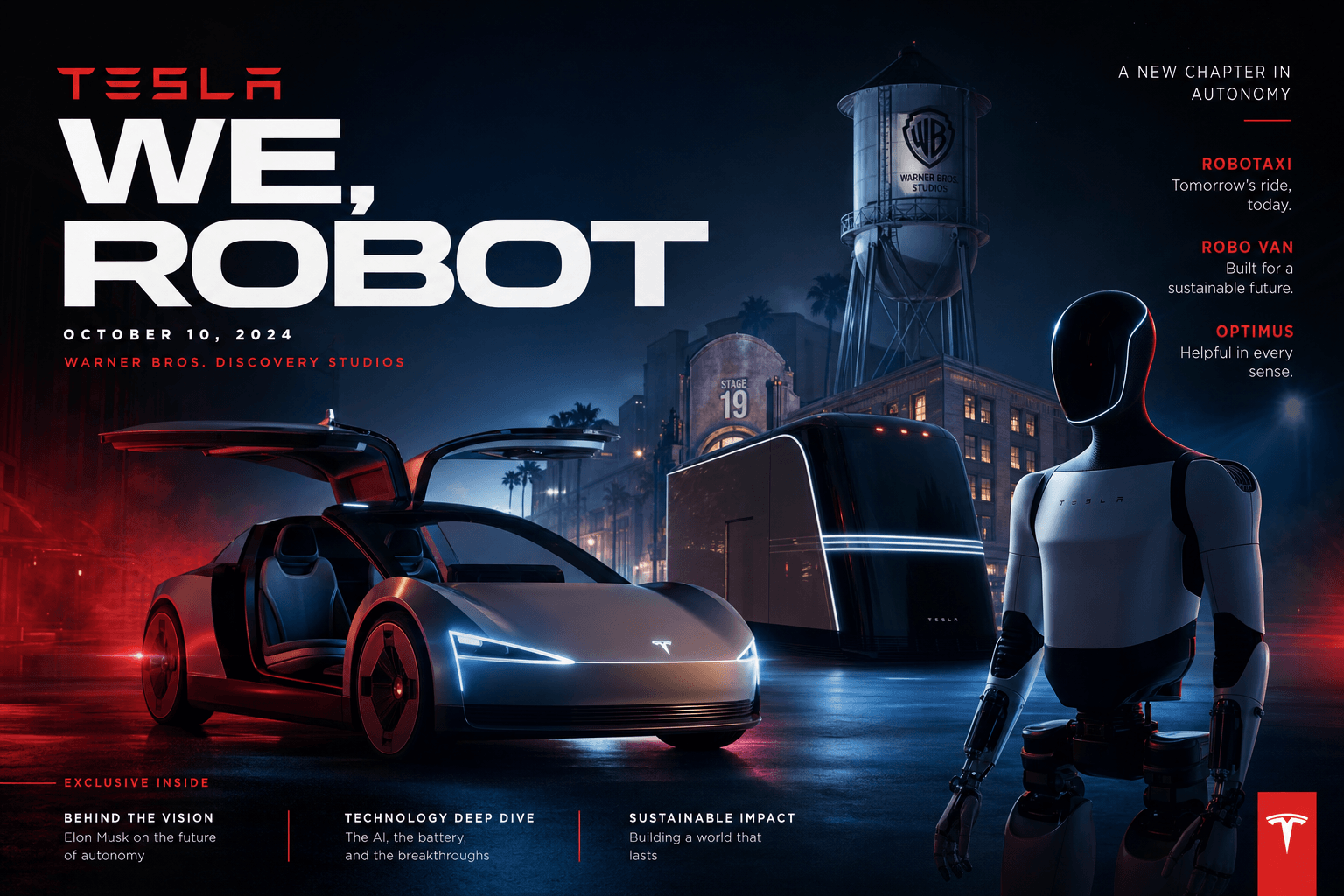
Tesla's long-awaited "We, Robot" event is finally here. After years of promises and blown deadlines, Elon Musk has unveiled the company's vision for a fully autonomous future—and it's more ambitious than anyone expected. From the $30,000 Cybercab robotaxi to a surprise 20-passenger Robovan and fleets of Optimus humanoid robots serving drinks, tonight's reveals at Warner Bros. Studios in Burbank mark a pivotal moment for Tesla and the autonomous vehicle industry.
Table of Contents #
- The Cybercab: Tesla's $30,000 Robotaxi Vision — A purpose-built autonomous vehicle without steering wheel or pedals
- The Surprise Robovan: Mass Transit Reimagined — Tesla's unexpected 20-passenger autonomous van
- Optimus Robots: From Factory Floor to Party Scene — Humanoid robots mingle with guests and serve drinks
- The Autonomous Driving Timeline — When unsupervised FSD is coming to Texas and California
- The Vision-Only Approach vs. Competitors — How Tesla's camera-only system compares to Waymo's sensor-heavy approach
- Wireless Charging and Infrastructure — Inductive charging for the Cybercab fleet
- The "AWS for AI" Vision — Turning idle Teslas into distributed compute power
- Market Reaction and Reality Check — Investor response and skepticism around timelines
- What This Means for the Future — The broader implications of Tesla's autonomy push
The Cybercab: Tesla's $30,000 Robotaxi Vision #
The Tesla Cybercab is a purpose-built, fully autonomous two-seater vehicle without a steering wheel or pedals, priced under $30,000, with production targeted for 2026. Tonight, Elon Musk unveiled what Tesla is calling the future of transportation—a vehicle designed from the ground up for autonomy rather than retrofitted with self-driving capabilities.
The Cybercab looks like a smaller, sleeker Cybertruck with more rounded edges and signature gullwing doors that open upward like butterfly wings. The cabin is compact, fitting only two passengers—clearly designed for ride-hailing efficiency rather than family hauls. Inside, there's no steering wheel, no pedals, and no traditional controls whatsoever. This is Tesla betting completely on its Full Self-Driving (FSD) technology.
| Cybercab Spec | Details |
|---|---|
| Price | Under $30,000 |
| Seating | 2 passengers |
| Controls | No steering wheel or pedals |
| Doors | Gullwing/butterfly style |
| Production | Targeted for 2026, "before 2027" |
| Charging | Wireless inductive charging |
Musk announced that the Cybercab will be available for purchase, not just operated by Tesla as part of a fleet. "And yes, you'll be able to buy one," Musk told the crowd, to cheers. The price point—under $30,000—is aggressive, especially considering the autonomous hardware packed into each vehicle. For context, Waymo's vehicles reportedly cost upwards of $100,000 when factoring in all the LiDAR and sensor arrays.
The unveiling wasn't just slides and promises. Twenty Cybercab prototypes are operating right now on the Warner Bros. lot, giving guests actual rides around the studio. Another 30 driverless Model Ys are also running demonstration routes. This is Tesla's approach to proving the technology works—putting people in real vehicles in a controlled but still complex environment.
What makes the Cybercab different from Tesla's existing vehicles is that it's purpose-built for autonomy. Current Teslas are designed for human drivers first, with FSD as an add-on. The Cybercab flips that script—there's no manual backup option. This design choice forces Tesla to solve the autonomy problem completely rather than rely on human intervention when the AI fails.
The regulatory path for the Cybercab remains unclear. Vehicles without steering wheels and pedals fall outside current Federal Motor Vehicle Safety Standards (FMVSS). Tesla will need to either secure exemptions or demonstrate that the Cybercab meets safety standards through self-certification. Given the National Highway Traffic Safety Administration's increased scrutiny of autonomous vehicles following incidents with Cruise and other operators, this won't be a quick process.
Tonight's demonstration on the Warner Bros. lot—a controlled environment with mapped roads and no unpredictable traffic—is a far cry from real-world operation in downtown Los Angeles or San Francisco. But it's a start. And for Tesla, after years of "two years away" promises, having actual hardware people can touch and ride in represents tangible progress.
The Surprise Robovan: Mass Transit Reimagined #
The Tesla Robovan is a surprise reveal—a fully autonomous transport vehicle capable of carrying up to 20 passengers or configured for cargo transport, designed for high-density urban transit at an estimated cost of $0.05 to $0.10 per mile. While everyone expected the Cybercab, Musk had a second vehicle waiting that few predicted.
The Robovan looks nothing like conventional vans. With an Art Deco-inspired design that Musk compared to a train engine, it features a sleek, elongated shape with no visible wheels from most angles. It looks futuristic in the way concept cars from the 1930s imagined the year 2000—streamlined, bold, and deliberately striking.
Musk pronounces it "ruh-BO-vehn," and it represents Tesla's answer to mass transit. Where the Cybercab handles individual rides, the Robovan is built for group transportation—sports teams, airport shuttles, corporate commuting, or any scenario where moving multiple people efficiently matters more than personal privacy.
| Robovan Features | Capabilities |
|---|---|
| Capacity | Up to 20 passengers |
| Alternative Config | Cargo/freight transport |
| Use Case | Mass transit, high-density routes |
| Est. Cost per Mile | $0.05 to $0.10 |
| Design | Art Deco train-inspired, no visible wheels |
The cost per mile Musk quoted—five to ten cents—is dramatically lower than current ride-sharing rates or public transit subsidies in many cities. If Tesla can actually deliver on those economics, the Robovan could fundamentally reshape how cities think about transportation infrastructure. Why build expensive rail lines when autonomous vans can provide comparable efficiency at a fraction of the capital cost?
Musk's vision extends beyond just moving people. "Autonomous Robovans will turn parking lots into parks," he said during the presentation. The idea is that as vehicles become autonomous and constantly used rather than sitting parked 95% of the time, the vast urban acreage currently devoted to parking can be repurposed for green space, housing, or other uses.
The Robovan also signals Tesla's broader ambitions beyond personal vehicles. The company isn't just trying to replace the family sedan—it's positioning itself as a comprehensive transportation provider, handling everything from individual robotaxi rides to mass transit to freight logistics. This is the "Master Plan Part 4" writ large: sustainable energy, autonomous mobility, and now autonomous logistics.
Like the Cybercab, the Robovan has no manual controls. It's autonomy or nothing. And like the Cybercab, it faces significant regulatory hurdles before it can operate on public roads. But as a demonstration of what's possible, it's a compelling vision of how autonomous vehicles could solve real transportation problems beyond just replacing Uber with a robot.
Optimus Robots: From Factory Floor to Party Scene #
Tesla's Optimus humanoid robots made a dramatic appearance at the We, Robot event, mingling with guests, serving drinks at the bar, playing games, and even dancing to Daft Punk—though some robots were revealed to be human-controlled rather than fully autonomous. Roughly a dozen Optimus units walked on stage alongside the Robovan reveal, and more were deployed throughout the event space.
Musk has made bold claims about Optimus before. Earlier this year, he predicted the robots would be performing tasks in Tesla factories by the end of 2024. Tonight, he doubled down on the vision: "I think it's going to be the biggest product ever, of any kind." That's a massive statement from someone who runs a car company, a rocket company, and an AI lab.
| Optimus Robot Details | Information |
|---|---|
| Price Target | $20,000 to $30,000 |
| Capabilities Demoed | Serving drinks, dancing, conversational interaction |
| Factory Timeline | In Tesla factories by end of 2024 |
| External Sales | Available for purchase by end of 2025 |
| Control Method | Mix of autonomous and human tele-operation |
The robots at tonight's event were impressive showmen. One Optimus wore a cowboy hat while bartending. Others engaged in conversations with guests, with one reportedly calling Musk the "Technoking"—a nod to his official, if unusual, title at Tesla. Several robots performed synchronized dance routines to "Baby Don't Hurt Me" in what looked like a disco party.
But the reality behind the spectacle is more nuanced. Reports from attendees and subsequent analysis suggest that many of the Optimus interactions were human-controlled via tele-operation rather than fully autonomous. The robots weren't independently understanding speech, navigating crowds, or improvising responses—they were being puppeteered by human operators off-site.
This isn't necessarily damning. Boston Dynamics has used similar demonstrations for years, gradually increasing autonomy while maintaining human oversight. The key question is where Tesla is on that progression—and Musk's timelines suggest they're further along than the current demos might indicate.
Musk's vision for Optimus extends far beyond party tricks. He envisions robots that can "watch your kids and do the dishes"—general-purpose humanoid helpers for domestic tasks. At $20,000 to $30,000, an Optimus would cost less than a Model 3, making it potentially accessible to a broad market if the capabilities match the price.
The factory deployment timeline is the near-term test. If Optimus units are actually performing useful manufacturing tasks at Tesla facilities by year's end, that validates the hardware and software stack in a controlled environment. From there, the path to home use is clearer, if still long and uncertain.
What's striking is the contrast between the Optimus presentation and the vehicle reveals. The Cybercab and Robovan, while ambitious, are extensions of existing Tesla capabilities—electric powertrains, battery tech, and software. Optimus is an entirely new category, competing with established players like Boston Dynamics and a wave of robotics startups. Tonight's demos suggest Tesla has made progress, but the gap between controlled event demos and real-world utility remains significant.
The Autonomous Driving Timeline #
Tesla plans to launch unsupervised Full Self-Driving for Model 3 and Model Y vehicles in Texas and California by 2025, with Cybercab production targeted for 2026 and Optimus external sales by late 2025. These timelines, announced tonight, are aggressive—and they come with the weight of years of missed predictions.
Musk has been promising fully autonomous Tesla vehicles for nearly a decade. In 2015, he told Fortune that Tesla was two years away from full autonomy. He's repeated variations of "next year" or "this year" so many times that tracking them has become a sport among Tesla watchers. The 2019 Autonomy Day promise of a million robotaxis by 2020 is perhaps the most infamous, but it's far from the only one.
Tonight's announcements follow that pattern, but with more specific constraints:
| Product | Timeline Announced | Context |
|---|---|---|
| Unsupervised FSD (CA & TX) | 2025 | Model 3 and Model Y only |
| Cybercab Production | 2026, "before 2027" | Purpose-built robotaxi |
| Optimus in Factories | End of 2024 | Internal Tesla operations |
| Optimus External Sales | End of 2025 | Consumer and business purchase |
| Robovan | Unspecified | Concept/prototype stage |
The 2025 timeline for unsupervised FSD in Texas and California is more constrained than past promises. It's limited to two states—both with favorable regulatory climates and extensive Tesla presence—and to existing Model 3 and Model Y vehicles rather than the entire fleet. These constraints make the target more achievable, though still ambitious.
Anthony Levandowski, the engineer who co-founded Google's self-driving program (now Waymo), offered a measured assessment after the event. "I think the issue isn't building the car without a steering wheel, it's making the software work," he told TechCrunch. "There's a lot of gap between driving around on a track at an amusement park and driving around in Los Angeles traffic."
Levandowski's point is crucial. What Tesla demonstrated tonight—20 Cybercabs operating on a closed film studio lot—is fundamentally different from operating in uncontrolled urban environments with pedestrians, cyclists, emergency vehicles, construction zones, and the infinite variability of real-world driving. The software that handles a mapped, controlled environment isn't the same as the software that handles the open road.
Former Cruise CEO Kyle Vogt, who led GM's autonomous vehicle subsidiary until resigning in 2023, shared a 15-point checklist of what serious robotaxi operations require. It includes everything from handling stuck vehicles and detecting collisions to managing sensor cleaning, degraded states, emergency vehicle detection, and liability frameworks. These are the unglamorous but essential details that separate demos from deployed services.
Musk's response to skepticism has always been to move faster and prove the doubters wrong. The question tonight isn't whether Tesla can eventually achieve these goals—it's whether the 2025-2026 timelines are credible given the history. Investors, initially enthusiastic, seemed uncertain: Tesla shares traded down as much as 6% premarket following the event.
The "before 2027" hedge on Cybercab production is telling. Even Musk is building in buffer, acknowledging that regulatory approval, manufacturing scale-up, and software validation could push the timeline. For a company that's missed virtually every self-driving prediction it's made, that hedging might be the most realistic thing about tonight's announcements.
The Vision-Only Approach vs. Competitors #
Tesla's vision-only approach relies exclusively on cameras and neural networks, rejecting the LiDAR and radar sensors that competitors like Waymo use, betting that machine learning can achieve full autonomy without expensive hardware. This is perhaps Tesla's most controversial technical decision—and the one that will determine whether tonight's promises become reality.
Waymo, the leader in commercial robotaxi operations, uses a sensor-heavy approach. Its vehicles are equipped with multiple LiDAR units, radar, and cameras, creating redundant sensing systems that cross-validate each other. The result is expensive—Waymo vehicles reportedly cost well over $100,000—but proven: Waymo is currently operating fully driverless rides in San Francisco, Los Angeles, and Phoenix, with over 100,000 paid trips completed.
| Approach | Tesla | Waymo |
|---|---|---|
| Primary Sensors | Cameras only | LiDAR + Radar + Cameras |
| Hardware Cost | Lower (~$30K target) | Higher (~$100K+ per vehicle) |
| Current Operations | Driver-supervised FSD | Fully driverless in 3 cities |
| Scale | Millions of vehicles (if deployed) | Hundreds of vehicles |
| Philosophy | AI can match human vision | Redundant sensing required |
Musk's argument is elegant: humans drive with two cameras (eyes) and a neural network (brain). If humans can do it, AI should be able to do it. Adding LiDAR is a "crutch" that substitutes expensive hardware for better software. At scale, this matters enormously—a $30,000 Cybercab with cameras-only has fundamentally different unit economics than a $100,000+ LiDAR-equipped vehicle.
Levandowski, despite his Waymo background, agrees with Musk's direction. "To scale that out to the masses, you need something that's affordable," he told TechCrunch. "Waymo already has fully operational driverless robotaxis... but it's a much more engineer-heavy and sensory-heavy approach." The trade-off is clear: Waymo's approach works now but is hard to scale; Tesla's approach could scale massively if the software works.
The challenge is that Tesla's FSD, despite years of development and billions of miles of real-world data, still requires human supervision. Users report interventions, near-misses, and system failures that would be unacceptable in a truly driverless vehicle. The crowdsourced tracking at TeslaFSDTracker.com documents these issues, contradicting Tesla's polished marketing videos.
Tonight's event didn't include detailed safety data or intervention rates that would demonstrate FSD is ready for unsupervised operation. Musk's confidence is based on the rapid improvement of AI capabilities—what wasn't possible two years ago is routine today, and the pace of change is accelerating. But the gap between "mostly works" and "works reliably enough to remove the steering wheel" is substantial.
Tesla has one massive advantage: scale. With millions of vehicles on the road collecting data, Tesla's neural networks train on more real-world miles than any competitor. Each FSD-enabled Tesla is a data collection device, building the training dataset that (in theory) enables the camera-only approach. Waymo has better sensors but fewer miles; Tesla has simpler sensors but vastly more data.
Which approach wins depends on how quickly AI capabilities advance. If neural networks can indeed match human-level visual understanding and decision-making, Tesla's approach wins on cost and scale. If the long tail of edge cases—construction zones, emergency vehicles, unusual weather, unpredictable human behavior—requires explicit sensor redundancy, Waymo's approach will maintain its lead.
Tonight's reveals don't settle this debate. They intensify it. The Cybercab is Tesla's bet that software can close the gap in the next 18-24 months. If that bet pays off, the economics of autonomy change dramatically. If it doesn't, Tesla will have built a fleet of vehicles that can't legally or safely operate as promised.
Wireless Charging and Infrastructure #
The Cybercab will use wireless inductive charging rather than physical plugs, allowing autonomous vehicles to charge without human intervention—an essential feature for true robotaxi operations. Musk confirmed tonight that the Cybercab has no charging port, relying entirely on wireless power transfer.
This detail is easy to overlook but operationally crucial. A robotaxi that requires a human to plug it in isn't truly autonomous. Every intervention breaks the economics of 24/7 automated fleet operation. Wireless charging enables vehicles to pull into charging bays, top up automatically, and return to service without any human touch.
| Charging Method | Pros | Cons |
|---|---|---|
| Traditional Plug-in | Higher efficiency, proven technology | Requires human intervention |
| Wireless Inductive | Fully automated, clean integration | Lower efficiency, higher infrastructure cost |
Tesla has teased wireless charging for years, filing patents and showing concept demonstrations. The Cybercab represents the first commitment to deploy it at scale. The technology works through electromagnetic induction: charging pads embedded in parking spaces transfer power to receiver coils in the vehicle's undercarriage. Drivers (or autonomous systems) simply position the vehicle over the pad.
Efficiency is the trade-off. Wireless charging typically loses 10-15% of energy compared to direct plug-in charging. For fleet operators, that's an acceptable cost for eliminating the labor of plugging and unplugging hundreds or thousands of vehicles daily. For the economics to work, Tesla will need to deploy charging infrastructure at scale—potentially hundreds of thousands of wireless charging points across its operating regions.
The infrastructure challenge extends beyond charging. For unsupervised FSD to work, Tesla needs:
- High-definition mapping of all operational routes
- Regulatory approval in each operating jurisdiction
- Remote operations centers for edge cases and vehicle recovery
- Maintenance facilities that can service vehicles without human drivers reporting issues
- Fleet management software to optimize vehicle deployment, charging, and cleaning
Tesla has pieces of this infrastructure through its Supercharger network and service centers, but robotaxi operations require different capabilities. A Supercharger station designed for highway travelers isn't optimized for urban robotaxi fleets that need rapid, automated charging between rides.
Musk mentioned the Cybercab's operating cost would be around $0.20 per mile, compared to $0.50-$1.00 per mile for traditional ride-sharing. That calculation includes charging costs, maintenance, insurance, and depreciation. Wireless charging infrastructure will be a significant component of those economics—if Tesla can build it efficiently.
The wireless charging announcement also hints at Tesla's broader energy ambitions. The company already sells solar panels, home batteries, and grid-scale storage. Adding wireless charging pads for residential garages and commercial fleets creates another revenue stream and ties the energy business to the transportation business more tightly.
For tonight's event, the practical demonstration was limited: the Cybercabs operating on the Warner Bros. lot presumably had charging infrastructure available. The real test will come when Tesla attempts to deploy wireless charging across cities at the scale required for commercial robotaxi service. That's a hardware infrastructure challenge as complex as the software autonomy challenge—and equally critical to success.
The "AWS for AI" Vision #
Elon Musk envisions turning Tesla's fleet into distributed compute infrastructure, where idle vehicles contribute processing power for AI inference—creating what he describes as "AWS for AI" This concept, mentioned again tonight, represents Tesla's most ambitious attempt to extract value from its vehicle fleet beyond transportation.
The idea is straightforward in theory: when Tesla vehicles aren't driving, their powerful onboard computers—designed to run full self-driving neural networks—sit mostly idle. Those computers could theoretically process AI workloads for other applications, generating revenue for vehicle owners while the car is parked.
| AWS for AI Concept | Details |
|---|---|
| Core Idea | Distributed inference compute from idle vehicles |
| Hardware | Tesla FSD computers (currently HW3/HW4) |
| Business Model | Revenue share with vehicle owners |
| Comparison | Amazon Web Services for AI inference |
| Status | Conceptual / Early development |
Musk has referenced this concept multiple times over the past year, suggesting that the aggregate compute power of millions of Teslas could rival or exceed centralized data centers. It's an appealing vision for owners—your car earns money driving people around during the day, then earns more money doing AI computation while you sleep.
The reality is more complicated. AWS works because Amazon controls massive, purpose-built data centers with reliable power, cooling, networking, and security. Tesla vehicles are mobile, unreliable in their availability, and geographically distributed. The networking challenge alone—moving data to millions of cars and back efficiently—is substantial.
But Musk's point is that the hardware is already being manufactured and deployed at enormous scale. Tesla has shipped millions of FSD-capable vehicles, each with a computer capable of running substantial neural network inference. In aggregate, that's a lot of silicon doing nothing most of the day.
The "inference compute" concept fits Tesla's broader strategy of vertical integration and resource utilization. Tesla builds its own batteries, motors, and computers. It sells electricity through Superchargers. It offers insurance. And now it wants to monetize the compute capacity sitting in its fleet.
For AI Automation and Growth practitioners, this concept is worth watching. If Tesla succeeds in building a distributed inference network, it could:
- Reduce costs for AI inference workloads by using edge compute
- Create a new revenue model for edge AI hardware deployments
- Demonstrate that consumer hardware can be aggregated for commercial compute
- Accelerate the trend toward specialized AI accelerators in edge devices
Tonight's event didn't include specific timelines or technical details for the AWS for AI vision. It's clearly a longer-term project than the Cybercab or even Optimus. But it's indicative of how Tesla thinks about its fleet—not just as vehicles, but as a network of intelligent computers that happen to have wheels.
Whether this works depends on solving distributed computing problems that have challenged the industry for decades: unreliable nodes, variable latency, data privacy, security, and economic incentives. Amazon solved these by building data centers. Tesla is betting it can solve them with software orchestration across an inherently unreliable substrate.
If it works, the implications extend far beyond Tesla. Any device with sufficient compute and idle time—phones, laptops, smart appliances—could potentially join distributed inference networks. The edge AI ecosystem would transform from individual devices to aggregated cloud-like services.
That's a big if. But tonight's event suggests Tesla is serious about exploring it.
Market Reaction and Reality Check #
Tesla shares dropped as much as 6% in premarket trading following the We, Robot event, with investors apparently unconvinced that tonight's reveals justified the ambitious timelines or met the sky-high expectations. The market's reaction highlights the gap between Tesla's aspirational presentations and Wall Street's demand for concrete deliverables.
The event itself was characteristically Musk: delayed by nearly an hour due to a reported medical emergency in the crowd, running just 20 minutes once it started, heavy on vision and light on specifics. There were no detailed safety statistics for FSD, no production partnership announcements, no regulatory pathway details—just prototypes operating on a closed film lot and promises of future capabilities.
| Market/Expert Response | Assessment |
|---|---|
| Stock Price | Down ~6% premarket |
| Anthony Levandowski | Bullish on vision, skeptical of timeline |
| Kyle Vogt | 15-point checklist for serious robotaxi ops |
| Investor Sentiment | Cautious, seeking concrete deliverables |
| General Public | Impressed by demos, uncertain on dates |
Levandowski's assessment captures the expert view: "If you can't start a webcast on time, maybe your prediction for 2026 is a little ambitious." The reference is to Musk's notorious timeline optimism, which has characterized Tesla's entire autonomy journey. Every prediction has been wrong; the only question is by how much.
But there's another perspective: Tesla delivered more tonight than just another PowerPoint. Twenty Cybercabs are actually driving people around. Optimus robots, even if partially tele-operated, are interacting with guests. The hardware exists, and it's operating in real-time. That's more than Tesla had for previous autonomy announcements.
The reality check comes down to a fundamental question: what's the difference between a compelling demo and a commercial product?
For Waymo, that transition took years. Even with Google-level resources and some of the world's best engineers, moving from "works in controlled conditions" to "commercial robotaxi service" required solving thousands of edge cases, building operational infrastructure, and navigating regulatory approval. Tesla is attempting the same transition with a different technical approach and more aggressive timelines.
The market skepticism isn't about whether Tesla can eventually build autonomous vehicles—it's about whether the 2025-2026 timelines are credible. Investors have been burned by Tesla autonomy promises before. They're pricing in the probability that tonight's dates will slip, just like every previous prediction.
For builders and operators watching this space, the key takeaway isn't the timeline—it's the technical direction. Tesla is betting everything on vision-only autonomy at consumer price points. If that bet pays off, it fundamentally changes the economics of autonomous transportation. If it doesn't, Waymo's sensor-heavy approach gains validation, and Tesla faces a costly pivot or continued delays.
Tonight's event didn't provide the conclusive evidence that would settle this debate. The Cybercabs on the Warner Bros. lot are impressive, but they're operating in a controlled environment with mapped roads and no unexpected variables. The gap between that and San Francisco rush hour traffic is substantial.
What tonight did establish is that Tesla has real hardware, real prototypes, and a clear vision for how autonomy fits into its broader ecosystem of vehicles, energy, and AI. The market may be skeptical of the timeline, but the direction is now clearer than ever.
What This Means for the Future #
Tesla's We, Robot event represents a strategic pivot from electric vehicle manufacturer to comprehensive autonomous mobility and AI company—a transition that, if successful, would rank among the most significant business transformations in modern history. Tonight's reveals aren't just new products; they're a redefinition of what Tesla is and what it aims to become.
The implications extend across multiple industries:
Transportation: A $30,000 autonomous vehicle changes the economics of ride-sharing, personal car ownership, and urban planning. If Tesla can deliver on the promised $0.20 per mile operating cost, traditional Uber and Lyft models face disruption. More broadly, the concept of personal car ownership—vehicles sitting idle 95% of the time—becomes economically irrational for many people.
Urban Development: Musk's comment about turning parking lots into parks isn't just rhetoric. If autonomous vehicles are constantly in motion rather than parked, cities can repurpose vast tracts of valuable real estate currently devoted to parking. This is potentially transformative for housing, green space, and urban density.
Energy: Tesla's energy business—solar, storage, charging—increasingly ties into its transportation business. The Cybercab's wireless charging requirement means Tesla will need to deploy substantial new infrastructure, potentially creating new standards for the industry. The "AWS for AI" vision adds compute to the energy business, creating a three-way integration of transport, energy, and AI.
Robotics: Optimus, even in its current state, signals Tesla's ambition beyond vehicles. The robot market—domestic helpers, industrial automation, service applications—dwarfs the automotive market if general-purpose humanoid robots can be built affordably. Tesla is betting its manufacturing and AI expertise can crack this problem faster than Boston Dynamics, Figure AI, or the dozens of robotics startups currently competing.
For the AI Automation + Growth audience I typically write for, tonight's event is a signal about the direction of autonomous systems. Tesla's approach—vision-only, consumer-priced, massively scaled—is one possible future. Waymo's approach—sensor-heavy, premium-priced, operationally focused—is another. Both are advancing rapidly, and competition between them will accelerate innovation.
The strategic takeaway: autonomy is moving from research to deployment. The questions are no longer "can we build self-driving cars?" but "how do we deploy them safely at scale?" and "what business models work?" Tesla's answers—consumer-owned robotaxis, vision-only systems, integrated energy/compute infrastructure—are bold but untested.
What strikes me watching tonight's reveals is the scope of Tesla's ambition. Most companies would be content building better electric cars. Tesla wants to replace human drivers entirely, deploy humanoid robots into homes, turn vehicle fleets into distributed supercomputers, and reshape urban landscapes. Even if only a fraction of this vision materializes, it's a fundamentally different company than the one that launched the Roadster in 2008.
The risk, as always with Tesla, is execution against timeline. Tonight's event showed real progress—hardware that works, prototypes that operate, prices that could change markets. What it didn't show was the path from controlled demos to commercial deployment at scale. That gap is where Tesla's history of missed predictions lives.
For builders and business leaders, the lesson is to separate the directional signal from the timeline noise. Autonomous vehicles, humanoid robots, and edge AI computation are coming. The exact timing remains uncertain, but the trajectory is clear. Preparing for that future—building skills, exploring applications, considering implications—should start now, regardless of whether Tesla hits its 2026 targets.
Tonight's event was pure Tesla: audacious vision, impressive demos, aggressive timelines, and unanswered questions about execution. The Cybercab, Robovan, and Optimus robots are real hardware that points to a radically different future. Whether that future arrives on Musk's schedule or years later, the direction is now set.
Frequently Asked Questions #
What is the Tesla Cybercab and how much will it cost? #
The Tesla Cybercab is a purpose-built two-seater autonomous vehicle without a steering wheel or pedals, priced under $30,000. It features gullwing doors, wireless inductive charging, and is designed specifically for autonomous ride-sharing rather than being a retrofit of an existing vehicle.
When will the Cybercab be available for purchase? #
Tesla targets Cybercab production to begin in 2026, with Musk specifying "before 2027" at tonight's event. This timeline assumes successful development of unsupervised Full Self-Driving software and regulatory approval for vehicles without manual controls.
What is the Tesla Robovan? #
The Robovan is a surprise autonomous transport vehicle revealed at the We, Robot event, capable of carrying up to 20 passengers or configured for cargo transport. It features an Art Deco-inspired train-like design and targets mass transit applications at an estimated cost of $0.05 to $0.10 per mile.
What can Tesla's Optimus robot actually do? #
Optimus robots demonstrated at tonight's event served drinks, engaged in conversation, danced, and interacted with guests—though many interactions were human-controlled via tele-operation rather than fully autonomous. Tesla targets a $20,000-$30,000 price point and plans factory deployment by end of 2024, with external sales beginning late 2025.
Is Tesla's Full Self-Driving actually fully autonomous now? #
No, Tesla's current Full Self-Driving still requires human supervision and attention. Musk announced tonight that unsupervised FSD will launch in Texas and California for Model 3 and Model Y vehicles in 2025, but this represents a future capability rather than current functionality.
How does Tesla's vision-only approach compare to Waymo? #
Tesla relies exclusively on cameras and neural networks, while Waymo uses LiDAR, radar, and cameras for redundant sensing. Tesla's approach is cheaper but still requires supervision; Waymo's approach is more expensive but already operates fully driverless robotaxis in San Francisco, Los Angeles, and Phoenix.
Will Cybercabs use traditional charging or something different? #
The Cybercab uses wireless inductive charging with no physical plug, allowing fully automated charging without human intervention. This is essential for 24/7 robotaxi operations where vehicles need to charge between rides without an operator plugging them in.
What is Tesla's "AWS for AI" concept? #
Musk envisions using the collective compute power of idle Tesla vehicles to run AI inference workloads, effectively creating a distributed cloud computing network. Vehicle owners could theoretically earn revenue from their parked cars processing AI tasks, similar to how Amazon Web Services rents compute capacity.
Are the Optimus robots at the event fully autonomous? #
Reports indicate that Optimus robots at tonight's event were a mix of tele-operated and partially autonomous systems. The conversational interactions and crowd navigation appeared to involve human operators, though Tesla did not explicitly clarify the level of autonomy during the demos.
When will unsupervised FSD be available for current Tesla owners? #
Musk announced that unsupervised Full Self-Driving will be available for Model 3 and Model Y vehicles in Texas and California starting in 2025. This is limited to those two states initially and requires vehicles with compatible Full Self-Driving hardware.
Can private owners operate their own Cybercab fleets? #
Yes, Musk confirmed that individuals will be able to purchase Cybercabs and operate them as part of their own robotaxi fleets. This "mom and pop" fleet model differs from Waymo's centralized approach and could enable small business owners to operate 10-20 vehicle ride-sharing services.
What safety measures is Tesla implementing for autonomous operation? #
Tesla did not release detailed safety data or intervention rates at tonight's event. Former Cruise CEO Kyle Vogt has outlined 15 critical safety considerations for robotaxi operations, including collision detection, emergency vehicle response, sensor cleaning, degraded state handling, and liability frameworks—areas where Tesla has not yet provided comprehensive details.
Building the Autonomous Future #
Tonight's We, Robot event gave us a glimpse of a future where autonomous vehicles are affordable, humanoid robots assist with daily tasks, and distributed compute networks emerge from connected devices. Whether that future arrives in 2026 or takes longer to materialize, the trajectory is becoming clearer.
For organizations looking to tap into AI automation and build next-generation digital experiences, the key insight is this: autonomy is becoming a platform, not just a feature. Tesla isn't just building self-driving cars—it's building infrastructure, business models, and ecosystems around autonomous systems.
If you're exploring how AI automation can transform your operations or considering a custom digital experience that uses emerging AI capabilities, let's talk.
Book an AI Automation Strategy Call →
Written from the perspective of October 10, 2024.
Related reading: Check out my coverage of Anthropic's Computer Use Beta and the latest developments in AI agent frameworks to see how autonomous systems are evolving beyond vehicles into software agents and digital workers.
Written from the perspective of October 10, 2024.
Related Posts
Google I/O 2026 Action List: How I Prompted Gemini 3.5 Flash and Antigravity Workflows
Google I/O 2026 just reset the AI tooling landscape. Here's the 9-action checklist for builders who want to ship this week, not just watch the keynote.
Anthropic vs. OpenAI vs. Google: The State of the Frontier in May 2026
A head-to-head breakdown of the three AI giants in May 2026: Claude Opus 4.6, GPT-5.3 and 5.4, Gemini 3.1 Pro. Real specs, real pricing, and what actually matters for builders.
Kimi K2 Open Weights: How I Prompted Moonshot's Frontier Model for Agentic Tool Use
How I direct Kimi K2 by Moonshot AI for agentic workflows, long-context tool calling, and workflow automation. A 1 trillion parameter MoE model with competitive benchmarks at 5-17x lower cost than GPT-5 and Claude.