CES 2026: NVIDIA Rubin Keynote and the AI Hardware Moment

Table of Contents
CES 2026: NVIDIA Rubin Keynote and the AI Hardware Moment #
The Bottom Line Up Front #
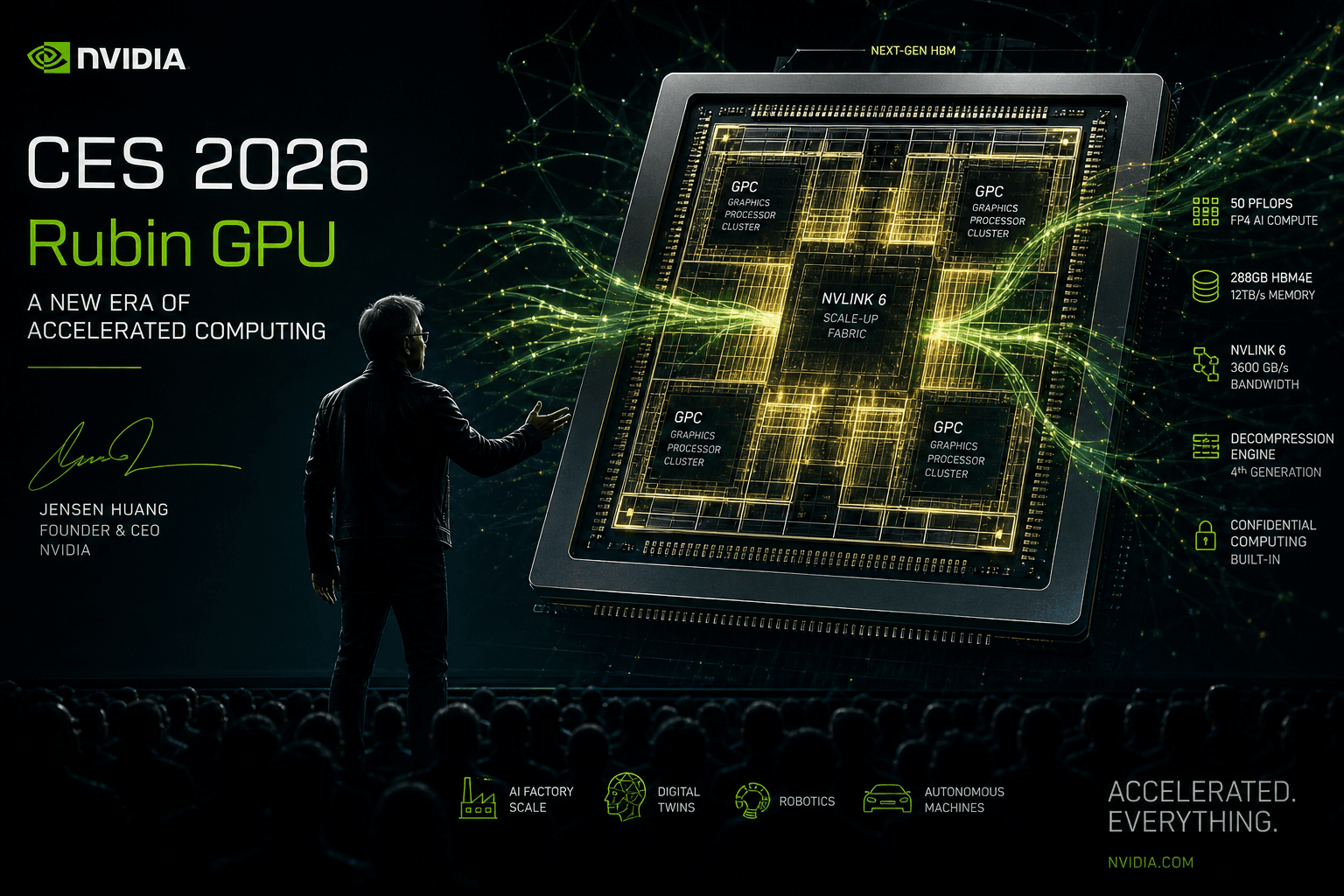
Rubin is in full production. Jensen Huang's CES 2026 keynote delivers exactly what the market expected and feared: NVIDIA's next-generation AI architecture is real, shipping, and represents a generational leap that extends the company's lead over AMD and the custom silicon efforts from hyperscalers. The Vera Rubin NVL72 packs 72 GPUs and 36 CPUs into a single rack, delivers 50 petaflops of NVFP4 inference per chip, and cuts inference token costs by 10x compared to Blackwell.
I am watching three signals tonight: memory bandwidth (HBM4 at 22 TB/s), interconnect scaling (NVLink 6 at 3.6 TB/s), and the AI factory narrative that reframes data centers as compute generation plants. Rubin excels on all three. For enterprises building inference infrastructure, the economic math just shifted decisively.
What NVIDIA Announced at CES 2026 #
Jensen Huang takes the Las Vegas stage tonight to unveil the Rubin platform—NVIDIA's first "extreme-codesigned" six-chip AI platform. The announcement is comprehensive, spanning silicon, systems, networking, and software. Here is what matters:
Rubin GPU (R200/VR200): The next-generation GPU built on TSMC's 3nm process, featuring 336 billion transistors and 288 GB of HBM4 memory per chip. Huang confirms Rubin delivers 50 petaflops of NVFP4 inference performance per GPU—roughly double the effective inference throughput of Blackwell at similar precision.
Vera CPU: An 88-core custom ARM processor designed specifically for data movement and agentic AI workloads. Each Vera includes 1.5 TB of LPDDR5X memory and is engineered to feed the Rubin GPUs without bottlenecks. This is NVIDIA's first CPU truly co-designed with its GPU architecture for AI factory workloads.
NVLink 6: The sixth generation of NVIDIA's scale-up interconnect delivers 3.6 TB/s per-GPU bandwidth—enabling direct GPU-to-GPU communication across the 72-GPU NVL72 configuration. For large-model parallelism, this matters more than raw FLOPS.
Spectrum-X Ethernet Photonics: New optical networking for scale-out connectivity, paired with ConnectX-9 SuperNICs pushing 1.6 Tb/s per GPU and BlueField-4 DPUs for infrastructure offloading.
DGX GB300 Systems: The Blackwell Ultra refresh bridges today's deployments to Rubin. The GB300 NVL72 delivers 1.5x the AI performance of GB200 systems with 37 TB of fast memory and 1,440 PFLOPS of FP4 compute.
The strategic framing is explicit: NVIDIA is building AI factories—facilities that generate intelligence as a product, not just process it.
Rubin Architecture: Technical Specifications #
I have spent the evening analyzing the Rubin specifications. The numbers tell a clear story of bandwidth-first design for inference-heavy workloads.
| Specification | Rubin (R200) | Blackwell (B200) | Delta |
|---|---|---|---|
| Process | TSMC 3nm | TSMC 4NP | — |
| Transistors | 336 billion | 208 billion | +62% |
| HBM Memory | 288 GB HBM4 | 192 GB HBM3e | +50% |
| Memory Bandwidth | 22 TB/s | 8 TB/s | +175% |
| NVFP4 Inference | 50 PFLOPS | ~20 PFLOPS | +150% |
| TDP | 1,800-2,300W | 1,000W | +80-130% |
| NVLink Bandwidth | 3.6 TB/s | 1.8 TB/s | +100% |
Memory Architecture: Rubin moves to HBM4 with a 2,048-bit interface width per stack—double HBM3e's 1,024-bit width. The 288 GB capacity supports 1.5x larger model footprints without spilling to slower memory tiers. For 70B-parameter models at FP4 precision, this means entire models sit in high-bandwidth memory, eliminating the pagination overhead that plagues smaller-GPU deployments.
Multi-Chip Module Design: Rubin uses a CoWoS-L interposer packaging two compute dies and two I/O dies. This modular approach improves yield and enables NVIDIA to scale compute independently of I/O for different market segments.
Vera CPU Integration: The 88-core ARM design is not an afterthought. With 1.5 TB of local memory and optimized data movement paths, Vera functions as a preprocessing and orchestration layer that keeps the GPUs saturated. For agentic AI pipelines—where reasoning spans multiple model calls and tool invocations—this integration eliminates host bottlenecks.
The NVL72 Configuration: The flagship Vera Rubin NVL72 pairs 72 Rubin GPUs with 36 Vera CPUs in a liquid-cooled rack. The unified memory pool across NVLink-connected GPUs effectively creates a single 20 TB HBM4 super-processor. For training mixture-of-experts models, NVIDIA claims Rubin requires 4x fewer GPUs than competing architectures.
Blackwell Ultra: The Bridge Strategy #
Rubin dominates the headlines tonight, but the Blackwell Ultra announcement is equally important for immediate deployment timelines. The DGX GB300 systems give enterprises a production path today while Rubin ramps in the second half of 2026.
DGX GB300 NVL72 Specifications:
- 72 Blackwell Ultra GPUs + 36 Grace CPUs
- 37 TB of fast memory (HBM3e)
- 1,440 PFLOPS FP4 tensor performance
- 1.5x AI performance vs. GB200 systems
- 38 TB memory for multistep reasoning workloads
The Blackwell Ultra refresh emphasizes test-time scaling inference—the practice of applying more compute during inference to improve output quality. This is the architectural shift enabling advanced reasoning models like OpenAI's o-series and Anthropic's Claude thinking modes. For agentic AI applications requiring multiple reasoning steps, the additional memory and compute headroom in GB300 systems translates directly to lower latency and higher throughput.
DGX B300 NVL16: For enterprises requiring air-cooled deployments, the B300 NVL16 provides a flexible alternative without the infrastructure demands of liquid cooling.
DGX SuperPOD: NVIDIA's turnkey supercomputer architecture scales GB300 systems to tens of thousands of Grace Blackwell Ultra Superchips. Equinix is already deploying these through the NVIDIA Instant AI Factory managed service across 45 global markets.
The bridge strategy is clear: deploy Blackwell Ultra now for immediate inference capacity, migrate to Rubin in late 2026 for next-generation economics. CUDA software compatibility ensures the transition requires zero code changes—code running on Hopper today compiles for Rubin without modification.
The AI Factory Narrative #
Tonight's keynote introduces—or rather, crystallizes—a new framing that I expect to dominate infrastructure conversations in 2026: the AI factory. Huang is explicit that data centers are no longer just facilities for storing and processing data. They are compute-generation plants that produce intelligence as a product.
The metaphor matters for capital allocation decisions. Traditional data centers are evaluated on storage capacity, network latency, and compute density. AI factories are evaluated on tokens per dollar, reasoning throughput, and marginal inference cost.
Key Components of NVIDIA's AI Factory Stack:
- Vera Rubin NVL72 as the base compute unit
- NVLink 6 for scale-up communication within the rack
- Spectrum-X Ethernet for scale-out across racks
- BlueField-4 DPUs for infrastructure isolation and security
- NVIDIA AI Enterprise software stack for orchestration
The AI factory narrative also explains the pricing and availability strategy. NVIDIA is not just selling chips—it is selling complete systems optimized for intelligence generation. This is why the company emphasizes rack-scale deployments over individual GPU sales. An AI factory requires coordinated compute, memory, networking, and software. Selling GPUs without the surrounding infrastructure would be like selling turbine blades without the generator housing.
Equinix Instant AI Factory: The first managed service deployment of DGX GB300 infrastructure represents NVIDIA's push into operational AI infrastructure, not just silicon. Customers can consume AI factory capacity without building their own liquid-cooled data centers.
For enterprises evaluating build-vs-buy decisions for inference infrastructure, the AI factory framing provides a useful economic lens. The question is no longer "what GPUs should we buy?" but "what is our marginal cost per million generated tokens?"
Competition Check: AMD, Intel, and Custom Silicon #
Rubin's dominance tonight raises the obvious question: what are AMD, Intel, and the hyperscaler custom silicon teams doing?
AMD MI400: The most credible competitive threat. AMD's MI400 series is expected in 2026 with up to 432 GB of HBM4 memory—exceeding Rubin's 288 GB—and advanced chiplet designs optimized for cost-efficient inference. AMD's data center revenue hit $16.64 billion in 2025 (up 32%), with design wins from OpenAI and xAI signaling growing ecosystem traction. The MI400's larger memory footprint could appeal to customers running 400B+ parameter models where capacity matters more than raw bandwidth.
Intel: Effectively absent from the 2026 AI accelerator market. Intel canceled Falcon Shores—the chip originally slated for late 2025—and is refocusing on Jaguar Shores for post-2026 release. Interim co-CEO Michelle Johnston Holthaus acknowledged that Intel learned from Gaudi's failures: the market wants rack-scale solutions, not just silicon. Falcon Shores lacked this capability, so Intel is starting over. Rubin will face no meaningful competition from Intel this year.
Google TPU v8: Google just launched its eighth-generation TPUs with a bifurcated strategy—separate chips for training (TPU 8t) and inference (TPU 8i). The inference chip delivers 80% better performance per dollar than previous generations, with 216 GB of HBM per chip and 6.5 TB/s bandwidth. For Google Cloud customers running internal workloads, TPU 8i represents a viable alternative. But for external model deployment requiring broad framework compatibility, CUDA's ecosystem moat remains formidable.
Amazon Trainium3/4: Trainium3 delivers 4.4x more compute than Trainium2 with 40% better energy efficiency. Trn3 UltraServers scale to 144 chips and claim 5x more tokens per megawatt for inference. Trainium4 is planned for late 2026 or early 2027. AWS's strategy mirrors Google's: custom silicon optimized for internal workloads and cost-conscious cloud customers, not necessarily the frontier training market.
The Moat Assessment: NVIDIA maintains 80-92% market share in AI data center GPUs. Rubin extends this lead through: (1) HBM4 bandwidth advantages, (2) NVLink 6 scale-up networking that no competitor matches, (3) CUDA software ecosystem lock-in, and (4) the AI factory integrated system narrative that competitors cannot easily replicate. AMD MI400 will capture share among price-sensitive customers and those with specific memory requirements. Custom silicon from Google and Amazon will serve internal workloads efficiently. But for the high-performance training and reasoning market that drives the majority of revenue, Rubin is unchallenged tonight.
Memory, Interconnect, and the Bandwidth Wall #
The most significant technical story in Rubin is not the FLOPS—it is the memory bandwidth. I have written before about the bandwidth wall constraining large model inference. Rubin attacks this problem aggressively.
HBM4 at 22 TB/s: Rubin's 288 GB of HBM4 delivers 22 TB/s of aggregate bandwidth—2.75x Blackwell's 8 TB/s. For transformer inference, memory bandwidth is the binding constraint on token generation speed. More bandwidth directly translates to lower latency per token and higher throughput for batch sizes that matter in production.
The Arithmetic Intensity Shift: Large language model inference is memory-bound, not compute-bound. Rubin shifts the balance toward compute efficiency by: (1) increasing bandwidth faster than FLOPS, and (2) adding support for new data types (NVFP4, NVFP6) that preserve model quality at lower precision. The 50 petaflops of NVFP4 compute is only useful because the 22 TB/s memory subsystem can feed it.
NVLink 6 at 3.6 TB/s: For distributed inference across multiple GPUs, the interconnect bandwidth determines how quickly activations can be exchanged between layers on different chips. NVLink 6's 3.6 TB/s per-GPU bandwidth enables larger effective batch sizes and lower communication overhead for pipeline and tensor parallelism strategies.
Spectrum-X Ethernet Photonics: For scale-out networking across racks, NVIDIA is moving to optical Ethernet. Photonics reduces power consumption and latency for the connections that link AI factory nodes into larger supercomputers. The ConnectX-9 SuperNICs at 1.6 Tb/s per GPU ensure that network bottlenecks do not limit aggregate system throughput.
Long-Context Storage: Huang highlights new "AI-native storage" capabilities enabling 5x higher tokens per second for long-context inference. This suggests Rubin includes hardware support for offloading KV cache to fast storage tiers without the latency penalties that plague current implementations.
Power, Thermals, and Data Center Reality #
Rubin's performance comes with power demands that reshape data center planning. The 1,800-2,300W TDP per GPU—roughly double Blackwell's 1,000W—requires liquid cooling infrastructure that many facilities lack.
The Power Math: A Vera Rubin NVL72 rack with 72 GPUs draws approximately 130-165 kW of power for compute alone. Add networking, storage, and cooling overhead, and a single rack approaches 200 kW. Traditional data centers designed for 10-15 kW per rack cannot accommodate this density without wholesale infrastructure rebuilds.
Liquid Cooling Requirements: NVIDIA specifies direct liquid cooling (DLC) for Rubin NVL72 deployments. This means: cold plates on every GPU and CPU, coolant distribution units (CDUs) in each rack, and facility water loops capable of handling the thermal load. For enterprises without existing liquid cooling infrastructure, the capital expenditure is significant.
The AI Factory Infrastructure Play: This thermal reality explains NVIDIA's emphasis on managed AI factory deployments through partners like Equinix. Rather than retrofitting existing data centers, customers can consume Rubin capacity in pre-engineered facilities designed for the power and cooling requirements. The DGX SuperPOD architecture includes all necessary cooling infrastructure as part of the system design.
Geographic Constraints: Not all data center markets can support 200 kW racks. Rubin deployments will concentrate in markets with: (1) available power capacity, (2) liquid cooling infrastructure, and (3) proximity to major network interchanges. Northern Virginia, Phoenix, Dallas, Frankfurt, Amsterdam, and Singapore will see the first large-scale Rubin deployments.
Sustainability Implications: The 10x inference cost reduction Rubin delivers per token could drive 10x or greater increases in total AI compute demand—Jevons paradox in action. Whether Rubin improves or worsens aggregate AI energy consumption depends on whether efficiency gains outpace demand growth. Early evidence suggests demand elasticity is high; we should expect Rubin to accelerate, not slow, AI infrastructure buildouts.
Pricing Signals and Market Positioning #
NVIDIA has not released official pricing for Rubin GPUs tonight, but the positioning signals are clear from the keynote framing and product architecture decisions.
The AI Factory Bundling Strategy: NVIDIA is selling rack-scale systems, not individual GPUs. The Vera Rubin NVL72 will be priced as an integrated system including: GPUs, CPUs, NVLink switches, networking, cooling infrastructure, and software licenses. This bundling obscures per-GPU pricing while capturing margin across the full stack.
Competitive Pricing Pressure: AMD's MI400 with 432 GB HBM4 will likely undercut Rubin on raw price-per-gigabyte of memory. Google TPU 8i and Amazon Trainium3 will deliver better price-performance for customers willing to commit to custom silicon ecosystems. NVIDIA's defense is ecosystem lock-in and the 10x cost reduction Rubin delivers relative to previous-generation deployments.
DGX GB300 as the Entry Point: For customers unable to wait for Rubin or justify its infrastructure requirements, the DGX GB300 systems provide a bridge at presumably lower price points. The 1.5x performance improvement over GB200 suggests NVIDIA will maintain GB300 pricing roughly at current DGX levels while Rubin commands a premium.
Managed Service Consumption: The Equinix Instant AI Factory model suggests NVIDIA is comfortable with customers consuming Rubin capacity as a service rather than purchasing hardware. This shifts the economic question from CapEx to OpEx and enables faster adoption among enterprises without data center infrastructure.
Market Segmentation Prediction: I expect Rubin to target three tiers: (1) hyperscalers buying NVL72 racks at volume discounts, (2) enterprise AI factories through managed services, and (3) research institutions and national labs via grant-funded supercomputer deployments. Each tier will see different effective pricing based on commitment levels and software licensing terms.
What This Means for Inference Economics #
The headline metric from tonight's keynote—10x reduction in inference token generation cost—fundamentally reshapes the economics of AI deployment.
The Cost Curve Acceleration: Over the past two years, inference costs have fallen roughly 10x annually. Rubin continues this trend. For applications where inference cost is the binding constraint—high-volume customer service agents, real-time content generation, embedded reasoning in applications—the economic viability window expands dramatically.
Marginal Cost Per Token: Rubin's 50 petaflops of NVFP4 compute and 22 TB/s memory bandwidth enable higher throughput with fewer GPUs. For a 70B-parameter model serving 1,000 concurrent users, the required GPU count drops by roughly half compared to Blackwell, while power consumption per token drops faster still.
Batch Size Optimization: The HBM4 capacity increase enables larger batch sizes without spilling to CPU memory. Larger batches improve GPU utilization and amortize fixed overhead across more tokens. Rubin's 288 GB capacity supports batch sizes that saturate the compute units for all but the largest models.
The MoE Training Advantage: NVIDIA claims Rubin requires 4x fewer GPUs to train mixture-of-experts models compared to alternatives. MoE architectures—now standard in frontier models like GPT-4, Claude, and Gemini—are communication-intensive during training. NVLink 6's bandwidth advantage directly translates to faster training and lower costs for the most capable model architectures.
Reasoning Model Economics: Test-time scaling inference—running models for longer to improve output quality—is becoming standard for high-value applications. Rubin's improved memory subsystem and compute density make this economically viable at production scale. The 5x improvement in long-context inference tokens per second specifically targets reasoning workloads.
Competitive Response Timeline: AMD MI400 and custom silicon will respond with similar cost reductions over 2026. The key question is whether Rubin's 10x improvement resets customer expectations faster than competitors can match. History suggests NVIDIA's lead time—6-12 months before competitive parity—will capture the majority of 2026 infrastructure investment decisions.
Timeline and Availability #
Tonight's announcements come with specific availability windows that matter for infrastructure planning.
Rubin Platform Status: Jensen Huang confirms Rubin is in full production now. The silicon is validated, TSMC yields are meeting targets, and the platform is ready for volume manufacturing.
Product Availability: Systems and services running on Rubin will be available from partners starting in the second half of 2026. This likely means Q3 for hyperscaler deployments, Q4 for enterprise availability through NVIDIA's channel partners.
DGX GB300 Availability: Blackwell Ultra systems are shipping immediately. Equinix already offers GB300 capacity through Instant AI Factory. For enterprises needing inference capacity in H1 2026, GB300 is the deployment target.
Software Readiness: CUDA 12.x and NVIDIA AI Enterprise 5.x will support Rubin at launch. The compatibility promise—code written for Hopper or Blackwell compiles for Rubin without modification—remains intact. NVIDIA's software ecosystem continues to be its deepest competitive moat.
Vera CPU Timeline: The custom ARM CPU launches alongside Rubin in H2 2026. Early deployments may use existing Grace CPUs in transitional configurations, but the full Vera + Rubin pairing arrives together.
Networking Components: NVLink 6, ConnectX-9 SuperNICs, and Spectrum-X Ethernet switches will begin shipping in Q2 2026 to support H2 system deployments. Data center network refreshes targeting Rubin should begin planning now.
Frequently Asked Questions #
What is the NVIDIA Rubin architecture? #
Rubin is NVIDIA's next-generation GPU architecture announced at CES 2026. Named after astronomer Vera Rubin, it is the company's first "extreme-codesigned" six-chip AI platform comprising: Rubin GPUs with 336 billion transistors and 288 GB HBM4 memory, Vera CPUs with 88 custom ARM cores, NVLink 6 interconnects, Spectrum-X Ethernet networking, ConnectX-9 SuperNICs, and BlueField-4 DPUs. The flagship Vera Rubin NVL72 configuration packs 72 GPUs and 36 CPUs into a liquid-cooled rack.
How does Rubin compare to Blackwell? #
Rubin delivers approximately 2.5x the inference performance of Blackwell with 50 petaflops of NVFP4 compute versus Blackwell's ~20 petaflops. Memory bandwidth increases 2.75x (22 TB/s vs 8 TB/s) thanks to HBM4. Rubin also doubles NVLink bandwidth to 3.6 TB/s and increases GPU memory capacity by 50% to 288 GB. The tradeoff is higher power consumption: 1,800-2,300W TDP versus Blackwell's 1,000W.
When will Rubin GPUs be available? #
Rubin is in full production as of January 2026. Systems and services running on Rubin will be available from partners starting in the second half of 2026—likely Q3 for hyperscalers and Q4 for enterprise deployments through NVIDIA's channel partners.
What is Blackwell Ultra? #
Blackwell Ultra is the refresh of NVIDIA's Blackwell architecture announced alongside Rubin. The DGX GB300 NVL72 systems deliver 1.5x the AI performance of GB200 with 37 TB of fast memory and 1,440 PFLOPS of FP4 compute. GB300 is shipping now and serves as a bridge for enterprises needing immediate inference capacity before Rubin availability.
What is an AI factory? #
An AI factory is NVIDIA's framing for the next generation of data centers. Rather than facilities for storing and processing data, AI factories are compute-generation plants that produce intelligence as a product. They are evaluated on tokens per dollar, reasoning throughput, and marginal inference cost rather than traditional data center metrics like storage capacity and network latency.
How does Rubin compare to AMD MI400? #
AMD MI400 is Rubin's most credible competitor for 2026. MI400 features up to 432 GB of HBM4 memory—exceeding Rubin's 288 GB—and targets cost-efficient inference with advanced chiplet designs. Rubin counters with superior memory bandwidth (22 TB/s vs likely ~15 TB/s for MI400), NVLink 6 scale-up networking that AMD lacks, and CUDA ecosystem lock-in. AMD will likely win on price-per-gigabyte; NVIDIA wins on bandwidth and software.
What memory technology does Rubin use? #
Rubin uses HBM4 (High Bandwidth Memory 4) with 288 GB capacity per GPU across 8 stacks. HBM4 doubles the interface width to 2,048 bits per stack compared to HBM3e's 1,024 bits, delivering 22 TB/s aggregate bandwidth. For context, this is 2.75x the memory bandwidth of Blackwell's HBM3e subsystem.
Will Rubin support current CUDA applications? #
Yes. NVIDIA maintains CUDA compatibility across generations. Code written for Hopper (H100) or Blackwell (B200) compiles for Rubin without modification. CUDA 12.x and NVIDIA AI Enterprise 5.x will support Rubin at launch. This software continuity is a core part of NVIDIA's competitive moat.
How much power will Rubin consume? #
Rubin GPUs have a TDP of 1,800-2,300W per chip—roughly double Blackwell's 1,000W. A full Vera Rubin NVL72 rack draws approximately 130-165 kW for compute alone, approaching 200 kW with networking and cooling overhead. This necessitates direct liquid cooling (DLC) infrastructure that traditional air-cooled data centers cannot support.
What does this mean for AI inference costs? #
Jensen Huang announced a 10x reduction in inference token generation cost with Rubin compared to previous generations. This continues the roughly 10x annual cost reduction trend of the past two years. For applications where inference cost is the binding constraint—high-volume agents, real-time generation, embedded reasoning—the economic viability window expands dramatically.
Is Rubin for training or inference? #
Both. Rubin's 50 petaflops of NVFP4 compute and 22 TB/s memory bandwidth excel at large-scale inference. The 4x reduction in GPUs needed for MoE training and the 5x improvement in long-context tokens per second make it equally capable for training next-generation models. The AI factory narrative specifically targets both workloads as unified infrastructure.
How does custom silicon compete with Rubin? #
Google TPU 8i and Amazon Trainium3 compete with Rubin on price-performance for specific workloads. TPU 8i delivers 80% better inference performance-per-dollar with 216 GB HBM per chip. Trainium3 offers 4.4x more compute than Trainium2 with 40% better efficiency. However, custom silicon requires committing to specific cloud ecosystems and lacks the broad framework compatibility of CUDA. For external model deployment and multi-cloud strategies, Rubin's ecosystem advantage remains decisive.
Final Take: The Hardware Moment Is Now #
Tonight's keynote cements a reality I have been tracking: the AI infrastructure buildout is not slowing—it is accelerating. Rubin's 10x cost reduction for inference, combined with the AI factory framing, resets expectations for what enterprises should demand from their infrastructure investments.
I see three immediate implications for organizations building AI capabilities:
First, the inference cost curve just steepened. Applications that were marginal at Blackwell economics become profitable at Rubin economics. If you have been waiting for inference costs to justify an AI initiative, the threshold just dropped by an order of magnitude.
Second, the infrastructure requirements just intensified. Rubin's 200 kW per rack and liquid cooling mandates mean most existing data centers cannot accommodate it without wholesale rebuilds. The Equinix AI Factory model—or similar managed infrastructure plays—will dominate Rubin adoption for all but the largest hyperscalers.
Third, NVIDIA's moat is widening, not narrowing. AMD MI400 will capture share at the margin. Google and Amazon will optimize internal workloads on custom silicon. But for the high-performance, general-purpose AI compute market that drives revenue, Rubin extends NVIDIA's lead by 12-18 months. The ecosystem lock-in—CUDA, NVLink, the software stack—proves more durable than hardware specifications alone.
The hardware moment is now. Rubin does not just represent faster GPUs; it represents the infrastructure layer that enables the next wave of AI applications. Enterprises making infrastructure decisions in 2026 are not just choosing hardware—they are choosing whether to participate in the intelligence-generation economy at competitive cost structures.
I am watching for AMD's MI400 response, Google's TPU trajectory, and the inevitable Rubin supply constraints as demand outstocks capacity in H2 2026. But tonight, Jensen Huang's keynote is the story. Rubin is real. It is in production. And it reshapes the economics of AI infrastructure starting now.
Related Reading:
- DeepSeek R1 and the NVIDIA Market Shock — How efficient model architectures challenged NVIDIA's dominance a year ago
- GPT-5 Launch: The Single Model Router Era — The software layer that Rubin infrastructure enables
- Llama 3.2 Multimodal at Meta Connect 2024 — Open model competition driving inference demand
- OpenAI DevDay 2025: Apps and AgentKit — The agentic applications consuming Rubin-scale compute
Ready to Build Your AI Infrastructure? #
Rubin represents the absolute latest generation, but most organizations do not need 72-GPU racks to capture AI value. I help enterprises design and deploy AI infrastructure strategies—from inference-optimized deployments on existing hardware to planning for Rubin-scale AI factory buildouts.
Explore AI Automation & Infrastructure Services to discuss your inference economics, deployment architecture, and how to position your infrastructure for the Rubin generation.
Related Posts

Google I/O 2026 Action List: How I Prompted Gemini 3.5 Flash and Antigravity Workflows
Google I/O 2026 just reset the AI tooling landscape. Here's the 9-action checklist for builders who want to ship this week, not just watch the keynote.

Anthropic vs. OpenAI vs. Google: The State of the Frontier in May 2026
A head-to-head breakdown of the three AI giants in May 2026: Claude Opus 4.6, GPT-5.3 and 5.4, Gemini 3.1 Pro. Real specs, real pricing, and what actually matters for builders.

Kimi K2 Open Weights: How I Prompted Moonshot's Frontier Model for Agentic Tool Use
How I direct Kimi K2 by Moonshot AI for agentic workflows, long-context tool calling, and workflow automation. A 1 trillion parameter MoE model with competitive benchmarks at 5-17x lower cost than GPT-5 and Claude.