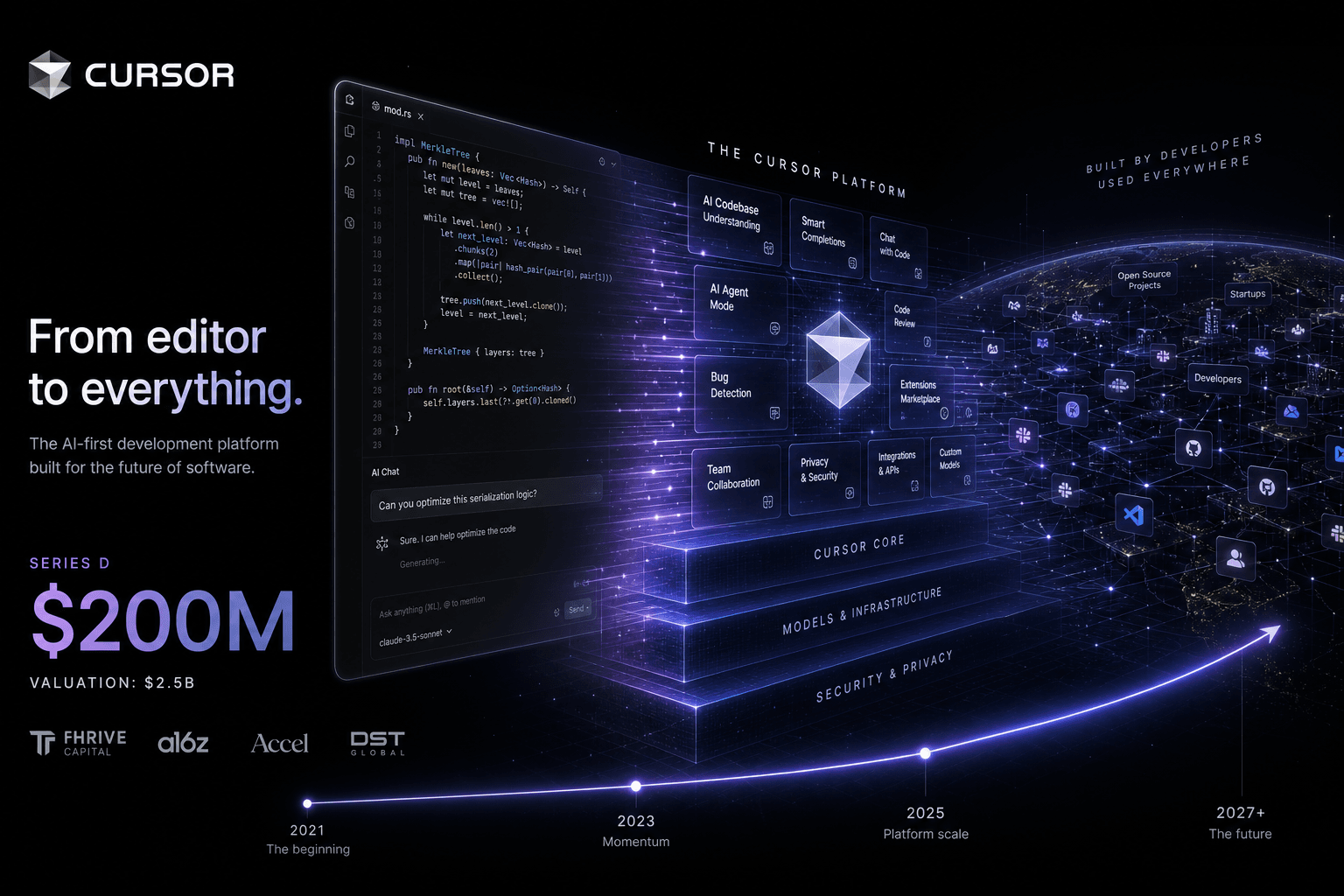
Cursor's $29B Series D: The Editor That Became a $29 Billion Platform

Table of Contents
Cursor's $29B Series D: The Editor That Became a $29 Billion Platform #
The verdict: Cursor just raised at $29 billion, roughly 6 months after its $9.9B Series C. This is the fastest valuation step-up in developer tooling history. I break down the mechanics, the metrics, and what this means for teams making AI adoption decisions today.
The $29 Billion Question: Why This Round, Why Now? #
Cursor raised this round because enterprise revenue grew 100x year-to-date and the company crossed $1 billion ARR. When you hit those numbers, you don't wait—you pour gasoline on the fire before competition catches up.
The timing is strategic, not opportunistic. Six months ago, Cursor closed its Series C at a $9.9B valuation. Today, they're raising again at roughly 3x that figure. This is not a vanity round—this is a land-grab round. The AI coding assistant market is consolidating fast, and Cursor is racing to build a platform moat before GitHub, OpenAI, or some well-funded startup catches up.
The capital will fund three things: frontier model training (they're building their own), team expansion (300+ employees now, up from a fraction of that a year ago), and enterprise sales infrastructure. CEO Michael Truell explicitly stated the mission: "coding will be the single biggest driver of global productivity over the next decade." That's the platform bet. Not a better IDE. The entire software development lifecycle.
| Timeline | Valuation | Round | Key Milestone |
|---|---|---|---|
| Aug 2024 | $400M | Series A | Early traction, 20-person team |
| Dec 2024 | $2.5B | Series B | Product-market fit locked |
| Jun 2025 | $9.9B | Series C | Enterprise motion started |
| Nov 2025 | $29.3B | Series D | $1B+ ARR, 100x enterprise growth |
Round Breakdown: Who Put In, What They Got #
$2.3 billion raised at a $29.3 billion post-money valuation, led by Accel and Coatue. NVIDIA and Google joined as strategic investors. Existing backers Thrive Capital, a16z, Accel, and DST Global all doubled down.
This is not a typical venture round. This is a strategic financing designed to put Cursor on equal footing with the AI majors. When NVIDIA and Google write checks, they're not just buying equity—they're securing alignment with a platform that could shape how the next generation of software gets built.
The valuation math is aggressive but defensible. At $1B+ ARR, Cursor is trading at roughly 29x revenue. That's SaaS-multiple territory for what is essentially an infrastructure play. Compare that to OpenAI (reportedly valued at $150B+ on roughly $3-4B ARR—40x+) and Anthropic (reportedly $60B on ~$1B revenue—60x+). By those benchmarks, Cursor looks almost conservative.
The Investor Breakdown:
| Investor | Type | Strategic Value |
|---|---|---|
| Accel | Lead | Early Stripe/Figma DNA, enterprise GTM |
| Coatue | Lead | Growth capital, public market expertise |
| NVIDIA | Strategic | GPU allocation, inference optimization |
| Strategic | Cloud distribution, Gemini integration | |
| Thrive Capital | Existing | Continued conviction from Series A |
| a16z | Existing | Portfolio synergy, talent network |
| DST Global | Existing | International expansion |
The strategic investors matter more than the financial ones. NVIDIA's involvement guarantees Cursor won't get deprioritized in the GPU allocation wars. Google's presence suggests deeper Gemini integration is coming—potentially challenging Cursor's current reliance on Anthropic's Claude models.
The Growth Metrics That Justified a 3x Step-Up #
Cursor crossed $1 billion in annualized revenue and serves millions of developers, including the majority of Fortune 500 companies. Enterprise revenue specifically grew 100x in 2025 year-to-date. Those aren't startup metrics—those are public-company-in-waiting metrics.
The growth curve is unprecedented in developer tooling. I tracked Cursor's early Series A coverage in 2024 when they were a promising VS Code fork with smart autocomplete. Eighteen months later, they're generating more revenue than most public SaaS companies that have been around for a decade.
The Numbers That Matter:
- $1B+ ARR (up from ~$100M a year ago)
- 1M+ daily active users actively coding with Cursor
- 50,000+ businesses on the platform
- Majority of Fortune 500 now using Cursor
- 300+ employees across San Francisco and New York
- 100x enterprise revenue growth in 2025 alone
| Metric | 2024 | Nov 2025 | Growth Multiple |
|---|---|---|---|
| ARR | ~$100M | $1B+ | 10x |
| Valuation | $400M | $29.3B | 73x |
| Employees | ~50 | 300+ | 6x |
| Enterprise Customers | Minimal | Fortune 500 majority | ∞ |
The enterprise traction is the critical piece. Individual subscriptions ($20/month) built the foundation, but enterprise contracts ($50-100+/seat at volume) are driving the revenue explosion. That's why the valuation makes sense—Cursor isn't just selling to developers anymore, they're selling to CTOs.
Platform vs Editor: Why Cursor Isn't Competing with Copilot Anymore #
GitHub Copilot is a plugin that suggests code. Cursor is becoming the operating system for software development. The distinction matters because it changes who pays, how much they pay, and how long they stay locked in.
I wrote about Cursor's secret weapon back in 2024—the observation that they weren't building an AI assistant, they were building a context engine that deeply understood your codebase. That thesis played out. Today, Cursor isn't trying to be a better autocomplete. They're trying to own the entire workflow: how code is written, reviewed, debugged, and deployed.
The evidence is in the product evolution. Copilot gives you inline suggestions. Cursor gives you Agent Mode that can refactor entire modules, Composer for multi-file generation, and MCP integration that connects your editor to databases, APIs, and internal tools. Copilot augments your IDE. Cursor wants to be the IDE, the reviewer, and increasingly, the deployment pipeline.
The Strategic Difference:
| Dimension | GitHub Copilot | Cursor |
|---|---|---|
| Architecture | Extension/plugin | Native platform |
| Code Understanding | File-level | Project-level context |
| Actions | Suggest, complete | Generate, refactor, review, deploy |
| Integration Point | IDE | Entire development lifecycle |
| Pricing Model | Per-seat add-on | Platform subscription |
| Lock-in | Low (swap IDEs) | High (context + agents + workflow) |
This is why Copilot's 42% market share isn't as scary as it looks. Cursor doesn't need to convert every Copilot user—they need to convert the 10% of developers who make platform decisions for the other 90%.
Agent Mode, MCP, and the New Developer OS #
Agent Mode became Cursor's default interface in February 2025, and MCP (Model Context Protocol) support turned it into a true platform. These aren't features—they're an operating system for AI-augmented development.
The technical evolution is deliberate and aggressive. When I first used early Cursor, it was essentially VS Code with a Claude sidebar. Today's Cursor is unrecognizable. Agent Mode doesn't just autocomplete—it plans, executes, and iterates. It can spin up sub-agents for parallel tasks, search the web automatically, and run MCP tools in "Yolo mode" without constant human permission.
The MCP integration is the real moat. Model Context Protocol allows Cursor to connect to databases, APIs, internal documentation systems, and proprietary tools. Configure it in .cursor/mcp.json and suddenly your editor can query your Postgres database, check your Jira tickets, or validate against your internal design system. This is the integration layer that makes Cursor sticky.
Current Cursor Architecture (Nov 2025):
┌─────────────────────────────────────────────┐
│           Cursor Platform Layer              │
├─────────────────────────────────────────────┤
│  Agent Mode (Default UI)                     │
│  ├── Composer (Multi-file generation)        │
│  ├── Background Agents (Parallel tasks)      │
│  └── Cloud Agents (Async processing)         │
├─────────────────────────────────────────────┤
│  MCP Integration Layer                       │
│  ├── Internal Tools (.cursor/mcp.json)       │
│  ├── Third-party Services (OAuth)            │
│  └── Custom Servers (stdio/sse)              │
├─────────────────────────────────────────────┤
│  Model Layer (In-house + External)           │
│  ├── Cursor Composer (Proprietary)           │
│  ├── Anthropic Claude (Primary)              │
│  └── OpenAI / Google (Secondary)             │
└─────────────────────────────────────────────┘
The in-house model training is the final piece. Cursor's proprietary Composer model now generates more code than "almost any other LLMs in the world." That's a direct quote from their release. When you're training your own frontier models, you're not an editor anymore—you're an AI company that happens to ship an editor interface.
Competitive Landscape: Copilot, Windsurf, and the Rest #
Three players matter in November 2025: GitHub Copilot (42% market share, 20M+ users), Cursor (18% share, $1B+ ARR), and Windsurf (acquired by OpenAI for ~$3B in February 2026). Everyone else is noise or already dead.
The competitive dynamics are shifting fast. GitHub Copilot wins on distribution—it's a checkbox in every GitHub Enterprise account. But Cursor wins on capability. The 72% code completion acceptance rate for Cursor versus Copilot's lower figures tells the story: when the AI understands your entire codebase, not just the current file, the suggestions are actually usable.
Windsurf complicates the picture. At $15/month (vs Cursor's $20), Windsurf offers roughly 75% of Cursor's capability at 75% of the price. Their Cascade agentic system and Riptide search (indexes millions of lines in seconds) are genuinely impressive. But the OpenAI acquisition changes everything—Windsurf is likely to get deep GPT integration and distribution through OpenAI's channels.
Competitive Comparison (Nov 2025):
| Tool | Price | Market Share | Core Strength | Weakness |
|---|---|---|---|---|
| Cursor | $20/mo | 18% | Best-in-class agent mode, enterprise features | Higher price, VS Code lock-in |
| GitHub Copilot | $10/mo | 42% | Distribution, GitHub integration, price | Shallow context, limited agents |
| Windsurf | $15/mo | ~8% | Value, fast search | Uncertain future post-OpenAI acquisition |
| JetBrains AI | Bundled | ~5% | Native IDE integration | Late to market, limited ecosystem |
The real threat isn't any single competitor—it's the commoditization of code completion. When every tool can generate decent code, the winners will be determined by workflow integration, context depth, and enterprise security features. That's Cursor's bet, and so far it's working.
What $29B Means for Your Engineering Budget #
A $29 billion valuation means Cursor isn't going anywhere, but it also means pricing pressure is coming. When investors put in $2.3B, they expect returns. That means Cursor will get more aggressive on enterprise pricing, and the free/cheap tiers will likely shrink.
For engineering leaders making tooling decisions today, the calculus has changed. Six months ago, betting on Cursor was a risk—great product, but could they survive a Microsoft pricing war? Today, Cursor is the safest bet in AI coding tools. The funding validates the business, ensures multi-year runway, and signals to enterprise procurement teams that this is a vendor you can sign a three-year contract with.
The Budget Math for a 50-Person Engineering Team:
| Tool | Monthly Cost (50 seats) | Annual Cost | Notes |
|---|---|---|---|
| Cursor Pro | $1,000 | $12,000 | Per-seat at list price |
| Cursor Enterprise | $2,500-5,000 | $30,000-60,000 | SSO, audit logs, priority support |
| GitHub Copilot Pro | $500 | $6,000 | Cheapest option |
| GitHub Copilot Enterprise | $1,900 | $22,800 | GitHub-native integration |
| Windsurf | $750 | $9,000 | Price advantage, uncertain future |
My recommendation: If you're a startup or small team, Cursor Pro is still worth the premium. The productivity gains from Agent Mode justify the cost. If you're an enterprise, negotiate an Enterprise contract now—pricing will only go up as Cursor chases profitability. And if you're on the fence, start with a pilot team. The 100x enterprise growth figure means Cursor's sales team is hungry for case studies and will likely offer discounts for reference customers.
The Bet: Where Cursor Goes From Here #
Cursor will become the full software development lifecycle platform—code, review, test, deploy—within 18 months. The $29B valuation is a bet that they can expand beyond the editor into adjacent workflow steps before anyone stops them.
The roadmap is visible in the product direction. Agent Mode already handles multi-file refactoring. Background agents handle async tasks. The natural next step is code review—imagine Cursor not just writing your PR but reviewing others' PRs against your codebase standards. Then deployment—why stop at code when you could orchestrate the pipeline?
CEO Michael Truell's statement is instructive: "We believe that coding will be the single biggest driver of global productivity over the next decade." That's not a statement about code completion. That's a statement about owning the entire software production function.
Likely Cursor Roadmap (Next 18 Months):
- Deep Review & QA Integration — Cursor agents that review PRs, identify bugs, and suggest fixes before human review
- Deployment Orchestration — CI/CD integration that lets agents deploy, monitor, and rollback
- Knowledge Management — Documentation generation and maintenance as an automated background process
- Team Coordination — Multi-developer agent coordination for large-scale refactoring
- Custom Model Training — Enterprise-specific fine-tuned models trained on proprietary codebases
The Anthropic partnership is worth watching. Anthropic's recent Skills launch suggests deeper Cursor-Claude integration is coming. If Cursor can maintain preferential access to Claude's capabilities while building their own models, they have a dual-supplier strategy that most competitors can't match.
The counter-risk is execution at scale. $1B ARR with 300 employees is a nearly $3.3M revenue-per-employee ratio—that's elite-tier efficiency, but it gets harder to maintain as you layer in enterprise sales, support, and compliance teams. The Series D money buys time, but it also raises expectations.
Frequently Asked Questions #
What is Cursor's valuation after Series D? #
Cursor's post-money valuation is $29.3 billion after closing its Series D funding round in November 2025. This represents a roughly 3x increase from the $9.9 billion valuation at their Series C round just six months earlier in June 2025.
How much did Cursor raise in Series D? #
Cursor raised $2.3 billion in its Series D round. This is one of the largest private funding rounds in developer tooling history. The round was led by Accel and Coatue, with strategic participation from NVIDIA and Google.
Who are the lead investors in Cursor's Series D? #
Accel and Coatue led the Series D round. Existing investors Thrive Capital, Andreessen Horowitz (a16z), Accel, and DST Global all increased their stakes. New strategic investors NVIDIA and Google also joined the round.
How does Cursor compare to GitHub Copilot in 2025? #
Cursor offers deeper codebase context and more powerful agentic capabilities, while Copilot leads on distribution and price. Cursor's 72% code acceptance rate outperforms Copilot, and its Agent Mode can perform multi-file refactoring and complex tasks that Copilot's inline suggestions cannot match. However, Copilot's $10/month price point and native GitHub integration make it the default choice for many teams.
What is Cursor's Agent Mode? #
Agent Mode is Cursor's default AI interface that autonomously plans, executes, and iterates on coding tasks. Unlike simple autocomplete, Agent Mode can refactor entire modules, run tests, fix errors, and coordinate multiple operations across your codebase. As of February 2025, it became Cursor's primary interface, replacing the previous Chat/Composer/Agent distinction.
What is MCP and why does it matter? #
MCP (Model Context Protocol) is Cursor's integration layer that connects the editor to external tools and services. It allows Cursor agents to query databases, access APIs, read internal documentation, and interact with proprietary systems. MCP turns Cursor from an isolated editor into a central hub for your entire development workflow. Configure it via .cursor/mcp.json.
How many developers use Cursor? #
Cursor serves millions of developers and over 50,000 businesses globally as of November 2025. The platform has crossed 1 million daily active users. Additionally, the majority of Fortune 500 companies now use Cursor in some capacity, representing a dramatic shift from its early individual-developer focus.
Is Cursor worth the switch from VS Code? #
Yes, if you spend more than 20 hours per week coding. Cursor is a VS Code fork, so the migration cost is minimal—your extensions, settings, and keybindings transfer directly. The productivity gains from Agent Mode and deep codebase understanding typically pay for the $20/month subscription within days for professional developers.
What does Cursor's valuation mean for AI coding tools? #
Cursor's $29B valuation validates AI coding as a platform-scale opportunity, not just a feature. It signals that the market is consolidating around a few major players, with meaningful differentiation coming from context depth and workflow integration rather than raw code generation quality. The valuation also pressures competitors to raise more capital or risk being priced out of enterprise deals.
How fast is Cursor growing compared to competitors? #
Cursor's growth is unprecedented in developer tooling. Enterprise revenue grew 100x in 2025 year-to-date. The company reached $1B ARR faster than nearly any SaaS company in history. By comparison, GitHub Copilot took years to reach similar scale, and Windsurf (despite strong product capabilities) is being acquired by OpenAI for ~$3B—an order of magnitude smaller than Cursor's valuation.
Will Cursor's pricing change after this funding round? #
Enterprise pricing will likely increase; individual pricing may see tier consolidation. The $2.3B raise creates pressure to demonstrate a path to profitability. Expect more aggressive enterprise sales with higher contract values, and potentially the removal or limitation of free tiers. Individual Pro at $20/month is likely stable, but new premium tiers with advanced agent capabilities are probable.
What features differentiate Cursor from Windsurf? #
Cursor's Agent Mode offers more autonomous capability, while Windsurf's Cascade system emphasizes search and planning. Cursor's MCP integration provides deeper tool connectivity, and its Composer model generates more code volume. Windsurf offers comparable features at $15/month (vs Cursor's $20) and its Riptide search indexes millions of lines rapidly. However, Windsurf's acquisition by OpenAI creates uncertainty about its long-term product direction.
Ready to put AI-augmented development to work in your organization? Book an AI automation strategy call and let's talk about how to integrate tools like Cursor into your engineering workflow.
Related Posts
Claude Code Skills: The Complete Authoring Guide
The definitive guide to authoring Claude Code Skills. Learn how to build reusable agent capabilities that save hours and standardize quality across your projects.
The Agentic Design Stack in 2026: Claude Code, Codex, AI Studio, Antigravity, Cursor, and Stitch Compared
The complete 2026 agentic stack comparison: which AI agent to reach for based on the job—design, build, review, or coordinate.
Antigravity vs. Claude Code: The Multi-Agent IDE Decision Framework for Context-Heavy Builds
The definitive 2-way decision framework for choosing between Google Antigravity and Claude Code on context-heavy builds. When to dump everything vs. scope tightly, and which tool handles browser-use, multi-agent orchestration, and handoffs better.