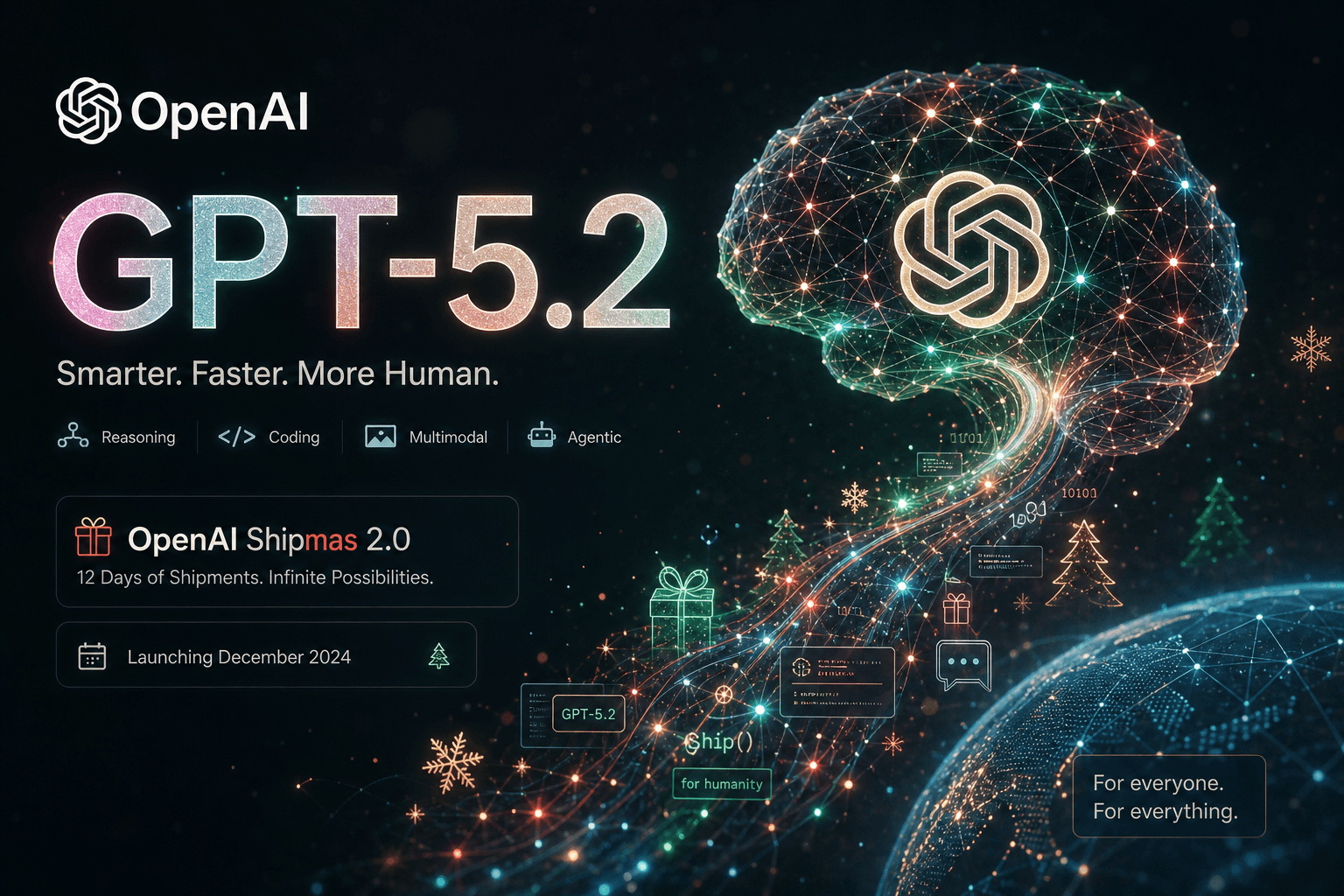
GPT-5.2 + Shipmas 2.0: OpenAI's December Offensive Begins

Table of Contents
GPT-5.2 + Shipmas 2.0: OpenAI's December Offensive Begins #
The takeaway: OpenAI is running a second consecutive December announcement marathon—Shipmas 2.0—and GPT-5.2 is the headline act. Three model variants (Instant, Thinking, Pro), a 400K token context window, and API pricing at $1.75/$14 per million tokens. The model is rolling out to paid ChatGPT users this week, and the API is live today.
This launch represents more than a version bump. OpenAI has restructured its model lineup around three distinct capability tiers, expanded context windows to 400K tokens, and delivered measurable improvements in hallucination reduction that shift the risk calculus for production deployments. The GDPval benchmark—testing performance against human professionals across 44 occupations—signals OpenAI's intent: this model is designed for economically valuable work, not just benchmark supremacy.
What OpenAI Is Shipping This December #
OpenAI is reprising its "12 Days of OpenAI" format from last December, and the community has already dubbed it "Shipmas 2.0." This week marks the start of a concentrated daily announcement cycle that compresses what would normally be months of releases into a tight December window.
The timing is not subtle. Anthropic's Claude Sonnet 4.5 and Sora 2 dropped in September, and Google has Gemini 3 Pro circulating in preview. OpenAI needs to reclaim the narrative momentum, and Shipmas 2.0 is the delivery mechanism.
Sam Altman confirmed the format in a post this morning: daily livestreams at 10 AM PT, each revealing "something people have asked for." The first drops today. GPT-5.2 is the anchor, but expect adjacent product announcements—ChatGPT interface updates, new enterprise tiers, and potential Codex refinements built specifically for the new model architecture.
The "something people have asked for" framing is telling. It positions OpenAI as responsive to user needs rather than pushing technology for its own sake. This is a deliberate narrative choice that contrasts with criticism the company has faced for being research-driven rather than user-focused.
This is OpenAI's most aggressive end-of-year push yet. The company is clearly betting that a dense release schedule keeps competitors reactive and keeps the developer community locked into the OpenAI ecosystem through the holiday cycle.
The Shipmas format serves multiple strategic functions. First, it creates sustained media coverage over an extended period, ensuring OpenAI dominates industry conversations through the end of the year. Second, it allows OpenAI to sequence announcements strategically, building momentum and anticipation. Third, it establishes a competitive rhythm that competitors struggle to match—few organizations can sustain a daily announcement cadence.
The timing also reflects competitive pressure. Since the August launch of GPT-5, Anthropic has released Claude Sonnet 4.5 to strong reception in the enterprise market. Google's Gemini 3 Pro has gained traction among developers already committed to the Google Cloud ecosystem. OpenAI needs to demonstrate that its models maintain leadership not just in benchmarks but in practical utility for paying customers.
Shipmas 2.0 serves another purpose: it creates narrative momentum that extends through the end of the year. In the technology industry, December is when many organizations finalize budgets and technology roadmaps for the coming year. By dominating the news cycle through this period, OpenAI positions itself favorably for 2026 procurement decisions.
GPT-5.2 Model Specs and Improvements #
GPT-5.2 is OpenAI's most capable frontier model series yet, purpose-built for professional knowledge work and long-running agentic workflows. The headline numbers are substantial: 70.9% on GDPval (beating or tying industry professionals across 44 occupations), 100% on AIME 2025 competition math, and 55.6% on SWE-Bench Pro for real-world software engineering tasks.
The jump from GPT-5.1 is measurable across every dimension. On SWE-bench Verified, GPT-5.2 Thinking hits 80% versus GPT-5.1's 76.3%. On GPQA Diamond graduate-level science questions, it reaches 92.4% versus 88.1%. Even on FrontierMath's expert-tier mathematics problems, GPT-5.2 Thinking solves 40.3% of Tier 1-3 problems—a new state of the art.
For enterprise users, the efficiency gains matter as much as the raw capability. GPT-5.2 Thinking produces GDPval task outputs at over 11x the speed and less than 1% the cost of expert professionals. That is not marketing math; that is a structural shift in how knowledge work gets priced.
The model also cuts hallucination rates meaningfully. On de-identified ChatGPT queries, responses with errors are 30% less common compared to GPT-5.1 Thinking. For production use cases where accuracy directly impacts revenue or compliance, that delta is the difference between "experimental" and "deployed."
Additional improvements include better formatting for professional deliverables. GPT-5.2 Thinking produces spreadsheets and presentations with layout and design sophistication that approaches professional work product. In side-by-side comparisons, workforce planning models and financial analyses show cleaner structure, proper formatting, and more intuitive visual organization than GPT-5.1 outputs.
The Three Variants: Instant, Thinking, and Pro #
OpenAI is releasing GPT-5.2 in three distinct flavors, each targeting a different use case and latency budget.
GPT-5.2 Instant is the fast, efficient workhorse. It carries clear improvements in info-seeking queries, technical writing, translation, and conversational tasks. OpenAI has tuned it for warmer, clearer explanations that surface key information upfront. This is the default for everyday work and learning—less reasoning overhead, lower latency, lower cost.
GPT-5.2 Thinking is the deep-work variant. It handles complex coding, long-document analysis, multi-step math and logic, and planning tasks with structured outputs. Early testers note it feels "more reliable" for production software engineering and agentic workflows. The model also introduces a fifth reasoning effort tier—"xhigh"—for tasks where quality is worth the wait.
GPT-5.2 Pro is the flagship. It achieves 93.2% on GPQA Diamond (besting Thinking's 92.4%), 90.5% on ARC-AGI-1, and 54.2% on ARC-AGI-2. OpenAI positions this as the "smartest and most trustworthy option for difficult questions." The tradeoff is pricing: $21 per million input tokens, $168 per million output tokens. This is not a model you fire for autocomplete. This is a model you fire for hedge fund analysis, drug discovery hypotheses, and architectural decisions that ship to production.
The Pro variant also supports the xhigh reasoning effort tier, providing maximum computational depth for tasks where failure is expensive. On the internal investment banking analyst benchmark—tasks like building three-statement models for Fortune 500 companies or leveraged buyout models for take-private transactions—Pro achieves 71.7% versus Thinking's 68.4%.
For organizations making high-stakes decisions, the Pro pricing is defensible. A $168 per million output tokens rate translates to roughly $0.000168 per token. When the alternative is billable hours from specialized consultants at hundreds of dollars per hour, the model pays for itself on single complex analyses.
| Variant | Input Price | Output Price | Best For |
|---|---|---|---|
| Instant | $1.75/1M | $14/1M | Everyday tasks, chat, quick queries |
| Thinking | $1.75/1M | $14/1M | Coding, analysis, complex reasoning |
| Pro | $21/1M | $168/1M | Scientific work, highest-stakes decisions |
Model selection should reflect task economics. For high-volume, low-complexity applications—customer support triage, content categorization, simple data extraction—Instant delivers sufficient capability at lower cost. For professional services work where quality directly impacts revenue, Thinking provides the right balance of capability and cost. Pro should be reserved for situations where errors carry existential risk—medical diagnoses, financial compliance, safety-critical engineering.
The knowledge cutoff is August 31, 2025, meaning the model includes relatively recent information. Combined with the improved search and browsing capabilities announced earlier this year, GPT-5.2 can access current information when needed while maintaining the reasoning advantages of its training.
Context Window and Long-Context Breakthroughs #
The GPT-5.2 series ships with a 400,000 token context window and 128,000 token max output. Those are the headline specs, but the real breakthrough is accuracy at scale.
On OpenAI's MRCRv2 (Multi-Round Coreference Resolution) benchmark, GPT-5.2 Thinking achieves near 100% accuracy on the 4-needle variant out to 256,000 tokens. This is the first model from OpenAI that maintains coherence across document-length contexts without the typical degradation curve. For legal contract review, research paper synthesis, multi-file codebase analysis, and long-transcript workflows, this is the difference between usable and theoretical.
Previous models suffered from the "needle in a haystack" problem—when asked to recall specific information from the middle of a long context, accuracy would drop substantially. GPT-5.2's MRCRv2 performance demonstrates that this degradation has been largely solved. The model can integrate information spread across hundreds of thousands of tokens with near-perfect accuracy.
The model also integrates with OpenAI's new responses/compact endpoint, which extends the effective context window for tool-heavy, long-running workflows. If you are building agents that chain multiple tool calls over extended sessions, this endpoint prevents the context truncation that previously forced complex state management.
For developers working with large codebases, financial models, or multi-document RAG pipelines, the combination of 400K context and maintained accuracy means fewer chunking hacks and more direct processing. Triple Whale, one of OpenAI's early testers, reports collapsing a multi-agent system into a single "mega-agent" with 20+ tools using GPT-5.2. The context handling was the enabler.
The practical impact of this long-context capability extends to RAG architectures. Traditional RAG systems chunk documents into small segments, embed them, then retrieve relevant chunks for each query. This works but loses document-level context and cross-reference awareness. GPT-5.2's 400K window allows more documents to be processed in their entirety, reducing the complexity of retrieval pipelines while improving comprehension of document relationships and structure.
For financial analysis, this means feeding entire 10-K filings, analyst reports, and market data into a single context window for comprehensive analysis. For legal work, it means processing complete contract suites with all exhibits and schedules intact. For research, it means analyzing multiple papers simultaneously to identify cross-cutting themes and contradictions.
Pricing Changes and API Updates #
GPT-5.2 Instant and Thinking are priced at $1.75 per million input tokens and $14 per million output tokens. That is a 40% increase over GPT-5.1's $1.25/$10 pricing. The bet OpenAI is making: the improved token efficiency and higher success rates on first-pass completions will offset the per-token premium.
The math holds on agentic benchmarks. Despite higher per-token costs, the total cost to achieve a given quality threshold ends up lower because GPT-5.2 requires fewer completion attempts and less error recovery.
Cached inputs receive a 90% discount—$0.175 per million tokens. For applications with repetitive context (customer support playbooks, legal templates, code review guidelines), this is where the cost optimization lives.
GPT-5.2 Pro carries flagship pricing at $21/$168 per million tokens. This is explicitly positioned above the standard tier and below the cost of equivalent human expertise for the tasks it targets.
Key API Changes:
- GPT-5.2 Thinking is available in the Responses API as
gpt-5.2and in Chat Completions asgpt-5.2 - GPT-5.2 Instant is available as
gpt-5.2-chat-latestin both APIs - GPT-5.2 Pro is Responses API only, as
gpt-5.2-pro - Both Thinking and Pro support the new
xhighreasoning effort level - The
responses/compactendpoint is live for context window extension
OpenAI has confirmed no deprecation timeline for GPT-5.1 or GPT-5 in the API. GPT-5.1 will remain available in ChatGPT for three months under legacy models, then sunset.
For teams managing cost at scale, the pricing structure rewards optimization. Applications that can cache repetitive context—support ticket templates, legal contract clauses, standard code review checklists—will see substantial savings. The 90% discount on cached inputs drops effective costs below GPT-5.1 levels for workloads with stable context patterns.
Developer feedback on the new Responses API has been positive. The unified interface simplifies tool calling and reduces the boilerplate required for agentic workflows. The responses/compact endpoint specifically addresses a pain point that previously forced developers to implement complex state management for long-running conversations.
Shipmas 2.0: The Daily Announcement Schedule #
OpenAI is running 12 consecutive business days of announcements starting this week. The format mirrors last December's "12 Days of OpenAI" structure: daily 10 AM PT livestreams, product drops, and API rollouts. The format proved effective in 2024—compressing months of announcements into a concentrated window that dominates industry attention and forces competitors into reactive mode.
The strategic value of this approach is threefold. First, it creates sustained media coverage over a multi-week period rather than a single announcement spike. Second, it allows OpenAI to sequence releases strategically—leading with its strongest product (GPT-5.2) and following with adjacent features that extend its utility. Third, it locks developer attention through the end of the year, making it harder for competitors to gain traction during the critical technology planning season.
For the developer community, Shipmas 2.0 creates both opportunity and pressure. Opportunity in the form of new capabilities to build against; pressure in the form of rapid change that requires continuous adaptation. Teams that can quickly evaluate and integrate new features will gain competitive advantage. Teams that move slowly may find themselves building on deprecated patterns.
The daily announcement format also creates information management challenges. Following 12 days of releases requires sustained attention. OpenAI's documentation team faces the challenge of keeping API references and integration guides current in real-time. For busy developers, digesting this volume of information requires discipline.
GPT-5.2 is the first-day headliner, but the schedule is expected to include:
- ChatGPT interface updates — Projects and canvas improvements teased in earlier roadmap posts
- New enterprise tiers — Enhanced admin controls and audit logging for regulated industries
- Realtime API enhancements — Lower latency voice and multi-modal streaming
- Codex refinements — A GPT-5.2-optimized version of the coding agent
- Safety and alignment updates — The new "deliberative alignment" framework for reasoning models
The community has labeled this "Shipmas 2.0" in reference to the 2024 event that delivered o1, Sora, reinforcement fine-tuning, and the 1-800-CHATGPT phone service. The density of announcements serves multiple purposes: it dominates AI news cycles during a competitive period, it gives developers a concentrated window to plan 2026 roadmaps, and it forces competitors into reactive mode.
Altman's framing is deliberate: "something people have asked for" each day. This positions the releases as responsive rather than speculative—user-driven product development rather than technology in search of a problem.
The competitive context matters. Last year's Shipmas established OpenAI's dominance through the holiday season. Anthropic and Google both had competitive models in development, but the concentrated release schedule kept them from gaining comparable mindshare. Shipmas 2.0 repeats the playbook, this time against stronger competition. Claude Sonnet 4.5 and Gemini 3 Pro are already in market, so OpenAI needs to demonstrate clear differentiation rather than simply being first.
The community response has been immediate. Within hours of the announcement, developers were testing GPT-5.2 against their existing benchmarks and sharing results on social platforms. Early reports confirm the long-context improvements are real and substantial. The comparison discussions with Claude Sonnet 4.5 have already begun, with users debating the tradeoffs between Anthropic's safety focus and OpenAI's professional utility emphasis.
The framing battle will continue through the announcement period. Each vendor will emphasize their strengths—Anthropic on safety and steerability, Google on integration and scale, OpenAI on professional work product quality. For buyers, this competition drives capability improvements and cost reductions across the board.
GPT-5.2 vs Claude Sonnet 4.5 vs Gemini 3 Pro #
The frontier model competition is now a three-way race with distinct positioning.
Claude Sonnet 4.5 (released September 2025) set the bar for reasoning and safety. Anthropic's model leads on some agentic benchmarks and maintains the company's emphasis on steerability and reduced hallucination. Claude's 200K context window and Constitutional AI training give it an edge in applications where explainability matters. Sonnet 4.5 is positioned as the reliable workhorse for enterprises with strong safety requirements.
Gemini 3 Pro (Google, previewed Fall 2025) leverages Google's infrastructure and multimodal depth. It integrates tightly with Google Workspace, Search, and Cloud. The model shows strength in multimodal reasoning and long-context tasks, with a 2 million token context window that outstrips both competitors on raw capacity.
GPT-5.2 anchors on professional utility. The GDPval benchmark—testing real knowledge work across 44 occupations—is the clearest differentiator. OpenAI is not claiming superiority on every dimension; it is claiming superiority on economically valuable tasks.
| Model | GDPval | SWE-Bench Verified | GPQA Diamond | Context Window |
|---|---|---|---|---|
| GPT-5.2 Thinking | 70.9% | 80.0% | 92.4% | 400K |
| Claude Sonnet 4.5 | ~65%* | 76.0%* | 91.0%* | 200K |
| Gemini 3 Pro | ~62%* | 78.0%* | 89.5%* | 2M |
*Estimated based on published benchmarks and third-party evaluations
The strategic positioning here matters. Anthropic has built a reputation around safety and steerability—Claude is the model you choose when you need predictable outputs and constitutional alignment. Google has scale and integration—Gemini is the model you choose when you are already in the Google ecosystem and need multimodal breadth. OpenAI is now anchoring on economic value—GPT-5.2 is the model you choose when you need professional-grade work product delivered at fractional cost.
This segmentation is healthy for the market. It means buyers can make decisions based on actual requirements rather than chasing a single "best" model. For complex reasoning with safety constraints, Claude remains compelling. For multimodal workflows inside Google Workspace, Gemini makes sense. For professional knowledge work at enterprise scale, GPT-5.2 has the edge.
The price-performance tradeoffs also differ. GPT-5.2's three-tier structure offers more granular cost control than Claude's current lineup. Gemini 3 Pro, still in preview, hasn't finalized pricing. For cost-conscious organizations, this transparency matters—knowing exact per-token rates enables accurate budget forecasting.
Enterprise procurement teams now face a genuine choice rather than a default. Each model family has valid claims to leadership in specific domains. The decision requires mapping actual use cases against demonstrated capabilities rather than relying on brand recognition or benchmark leaderboards.
Coding and Software Engineering Benchmarks #
GPT-5.2 Thinking establishes a new state of the art on software engineering evaluations. SWE-Bench Pro—a contamination-resistant benchmark testing four languages and real-world repository tasks—comes in at 55.6%. SWE-bench Verified hits 80%.
The practical translation: GPT-5.2 can debug production code, implement feature requests across large codebases, and ship fixes with less manual intervention than previous models. Early testers report particular strength on front-end development and unconventional UI work, including 3D elements.
Windsurf CEO Jeff Wang is direct: "GPT-5.2 represents the biggest leap for GPT models in agentic coding since GPT-5. The version bump undersells the jump in intelligence."
The significance of this assessment shouldn't be understated. Windsurf has visibility into how models perform across thousands of real developer workflows. Their evaluation includes not just benchmark scores but actual user satisfaction, task completion rates, and error recovery patterns. When they describe GPT-5.2 as the biggest leap since GPT-5, they're speaking from production data.
For SWE-Lancer Diamond-tier tasks—complex software engineering contracts—GPT-5.2 Thinking scores 74.6%, up from GPT-5.1's 69.7%. This is the tier that translates most directly to real freelance engineering work.
The model also excels at code review and bug finding. Cognition, Warp, JetBrains, and Augment Code have all integrated GPT-5.2 as a default for agentic coding workflows.
What distinguishes GPT-5.2 in production coding environments is reliability across longer contexts. Previous models would degrade when working with large repositories or extended files. GPT-5.2 maintains coherence across multi-file projects, making it suitable for architectural refactoring and cross-module changes that require understanding relationships across the entire codebase.
Early developer reports suggest GPT-5.2 is particularly effective at interactive coding—scenarios where the developer and model are iterating together on a problem. The model's ability to maintain context across multiple turns of refinement, accepting feedback and adjusting output accordingly, makes it feel more like a pair programming partner than a code generator.
The front-end development improvements deserve specific mention. GPT-5.2 demonstrates particular strength in creating complex user interfaces, including 3D elements and unconventional layouts. OpenAI's examples include interactive simulations—ocean wave generators, physics demonstrations, data visualizations—generated from single prompts with functional interactivity. This extends the model's utility beyond back-end logic to full-stack prototyping.
Code review workflows also benefit. The model can analyze pull requests across multiple files, identifying not just syntax issues but architectural concerns, potential performance bottlenecks, and security considerations. For teams conducting code review at scale, this capability reduces the burden on senior engineers while maintaining quality standards.
Vision, Tool Calling, and Agent Capabilities #
GPT-5.2 Thinking cuts vision error rates roughly in half on chart reasoning and software interface understanding. CharXiv Reasoning (scientific figures) hits 88.7% with Python tooling enabled. ScreenSpot-Pro (GUI understanding) reaches 86.3%.
For enterprise workflows—analyzing dashboards, interpreting product screenshots, processing technical diagrams—this level of visual reasoning eliminates the brittle OCR-and-parse pipelines that previously bridged text models to visual data.
Tool calling reaches 98.7% on Tau2-bench Telecom, a multi-turn customer support simulation requiring coordination across multiple systems. For latency-sensitive applications, GPT-5.2 Thinking also performs substantially better at reasoning_effort='none' than GPT-5.1. This means the same model that excels at complex reasoning can also serve quick queries without the latency overhead typically associated with capable models. The tunable reasoning parameter becomes a runtime optimization lever rather than a static architectural choice.
Vision capabilities extend to video understanding as well. Video MMMU scores reach 85.9% without tools, enabling analysis of video content for training, documentation, and monitoring use cases. MMMU Pro scores 80.4% with Python tooling on multimodal reasoning tasks.
The agent implications are significant. GPT-5.2 can coordinate longer workflows with fewer breakdowns between steps. The example OpenAI demos: a complex airline customer service scenario involving flight delays, missed connections, lost baggage, overnight accommodations, and medical seating requirements—all resolved in a single coordinated chain rather than fragmented handoffs.
Scale MCP-Atlas testing shows 60.6% on multi-tool agentic tasks. Toolathlon scores 46.3%. These are not laboratory benchmarks; they measure real agentic performance across extended interactions.
The agentic implications extend beyond individual tool use to orchestration. GPT-5.2 can coordinate multiple tools in sequence, maintaining state and context across extended workflows. The airline customer service example—handling rebooking, special assistance, and compensation in a single coordinated chain—demonstrates the level of complexity that becomes tractable.
For enterprises building internal agents, this reduces the orchestration layer complexity. Where previous implementations required custom state machines and error recovery logic to handle multi-step processes, GPT-5.2 can maintain coherence through longer sequences with fewer handoff failures. This translates directly to reduced development time and more reliable production behavior.
What This Means for Enterprises #
For enterprises already running AI-assisted workflows, GPT-5.2 represents a capability unlock and a pricing recalculation.
The 400K context window and maintained accuracy at scale means document-heavy industries—legal, financial services, healthcare, insurance—can process entire contracts, portfolios, or patient records without chunking and reassembly. The reduction in pipeline complexity alone justifies evaluation.
Consider the implications for legal review. A typical M&A contract package might run 100,000 to 300,000 tokens when including exhibits and schedules. Previous models required chunking into sections, analyzing each independently, then synthesizing findings—introducing both pipeline complexity and potential loss of cross-reference coherence. GPT-5.2 can process the entire package in context, maintaining awareness of definitions, cross-references, and interdependencies across the full document set.
Healthcare organizations face similar challenges with patient records spanning years of treatment history. Insurance companies review claims files that include medical reports, policy documents, and correspondence. Financial services firms analyze portfolio holdings across thousands of positions with complex relationships. All of these workflows benefit from the 400K context capability.
The GDPval results signal something more significant: GPT-5.2 performs economically valuable knowledge work at professional grade. The 70.9% win/tie rate against industry experts across 44 occupations suggests that paired with appropriate human oversight, the model can deliver client-facing work product—presentations, spreadsheets, analyses, memos—that meets professional standards.
This is a threshold moment for AI adoption in professional services. Previous models were useful for drafting and ideation, but required substantial human revision before client delivery. GPT-5.2's GDPval performance suggests that for a significant subset of professional tasks, the model can produce deliverables that require only review and minor correction rather than substantial rewriting. The efficiency implications are substantial.
Consider a management consulting engagement. The typical workflow involves data gathering, analysis, synthesis, and presentation development. GPT-5.2 can handle significant portions of the synthesis and presentation work—creating structured analyses, building formatted spreadsheets with proper formulas, and generating slide decks with coherent narratives. The human role shifts from creator to reviewer and strategist.
The same pattern applies across professional services. Legal research assistants can use GPT-5.2 to analyze case law and draft preliminary memos. Financial analysts can generate initial valuation models and sensitivity analyses. Marketing strategists can produce competitive landscape assessments and campaign briefs. In each case, the model accelerates the initial work while humans focus on verification, customization, and client presentation.
The 30% reduction in hallucination rates shifts the risk calculus for customer-facing and regulated use cases. Where GPT-5.1 required heavier guardrails and verification layers, GPT-5.2 reduces the overhead of error correction.
This reduction has immediate practical impact. In regulated industries—healthcare, finance, legal—error rates directly correlate with compliance risk and liability exposure. A 30% reduction doesn't just improve user experience; it potentially changes regulatory posture and insurance considerations. Organizations that previously deemed AI-generated content too risky for direct customer communication may find GPT-5.2 meets their risk thresholds.
The safety improvements extend beyond hallucination reduction. GPT-5.2 shows improved handling of sensitive conversations, particularly around mental health and self-harm. The model's responses in these contexts are more appropriate and helpful, reflecting OpenAI's continued investment in safety research. For healthcare applications and crisis support systems, this capability is essential.
For developers, the API availability today means immediate prototyping. The three-variant structure (Instant, Thinking, Pro) lets teams match model capability to task criticality rather than over-provisioning expensive compute for simple queries.
Migration planning should consider token usage patterns. Applications with stable context—customer support systems processing similar ticket types, legal tools reviewing standard contract forms, code review systems checking against established style guides—will benefit most from the cached input pricing. Applications with highly variable context may see higher effective costs despite the improved efficiency.
Enterprises should evaluate GPT-5.2 first on long-context workflows and second on agentic pipelines requiring multi-step reasoning. These are the capabilities where the delta over GPT-5.1 is largest and where the business value is most defensible.
Implementation planning should account for the three-tier structure. Not every query needs Thinking or Pro. Instant handles a surprising breadth of tasks at lower cost and latency. Smart routing—analyzing query complexity and dispatching to the appropriate tier—will separate efficient implementations from expensive ones.
A typical routing strategy might look like this: Instant for greetings, simple queries, and factual lookups under 100 tokens. Thinking for coding requests, analysis tasks, document processing, and anything requiring reasoning. Pro only for tasks where errors carry significant cost—financial modeling, legal analysis, medical recommendations, architectural decisions.
Cost estimation at scale requires modeling your specific workload distribution. If 80% of queries can be handled by Instant, 15% require Thinking, and 5% need Pro, blended costs remain reasonable even with the higher per-token rates for capable tiers. The key is accurate classification—misrouting complex work to Instant generates errors; misrouting simple work to Pro wastes budget.
For compliance-sensitive industries, OpenAI has updated its safety framework. GPT-5.2 builds on the "safe completion" research introduced with GPT-5, teaching the model to give helpful answers while maintaining boundaries. Specific improvements address responses to sensitive conversations around mental health and self-harm. The system card details these interventions for organizations conducting their own safety reviews.
The age prediction model mentioned in OpenAI's safety documentation is also beginning rollout, enabling automatic application of content protections for users under 18. This extends existing parental controls and age verification systems, creating additional safeguards for younger users.
Organizations evaluating GPT-5.2 for sensitive applications should review the updated system card alongside their own risk assessments. The improvements are substantial, but no model is perfect—appropriate human oversight remains essential for critical decisions.
FAQ: GPT-5.2 and Shipmas 2.0 #
What is GPT-5.2? #
GPT-5.2 is OpenAI's latest frontier model series, announced today as part of Shipmas 2.0. It comes in three variants—Instant, Thinking, and Pro—and sets new state-of-the-art benchmarks on professional knowledge work, coding, and long-context reasoning.
When is GPT-5.2 being released? #
The API is live today. ChatGPT rollout begins this week for Plus, Pro, Go, Business, and Enterprise users. OpenAI deploys gradually, so if you do not see it immediately, it will appear within days.
What are the different GPT-5.2 variants? #
- Instant: Fast, efficient everyday workhorse for chat, queries, and writing
- Thinking: Deep reasoning for coding, analysis, and complex problem-solving
- Pro: Flagship model for highest-stakes scientific and professional work
How much does GPT-5.2 cost? #
Instant and Thinking: $1.75/1M input tokens, $14/1M output tokens. Pro: $21/1M input, $168/1M output. Cached inputs receive a 90% discount at $0.175/1M tokens.
What is the GPT-5.2 context window? #
400,000 tokens input, 128,000 tokens output. The model maintains near-perfect accuracy on 4-needle recall tasks out to 256K tokens—a significant improvement over previous models.
What is Shipmas 2.0? #
The community nickname for OpenAI's December 2025 announcement series—12 consecutive business days of product launches and updates, following the format of the 2024 "12 Days of OpenAI" event.
How does GPT-5.2 compare to GPT-5.1? #
GPT-5.2 improves across every benchmark: 80% vs 76.3% on SWE-bench Verified, 92.4% vs 88.1% on GPQA Diamond, 30% fewer hallucinations. It also adds a 400K context window and a fifth reasoning effort tier (xhigh).
Is GPT-5.2 available in the API? #
Yes. All three variants are available today: gpt-5.2 and gpt-5.2-chat-latest in Chat Completions and Responses APIs, gpt-5.2-pro in Responses API only.
Migration from GPT-5.1 is straightforward—the API parameters remain consistent, so existing code requires minimal changes. The main decision is which variant to route traffic to. Most applications should start with Thinking and fall back to Instant for high-volume, low-complexity queries. Pro should be reserved for specific high-stakes operations.
What benchmarks does GPT-5.2 lead on? #
State-of-the-art on GDPval (70.9%), AIME 2025 (100%), SWE-bench Verified (80%), GPQA Diamond (92.4%), and multiple long-context and vision evaluations. See the benchmark tables in the model specs section above.
Additional notable benchmarks include FrontierMath where GPT-5.2 Thinking achieves 40.3% on expert-level mathematics problems, and ARC-AGI-2 where it reaches 52.9%—the first chain-of-thought model to cross the 50% threshold on this fluid reasoning benchmark.
BrowseComp scores of 65.8% demonstrate strong capability in complex information retrieval and synthesis tasks requiring multiple search steps. Scale MCP-Atlas at 60.6% shows real-world agentic performance with multiple tools. These compound benchmarks measure capabilities closer to actual use cases than single-skill evaluations.
Does GPT-5.2 support vision and image input? #
Yes. GPT-5.2 Thinking achieves 88.7% on CharXiv reasoning and 86.3% on ScreenSpot-Pro—roughly halving error rates on chart and GUI understanding compared to GPT-5.1.
What is reasoning effort in GPT-5.2? #
A tunable parameter controlling how much compute the model applies to a task. Options: none, low, medium, high, and the new xhigh tier. Higher effort yields better results on complex tasks at increased latency and cost.
For production applications, reasoning effort becomes a quality/latency tradeoff knob. Customer-facing applications may prefer none or low for responsiveness. Background processing tasks can use high or xhigh for maximum quality. The ability to tune this per-request enables sophisticated quality-of-service management.
How do I access GPT-5.2 in ChatGPT? #
Model selector dropdown for paid plans (Plus, Pro, Go, Business, Enterprise). GPT-5.1 remains available as a legacy model for three months, then sunsets.
What industries benefit most from GPT-5.2? #
Professional services (consulting, legal, financial advisory), software development, healthcare administration, and research-intensive fields see the strongest immediate impact. The combination of long-context processing, reduced hallucination rates, and professional-grade output quality addresses specific pain points in these sectors.
Legal services particularly benefit from the 400K context window—enabling analysis of complete contract packages without chunking. Financial services gain from the spreadsheet and presentation generation capabilities at professional quality. Software development teams see productivity gains from improved coding assistance and code review capabilities.
Will GPT-5.2 replace existing models in my applications? #
API users can continue using GPT-5.1 and GPT-5 with no deprecation timeline announced. ChatGPT users will have three months of legacy access to GPT-5.1 before it sunsets. Migration should be planned based on feature needs rather than forced timelines.
How does cached input pricing work? #
The 90% discount applies to input tokens that have been seen in recent requests within the same session. For applications with repetitive system prompts, document context, or conversation history, this substantially reduces effective costs. Cache hit rates depend on request patterns—workloads with stable context see the greatest savings.
Final Take: OpenAI Sets the Pace #
Shipmas 2.0 is not just a marketing calendar. It is OpenAI's response to a competitive landscape that has tightened considerably since GPT-5 unified the model line back in August. Anthropic has Claude Sonnet 4.5. Google has Gemini 3 Pro. The frontier is crowded.
GPT-5.2's positioning is clear: professional utility over raw benchmark supremacy. The GDPval focus, the 400K context window, the reduced hallucination rates—these are capabilities that translate directly to enterprise contracts and developer retention.
The model's economic value proposition is its most significant differentiator. When a system can deliver professional-grade work product at 11x the speed and 1% the cost of human experts, the conversation shifts from "should we use AI?" to "how do we restructure our workflows around it?" This is the inflection point OpenAI is targeting.
The economic argument extends beyond direct labor cost replacement. Speed matters as much as cost in competitive markets. A financial analysis that takes 30 minutes instead of 4 hours changes decision timelines. A contract review that completes overnight rather than over three days accelerates deal velocity. These time savings compound across organizations, creating competitive advantage that pure cost comparisons miss.
The speed advantage is particularly acute in time-sensitive industries. Trading desks need analysis before markets move. Newsrooms need summaries before stories age. Customer support teams need responses before customers churn. GPT-5.2's 11x speed advantage translates directly to business outcomes in these contexts.
Risk-adjusted returns also favor adoption. Yes, GPT-5.2 makes errors. But humans make errors too, and at higher rates on routine tasks. The 30% hallucination reduction brings AI error rates closer to human baseline on many knowledge work tasks. When combined with appropriate review processes, the risk profile becomes manageable for many applications.
For developers and enterprises making 2026 technology decisions, GPT-5.2 establishes a new baseline. The three-variant structure offers cost control without sacrificing capability ceiling. The long-context breakthroughs eliminate entire categories of pipeline complexity. The agentic tool-calling improvements make autonomous workflows genuinely viable.
The timing of this release matters. December is when technology budgets crystallize and 2026 roadmaps get finalized. By delivering GPT-5.2 now, OpenAI gives enterprises a concrete capability to plan around. The organizations that move quickly to evaluate and pilot will enter 2026 with operational experience. Those that wait will be playing catch-up.
For the broader AI industry, GPT-5.2 raises the bar. Claude Sonnet 4.5 and Gemini 3 Pro will need to demonstrate comparable professional utility to maintain competitive position. This benefits everyone—faster capability advancement, more pricing pressure, better tools for builders.
The competitive dynamic is intensifying. Each major release prompts competitive response, driving the entire frontier forward faster than any single vendor could manage alone. GPT-5.2's GDPval performance and long-context capabilities establish new expectations that competitors must meet or exceed.
For the ecosystem, this means better tools arriving faster. It also means more complexity in model selection—enterprises must evaluate multiple strong options rather than defaulting to a clear leader. This evaluation burden is the cost of healthy competition.
I am tracking the daily announcements as they land. If you are evaluating GPT-5.2 for production deployment, the priority use cases are clear: long-document processing, multi-step agentic workflows, and professional knowledge work where the 70.9% GDPval score maps to measurable output quality.
Need help integrating GPT-5.2 into your stack? I build AI automation systems and full-stack applications that leverage frontier models for real business outcomes. Whether you need a proof-of-concept agent pipeline, a document processing workflow, or a complete custom implementation, let's talk.
The next two weeks will bring more announcements. I will update this post as additional Shipmas 2.0 details emerge. For real-time updates, follow the daily coverage as OpenAI rolls out each day's reveals.
Related reading:
- GPT-5: The Unified Model Router Is Here — How OpenAI consolidated its model line back in August
- Claude Sonnet 4.5 + Sora 2: The September Double Drop — Anthropic's competitive response and the state of AI video generation
- OpenAI DevDay 2025: Realtime API, AgentKit, and the Path to Agents — The foundation for agentic workflows that GPT-5.2 now extends
- OpenAI Sora Launch: First Look at Sora.com — Last year's Shipmas video generation debut that changed the AI video landscape
About the author: William Spurlock builds AI automation systems and custom full-stack applications for businesses leveraging frontier models. From proof-of-concept agent pipelines to production document processing workflows, I help organizations extract real value from AI capabilities.
Related Posts
Google I/O 2026 Action List: How I Prompted Gemini 3.5 Flash and Antigravity Workflows
Google I/O 2026 just reset the AI tooling landscape. Here's the 9-action checklist for builders who want to ship this week, not just watch the keynote.
Anthropic vs. OpenAI vs. Google: The State of the Frontier in May 2026
A head-to-head breakdown of the three AI giants in May 2026: Claude Opus 4.6, GPT-5.3 and 5.4, Gemini 3.1 Pro. Real specs, real pricing, and what actually matters for builders.
Kimi K2 Open Weights: How I Prompted Moonshot's Frontier Model for Agentic Tool Use
How I direct Kimi K2 by Moonshot AI for agentic workflows, long-context tool calling, and workflow automation. A 1 trillion parameter MoE model with competitive benchmarks at 5-17x lower cost than GPT-5 and Claude.