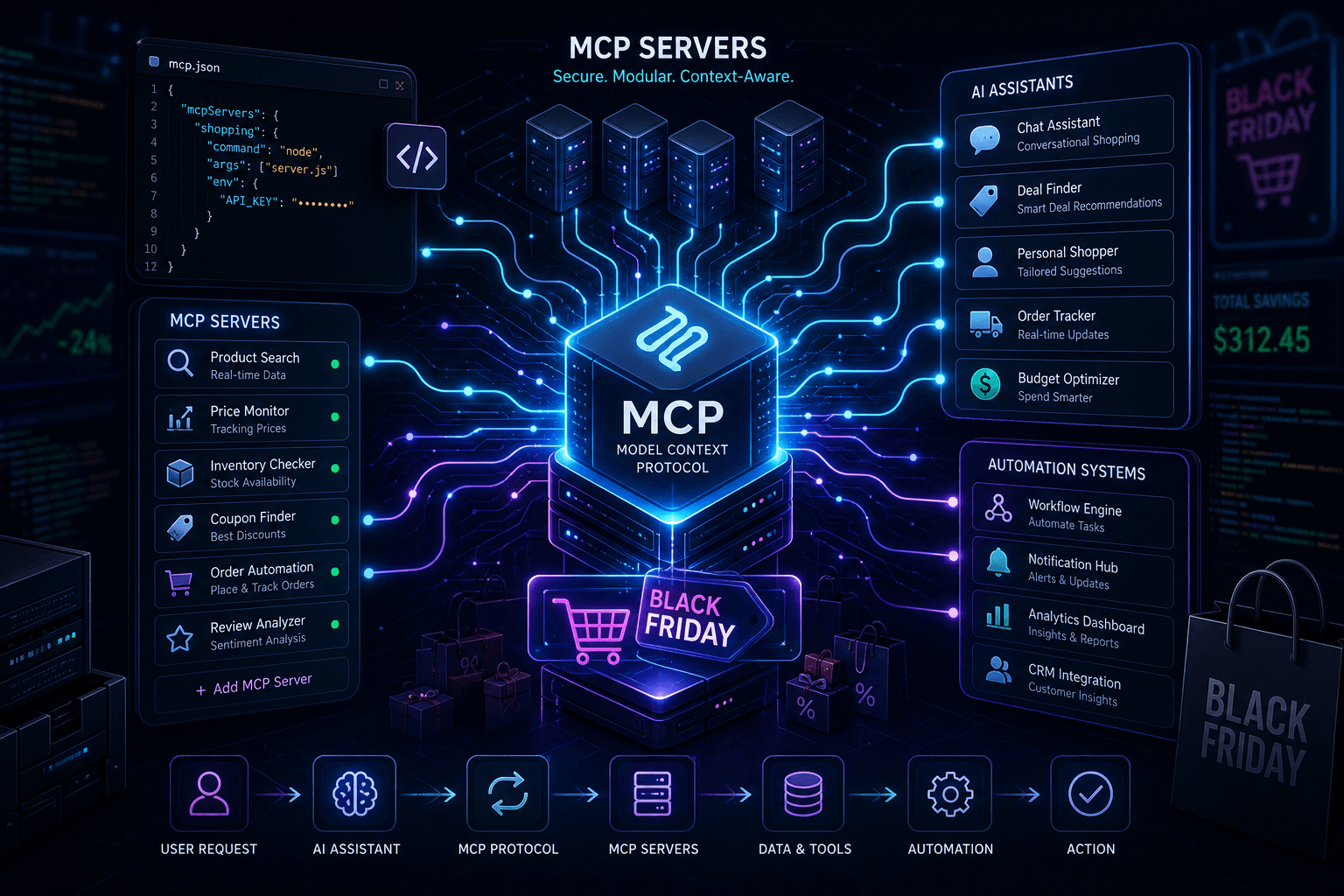
First Wave of MCP Server Tutorials: Black Friday AI Tool Deals

Table of Contents
First Wave of MCP Server Tutorials: Black Friday AI Tool Deals #
The Model Context Protocol (MCP) is barely two weeks old as a public standard, and the tutorial ecosystem is already exploding. While Anthropic's November 25, 2024 announcement kicked off the protocol, developers have spent this week building the first wave of comprehensive tutorials, reference implementations, and community servers. At the same time, Black Friday 2024 deals are live across the AI tooling landscape — though the discounts aren't landing where you might expect.
As an AI automation engineer, I've been tracking both threads: the rapid MCP education surge and the annual pricing circus. This post covers the state of MCP tutorials as of today, November 30, 2024, plus the real Black Friday deals (and non-deals) on Cursor, Claude, n8n, and the broader automation stack.
What Just Happened: MCP Tutorial Ecosystem in One Week #
MCP server tutorials emerged immediately after Anthropic's November 25 announcement, with IBM, independent developers, and the official MCP documentation team shipping comprehensive guides within days. The protocol's simplicity — it's essentially JSON-RPC 2.0 with a standard schema for tools, resources, and prompts — means experienced developers can go from zero to functioning server in under an hour.
The first wave of tutorials focuses on three core tracks:
| Tutorial Source | Language/Framework | Focus Area | Difficulty |
|---|---|---|---|
| Official MCP Docs | Python/TypeScript | Weather server, tool/resource patterns | Beginner |
| IBM Tutorial | Python (fastmcp) | Tutorial search server, error handling | Intermediate |
| Self.md Guide | Python + TypeScript | Minimal starters, Claude Code debugging | Beginner |
| Khushal Jethava | Python | Tool/resource/prompt distinction | Beginner |
| MCPStack | TypeScript + Python | Production deployment, architecture | Advanced |
Each tutorial covers the same fundamental architecture: MCP servers expose three primitives — tools (functions the LLM can call), resources (read-only data), and prompts (reusable templates). The host application (Claude Desktop, Cursor, VS Code with Copilot) maintains a persistent JSON-RPC connection to the server, allowing real-time bidirectional communication.
The Official MCP Weather Server Tutorial #
Anthropic's official quickstart remains the best entry point for developers new to the protocol. The tutorial walks through building a weather server with two tools — get-alerts and get-forecast — then connects it to Claude for Desktop.
The server implementation follows a clean pattern that's become the community standard:
from mcp.server import Server
from mcp.types import Tool, TextContent

server = Server("weather-server")

@server.list_tools()
async def list_tools() -> list[Tool]:
    return [
        Tool(
            name="get_forecast",
            description="Get weather forecast for a location",
            inputSchema={
                "type": "object",
                "properties": {
                    "location": {"type": "string"},
                    "days": {"type": "integer", "default": 3}
                },
                "required": ["location"]
            }
        )
    ]

@server.call_tool()
async def call_tool(name: str, arguments: dict):
    if name == "get_forecast":
        # Weather API integration here
        return [TextContent(type="text", text="Sunny, 72°F")]
The tutorial emphasizes schema-first design — the inputSchema field uses JSON Schema to define exactly what parameters Claude can pass, enabling automatic validation and type safety. This is the mechanism that makes MCP more reliable than ad-hoc function calling.
IBM's Production-Ready MCP Server Guide #
IBM's tutorial takes a different angle, focusing on production concerns from the start. Using the fastmcp framework and the requests library, IBM demonstrates error handling patterns that most beginner tutorials skip.
The key insight from IBM's approach: MCP servers should fail gracefully with structured error responses. When a tool call fails, return a structured error object that includes:
- The error type (network, validation, authentication)
- A human-readable message for the LLM
- Optional retry guidance
This pattern enables what IBM calls "self-healing" agent loops — Claude can interpret the error and potentially retry with corrected parameters or fallback to alternative tools.
Community Server Explosion: 100+ Servers in Days #
The MCP community has already built over 100 public servers, with the awesome-mcp-servers repository tracking implementations across every major domain. The reference implementations from Anthropic cover the essentials:
| Server | Function | Use Case |
|---|---|---|
| Filesystem | Secure file operations | Project navigation, file editing |
| Git | Repository tools | Commit history, branch management |
| Fetch | Web content retrieval | Real-time data, API calls |
| Memory | Knowledge graph storage | Persistent context across sessions |
| PostgreSQL | Database access | SQL queries, data analysis |
| Puppeteer | Browser automation | Web scraping, form filling |
| Slack | Message operations | Team notifications, channel search |
| GitHub | Repository management | Issue tracking, PR review |
Community servers extend this list dramatically — from AWS integration to Notion databases to financial data sources. The protocol's adoption by major AI providers (OpenAI, Google DeepMind) and IDEs (Cursor, VS Code) means these servers work across multiple host applications, not just Claude.
Black Friday 2024: The AI Tool Deal Reality Check #
Black Friday 2024 AI tool deals are selective — the major coding assistants and LLM platforms largely skipped the discount season, while adjacent automation and content tools went deep on pricing. Here's the complete breakdown as of today.
Cursor: No Black Friday Deal (And That's Normal) #
Cursor AI is not running a Black Friday 2024 promotion, and this aligns with their historical pattern. Cursor rarely discounts — the only savings available are the standard 20% annual billing discount ($20/month vs $240/year effectively).
Cursor's pricing remains:
| Plan | Monthly | Annual (Effective) | Notes |
|---|---|---|---|
| Hobby | Free | Free | Limited usage |
| Pro | $20/month | $16/month | 20% savings on annual |
| Teams | $40/user/month | $32/user/month | Collaboration features |
| Enterprise | Custom | Custom | SSO, audit logs |
The lack of seasonal discounts reflects Cursor's enterprise positioning — they're building a utility-style business, not a promotional retail product. For developers evaluating Cursor, the question isn't "wait for a deal" but "does the productivity gain justify $20/month?" For most serious engineers, the answer is yes within the first week.
Claude: No Standalone Discount, But Check Your Usage #
Anthropic is not offering Claude Pro Black Friday discounts in 2024. The standard pricing applies:
- Claude Pro: $20/month or $200/year (17% savings)
- Claude for Work: $25/user/month (team features)
However, Anthropic's official support documentation notes they "occasionally run limited-time promotions" — these are typically announced through their newsletter and social channels, not predictable seasonal sales.
The real value play with Claude isn't the subscription price — it's the MCP integration now available in Claude Desktop. For the same $20/month, you now get access to the entire MCP server ecosystem, effectively turning Claude into a universal interface for any tool you can wrap in a server.
n8n: The Automation Deal to Watch #
n8n's Black Friday 2024 status is unclear, but their 2023 playbook suggests keeping an eye out. Last year, n8n offered 40% off annual plans during Black Friday — a substantial discount on what is already the most cost-effective workflow automation platform.
Current n8n pricing (without any confirmed 2024 discount):
| Plan | Price | Executions | Best For |
|---|---|---|---|
| Starter | €20/month | 2,500/month | Personal projects |
| Pro | €50/month | Custom | Small teams |
| Startup | €333/month | Custom | <20 employees, <€5M funding |
| Enterprise | Custom | Custom | 200+ concurrent executions |
The annual billing discount saves 17% year-round — if Black Friday 2024 matches 2023's 40% off, this becomes the standout deal in AI automation tooling. For teams building MCP-integrated workflows, n8n + the upcoming n8n MCP integration represents the best value stack available.
The Deals That Actually Landed #
While the big three (Cursor, Claude, n8n) stayed quiet on discounts, adjacent AI tools went aggressive for Black Friday 2024:
| Tool | Category | Deal |
|---|---|---|
| MindPal | AI Agents | 60% off annual with code BLACKFRIDAY24 |
| NeuronWriter | AI Writing | 50% off annual plans |
| Fliki | Text-to-Video | 50% off with code FLIKIBLACKFRIDAY50 |
| Pictory | Video Generation | 50% off annual |
| Veed | Video Editing | 40% off with code VEEDBF40 |
| QuillBot | Writing Assistant | 40-50% off annual |
| Leonardo AI | Image Generation | 20% off with code BLACKFRIDAY-20 |
These tools complement the core coding/automation stack — video generation for marketing workflows, writing assistants for documentation, image generation for design assets. For teams building comprehensive AI automation pipelines, Black Friday 2024 is an opportunity to stock up on supporting tools even if the core platform pricing stays firm.
MCP + n8n: The Integration Tutorial Everyone Wants #
The tutorial the community is waiting for: comprehensive n8n + MCP integration. While n8n announced MCP support is coming, the definitive guide on exposing n8n workflows as MCP tools hasn't dropped yet.
The architecture is clear from the protocol spec: any n8n workflow with a webhook trigger can become an MCP tool by wrapping it in a lightweight server. The pattern looks like this:
- Build the n8n workflow with a webhook node as the trigger
- Define strict JSON schemas for request/response
- Wrap the webhook in an MCP server using the TypeScript or Python SDK
- Register in Claude/Cursor config under
mcpServers - Test with explicit tool calls before adding to agent loops
Synta.io published an early guide on this pattern, but the community is still waiting for the definitive production implementation tutorial. Given n8n's 40% Black Friday discount history, this integration becomes even more compelling — cheap workflow executions via n8n, exposed as premium AI tools via MCP.
Building Your First MCP Server: Current Best Practices #
Based on the first wave of tutorials, here are the consensus best practices for MCP server development as of November 30, 2024:
1. Start With the Schema #
Define your tool schemas before writing implementation code. MCP's JSON Schema validation means Claude will only send well-formed requests, but you need to design schemas that are:
- Descriptive: Clear parameter names and descriptions
- Constrained: Min/max values, regex patterns, enum options
- Typed: Explicit types for every field
2. Handle Errors Explicitly #
Don't let exceptions bubble up unhandled. Return structured error objects that include:
{
    "error": {
        "type": "network_error",
        "message": "Failed to reach weather API, retry in 30 seconds",
        "retryable": True
    }
}
3. Use STDIO for Local, HTTP+SSE for Remote #
MCP supports multiple transports:
- STDIO: Local servers, subprocess communication
- HTTP+SSE: Remote servers, enterprise deployments
Current MCP only supports local servers officially, but remote server support with enterprise authentication is in development.
4. Test Outside the Agent First #
Before connecting your server to Claude or Cursor, test it standalone:
# Send JSON-RPC directly to verify responses
echo '{"jsonrpc":"2.0","id":1,"method":"tools/list"}' | python my_server.py
5. Version Your Server #
MCP servers declare their version in the server initialization. Use semantic versioning and document breaking changes — your users will have multiple servers installed, and version conflicts are inevitable.
What's Coming: The December 2024 MCP Roadmap #
The next month of MCP development will focus on three areas, based on community signals and Anthropic's public comments:
- Remote server support: Enterprise authentication, cloud-hosted MCP servers
- More official servers: Additional integrations from Anthropic's partners
- IDE integrations: Deeper VS Code, Cursor, and Zed support
Early adopters including Block, Apollo, Replit, Codeium, and Sourcegraph are already shipping MCP-enabled features. The protocol's adoption by OpenAI and Google DeepMind means MCP is becoming a universal standard, not an Anthropic-specific feature.
For developers, the tutorial wave is just beginning. Expect comprehensive guides on:
- Multi-server orchestration patterns
- MCP security hardening
- Production deployment architectures
- Custom transport implementations
FAQ: MCP Servers and Black Friday 2024 Deals #
Q: What is Model Context Protocol (MCP) and why does it matter? #
MCP is an open standard from Anthropic that lets AI assistants discover and call external tools through a persistent JSON-RPC connection. Unlike per-request function calling, MCP servers stay live, expose typed tools, and can stream results back to the model. This matters because it creates a universal plug-in architecture for AI — any MCP server works with any MCP client (Claude, Cursor, VS Code, etc.).
Q: Are there any Black Friday 2024 deals on Cursor AI? #
No, Cursor is not offering Black Friday discounts. The only savings available are the standard 20% annual billing discount ($20/month monthly, effectively $16/month annual). Cursor rarely runs promotions — their enterprise-style pricing model doesn't rely on seasonal sales.
Q: Is Claude Pro discounted for Black Friday 2024? #
No, Anthropic is not offering Claude Pro Black Friday discounts. Standard pricing applies: $20/month or $200/year (17% savings). Anthropic occasionally runs limited promotions, but these are unpredictable and announced through official channels, not scheduled seasonal sales.
Q: Does n8n have a Black Friday 2024 deal? #
n8n has not announced a Black Friday 2024 discount yet, but their 2023 promotion was 40% off annual plans. The standard 17% annual billing discount applies year-round. For teams building MCP-integrated workflows, n8n remains the most cost-effective automation platform regardless of seasonal promotions.
Q: How do I build my first MCP server? #
Start with Anthropic's official weather server tutorial. It covers the fundamentals: defining tools with JSON Schema, implementing handlers, and connecting to Claude Desktop. The tutorial uses Python but the patterns translate directly to TypeScript. IBM's tutorial is the next step for production error handling patterns.
Q: What MCP servers are available right now? #
Over 100 community servers are available, plus official reference implementations from Anthropic. Key servers include filesystem access, Git operations, PostgreSQL queries, Slack integration, web fetching (Puppeteer), and knowledge graph memory. The awesome-mcp-servers GitHub repository tracks the full ecosystem.
Q: Can I use MCP servers with Cursor? #
Yes, Cursor supports MCP natively. Configure servers in Cursor's MCP settings, and they'll be available as tools across all your projects. The same servers work with Claude Desktop, VS Code with GitHub Copilot, and any other MCP-compatible client.
Q: How does MCP compare to traditional API integration? #
MCP provides persistent, bidirectional connections with built-in schema validation and tool discovery. Traditional API integrations require custom code for each endpoint, manual error handling, and ad-hoc authentication. MCP standardizes all of this — one protocol, multiple clients, consistent behavior.
Q: What are the best Black Friday AI tool deals in 2024? #
The deepest discounts are on content creation and adjacent automation tools, not core coding assistants. MindPal (AI agents) offers 60% off, NeuronWriter and Fliki offer 50% off, Veed offers 40% off video editing, and Leonardo AI offers 20% off image generation. Core tools (Cursor, Claude, n8n) maintain standard pricing.
Q: Is MCP ready for production use? #
MCP is ready for local production use today. The current limitation is that MCP only officially supports local servers — remote server support with enterprise authentication is in development. For local development workflows and personal automation, MCP is stable and production-ready.
Next Steps: Building Your MCP Stack #
The first wave of MCP tutorials has given us the foundation — now it's time to build. If you're evaluating AI automation stacks during this Black Friday season, here's my recommended approach:
- Start with Claude Pro ($20/month) for MCP client access — the Desktop app is currently the most mature MCP host
- Build or adopt 3–5 MCP servers covering your core workflows (filesystem, Git, database, web access)
- Consider n8n (watch for that 40% discount) for workflow orchestration behind your MCP tools
- Skip waiting for Cursor/Claude deals — the productivity gain pays for the subscription within days
- Grab supporting tool deals while they're available — MindPal, Fliki, and Leonardo AI at 50%+ off round out a complete AI automation stack
The MCP ecosystem is moving fast. What exists today — 100+ servers, comprehensive tutorials, major IDE support — is just the foundation. The next wave will bring remote servers, enterprise features, and deeper integrations across every platform.
If you're building AI automations for your team or clients, the question isn't whether to adopt MCP — it's how quickly you can ship your first server. The protocol's simplicity means you can go from zero to production tool in an afternoon. And that's exactly what thousands of developers are doing right now.
Want help architecting your MCP stack or building custom servers for your specific workflows? Book an AI automation strategy call — I help teams design and deploy production AI agent systems that actually ship.
Related Reading:
- Anthropic's MCP Launch: Model Context Protocol Explained — The foundational architecture guide
- Cursor Composer + o1 Tutorials — Advanced AI coding patterns
- Canvas vs Artifacts vs Cursor — AI interface comparison
Related Posts

How to Stop Client-Facing AI Agents From Hallucinating
Client-facing AI agents hallucinate when they answer without grounding. Here's the layered guardrail stack I use to keep agents accurate and on-script.

AI Sales Systems vs Traditional CRM Automation
Traditional CRM automation fires rules; AI sales systems reason about each lead. Here's how they differ, where each wins, and how to combine them.

The Manual Workflows With the Highest ROI When Replaced by AI Agents
Not every task is worth automating. Here are the manual workflows with the highest ROI when you replace them with AI agents, ranked by payback speed.