NVIDIA GTC 2026: Vera Rubin, $1T in Orders, and the AI Factory Era

Table of Contents
NVIDIA GTC 2026: Vera Rubin, $1T in Orders, and the AI Factory Era #
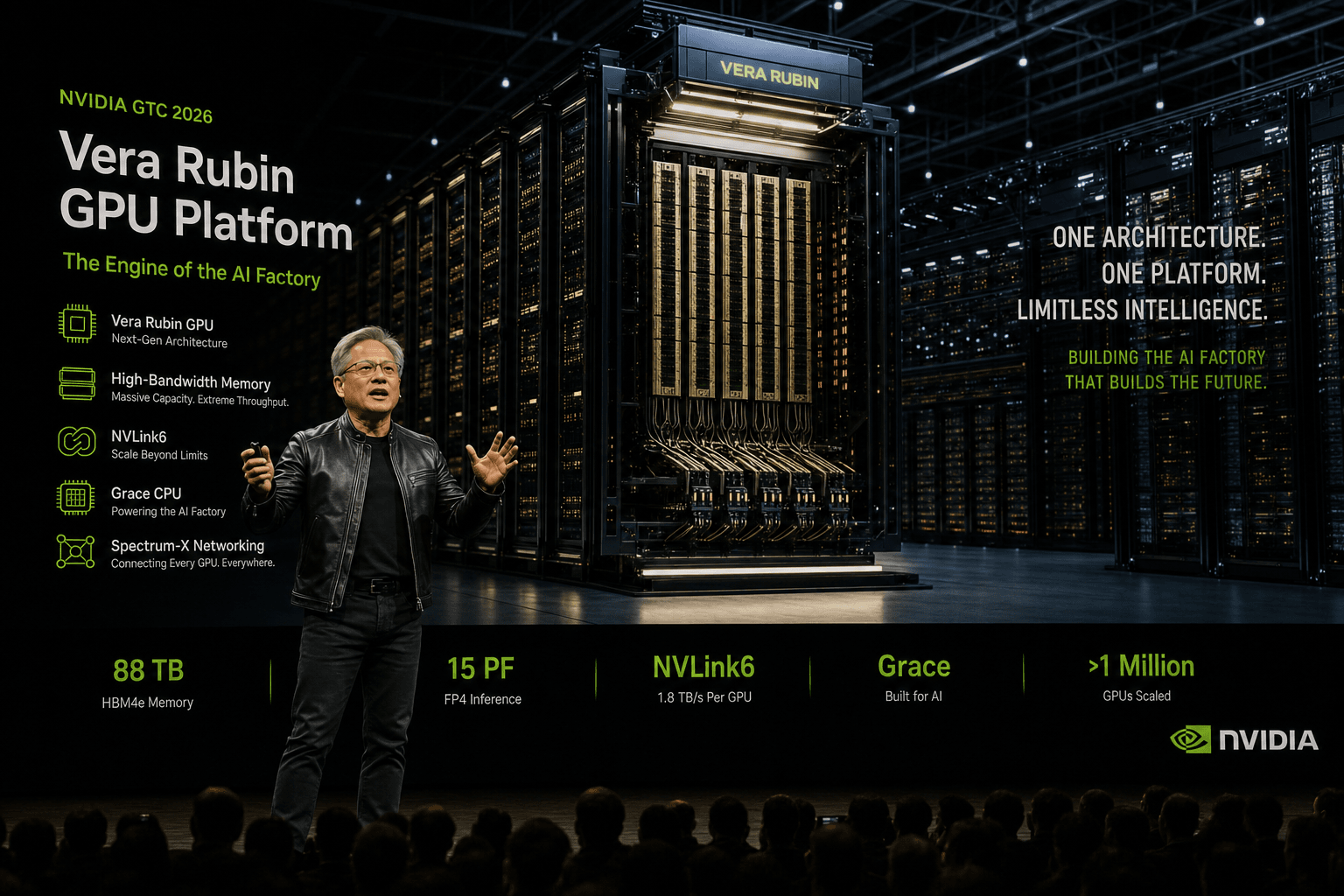
Jensen Huang just announced $1 trillion in projected infrastructure orders through 2027. That's double the forecast from last year. The Vera Rubin platform isn't an incremental upgrade—it's a generational leap that repositions NVIDIA from GPU vendor to complete AI infrastructure architect. Here's my take from the floor at GTC 2026 in San Jose.
What Is the Vera Rubin Platform? #
Vera Rubin is a seven-chip, five-rack-scale system that functions as a single AI supercomputer. This isn't marketing speak. The platform integrates:
- Vera Rubin NVL72: 72 Rubin GPUs + 36 Vera CPUs in a single rack-scale unit
- Vera CPU racks: 256 liquid-cooled chips per rack for high single-threaded performance
- Groq 3 LPX inference accelerators: 256 LPUs delivering 35x tokens-per-watt improvement
- BlueField-4 DPUs: Storage acceleration at rack scale
- Spectrum-6 SPX Ethernet: Co-packaged optics for scale-out networking
The headline number: 10x higher inference throughput per watt at one-tenth the cost per token compared to Blackwell. That's not a modest improvement. That's a fundamental shift in the economics of running AI at scale.
The $1 Trillion Infrastructure Forecast #
Last year, Huang projected $500 billion in "high confidence" purchase orders for Blackwell and Rubin systems through 2026. Today, he doubled that to $1 trillion through 2027.
The reasoning is straightforward: inference has become the bottleneck. Training was the sexy problem everyone talked about. But training happens once. Inference happens billions of times per day. Every ChatGPT query, every Claude interaction, every enterprise AI agent deployment—it all runs on inference infrastructure.
The order book breakdown tells the story:
| Customer Segment | Estimated Orders | Primary Use Case |
|---|---|---|
| Hyperscalers (AWS, Azure, GCP) | $400B+ | Cloud AI inference + training |
| Sovereign AI programs | $150B+ | National compute infrastructure |
| Enterprise direct | $200B+ | On-prem AI factories |
| Telecom + automotive | $100B+ | Edge AI, autonomous systems |
| Research / government | $150B+ | National labs, defense, science |
Huang's framing is deliberate: "Data centers used to be a place to store files. They're now a factory to generate tokens." This reframing matters because it changes how CFOs think about capex. You're not buying servers. You're building a token factory. And a token factory has revenue per unit of compute—making GPU infrastructure a revenue-generating asset, not a cost center.
AI Factories: The New Industrial Infrastructure #
The "AI Factory" concept is NVIDIA's attempt to productize the entire stack. Instead of selling GPUs and letting customers figure out the rest, NVIDIA is positioning the complete Vera Rubin system as a turnkey "AI Factory" platform called DSX (Data center Scale-out eXtension).
The DSX platform provides:
- Blueprints for AI factories co-designed in NVIDIA Omniverse
- Power-optimized layouts that leave "no power squandered"
- Integrated networking with NVLink scale-up and Spectrum-X scale-out
- Software stack: CUDA, cuDNN, TensorRT, NeMo, and NIM microservices
This is the "vertically integrated but horizontally open" strategy Huang keeps repeating. NVIDIA owns the full stack but integrates with every cloud provider, OEM, and software platform. You're not locked in—you're just running on the most optimized path.
The economics of AI Factories deserve attention. Huang showed a comparison that resonated with the enterprise crowd:
- Traditional data center: $10M investment, serves 500 users, depreciates over 5 years, generates zero direct revenue
- AI Factory (Vera Rubin): $10M investment, generates 700M tokens/second, can serve thousands of concurrent agent sessions, produces measurable revenue per token
The reframing from "cost center" to "revenue generator" is how NVIDIA gets CFOs to approve purchase orders in the hundreds of millions. If a token factory generates $50M in annual value from automation and AI services, a $10M infrastructure investment has a 5x return. That's a language finance teams understand—and it's why the $1T order book is credible.
Groq 3 LPX: The Low-Latency Secret Weapon #
The most technically interesting announcement is the Groq 3 LPX integration. NVIDIA acquired or partnered with Groq (the LPU pioneer) and is now incorporating their SRAM-heavy inference accelerators into Vera Rubin racks.
Here's why this matters: low latency and high throughput are enemies of each other. Traditional GPU inference optimizes for throughput (tokens per second). But agentic AI and real-time applications need low latency (time to first token).
The Groq 3 LPX rack delivers up to 10x revenue potential for companies running disaggregated inference—separating prefill (high throughput) from generation (low latency). Jensen explicitly called this out as the solution to a problem that has plagued large-scale deployments.
The Software Stack: CUDA's 20th Birthday #
GTC 2026 marks the 20th anniversary of CUDA. Huang spent significant stage time on this because it's the real moat—not the silicon, but the 20 years of accumulated software optimization.
Key library announcements:
- cuDF and cuVS: Accelerated DataFrame and vector store processing for structured and unstructured data
- IBM Watsonx.data integration: cuDF acceleration for enterprise SQL workloads (Nestle seeing 5x speedup at 83% lower cost)
- NeMo and NIM: Updated model serving microservices for the agentic era
- NemoClaw: NVIDIA's simplified OpenClaw setup for enterprise AI agents
The installed base argument is compelling: Ampere GPUs shipped six years ago are seeing increasing cloud pricing because the software optimizations keep improving. Your hardware gets faster over time, not slower. This is NVIDIA's deepest competitive advantage—not the silicon, but the compounding returns of two decades of library optimization that make every generation of hardware more valuable than its spec sheet suggests.
CUDA 13, announced today, adds native support for agentic inference patterns, including speculative decoding at the library level and automatic batching for multi-agent systems. For anyone building production agent pipelines, this is the kind of infrastructure plumbing that saves months of custom engineering.
The Roadmap: Feynman Systems in 2028 #
Huang teased the next generation: Feynman systems launching in 2028. Specs revealed:
- New GPU architecture beyond Rubin
- New LPU (successor to Groq 3)
- Rosa CPU: Next-gen processor after Vera
- BlueField-5 DPUs
- Kyber networking with copper and CPO (co-packaged optics)
The message is clear: this is a multi-decade infrastructure buildout. The 2-year rhythm isn't slowing down.
Physical AI and Robotics #
Beyond the data center, NVIDIA announced 110 robots on display at GTC and partnerships with BYD, Hyundai, and Nissan for robo-taxis. The "Physical AI" segment includes:
- AI agents that operate in the physical world
- Robotic training in NVIDIA Omniverse before real-world deployment
- Integration with Uber's network for commercial robo-taxi service
This is the next frontier after generative AI: AI that can act in physical environments, not just generate text.
The BYD partnership is particularly telling. BYD is the world's largest EV manufacturer and is now integrating NVIDIA's DRIVE Thor platform for L4 autonomous driving. Hyundai and Nissan follow similar paths. The pattern: train in simulation (Omniverse), validate in controlled environments, deploy in production vehicles. Jensen's claim that "every robot will be trained in a digital twin before entering the physical world" isn't aspirational—it's already happening in automotive. The question is how fast it expands to warehouse robotics, surgical systems, and industrial automation.
Partner Ecosystem: The Horizontal Open Strategy #
NVIDIA's cloud partnerships were front and center:
- AWS: OpenAI coming to AWS this year to address compute constraints
- Google Cloud: Accelerated BigQuery, Vertex AI, and JAX/XLA optimizations
- Microsoft Azure: Confidential computing for protected model deployment
- Oracle: Expanded AI cloud capacity with OpenAI and other partners
- CoreWeave: The "AI native" cloud built specifically for GPU workloads
The pattern is consistent: NVIDIA brings the libraries and optimizations, cloud providers bring the infrastructure, and customers get the performance. Everyone wins except the CPU-only shops.
The Competitive Landscape: AMD, Intel, and Custom Silicon #
NVIDIA's GTC dominance shouldn't obscure the fact that competitors are closing gaps in specific segments. The AI hardware market isn't winner-take-all—it's winner-take-most with important niches.
| Competitor | Product | Strength | Weakness vs. Vera Rubin |
|---|---|---|---|
| AMD MI400 | Next-gen GPU (late 2026) | Competitive HBM4 bandwidth, ROCm improving | Software ecosystem still 3+ years behind CUDA |
| Intel Falcon Shores | GPU + CPU hybrid | Strong on heterogeneous workloads | Delayed roadmap, market share <5% |
| Google TPU v6 | Custom ASIC | Optimized for JAX/TensorFlow, internal pricing advantage | Not available for general purchase |
| Amazon Trainium3 | Custom ASIC | Aggressive pricing on AWS | Locked to AWS ecosystem |
| Cerebras WSE-3 | Wafer-scale engine | Unmatched memory bandwidth for large models | Narrow use case, high per-unit cost |
The honest assessment: AMD is the only credible threat to NVIDIA's data center GPU dominance in the next 18 months. But "credible threat" doesn't mean "competitive parity." CUDA's 20-year head start in software optimization is the real moat. Every ML framework, every inference server, every training pipeline has been optimized for NVIDIA first. ROCm is good and getting better—but "good" loses to "20 years of compounding optimization."
Custom silicon (TPUs, Trainium) matters for the hyperscalers running their own workloads. But for enterprises buying infrastructure, NVIDIA's ecosystem advantage is decisive. You can hire CUDA engineers. Finding ROCm or TPU experts is an order of magnitude harder.
Why This Matters for Enterprise AI Strategy #
If you're building an AI strategy today, here's what GTC 2026 changes:
- Inference economics just shifted dramatically. 10x efficiency gains mean on-prem AI becomes viable for more workloads. A task that cost $10,000/month on Blackwell runs at $1,000/month on Vera Rubin at equivalent throughput.
- The "AI Factory" framing changes procurement conversations. You're not buying servers—you're building a token generation facility with measurable ROI per token.
- Agentic AI infrastructure is now the priority. The Vera Rubin platform is explicitly designed for long-running, autonomous AI agents that need sustained throughput over hours, not just burst capacity.
- Latency-sensitive applications have a path. The Groq 3 LPX integration finally gives NVIDIA a credible low-latency inference story for real-time agent interactions.
- The build vs. rent calculus is shifting. With 10x efficiency gains, the break-even point for on-prem AI factories drops significantly. Enterprises processing more than 100M tokens/day should model the economics of owned infrastructure against cloud API costs.
FAQ: NVIDIA GTC 2026 #
What is the NVIDIA Vera Rubin platform? #
The Vera Rubin platform is a seven-chip, five-rack-scale AI supercomputer system featuring 72 Rubin GPUs, 36 Vera CPUs, Groq 3 LPX inference accelerators, BlueField-4 DPUs, and Spectrum-6 networking. It delivers 10x higher inference throughput per watt at one-tenth the cost per token compared to Blackwell.
What did Jensen Huang announce at GTC 2026? #
Jensen Huang unveiled the Vera Rubin AI platform, projected $1 trillion in infrastructure orders through 2027, introduced the "AI Factory" concept with the DSX platform, announced Groq 3 LPX integration for low-latency inference, and marked CUDA's 20th anniversary with significant library updates.
When will Vera Rubin systems be available? #
Vera Rubin systems are sampling now with launch partners and on track for general availability in the second half of 2026. NVIDIA began shipping samples to customers weeks ago.
What is NVIDIA's AI Factory concept? #
The AI Factory concept repositions data centers as token generation facilities rather than file storage systems. NVIDIA's DSX platform provides blueprints, power optimization, and integrated networking for building complete AI factories using Vera Rubin infrastructure.
How does Groq 3 LPX improve inference performance? #
The Groq 3 LPX delivers 35x tokens-per-watt performance improvement for low-latency inference workloads. It enables disaggregated inference—separating prefill (high throughput) from generation (low latency)—which NVIDIA says can deliver up to 10x revenue potential for AI service providers.
What is NVIDIA's $1 trillion forecast? #
Jensen Huang projected $1 trillion in purchase orders for Blackwell and Vera Rubin systems through 2027, doubling last year's $500 billion forecast through 2026. This reflects explosive demand for inference infrastructure as agentic AI deployments scale.
What software updates did NVIDIA announce? #
NVIDIA announced cuDF and cuVS for accelerated data processing, updated NeMo and NIM microservices, NemoClaw for simplified OpenClaw enterprise deployment, and IBM Watsonx.data integration delivering 5x speedups at 83% lower cost for enterprise SQL workloads.
What comes after Vera Rubin? #
NVIDIA teased Feynman systems for 2028, featuring a new GPU architecture, new LPU, Rosa CPU, BlueField-5 DPUs, and Kyber networking with co-packaged optics.
How does Vera Rubin compare to Blackwell? #
Vera Rubin delivers 10x higher inference throughput per watt and one-tenth the cost per token compared to Blackwell. The system includes 700 million tokens per second capability compared to 2 million for previous x86/Hopper configurations.
What are NVIDIA's cloud partnerships at GTC 2026? #
NVIDIA announced expanded partnerships with AWS (OpenAI deployment), Google Cloud (BigQuery acceleration), Microsoft Azure (confidential computing), Oracle (AI cloud capacity), and CoreWeave (AI-native cloud infrastructure).
Final Analysis: The Infrastructure War Is Over #
NVIDIA isn't just winning the AI infrastructure war—they're defining what the battlefield looks like. The Vera Rubin platform isn't a chip. It's a complete re-architecture of how AI infrastructure gets built, deployed, and operated.
The $1 trillion forecast isn't hype. It's a reflection of the reality that every major enterprise is now in the token generation business. Whether you're building customer-facing AI agents, internal automation, or reasoning systems—you need inference infrastructure. Lots of it.
For enterprises still running CPU-bound data processing, the message from GTC 2026 is unambiguous: accelerated computing isn't the future. It's the present. The 20-year CUDA investment has created a moat that's only getting wider.
If you're planning AI infrastructure investments for 2026-2027, the Vera Rubin platform sets the baseline. Everything else is now measured against it.
Want to understand how these infrastructure shifts affect your specific AI automation strategy? Explore my AI Automation + Growth services or read my analysis of the CES 2026 Rubin keynote reveal for the early signals that led to this moment.
Related Reading #
- CES 2026: NVIDIA Rubin Keynote and the Inference Inflection — The January 2026 reveal that set the stage for GTC
- DeepSeek R1 and the NVIDIA Market Recalculation — How efficiency breakthroughs reshaped infrastructure thinking
- GPT-5 Launch: The Single Model Router Architecture — Why inference infrastructure matters more than ever
- OpenAI DevDay 2025: Apps, AgentKit, and the Agent Era — The software layer running on this hardware
Related Posts
Google I/O 2026 Action List: How I Prompted Gemini 3.5 Flash and Antigravity Workflows
Google I/O 2026 just reset the AI tooling landscape. Here's the 9-action checklist for builders who want to ship this week, not just watch the keynote.
Anthropic vs. OpenAI vs. Google: The State of the Frontier in May 2026
A head-to-head breakdown of the three AI giants in May 2026: Claude Opus 4.6, GPT-5.3 and 5.4, Gemini 3.1 Pro. Real specs, real pricing, and what actually matters for builders.
Kimi K2 Open Weights: How I Prompted Moonshot's Frontier Model for Agentic Tool Use
How I direct Kimi K2 by Moonshot AI for agentic workflows, long-context tool calling, and workflow automation. A 1 trillion parameter MoE model with competitive benchmarks at 5-17x lower cost than GPT-5 and Claude.