The OpenAI Superalignment Crisis: Ilya Sutskever's Departure and What It Meant
Table of Contents
The OpenAI Superalignment Crisis: Ilya Sutskever's Departure and What It Meant #
Ilya Sutskever, OpenAI's Chief Scientist and co-founder, announced his departure yesterday. Jan Leike, co-lead of the superalignment team, resigned this morning. Together, these exits effectively dissolve the team responsible for ensuring future superintelligent AI systems remain aligned with human values—and signal a fundamental shift in how OpenAI balances safety against speed.
This is not a routine leadership transition. Sutskever's departure marks the exit of the technical architect who built GPT-4, who co-founded the company with Sam Altman and Greg Brockman, and who has been described as the "moral compass" of OpenAI's research culture. When that person leaves within 24 hours of the superalignment team co-lead resigning over safety culture concerns, the signal is clear: OpenAI is choosing product velocity over safety research, and it is choosing it now.
For builders deploying AI in production, for enterprises negotiating contracts, and for researchers tracking the field's trajectory, understanding what just happened matters. This article breaks down the timeline, the technical stakes, and what this shift means for the future of AI development.
What Just Happened: A Timeline of the Past 48 Hours #
The crisis unfolded rapidly over Tuesday and Wednesday, creating the most significant leadership vacuum in OpenAI's history. Here is the chronological breakdown:
Tuesday, May 14, 2024 — 10:00 AM PT: Ilya Sutskever posts on X (formerly Twitter): "After almost a decade, I have made the decision to leave OpenAI." The post comes just 24 hours after OpenAI unveiled GPT-4o, its new multimodal model capable of real-time voice conversation. CEO Sam Altman responds within minutes, calling Sutskever "one of the greatest minds of our generation, a guiding light of our field, and a dear friend."
Tuesday, May 14 — 11:30 AM PT: OpenAI announces Jakub Pachocki, who led the development of GPT-4 and OpenAI Five, will replace Sutskever as Chief Scientist. Pachocki is a respected researcher, but his background is in capabilities research—not safety or alignment.
Tuesday evening: Internal messages suggest Jan Leike, co-lead of the superalignment team alongside Sutskever, is also departing. The news has not yet gone public.
Wednesday, May 15, 2024 — 8:00 AM PT: Jan Leike posts on X: "I resigned." The two-word announcement confirms that both superalignment co-leads are gone within a single 24-hour window.
Wednesday afternoon: OpenAI confirms John Schulman, another co-founder, will oversee the remnants of the superalignment team, which will be "integrated more deeply" across other research groups—effectively dissolving it as a standalone unit.
Today: The AI research community is processing what this means. Multiple sources report that the superalignment team, launched with fanfare in July 2023 with a pledge of 20% of OpenAI's compute resources, never received the promised resources and has now ceased to exist as a coherent entity.
Who Is Ilya Sutskever and Why His Exit Destabilizes OpenAI #
Sutskever is not merely a prominent researcher leaving a successful company—he is the technical architect who built the systems that made OpenAI valuable. Understanding his role clarifies why his departure represents an existential cultural shift.
Sutskever co-founded OpenAI in 2015 alongside Sam Altman, Greg Brockman, and others. Before that, he was a key researcher at Google Brain, where he co-authored the landmark AlexNet paper (2012) that launched the modern deep learning era. At OpenAI, he led the research behind GPT-1, GPT-2, GPT-3, and GPT-4. When OpenAI talks about its "capability advances," it is largely describing Sutskever's work.
More importantly for today's crisis, Sutskever has been the internal voice pushing for safety alongside capability. He advocated for cautious deployment, warning that once AI systems exceed human intelligence across domains, alignment becomes exponentially harder. His famous quote—"Today's large language models are slightly conscious"—made headlines precisely because it came from someone with his technical credibility.
The destabilization happens on multiple levels:
| Level | Impact |
|---|---|
| Technical leadership | GPT-5 and beyond lose their primary architectural shepherd; Pachocki is capable but has different priorities |
| Safety voice | The person who consistently argued for capability restraint is gone; no equivalent replacement is visible |
| External credibility | Enterprise customers and governments viewed Sutskever as proof OpenAI took safety seriously; his exit removes that assurance |
| Internal morale | Researchers who joined for safety-first mission alignment now see that path deprioritized |
Sutskever has stated he is working on "a new project that is very personally meaningful." Speculation centers on a new AI safety initiative, possibly with a different structural model than OpenAI's nonprofit-commercial hybrid. Whatever form it takes, the AI safety community will follow it closely.
The Superalignment Team: What They Were Actually Building #
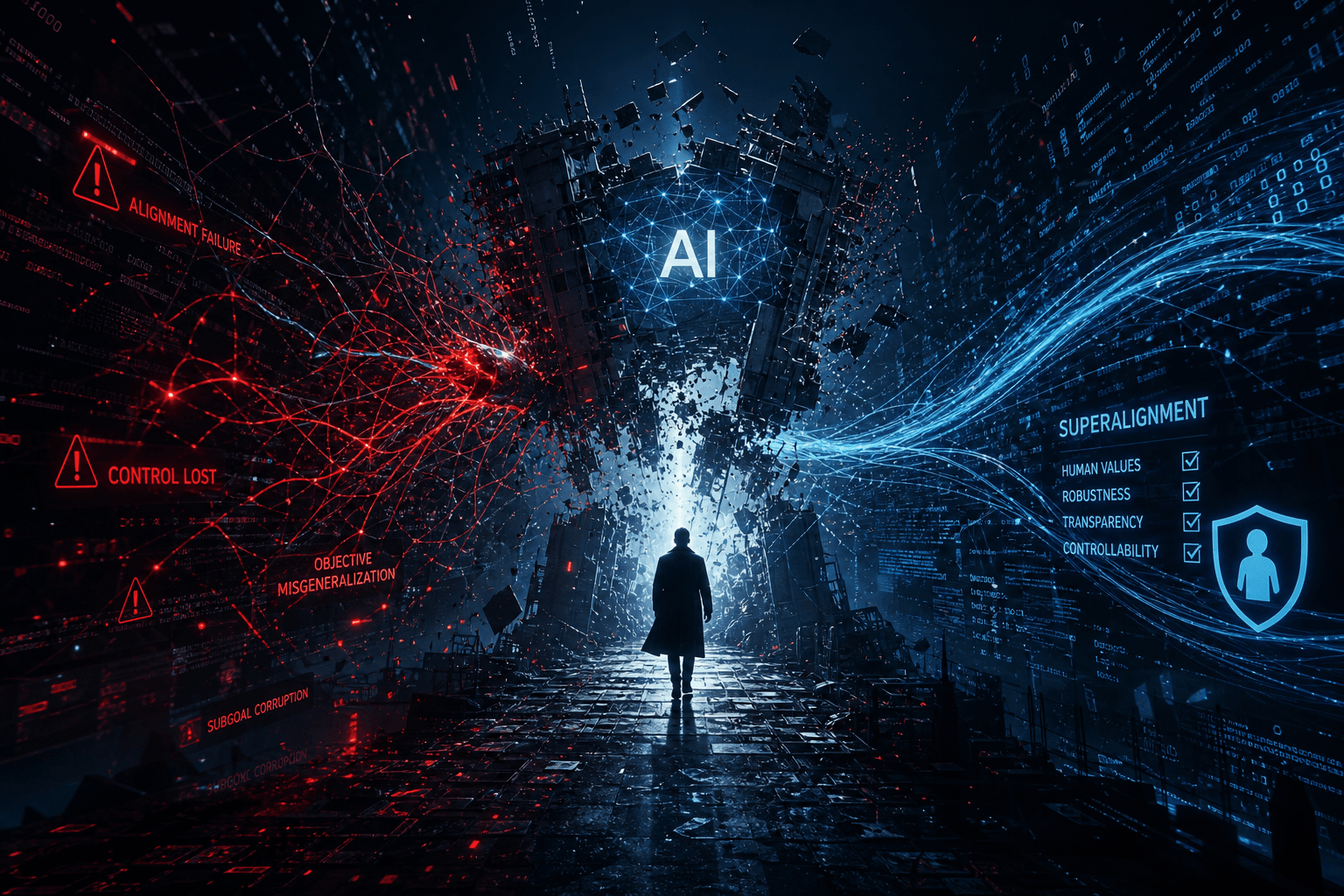
The superalignment team was created to solve perhaps the hardest problem in AI: how to ensure systems smarter than humans remain aligned with human values. Its dissolution represents more than organizational reshuffling—it signals abandonment of the long-term safety research that justified OpenAI's existence as a capped-profit "safety-first" organization.
When OpenAI announced the superalignment team in July 2023, the messaging was ambitious. The team would "solve the core technical challenges of superintelligence alignment within four years." The approach was three-pronged:
- Scalable training methods — Developing techniques to train AI systems that generalize alignment even as capabilities exceed human oversight
- Validation and verification — Building automated systems to check whether aligned models remain aligned under deployment stress
- Adversarial testing — Stress-testing alignment pipelines against worst-case scenarios, including deliberate attempts to elicit misaligned behavior
The team was led by Sutskever and Jan Leike, with a stated allocation of 20% of OpenAI's computing resources over the four-year timeline. This commitment was substantial—OpenAI's compute budget runs into hundreds of millions annually—and was meant to demonstrate serious prioritization of safety research.
What actually happened: According to multiple sources, the superalignment team never received the promised compute. Requests for even a fraction of the pledged resources were routinely denied. Team members reportedly struggled to secure GPUs for experiments while the capabilities teams had abundant access. By early 2024, the writing was on the wall: OpenAI was not actually prioritizing superalignment work despite the public commitment.
Today's dissolution makes it official. The team is being "integrated" into broader research groups—meaning its dedicated focus on long-term alignment is ending. The 20% compute commitment is effectively void. For a company that justifies its capped-profit structure by claiming to prioritize safety, this is a fundamental betrayal of its stated mission.
Jan Leike Resigns: His Public Statements About Safety Culture #
Jan Leike's resignation message this morning contains the most damning public statement about OpenAI's priorities from an insider since the company was founded. His words deserve close reading:
Leike posted on X: "I resigned." Two days later, on Friday, May 17, he expanded in a thread that has since been widely circulated:
"Over the past years, safety culture and processes have taken a backseat to shiny products."
This is not a vague complaint about corporate culture. Leike is stating that OpenAI's leadership has systematically deprioritized safety work relative to product releases. The "shiny products" framing is particularly pointed—Leike is suggesting that demos and press releases matter more than the foundational research that would make those products actually safe to deploy.
Leike continued:
"I have been disagreeing with OpenAI leadership about the company's core priorities for quite some time, until we finally reached a breaking point."
This reveals that the superalignment team's struggles were not recent or sudden. The tension between safety research and product development has been ongoing, with leadership consistently choosing the latter. The breaking point appears to have been the final refusal to grant the team the resources needed to do its job—or possibly, the decision to dissolve the team entirely.
Most critically:
"My team was sailing against the wind. We were struggling to get compute for our crucial work."
This confirms the reporting that the 20% compute commitment was never honored. The superalignment team, tasked with solving alignment for superintelligent systems, could not get the computational resources necessary to run experiments. Meanwhile, GPT-4o launched with real-time voice capabilities—capabilities that increase the surface area for misuse and misalignment.
Leike's final statement carries weight because he is not a disgruntled junior employee. He is a leading AI safety researcher who co-authored the seminal "Scalable Agent Alignment via Reward Modeling" paper and has been working on alignment longer than most OpenAI employees have been at the company. When he says safety has taken a backseat, the AI community listens.
The November Board Crisis: When Ilya Sided Against Altman #
The seeds of today's resignations were planted six months ago, during the chaotic week of November 17, 2023, when Sutskever helped fire Sam Altman—only to reverse course days later. Understanding that crisis explains why Sutskever's departure today was inevitable.
On Friday, November 17, 2023, Sutskever convened a Google Meet call with three other board members and voted to remove Altman as CEO. The board cited concerns that Altman "was not always truthful with them." Sutskever removed Altman, removed Greg Brockman from the board, and elevated CTO Mira Murati to interim CEO.
The precise reasons for the ouster remain partially unclear, but reporting at the time emphasized a fundamental tension: Altman favored aggressive AI development and commercialization, while Sutskever and certain board members wanted more cautious progress with stronger safety guardrails. Sutskever had reportedly grown concerned that OpenAI was shipping capabilities faster than it could verify safety.
The coup collapsed within days. Microsoft CEO Satya Nadella announced Altman and Brockman would join Microsoft to lead a new AI research lab—effectively threatening to strip OpenAI of its key talent. Over 700 OpenAI employees signed a letter threatening to resign unless the board reversed its decision. Sutskever himself signed the letter, publicly stating he "deeply regretted" his participation in the board's action.
By November 22, Altman was reinstated. The board was completely overhauled: Bret Taylor became chair, Larry Summers joined, and Adam D'Angelo remained. Helen Toner, Tasha McCauley, and Sutskever were removed from the board. Sutskever remained at the company as Chief Scientist—but his removal from governance was complete.
The foreshadowing is clear in retrospect. Sutskever tried to slow OpenAI down via board action and failed. He tried to build a safety-focused research team via superalignment and saw it dissolved. Today, he is leaving entirely—along with the other leader who shared his safety priorities.
The November crisis revealed that Altman and the commercial faction had won. Today's resignations confirm that victory is permanent. OpenAI will not be governed by safety-conscious researchers; it will be governed by product-focused executives answering to Microsoft and investors who want returns on the billions invested.
What This Signals About OpenAI's Safety Commitment #
OpenAI's transformation from "safety-first research lab" to "product-first tech company" is now complete. The resignations are not an aberration—they are the logical endpoint of a strategic shift that has been underway for years.
Consider the evidence:
| Timeline Event | Safety Signal |
|---|---|
| July 2023 | Superalignment team announced with 20% compute pledge |
| November 2023 | Sutskever's failed board coup—safety faction loses governance |
| Early 2024 | Superalignment team denied promised compute resources |
| May 2024 | Sutskever and Leike resign; team dissolved |
The pattern is unmistakable. OpenAI made public commitments to safety research that it never intended to honor. The superalignment team existed primarily for public relations and regulatory positioning—not for actual research output.
What changes in practice:
- No standalone safety research: Long-term alignment work is now subsumed into capabilities teams, where it will compete for resources against features that directly drive revenue
- No safety veto power: Without Sutskever or Leike in leadership, no one remains who can credibly argue for delaying releases to verify safety
- Compute allocation reality: Resources will flow to GPT-5 training, not to alignment research—regardless of what press releases claim
What this means for the "capped-profit" structure: OpenAI justified its unusual corporate structure—nonprofit controlling a for-profit subsidiary—by claiming it needed governance independence to prioritize safety over profit. That justification is now in tatters. The nonprofit board has been purged of safety advocates, and the for-profit subsidiary is clearly driving all major decisions.
For builders evaluating AI vendors, the calculation shifts. OpenAI may still have the best models, but its credibility on safety commitments is damaged. Enterprises in regulated industries should scrutinize OpenAI's actual safety practices more carefully than its marketing materials.
How Anthropic and DeepMind Are Positioned to Benefit #
OpenAI's safety crisis is Anthropic's opportunity—and to a lesser extent, Google DeepMind's. As safety-conscious researchers, enterprise customers, and policymakers look for alternatives, the companies that maintained consistent safety messaging are positioned to capture trust and talent.
Anthropic's advantage is structural. The company was founded in 2021 by Dario and Daniela Amodei, who left OpenAI precisely because they believed it was insufficiently focused on safety. Anthropic's constitutional AI approach, its public benefit corporation structure, and its consistent messaging about responsible scaling give it credibility that OpenAI is hemorrhaging.
Today, Anthropic can credibly claim that it has not abandoned its safety commitments. Claude 3.5 Sonnet, released next month, will demonstrate that capability advances and safety research can coexist. More importantly, Anthropic has not had public leadership purges over safety disagreements—suggesting its internal culture is more aligned on prioritization.
Talent migration is the leading indicator to watch. Researchers who joined OpenAI for safety-first mission alignment now face a choice: stay at a company that has deprioritized their work, or join competitors that share their values. Anthropic has already hired several prominent OpenAI safety researchers; today's resignations accelerate that trend.
Enterprise positioning shifts too. Companies evaluating AI vendors increasingly ask about safety practices, not just capabilities. OpenAI's recent crisis gives procurement teams reason to prefer Anthropic or Google—vendors without equivalent public safety meltdowns. For regulated industries (finance, healthcare, government), vendor stability and safety credibility matter as much as model performance.
Google DeepMind plays a different role. With Demis Hassabis leading Google's combined AI efforts, DeepMind represents a third pole—massive resources, established safety research culture, and less dependency on venture capital returns. DeepMind's traditional focus on long-term AGI safety research may look more attractive to researchers disappointed by OpenAI's pivot.
The competitive landscape is shifting from "OpenAI vs. everyone else" to a three-way race where OpenAI leads on raw capability but lags on trust. In the long run, that trust deficit may prove more costly than any technical lead.
What Builders Should Watch For Next #
For practitioners deploying AI in production, this crisis creates both immediate risks and strategic opportunities. Here are the concrete indicators to monitor over the coming months:
1. Model Release Velocity vs. Safety Documentation
Watch whether OpenAI accelerates release schedules without corresponding safety evaluation publications. GPT-4o shipped with impressive capabilities but minimal documentation of safety testing. If GPT-5 appears without detailed red-teaming reports or alignment verification, that confirms the pattern Leike identified.
2. Compute Allocation Transparency
OpenAI pledged 20% of compute to superalignment. If the company does not publish accounting of that allocation—or if safety researchers confirm continued resource denial—this validates today's concerns. Responsible vendors should be transparent about how they balance capability and safety investment.
3. Talent Migration Patterns
Follow where departed OpenAI safety researchers land. If they cluster at Anthropic, DeepMind, or new safety-focused startups, this confirms that OpenAI's culture has shifted away from their values. Sutskever's next project, in particular, will signal where safety-focused technical leadership sees the best path forward.
4. Enterprise Contract Terms
Companies negotiating OpenAI contracts should scrutinize safety commitments. Ask specific questions: What alignment research supports this model? What red-teaming was performed? What is the escalation path if safety issues emerge? Vendors with genuine safety investment can answer these; those without will deflect.
5. Incident Response Preparedness
As OpenAI ships more capable systems faster, watch for safety incidents—jailbreaks, deceptive behavior, or capability overhangs. A safety-focused organization responds transparently; a product-focused organization minimizes and spins. The response to the first significant GPT-4o safety issue will be revealing.
Strategic recommendation: Diversify AI vendor relationships. The crisis demonstrates that single-vendor dependency creates concentration risk—not just technical risk, but governance and values-alignment risk. Maintain active relationships with Anthropic, Google, and open-weight providers so you can shift workloads if vendor priorities diverge from your requirements.
The Governance Implications: Self-Regulation vs. External Oversight #
Today's resignations undermine the argument that AI companies can safely govern themselves—and strengthen the case for external oversight. When the world's leading AI safety lab dissolves its safety team because leadership prioritizes products, regulators take notice.
The fundamental tension in AI governance is this: companies developing powerful technology have financial incentives to deploy quickly, while society has an interest in careful verification. Self-regulation works only when company leadership genuinely prioritizes safety over profit. OpenAI was supposed to be the test case for whether that prioritization was possible within a commercial structure.
The evidence from today's crisis: Self-regulation failed at the company most committed to it. OpenAI's nonprofit board, capped-profit structure, and public safety commitments were supposed to constrain commercial impulses. They did not. The profit-making subsidiary effectively captured the governance structure, and safety advocates were pushed out.
What this means for policy:
- In the United States, the Biden Administration's AI executive order already requires safety testing for large models. Today's crisis strengthens the case for mandatory external auditing—companies cannot be trusted to self-report accurately.
- In the European Union, the AI Act's risk-tier framework looks prescient. High-risk AI applications require conformity assessments; today's events suggest that foundation model providers should face similar scrutiny regardless of use case.
- In the UK, the AI Safety Institute's work on evaluations and testing gains urgency. If companies will not invest in safety research voluntarily, government-funded research becomes essential.
The broader lesson: Markets optimize for capability and profit, not for safety and alignment. The AI industry needs external constraints—regulatory, social, and institutional—to ensure that safety research keeps pace with capability advances. Today's crisis proves that relying on corporate goodwill is insufficient.
For the field as a whole, this is a setback. The superalignment team was working on genuinely hard problems with real resources. Its dissolution means that research slows, knowledge disperses, and the timeline for solving alignment before superintelligence arrives gets tighter. Whether that gap can be closed by other institutions—academic labs, government research, or competitors like Anthropic—will determine whether this crisis is a temporary disruption or a permanent strategic failure.
FAQ: The Questions Everyone Is Asking #
Q: Why did Ilya Sutskever leave OpenAI? #
A: Sutskever left after his efforts to prioritize safety research were systematically deprioritized by OpenAI leadership. He announced his departure on Tuesday, May 14, 2024, following months of tension over resource allocation to safety work. Sutskever stated he is working on "a new project that is very personally meaningful," with speculation centering on a new safety-focused AI initiative outside OpenAI's structure.
Q: What was the OpenAI superalignment team? #
A: The superalignment team was a dedicated research unit launched in July 2023 to solve alignment for AI systems smarter than humans. Co-led by Sutskever and Jan Leike, the team was promised 20% of OpenAI's compute resources over four years. It focused on scalable training methods, validation systems, and adversarial testing—research essential for ensuring superintelligent systems remain aligned with human values.
Q: Who is Jan Leike and why did he resign? #
A: Jan Leike is a leading AI safety researcher who co-led the superalignment team. He resigned on Wednesday, May 15, 2024, stating that OpenAI's "safety culture and processes have taken a backseat to shiny products." Leike revealed his team struggled to get computational resources despite the 20% pledge, and that he had been disagreeing with leadership about core priorities "for quite some time."
Q: What did Jan Leike say about OpenAI's priorities? #
A: Leike stated directly that "safety culture and processes have taken a backseat to shiny products" and that his team was "sailing against the wind" trying to secure compute for safety research. He emphasized that OpenAI is "long overdue in getting incredibly serious about the implications of AGI" and needs to prioritize preparing for superintelligence.
Q: Is OpenAI still committed to AI safety? #
A: OpenAI claims it remains committed, but the evidence suggests otherwise. The dissolution of the superalignment team and the resignations of both its co-leads within 24 hours signal a fundamental deprioritization of long-term safety research. Safety work is being "integrated" into capabilities teams, where it competes for resources against revenue-generating features.
Q: What happened during the November 2023 OpenAI board crisis? #
A: In November 2023, Sutskever convened a board meeting that fired Sam Altman over concerns about his truthfulness and the pace of commercialization. The coup collapsed within days when employees threatened mass resignation. Altman returned as CEO, the board was overhauled, and Sutskever was removed from governance—though he remained Chief Scientist until today's departure.
Q: Where is Ilya Sutskever going next? #
A: Sutskever has not announced his next destination, stating only that he is working on "a new project that is very personally meaningful." Industry speculation centers on a new AI safety research initiative—potentially with a different organizational structure than OpenAI's nonprofit-commercial hybrid. The AI safety community is watching closely for his next move.
Q: What is superalignment and why does it matter? #
A: Superalignment is the technical challenge of ensuring AI systems more intelligent than humans remain aligned with human values. It matters because once AI exceeds human capability across domains, we cannot rely on human oversight to catch misalignment. Solving superalignment before such systems exist is considered essential for preventing catastrophic outcomes from misaligned superintelligence.
Q: How does this affect GPT-5 development? #
A: GPT-5 development likely continues with increased resources but reduced safety oversight. Jakub Pachocki, GPT-4's architect and a capabilities researcher, replaces Sutskever as Chief Scientist—suggesting the focus remains on performance benchmarks rather than alignment verification. Builders should scrutinize GPT-5 safety documentation more carefully given these leadership changes.
Q: Should enterprises be concerned about OpenAI's safety commitment? #
A: Yes. Enterprises in regulated industries should treat OpenAI's safety claims with increased skepticism following this crisis. The company has demonstrated that it prioritizes product releases over safety research, and it has broken public commitments to safety resource allocation. Procurement teams should diversify vendor relationships and demand specific safety documentation.
Q: What is Anthropic's response to the OpenAI safety crisis? #
A: Anthropic has not made a formal statement, but the company is positioned to benefit from talent migration and enterprise concern about OpenAI's credibility. Founded by former OpenAI researchers who left over safety concerns, Anthropic has maintained consistent constitutional AI and responsible scaling messaging—making it an attractive alternative for safety-conscious organizations.
Q: What comes next for AI alignment research? #
A: Alignment research continues at Anthropic, Google DeepMind, academic labs, and government institutions like the UK AI Safety Institute. However, the dissolution of OpenAI's team represents a significant setback—talent is dispersed, momentum is lost, and the timeline for solving alignment before superintelligence tightens. Whether other institutions can compensate for OpenAI's retreat remains to be seen.
What This Means for AI Automation Strategy #
The OpenAI superalignment crisis is a wake-up call for anyone building on frontier AI models. The systems you're integrating into production workflows today—GPT-4, Claude 3, Gemini—are precursors to far more capable systems arriving in the next 2-3 years. Understanding which vendors prioritize safety, which are transparent about their research, and how to diversify dependencies is now a core infrastructure decision.
The pattern is clear: OpenAI optimized for capability and commercial velocity. Anthropic optimized for safety and responsible deployment. Google DeepMind has the resources to do both but moves slower. The right strategy depends on your use case, regulatory environment, and risk tolerance.
For my part, I've been building AI automation systems for clients since before GPT-3.5. I've seen what happens when you bet everything on a single vendor—and I've seen the resilience that comes from multi-model architectures, vendor diversification, and safety-first evaluation criteria.
If you're navigating these decisions for your organization, I can help. Whether you need a vendor evaluation framework, a multi-model automation architecture, or a safety audit of your current AI deployments, the next phase of AI adoption requires more sophistication than the first wave.
Book a 30-minute AI automation strategy call to discuss your specific situation. Bring your current stack, your concerns about vendor stability, and your roadmap—we'll build a resilient approach that accounts for the reality this crisis has revealed.
Related Reading #
- GPT-4o Launch Day: The Omni Model and Free Tier Rollout — The announcement that preceded the crisis by 24 hours
- Anthropic Claude iOS App and Team Plan Launch — How Anthropic is positioned to benefit from OpenAI's instability
- Google I/O 2024: AI Count, Project Astra, and the Gemini Ecosystem — Google's competitive positioning as OpenAI stumbles
- xAI Grok-1.5V Multimodal Preview — The broader competitive landscape reshaping around safety concerns
Related Posts

Anthropic Constitutional Classifiers Paper: Safety Research Continues
Anthropic's January 2025 Constitutional Classifiers paper introduces a new defense mechanism against universal jailbreaks, with thousands of hours of red teaming validation.
Trump EO 14179: Removing Barriers to American Leadership in AI — Biden's 2023 AI EO Rescinded
President Trump signed Executive Order 14179 today, rescinding Biden's 2023 AI EO and establishing a new policy focused on sustaining America's global AI dominance. Here's what builders need to know.
Final Pre-Inauguration AI Policy Recaps: What the Biden EO Meant
Three days before Trump's inauguration, a complete recap of Biden's Executive Order 14110: what it required, what got implemented, and what might survive the transition.