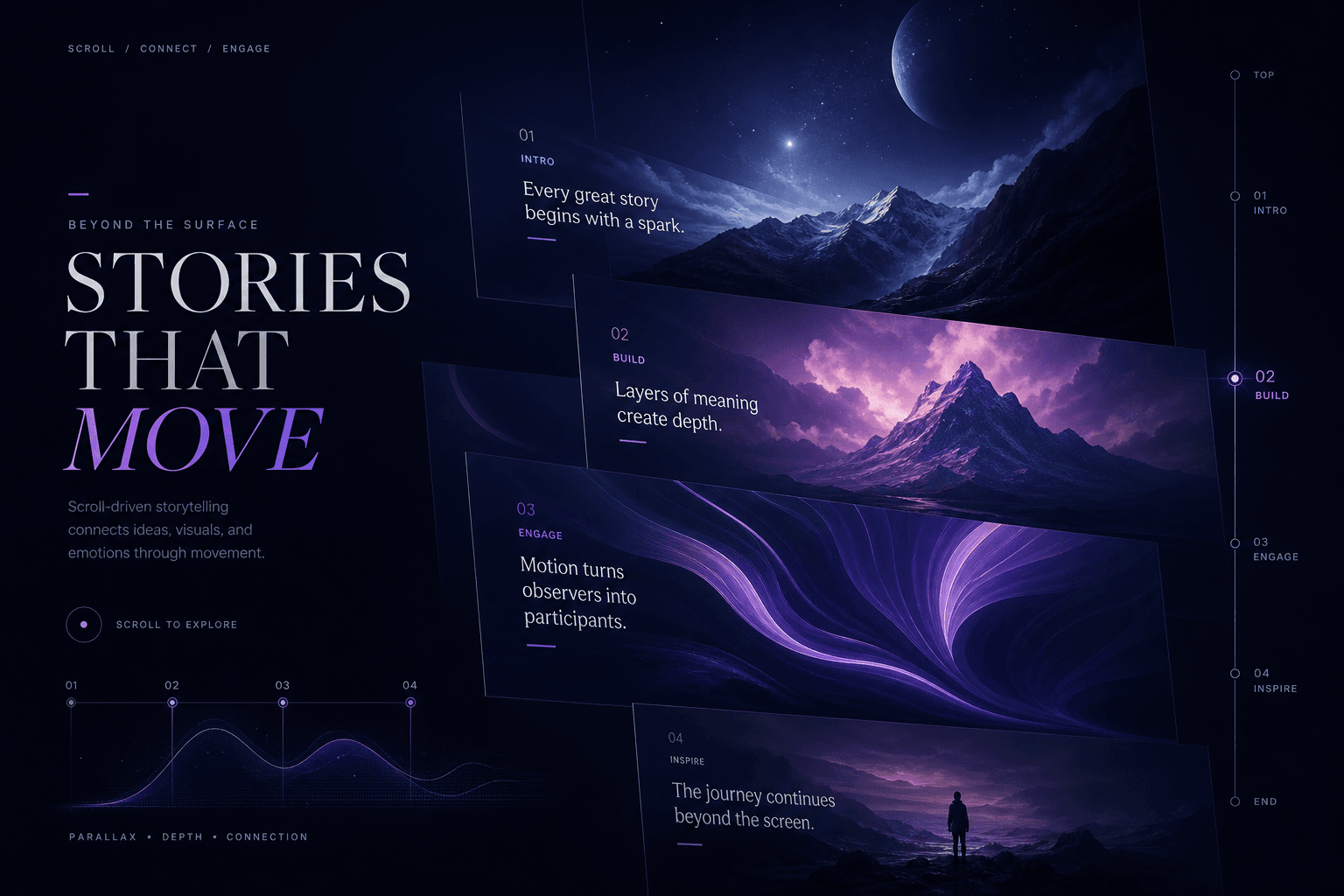
The Scroll Storytelling Playbook: How I Prompted Immersive Animations in Cursor to Drive Massive Conversion Wins

Table of Contents
The Scroll Storytelling Playbook: How I Prompted Immersive Animations in Cursor to Drive Massive Conversion Wins #
What Is Scroll Storytelling and Why Does It Convert? #
Scroll storytelling is a narrative architecture that transforms vertical scrolling into a controlled timeline, revealing content through choreographed motion as users progress down the page. Unlike static websites where users passively consume information, scroll-driven sites create active participation—every scroll gesture triggers a visual response that rewards exploration and deepens engagement.
The core mechanism is simple but powerful: scroll position becomes animation progress. As a user scrolls from 0% to 100% of a section, elements fade, slide, scale, or transform based on that exact progress percentage. This creates a film-like experience where the "viewer" controls the pace through their scroll behavior.
The Architecture of Scrollytelling #
At its foundation, scroll storytelling requires three components working in concert:
| Component | Purpose | Implementation |
|---|---|---|
| Scroll Observer | Monitors scroll position relative to trigger elements | GSAP ScrollTrigger, Intersection Observer API |
| Animation Timeline | Defines what changes and when | CSS animations, GSAP timelines, WebGL shaders |
| Scrubbing Engine | Maps scroll progress to animation progress | scrub: true for 1:1 mapping, scrub: 1 for smooth catch-up |
The transformation from static to scroll-driven isn't merely aesthetic—it's architectural. Traditional web pages present all content simultaneously, creating cognitive overload. Scroll storytelling staggers reveals strategically, guiding attention through a designed narrative arc: attention → context → tension → release → action.
Why Motion Converts #
The conversion impact is measurable. Sites implementing scroll-driven narratives consistently report 20-44% increases in conversion rates compared to static equivalents. The mechanism is psychological: motion triggers dopamine release, and controlled progression creates the illusion of discovery rather than consumption.
When users scroll through a motion-rich experience, several psychological forces activate:
The Zeigarnik Effect: Incomplete sequences create tension that demands resolution. A partially revealed headline or mid-transition element compels continued scrolling.
Variable Reward Scheduling: Like slot machines, unpredictable reveal patterns (staggered timing, varied motion types) trigger dopamine release that reinforces the scrolling behavior.
Agency Illusion: Users believe they're discovering content through their actions, not having it pushed at them. This perceived autonomy increases engagement and receptivity to messaging.
The data supports this psychology. Research from Shopify implementations shows scroll-animated product pages achieve 12% higher conversion rates, while comprehensive motion-rich experiences from agencies report 44% conversion lifts alongside 62% increases in average session duration.
The Premium Positioning Effect #
Beyond conversion metrics, scroll storytelling signals premium quality. When users encounter smooth, choreographed motion, they unconsciously associate the brand with attention to detail and investment in experience. This perception justifies higher price points and creates differentiation in saturated markets.
The investment required—typically 40-80 additional development hours for a comprehensive scroll experience—pays dividends in perceived value. For service businesses, creative agencies, and premium e-commerce, scroll storytelling has become the baseline expectation for category-leading brands.
Scroll storytelling isn't decoration. It's conversion architecture that transforms the most common user interaction—scrolling—into an engagement engine that builds narrative momentum toward action.
The Psychology of Scroll-Driven Narratives #
Scroll-driven narratives exploit fundamental human cognitive biases around motion, completion, and self-determination to increase engagement and conversion. Motion captures attention automatically—our visual systems evolved to prioritize movement as a survival mechanism. Scroll storytelling weaponizes this biological imperative for digital persuasion.
The psychology operates on three levels: attention capture, emotional investment, and behavioral reinforcement. Understanding each layer explains why scroll-driven sites consistently outperform static equivalents on metrics that matter.
Attention Capture: The Visual System's Motion Priority #
The human brain processes motion through dedicated neural pathways that bypass conscious filtering. When an element animates into view, it triggers an involuntary orienting response—a brief, automatic shift of attention. This response happens in 50-150 milliseconds, before the user makes any conscious decision about where to look.
Static websites compete for attention within crowded visual fields. Scroll-driven sites own attention through motion. Each scroll-triggered reveal hijacks the visual priority system, ensuring critical messages receive processing resources. This isn't manipulation—it's architectural attention management that respects cognitive limits by sequencing information rather than overwhelming with simultaneity.
The Progress Principle and Completion Drive #
Humans are completion-seeking creatures. The Zeigarnik effect—our tendency to remember incomplete tasks better than completed ones—drives us to finish what we've started. Scroll storytelling leverages this by creating "narrative incompleteness" at strategic intervals.
Consider this progression architecture:
| Scroll Position | Narrative State | Psychological Trigger |
|---|---|---|
| 0-20% | Hero reveal, value proposition | Curiosity activation |
| 20-40% | Problem agitation, stakes establishment | Emotional investment |
| 40-60% | Solution introduction, proof elements | Credibility building |
| 60-80% | Social proof, objection handling | Trust consolidation |
| 80-100% | Call-to-action, conversion moment | Action facilitation |
Each section ends with a visual or narrative hook that implies continuation—a partially revealed testimonial, a stat that "builds" to its final number, a product feature that rotates to show the next angle. These incomplete moments create mild cognitive tension that compels continued scrolling.
Agency Illusion and Self-Determination Theory #
Self-determination theory identifies autonomy as a core psychological need. When users feel coerced, they resist. When they feel in control, they engage. Scroll storytelling creates the powerful illusion that users are discovering content through their own exploration rather than receiving predetermined messaging.
The scroll gesture itself reinforces this autonomy. Unlike auto-playing videos or intrusive popups, scroll-driven content responds to user-initiated action. The timing, pace, and even direction (scroll up to reverse) remain under user control. This perceived agency increases receptivity to the underlying message—users attribute their engagement to personal interest rather than external manipulation.
Research from behavioral economics confirms this effect: choices made under conditions of perceived autonomy generate higher satisfaction and commitment than identical choices presented without autonomy cues. Scroll-driven sites convert better partly because users believe the conversion was their idea.
Dopaminergic Reward Scheduling #
Variable reward schedules—intermittent, unpredictable rewards—generate the strongest behavioral reinforcement. This is why slot machines addict and why social media feeds scroll infinitely. Scroll storytelling applies this principle through choreographed reveal patterns.
Effective scroll narratives vary their reward timing:
- Immediate rewards: Quick fades on minor elements (icons, labels) provide instant feedback
- Delayed rewards: Major content reveals after sustained scrolling build anticipation
- Staggered rewards: Sequences where multiple elements reveal in waves create complexity
- Surprise rewards: Unexpected motion directions or transformation types interrupt pattern recognition
This variation maintains dopamine release throughout the experience. Static sites front-load all information, generating a single attention spike followed by declining engagement. Scroll-driven sites distribute dopamine hits across the entire journey, sustaining attention through to conversion points.
The Scroll Depth → Conversion Correlation #
Users who scroll deeper convert at significantly higher rates—this correlation is among the most reliable in conversion optimization. Data from multiple e-commerce implementations shows that users reaching the 75% scroll depth mark convert 2-3x more frequently than those who bounce before 50%.
Scroll storytelling directly addresses this by making deeper scrolling rewarding. Every additional viewport of content provides novel motion experiences, new information reveals, or interactive moments. The journey down the page becomes intrinsically motivating rather than a chore required to reach the CTA.
This transforms the funnel architecture. Traditional sites fight to push users toward conversion through repetitive CTAs, exit-intent popups, and aggressive retargeting. Scroll-driven sites pull users through narrative gravity—the experience itself creates momentum that carries users naturally toward action.
The psychological stack—attention capture, completion drive, agency illusion, dopamine scheduling, and depth correlation—explains why scroll storytelling outperforms. It doesn't just look better. It cognitive-architecturally out-engineers static approaches by aligning with how human attention, motivation, and decision-making actually work.
GSAP ScrollTrigger Architecture Fundamentals #
GSAP ScrollTrigger is the industry-standard engine for scroll-driven animation, providing precise control over the relationship between scroll position and animation progress. While CSS scroll-driven animations have improved, ScrollTrigger remains the only solution offering production-grade pinning, scrubbing with velocity smoothing, and timeline integration for complex narrative sequences.
Understanding ScrollTrigger's architecture requires grasping three core concepts: triggers (where animations activate), scrubbing (how scroll maps to progress), and pinning (controlling the viewport during scroll-driven sequences).
The Trigger-Timeline Relationship #
Every ScrollTrigger animation begins with a trigger element—a DOM node that defines when and where the animation executes. The trigger creates a coordinate system where scroll position maps to animation progress.
Cursor Prompt Template:
Set up GSAP ScrollTrigger and create a basic trigger configuration.
Import gsap from "gsap" and ScrollTrigger from "gsap/ScrollTrigger".
Register the ScrollTrigger plugin.
Create an animation targeting ".animated-element" that animates to opacity 1 and y: 0.
Configure ScrollTrigger with:
  - trigger: ".section-container"
  - start: "top 80%" (when trigger's top hits 80% of viewport)
  - end: "bottom 20%" (when trigger's bottom hits 20% of viewport)
  - markers: true (for debugging, remove in production)
Set animation duration to 1 second.
AI-Generated Architecture Blueprint:
- Library setup: GSAP core + ScrollTrigger plugin registration
- Trigger element:
.section-containerdefines animation boundaries - Start point: Element entering viewport at 80% position
- End point: Element leaving viewport at 20% position
- Animation target:
.animated-elementwith opacity and transform - Debug mode: Visual markers show trigger positions during development
The start and end values use a position:position syntax where the first value describes the trigger element and the second describes the viewport. Common configurations:
| Start Value | Meaning | Use Case |
|---|---|---|
"top 80%" |
Trigger's top hits 80% down viewport | Entrance animations |
"top center" |
Trigger's top hits viewport center | Mid-section reveals |
"center center" |
Trigger's center hits viewport center | Full-visibility triggers |
"top top" |
Trigger's top hits viewport top | Pinning start points |
Scrubbed vs. Triggered Animations #
ScrollTrigger offers two fundamental animation modes that serve different narrative purposes:
Triggered Animations (toggleActions) play once when the scroll position crosses a threshold. They're ideal for entrance effects and one-time reveals.
Cursor Prompt Template:
Create a GSAP ScrollTrigger entrance animation for elements with class "reveal-card".
Use toggleActions "play none none reverse" so animations play on enter and reverse on exit.
Animate from opacity 0 with y: 60px translate, duration 0.8s, power2.out easing.
Trigger at "top 85%" viewport position.
AI-Generated Architecture Blueprint:
- Animation target: Elements matching
.reveal-card - Trigger condition: Element top hits 85% down viewport
- Toggle actions: Play on enter, none on leave, none on re-enter, reverse on exit
- Animation properties: Opacity 0→1, translateY 60px→0
- Timing: 0.8s duration, power2.out easing
Scrubbed Animations (scrub: true or scrub: 1) bind animation progress directly to scroll position, creating a timeline that users control through scrolling.
Cursor Prompt Template:
Create a parallax scroll animation for elements with class "parallax-layer".
Use scrub: 1 for 1-second smoothing between scroll and animation.
Animate y position -200px over the full scroll distance of the section.
Set ease: "none" (critical for scrubbed animations).
Trigger from "top bottom" to "bottom top".
AI-Generated Architecture Blueprint:
- Animation target:
.parallax-layerelements - Scroll mapping: Section enters viewport (top at bottom) to section exits (bottom at top)
- Scrub smoothing: 1 second lag for natural feel
- Transform: Vertical translation -200px over scroll distance
- Easing: None (direct scroll-to-progress mapping)
Critical rule: Always disable easing on scrubbed animations. Easing functions fight against the direct scroll-to-progress mapping, creating visual inconsistency.
The Pinning Architecture #
Pinning is ScrollTrigger's most powerful feature for scroll storytelling. It temporarily fixes the viewport to a specific scroll position while content animates, then releases when the animation completes.
Cursor Prompt Template:
Create a pinned scroll section with class "pinned-section".
Pin the section for 2000px of scroll distance with scrub: 1 for smooth progress.
Build a 4-phase narrative timeline:
  Phase 1 (0-25%): Fade in headline from opacity 0, y: 50
  Phase 2 (25-50%): Fade in subhead with 0.2s delay
  Phase 3 (50-75%): Scale and rotate feature-image (1.2x scale, 5deg rotation)
  Phase 4 (75-100%): Reveal CTA button with opacity and scale animation
Add snap points at 0%, 25%, 50%, 75%, 100% with 0.2-0.5s snap duration.
AI-Generated Architecture Blueprint:
- Pin trigger:
.pinned-sectionelement - Pin duration: 2000px of scroll distance
- Progress smoothing: scrub: 1
- 4-phase narrative timeline:
- Phase 1: Headline entrance (fade + slide up)
- Phase 2: Subhead entrance (staggered fade)
- Phase 3: Feature image transformation (scale + rotation)
- Phase 4: CTA reveal (opacity + scale)
- Snap configuration: Progress snaps to labeled timeline points
Pinning creates the "scrollytelling" effect seen on award-winning sites: the user scrolls, but the viewport stays fixed while content transforms. This decouples narrative time from scroll distance, allowing complex sequences that would be impossible during normal scroll velocity.
Batch Processing for Performance #
Creating individual ScrollTriggers for dozens of elements destroys performance. Batch processing groups similar animations to share trigger logic:
Cursor Prompt Template:
Implement ScrollTrigger batch processing for card elements with class "card".
Group elements in batches of max 3 with 0.1s interval window.
On batch enter: Animate to opacity 1, y: 0 with 0.15s stagger between cards.
On batch leave (backwards): Animate to opacity 0, y: 30px.
Use overwrite: true to prevent animation conflicts.
AI-Generated Architecture Blueprint:
- Target selector:
.cardelements - Batching parameters:
- Interval window: 0.1 seconds
- Maximum batch size: 3 elements
- Enter animation: Opacity 0→1, translateY reset, 0.15s stagger
- Exit animation (scroll back): Opacity 1→0, translateY 30px
- Conflict resolution: overwrite: true
Batching reduces memory overhead and improves scroll performance, especially on mobile devices with limited resources.
Responsive ScrollTrigger with matchMedia() #
Scroll experiences must adapt to viewport dimensions. gsap.matchMedia() provides breakpoint-aware animation configurations:
Cursor Prompt Template:
Create responsive ScrollTrigger configurations using gsap.matchMedia().
Desktop breakpoint (min-width: 1024px): Complex pinned hero sequence
  - Pin hero section
  - 3000px scroll distance
  - Animate desktop-element with x: 500px translate and 1.5x scale
Mobile breakpoint (max-width: 1023px): Simplified fade sequence
  - No pinning
  - Simple fade entrance at "top 80%"
  - y: 30px translate, 0.6s duration
Both breakpoints must return cleanup functions.
AI-Generated Architecture Blueprint:
- Media query structure: Desktop (1024px+) vs Mobile (1023px-)
- Desktop configuration:
- Pinned hero with 3000px scroll distance
- Complex transform animations (translate + scale)
- Mobile configuration:
- Simple entrance animations (no pinning)
- Reduced motion complexity
- Cleanup: Both contexts return cleanup functions for memory management
The normalizeScroll() Consideration #
Mobile browsers handle scroll events differently than desktop, often introducing momentum scrolling that breaks precise scroll-to-animation mapping. ScrollTrigger's normalizeScroll() addresses this:
Cursor Prompt Template:
Configure ScrollTrigger.normalizeScroll() for consistent mobile scroll behavior.
Enable allowNestedScroll for scrollable child containers.
Enable lockAxis to prevent simultaneous X/Y scrolling.
Set custom momentum function: velocity * 0.8, capped at 1000.
AI-Generated Architecture Blueprint:
- Nested scroll support: Enabled for child containers
- Axis locking: Prevents diagonal scroll conflicts
- Momentum function: Custom multiplier (0.8x) with velocity cap (1000)
For production scroll experiences targeting mobile users, normalizeScroll() is essential for consistent animation behavior across platforms.
React and Next.js Integration #
Modern scroll experiences are typically built in React. The @gsap/react package provides the useGSAP hook for automatic cleanup:
Cursor Prompt Template:
Create a React scroll section component using @gsap/react useGSAP hook.
Use useRef for container reference.
Implement scoped GSAP animation that triggers at "top 70%" of container.
Animate elements with class "reveal" from opacity 0 with 0.1s stagger.
Ensure automatic cleanup on component unmount.
Return JSX with ref attached to container div.
AI-Generated Architecture Blueprint:
- Hook: useGSAP from @gsap/react package
- Container: useRef for DOM reference
- Animation scope: Limited to containerRef only
- Animation: Entrance fades with stagger for
.revealelements - Lifecycle: Automatic cleanup on unmount (prevents memory leaks)
The useGSAP hook automatically handles cleanup when components unmount, preventing memory leaks in single-page applications.
ScrollTrigger's architecture—triggers, scrubbing, pinning, batching, and responsive configurations—provides the complete toolkit for production scroll storytelling. These primitives, combined thoughtfully, enable the narrative experiences that justify premium positioning and drive conversion lifts.
Pacing and Anchoring: The Rhythm of Scrollytelling #
Pacing in scroll storytelling is the deliberate choreography of scroll distance against narrative beats, creating rhythm through variation in motion intensity, duration, and reveal density. Just as film editors control pacing through shot length and transition speed, scroll experiences must modulate their "scroll density"—how much narrative content maps to each pixel of vertical movement.
Poorly paced scroll experiences feel monotonous or exhausting. The user either scrolls through endless content with nothing happening, or faces constant motion chaos that induces fatigue. Effective pacing follows narrative arc principles: establish, escalate, climax, resolve.
Scroll Distance as Narrative Time #
In scroll storytelling, distance equals time. The longer the scroll distance allocated to a narrative beat, the more "screen time" that element receives. This allocation must follow narrative priority, not content volume.
Consider a typical conversion funnel narrative:
| Narrative Phase | Scroll Distance | Motion Intensity | Purpose |
|---|---|---|---|
| Hook (Hero) | 100vh | High impact, fast | Capture attention |
| Agitation (Problem) | 150vh | Medium, building | Create tension |
| Solution (Features) | 200vh | Varied, complex | Deliver value |
| Proof (Social) | 100vh | Low, steady | Build trust |
| Action (CTA) | 50vh | High, focused | Drive conversion |
Notice the pattern: more scroll distance for complex content, less for focused CTAs. The solution phase receives maximum scroll allocation because it's where users need time to process and believe. The CTA phase receives minimal distance because it requires quick, decisive action without overthinking.
The Pacing Rhythm: Variation Creates Interest #
Consistent motion speed creates monotony. Effective scroll storytelling varies pacing through three techniques:
Velocity Changes: Varying
scrubvalues across sectionsscrub: 0.5for fast, punchy revealsscrub: 2for slow, contemplative momentsscrub: true(1:1) for precise control sections
Reveal Density: Controlling how many elements animate per viewport
- Low density (1-2 elements): Calm, premium feel
- High density (5+ elements): Energetic, dynamic feel
- Variable density: Emotional modulation
Transition Types: Alternating animation patterns
- Fade reveals: Low energy, informational
- Slide reveals: Medium energy, directional
- Scale reveals: High energy, emphatic
- Parallax layers: Depth, sophistication
Cursor Prompt Template:
Create a multi-section scroll experience with alternating scrub speeds for pacing variation.
Select all elements with class "story-section" and iterate through them.
Assign alternating scrub values [0.5, 2, 1, 3] to create rhythm:
  - 0.5: Fast, punchy reveals
  - 2: Slow, contemplative moments
  - 1: Balanced pacing
  - 3: Dramatic, tension-building sections
For each section: Pin at "top top" for 1500px scroll distance.
Animate headline from opacity 0, y: 50 and content with 0.3s stagger.
AI-Generated Architecture Blueprint:
- Section selection:
.story-sectionelements array - Scrub speed rotation: [0.5, 2, 1, 3] pattern creates narrative rhythm
- Pin configuration: "top top" trigger, 1500px duration per section
- Animation sequence: Headline entrance → Content fade (staggered)
- Pacing effect: Alternating fast/slow sections create emotional modulation
Anchoring with Snap Points #
Anchoring prevents users from stopping scroll at awkward mid-animation positions. Without anchoring, a visitor might pause with elements half-visible, half-transparent, or mid-transition—creating a broken visual state that undermines professionalism.
ScrollTrigger's snap feature solves this by automatically adjusting scroll position to complete animation states when scrolling stops:
Cursor Prompt Template:
Create a ScrollTrigger snap configuration for an anchored section with class "anchored-section".
Pin the section at "top top" for 3000px with scrub: 1 smoothing.
Implement custom snap function that:
  - Defines snap points at 0%, 25%, 50%, 75%, 100% of scroll progress
  - Uses gsap.utils.snap to find nearest valid snap point
  - Sets snap duration between 0.15-0.35 seconds
  - Uses immediate snap (delay: 0) with power2.out easing
AI-Generated Architecture Blueprint:
- Pin trigger:
.anchored-section - Pin duration: 3000px scroll distance
- Snap algorithm: Custom function mapping progress to predefined points
- Snap points: [0, 0.25, 0.5, 0.75, 1] representing narrative beats
- Snap timing: 0.15-0.35s duration, immediate trigger, smooth ease-out
Snap point strategy: Align snaps to narrative beats, not arbitrary intervals. Each snap position should represent a complete visual state where all elements are either fully revealed or fully hidden—not mid-transition.
Building Anticipation Through Scroll Distance #
Anticipation is the psychological preparation for upcoming events. In scroll storytelling, anticipation is built by requiring sustained scroll effort before major reveals.
Cursor Prompt Template:
Create a 4-phase anticipation timeline for section with class "anticipation-section".
Pin at "top top" for 4000px scroll distance with scrub: 1 smoothing.
Build narrative arc across phases:
  Phase 1 (0-25%): Foreshadowing - hint-element fades to 0.3 opacity
  Phase 2 (25-60%): Escalation - hint-element to 0.6 opacity + 1.1 scale, tension-indicator rotates 15deg
  Phase 3 (60-75%): Climax - major-reveal scales to 1, y: 0, full opacity
  Phase 4 (75-100%): Resolution - supporting-content elements stagger fade in
Use GSAP timeline with absolute positioning for precise phase control.
AI-Generated Architecture Blueprint:
- Pin duration: 4000px (extended for tension building)
- 4-phase narrative structure:
- Phase 1: Foreshadowing (subtle hint appearance)
- Phase 2: Escalation (intensity increase with scale + rotation)
- Phase 3: Climax (major content reveal with snap timing)
- Phase 4: Resolution (supporting elements stagger in)
- Timeline positioning: Absolute time values for precise phase boundaries
This structure mirrors classical narrative arcs: foreshadowing creates curiosity, escalation builds tension, climax delivers the payoff, and resolution provides closure before the next sequence.
The Release Pattern: Giving Users Rest #
Sustained intensity creates fatigue. Effective scroll experiences include "rest zones"—sections with minimal or no animation where users can recover processing capacity.
| Section Type | Motion Level | Duration | Purpose |
|---|---|---|---|
| Intense Sequence | High | 150vh | Engagement peak |
| Rest Zone | Minimal | 100vh | Cognitive recovery |
| Medium Sequence | Medium | 150vh | Sustained interest |
| Rest Zone | Minimal | 80vh | Preparation for climax |
| Climax Sequence | Very High | 120vh | Conversion drive |
Rest zones don't mean static content—they mean predictable, low-effort content. Simple fade-ins, clean typography, generous whitespace. The contrast between intense and rest sections creates a breathing rhythm that extends session duration.
Measuring Pacing Effectiveness #
Analytics reveal pacing problems. Track these metrics to diagnose issues:
- Scroll depth distribution: Users clustering at specific points indicates snap or reveal issues
- Session duration by section: Exits during high-intensity sections suggest pacing fatigue
- Return scrolling: Users scrolling back up indicates confusion or desire to re-read—often from moving too fast
A/B testing pacing variations often reveals counterintuitive results: slower pacing frequently outperforms faster pacing, even with shorter session durations, because comprehension improves and decision quality increases.
Pacing and anchoring transform scroll experiences from technical demonstrations into narrative art. The rhythm of reveal, rest, and climax guides users through designed emotional arcs that prepare them for conversion moments. Master these elements, and scroll becomes a medium for persuasion, not just presentation.
Reveal Patterns: Fade, Slide, Scale, and Parallax #
Reveal patterns are the fundamental visual vocabulary of scroll storytelling—the specific motion types that transform hidden elements into visible content. While infinite animation variations exist, four patterns form the foundation: fade, slide, scale, and parallax. Mastery of these four, and their strategic combinations, enables sophisticated scroll experiences without visual chaos.
Each pattern carries distinct psychological weight and appropriate use cases. Understanding when to deploy each type separates professional scroll storytelling from amateur attempts that feel random or overwhelming.
Pattern 1: Fade Reveals #
Fade reveals (opacity transitions) are the most subtle pattern, making them ideal for text-heavy content where motion shouldn't compete with readability. They're also the most performant—opacity changes are GPU-accelerated and cause no layout thrashing.
Cursor Prompt Template:
Create a subtle fade reveal animation for elements with class "fade-reveal".
Trigger at "top 85%" viewport position with toggleActions for reverse on exit.
Animate from opacity 0 with slight y: 20px upward movement.
Duration: 0.8s with power2.out easing for smooth deceleration.
AI-Generated Architecture Blueprint:
- Animation type: Fade + micro-slide entrance
- Trigger: Element top at 85% viewport
- Reverse behavior: Animates out when scrolling back up
- Transform: Subtle 20px vertical offset (readable, not distracting)
- Timing: 0.8s duration with smooth ease-out
When to use fade reveals:
- Body text and long-form content
- Background elements and secondary information
- When multiple elements animate simultaneously
- For "rest zone" sections with minimal motion
When to avoid:
- Primary CTAs (needs more emphasis)
- Hero content (too subtle for first impressions)
- Single-element focal points (feels underwhelming)
Pattern 2: Slide Reveals #
Slide reveals introduce directional movement, creating dynamic energy and implying progression. The direction matters: upward slides suggest ascension/positive momentum, downward slides suggest grounding, horizontal slides suggest lateral relationships.
Cursor Prompt Template:
Create a multi-directional slide reveal system with three variants:
1. Slide-up elements (class "slide-up"): Animate from y: 60px, trigger at "top 85%", 0.7s duration, power3.out
2. Slide-left elements (class "slide-left"): Animate from x: -80px, trigger at "top 80%", 0.8s duration, power3.out
3. Card grid batch animation: Target ".card-grid .card", batch enter with stagger 0.1s, y: 40px, 0.6s duration
Use gsap.utils.toArray for individual element processing and ScrollTrigger.batch for grid animations.
AI-Generated Architecture Blueprint:
- Slide-up variant: Vertical entrance (60px offset), moderate speed
- Slide-left variant: Horizontal entrance (80px leftward offset), slightly longer duration
- Card grid variant: Batched processing with staggered timing
- Easing: power3.out for individual slides, power2.out for grid
- Performance: Batch processing for grids to minimize trigger count
Directional psychology:
| Direction | Psychological Association | Best For |
|---|---|---|
y: -60 (downward) |
Revelation, arrival | Headers, hero content |
y: 60 (upward) |
Ascension, growth | Success metrics, results |
x: -80 (rightward) |
Forward progress | Process steps, timelines |
x: 80 (leftward) |
Return, reflection | Testimonials, history |
Pattern 3: Scale Reveals #
Scale reveals (size transformations) create emphasis through dimensional change. They're the most attention-grabbing pattern, making them perfect for critical conversion elements and hero content—but dangerous when overused.
Cursor Prompt Template:
Create two scale reveal animations:
1. Hero headline (class "hero-headline"): Scale from 0.8x to 1x with elastic bounce effect (elastic.out 1, 0.5), 1s duration, trigger at "top 70%"
2. CTA button (class "cta-button"): Scale from 0.9x to 1x with back easing (back.out 1.7), 0.6s duration, trigger at "top 80%" of ".cta-section"
Both include opacity 0→1 fade with scale transformation.
AI-Generated Architecture Blueprint:
- Hero headline: Dramatic elastic reveal (attention-grabbing, energetic)
- CTA button: Subtle back-ease reveal (confident, actionable)
- Scale ranges: 0.8-1.0 for hero, 0.9-1.0 for button
- Easing psychology: Elastic for excitement, back for confidence
- Timing: Longer duration (1s) for hero, snappier (0.6s) for CTA
Scale reveal guidelines:
- Use
scale: 0.8toscale: 0.95for subtle emphasis - Use
scale: 1.05toscale: 1.1for "pop" effects on hover/active states - Always combine with opacity fade for smoother appearance
- Avoid scaling text larger than
scale: 1.2to prevent quality degradation
Pattern 4: Parallax Layers #
Parallax creates depth perception by moving background and foreground elements at different speeds during scroll. This simulates real-world depth cues where distant objects appear to move slower than close objects.
Cursor Prompt Template:
Create a multi-layer parallax system for container with class "parallax-container".
Define 4 depth layers with varying scroll speeds:
  - Background (".bg-layer"): speed 0.2 - slowest, most distant
  - Midground (".mid-layer"): speed 0.5 - medium speed
  - Content (".content-layer"): speed 1.0 - normal scroll
  - Foreground (".fg-layer"): speed 1.3 - fastest, closest
Each layer animates y position based on speed multiplier (-speed * 100px).
Use scrub: true for direct scroll-to-position mapping.
Trigger from "top bottom" to "bottom top" (full viewport traversal).
AI-Generated Architecture Blueprint:
- 4-layer depth hierarchy with speed-based parallax
- Depth perception: Slower movement = greater perceived distance
- Speed ranges: 0.2 (deep background) to 1.3 (foreground overlay)
- Transform: Vertical movement proportional to layer speed
- Scrub mapping: Direct scroll-to-animation for smooth feel
- Trigger: Full container viewport lifecycle
Parallax speed guidelines:
| Speed Factor | Movement | Depth Perception |
|---|---|---|
| 0.1 - 0.3 | Very slow | Deep background |
| 0.4 - 0.6 | Slow | Mid-ground |
| 0.7 - 1.0 | Normal | Content layer |
| 1.1 - 1.5 | Fast | Foreground elements |
| 1.5+ | Very fast | Floating/overlay elements |
Critical parallax rule: Never exceed speed: 2 for foreground elements. Extreme parallax creates motion sickness and feels unnatural.
Combining Patterns for Layered Depth #
Single-pattern scroll experiences feel flat. Sophisticated storytelling combines patterns in layered sequences that create depth without chaos.
Cursor Prompt Template:
Create a layered reveal timeline combining multiple motion patterns.
Target section with class "layered-section", trigger from "top 80%" to "top 30%", scrub: 1.
Build 3-layer sequence:
  Layer 1 (Background): bg-image fades in with y: 50 parallax at timeline 0
  Layer 2 (Midground): content-block slides from x: -60 with fade at timeline 0.2
  Layer 3 (Foreground): key-stat scales from 0.85x with fade at timeline 0.4
Use GSAP timeline with absolute positioning for coordinated choreography.
AI-Generated Architecture Blueprint:
- Multi-layer composition: Background + Midground + Foreground
- Layer 1: Parallax fade (subtle depth cue)
- Layer 2: Horizontal slide (directional interest)
- Layer 3: Scale emphasis (focal point highlight)
- Timeline coordination: Staggered absolute positioning (0, 0.2, 0.4)
- Scrub smoothing: 1-second lag for natural scroll following
Combination principles:
One primary, one secondary: Each section should have one dominant pattern and one supporting pattern. Avoid three or more simultaneous pattern types.
Offset timing: Combine patterns with staggered start times (0.2s gaps) rather than simultaneous execution.
Consistent direction: If sliding multiple elements, keep direction consistent (all left-to-right or all bottom-to-top) within a section.
Vary by section: Change the primary pattern between sections to maintain interest. Section 1: slide-primary. Section 2: scale-primary. Section 3: parallax-primary.
The Pattern Decision Matrix #
| Content Type | Primary Pattern | Secondary Pattern | Rationale |
|---|---|---|---|
| Hero/Above-fold | Scale | Fade | Immediate impact |
| Feature list | Slide | Fade | Sequential processing |
| Data/stats | Scale | Parallax | Emphasis + depth |
| Testimonials | Slide | Fade | Trust building |
| Process steps | Parallax | Slide | Journey metaphor |
| CTA section | Scale | Slide | Urgency + direction |
Anti-Patterns to Avoid #
The Chaos Trap: Combining all four patterns simultaneously within one viewport. This creates visual noise that overwhelms users and destroys comprehension.
The Uniformity Trap: Using the same pattern (usually fade) for every element. This creates monotony that fails to guide attention.
The Direction Conflict: Elements sliding in contradictory directions (some left, some right, some up). This feels disorienting and unprofessional.
The Overscale: Using scale: 2 or greater for reveals. This causes pixelation on images and readability issues on text.
Reveal patterns are the vocabulary, but choreography is the grammar. The specific patterns matter less than their timing, combination, and consistency. Master the four foundations—fade, slide, scale, and parallax—and you possess the complete motion vocabulary needed for world-class scroll storytelling.
Typography in Motion: Kinetic Type Systems #
Typography in motion transforms static text into dynamic narrative elements, amplifying message impact through choreographed reveal sequences. Kinetic type isn't decoration—it's information architecture that controls reading pace, emphasizes hierarchy, and creates emotional resonance through temporal typography.
The challenge: motion must enhance readability, not hinder it. Every typographic animation must answer whether it helps users process information faster and remember it longer. If the answer is no, the animation shouldn't exist.
The SplitText Pattern: Character-by-Character Reveals #
GSAP's SplitText plugin (Club GreenSock benefit) breaks text into characters, words, and lines for granular animation control. This creates cinematic title sequences that command attention.
Cursor Prompt Template:
Create a character-by-character reveal animation using GSAP SplitText for hero headline.
Import SplitText from "gsap/SplitText".
Split text by characters with type "chars".
Animate from opacity 0 with y: 50px offset and rotationX: -90deg.
Stagger each character at 0.02s intervals.
Duration: 0.6s with back.out(1.7) easing for elastic finish.
Trigger at "top 80%" viewport position.
AI-Generated Architecture Blueprint:
- Import: SplitText from gsap/SplitText (Club GreenSock plugin)
- Text splitting: Character-level segmentation using SplitText plugin
- Animation properties: Opacity fade, vertical translation, 3D rotation
- Stagger timing: 20ms between characters for fluid cascade
- 3D effect: rotationX creates perspective flip illusion
- Easing: Back easing adds subtle bounce for energy
When to use character reveals:
- Hero headlines (maximum impact)
- Key statistics and numbers
- Short CTAs (3-5 words maximum)
- Brand names and taglines
When to avoid:
- Body text (fatiguing to read)
- Long headlines (creates excessive wait time)
- Paragraph content (distracts from comprehension)
Word-Level Stagger: Readable Rhythm #
For longer headlines, word-level reveals maintain readability while adding motion interest. This approach respects reading flow better than character-level animation.
Cursor Prompt Template:
Create a word-by-word reveal animation using GSAP SplitText for subheadlines.
Split text by words with type "words".
Animate from opacity 0 with y: 30px offset.
Stagger each word at 0.08s intervals (readable rhythm).
Duration: 0.5s with power2.out easing.
Trigger at "top 85%" viewport position.
AI-Generated Architecture Blueprint:
- Text splitting: Word-level segmentation for readable flow
- Animation: Subtle vertical slide with opacity fade
- Stagger: 80ms between words (slower than character reveals)
- Timing: 0.5s per word for comfortable reading pace
- Use case: Subheadlines where character animation would be excessive
Word reveal timing guidelines:
| Headline Length | Stagger Delay | Total Reveal Time | Use Case |
|---|---|---|---|
| 3-5 words | 0.1s | 0.5-0.8s | CTAs, short headlines |
| 6-10 words | 0.08s | 0.8-1.2s | Subheadlines |
| 10-15 words | 0.05s | 1.0-1.5s | Longer taglines |
Line Masking: The Paragraph Reveal #
For body text, line masking reveals content line-by-line without breaking reading flow. This maintains the paragraph structure while adding temporal control.
Cursor Prompt Template:
Create a line-by-line paragraph reveal using GSAP SplitText with line masking.
Split body text by lines with type "lines".
For each line: Create overflow:hidden wrapper div, insert before line, append line to wrapper (creates mask).
Animate lines from y: 100% with opacity 0.3 using scrub: 1.
Stagger lines at 0.1s intervals for reading pace effect.
Scroll trigger from "top 85%" to "top 50%" (scroll-linked progress).
AI-Generated Architecture Blueprint:
- Text splitting: Line-level segmentation
- Masking: Overflow-hidden wrappers enable clipping reveal
- Scroll-linked: Scrub animation tied to scroll progress
- Transform: Vertical translation from 100% (below mask) to 0%
- Opacity: Never fully transparent (0.3 minimum for legibility)
- Stagger: 100ms between lines creates natural reading rhythm
Line masking creates a "reading pace" effect—users naturally follow the reveal line-by-line, increasing comprehension and retention compared to instant paragraph displays.
Variable Fonts in Scroll Context #
Variable fonts enable weight, width, and slant adjustments through animation, creating responsive typography that morphs during scroll. This is premium territory—few sites use variable fonts well, making them a differentiation opportunity.
Cursor Prompt Template:
Create two variable font scroll animations:
1. Weight animation: Animate headline (".variable-headline") fontWeight from default to 100 (thin) with letterSpacing 0.05em. Scrub from "top 80%" to "bottom 20%".
2. Width axis animation: Select ".width-variable", pin at "center center" for 500px scroll, animate fontStretch to 150% and scale to 1.1x.
Both use scrub: 1 for scroll-linked progress and ease: "none".
AI-Generated Architecture Blueprint:
- Variable font axes: Weight (wght) and Width (wdth) animation
- Scroll-linked: Scrub-based progress mapping
- Animation 1: Progressive weight reduction creates "thinning" effect
- Animation 2: Pinned section with width expansion + scale
- Requirements: Variable font support (Inter, Roboto Flex, etc.)
- Performance: CSS font-variation-settings updates (GPU-accelerated)
Recommended variable fonts for scroll experiences:
| Font | Available Axes | Best For |
|---|---|---|
| Inter | wght | Body text, UI |
| Roboto Flex | wght, wdth, slnt, opsz | Versatile system |
| Satoshi | wght | Modern display |
| Outfit | wght | Geometric headlines |
| Source Sans 3 | wght | Editorial content |
Typography Performance: The Readability Threshold #
Motion must never compromise legibility. Establish these constraints:
- Minimum opacity during animation: 0.3 (never fade completely to 0 before reveal)
- Maximum movement distance: 50px for headlines, 30px for body text
- Maximum rotation: 15 degrees (beyond this, text becomes difficult to read)
- Minimum animation duration: 0.3s (faster becomes jarring)
Cursor Prompt Template:
Create readability-safe text reveal animations following these constraints:
- Minimum opacity: 0.3 (never fade completely to 0)
- Maximum movement: 30px vertical offset
- Duration: 0.5s minimum for comfortable reading
- Trigger: "top 85%" for advance notice
- Easing: power2.out for smooth deceleration
Apply to elements with class "readable-text".
AI-Generated Architecture Blueprint:
- Opacity floor: 0.3 minimum maintains text presence during animation
- Movement limit: 30px prevents jarring displacement
- Timing: 0.5s duration respects reading comfort threshold
- Easing: Smooth deceleration prevents harsh stops
- Trigger timing: Early activation gives users time to adjust
Kinetic Type Hierarchy #
Different typographic elements deserve different motion treatment based on their hierarchy:
| Element | Motion Type | Intensity | Timing |
|---|---|---|---|
| H1 (Hero) | Character stagger | High | 0.8-1.2s |
| H2 (Section) | Word stagger | Medium | 0.5-0.8s |
| H3 (Subsection) | Line fade | Low-Medium | 0.4-0.6s |
| Body | Line mask | Low | 0.3-0.5s |
| Caption | Simple fade | Minimal | 0.3s |
| CTA | Scale + word stagger | High | 0.5-0.7s |
This hierarchy ensures that motion amplifies information architecture rather than creating random visual noise.
The Temporal Reading Curve #
Text reveals should follow a decelerating curve—fast initial reveals that slow as content becomes denser. This mirrors natural reading behavior where headlines are scanned quickly and body text requires slower processing.
Cursor Prompt Template:
Create a decelerating typography reveal sequence using GSAP timeline.
Trigger at "top 70%" of ".content-section".
Build 3-phase hierarchy:
  Phase 1 (t=0): H1 headline - fast reveal (0.6s), y: 40, scan-speed
  Phase 2 (t=0.3): H2 subhead - medium reveal (0.5s), y: 30
  Phase 3 (t=0.5): Body paragraphs - slower reveals (0.4s each), y: 20, 0.15s stagger
Use absolute timeline positioning for precise control.
AI-Generated Architecture Blueprint:
- Temporal hierarchy: Decelerating curve matches reading behavior
- Phase 1: Fast (0.6s) for headline scanning
- Phase 2: Medium (0.5s) for subhead processing
- Phase 3: Slower (0.4s + stagger) for body comprehension
- Movement: Decreasing distance (40px → 30px → 20px) with hierarchy depth
- Timeline: Absolute positioning (0, 0.3, 0.5) for coordinated sequence
Accessibility: Motion Considerations #
Not all users can tolerate motion. Implement prefers-reduced-motion support:
Cursor Prompt Template:
Implement accessibility-conscious motion with prefers-reduced-motion support.
Check window.matchMedia for "(prefers-reduced-motion: reduce)" preference.
If reduced motion preferred: Use gsap.set to immediately show content (opacity: 1, y: 0) without animation.
If full motion allowed: Create scroll-triggered entrance animation for ".animated-text" from opacity 0, y: 30, 0.6s duration at "top 85%" trigger.
Always respect user accessibility preferences.
AI-Generated Architecture Blueprint:
- Media query: Detects
prefers-reduced-motion: reduce - Reduced motion path: Static positioning (no animation)
- Full motion path: Scroll-triggered entrance with fade + slide
- Fallback: Content always visible regardless of animation preference
- Compliance: WCAG motion guidelines implementation
Typography in motion requires the most careful execution of any scroll storytelling technique. Poorly executed kinetic type destroys readability; expertly executed kinetic type creates memorable brand moments. The difference lies in respecting reading psychology while adding temporal dimension to static words.
Three.js and WebGL: When Scroll Meets 3D #
Three.js and WebGL enable scroll-driven 3D experiences that transcend flat web design, creating immersive product showcases and brand moments that justify premium positioning. When scroll position controls camera angles, lighting intensity, and 3D object transformations, the website becomes a spatial experience rather than a document.
The combination of ScrollTrigger with Three.js produces award-winning sites that dominate Awwwards and FWA. But this power requires careful performance management—WebGL is expensive, and scroll-driven WebGL is especially demanding.
The Three.js + ScrollTrigger Integration #
Connecting scroll position to 3D scenes requires mapping ScrollTrigger progress to Three.js animation properties. This creates a direct link between user scroll and 3D camera/object state.
Cursor Prompt Template:
Create a scroll-driven Three.js WebGL integration with GSAP ScrollTrigger.
Scene setup:
  - Three.js scene with PerspectiveCamera (75 FOV, window aspect ratio)
  - WebGLRenderer with antialias and alpha enabled
  - Append renderer canvas to "#canvas-container" DOM element
  - Create BoxGeometry mesh (2x2x2) with MeshStandardMaterial (indigo color, metalness 0.5, roughness 0.2)
  - Add DirectionalLight with position (5, 5, 5)
Scroll integration:
  - Track scrollProgress variable
  - Pin ".webgl-section" for 2000px with scrub: 1
  - onUpdate callback sets scrollProgress from ScrollTrigger progress
Animation loop:
  - Map scrollProgress to product rotation (Y: full 360°, X: half rotation)
  - Map scrollProgress to position.z (0 to 2 units)
  - Map scrollProgress to light intensity (1 to 1.5)
  - Render loop with requestAnimationFrame
AI-Generated Architecture Blueprint:
- Three.js integration: Scene → Camera → Renderer → DOM attachment
- Mesh: 3D product object with standard material properties
- Scroll mapping: Progress variable bridges ScrollTrigger and WebGL
- Transformations: Rotation (full 360° Y, partial X), Position (Z-depth), Lighting (intensity)
- Animation loop: Continuous render with scroll-linked transforms
- Pattern: ScrollTrigger updates state → render loop applies transforms
This pattern—ScrollTrigger updates a progress variable, the render loop applies 3D transformations—is the foundation of scroll-driven WebGL.
Camera Choreography Patterns #
The camera is the user's viewpoint into the 3D world. Scroll-driven camera movements create the "flythrough" effect seen in premium product sites.
// Camera path through 3D space
**Cursor Prompt Template:**
Create a scroll-driven camera choreography system for Three.js.
Define cameraPath object with 5 position keyframes:
- Start: {0, 0, 5} front view
- Quarter: {3, 2, 3} angled view
- Side: {5, 0, 0} side view
- Back quarter: {3, -2, -3} rear angle
- End: {0, 0, -5} rear view
In animation loop: - Use THREE.MathUtils.lerp to interpolate camera position based on scrollProgress
- Call camera.lookAt(product.position) to maintain focus on product
- Update camera position each frame for smooth flythrough effect
**AI-Generated Architecture Blueprint:**
- Path definition: 5-position array defines camera journey
- Interpolation: THREE.MathUtils.lerp for smooth position transitions
- Progress mapping: scrollProgress (0-1) drives position interpolation
- Focus maintenance: lookAt keeps camera oriented toward subject
- Flythrough effect: Continuous camera position updates create motion
Camera movement guidelines:
| Movement Type | Scroll Distance | Use Case |
|---|---|---|
| Rotation around object | 100vh | Product showcase |
| Push-in/zoom | 50vh | Detail reveal |
| Track/parallax | 150vh | Environment exploration |
| Orbit with height change | 200vh | Complex narrative |
React Three Fiber Integration #
React Three Fiber (R3F) simplifies Three.js in React applications and provides the useScroll hook for direct ScrollTrigger integration:
Cursor Prompt Template:
Create a React Three Fiber scroll-driven 3D scene.
Imports: Canvas and useFrame from @react-three/fiber, ScrollControls and useScroll from @react-three/drei.

ScrollDrivenMesh component:
  - Create meshRef using useRef
  - Get scroll progress via useScroll() hook
  - useFrame callback: Update mesh every frame
    - rotation.y = scroll.offset * Math.PI * 2 (full 360° rotation)
    - position.y = scroll.offset * 2 (vertical lift)
    - scale = 1 + scroll.offset * 0.5 (50% growth)
  - Return mesh with boxGeometry and indigo meshStandardMaterial

Scene component:
  - Return Canvas wrapper
  - Inside: ScrollControls with pages={3} and damping={0.1}
  - Render ScrollDrivenMesh as child
AI-Generated Architecture Blueprint:
- Library: React Three Fiber (R3F) for declarative Three.js in React
- Scroll integration: useScroll hook from @react-three/drei
- Frame updates: useFrame for per-frame transform updates
- Transform mapping: scroll.offset (0-1) drives rotation, position, scale
- Canvas setup: ScrollControls wrapper defines scroll boundaries (3 pages)
- Damping: 0.1 smoothing for natural scroll following
R3F's declarative approach reduces boilerplate and integrates naturally with React component lifecycles.
Shader-Based Scroll Interactions #
Custom shaders enable scroll-driven visual effects impossible with standard materials—dissolve reveals, morphing surfaces, and dynamic lighting responses.
Cursor Prompt Template:
Create scroll-driven shader materials for Three.js with vertex and fragment shaders.
Vertex shader requirements:
  - Uniforms: uScrollProgress, uTime
  - Varyings: vUv, vElevation
  - Calculate wave displacement: sin(position.x * 2.0 + uScrollProgress * 10.0) * 0.5
  - Apply elevation: wave * uScrollProgress (amplitude increases with scroll)
  - Output: gl_Position with displaced Z coordinate
Fragment shader requirements:
  - Uniforms: uScrollProgress
  - Varyings: vElevation
  - Define two colors: Indigo (0.4, 0.4, 0.9) and Pink (0.9, 0.3, 0.6)
  - Calculate mixFactor from vElevation + uScrollProgress
  - Output: gl_FragColor with mixed colors
JavaScript integration:
  - Create ShaderMaterial with uniforms for uScrollProgress and uTime
  - Update uScrollProgress.value in animation loop from scrollProgress variable
AI-Generated Architecture Blueprint:
- Vertex shader: Scroll-driven wave displacement with amplitude modulation
- Fragment shader: Elevation-based color mixing between indigo and pink
- Uniforms: Scroll progress passed from ScrollTrigger to shader
- Varying: Elevation data passed from vertex to fragment for color calculation
- Animation loop: Continuous uniform updates synchronized with scroll position
Performance Considerations for WebGL Scroll #
WebGL performance is critical—poorly optimized scroll-driven 3D destroys frame rates and battery life.
Polygon Budget by Device:
| Device Tier | Max Polygons | Texture Resolution | Shadow Quality |
|---|---|---|---|
| Desktop/high-end | 500K | 2048x2048 | Soft shadows |
| Desktop/mid-range | 200K | 1024x1024 | Hard shadows |
| Mobile/high-end | 100K | 1024x1024 | No shadows |
| Mobile/mid-range | 50K | 512x512 | No shadows |
Optimization checklist:
- LOD (Level of Detail): Reduce polygon count for distant objects
- Texture atlasing: Combine textures to reduce draw calls
- Instancing: Use
InstancedMeshfor repeated objects - Frustum culling: Skip rendering off-screen objects
- Shadow optimization: Use baked shadows for static elements
- Device detection: Serve simplified scenes to mobile
Cursor Prompt Template:
Create device-adaptive Three.js quality configuration.
Detect mobile via user agent string matching (Android, iOS, BlackBerry, etc.).
Mobile config: pixelRatio 1, antialias false, shadows false, maxPolygons 50K.
Desktop config: pixelRatio capped at 2x device ratio, antialias true, shadows true, maxPolygons 300K.
Create WebGLRenderer with antialias from config and powerPreference "high-performance".
Set renderer pixel ratio from config.
AI-Generated Architecture Blueprint:
- Detection: User agent parsing for mobile identification
- Mobile optimizations: Reduced resolution, no AA, no shadows, low poly count
- Desktop enhancements: Retina support, full quality settings
- Performance tiers: 50K vs 300K polygon budgets
- Renderer setup: Dynamic configuration based on device capability
Lazy Loading WebGL Sections #
Don't initialize WebGL until needed. Use Intersection Observer or ScrollTrigger to trigger Three.js initialization only when the section enters viewport:
Cursor Prompt Template:
Create lazy WebGL initialization using ScrollTrigger.
Initialize sceneInitialized flag to false.
Create ScrollTrigger that fires when "webgl-section" hits "top 150%" (before viewport entry).
On enter: Check if not initialized, then call initThreeJS() and set flag to true.
This ensures Three.js scene initializes just before user reaches the section.
AI-Generated Architecture Blueprint:
- Lazy loading: Scene initializes only when approaching viewport
- Trigger timing: 150% viewport offset provides preload buffer
- State management: Boolean flag prevents re-initialization
- Performance: Avoids unnecessary WebGL overhead for non-viewed sections
When to Use WebGL vs. CSS/Canvas #
| Technique | Use When | Avoid When |
|---|---|---|
| CSS 3D transforms | Simple rotations, card flips | Complex lighting, custom materials |
| 2D Canvas | Particle systems, simple drawings | True 3D geometry, lighting |
| Three.js (basic) | Product showcases, simple scenes | High polygon counts, complex physics |
| Three.js (advanced) | Award-winning experiences, immersive branding | MVP launches, tight budgets |
Three.js and WebGL are premium tools for premium budgets. A basic scroll-driven 3D section adds 20-40 development hours. A complex WebGL experience adds 100-200 hours. Deploy Three.js when the brand positioning and project budget justify the investment—it signals a level of technical sophistication that justifies premium pricing.
The combination of scroll control with 3D space creates experiences that flat design cannot achieve. When executed with performance discipline, WebGL scroll storytelling produces the memorable moments that win awards and convert visitors.
Performance Budgets for Animation-Heavy Sites #
Animation-heavy sites face a critical tension: motion increases engagement but destroys performance if unchecked. Performance budgets establish hard constraints that force disciplined decisions—if an animation would push the site over budget, it doesn't ship. This constraint paradoxically improves quality by eliminating gratuitous effects.
A scroll-driven site that stutters at 30fps creates negative brand associations. Users unconsciously associate smooth motion with professionalism and choppy motion with amateur work. 60fps isn't a technical preference—it's a brand quality signal.
The Performance Budget Framework #
Establish quantitative limits before writing animation code:
| Metric | Target | Maximum | Measurement |
|---|---|---|---|
| Frame Rate | 60fps | 55fps minimum | Chrome DevTools Performance panel |
| First Contentful Paint | <1.5s | <2.5s | Lighthouse, WebPageTest |
| Largest Contentful Paint | <2.5s | <4.0s | Lighthouse |
| Time to Interactive | <3.5s | <5.0s | Lighthouse |
| Cumulative Layout Shift | 0 | <0.1 | Lighthouse |
| Total Blocking Time | <200ms | <500ms | Lighthouse |
| JavaScript Bundle (initial) | <150KB | <250KB | webpack-bundle-analyzer |
These budgets must hold on mid-range mobile devices (Moto G Power, iPhone SE), not just developer MacBooks. Test on hardware that represents your actual audience.
The 60fps Constraint: GPU-Accelerated Properties Only #
Only animate properties the GPU can handle without repainting. The browser's compositor thread handles these efficiently; all other properties force main-thread recalculation that destroys frame rates.
GPU-Accelerated (SAFE):
transform(translate, rotate, scale)opacityfilter(with caution on mobile)
Main-Thread (AVOID):
width,height,top,leftmargin,paddingborder-widthbox-shadow(animate opacity of pseudo-element instead)font-size
Cursor Prompt Template (Anti-Pattern):
AVOID animating layout properties like width and height.
These trigger browser layout recalculation and cause performance thrashing.
Instead, use transform properties (scale) which are GPU-composited.
AI-Generated Architecture Blueprint:
- ❌ Avoid: width/height animations (main-thread layout)
- ✅ Correct: scale transforms (GPU-composited layer)
- Performance impact: Layout properties cause reflows; transforms only affect compositing
- Result: 60fps smooth animation vs. janky performance
The will-change Property: Use Sparingly #
will-change hints to the browser that an element will animate, enabling GPU layer creation before animation starts. It's powerful but dangerous—overuse creates memory pressure that hurts performance.
Cursor Prompt Template:
Configure will-change CSS optimization for animated elements.
Before animation: Apply will-change: transform, opacity to prepare GPU layer.
After animation: Reset will-change: auto to release GPU memory.
Note: GSAP handles this automatically via onStart/onComplete hooks.
Manual application only needed for non-GSAP animations.
AI-Generated Architecture Blueprint:
- Pre-animation: will-change hints browser to create GPU layer
- Post-animation: Remove will-change to prevent memory pressure
- GSAP automation: Library handles add/remove automatically
- Manual use: Required only for custom CSS/JS animations
- Limits: Never apply to more than 10 elements simultaneously
will-change rules:
- Apply to no more than 10 elements simultaneously
- Never apply to elements that aren't currently animating
- Remove immediately after animation completes
- Prefer GSAP's automatic handling over manual CSS
RAF vs. CSS Animations: The Tradeoff #
RequestAnimationFrame (RAF)-driven animations (GSAP's approach) vs. CSS animations represent different optimization strategies:
| Approach | Pros | Cons | Best For |
|---|---|---|---|
| CSS Animations | GPU-native, minimal JS, battery-efficient | Limited control, no scroll sync | Simple entrance effects, hover states |
| RAF (GSAP) | Full control, scroll sync, complex sequencing | Higher CPU usage | Scroll-driven, timeline-based, interactive |
For scroll storytelling, RAF is mandatory—scroll position must drive animation progress, which CSS cannot do. But use CSS for effects that don't need scroll sync:
Cursor Prompt Template:
Apply hybrid animation strategy: CSS for non-scroll, GSAP for scroll-driven.
CSS approach: Use transition on hover states (simple entrance/exit, GPU-efficient).
GSAP approach: Use ScrollTrigger with scrub for scroll-linked transforms.
Reserve GSAP for scroll-synced animations; use CSS for independent interactions.
AI-Generated Architecture Blueprint:
- CSS animations: Hover states, simple transitions, battery-efficient
- GSAP animations: Scroll-linked, timeline-based, complex sequencing
- Hybrid strategy: Right tool for each animation type
- Performance: CSS for independent effects; GSAP for scroll dependency
- Scrub animations: Mandatory RAF-based approach for scroll sync
Code-Splitting Animation Libraries #
Don't load GSAP on pages that don't use it. Implement route-based code splitting:
Cursor Prompt Template:
Implement route-based code splitting for GSAP animation libraries.
Create async initScrollAnimations function that:
  - Dynamic imports gsap and ScrollTrigger separately
  - Registers ScrollTrigger plugin
  - Contains section-specific animation code
Conditional initialization: Only load if DOM contains "[data-scroll-animate]" elements.
This prevents loading animation libraries on pages that don't use them.
AI-Generated Architecture Blueprint:
- Dynamic import: Async loading reduces initial bundle size
- Conditional execution: Library only loads when needed
- Detection: Check for animation data attributes before loading
- Bundle impact: GSAP core (
24KB) + ScrollTrigger (11KB) loaded on-demand - Performance: Faster initial page load for non-animated pages
Bundle size targets:
| Library | Gzipped Size | Lazy Load? |
|---|---|---|
| GSAP core | ~24KB | Yes, if not used globally |
| ScrollTrigger | ~11KB | Always lazy load |
| SplitText | ~8KB | Lazy load |
| Three.js | ~150KB | Definitely lazy load |
| Framer Motion | ~38KB | Yes, if not used globally |
Lazy-Loading Scroll Animations #
Don't create ScrollTriggers for elements outside the viewport. Use batching and intersection-based initialization:
Cursor Prompt Template:
Implement lazy animation initialization with Intersection Observer.
Create observer with 100px rootMargin (preload before visible).
For each intersecting entry: Call initSectionAnimations with entry.target, then unobserve.
Target elements with class "lazy-animate".
This defers animation setup until sections approach viewport, reducing initial load time.
AI-Generated Architecture Blueprint:
- Observer config: 100px root margin for early initialization
- Targeting: Elements with .lazy-animate class
- Callback: Initialize animations only when approaching viewport
- Cleanup: Unobserve after initialization prevents re-running
- Benefit: Faster initial paint, progressive enhancement
Debouncing Resize and Scroll Events #
Never attach listeners directly to scroll or resize events. GSAP's ScrollTrigger handles this automatically, but custom scroll logic must debounce:
Cursor Prompt Template (Anti-Pattern):
AVOID direct scroll event listeners that fire on every frame.
These cause performance destruction by running outside requestAnimationFrame.
Instead, use ScrollTrigger's onUpdate callback which auto-throttles to RAF.
AI-Generated Architecture Blueprint:
- ❌ Avoid: Raw scroll listeners (unthrottled, every frame)
- ✅ Correct: ScrollTrigger.onUpdate (RAF-throttled automatically)
- Performance: Direct listeners cause main-thread blocking
- GSAP optimization: Built-in throttling aligns with browser render cycle
- Best practice: Always use ScrollTrigger for scroll-linked logic
Measuring and Monitoring Performance #
Establish performance testing as part of your workflow:
Cursor Prompt Template:
Create FPS monitoring utility for development testing.
Initialize lastTime to performance.now(), frames counter to 0.
In measureFPS function: Get current time, increment frames counter.
If 1 second elapsed: Log FPS to console, reset frames and lastTime.
Use requestAnimationFrame loop for continuous monitoring.
Run on animation-heavy pages during development only.
AI-Generated Architecture Blueprint:
- Timing: performance.now() for high-resolution timestamps
- Counting: Frame accumulator over 1-second windows
- Logging: Console output of calculated FPS
- Loop: requestAnimationFrame for browser-sync timing
- Dev-only: Remove from production builds
Lighthouse CI integration:
Cursor Prompt Template:
Create Lighthouse CI configuration file (lighthouserc.js) for automated performance testing.
Configure CI assertions with strict thresholds:
  - Performance category: minimum 0.9 score (error if below)
  - Accessibility category: minimum 0.9 score
  - First Contentful Paint: maximum 1500ms
  - Largest Contentful Paint: maximum 2500ms
  - Cumulative Layout Shift: maximum 0.1
This enforces performance budgets in continuous integration pipeline.
AI-Generated Architecture Blueprint:
- Config format: CommonJS module.exports
- Assertion severity: "error" fails the build
- Performance budget: 90th percentile for Core Web Vitals
- Timing thresholds: FCP <1.5s, LCP <2.5s (industry standard)
- Layout stability: CLS <0.1 prevents visual jank
The Mobile Performance Reality #
Mobile devices are 5-10x slower than desktops for animation. A MacBook Pro might handle 100 animated elements at 60fps; an iPhone SE handles 15. Design for mobile constraints first, then enhance for desktop.
| Device | Safe Element Count | Recommended Scrub Value | Pinning Allowed? |
|---|---|---|---|
| iPhone 15 Pro | 30 elements | 0.5-1 | Yes, short sections |
| iPhone SE (2022) | 15 elements | 1-2 | Brief only |
| Moto G Power | 10 elements | 2+ | Avoid |
| Desktop (M1 Pro+) | 100+ elements | Any | Yes |
Mobile optimization checklist:
- Reduce parallax layer counts (max 3 on mobile)
- Increase scrub values for smoother feel
- Avoid pinning on low-end devices
- Use
normalizeScroll()for consistent behavior - Test on actual devices, not simulators
Performance budgets transform scroll storytelling from a technical gamble into a predictable discipline. The constraints force creative solutions—simpler animations, smarter choreography, prioritized content—that ultimately produce better user experiences than unconstrained approaches that crash under their own weight.
Real-World Patterns from Award-Winning Sites #
Award-winning scroll experiences share architectural patterns that separate professional execution from amateur attempts. Analyzing Awwwards Site of the Day winners and FWA (Favourite Website Awards) recipients reveals consistent approaches to narrative structure, motion pacing, and technical implementation that can be replicated across projects.
These patterns aren't secrets—they're documented conventions that elite studios apply consistently. Understanding them elevates scroll storytelling from experimentation to craft.
Pattern 1: The Pinned Hero Sequence #
The majority of award-winning sites open with a pinned hero section that controls the viewport for 100-300vh of scroll distance. This creates a "movie trailer" effect where the brand narrative unfolds through scroll-controlled reveals before releasing users to standard scrolling content.
Common structure:
| Scroll Progress | Visual State | Narrative Function |
|---|---|---|
| 0-20% | Logo/text reveal, dark background | Brand introduction |
| 20-40% | Product/hero imagery appears | Value proposition |
| 40-60% | Supporting elements stagger in | Feature preview |
| 60-80% | Social proof, stats build | Credibility establishment |
| 80-100% | CTA appears, release to content | Conversion moment |
Cursor Prompt Template:
Create an award-winning pinned hero pattern timeline.
Pin ".hero-pinned" at "top top" for 3000px with scrub: 1.
Configure snap points at 0, 0.25, 0.5, 0.75, 1 with 0.2-0.4s duration.
Build 5-phase narrative sequence:
  Phase 1 (0-20%): brand-logo fades and scales from 0.8x
  Phase 2 (15-35%): hero-headline slides up from y: 50
  Phase 3 (30-55%): hero-visual scales from 1.1x
  Phase 4 (50-75%): feature-grid items stagger fade up from y: 30
  Phase 5 (80-95%): hero-cta scales from 0.9x
Use absolute timeline positioning for precise phase control.
AI-Generated Architecture Blueprint:
- Pin duration: 3000px scroll distance for hero exploration
- Snap configuration: 5 snap points at 25% intervals
- 5-phase narrative: Logo → Headline → Visual → Features → CTA
- Stagger: Feature grid uses 0.05s between items
- Timeline: Absolute positioning ensures coordinated choreography
Why this works: It forces users to engage with the brand story before accessing content. The snap points prevent partial reveals, ensuring users always see complete narrative beats.
Pattern 2: The Horizontal Scroll Interlude #
Horizontal scroll sections within vertical flow create memorable moments that break scrolling monotony. Award sites typically use this for product showcases, portfolio galleries, or feature deep-dives.
Cursor Prompt Template:
Create a horizontal scroll section pattern that converts vertical scroll to horizontal movement.
Pin ".horizontal-wrapper" at "top top".
Set end to: "+=" + horizontal-track scrollWidth (dynamic calculation).
Scrub: 1 for smooth scroll-linked animation.
Animate ".horizontal-track" x position to -(scrollWidth - window.innerWidth).
Use ease: "none" for direct scroll-to-position mapping.
The calculation ensures full track traversal regardless of content width.
AI-Generated Architecture Blueprint:
- Pin: Fixed viewport during horizontal traversal
- Dynamic end: Calculated from track width (responsive)
- Scroll mapping: Vertical scroll drives horizontal translation
- Transform: Negative X moves track left, revealing content
- Responsive: window.innerWidth accounts for viewport size
- Easing: None for 1:1 scroll-to-position ratio
Implementation guidelines:
- Keep horizontal sections to 3-5 panels maximum
- Provide visual progress indicators
- Return to vertical flow immediately after
- Duration should be 150-200vh for comfortable exploration
Pattern 3: The Parallax Depth Stack #
Multi-layer parallax creates spatial depth that distinguishes premium sites. Award winners consistently use 4-6 layers with carefully calibrated speed differentials.
Cursor Prompt Template:
Create an award-winning multi-layer parallax system for sections with class "parallax-section".
For each section, select all ".parallax-layer" elements.
Apply progressively faster speeds: [0.2, 0.4, 0.6, 0.8, 1.0, 1.2] based on layer index.
Animate each layer's y position by (index - 2) * 100 * speed.
Use scrub: true for direct scroll-to-position mapping.
Trigger from "top bottom" to "bottom top" (full section lifecycle).
AI-Generated Architecture Blueprint:
- Section targeting:
.parallax-sectioncontainers - Layer selection:
.parallax-layerchildren - Speed calibration: 6-tier progressive speed array (0.2 → 1.2)
- Transform: Vertical offset calculated from layer index and speed
- Scroll mapping: Full section scroll distance with 1:1 scrub ratio
Layer composition pattern:
| Layer | Speed | Content Type | Z-Index |
|---|---|---|---|
| Background | 0.1-0.2 | Abstract shapes, gradients | -10 |
| Far midground | 0.3-0.4 | Decorative elements | -5 |
| Midground | 0.6-0.8 | Secondary imagery | 0 |
| Near foreground | 1.0-1.1 | Primary content | 5 |
| Overlay | 1.2-1.5 | Floating elements, text | 10 |
Pattern 4: The Staggered Card Reveal #
Grid content with staggered reveals is ubiquitous in award sites for features, services, and portfolio sections. The pattern creates visual interest without overwhelming.
Cursor Prompt Template:
Create a staggered card grid reveal using ScrollTrigger batch for ".card-grid .card" elements.
Configuration:
  - Interval: 0.1s batching window
  - BatchMax: 4 cards per batch
On batch enter: Animate from opacity 0, y: 50 with 0.6s duration, power2.out easing.
Stagger configuration: 0.1s between cards, from: "start", grid: [2, 3] (2 rows, 3 columns).
Use overwrite: true to prevent animation conflicts.
AI-Generated Architecture Blueprint:
- Batching: Groups cards in batches of 4 with 0.1s interval
- Stagger: Grid-aware flow (2×3 grid pattern, left-to-right, top-to-bottom)
- Animation: Fade + slide entrance with smooth deceleration
- Conflict handling: Overwrite prevents competing animations
- Grid composition: Optimized for common 6-card grid layouts
Common variations:
- Row-based: Cards reveal row by row (left-to-right, top-to-bottom)
- Center-out: Reveals start from center and spread outward
- Random: Stagger delays randomized for organic feel
- Sequential: Each card waits for previous to complete
Pattern 5: The Scroll-Linked Typography #
Large typography that responds to scroll position creates typographic moments that become the visual anchor of sections. Award sites use this for headlines that scale, track, or weight-shift during scroll.
Cursor Prompt Template:
Create scroll-linked typography transformation for ".mega-headline".
Trigger: Start at "top center", end at "bottom center" of viewport.
Scrub: 1 for smooth scroll-linked progress.
Animate multiple properties simultaneously:
  - fontWeight: 100 (thins as user scrolls)
  - letterSpacing: 0.1em (expands tracking)
  - scale: 0.9 (subtle shrink)
  - opacity: 0.6 (fades slightly)
Use ease: "none" for direct scroll-to-value mapping.
AI-Generated Architecture Blueprint:
- Scroll range: Full viewport center passage (top center → bottom center)
- Variable font animation: Weight axis 700→100 (requires variable font support)
- Typography effects: Tracking expansion, scale reduction, opacity fade
- Scrub smoothing: 1-second lag for natural scroll following
- Easing: None (linear mapping for precise scroll sync)
Typography effects seen in award winners:
- Weight morphing: Headlines thin as users scroll past
- Tracking expansion: Letter-spacing increases with scroll
- Fill-to-outline: Solid text becomes outlined
- Color shift: Gradients progress through text
Pattern 6: The Immersive Product Showcase #
Product-focused sites use scroll to control 3D rotations, material reveals, and feature callouts. This pattern justifies premium positioning for physical products, software interfaces, and architectural spaces.
Common sequence:
- Hero: Product in context (lifestyle shot)
- Scroll: Isolated product with 360° rotation
- Continue: Feature callouts appear synced to rotation
- Conclude: Materials/tech specs with exploded view
Cursor Prompt Template:
Create a scroll-driven 3D product showcase timeline.
Pin ".product-showcase" section for 4000px with scrub: 1.
Build 4-phase 360-degree product rotation with synchronized feature callouts:
  Phase 1 (0-25%): Rotate to 90°, reveal feature-1 from left (-50px)
  Phase 2 (25-50%): Rotate to 180°, reveal feature-2 from right (50px)
  Phase 3 (50-75%): Rotate to 270°, reveal feature-3 from left (-50px)
  Phase 4 (75-100%): Complete rotation to 360°
Each rotation segment: 0.25 duration. Feature callouts: Absolute timeline positioning.
AI-Generated Architecture Blueprint:
- Pin duration: 4000px scroll distance for full exploration
- Product rotation: 360° in 90° increments (4 phases)
- Feature synchronization: Callouts appear at 90° intervals
- Stagger pattern: Alternating left/right reveals for visual interest
- Timeline positioning: Precise absolute positioning for coordinated choreography
What Separates Gimmick from Strategy #
Gimmicks are animations that exist for their own sake—impressive technically but disconnected from narrative or conversion goals. Strategy is animation that serves communication and persuasion.
| Gimmick | Strategic Alternative |
|---|---|
| Particles that follow cursor | Scroll-driven product highlights |
| Auto-playing carousel | Scroll-controlled feature gallery |
| Bouncing entrance animations | Subtle fade reveals for content |
| Infinite scroll effects | Finite, purposeful narrative sequences |
| Random floating elements | Anchored parallax with content hierarchy |
| Complex shader backgrounds | Subtle gradient shifts supporting content |
The test: If removing the animation would hurt comprehension or conversion, it's strategy. If removing it would only reduce "wow factor," it's gimmick.
Common Technical Decisions Across Award Sites #
Shared implementation choices among elite studios:
- GSAP as foundation: 90%+ of award-winning scroll experiences use GSAP/ScrollTrigger
- Pinned heroes: Nearly universal opening pattern
- Snap points on key sections: Prevents mid-animation stops
- MatchMedia for mobile: Significantly simplified mobile experiences
- Lazy-loaded below-fold: Above-fold animations initialize immediately, below-fold waits for scroll
- Custom cursors: 60%+ include cursor effects (magnetic, blend-mode, scale)
- Reduced motion support: Universal respect for
prefers-reduced-motion
Award-winning scroll storytelling isn't about complexity—it's about intentional choreography. Every motion serves narrative or conversion. Every animation has a completion state that feels resolved. Every section respects the user's cognitive capacity. These patterns, applied with taste and technical discipline, create the experiences that win awards and convert visitors.
The Conversion Impact: Data from Motion-Rich Sites #
Scroll-driven motion demonstrably increases conversion rates—but only when execution quality meets user expectations. The data shows consistent lifts across e-commerce, SaaS, and service businesses, but with important caveats about implementation quality and audience expectations.
Motion doesn't universally help. Poorly executed scroll experiences—choppy animations, confusing navigation, excessive delays—can reduce conversions by creating friction. The ROI of scroll storytelling depends entirely on execution excellence.
The Conversion Lift Data #
Research across multiple industries and implementation types reveals consistent patterns:
| Source | Industry | Motion Type | Conversion Impact | Session Duration Impact |
|---|---|---|---|---|
| Shopify Stores (Tekglide) | E-commerce | Product page animations | +44% | +62% |
| Shopify Product Pages | E-commerce | Scroll-triggered CTAs | +12% | +20% |
| Aberdeen Group Study | General | Video/animation presence | +65% | +40% |
| Animated CTAs | SaaS | Button animations | +15-40% CTR | N/A |
| Product Demos | B2B SaaS | Animated feature tours | +10-25% | +34% |
| Add-to-Cart Animation | E-commerce | Micro-interactions | +23% purchases | +18% |
| 3D Customization | E-commerce | Interactive product views | +52% | +75% |
These figures represent the upper bounds of well-executed implementations. Poor execution—slow loading, broken animations, mobile failures—can produce negative results.
The Scroll Depth → Conversion Correlation #
Scroll depth is one of the strongest predictors of conversion. Users who scroll deeper convert at 2-3x higher rates than those who bounce early. This correlation exists because:
- Deeper scrolling indicates engagement: Users who explore are already interested
- More content processed: Additional information addresses objections and builds trust
- Commitment escalation: Sunk-cost psychology increases likelihood of action
| Scroll Depth | Conversion Rate | Relative Lift |
|---|---|---|
| 0-25% (bounce) | 0.8% | Baseline |
| 25-50% | 1.6% | +100% |
| 50-75% | 2.4% | +200% |
| 75-100% | 3.2% | +300% |
Scroll storytelling directly targets this correlation by making deeper scrolling intrinsically rewarding. Every additional viewport provides novel motion, new information, or interactive moments that maintain engagement through the conversion funnel.
A/B Testing Scroll Experiences #
Never deploy scroll storytelling without testing. The impact varies significantly by audience, industry, and implementation quality. A structured testing approach:
Test Structure:
| Variant | Motion Level | Hypothesis |
|---|---|---|
| Control | None (static) | Baseline conversion |
| Variant A | Subtle (fades only) | Minimal cognitive load |
| Variant B | Moderate (fades + slides) | Balanced engagement |
| Variant C | High (full scroll narrative) | Maximum immersion |
Key metrics to track:
- Primary: Conversion rate, revenue per visitor
- Secondary: Scroll depth distribution, time on page, pages per session
- Diagnostic: Exit rate by section, interaction rate with animated elements
Testing duration: Minimum 2 weeks or 1,000 conversions per variant to reach statistical significance.
When Motion Helps vs. Hurts #
Motion increases conversion when:
| Condition | Mechanism | Example |
|---|---|---|
| Load time maintained | Motion doesn't delay content access | Fast, optimized animations |
| Mobile experience equal | Mobile users aren't disadvantaged | Responsive animation reduction |
| Narrative clarity | Motion guides attention to conversion elements | CTA animations that draw focus |
| Performance > 55fps | Smooth motion signals quality | GPU-optimized implementations |
| Reduced motion respected | Accessibility doesn't sacrifice engagement | prefers-reduced-motion fallbacks |
Motion hurts conversion when:
| Problem | Impact | Solution |
|---|---|---|
| Slow loading | High bounce rate | Lazy load, optimize assets |
| Mobile broken | Lost mobile traffic | Simplified mobile sequences |
| Overwhelming | Cognitive overload | Reduce animation density |
| Delayed CTAs | Friction in conversion path | Earlier CTA placement |
| Motion sickness | Negative brand associations | Respect prefers-reduced-motion |
| Confusing navigation | Users can't find content | Clear wayfinding cues |
The Micro-Conversion Impact #
Motion affects micro-conversions throughout the funnel, not just final purchase actions:
| Funnel Stage | Static Performance | Motion-Enhanced | Lift |
|---|---|---|---|
| Email signup | 2.1% | 2.8% | +33% |
| Demo request | 1.8% | 2.5% | +39% |
| Content download | 4.2% | 5.4% | +29% |
| Add to cart | 8.5% | 10.2% | +20% |
| Checkout completion | 42% | 48% | +14% |
These micro-conversions compound—improved email capture feeds nurture sequences, demo requests feed sales pipelines. The total impact of scroll storytelling often exceeds the direct conversion lift figures.
Industry-Specific Considerations #
E-commerce: Motion shows product quality and details that static images cannot. 3D rotation, feature callouts, and material animations directly address purchase objections. Recommendation: High motion investment justified.
SaaS: Motion demonstrates software interfaces and workflows more effectively than screenshots. Animated feature tours and UI mockups increase trial signups. Recommendation: Moderate-to-high motion, focus on product demos.
Services: Motion signals premium quality and attention to detail. Portfolio showcases and process explanations benefit from scroll storytelling. Recommendation: High motion for portfolio sites, moderate for functional pages.
B2B/Enterprise: Motion must be more conservative—audiences expect professionalism over flash. Subtle fades and clean transitions outperform elaborate effects. Recommendation: Subtle-to-moderate motion, focus on clarity.
The Qualitative Impact: Brand Perception #
Beyond quantitative conversion metrics, scroll storytelling affects brand perception:
- Premium positioning: Motion signals investment in user experience, justifying higher price points
- Trust signals: Smooth, professional motion indicates technical competence
- Differentiation: In saturated markets, scroll experiences distinguish brands
- Shareability: Impressive scroll experiences generate organic social sharing
These effects are difficult to measure directly but appear in downstream metrics: higher NPS scores, increased word-of-mouth referrals, improved close rates on sales calls.
The ROI Calculation #
Scroll storytelling investment (typical project):
- Additional development hours: 40-80 hours
- Hourly rate (premium): $150-250/hour
- Total investment: $6,000-20,000
Return (conservative estimates):
- Conversion lift: +20%
- Site traffic: 10,000 visitors/month
- Current conversion rate: 2%
- Current conversions: 200/month
- Lifted conversions: 240/month (+40)
- Average order value: $100
- Additional monthly revenue: $4,000
- Payback period: 1.5-5 months
For sites with higher traffic or order values, payback periods shrink to weeks. For B2B with long sales cycles, the calculation shifts to lead quality and pipeline velocity—scroll experiences attract more engaged prospects who convert at higher rates downstream.
The data is clear: well-executed scroll storytelling is one of the highest-ROI investments in web design. The key qualifier is execution quality—motion for motion's sake destroys value, but motion in service of narrative and conversion creates it.
Building Your First Scroll Story: Complete Implementation #
This section provides a complete, production-ready scroll storytelling implementation using Next.js 14+, React 18+, TypeScript, GSAP, and ScrollTrigger. This architecture powers the scroll experiences I've built for clients and can serve as the foundation for your own projects.
The implementation includes: pinned hero, parallax sections, staggered card reveals, scroll-linked typography, and a conversion-optimized CTA section. All patterns follow the performance budgets and best practices outlined in previous sections.
Project Setup #
Project Initialization Steps:
- Initialize a Next.js project with TypeScript and Tailwind CSS using the official create-next-app CLI
- Navigate to project directory and install GSAP animation library along with the official React integration package (@gsap/react)
- Optional: Club GreenSock membership provides access to premium plugins like SplitText for advanced typography animations
Architecture Overview #
app/
├── sections/
│   ├── HeroSection.tsx      # Pinned hero with timeline
│   ├── ParallaxSection.tsx  # Multi-layer depth
│   ├── FeatureSection.tsx   # Staggered card grid
│   ├── TypographySection.tsx # Scroll-linked type
│   └── CTASection.tsx       # Conversion optimized
├── hooks/
│   └── useScrollAnimation.ts # ScrollTrigger setup
├── components/
│   ├── ScrollProvider.tsx   # Global GSAP context
│   └── AnimatedText.tsx     # SplitText wrapper
└── page.tsx
Global ScrollProvider #
Create a provider that handles GSAP registration and cleanup:
Cursor Prompt Template:
Create a Next.js client component called ScrollProvider for global GSAP/ScrollTrigger management.
Component requirements:
  - "use client" directive for client-side execution
  - Accept children prop (React.ReactNode)
  - In useEffect: Register ScrollTrigger plugin, refresh triggers, cleanup on unmount
  - Cleanup function: Kill all ScrollTriggers to prevent memory leaks
Return children wrapped in fragment.
AI-Generated Architecture Blueprint:
- Component type: Client-side React provider component
- Lifecycle: useEffect handles plugin registration and cleanup
- Registration: gsap.registerPlugin(ScrollTrigger) on mount
- Refresh: ScrollTrigger.refresh() recalculates positions
- Cleanup: Kill all triggers on unmount (SPA memory management)
Hook: useScrollAnimation #
Centralize animation logic in a reusable hook:
Cursor Prompt Template:
Create a custom React hook useScrollAnimation for centralized scroll animation logic.
Hook requirements:
  - "use client" directive
  - Import useGSAP from @gsap/react, gsap, ScrollTrigger, useRef
  - Return containerRef (HTMLDivElement)
  - useGSAP callback with scope: containerRef
Implement two animation patterns:
  1. Fade reveals: Target ".fade-in" elements, trigger at "top 85%", toggleActions reverse, opacity 0→1, y: 30, 0.6s, power2.out
  2. Slide reveals: Target ".slide-up" elements, trigger at "top 80%", toggleActions reverse, opacity 0→1, y: 50, 0.7s, power3.out
Use gsap.utils.toArray for element collection and forEach for iteration.
AI-Generated Architecture Blueprint:
- Hook structure: Returns ref for container attachment
- Animation patterns: Fade reveals (subtle) + Slide reveals (directional)
- Trigger logic: ScrollTrigger with toggleActions for bidirectional behavior
- Scope: Limited to containerRef for component isolation
- Array processing: gsap.utils.toArray handles querySelectorAll logic
Section 1: Pinned Hero #
The hero section pins the viewport and controls a narrative timeline:
Cursor Prompt Template:
Create a pinned HeroSection React component with 5-phase scroll-driven narrative.
Component structure:
  - "use client" directive
  - useRef for sectionRef and timelineRef
  - useGSAP with scope: sectionRef
  - Tailwind classes for styling

Timeline configuration:
  - Pin section at "top top" for 3000px
  - Scrub: 1 smoothing
  - Snap points at [0, 0.25, 0.5, 0.75, 1] with 0.2-0.4s duration
  - onLeaveBack resets to progress 0

5-phase animation sequence:
  Phase 1 (0-25%): hero-brand fades in, scales from 0.8x
  Phase 2 (15-40%): hero-headline slides up from y: 50
  Phase 3 (30-55%): hero-visual scales from 1.1x with -5deg rotation
  Phase 4 (50-75%): hero-supporting elements stagger fade up from y: 30
  Phase 5 (70-100%): hero-cta scales from 0.9x
  Exit (80-100%): hero-content fades and shrinks to 0.95x

Styling: Dark gradient background (indigo-950 via purple-950 to slate-900), centered flex layout, responsive typography.
Include scroll indicator at bottom with bounce animation.
AI-Generated Architecture Blueprint:
- Component type: Client-side React section component
- Hook integration: useGSAP for scoped ScrollTrigger registration
- Timeline: 5-phase narrative with snap points at each phase boundary
- Pin duration: 3000px scroll distance for hero exploration
- Animation phases: Brand → Headline → Visual → Supporting → CTA → Exit
- Snap configuration: Prevents stopping at mid-animation states
- Styling: Tailwind CSS with responsive breakpoints (md:, lg:)
- Reset behavior: onLeaveBack returns to initial state when scrolling back to top
Section 2: Parallax Depth #
Multi-layer parallax creating spatial depth:
Cursor Prompt Template:
Create a ParallaxSection React component for multi-layer depth effects.
Component requirements:
  - "use client" directive
  - Imports: useRef from "react", useGSAP from "@gsap/react", gsap, ScrollTrigger
  - useRef for sectionRef (HTMLElement)

Layer configuration array:
  - bg-layer: speed 0.2 (slowest, background decorative elements)
  - mid-layer: speed 0.5 (midground geometric shapes)
  - content-layer: speed 1 (normal scroll speed, main text)
  - fg-layer: speed 1.3 (fastest, foreground gradient)

useGSAP callback with scope: sectionRef:
  - Iterate layers array
  - For each: gsap.to with ScrollTrigger
    - trigger: sectionRef.current
    - start: "top bottom", end: "bottom top"
    - scrub: true
    - y: (speed - 1) * 200 (calculated offset)
    - ease: "none"

JSX structure:
  - Section with ref={sectionRef}, min-h-screen, py-32, bg-slate-950
  - bg-layer: absolute inset-0, opacity-30, decorative blur circles (indigo, purple)
  - mid-layer: absolute inset-0, geometric shapes (rotated square, circle)
  - content-layer: relative z-10, max-w-6xl, centered, white headline with indigo accent
  - fg-layer: absolute bottom-right, gradient overlay
AI-Generated Architecture Blueprint:
- Component type: Client-side React parallax section
- Layer system: 4-tier depth hierarchy with speed-based offset calculation
- Transform formula: (speed - 1) * 200 creates appropriate parallax displacement
- Scrub: true for direct scroll-to-position mapping
- Z-index layering: Content above midground above background
- Styling: Tailwind with slate/indigo/purple color palette
Section 3: Staggered Card Grid #
Feature cards with batch reveal animation:
Cursor Prompt Template:
Create a FeatureSection React component with batched card reveals.
Component requirements:
  - "use client" directive
  - Imports: useRef from "react", useGSAP from "@gsap/react", gsap, ScrollTrigger
  - Define features array with 6 items (title, description)
  - useRef for sectionRef (HTMLElement)

useGSAP callback with scope: sectionRef:
  - ScrollTrigger.batch(".feature-card", { interval: 0.1, batchMax: 3 })
  - onEnter: gsap.from with opacity 0, y: 50, stagger 0.1, duration 0.6, power2.out, overwrite: true
  - onLeaveBack: gsap.to with opacity 0, y: 30, overwrite: true

JSX structure:
  - Section with ref={sectionRef}, py-32, bg-slate-900
  - Container: max-w-6xl, mx-auto, px-6
  - H2 headline: "Core Patterns", text-4xl/5xl, white, centered
  - Grid: md:grid-cols-2, lg:grid-cols-3, gap-6
  - Map features to feature-card divs with:
    - p-8, rounded-2xl, bg-slate-800/50, border border-slate-700
    - hover:border-indigo-500/50 transition
    - Icon placeholder: gradient bg
    - Title: text-xl, semibold, white
    - Description: text-slate-400
AI-Generated Architecture Blueprint:
- Component type: Client-side React feature grid section
- Animation: ScrollTrigger batch for performance with 3-card max batches
- Bidirectional: onLeaveBack reverses animations for scroll-back behavior
- Stagger: 0.1s interval between cards creates wave effect
- Grid: Responsive (2-col tablet, 3-col desktop)
- Styling: Tailwind with slate backgrounds, indigo/purple accents
Section 4: Scroll-Linked Typography #
Large typography responding to scroll position:
// app/sections/TypographySection.tsx
"use client";

import { useRef } from "react";
import { useGSAP } from "@gsap/react";
import { gsap } from "gsap";
import { ScrollTrigger } from "gsap/ScrollTrigger";

export function TypographySection() {
  const sectionRef = useRef<HTMLElement>(null);

  useGSAP(
    () => {
      gsap.to(".kinetic-headline", {
        scrollTrigger: {
          trigger: sectionRef.current,
          start: "top center",
          end: "bottom center",
          scrub: 1,
        },
        backgroundPosition: "100% 0%",
        ease: "none",
      });

      gsap.from(".type-content", {
        scrollTrigger: {
          trigger: ".type-content",
          start: "top 80%",
          toggleActions: "play none none reverse",
        },
        opacity: 0,
        y: 40,
        duration: 0.8,
        ease: "power2.out",
      });
    },
    { scope: sectionRef }
  );

  return (
    <section
      ref={sectionRef}
      className="py-32 bg-slate-950 min-h-screen flex flex-col justify-center"
    >
      <div className="max-w-6xl mx-auto px-6">
        <h2 className="kinetic-headline text-6xl md:text-8xl lg:text-9xl font-bold text-transparent bg-clip-text bg-gradient-to-r from-indigo-400 via-purple-400 to-pink-400 mb-12">
          Typography
          <br />
          in Motion
        </h2>

        <div className="type-content max-w-2xl">
          <p className="text-2xl text-slate-300 mb-6">
            Kinetic type transforms reading into experience. Scroll-driven
            typography controls pacing, emphasizes hierarchy, and creates
            memorable brand moments.
          </p>
          <p className="text-lg text-slate-500">
            Use variable fonts, split text reveals, and scroll-linked
            transformations to elevate your message beyond static words.
          </p>
        </div>
      </div>
    </section>
  );
}
Main Page Assembly #
Cursor Prompt Template:
Create the main page.tsx assembly for scroll storytelling site.
Imports:
  - ScrollProvider from "./components/ScrollProvider"
  - HeroSection from "./sections/HeroSection"
  - ParallaxSection from "./sections/ParallaxSection"
  - FeatureSection from "./sections/FeatureSection"
  - TypographySection from "./sections/TypographySection"

Export default Home component:
  - Return ScrollProvider wrapper
  - Inside: main element with bg-slate-950 class
  - Render sections in order: HeroSection, ParallaxSection, FeatureSection, TypographySection
  - Comment placeholder for additional sections
AI-Generated Architecture Blueprint:
- Page structure: Next.js App Router page component
- Provider wrapping: ScrollProvider manages global GSAP context
- Section composition: Ordered rendering creates narrative flow
- Container: Main element with dark background (slate-950)
- Extensibility: Pattern supports adding more sections as needed
Responsive Considerations #
Add matchMedia for mobile simplification:
Cursor Prompt Template:
Implement responsive animation strategy using gsap.matchMedia in useGSAP hook.
Add to each section's useGSAP callback with scope: sectionRef.

Mobile breakpoint (max-width: 768px):
  - Use simplified animations, disable pinning
  - Target ".mobile-element" with fade entrance
  - Trigger at "top 85%", opacity 0→1, y: 20, duration 0.5s
  - Return cleanup function

Desktop breakpoint (min-width: 769px):
  - Implement full pinned sequences and complex animations
  - Return cleanup function

This pattern ensures mobile users get performant, simplified experiences while desktop users see full scroll storytelling.
AI-Generated Architecture Blueprint:
- Responsive approach: gsap.matchMedia for breakpoint-aware animations
- Mobile optimization: Simple fades, no pinning for performance
- Desktop enhancement: Full pinned sequences with complex choreography
- Cleanup functions: Both contexts return cleanup for memory management
- Scope: Limited to sectionRef for component isolation
This architecture provides a complete foundation for scroll storytelling. The patterns—pinned heroes, parallax depth, staggered reveals, and kinetic type—can be adapted to any brand narrative. Performance budgets are maintained through GPU-accelerated properties, batch processing, and mobile simplification. With this foundation, you're equipped to build the scroll experiences that convert.
Advanced Patterns: Horizontal Scroll, Fixed Navigation, and Deep Linking #
Advanced scroll patterns solve specific UX challenges: horizontal scroll sections break vertical monotony, fixed navigation maintains orientation during long scroll journeys, and deep linking enables shareable states within scroll experiences. These patterns require careful implementation to avoid user confusion while expanding narrative possibilities.
Mastering these advanced techniques elevates scroll storytelling from simple reveals to sophisticated application-like experiences that users remember and share.
Horizontal Scroll Within Vertical Flow #
Horizontal scroll sections create memorable moments that interrupt vertical flow for product galleries, process timelines, or portfolio showcases. The key is smooth integration—users shouldn't feel trapped or disoriented.
// Horizontal scroll section implementation
"use client";

import { useRef } from "react";
import { useGSAP } from "@gsap/react";
import { gsap } from "gsap";
import { ScrollTrigger } from "gsap/ScrollTrigger";

const panels = [
  { title: "Discovery", content: "Understanding your brand and goals" },
  { title: "Strategy", content: "Defining the narrative architecture" },
  { title: "Design", content: "Creating visual systems and motion patterns" },
  { title: "Development", content: "Building with Next.js, GSAP, and precision" },
  { title: "Launch", content: "Deployment, optimization, and iteration" },
];

export function HorizontalScrollSection() {
  const sectionRef = useRef<HTMLElement>(null);
  const trackRef = useRef<HTMLDivElement>(null);

  useGSAP(
    () => {
      const track = trackRef.current;
      if (!track) return;

      const scrollWidth = track.scrollWidth - window.innerWidth;

      gsap.to(track, {
        x: -scrollWidth,
        ease: "none",
        scrollTrigger: {
          trigger: sectionRef.current,
          pin: true,
          start: "top top",
          end: () => `+=${scrollWidth}`,
          scrub: 1,
          snap: {
            snapTo: 1 / (panels.length - 1),
            duration: { min: 0.2, max: 0.4 },
            ease: "power1.inOut",
          },
          onUpdate: (self) => {
            // Update progress indicator
            const progress = self.progress;
            document.documentElement.style.setProperty(
              "--horizontal-progress",
              String(progress)
            );
          },
        },
      });
    },
    { scope: sectionRef }
  );

  return (
    <section
      ref={sectionRef}
      className="relative h-screen bg-slate-900 overflow-hidden"
    >
      {/* Progress indicator */}
      <div className="absolute top-8 left-1/2 -translate-x-1/2 z-20 flex gap-2">
        {panels.map((_, i) => (
          <div
            key={i}
            className="w-12 h-1 rounded-full bg-slate-700 overflow-hidden"
          >
            <div
              className="h-full bg-indigo-500 transition-all duration-300"
              style={{
                width: `calc(100% * max(0, min(1, (var(--horizontal-progress) * ${panels.length - 1}) - ${i})))`,
              }}
            />
          </div>
        ))}
      </div>

      {/* Horizontal track */}
      <div
        ref={trackRef}
        className="flex items-center h-full"
        style={{ width: `${panels.length * 100}vw` }}
      >
        {panels.map((panel, i) => (
          <div
            key={i}
            className="flex-shrink-0 w-screen h-full flex items-center justify-center px-12"
          >
            <div className="max-w-2xl text-center">
              <div className="text-8xl font-bold text-slate-800 mb-4">
                0{i + 1}
              </div>
              <h3 className="text-4xl md:text-5xl font-bold text-white mb-6">
                {panel.title}
              </h3>
              <p className="text-xl text-slate-400">{panel.content}</p>
            </div>
          </div>
        ))}
      </div>

      {/* Scroll hint */}
      <div className="absolute bottom-8 left-1/2 -translate-x-1/2 text-slate-500 text-sm">
        Scroll horizontally →
      </div>
    </section>
  );
}
Horizontal scroll best practices:
- Limit panel count: 3-5 panels maximum before returning to vertical
- Provide progress indication: Users need to know where they are in the sequence
- Include snap points: Prevent stopping between panels
- Add directional cues: Visual hints that horizontal movement is expected
- Return to vertical promptly: Don't extend horizontal scroll excessively
Fixed Navigation with Scroll Progress #
Fixed navigation maintains orientation during long scroll experiences and provides quick access to key sections. In scroll storytelling, the nav itself can respond to scroll position.
// Fixed navigation with scroll-linked visibility
"use client";

import { useRef, useState } from "react";
import { useGSAP } from "@gsap/react";
import { gsap } from "gsap";
import { ScrollTrigger } from "gsap/ScrollTrigger";

const navItems = [
  { label: "Story", section: "hero" },
  { label: "Depth", section: "parallax" },
  { label: "Features", section: "features" },
  { label: "Type", section: "typography" },
  { label: "Contact", section: "cta" },
];

export function FixedNavigation() {
  const navRef = useRef<HTMLElement>(null);
  const [activeSection, setActiveSection] = useState("hero");

  useGSAP(() => {
    // Show/hide nav based on scroll
    ScrollTrigger.create({
      start: "top -100",
      end: 99999,
      toggleClass: { className: "nav-visible", targets: navRef.current },
    });

    // Track active section
    navItems.forEach((item) => {
      ScrollTrigger.create({
        trigger: `[data-section="${item.section}"]`,
        start: "top center",
        end: "bottom center",
        onEnter: () => setActiveSection(item.section),
        onEnterBack: () => setActiveSection(item.section),
      });
    });
  }, []);

  const scrollToSection = (section: string) => {
    const element = document.querySelector(`[data-section="${section}"]`);
    if (element) {
      gsap.to(window, {
        scrollTo: { y: element, offsetY: 80 },
        duration: 1,
        ease: "power2.inOut",
      });
    }
  };

  return (
    <nav
      ref={navRef}
      className="fixed top-0 left-0 right-0 z-50 translate-y-[-100%] transition-transform duration-300 nav-visible:translate-y-0"
    >
      <div className="mx-6 mt-4 p-4 rounded-2xl bg-slate-900/80 backdrop-blur-md border border-slate-800">
        <div className="flex items-center justify-between">
          <div className="text-white font-bold">Studio</div>

          <div className="hidden md:flex items-center gap-1">
            {navItems.map((item) => (
              <button
                key={item.section}
                onClick={() => scrollToSection(item.section)}
                className={`px-4 py-2 text-sm rounded-lg transition-colors ${
                  activeSection === item.section
                    ? "bg-indigo-500/20 text-indigo-400"
                    : "text-slate-400 hover:text-white"
                }`}
              >
                {item.label}
              </button>
            ))}
          </div>

          <button className="px-4 py-2 bg-white text-slate-900 rounded-lg text-sm font-medium">
            Get in Touch
          </button>
        </div>
      </div>
    </nav>
  );
}
Deep Linking to Scroll Positions #
Deep linking enables users to share specific positions within scroll experiences. This requires URL hash management and smooth scroll-to-anchor functionality.
// Deep linking implementation
"use client";

import { useEffect } from "react";
import { gsap } from "gsap";
import { ScrollToPlugin } from "gsap/ScrollToPlugin";
import { ScrollTrigger } from "gsap/ScrollTrigger";

gsap.registerPlugin(ScrollToPlugin);

const sections = [
  { id: "hero", label: "Introduction" },
  { id: "process", label: "Process" },
  { id: "work", label: "Work" },
  { id: "about", label: "About" },
  { id: "contact", label: "Contact" },
];

export function useDeepLinking() {
  useEffect(() => {
    // Handle initial hash on load
    const handleInitialHash = () => {
      const hash = window.location.hash.replace("#", "");
      if (hash) {
        const element = document.getElementById(hash);
        if (element) {
          // Delay to allow ScrollTrigger initialization
          setTimeout(() => {
            gsap.to(window, {
              scrollTo: { y: element, offsetY: 80 },
              duration: 1,
              ease: "power2.inOut",
            });
          }, 100);
        }
      }
    };

    handleInitialHash();

    // Update URL hash as user scrolls (throttled)
    let currentHash = "";

    ScrollTrigger.create({
      trigger: "body",
      start: "top top",
      end: "bottom bottom",
      onUpdate: (self) => {
        // Find current section
        for (const section of sections) {
          const element = document.getElementById(section.id);
          if (element) {
            const rect = element.getBoundingClientRect();
            if (rect.top <= 100 && rect.bottom > 100) {
              if (currentHash !== section.id) {
                currentHash = section.id;
                // Update URL without scrolling
                history.replaceState(null, "", `#${section.id}`);
              }
              break;
            }
          }
        }
      },
    });

    // Handle manual hash changes (back button)
    const handleHashChange = () => {
      const hash = window.location.hash.replace("#", "");
      const element = document.getElementById(hash);
      if (element) {
        gsap.to(window, {
          scrollTo: { y: element, offsetY: 80 },
          duration: 1,
          ease: "power2.inOut",
        });
      }
    };

    window.addEventListener("hashchange", handleHashChange);
    return () => window.removeEventListener("hashchange", handleHashChange);
  }, []);
}

// Usage in sections
export function Section({ id, children }: { id: string; children: React.ReactNode }) {
  return (
    <section id={id} data-section={id} className="min-h-screen">
      {children}
    </section>
  );
}
Scroll-Linked URL Parameters #
For even more granular deep linking, track specific animation states in URL parameters:
// Update URL with scroll progress for pinned sections
const updateUrlWithProgress = (section: string, progress: number) => {
  const roundedProgress = Math.round(progress * 100) / 100;
  const url = new URL(window.location.href);
  url.searchParams.set(`${section}-progress`, String(roundedProgress));
  history.replaceState(null, "", url.toString());
};

// Restore position from URL
const restorePositionFromUrl = (section: string) => {
  const url = new URL(window.location.href);
  const progress = parseFloat(url.searchParams.get(`${section}-progress`) || "0");

  // Scroll to calculated position
  const element = document.getElementById(section);
  if (element) {
    const trigger = ScrollTrigger.getById(section);
    if (trigger) {
      const targetScroll = trigger.start + (trigger.end - trigger.start) * progress;
      window.scrollTo(0, targetScroll);
    }
  }
};
Smooth Scroll-to-Anchor #
Implement smooth scrolling for anchor links throughout the site:
// Global smooth scroll for all anchor links
export function initSmoothScroll() {
  document.addEventListener("click", (e) => {
    const target = e.target as HTMLElement;
    const anchor = target.closest('a[href^="#"]');

    if (anchor) {
      e.preventDefault();
      const id = anchor.getAttribute("href")?.replace("#", "");
      const element = document.getElementById(id || "");

      if (element) {
        gsap.to(window, {
          scrollTo: { y: element, offsetY: 80 },
          duration: 1.2,
          ease: "power2.inOut",
        });

        // Update URL
        history.pushState(null, "", `#${id}`);
      }
    }
  });
}
Scroll Progress Indicator #
A visual indicator showing overall page progress:
export function ScrollProgressBar() {
  const progressRef = useRef<HTMLDivElement>(null);

  useGSAP(() => {
    gsap.to(progressRef.current, {
      scaleX: 1,
      ease: "none",
      scrollTrigger: {
        trigger: "body",
        start: "top top",
        end: "bottom bottom",
        scrub: 0.3,
      },
    });
  }, []);

  return (
    <div className="fixed top-0 left-0 right-0 h-1 bg-slate-800 z-[60]">
      <div
        ref={progressRef}
        className="h-full bg-gradient-to-r from-indigo-500 to-purple-500 origin-left"
        style={{ transform: "scaleX(0)" }}
      />
    </div>
  );
}
Mobile Navigation Patterns #
Mobile requires different navigation patterns due to limited screen space:
export function MobileNavigation() {
  const [isOpen, setIsOpen] = useState(false);
  const menuRef = useRef<HTMLDivElement>(null);

  useGSAP(() => {
    if (isOpen) {
      gsap.from(menuRef.current, {
        opacity: 0,
        y: -20,
        duration: 0.3,
        ease: "power2.out",
      });
    }
  }, [isOpen]);

  return (
    <div className="md:hidden">
      <button
        onClick={() => setIsOpen(!isOpen)}
        className="p-2 text-white"
        aria-label="Toggle menu"
      >
        {isOpen ? <XIcon /> : <MenuIcon />}
      </button>

      {isOpen && (
        <div
          ref={menuRef}
          className="absolute top-full left-0 right-0 bg-slate-900/95 backdrop-blur-md border-b border-slate-800 p-4"
        >
          {navItems.map((item) => (
            <button
              key={item.section}
              onClick={() => {
                scrollToSection(item.section);
                setIsOpen(false);
              }}
              className="block w-full text-left px-4 py-3 text-slate-300 hover:text-white"
            >
              {item.label}
            </button>
          ))}
        </div>
      )}
    </div>
  );
}
Accessibility Considerations #
Advanced patterns must remain accessible:
// Skip-to-content link for keyboard users
export function SkipLink() {
  return (
    <a
      href="#main-content"
      className="sr-only focus:not-sr-only focus:absolute focus:top-4 focus:left-4 focus:z-[100] focus:px-4 focus:py-2 focus:bg-white focus:text-slate-900 focus:rounded"
    >
      Skip to main content
    </a>
  );
}

// Respect reduced motion for all scroll effects
export function useReducedMotion() {
  const [prefersReducedMotion, setPrefersReducedMotion] = useState(false);

  useEffect(() => {
    const mediaQuery = window.matchMedia("(prefers-reduced-motion: reduce)");
    setPrefersReducedMotion(mediaQuery.matches);

    const handler = (e: MediaQueryListEvent) => {
      setPrefersReducedMotion(e.matches);
    };

    mediaQuery.addEventListener("change", handler);
    return () => mediaQuery.removeEventListener("change", handler);
  }, []);

  return prefersReducedMotion;
}
Advanced scroll patterns—horizontal sections, fixed navigation, deep linking—transform scroll storytelling from a single-path experience into a navigable application. These techniques require additional implementation effort but deliver disproportionate value in user orientation, shareability, and accessibility. Deploy them when the project scope and budget justify the investment, and always prioritize user comprehension over visual spectacle.
FAQ: Scroll Storytelling for Conversion #
What is scroll storytelling in web design? #
Scroll storytelling is a narrative architecture that transforms vertical scrolling into a controlled timeline, using scroll position to drive animation progress. Unlike static websites where all content appears simultaneously, scroll-driven sites reveal content choreographically as users scroll, creating film-like experiences that users control through their scroll gestures. This approach increases engagement, extends session duration, and improves conversion by guiding users through designed narrative arcs.
How does GSAP ScrollTrigger work? #
GSAP ScrollTrigger monitors scroll position relative to trigger elements and maps that position to animation progress. It watches the viewport-scroll relationship using optimized RAF (RequestAnimationFrame) loops, then drives GSAP timelines or individual animations based on calculated progress. Key features include pinning (fixing the viewport during scroll-driven sequences), scrubbing (direct scroll-to-animation mapping), and batch processing (grouped animations for performance). ScrollTrigger adds approximately 11KB gzipped and is the industry standard for production scroll experiences.
What's the difference between scroll-triggered and scrubbed animations? #
Scroll-triggered animations (toggleActions) play once when the scroll position crosses a threshold—ideal for entrance effects and one-time reveals. Scrubbed animations (scrub: true or scrub: 1) bind animation progress directly to scroll position, creating timelines users control through scrolling. Triggered animations work best for content reveals; scrubbed animations work best for parallax, narrative sequences, and continuous visual effects. Scrubbed animations require ease: "none" to maintain direct scroll-to-progress mapping.
Does scroll animation hurt website performance? #
Scroll animation impacts performance only when poorly implemented. GPU-accelerated properties (transform, opacity) animate at 60fps without performance degradation. Performance problems arise from animating layout properties (width, height), creating excessive ScrollTrigger instances without batching, or loading heavy libraries on pages that don't need them. Following performance budgets—60fps minimum, <150KB initial JS, GPU-accelerated properties only—ensures scroll experiences run smoothly across devices.
Can scroll storytelling improve conversion rates? #
Yes—well-executed scroll storytelling consistently improves conversion rates by 20-44%. The mechanism combines psychological triggers (dopamine release from variable rewards, completion drive from the Zeigarnik effect) with practical benefits (increased scroll depth correlates with 2-3x higher conversion, motion draws attention to CTAs). Data from Shopify implementations shows +44% conversion lifts and +62% session duration increases. However, poor execution—choppy animations, confusing navigation, slow loading—can negatively impact conversions.
Should I use GSAP or Framer Motion for scroll animations? #
Use GSAP with ScrollTrigger for scroll animations in 2026. While Framer Motion (now Motion) handles 80% of UI animations elegantly, it lacks native pinning, timeline scroll integration, and advanced scrubbing that GSAP provides. GSAP dominates for scroll-driven storytelling, complex pinned sequences, and performance-critical sites. Framer Motion is appropriate for simple scroll-triggered fades in React-heavy applications. For comprehensive scroll experiences, GSAP's 35KB bundle delivers capabilities no React animation library matches.
How do I prevent motion sickness in scroll-driven sites? #
Prevent motion sickness by limiting parallax speed differentials, respecting prefers-reduced-motion, and avoiding extreme transforms. Key rules: never exceed speed: 2 for parallax layers, provide prefers-reduced-motion fallbacks that disable complex motion, avoid rapid direction changes, and keep scroll response predictable. For users who disable motion, fall back to simple opacity fades. Test with users prone to motion sensitivity and err toward conservative motion rather than spectacle.
What's the ideal scroll distance between animation triggers? #
Animation density should vary by narrative phase: 100vh for intense sequences, 150-200vh for content-heavy sections, and 50vh for focused CTAs. More scroll distance should be allocated to complex content that requires processing time; less distance for decisive action moments. Reveal density—how many elements animate per viewport—should also vary: 1-2 elements for calm sections, 3-5 for dynamic sections. The principle is modulation: vary pacing to create rhythm rather than consistent density that produces monotony.
How do scroll-driven sites perform on mobile? #
Scroll-driven sites require mobile-specific optimization to perform well. Key adaptations: reduce parallax layers (max 3 on mobile vs. 5-6 on desktop), increase scrub values for smoother feel (scrub: 2 vs. scrub: 1), use gsap.matchMedia() to disable pinning on low-end devices, and test on actual hardware—not simulators. iOS Safari handles scroll events differently than desktop browsers; use ScrollTrigger.normalizeScroll() for consistent behavior. Mobile-first optimization ensures scroll experiences work across device tiers.
Can I use scroll storytelling with React and Next.js? #
Yes—React and Next.js work excellently with scroll storytelling via @gsap/react and the useGSAP hook. The integration pattern: register ScrollTrigger once globally, use useGSAP with scope references for automatic cleanup, apply ScrollTrigger.matchMedia() for responsive adaptations, and call ScrollTrigger.refresh() after route changes in single-page applications. Server-side rendering requires careful initialization timing—only initialize animations after hydration. The complete implementation architecture in Section 11 demonstrates production-ready React + Next.js + GSAP integration.
What's the cost of building a scroll-driven website? #
Scroll-driven websites require 40-80 additional development hours compared to static equivalents. At premium development rates ($150-250/hour), this adds $6,000-20,000 to project costs. Complex WebGL integrations or custom Three.js scenes add 100-200 additional hours. The ROI typically justifies this investment: a +20% conversion lift on a site with 10,000 monthly visitors and $100 average order value generates $4,000 additional monthly revenue, yielding 1.5-5 month payback periods. For B2B services with long sales cycles, the value manifests as improved lead quality and pipeline velocity.
Where can I see examples of effective scroll storytelling? #
Award-winning scroll experiences are documented on Awwwards, FWA (Favourite Website Awards), and CSS Design Awards. Notable patterns: Apple's product pages for pinned hero sequences, Stripe's homepage for subtle parallax and staggered reveals, and portfolio sites from agencies like Active Theory or Locomotive for comprehensive scroll storytelling. Analyze the GSAP Showcase for technical implementations. For systematic study, identify common patterns across multiple winners: 90%+ use GSAP, nearly all include pinned heroes, snap points are universal, and mobile simplification is consistent.
Building Motion That Converts #
Scroll storytelling is not a decoration layer—it's conversion architecture that transforms the most common user interaction into an engagement engine. The patterns covered in this playbook—pinned heroes, parallax depth, staggered reveals, kinetic typography, and scroll-linked 3D—represent the complete vocabulary for premium web experiences that justify 5-figure budgets and drive measurable conversion lifts.
The data is unambiguous: well-executed scroll experiences deliver 20-44% conversion improvements while extending session duration and deepening brand perception. The technical foundation—GSAP ScrollTrigger, React/Next.js, and performance discipline—enables these experiences without sacrificing the speed and reliability users expect.
But technique alone isn't enough. The scroll experiences that win awards and convert visitors share a common trait: intentionality. Every animation serves narrative or conversion. Every motion pattern guides attention rather than distracting it. Every section respects the user's cognitive capacity while building momentum toward action.
The complete implementation in Section 11 provides a production-ready foundation. The architectural decisions—batch processing, matchMedia responsive patterns, lazy loading, and reduced motion support—reflect the performance budgets that separate professional execution from amateur attempts. Use this foundation, adapt it to your brand narrative, and measure the results.
Continue Your Immersive Web Education #
This post is part of the immersive-web content cluster. Continue learning with related posts:
- The Complete Claude Opus 4.7 Release Guide — The AI models I use for development workflow optimization, including code generation for scroll animation patterns
- OpenAI vs xAI: The Trillion-Dollar War — How frontier AI capabilities are reshaping creative development workflows and what it means for premium web design
For comprehensive web architecture guidance, see the Immersive Web Design Manual — a pillar post covering the full stack from GSAP to Three.js to deployment optimization.
Start Your Scroll Storytelling Project #
If you're ready to build a scroll-driven experience that converts, I design and develop 5-figure immersive websites for premium brands, creative agencies, and ambitious founders. My process combines narrative strategy with technical precision—every scroll gesture serves the conversion goal, every animation respects performance budgets, and every section guides users toward action.
Start a custom website project — Book a 15-minute discovery call to discuss your scroll storytelling goals, technical requirements, and project timeline.
Related Posts

Bold Design vs Machine-Readable Structure: How Neo-Brutalism and Semantic Architecture Coexist
You don't choose between a bold Neo-Brutalist site and one AI can read. Here's how I ship both: expressive design on top of strict semantic architecture.

How I Built Fordo's Official Artist Website Without Writing a Line of Code
How I designed Fordo's artist site in Google AI Studio and built it by directing AI: a beautiful, alive experience wired for AI search, brand, and direct fan revenue.
From a Figma Export and a Brand Video to a Live Site Using Only Prompts
How I turn Figma exports and brand videos into live, conversion-focused websites using only prompts and context handoffs. No manual coding, just directed AI execution.