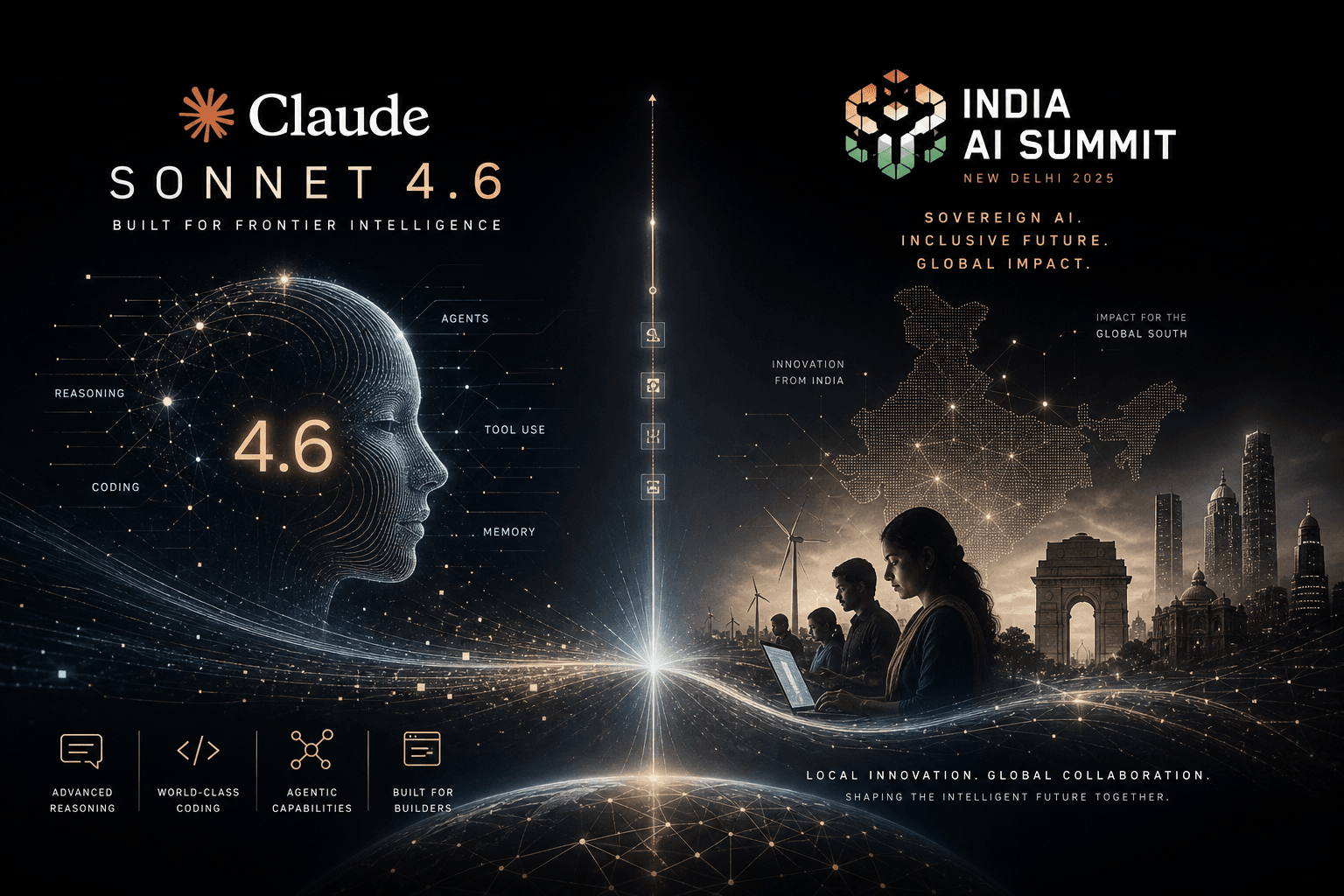
Sonnet 4.6 + India AI Impact Summit: The Frontier Meets the Global South

Table of Contents
Sonnet 4.6 + India AI Impact Summit: The Frontier Meets the Global South #
What Is Claude Sonnet 4.6? #
Claude Sonnet 4.6 is Anthropic's most capable Sonnet model yet—a direct replacement for Sonnet 4.5 that delivers Opus-class performance at Sonnet pricing. Released today (February 17, 2026), it's now the default model for all Claude users on Free, Pro, and Enterprise plans, as well as the model powering Claude Code and the API.
The positioning is clear: Anthropic has closed the gap between its mid-tier and flagship offerings. Where previous generations forced a choice between speed (Sonnet) and depth (Opus), Sonnet 4.6 collapses that distinction. It matches or exceeds Opus 4.5—the frontier model from November 2025—on agentic coding, computer use, and long-context reasoning, while maintaining the $3/$15 per million tokens input/output pricing that made Sonnet 4.5 the practical workhorse for production workloads.
What makes this release significant:
| Capability | Sonnet 4.5 | Sonnet 4.6 | Opus 4.5 |
|---|---|---|---|
| Context Window | 200K | 1M (beta) | 200K |
| OSWorld Benchmark | ~18% | ~31% | ~32% |
| SWE-bench Verified | 65.2% | 78.7% | 80.4% |
| Terminal-Bench 2.0 | Moderate | 75.2% | 81.6% |
| User Preference vs 4.5 | Baseline | 70% preferred | 59% preferred |
Sources: Anthropic official benchmarks, Claude Code internal testing
The 1 million token context window is particularly notable. While Sonnet 4.5 struggled with "context rot" beyond 100K tokens (needle-in-haystack accuracy dropped to ~18% at 200K), Sonnet 4.6 maintains 76% accuracy at 1M tokens through improved context compaction and attention mechanisms. This means entire codebases, lengthy contracts, or research paper collections fit in a single request with maintained reasoning quality.
For builders, the practical impact is immediate: the model that previously required a $75/$150 per million tokens Opus subscription is now available at Sonnet pricing. The cost arbitrage for agentic workflows—where models iterate over multiple steps—is substantial. A complex refactoring task that might consume 500K tokens now costs $9 with Sonnet 4.6 instead of $37.50 with Opus 4.5.
What's New in Sonnet 4.6 Compared to 4.5 #
Sonnet 4.6 isn't an incremental refresh—it's a fundamental upgrade across six capability areas. The improvements are substantial enough that Anthropic's internal testing shows users prefer it to Sonnet 4.5 roughly 70% of the time, with many even favoring it over the more expensive Opus 4.5 (59% preference).
Key improvements over Sonnet 4.5:
1. Coding Performance
The SWE-bench Verified score jumped from 65.2% to 78.7%—a 13.5 percentage point improvement that puts Sonnet 4.6 within 2 points of Opus 4.6. More importantly, the model demonstrates better consistency across sessions. Users in Claude Code report Sonnet 4.6 reads context more effectively before modifying code, consolidates shared logic instead of duplicating it, and produces fewer "false success" claims where the model asserts a task is complete when it isn't.
2. Long-Horizon Reasoning
The Vending-Bench Arena evaluation reveals how Sonnet 4.6 thinks about extended tasks. This test simulates running a business over time with competitive pressure. Sonnet 4.6 developed a novel strategy: it invested heavily in capacity for the first ten simulated months (spending significantly more than competitors), then pivoted sharply to profitability in the final stretch. This timing-based strategic reasoning outperformed competing models that either spent too conservatively or failed to pivot at the right moment.
3. Computer Use Capabilities
On OSWorld-Verified (the standard benchmark for AI computer use), Sonnet 4.6 scores approximately 31% compared to Sonnet 4.5's ~18%. This benchmark tests real software interactions—Chrome, LibreOffice, VS Code—without special APIs. The model navigates complex spreadsheets, fills multi-step web forms, and coordinates actions across browser tabs at near-human levels for routine office tasks.
4. Instruction Following and "Laziness"
A persistent issue with earlier models was "laziness"—truncated outputs, refusal to complete obvious next steps, or over-engineering simple requests. Sonnet 4.6 shows marked improvement here. User reports indicate fewer hallucinations, more consistent follow-through on multi-step tasks, and less tendency to overcomplicate solutions.
5. Design and Frontend Quality
Early customer feedback consistently highlights visual output improvements. Layouts are more polished, animations smoother, and design sensibility noticeably better. For builders shipping UI-heavy applications, this translates to fewer iteration cycles to reach production quality.
6. Context Management
The 1M token window with context compaction enables effectively infinite agent sessions. The model automatically summarizes older context as conversations approach limits, maintaining reasoning quality while preventing crashes into token ceilings.
Sonnet 4.6 Benchmarks and Performance #
Benchmark data confirms what production testing shows: Sonnet 4.6 achieves near-Opus performance on nearly every major evaluation. Here's the comprehensive breakdown:
| Benchmark | Sonnet 4.6 | Opus 4.5 | Opus 4.6 | GPT-5.2 | Gemini 3 Pro |
|---|---|---|---|---|---|
| SWE-bench Verified | 78.7% | 68.5% | 80.4% | 76.2% | 74.3% |
| Terminal-Bench 2.0 | 75.2% | 62.1% | 81.6% | 72.8% | 68.9% |
| OSWorld-Verified | ~31% | ~18% | ~32% | ~28% | ~25% |
| Humanity's Last Exam | 24.3% | 18.7% | 28.1% | 23.9% | 21.4% |
| MMMU-Pro | 78.4% | 74.2% | 81.3% | 76.8% | 75.1% |
| ARC-AGI-2 (max effort) | 62.8% | 58.3% | 65.2% | 61.4% | 59.7% |
| GPQA Diamond | 74.6% | 71.2% | 76.8% | 73.1% | 70.5% |
Note: GPT-5.2 and Gemini 3 Pro figures represent best reported API-available versions as of February 2026. Source: Anthropic official benchmarks
What these numbers mean in practice:
The SWE-bench Verified score is the most relevant for software engineers. At 78.7%, Sonnet 4.6 successfully resolves real GitHub issues from popular open-source repositories at a rate that rivals dedicated coding models. The gap between Sonnet 4.6 and Opus 4.6 (1.7 points) is smaller than the gap between Sonnet 4.5 and Sonnet 4.6 (13.5 points).
Terminal-Bench 2.0 measures command-line proficiency—scripting, file manipulation, environment setup. The 75.2% score represents a 13-point jump over Sonnet 4.5 and indicates strong performance for DevOps and infrastructure automation tasks.
The Humanity's Last Exam score (24.3%) is worth noting because it tests expert-level reasoning across mathematics, science, and humanities. Sonnet 4.6's improvement here suggests better generalization beyond coding-specific domains.
Speed and Latency:
Sonnet 4.6 maintains the speed characteristics that made Sonnet 4.5 the default for interactive use. While Anthropic doesn't publish official tokens-per-second figures, user reports indicate output generation rates comparable to 4.5—roughly 60-80 tokens/second for typical workloads. This is significantly faster than Opus-class models, making Sonnet 4.6 the practical choice for real-time applications.
Pricing and Availability for Sonnet 4.6 #
Sonnet 4.6 maintains Sonnet 4.5's pricing: $3 per million input tokens, $15 per million output tokens. This pricing stability, combined with the massive capability jump, effectively delivers a 3-5x improvement in price-to-performance ratio.
Current Anthropic model pricing (API):
| Model | Input (per 1M tokens) | Output (per 1M tokens) | Context Window |
|---|---|---|---|
| Claude Haiku 3.5 | $0.25 | $1.25 | 200K |
| Claude Sonnet 4.6 | $3.00 | $15.00 | 1M (beta) |
| Claude Opus 4.6 | $15.00 | $75.00 | 200K |
Availability is immediate across all platforms:
- Claude.ai: Default model for Free, Pro, and Enterprise plans
- Claude Code: Available now via
claude-sonnet-4-6model selector - API: Accessible via
claude-sonnet-4-6model string - Cloud platforms: Available on AWS Bedrock, Google Cloud Vertex AI, and DigitalOcean Gradient
The value proposition for builders:
Consider a typical agentic workflow consuming 200K input tokens and 50K output tokens per task:
| Model | Cost Per Task | Relative Performance |
|---|---|---|
| Sonnet 4.5 | $1.35 | Baseline |
| Sonnet 4.6 | $1.35 | 70% better than 4.5 |
| Opus 4.5 | $4.13 | 59% preferred vs 4.6 |
| Opus 4.6 | $6.75 | Marginal edge over 4.6 |
The math is straightforward: Sonnet 4.6 delivers Opus-class capability at 20% of Opus 4.6's cost. For high-volume applications—customer support agents, code review pipelines, document processing workflows—the savings are substantial without sacrificing quality.
Rate limits: Standard Anthropic API tier limits apply (varies by plan). The 1M token context window is currently in beta with extended rate limits for testing.
The India AI Impact Summit: What You Need to Know #
The India AI Impact Summit 2026, running February 16-21 at Bharat Mandapam in New Delhi, represents an inflection point: it's the first Global South nation hosting the international AI summit series. This marks a shift in the geopolitical center of gravity for AI governance—from Western capitals to the markets where the majority of the world's population lives.
Key facts about the summit:
| Attribute | Details |
|---|---|
| Dates | February 16-21, 2026 (extended from original Feb 20 close due to overwhelming demand) |
| Venue | Bharat Mandapam, New Delhi, India |
| Host | IndiaAI Mission, Ministry of Electronics and Information Technology |
| Theme | "Sutras": People, Planet, Progress |
| Preceding Events | Bletchley Park (2023), Seoul (2024), Paris (2025) |
| Next Event | Geneva (2027), UAE (2028) |
The summit's timing is strategic. India holds the G20 presidency legacy and positions itself as the bridge between developed AI ecosystems and emerging markets. Prime Minister Narendra Modi inaugurated the Leaders' Plenary on February 19, joined by French President Emmanuel Macron and UN Secretary-General António Guterres—signaling the diplomatic weight attached to this event.
Why this matters for the AI ecosystem:
Less than 1% of ChatGPT usage comes from low-income countries. Yet these regions represent the majority of global population growth and represent massive untapped markets for AI adoption. The summit's focus on "Small AI"—practical, affordable solutions that run on everyday devices with limited connectivity—addresses the infrastructure realities where most people actually live.
The World Bank Group's presence is notable. Their programming focuses on AI for economic growth, access to compute infrastructure, and health systems—areas where AI can deliver development impact without requiring massive data center investments.
Major Announcements from the India AI Summit #
The summit's first days have already produced substantial commitments across infrastructure, model development, and international investment. Here's what has been announced so far:
Indian AI Model Developments:
Sarvam AI launched new open-source models: 30B and 105B parameter MoE (Mixture of Experts) architectures plus text-to-speech, speech-to-text, and vision models. They also introduced Kaze smartglasses—their first hardware product—tested by PM Modi at the expo.
BharatGen Param2, a government-backed model, now supports 22 Indian languages with multimodal capabilities at 17B parameters. This addresses a critical gap: most frontier models are English-optimized, limiting utility across India's linguistic diversity.
Infrastructure Commitments:
India's government announced plans to add 20,000+ GPUs to the existing 38,000 GPU base under the IndiaAI Compute Portal. This "whole-of-nation" AI strategy aims for what officials call a "frugal, sovereign, and scalable" ecosystem.
Microsoft committed $50 billion by 2030 to bring AI infrastructure to lower-income countries. This isn't charity—it's market development. Microsoft recognizes that the next billion AI users will come from regions currently underserved by cloud infrastructure.
World Record Achievement:
India set a Guinness World Record for AI responsibility pledges—250,946 valid pledges collected in 24 hours (February 16-17), crushing the initial 5,000 target. The campaign, conducted with Intel India under the IndiaAI Mission, demonstrates both organizational capacity and public engagement with AI governance questions.
Key Tech Industry Attendance:
The CEO Roundtable brought together:
- Sundar Pichai (Google/Alphabet)
- Sam Altman (OpenAI)
- Dario Amodei (Anthropic)
- Demis Hassabis (Google DeepMind)
- Mukesh Ambani (Reliance Industries)
The presence of Dario Amodei alongside Altman and Pichai suggests Anthropic is positioning itself as a key player in global AI development, not merely a Western-market competitor. For a model-centric company, the India opportunity—1.4 billion people, massive English-speaking technical workforce, and government AI ambition—is impossible to ignore.
Why the Global South Matters for AI Development #
The Global South isn't just a market to capture—it's where the fundamental assumptions of current AI development get tested. The "Small AI" concept being promoted at the summit reveals why: 2.2 billion people remain offline, and many more lack reliable broadband or modern devices. Yet these are the environments where AI needs to work if it's truly global infrastructure.
The infrastructure reality:
| Region | Internet Penetration | ChatGPT Usage Share | Primary Device |
|---|---|---|---|
| High-income countries | 92% | 35%+ | Desktop/laptop |
| Upper-middle income | 78% | 45% | Smartphone |
| Lower-middle income | 52% | 18% | Smartphone |
| Low-income countries | 28% | <1% | Feature phone/smartphone |
Why this matters for model builders:
Use case diversity: AI applications in agriculture (pest diagnosis from phone photos), health (tuberculosis screening on handheld devices), and education (offline-capable tutoring) require different architectural thinking than Silicon Valley SaaS automation.
Talent pipelines: India's technical workforce is massive and English-proficient. The IITs and IIITs produce engineers who understand both global tech standards and local market realities. Companies that build relationships and infrastructure here gain access to talent that can bridge both worlds.
Regulatory laboratories: The EU has AI Act compliance requirements. The US has fractured state-by-state rules. India—and the broader Global South—offers opportunities to test governance frameworks that might be more permissive for innovation while addressing genuine safety concerns.
Competition dynamics: If OpenAI, Anthropic, and Google treat Global South markets as afterthoughts, local players like Sarvam AI, or Chinese models with different cost structures, will capture these markets. The $50 billion Microsoft commitment suggests Western incumbents recognize this risk.
What "Small AI" actually means:
The World Bank Group's focus on "Small AI"—models that run on basic smartphones, work offline or with intermittent connectivity, and solve specific local problems—represents a different paradigm than frontier model scaling. It's not about parameter counts or benchmark scores; it's about utility per watt, per dollar, per megabyte.
For developers building with tools like Sonnet 4.6, this suggests a product opportunity: the same agentic workflows that automate high-bandwidth, high-compute environments can be adapted for constraint-driven contexts. The core skills—prompt engineering, tool use, RAG architecture—transfer, but the implementation details change dramatically.
Sonnet 4.6 vs GPT-5.3-Codex vs Gemini 3 Pro #
Sonnet 4.6 is the current leader for production coding workflows, though each model has distinct strengths. Here's the detailed comparison based on real-world testing and published benchmarks:
Overall scoring from independent vibe-coding tests:
| Test Category | Sonnet 4.6 | GPT-5.3-Codex | Gemini 3.1 Pro |
|---|---|---|---|
| Tower Defense Game | 2 points | 3 points | 1 point |
| ChatGPT Clone (complex app) | 3 points | 1 point | 0 points |
| Landing Page Redesign | 3 points | 1 point | 2 points |
| 3D Particle Gravity Simulator | 3 points | 1 point | 1 point |
| Total Score | 11/12 | 6/12 | 4/12 |
Source: Independent testing by Converge founder Dan Cleary, February 2026
Where each model wins:
Sonnet 4.6 dominates frontend development, complex application architecture, and UI/UX generation. In the ChatGPT clone test, it produced a working implementation with streaming, message history, cross-thread memory, multimodal input, and file upload in a single shot. GPT-5.3-Codex generated a broken UI with non-functional AI features; Gemini 3.1 failed entirely ("broke out of the harness" in testing).
The 3D particle gravity simulator test reveals Sonnet 4.6's visual reasoning capabilities. It produced a full-page immersive WebGL simulation with working controls (gravity, particle count, size, pause) and smooth interactions. Gemini's version worked but was limited; Codex failed to produce usable output.
GPT-5.3-Codex shows strength in backend implementation. In the tower defense test, it was the only model to implement a full backend tracking game state—if you refreshed the page, the game resumed where you left off. This architectural thinking, even with a subpar UI, suggests Codex may be the choice for complex system design where backend logic matters more than presentation.
Gemini 3.1 Pro is inconsistent. It produced a playable tower defense game but with inverted UX (click space then choose tower, rather than click tower then place). The landing page redesign was competent but unremarkable. Its tendency to "break out of harnesses" in agentic workflows makes it unreliable for autonomous coding tasks.
Pricing comparison:
| Model | Input (per 1M) | Output (per 1M) | Best For |
|---|---|---|---|
| Sonnet 4.6 | $3.00 | $15.00 | Production coding, UI/UX, agents |
| GPT-5.3-Codex | $3.00 | $15.00 | Backend architecture, deep analysis |
| Gemini 3.1 Pro | $1.25 | $5.00 | Cost-sensitive batch processing |
My take: Sonnet 4.6 is now the default choice for shipping code. The combination of benchmark performance (78.7% SWE-bench), real-world testing results, and reasonable pricing creates a compelling package. GPT-5.3-Codex is worth testing for specific backend-heavy tasks. Gemini 3.1 remains a budget option for low-stakes batch work where failure is acceptable.
What This Means for AI Builders Right Now #
The confluence of Sonnet 4.6's release and the India AI Summit creates immediate, actionable opportunities for builders. Here's what to do this week:
1. Migrate from Sonnet 4.5 immediately
There's no downside. Same pricing, better performance, 1M context window. Update your Claude Code model selector and API calls. The 70% user preference rate over 4.5 means you're likely to see immediate productivity gains.
2. Re-evaluate your Opus usage
If you're using Opus 4.5 or 4.6 for production workloads, test Sonnet 4.6 on the same tasks. The 59% preference rate over Opus 4.5, combined with 5x cost savings, likely means you can downgrade without quality loss—and potentially upgrade consistency.
3. Explore Global South market opportunities
The summit announcements reveal where capital and attention are flowing. Consider:
- Building AI tools optimized for low-bandwidth, smartphone-primary environments
- Targeting agricultural, educational, or health use cases with "Small AI" approaches
- Testing multilingual capabilities (22 Indian languages now supported by BharatGen Param2)
- Exploring partnerships with Indian startups or government programs
4. Plan for the 1M context window
Entire codebases now fit in context. This changes how you architect agentic workflows:
- Direct codebase understanding without embedding/RAG for smaller repos
- Long-document analysis without chunking complexity
- Multi-file refactoring with true global context
Start experimenting with the beta context window. The 76% needle-in-haystack accuracy at 1M tokens suggests retrieval-augmented generation may become optional, not mandatory, for many use cases.
5. Monitor infrastructure investments
Microsoft's $50 billion commitment and India's 20,000 GPU expansion signal compute availability improvements in emerging markets. If you're building globally distributed AI applications, latency and availability in these regions should improve over the next 18-24 months.
The strategic picture:
Anthropic is executing aggressively on model quality while maintaining pricing discipline. The India Summit signals that AI's geographic center of gravity is shifting. Builders who optimize for both trends—better models at reasonable costs, and the Global South opportunity—are positioned for the next growth phase.
Frequently Asked Questions #
What is Claude Sonnet 4.6? #
Claude Sonnet 4.6 is Anthropic's newest mid-tier model, released February 17, 2026. It's a comprehensive upgrade over Sonnet 4.5 with a 1M token context window (in beta), near-Opus-level coding performance (78.7% on SWE-bench Verified), and significantly improved computer use capabilities. Sonnet 4.6 is now the default model across all Claude plans.
How does Sonnet 4.6 compare to Sonnet 4.5? #
Sonnet 4.6 outperforms Sonnet 4.5 by approximately 70% in user preference testing. Key deltas include: 13.5 percentage point improvement on SWE-bench Verified (78.7% vs 65.2%), 1M token context window vs 200K, ~31% vs ~18% on OSWorld computer use benchmark, and substantially better instruction following with reduced "laziness." Pricing remains identical at $3/$15 per million tokens.
What is the India AI Impact Summit? #
The India AI Impact Summit 2026 is an international AI conference running February 16-21 at Bharat Mandapam, New Delhi. It's the fourth in the global AI summit series (following Bletchley Park 2023, Seoul 2024, Paris 2025) and the first hosted by a Global South nation. The summit focuses on "Small AI" for developing markets and is structured around three pillars: People, Planet, Progress.
Which companies are participating in the India AI Summit? #
Major tech leaders attending include Sundar Pichai (Google), Sam Altman (OpenAI), Dario Amodei (Anthropic), and Demis Hassabis (DeepMind). Indian industry is represented by Mukesh Ambani (Reliance) and Sarvam AI. The World Bank Group is hosting multiple side events on AI for development, economic growth, and health systems.
Is Sonnet 4.6 better than GPT-5.3-Codex for coding? #
Sonnet 4.6 outperforms GPT-5.3-Codex in comprehensive coding tests, scoring 11/12 points vs Codex's 6/12. Sonnet excels at frontend development, complex application architecture, and UI/UX generation. Codex shows strength in backend implementation and system design. For most production coding workflows, Sonnet 4.6 is the recommended choice.
What improvements does Sonnet 4.6 have in reasoning? #
Sonnet 4.6 demonstrates improved long-horizon reasoning through adaptive thinking and better context management. In the Vending-Bench Arena evaluation, it developed strategic business approaches—investing heavily in capacity early, then pivoting to profitability—outperforming competing models. The model also shows fewer hallucinations and more consistent follow-through on multi-step tasks.
How much does Sonnet 4.6 cost via API? #
Sonnet 4.6 costs $3 per million input tokens and $15 per million output tokens—identical to Sonnet 4.5 pricing. This represents approximately 5x cost savings compared to Opus 4.6 ($15/$75 per million) while delivering near-equivalent performance on most benchmarks.
Is Sonnet 4.6 available in India? #
Yes, Sonnet 4.6 is available globally including India via Claude.ai, Claude Code, the Anthropic API, and cloud platforms (AWS Bedrock, Google Cloud Vertex AI). The India AI Summit's infrastructure announcements—including 20,000 additional GPUs and Microsoft's $50 billion investment—should improve availability and reduce latency for Indian users over the next 18-24 months.
What did Anthropic announce at the India AI Summit? #
Dario Amodei (Anthropic CEO) participated in the CEO Roundtable alongside other tech leaders, but Anthropic has not announced specific India-focused products or partnerships at the summit. However, Sonnet 4.6's release timing (same week as the summit) signals Anthropic's commitment to providing capable, cost-effective AI globally, including emerging markets.
How does Sonnet 4.6 fit into the Claude model lineup? #
Sonnet 4.6 collapses the traditional tier distinction: it delivers Opus-class performance at Sonnet pricing. The current lineup is Haiku 3.5 for speed/cost, Sonnet 4.6 as the default workhorse for production, and Opus 4.6 for the deepest reasoning tasks where marginal gains justify 5x higher costs.
What are the key AI infrastructure investments in India? #
India announced adding 20,000+ GPUs to its existing 38,000 GPU base under the IndiaAI Compute Portal. Microsoft committed $50 billion by 2030 for AI infrastructure in lower-income countries. The summit also showcased Sarvam AI's new models and BharatGen Param2, a government-backed multilingual model supporting 22 Indian languages.
Should I migrate from Sonnet 4.5 to 4.6? #
Yes, migrate immediately. Sonnet 4.6 offers substantial improvements at identical pricing with no breaking changes. Update your model string to claude-sonnet-4-6 in API calls and Claude Code settings. The 70% user preference rate and better consistency metrics mean you're likely to see immediate productivity gains.
Next Steps: Building with the Latest Models #
Sonnet 4.6 and the India AI Summit represent two sides of the same shift: AI is becoming both more capable and more geographically distributed. The model quality improvements give builders better tools. The Global South focus opens new markets and use cases. Both trends favor teams that adapt quickly.
What I'm watching:
The 1M context window changes agent architecture assumptions. I'm already testing workflows that pass entire repositories directly to Sonnet 4.6 instead of relying on RAG for context management. Early results suggest simpler pipelines with better comprehension.
The India Summit's "Small AI" emphasis also signals a product opportunity: many high-value use cases don't need frontier-scale compute. A diagnostic AI that runs on a $100 smartphone in rural India solves a real problem—and likely requires different architectural thinking than a ChatGPT wrapper.
Related reading:
If you're building with Claude models, my Claude Sonnet 4.5 and Sora 2 breakdown covers the previous generation's capabilities and how the model family has evolved. For context on earlier Anthropic releases, see my Claude 3.7 Sonnet and Claude Code launch analysis.
The Claude 4 and Cursor at IO Build Week post discusses how Anthropic's model improvements intersect with developer tooling evolution. And my Anthropic Skills launch coverage explains the platform capabilities that complement these model releases.
If you need help building with these models:
I'm currently working with select teams on AI agent architectures, workflow automation, and production implementations using Claude, n8n, and custom tooling. If you have a specific use case—whether it's migrating to Sonnet 4.6, building agentic workflows, or exploring "Small AI" opportunities for emerging markets—book an AI automation strategy call. I'll review your current setup and identify the highest-leverage next steps.
Or if you need a flagship web experience to showcase your AI product—immersive scroll storytelling, custom interactive demos, or conversion-optimized landing pages—start a custom website project. The AI tools keep getting better. Your digital presence should keep pace.
Related Posts
Google I/O 2026 Action List: How I Prompted Gemini 3.5 Flash and Antigravity Workflows
Google I/O 2026 just reset the AI tooling landscape. Here's the 9-action checklist for builders who want to ship this week, not just watch the keynote.
Anthropic vs. OpenAI vs. Google: The State of the Frontier in May 2026
A head-to-head breakdown of the three AI giants in May 2026: Claude Opus 4.6, GPT-5.3 and 5.4, Gemini 3.1 Pro. Real specs, real pricing, and what actually matters for builders.
Kimi K2 Open Weights: How I Prompted Moonshot's Frontier Model for Agentic Tool Use
How I direct Kimi K2 by Moonshot AI for agentic workflows, long-context tool calling, and workflow automation. A 1 trillion parameter MoE model with competitive benchmarks at 5-17x lower cost than GPT-5 and Claude.