A Music Artist Portfolio That Books Brand Sync Deals — Built Stitch → Cursor in a Weekend
Table of Contents
A music artist portfolio for brand sync is a clearance card. It names who can license the composition, who controls the recording, and which human answers the email.
I am William Spurlock, AI Systems Architect and Fractional AI CTO at Spurlock Studios LLC. I draw that card in Google Stitch, then I have Cursor ship the page. The weekend holds only when those names are already written down. If they are not, I stop. I do not invent a publisher.
This is not the fan site. Listeners and merch live in a different room. A supervisor with a picture and a deadline needs the owner lines on the first screen.
What is a music artist portfolio for brand sync? #
A music artist portfolio for brand sync is a public page that lets a music supervisor see who grants the composition license, who grants the master license, and who picks up the phone. The song can sound great and still be unusable if those three lines are missing.
The U.S. Copyright Office treats a song as two works. In its guide How Songwriters, Composers, and Performers Get Paid, revised July 2022, a musical work is the composition and a sound recording is the captured performance. Putting either one against picture needs its own license. The Office says a synchronization license covers the composition in timed relation to visual content, and a master use license covers the recording. It also says there is no compulsory sync license and no compulsory master use license. The mechanical license for audio-only copies does not cover a film, ad, or video, because phonorecords exclude sounds that accompany an audiovisual work. See 17 U.S.C. §§ 101 and 115 in that same note.
So the page is a desk, not a poster. I want a supervisor to forward three lines without opening a second tab.
| On the page | The job it does | What I refuse to substitute |
|---|---|---|
| Composition contact | Names who can grant the sync license for the musical work | A PRO logo with no person behind it |
| Master contact | Names who can grant the master use license for that recording | "DM for beats" or a link-in-bio |
| Human email | A named person who can answer with the file | info@ with nobody watching it |
The card has three jobs:
- Show the composition side and the recording side as separate lines, because the Copyright Office says they are separate works.
- Show a person, not a logo farm.
- Show only versions you can send the same day.
I do not put a price on that card. ASCAP's checklist for film and other picture, which I read on October 4, 2026, says sync and master fees are negotiable and not a standard rate. The fee moves with the use, the length, how often the cue hits, and where the picture plays. A public number would be a guess. The page gets them to the person who can negotiate. It does not pretend to be the license.
Why does a fan site fail a music supervisor? #
A fan site fails a music supervisor when the first screen sells a ticket or a shirt and never names the publisher or the master owner. The supervisor is not shopping merch. They are trying to clear a cue before a picture locks.
I already shipped the fan room as its own site. That build is the artist site aimed at listeners and merch. Keep it. Do not ask it to do this job too. A supervisor who lands on a tour banner still has to email someone and ask who owns the song. That email is the delay.
ASCAP's checklist, read October 4, 2026, splits the paperwork the same way the Copyright Office does. The synchronization license comes from the copyright owner of the musical work, usually the publisher. The master use license comes from the owner of the specific recording, usually the label. ASCAP's licensing FAQ, also read that day, says ASCAP does not license synchronization rights. Writers or publishers do. An ASCAP license also does not authorize reproduction of the sound recording. Membership in a PRO is not the clearance.
| What the supervisor needs | What a fan page usually shows | What I put on the sync desk instead |
|---|---|---|
| Who licenses the composition | A streaming link | Publisher or writer name, plus email |
| Who controls this recording | A follow button | Label or artist company, named |
| Which version exists | One autoplay master | A short list of files you can actually send |
| A human on the reply | A general inbox | One name and one address |
The fan page hides the deal in four common ways:
- The only contact is a link-in-bio with eight icons and no rights line.
- The page says "sync available" and then does not say who signs.
- The player starts the full master before anyone asked for it.
- The press kit is a zip from 2022 with no owner names inside.
I have a hard opinion here. If the artist cannot say who administers the composition, the site does not get a sync badge. A badge without a name wastes the supervisor's hour and makes the next email colder.
Motion still matters. The desk should feel like the records, not like a form from a county clerk. That visual system lives in the immersive web manual. The type can be big. The first facts still have to be the owner lines.
How do I move a Google Stitch screen into Cursor in a weekend? #
I move a Google Stitch screen into Cursor by exporting the design rules, dropping the screen image in the chat, and telling Agent to build one route from a rights note I already have. Stitch does not publish this site. Cursor does. The weekend is three blocks, and block one is useless if the note is empty.
On March 18, 2026, Google Labs described Stitch as an AI-native software design canvas that turns natural language into high-fidelity UI. The same post says you can pull a design system off a URL, and that DESIGN.md is an agent-friendly markdown file for moving design rules into other design and coding tools. It also says you can connect screens and hit Play to preview the flow, and that Stitch can export to AI Studio and Antigravity through its MCP server and SDK. I read that as the handoff. I do not read it as "Stitch is the host."
Google's export list names AI Studio and Antigravity. It does not name Cursor. I still finish in Cursor, because that is where the repo lives. Cursor's Agent docs, read October 4, 2026, say Agent can complete complex coding tasks, run terminal commands, and edit code. You open it with Cmd+I. It can read a PNG. Checkpoints snapshot the repo before big edits, which is the rollback I want when a layout pass goes sideways.
The other Stitch path, feeding a brand PDF and designing an immersive site from that document, is written up in prompting Stitch from a brand PDF. Use that when the job is a world. Use this path when the job is a clearance card.
| Block | Tool | Done when |
|---|---|---|
| 1. The screen | Google Stitch | DESIGN.md exported, one screen saved as a PNG, Play used once to check the order of the lines |
| 2. The route | Cursor Agent | One page in the repo, fields in the note's order, no guessed owner names |
| 3. The send test | A phone | I can copy the publisher line, the master line, and the email without pinching |
What I paste into Cursor, in this order:
- DESIGN.md from Stitch.
- The screen PNG.
- The rights note: song title, composition contact, master contact, email, and versions that exist.
- One instruction: leave a field blank if the note does not name it.
The Stitch prompt I actually use is short:
Dark page for a brand supervisor. First screen is a clearance card, not a concert poster. Show the song title, the composition contact, the master contact, a named human email, and up to three version labels. No autoplay. Large type. One red mark on the email line.
Then the Cursor instruction:
Read DESIGN.md and the screen PNG. Build one route. The card is a definition list in this order: song, composition contact, master contact, ISRC if the note has one, versions that exist, human email. Do not start a player on load. Do not invent a publisher. If the note is blank, leave the line blank.
I stay in the chat for that pass. If Agent adds a hero video or a shop module, I restore the checkpoint and repeat the field order. The immersive web manual is for the scroll and the type. It is not permission to bury the email under a trailer.
Which fields belong on a music artist portfolio for brand sync? #
The fields on a music artist portfolio for brand sync are the song, the composition contact, the master contact, the identifiers you actually have, the versions you can send, and one human email. Anything else is optional and goes below the fold.
The July 2022 Copyright Office guide is specific about identifiers. An ISWC identifies the musical work. An ISRC identifies the sound recording. The regional ISWC agency for the United States and Canada is operated by ASCAP, and you do not have to be an ASCAP member to get one, but you do have to be registered with a PRO. I print an ISRC or an ISWC only when the note already contains it. I do not mint one in the prompt.
Same person on both licenses is allowed to say so. The Office still counts two licenses. If the artist owns the composition and the master, the card can read "composition and master: [name]." If a publisher has the composition and a label has the master, the card shows two rows. I do not write "one-stop" as decoration when the rights are split.
| Field | Source I trust | Blank if |
|---|---|---|
| Song title | The rights note | Never. No title, no page |
| Composition contact | Publisher or writer who can grant the sync | The artist cannot name them |
| Master contact | Whoever owns that recording | The artist cannot name them |
| ISWC | The note, from the PRO | It is not in the note |
| ISRC | The note, from the label or ISRC manager | It is not in the note |
| Versions | Files you can send today | The file does not exist |
| Human email | A person who replies | Nobody is assigned |
Versions I will list, and only when the file is real:
- Main mix, the recording a supervisor would actually cut.
- Instrumental, if you can send it today.
- Clean edit, if you can send it today.
I leave TV-mix language off unless that file is in the folder. A label you cannot fulfill is worse than a short list.
What stays off the first screen:
- A price.
- A full bio longer than four lines.
- Autoplay.
- A shop.
- Every streaming icon before the owner lines.
ASCAP's checklist says a clearance request should include how the song is used, the length, the placement, and where the picture will be seen. Those facts belong in the supervisor's email, not in a fake rate card on the site. The page makes that email possible. It does not answer a brief that has not arrived.
How do I know a sync portfolio page is ready to send? #
A sync portfolio page is ready to send when I can copy the composition line, the master line, and the email on a phone, with the sound off, and every version on the list is a file I can attach. If I have to hunt, it is not ready.
I run this on my phone before I call the page done. Cursor's checkpoint is for the code. This test is for the desk.
| Check | Pass | Fail |
|---|---|---|
| Thumb copy | Publisher line and master line copy in one press each | The lines are inside an image |
| The address is a person, and the subject can include the song title | The only path is a contact form with no address | |
| Sound off | The card still makes sense | The page is a player with no words |
| Versions | Each label matches a file in the folder | A version is listed as a wish |
| Owners | Both licenses have a name, or the blank is honest | The page says available and names nobody |
I fail the page for any of these:
- The composition contact and the master contact are the same sentence of marketing copy.
- The email is a role with no one on it.
- The player starts before the names.
- A version is listed and the file is "coming soon."
Ready does not mean a brand booked the song. I do not have a placement rate to publish, and I will not invent one. Ready means a supervisor can ask a real question of a real person. The booking happens after that, in a negotiation the Copyright Office already said is voluntary and not a compulsory license.
If you want this desk built as a custom site, start with the discovery call I use for a custom site. Bring the rights note. If the note is empty, the call is about finding the owners, not about picking a typeface.
FAQ #
What is a synchronization license? #
A synchronization license is the right to use a musical work in timed relation with picture, and the U.S. Copyright Office says there is no compulsory sync license. The July 2022 guide says the composition owner negotiates that license in the market. A mechanical license for CDs, downloads, or audio streams does not cover a film, ad, or video. The portfolio should name the person who can grant it.
What is a master use license? #
A master use license is the right to use a specific sound recording in picture, and it is separate from the sync license. The same Copyright Office guide calls it the license to the recording, negotiated with the owner, with no compulsory master use license. ASCAP's checklist, read October 4, 2026, says you clear that right with the owner of the recording, usually the label. The page needs that name even when the artist also wrote the song.
Does an ASCAP membership replace a sync license? #
No. ASCAP membership does not replace a sync license. ASCAP's licensing FAQ, read October 4, 2026, says ASCAP does not license synchronization rights. Writers or publishers do. ASCAP also does not issue single-song licenses, and an ASCAP public-performance license does not authorize reproduction of the sound recording. Put the publisher on the card. Leave the PRO logo as a small mark if you want it at all.
What is the difference between an ISWC and an ISRC? #
An ISWC identifies the musical work, and an ISRC identifies the sound recording. The Copyright Office guide, revised July 2022, says the regional ISWC agency for the United States and Canada is operated by ASCAP, and labels or ISRC managers commonly assign ISRCs. I print either code only when it is already in the rights note. A prompt should not invent one.
Can Google Stitch publish the production site by itself? #
No. Google Stitch does not publish this production site. On March 18, 2026, Google Labs said Stitch turns natural language into high-fidelity UI, exports DESIGN.md, and can send designs to AI Studio and Antigravity. I use that handoff, then Cursor Agent edits the repo. The live page is the route in the codebase, not the Stitch canvas.
Should a sync portfolio autoplay the master? #
No. A sync portfolio should not autoplay the master. The supervisor often opens the page in a room with other people, and the first fact they need is the owner lines, which they can read with the sound off. A short clip they choose to start is enough. The full file goes out by email after someone asks.
What belongs in the first email to a music supervisor? #
The first email should name the song, the composition contact, the master contact, and the versions you can send today. ASCAP's checklist says a picture request should also describe the use, the length, the placement, and where it will be seen, but those details come from the supervisor's brief, not from a public price. Your email answers who can say yes. Their email answers how the cue is used.
How is a sync desk different from a fan merch site? #
A sync desk names the two copyright owners, and a fan merch site sells to listeners. I keep those as different pages. The listener build is the fan site for merch and the live show. The sync desk is the clearance card in this post. Mixing them puts a shop above the publisher line, which is the failure mode.
When should the weekend build stop? #
Stop the weekend build when the rights note cannot name the composition contact or the master contact. Stitch can still draw a dark card, and Cursor can still ship a route, but I will not fill the blank with a guessed company. Get the name, then run the three blocks. A page that says available and names nobody is not a portfolio for brand sync.
Build the desk, then the world #
I will build this as a custom site when the rights note is real. The look can carry the records. The first screen still has to clear the cue.
If that is the site you need, use the discovery call for a custom site and write through the contact section. I am William Spurlock, AI Systems Architect and Fractional AI CTO at Spurlock Studios LLC. The studio book is 600+ automations built and 500+ live, from 20,000+ hours on agentic systems, with 35,000+ hours saved for clients. Bring the song title and the two owner names. I will tell you on that call if the card is a weekend or if the owners still have to be found.
Related Posts

Bold Design vs Machine-Readable Structure: How Neo-Brutalism and Semantic Architecture Coexist
You don't choose between a bold Neo-Brutalist site and one AI can read. Here's how I ship both: expressive design on top of strict semantic architecture.

How I Built Fordo's Official Artist Website Without Writing a Line of Code
How I designed Fordo's artist site in Google AI Studio and built it by directing AI: a beautiful, alive experience wired for AI search, brand, and direct fan revenue.
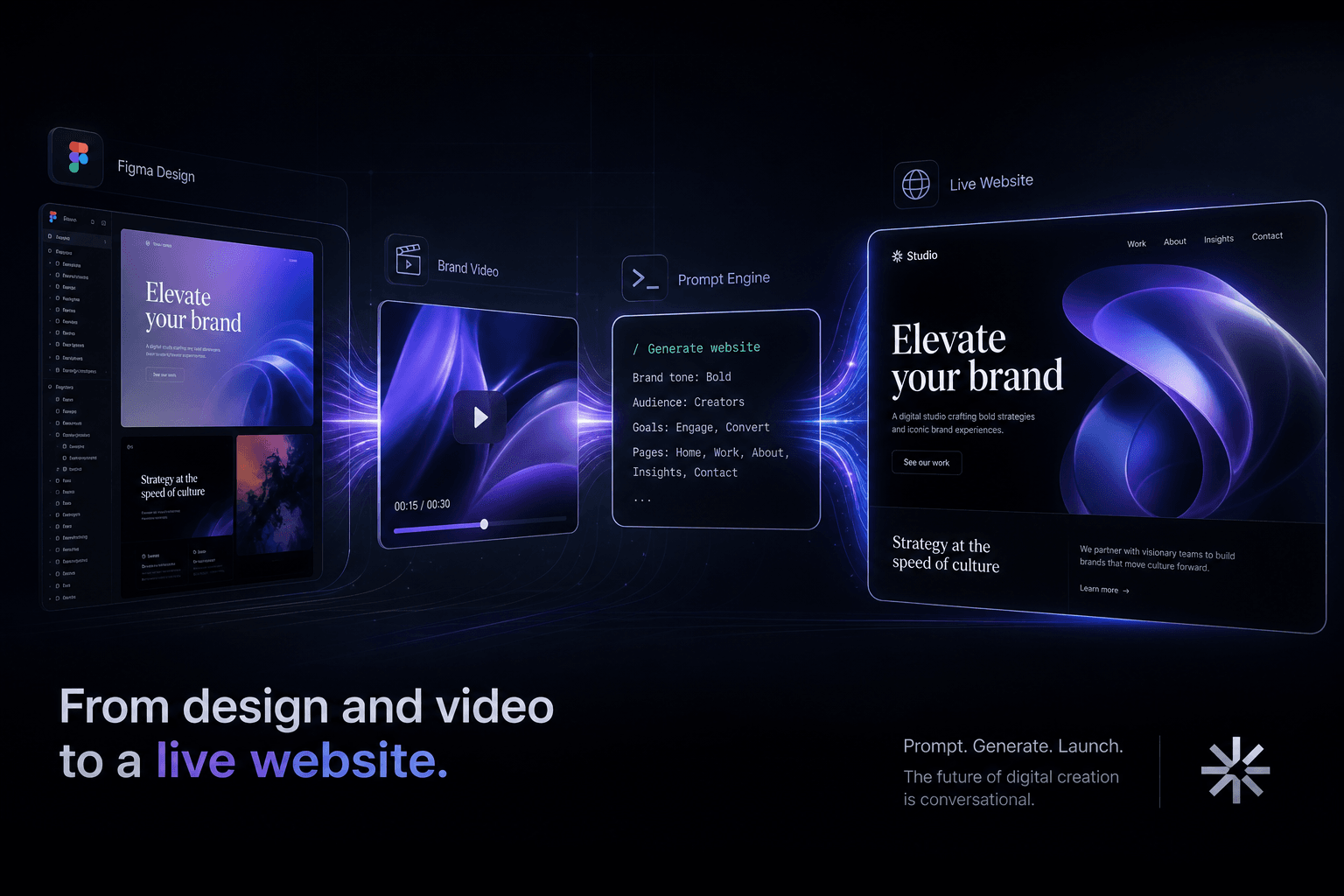
From a Figma Export and a Brand Video to a Live Site Using Only Prompts
How I turn Figma exports and brand videos into live, conversion-focused websites using only prompts and context handoffs. No manual coding, just directed AI execution.