The Discovery Call Template I Use to Close High-Value Custom Web Projects

Table of Contents
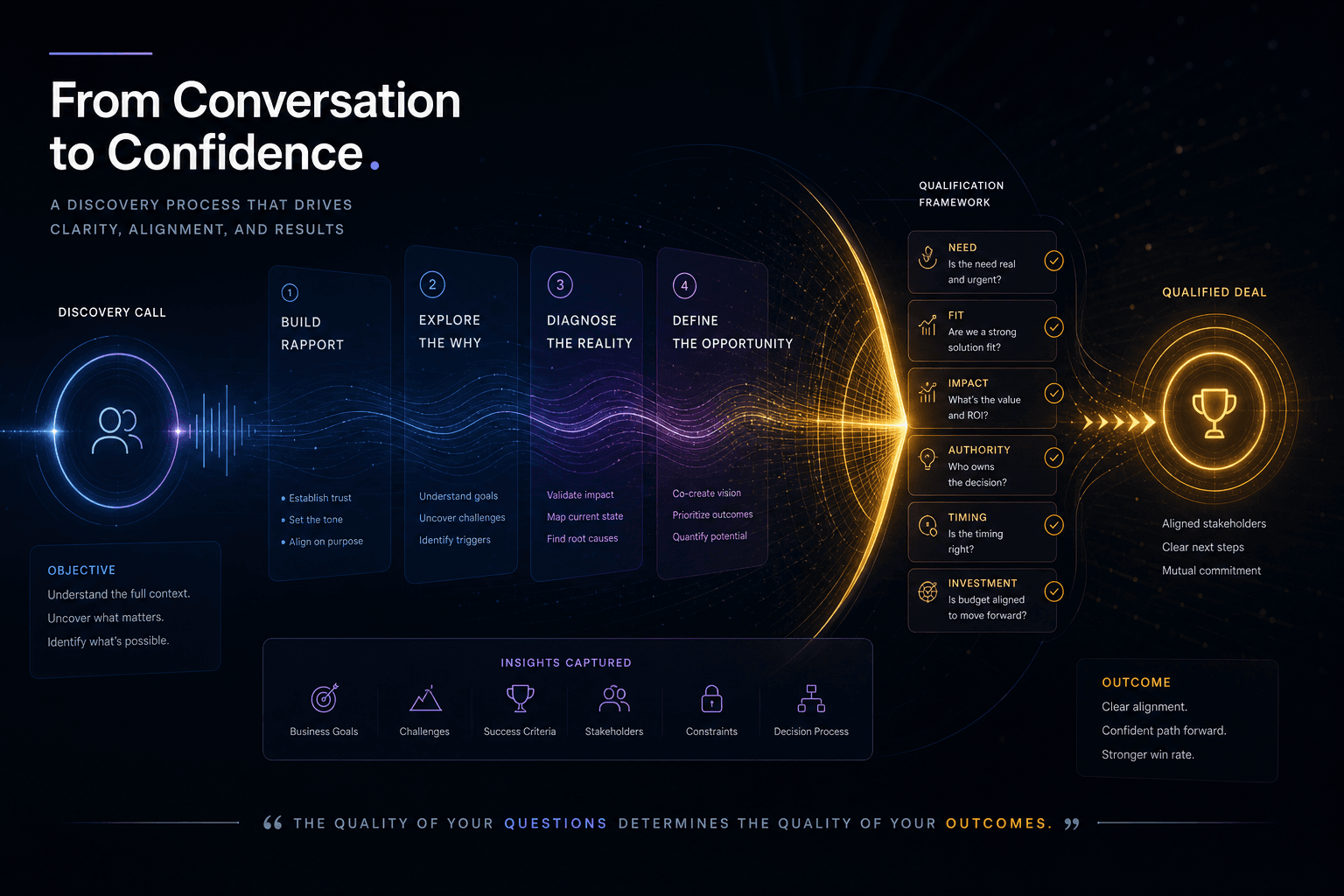
Most discovery calls fail in the first 90 seconds. The prospect is sizing you up, you are sizing them up, and if either party sends the wrong signals, the deal dies before you even get to scope. I have closed custom web projects ranging from $3K to $15K+ using the same structured call format. It is not a script. It is a diagnostic tool that surfaces budget, authority, timeline, and fit — fast.
Why Structure Beats Charisma Every Time #
Unstructured discovery calls hemorrhage revenue. When you wing it, you miss red flags, undercharge out of uncertainty, and leave calls without clear next steps. A structured call protects both you and the prospect from wasting time on mismatched projects. I treat every discovery call as a qualification exercise first, a sales conversation second. If they do not qualify, I disqualify them — politely, quickly, and with clarity on why. That respect often turns "not now" into "let us talk again in six months."
The Pre-Call AI Prep: How I Use Notion + n8n to Walk In Ready #
I never enter a discovery call cold. Before the conversation starts, I have an AI-assisted meeting prep automation setup with n8n, using my Notion workspace — calendar context, any prior notes, and the prospect's existing digital footprint. This surfaces talking points I would otherwise miss and gives me a tailored opening that signals I have done my homework. It's also completely hands-off for me at this point (it just works) and has drastically improved my performance and results on any type of meeting.
The Context Stack I Assemble #
My pre-call prep pulls from three Notion databases:
| Source | What It Contains | How I Use It |
|---|---|---|
| Calendar | Meeting time, prospect name, company, booking form answers | Confirm logistics, review their stated needs |
| CRM/Notes | Any prior interactions, referrals, cold outreach history | Reference past context to build continuity |
| Research | Website audit, social presence, competitor mentions | Find specific angles, gaps, or opportunities |
The Opening: Setting Authority and Expectations in 60 Seconds #
The first minute frames everything that follows. I open with a concise agenda that signals professionalism, sets time boundaries, and gets the prospect's buy-in on the flow. This is not small talk. It is a control sequence that establishes me as the facilitator, not the supplicant.
My Exact Opening Framework #
I use this three-part structure every time:
- Confirm the time: "I have us down for 30 minutes — does that still work on your end?"
- State the agenda: "Here is how I like to run these — first I will ask some questions to understand what you are building and why now. Then if it looks like a fit, I will share how I work and what kind of investment this typically requires. If that sounds good, we will wrap with clear next steps. Sound fair?"
- Get permission: "Great — tell me what prompted you to reach out."
That third step is critical. I never ask "what are you looking for?" That invites a laundry list of features. "What prompted you to reach out" surfaces motivation, urgency, and often the real business problem behind the project. It also tells me their self-awareness level — a key predictor of how smooth the project will run.
The Qualifying Questions: My 8-Question Diagnostic #
Discovery calls are interviews, not pitches. I spend 60-70% of the call asking questions and listening. The goal is not to impress them with my portfolio. It is to understand whether this project has the three ingredients of a successful premium engagement: clear business outcome, adequate budget, and realistic timeline with decision-making authority.
The Eight Questions I Ask Every Prospect #
These questions follow a deliberate sequence — from context to motivation to mechanics to money:
| # | Question | What I am Really Learning |
|---|---|---|
| 1 | What does your company do, and who is your ideal customer? | Business model clarity, market sophistication |
| 2 | What prompted you to reach out now versus six months ago? | Urgency, trigger event, internal pressure |
| 3 | What does success look like 6 months after this launches? | Outcome definition, metrics they care about |
| 4 | Who else are you talking to, and how did you find me? | Competitive landscape, referral quality, trust source |
| 5 | Who else needs to sign off on this project? | Decision-making authority, committee risk |
| 6 | What is your ideal timeline, and is there anything driving that date? | Real deadlines vs. aspirational hopes |
| 7 | Have you done a project like this before? How did it go? | Past trauma, expectations, budget reality check |
| 8 | Do you have a budget range in mind for this work? | Budget qualification, scope alignment |
I never skip question 8. Waiting until the proposal stage to discuss money wastes everyone's time. By asking directly — and noting their reaction — I learn whether they have thought about budget, whether they are shopping on price, and whether I need to educate them on what premium work actually costs.
Surfacing Budget Without Awkwardness #
The budget conversation is where most discovery calls derail. Either the prospect gets defensive, or the freelancer collapses their own pricing to avoid tension. Neither serves the project. I handle budget as a diagnostic, not a negotiation.
How I Frame the Budget Question #
After the context questions, I transition like this:
"To make sure I point you toward the right solution — whether that is a full custom build, a phased approach, or even a referral to someone else — it helps to know if you have a budget range in mind for this work."
Three things happen here:
- I signal I have multiple options (full build, phased, referral), which reduces their fear of being locked into a high-pressure sales pitch
- I frame budget as "helping me help you" — a collaborative data point, not a barrier
- I leave room for them to say "I do not know" — which is honest and lets me educate
How I Respond to Common Budget Answers #
| Their Response | My Follow-Up | What It Means |
|---|---|---|
| "We were thinking $1-2K" | "For the scope you described, that is below my starting point for a simple custom site, which typically ranges from $3K to $5K. A super complex, fully optimized build with AEO/AIO integrations and animations starts at $10K–$15K+. Would it make sense to discuss a phased approach?" | Budget mismatch — pivot to smaller scope or education |
| "What do you charge?" | "It depends on scope, but a simple custom site lands between $3K and $5K, while a highly complex, optimized, and animated platform starts at $10K to $15K+. Does that range feel workable?" | Testing me — anchor high, then qualify |
| "We have $12K set aside" | "That puts us in a great position. For that range, we can deliver a highly optimized, fully integrated brand experience with advanced AEO/SEO setup and interactive UI/UX features. Let me ask a few more questions to see what we can prioritize." | Qualified lead — proceed to scope specifics |
| "We do not really have a number" | "No problem. Based on what you have shared, a simple custom build typically runs $3K–$5K, while a super complex, fully optimized platform starts at $10K–$15K+. If that feels like a stretch, we can talk about what a phased delivery might look like." | Needs education — proceed with caution, anchor price |
I never apologize for my pricing. If $10K–$15K+ makes them flinch, that is useful data. It means either the scope needs shrinking, the value needs explaining, or we are not the right fit. All three outcomes are better than underquoting and eating the difference.
Scoping Outcomes: Turning Problems into Project Phases #
The best premium web projects solve business problems, not design preferences. Once I understand budget and motivation, I shift to scoping the actual work. This is where I translate their "we want a new website" into specific deliverables, phases, and success metrics.
The Scope Translation Framework #
I use this three-tier structure to match budget to outcomes:
| Tier | Typical Range | Best For | Typical Deliverables |
|---|---|---|---|
| Core / Simple | $3K-$5K | Clean, custom web presence | Custom responsive design (3-5 pages), basic CMS, core SEO setup, clear contact forms |
| Growth / Optimized | $6K-$9K | Conversion-focused builds, enhanced visibility | Everything in Core + custom scroll animations, structured data, multi-channel customer captures, CRM integrations, page speed optimizations |
| Flagship / Complex | $10K-$15K+ | Category-defining, high-performance platforms | Full custom build, advanced AEO/AIO/GEO/SEO, multiple custom captures & CRM integrations, super complex animations, full UI/UX upgrades, bespoke interactive elements |
I never quote exact numbers on the call. These ranges are directional. The actual proposal comes after the call, informed by the notes I take and any follow-up research. But giving these anchors during the call helps the prospect calibrate their expectations and helps me spot when their stated needs and stated budget are in different zip codes.
The Pricing Reveal: When and How I Discuss Investment #
Timing the pricing discussion is as important as the number itself. I do not lead with price — that makes me a commodity. I do not bury it until the proposal — that wastes time if we are miles apart. I surface a range after qualification but before the close, then use the proposal as the detailed confirmation.
My Pricing Conversation Sequence #
- Qualify first: Budget question in the first 15 minutes
- Anchor with ranges: Directional tiers after scoping discussion
- Confirm interest: "Does that range feel like it matches the value you are expecting?"
- Promise specifics: "If yes, I will follow up with a detailed proposal that breaks down exactly what we would deliver at that tier"
- Set the close condition: "The proposal will include timeline, payment schedule, and next steps. Typically I need [X days] to put that together. Does that timeline work?"
This sequence does three things: it validates we are in the same ballpark, it commits them to a proposal review, and it surfaces any hidden objections before I spend time writing a detailed scope.
Red Flags That Kill Deals (and How I Spot Them Early) #
Not every prospect should become a client. Over 500+ discovery calls, I have learned to spot the warning signs that predict project failure: scope creep, payment issues, endless revision cycles, or the project dying mid-flight. I disqualify prospects who show multiple red flags — and I do it politely, on the call.
The Deal-Killers I Watch For #
| Red Flag | What It Sounds Like | What I Do |
|---|---|---|
| Price shopping without value clarity | "We are getting quotes from five agencies" | Ask what criteria they are using besides price; if none, I often decline |
| Committee decision with no champion | "I will need to run this by the board/partners" | Ask who the champion is; if no one owns it, timeline risk is high |
| Unrealistic timeline | "We need this live in three weeks" | Clarify what is driving the date; if artificial, scope negotiation or pass |
| Previous project trauma | "Our last agency disappeared/failed" | Dig into what went wrong; sometimes a gem, sometimes a nightmare client |
| Scope ambiguity | "We will figure out the details as we go" | Require a paid discovery phase; undefined scope kills fixed-price projects |
| No budget awareness | "Just tell us what it costs" after a $10K–$15K anchor | Either needs education (fine) or expects premium work for template pricing (pass) |
| Technology fixation | "We need it in [obscure platform]" | Ask what business outcome the platform serves; tech-first usually means no strategy |
| Disrespect for process | "Can you just send over a quick estimate?" | Politely decline; urgent buyers who skip discovery become painful clients |
One red flag is a conversation. Two is caution. Three is a pass. I have learned that the revenue I lose by saying "no" early is nothing compared to the revenue I lose by saying "yes" to a nightmare project.
The Close: Securing Next Steps Without Pressure #
The goal of a discovery call is not to close the deal. It is to close the next step. For high-value custom projects, that next step is typically a detailed proposal with timeline, payment schedule, and scope. I never try to get a verbal commitment on the call. I try to get a commitment to review the proposal and a scheduled follow-up to discuss it.
My Closing Sequence #
After we have covered scope and budget range, I transition to next steps:
"Based on what we have discussed, this sounds like a [Foundation/Growth/Flagship] tier project. I will put together a detailed proposal that includes:
- Exact scope and deliverables
- Timeline with key milestones
- Investment breakdown and payment schedule
- My process and what I need from you to kick off
I typically need [3-5 business days] to deliver that. Should I send it to [email], and would you be open to scheduling a 20-minute call next [day range] to walk through it together?"
Key elements: specific deliverable, clear timeline, email confirmation, and — critically — a scheduled follow-up call. Proposals sent without a scheduled review call have a 20% close rate. Proposals sent with a scheduled review call have a 70%+ close rate. The difference is not the proposal. It is the commitment.
Post-Call Capture: How I Turn Notes into a Scoped Proposal #
The call ends, but the work continues. Immediately after hanging up — while the conversation is fresh — I run a structured capture process that turns my handwritten notes into a proposal-ready brief. This is where my AI-assisted workflow saves hours of manual drafting.
The Capture Sequence #
- Voice memo summary: 2-minute voice note capturing gut impressions, red flags, and pricing instincts
- Notion CRM update: Log the call outcome, key quotes, and next steps in my CRM database
- Proposal brief generation: Run a Claude prompt against my call notes to generate a draft proposal structure
The Proposal Brief Prompt #
I just finished a discovery call with [Prospect]. Here are my raw notes:

[PASTE NOTES]

Based on these notes, generate a proposal brief with:
1. Project summary (2-3 sentences)
2. Key business objectives we identified
3. Recommended tier (Foundation/Growth/Flagship) with justification
4. Specific deliverables to include
5. Timeline estimate with milestones
6. Pricing anchor and any scope adjustments needed
7. Any risks or open questions to address in the proposal
8. Two alternative approaches if budget is tighter than expected

Format for easy review and proposal writing.
This prompt saves me 30-45 minutes per proposal. It structures my scattered notes into a coherent narrative, surfaces gaps I need to fill with follow-up questions, and suggests alternative approaches I might not have considered. The final proposal is still my writing — I am not delegating client communication to AI — but the structural heavy lifting is handled.
The Complete Discovery Call Checklist #
Every call follows the same sequence. I keep this checklist visible during calls to ensure I hit every checkpoint without making the conversation feel scripted.
Pre-Call (10 Minutes Before) #
- Review booking form answers
- Run AI briefing prompt (Notion + Claude)
- Check current website and social presence
- Confirm video link, time zone, recording permission
Opening (First 5 Minutes) #
- Confirm time available
- Set agenda and get buy-in
- Ask "what prompted you to reach out"
- Signal active listening with relevant context from my prep
Qualification (Next 15-20 Minutes) #
- Business context (what they do, who they serve)
- Motivation (why now, why this project)
- Success definition (outcomes, metrics)
- Competitive context (who else they are talking to)
- Decision-making (who signs off, timeline drivers)
- Past experience (previous projects, any trauma)
- Budget range (direct question, watch reaction)
Scoping and Pricing (Next 5-10 Minutes) #
- Translate needs into tier (Foundation/Growth/Flagship)
- Anchor with directional range
- Confirm interest at that level
- Note any scope adjustments needed
Close and Next Steps (Final 5 Minutes) #
- Summarize what I heard
- Propose specific proposal contents
- Set timeline for delivery
- Schedule proposal review call
- Confirm email address for delivery
Post-Call (Within 30 Minutes) #
- Voice memo gut check
- Update Notion CRM
- Run proposal brief generation prompt
- Block time for proposal writing
FAQ: Discovery Calls for High-Value Web Projects #
How long should a discovery call be for a premium web project? #
Block 30 minutes, but expect to use 20-25. A premium custom web project discovery call needs enough time to cover business context, motivation, success metrics, decision-making authority, timeline, and budget — without rushing. I schedule 30-minute slots because that signals respect for both our time and forces focus. If the conversation is flowing exceptionally well and we are both energized, I will check if they have flexibility to continue. If we hit a natural conclusion in 20 minutes, I do not pad it. The goal is a complete qualification, not filling time.
Should I send a proposal after every discovery call? #
No — only to qualified prospects who confirmed interest in your price range. Sending proposals to unqualified leads wastes your time and creates false hope for them. I only write detailed proposals after a call where: (1) the business need is clear, (2) the prospect confirmed a budget range that fits my tiers, (3) the timeline is realistic, and (4) they agreed to a follow-up call to review the proposal. If any of those are missing, I follow up with a brief email summarizing what we discussed and why I do not think we are the right fit — or what needs to happen for us to get there.
What if the prospect refuses to share their budget? #
Anchor with a range, then ask if it is workable. When prospects dodge the budget question, it usually means either they genuinely do not know market rates or they are testing whether you will underquote. I handle this by sharing my directional range first: "Projects like this typically run between $3K for a simple custom site up to $15K+ for a super complex, fully optimized interactive platform with advanced integrations and animations. Does that range feel workable for what you are planning?" Their reaction tells you everything. If they flinch visibly, you have a budget mismatch. If they nod thoughtfully, you have a qualified lead who needs scope definition. If they push back immediately with "that seems high," you have an education opportunity or a mismatch.
How do I handle price shoppers who want quotes from five agencies? #
Ask what criteria they are using besides price, then decide if you want to compete. When a prospect tells me they are getting quotes from multiple agencies, I do not panic. I ask: "Beyond price, what are the main criteria you are using to evaluate the proposals you receive?" If they mention process, portfolio fit, timeline confidence, or strategic input, we are in a real conversation. If they shrug and say "just comparing options," I politely decline. Competing on price for premium creative work is a race to the bottom. The prospects who choose based on cheapest bid are rarely the clients you want for premium work.
What is the difference between a discovery call and a sales pitch? #
Discovery calls diagnose; sales pitches prescribe. In a discovery call, you are interviewing the prospect to understand their problem, qualify their fit, and determine whether you can deliver value worth your price. You are listening 70% of the time. In a sales pitch, you are presenting your solution, explaining your process, and persuading them to buy. You are talking 70% of the time. I run discovery calls as pure qualification. Only after I have qualified them do I shift into "here is how I would approach this" mode. If you pitch before you understand, you are selling aspirin for a problem that might need surgery.
When should I disqualify a prospect during the call? #
Disqualify when you see three or more red flags, or one deal-killer. Single red flags are worth noting; multiple red flags are worth acting on. If a prospect shows budget unawareness after education, has no decision-making authority with no internal champion, demands an unrealistic timeline without valid business reason, or treats you like a commodity vendor from minute one, those are disqualifying patterns. I disqualify politely: "Based on what you have shared, I do not think we are the right fit for this project. I would rather be upfront about that than waste your time with a proposal that does not align with your needs." This preserves goodwill and sometimes brings them back six months later when their situation changes.
How do I follow up if they go silent after the call? #
Send three follow-ups over three weeks, then archive the lead. My sequence: Day 2, a brief email summarizing the call and confirming next steps. Day 7, a check-in asking if they have questions or need anything to move forward. Day 14, a final email letting them know I am moving them to my "quarterly check-in" list unless they tell me otherwise. Each email is two sentences max. I do not chase indefinitely. Silence usually means internal priorities shifted, budget got reallocated, or they chose someone else and are avoiding the awkward conversation. Either way, my time is better spent on qualified leads than ghosted ones.
What tools do I need to run discovery calls effectively? #
You need a scheduling system, a note-taking method, and a CRM. I use Calendly for scheduling with intake questions that surface key context before the call. I use Notion for notes — one database for call logs linked to a prospects database. I use Zoom or Google Meet for video, with recording enabled (with permission) so I can review nuance I missed. The AI prep workflow I described earlier uses Claude Code with my Notion MCP connection. You do not need elaborate tech. You need a consistent system that captures information and surfaces it when you need it — during the call, after the call, and six months later when they re-engage.
How do I handle prospects who want to negotiate on the call? #
Defer negotiation until after the proposal, but signal flexibility in approach. If a prospect pushes for a lower price during the discovery call, I respond: "I hear that budget is a concern. Let me put together a proposal that shows exactly what we could deliver at different investment levels — a full scope version and a phased approach that gets you live faster with room to expand later. That way you can see the trade-offs clearly." This acknowledges their concern without committing to a number on the spot. It also positions me as collaborative rather than rigid. Negotiation is fine; it just belongs after the proposal where the scope is documented and the trade-offs are concrete.
Should I record my discovery calls? #
Yes, with explicit permission, for review and proposal accuracy. I record every discovery call after asking: "Mind if I record this so I can focus on our conversation and not miss any details?" No one has ever refused. The recording serves two purposes: (1) I review it before writing the proposal to catch nuances I missed in live notes, and (2) I have a record of exactly what was discussed if scope disputes arise later. I store recordings securely and delete them after the project concludes or after 12 months if the project never starts. Recording without permission is illegal in many jurisdictions; always ask.
How do I transition from discovery call to signed contract? #
The path is discovery call → proposal → proposal review call → contract. After a qualified discovery call, I send a detailed proposal within 3-5 business days. That proposal includes scope, timeline, pricing, payment schedule, and next steps. I schedule a 20-minute proposal review call 2-3 days after sending it. On that call, I walk through the proposal, answer questions, handle objections, and ask for the commitment. If they are ready, I send the contract immediately after that call via DocuSign or PandaDoc. If they need time to review internally, I set a specific follow-up date. The key is never sending a proposal without a scheduled review call — that single step triples my close rate.
What if the prospect asks for spec work or free ideas? #
Decline politely and redirect to your process. When a prospect asks me to "sketch out some concepts" or "show me what you are thinking" before they commit, I respond: "I do not do spec work — it is not fair to my paying clients and it is not the best way to evaluate whether we are the right fit. What I can do is share case studies of similar projects I have delivered, walk you through my exact process, and schedule a paid discovery phase where we develop strategic direction together. That gives you real value whether you move forward with me or not." Prospects who insist on free work are broadcasting that they do not value creative expertise. Those are clients who will micromanage, dispute invoices, and request endless revisions. Pass.
Ready to Discuss Your Custom Website Project? #
The discovery call is where great projects start. Whether you are a founder launching a new brand, a marketing leader rebuilding your company's digital presence, or an agency looking for a technical partner — the right conversation upfront determines everything that follows.
I have walked hundreds of prospects through this exact process. The ones who became premium clients shared one trait: they approached the conversation as a collaborative diagnostic, not a vendor interview. They wanted a partner who could think through their business problem, not just execute a feature list.
If that sounds like you, book a 15-minute discovery call. I will walk you through this same qualification process, answer your questions about my process and pricing, and we will both know within 20 minutes whether there is a fit worth exploring further.
Related reading:
Related Posts

Spurlock Studios LLC Is Live. This Site Stays the Operator Blog.
Spurlock Studios LLC is live at spurlockstudios.com. This site stays the operator blog. Four lanes, published floors, and which site to use when you book.
A SaaS Landing Page Redesign That Doubled Trial Signups — Directed Entirely Through Prompts and Reference Media
How I directed a complete SaaS landing page redesign using only prompts, screenshots, and brand context—no manual coding—and doubled trial signups in 30 days.

AutoSEO: How I Prompted an Autonomous SEO Agent Loop with Lighthouse Audits
Point an AI agent at a deployed site, give it a single Lighthouse scalar to maximize, and let it ratchet validated SEO wins into git overnight. Here is the full AutoSEO architecture.