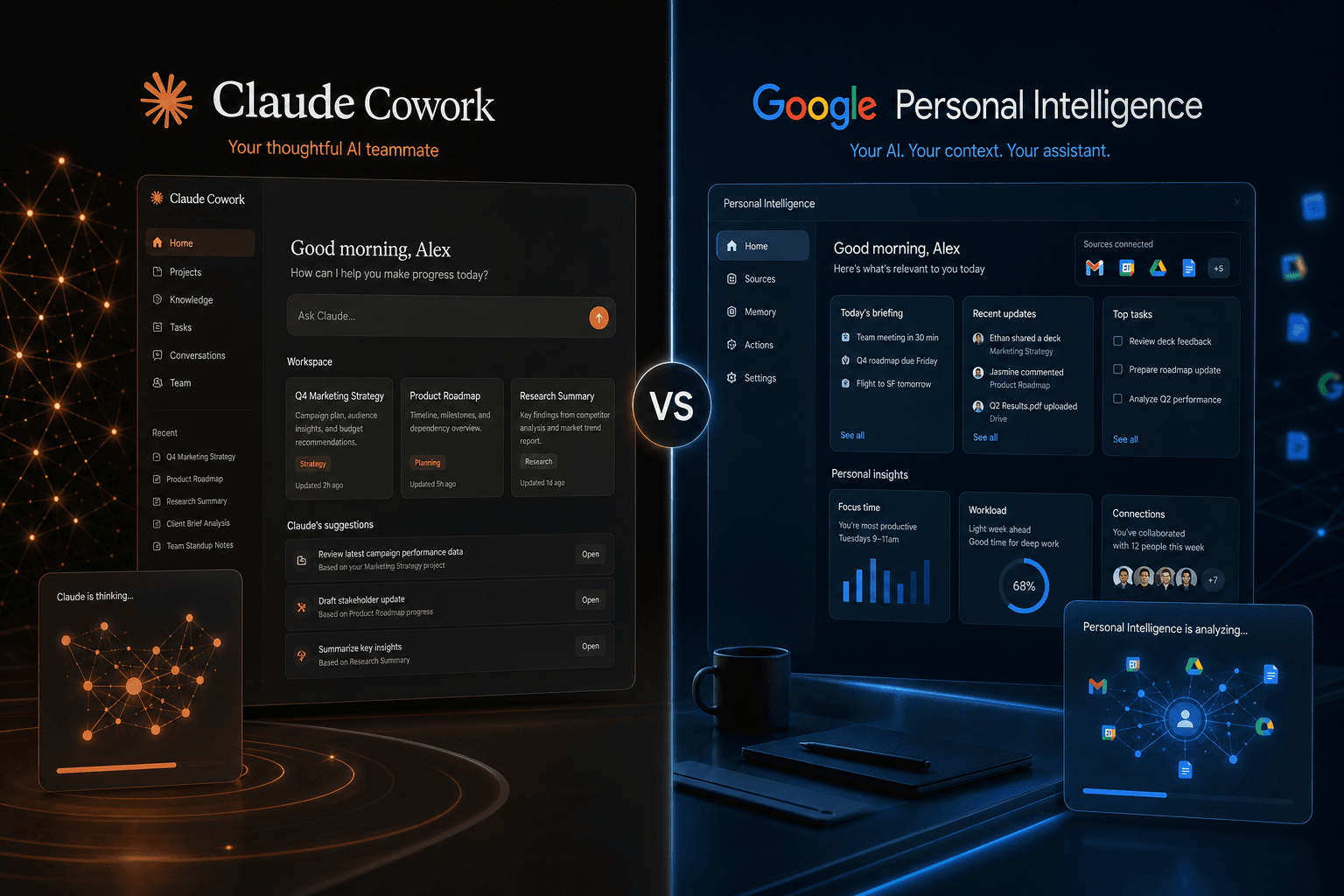
Claude Cowork + Google Personal Intelligence: The Desktop Agent War Begins

Table of Contents
Claude Cowork + Google Personal Intelligence: The Desktop Agent War Begins #
The desktop just became the primary battlefield for AI supremacy. Today, two of the most significant AI agent announcements in recent memory drop simultaneously: Anthropic unveils Claude Cowork, a persistent desktop companion that watches your screen and proactively assists, while Google launches Personal Intelligence across Android, Chrome, and Workspace. This isn't just another feature drop. It's the beginning of the always-on agent era.
The Announcement: What Just Launched #
Anthropic and Google just fired the starting gun on the desktop agent war. Both companies announced major agent initiatives today—January 13, 2026—and the timing isn't coincidental. This is a coordinated market shift, not a feature race.
Anthropic's Claude Cowork drops as a research preview for Max subscribers, bringing persistent desktop assistance to knowledge workers who don't write code. It runs inside the Claude desktop app in a dedicated "Cowork" tab, watching files, organizing documents, and handling complex multi-step tasks autonomously. The pitch is simple: "Claude Code for the rest of your work."
Google's Personal Intelligence launches simultaneously in beta for Google One AI Pro and Ultra subscribers in the U.S., connecting Gemini to Gmail, Photos, YouTube, and Search with cross-app reasoning. A new Auto Browse feature in Chrome lets Gemini complete tasks—booking appointments, purchasing tickets, planning events—rather than just providing instructions.
The significance is architectural, not incremental. These aren't chatbots with tool access. They're persistent agents with memory, context awareness, and the ability to act across your digital workspace. Both announcements land in the same week that ChatGPT's Agent mode has been in market for six months, and Cursor's agent mode has become standard for developers. The desktop agent category just went from niche to mainstream.
| Company | Product | Availability | Core Value Prop |
|---|---|---|---|
| Anthropic | Claude Cowork | Research preview (Max subscribers) | File management, research synthesis, document prep |
| Personal Intelligence | Beta (AI Pro/Ultra, US only) | Cross-app reasoning, task completion, personal context |
The battle lines are drawn: Anthropic owns the high-intent knowledge worker segment. Google owns the cross-platform consumer ecosystem. Both are betting that the desktop—and your personal data across apps—becomes the primary AI interface, not the chat window.
Claude Cowork: Anthropic's Persistent Desktop Companion #
Claude Cowork is Anthropic's bet that the future of AI assistance isn't conversational—it's ambient. Where Claude Code targets developers with terminal-centric workflows, Cowork targets the other 99% of knowledge work: file wrangling, document synthesis, research consolidation, and task orchestration that happens across spreadsheets, PDFs, and browsers.
The architecture is containerized and sandboxed. Cowork operates inside the Claude desktop application in a dedicated tab alongside Chat and Code. Users grant explicit folder access, and the agent maintains persistent awareness of file changes, document structure, and task state. It can read, analyze, create, and manipulate files locally—renaming, deduplicating, sorting, and preparing documents from source materials.
Key capabilities launching today:
- File manipulation and analysis: Reads and processes documents, spreadsheets, contracts, and reports across granted directories
- Research synthesis: Consolidates information from multiple sources into structured outputs
- Document preparation: Generates deliverables from raw source files—think turning a folder of research into a formatted report
- Data extraction: Pulls structured data from unstructured files like contracts and invoices
- Autonomous organization: Renames, sorts, and deduplicates file collections based on content analysis
The safety model is worth noting. Anthropic designed Cowork with what they're calling "human-in-the-loop for consequential decisions." The agent handles low-stakes automation—file organization, research prep, data extraction—but prompts for approval on actions with real consequences: sending emails, making purchases, or modifying critical documents. This is a deliberate positioning against the "agent autonomy" narrative coming from some competitors.
Pricing and availability: Research preview open to Max subscribers ($100-$200/month) today, expanding to Pro subscribers ($20/month) in the coming weeks. Anthropic is explicitly targeting knowledge workers who aren't developers—the marketing emphasizes "no technical background required."
Cowork represents a fundamental expansion of Claude's surface area. Where Claude Code brought agentic workflows to engineering teams and Skills made capabilities reusable across the ecosystem, Cowork brings the same agent architecture to general productivity work. The throughline is clear: Anthropic believes the future of AI isn't better chat—it's autonomous agents with appropriate scope and human oversight.
Google Personal Intelligence: AI Across Your Entire Digital Life #
Google Personal Intelligence is the company finally leveraging its unfair advantage: two decades of your data across Gmail, Photos, Search, and YouTube. Launched today in beta for U.S. subscribers, this isn't just Gemini with app connections—it's a fundamental rearchitecture of how Google's AI reasons about personal context.
The core innovation is cross-app reasoning. Once enabled, Gemini can traverse your Google services to answer complex questions that require synthesis across data silos. Ask about tire specifications for an upcoming trip, and Gemini pulls vehicle details from Photos, suggests tire types based on your family trip history from Maps, retrieves license plate numbers from stored images, and cross-references with your calendar.
Integration points at launch:
| Google Service | Data Access | Use Case Example |
|---|---|---|
| Gmail | Email content, attachments, threads | "Summarize all vendor communications from Q4" |
| Google Photos | Image content, metadata, location | "Find photos from my 2023 beach trip with the blue car" |
| YouTube | Watch history, subscriptions, comments | "What tutorial did I watch about Python decorators?" |
| Google Search | Query history, clicked results | "What was I researching about M2 MacBook thermal issues?" |
The Auto Browse feature in Chrome represents Google's most aggressive agentic move. Unlike traditional assistant features that provide instructions, Auto Browse executes tasks: booking restaurant reservations, purchasing event tickets, scheduling appointments, and planning events. A new Gemini side panel in Chrome provides persistent access without leaving your workflow.
Privacy positioning is central to the pitch. Google emphasizes that Personal Intelligence is opt-in, app-by-app configurable, and that personal data isn't used for AI training. The technical implementation uses on-device processing where possible and secure enclaves for sensitive operations. Whether this assuages privacy concerns remains to be seen—Google's business model depends on data monetization, and trust is the primary barrier to agent adoption.
Availability: Beta for Google One AI Pro and AI Ultra subscribers in the U.S. today, with expansion to more countries and free tier users planned. Google is also rolling Personal Intelligence into AI Mode in Search, creating a unified intelligent layer across its consumer products.
Personal Intelligence represents Google's endgame: AI that knows you because it has access to everything you've done. The competitive moat here isn't model capability—it's data gravity. No other company has this comprehensive a view of user behavior, and Google's betting that context wins over raw intelligence.
Desktop Agent Architecture: How Screen-Aware AI Works #
Desktop agents require solving three hard engineering problems: real-time screen parsing, persistent context management, and secure action execution. Both Claude Cowork and Google Personal Intelligence approach these differently, reflecting their architectural philosophies.
Screen Parsing and Vision
Desktop agents need to understand what's happening on screen without overwhelming the context window. Current implementations use a hybrid approach:
- Structured accessibility APIs: Modern OSs expose accessibility trees that represent UI elements programmatically. Agents read these trees rather than pixel-parsing the entire screen, dramatically reducing token consumption.
- Selective screenshot analysis: When structured APIs don't suffice, agents capture specific regions and feed them through vision models (Claude 3.5 Sonnet's vision capabilities, Gemini's multimodal understanding).
- DOM parsing for web: In browser contexts, agents can read page structure directly, enabling precise element targeting without visual interpretation.
Context Management at Scale
The persistent nature of desktop agents creates a memory problem. Unlike chat sessions that start fresh, desktop agents accumulate context over hours or days of work. Both implementations use tiered memory:
| Memory Tier | Persistence | Content Type |
|---|---|---|
| Active Context | Session | Current task, recent actions, open files |
| Working Memory | Hours | Task history, file states, user preferences |
| Long-term Memory | Indefinite | Learned patterns, recurring workflows, user corrections |
Claude Cowork maintains context within its sandboxed environment, with explicit boundaries around what the agent knows. Google's approach leverages its existing data infrastructure—Personal Intelligence draws from your Google account's activity history, creating deeper but more centralized memory.
Action Execution and Safety
Desktop agents need to actually do things—click buttons, type text, submit forms, modify files. The security model varies:
- Claude Cowork: Containerized execution with explicit permission boundaries. File operations are sandboxed; external actions (email, web) require human approval.
- Google Personal Intelligence: Integration with existing Google APIs and Chrome's automation capabilities. Auto Browse uses established web automation patterns with user-initiated triggers.
The common challenge is maintaining user trust. Agents that act without permission feel dangerous; agents that ask for confirmation on every action feel useless. Both companies are calibrating this threshold differently—Anthropic errs toward caution, Google toward utility.
Feature-by-Feature Comparison #
These aren't direct competitors—they're different bets on what desktop AI should be. Claude Cowork optimizes for deep file and document work in a controlled environment. Google Personal Intelligence optimizes for breadth across your existing digital footprint. Here's how they break down:
| Feature | Claude Cowork | Google Personal Intelligence |
|---|---|---|
| Primary Platform | Desktop app (macOS, Windows) | Android, Chrome, Web |
| Screen Awareness | File system, local documents, folder contents | Cross-app data (Gmail, Photos, YouTube, Search) |
| Proactive Behavior | Task-focused, human approval for external actions | Ambient suggestions, Auto Browse for web tasks |
| Privacy Model | Sandboxed, explicit folder grants, local-first | Opt-in per app, no training on personal data |
| Integration Depth | Deep file/directory manipulation | Broad Google ecosystem coverage |
| Pricing | Max ($100-200/mo) now, Pro ($20/mo) soon | AI Pro/Ultra subscribers |
| Availability | Research preview | Beta (US only) |
| Target User | Knowledge workers, non-technical professionals | Google ecosystem power users |
Screen Awareness Depth
Claude Cowork understands your local file system at the content level—it reads documents, extracts data from PDFs, and reasons about file relationships. It's "screen aware" in the sense that it watches directories you grant access to, not your literal screen. Google Personal Intelligence understands your digital history across services—it knows what you've watched, searched, emailed, and photographed. The awareness is broader but shallower per data source.
Proactive vs. Reactive
Both agents aim for proactivity but implement it differently. Cowork proactively suggests file organization, research synthesis, and document preparation when it detects relevant file patterns. Personal Intelligence surfaces suggestions based on calendar events, location changes, and usage patterns across Google services. Google's approach feels more ambient; Anthropic's feels more task-directed.
The Real Differentiator: Integration Philosophy
Anthropic's integration strategy centers on MCP and open standards. Cowork is designed as a local-first agent that could theoretically connect to any MCP server, though it launches with file-system capabilities. Google's strategy is ecosystem lock-in—Personal Intelligence only works with Google services because that's where your data lives.
The choice for users isn't just about features. It's about whether you want AI that augments your local workflows (Cowork) or AI that leverages your cloud history (Personal Intelligence). Most knowledge workers will likely use both for different contexts.
The Privacy Paradox: Always-On Means Always-Watching #
Desktop agents require the one thing privacy advocates have spent decades warning against: persistent access to your digital activity. Both Anthropic and Google are navigating this minefield with different strategies, but the core tension remains—ambient intelligence requires ambient surveillance.
Anthropic's Privacy Position
Claude Cowork takes a principled approach to data handling. The sandboxed architecture means the agent only accesses folders you explicitly grant. No cloud upload of file contents for processing—analysis happens locally. No retention of file data after the agent finishes working. Anthropic's business model (subscriptions, not ads) means there's no incentive to monetize user data.
The trade-off is capability. Cowork can't leverage your email history, search patterns, or browsing behavior because it doesn't have access. It's a deliberate limitation that prioritizes privacy over personalization.
Google's Privacy Challenge
Personal Intelligence faces a steeper trust curve. Google is explicitly building the feature on top of your accumulated data across Gmail, Photos, YouTube, and Search—the same data that powers Google's advertising business. Their privacy commitments are explicit:
- Personal data is not used for AI model training
- Connections are opt-in per app
- Users can disconnect services at any time
- Data handling follows existing Google privacy frameworks
But the skepticism is warranted. Google's entire business depends on understanding user behavior. Even if Personal Intelligence data isn't used for ads today, the infrastructure exists. Users must trust Google's long-term intentions, not just today's technical implementation.
The Enterprise Problem
For business use, these privacy models create complications. Claude Cowork's local-first approach is enterprise-friendly—files stay on-device, IT can control access boundaries. Google's Personal Intelligence is consumer-focused; enterprise Google Workspace admins will need to evaluate data governance implications carefully.
The Bottom Line
Desktop agents force a choice: privacy or capability. Anthropic optimizes for the former, Google for the latter. Neither is wrong—they're optimizing for different user segments. But both require users to trust the vendor's implementation, not just their marketing claims. In an era of AI surveillance concerns, that's a significant ask.
How This Changes the Agent Landscape #
The agent taxonomy just bifurcated. We've moved beyond "AI agents" as a single category. Today's launches establish three distinct agent archetypes with different use cases, architectures, and winners.
The Three Agent Categories
| Category | Representatives | Use Case | Architecture |
|---|---|---|---|
| Chat Agents | ChatGPT, Claude.ai | Conversational assistance, Q&A, content generation | Stateless, reactive, cloud-based |
| IDE Agents | Cursor agent mode, Claude Code, GitHub Copilot Workspace | Code generation, refactoring, debugging | IDE-integrated, terminal-aware, file manipulation |
| Desktop Agents | Claude Cowork, Google Personal Intelligence | Cross-application workflows, personal context, file management | OS-level, persistent, multi-modal |
ChatGPT Agent vs. Desktop Agents
OpenAI's ChatGPT Agent launched six months ago with browser automation and tool use. It remains the most capable general-purpose web agent, but it's still fundamentally chat-centric—you ask, it acts. Desktop agents invert this model: they watch, suggest, and act ambiently. ChatGPT Agent is a better research assistant. Desktop agents are better personal assistants.
Cursor and IDE Agents
Cursor's agent mode and Claude Code remain the gold standard for developers. They're deeply integrated into the IDE, understand codebases, and handle complex refactoring. Claude Cowork doesn't compete with these—it complements them. Anthropic's strategy is clear: Claude Code for engineers, Cowork for everyone else. Both share underlying capabilities (skills, MCP connections, model access) but target different contexts.
The Emerging Desktop Category
Desktop agents represent the biggest category expansion since chatbots. They're not replacing existing tools—they're creating a new layer between the user and their applications. The winners will be determined by:
- Trust: Can users believe their data is safe?
- Integration depth: How well does the agent work with existing workflows?
- Reliability: Does it actually complete tasks correctly?
- Scope calibration: Does it know when to ask vs. act?
Today's launches put Anthropic and Google in early leadership positions, but this is a marathon, not a sprint. Apple has the native OS advantage for desktop agents. Microsoft has the enterprise distribution. The next 12 months will determine which architectures and trust models win.
What Builders Should Implement Today #
Desktop agents create immediate opportunities for builders who move fast. Whether you're building products on top of these platforms or redesigning workflows to leverage them, the time to start is now.
If You're Building WITH Desktop Agents
Both platforms offer different integration surfaces:
Claude Cowork Integration Path:
- MCP servers are the native integration language. If you have a service that knowledge workers use, build an MCP server that Cowork can discover and use.
- File format expertise is valuable. Cowork excels at document processing, research synthesis, and data extraction. Tools that prepare files for Cowork consumption (standardized formats, metadata schemas) create defensible value.
- Workflow templates for common knowledge work tasks—contract review, research synthesis, document preparation—can be distributed as skills or prompts.
Google Personal Intelligence Integration Path:
- Google Actions and Assistant integrations become more valuable as Personal Intelligence becomes the primary interface. If your service isn't accessible via Google Assistant APIs, you're increasingly invisible.
- Cross-app data becomes queryable. If your product generates data that lives in Gmail, Photos, or Calendar, ensure it's structured for AI consumption.
- Chrome extension capabilities expand with the Gemini side panel. Extensions that augment the agent experience—contextual suggestions, data enrichment, task automation—have distribution advantages.
If You're Redesigning Workflows FOR Desktop Agents
Internal automation teams should evaluate both platforms immediately:
- Document-heavy workflows (legal, finance, research, ops) are Cowork's sweet spot. Test it on your file organization, contract review, and reporting pipelines.
- Google-centric teams already living in Workspace should enable Personal Intelligence and redesign information retrieval workflows. The cross-app reasoning eliminates significant manual lookup time.
- Hybrid approaches work best: use Cowork for local file operations, Personal Intelligence for cloud data queries, and n8n or Make for orchestrating between them.
MCP Implications
The Model Context Protocol becomes more important, not less. Desktop agents need standardized ways to connect to tools. If you're building infrastructure, bet on MCP as the integration standard—both Anthropic and the broader ecosystem are converging on it.
The Strategic Bet
I see two winning strategies:
- Specialized agents on general platforms: Build domain-specific agents (legal, medical, financial) that leverage Cowork or Personal Intelligence as the base layer.
- Agent-native workflows: Redesign entire processes assuming desktop agents exist. Don't bolt AI onto existing workflows—reimagine workflows around AI capabilities.
The builders who win will be those who treat desktop agents as a new platform, not a new feature.
The Road Ahead: Predictions for 2026 #
We're six weeks into 2026, and the desktop agent war has just begun. Based on the architectures revealed today, here's where I see this playing out over the next 11 months.
Prediction 1: Apple Enters by WWDC
Apple can't afford to cede the desktop to Google and Anthropic. Expect an announcement at WWDC 2026 (June) of a Siri upgrade with desktop agent capabilities, deeply integrated into macOS via Apple Intelligence. Apple's advantages: native OS access, on-device processing via Neural Engine, and a privacy story that resonates with the pro segment. Their challenge: Siri's reputation and the need to match the reasoning capabilities of Claude and Gemini.
Prediction 2: Microsoft Responds with Copilot Desktop
Microsoft's Copilot is already everywhere in Windows, but it's not yet a true desktop agent. I expect a Copilot Desktop announcement by mid-2026 that brings the agent capabilities from GitHub Copilot Workspace to general Windows usage. The integration with Office 365 gives Microsoft a Google-competitive ecosystem play, and their enterprise distribution is unmatched.
Prediction 3: Category Consolidation Around Three Winners
By year-end, we'll have three dominant desktop agent platforms:
- Google Personal Intelligence wins the consumer/cross-platform segment
- Anthropic Claude Cowork wins the high-intent knowledge worker segment
- Apple/Microsoft split the native desktop productivity segment
Smaller players (specialized agents, vertical solutions) survive by building on these platforms via MCP and APIs, not by competing as generalists.
Prediction 4: Privacy Becomes the Primary Differentiator
As agents accumulate more data and capability, privacy concerns will dominate purchasing decisions. Apple's marketing will lean heavily into "what happens on your Mac stays on your Mac." Anthropic will emphasize local processing and sandboxing. Google will face continued skepticism despite their opt-in architecture. The companies that win trust win the market.
Prediction 5: The Line Between "Agent" and "Application" Blurs
By Q4 2026, the distinction between using an application and delegating to an agent becomes unclear. Smart builders are already designing for this future: user interfaces that work equally well for human interaction and agent interaction, APIs that serve both, and workflows that switch between manual and automated execution without state loss.
The 2026 Agent Stack
| Layer | 2025 State | 2026 Prediction |
|---|---|---|
| Interface | Chat windows | Ambient agents, voice, context-aware suggestions |
| Reasoning | Single-turn completions | Multi-step planning, persistent memory, cross-app reasoning |
| Tools | Function calling | MCP-native ecosystems, agent-discoverable tools |
| Safety | Human-in-the-loop for everything | Calibrated autonomy, learned user preferences |
| Integration | API connections | Desktop-native, OS-level, ambient awareness |
The fundamental shift: 2025 was the year of the chatbot. 2026 is the year of the agent. By 2027, we won't think about "using AI"—we'll work alongside agents as naturally as we use applications today.
FAQ: Desktop AI Agents Explained #
What is Claude Cowork and how is it different from Claude Code? #
Claude Cowork is Anthropic's desktop agent for knowledge workers, while Claude Code is their terminal-centric tool for developers. Cowork launched in January 2026 as a research preview for Max subscribers, designed for file management, research synthesis, and document preparation. It runs in a dedicated "Cowork" tab within the Claude desktop app and requires no technical background. Claude Code, by contrast, targets engineers with IDE integration, terminal access, and code-specific workflows. Both share underlying agent architecture but serve completely different user segments—Cowork for the other 99% of knowledge work.
What exactly is Google Personal Intelligence? #
Google Personal Intelligence is a beta feature launched January 2026 that connects Gemini to your Google apps for personalized, cross-service assistance. It allows Gemini to reason across Gmail, Google Photos, YouTube, and Search simultaneously to answer complex questions requiring multiple data sources. The feature also includes Auto Browse in Chrome, which completes web tasks autonomously—booking appointments, purchasing tickets, planning events—rather than just providing instructions. It's available to Google One AI Pro and Ultra subscribers in the U.S., with Google emphasizing that personal data isn't used for AI training and connections are opt-in per app.
Do these agents actually see my screen in real-time? #
Not exactly—the architecture is more nuanced than literal screen watching. Claude Cowork monitors folders and files you explicitly grant access to, reading document contents and file structures rather than capturing your screen. It uses sandboxed, containerized execution to maintain boundaries. Google Personal Intelligence accesses data you've already created across Google services—emails, photos, search history—not your live screen activity. The new Auto Browse feature in Chrome can interact with web pages on your behalf, but this is task-initiated, not persistent surveillance. Both implementations prioritize explicit user consent over ambient monitoring.
Which platforms support Claude Cowork? #
Claude Cowork is available as a desktop application for macOS and Windows, launched January 13, 2026 as a research preview. It runs inside the existing Claude desktop app in a dedicated "Cowork" tab alongside the existing Chat and Code tabs. Currently limited to Max subscribers ($100-$200/month), Anthropic plans to expand access to Pro subscribers ($20/month) in the coming weeks. The tool is explicitly designed for knowledge workers without technical backgrounds, emphasizing local file operations, research synthesis, and document preparation rather than coding workflows.
Where does Google Personal Intelligence work? #
Google Personal Intelligence works across Android devices, Chrome browsers, and the web interface, launched January 2026 as a beta in the U.S. The feature connects to Gmail, Google Photos, YouTube, and Google Search, allowing Gemini to reason across these services simultaneously. A new Gemini side panel in Chrome provides persistent access while browsing, and the Auto Browse feature enables task completion directly in the browser. It's currently available to Google One AI Pro and Ultra subscribers, with plans to expand to more countries and eventually free-tier users. The integration is deepest on Android and Chrome, reflecting Google's cross-platform ecosystem strategy.
How do desktop agents handle privacy and data security? #
Both platforms take different approaches to the privacy challenge inherent in persistent AI assistance. Claude Cowork uses sandboxed, containerized execution with explicit folder-level permissions—users grant access to specific directories, and the agent cannot access anything else. File processing happens locally; Anthropic's subscription-based business model means there's no incentive to monetize user data. Google Personal Intelligence emphasizes opt-in connections per Google app, with explicit commitments that personal data isn't used for AI model training. However, Google's advertising-based business creates inherent tension with privacy promises. Both require user trust, but Anthropic's architecture is more restrictive by design while Google's is more capable but centralized.
Can I use both Claude Cowork and Google Personal Intelligence together? #
Yes, and for many knowledge workers, that's the optimal configuration. Claude Cowork excels at local file operations, document synthesis, and complex research tasks requiring deep content analysis. Google Personal Intelligence excels at cross-app data retrieval, web task automation, and leveraging your existing Google service history. The two agents serve different but complementary purposes. A typical hybrid workflow: use Personal Intelligence to find relevant emails and calendar context, then use Cowork to synthesize that information into a prepared document or report. Currently, there's no direct integration between the two—you'll manually transfer context—but both support copy-paste and standard file formats for handoffs.
What kinds of tasks can desktop agents automate? #
Desktop agents excel at three categories of work: information synthesis, file operations, and cross-application workflows. Claude Cowork specifically handles file organization and deduplication, document preparation from source materials, data extraction from unstructured files like contracts and PDFs, and complex research synthesis across multiple documents. Google Personal Intelligence handles cross-service queries requiring Gmail, Photos, YouTube, and Search data, plus web task completion via Auto Browse—booking appointments, purchasing tickets, planning events. Both agents can summarize long documents, answer questions about content you've created or encountered, and suggest next actions based on context. They're less suited for creative generation (where chat agents excel) and physical-world tasks (where specialized automation tools remain necessary).
How do these compare to ChatGPT's Agent mode? #
ChatGPT's Agent mode (launched mid-2025) remains the strongest general-purpose web agent, while desktop agents specialize in personal context and file operations. ChatGPT Agent excels at research, web browsing, and task completion via its browser tool—it can navigate websites, extract information, and perform complex multi-step web workflows. Claude Cowork and Google Personal Intelligence are more focused: Cowork on local file systems and document synthesis, Personal Intelligence on cross-app Google service data. The key distinction is persistence—desktop agents maintain context across sessions and proactively suggest actions, while ChatGPT Agent is primarily reactive to user prompts. For web research and general tasks, ChatGPT Agent wins. For personal productivity and file management, desktop agents win. Many users will use ChatGPT for research, then hand off findings to Cowork or Personal Intelligence for processing.
Will desktop agents replace existing automation tools like n8n or Make? #
No—desktop agents complement rather than replace workflow automation platforms. n8n, Make, and Zapier excel at server-side, event-driven automation: triggering workflows based on webhooks, scheduling tasks, integrating SaaS APIs, and handling high-volume data pipelines. Desktop agents excel at personal, context-aware assistance: understanding your files, anticipating needs, and handling one-off complex tasks requiring human judgment. The optimal architecture combines both: use n8n for the orchestration layer connecting services, and desktop agents for the intelligent layer handling exceptions, synthesis, and decision-making. In fact, desktop agents will likely become new nodes in n8n workflows—triggering automations, reviewing results, and handling edge cases that pure rule-based automation can't address. The future is orchestration platforms with agent augmentation, not replacement.
What are the system requirements for running these agents? #
Claude Cowork requires the Claude desktop application for macOS or Windows, available to Max subscribers ($100-$200/month) with Pro tier ($20/month) access coming soon. The tool runs locally with file processing happening on-device, meaning performance depends on your machine's specs for large document operations. Google Personal Intelligence requires a Google One AI Pro or Ultra subscription, works on any device with Chrome or Android, and processes primarily in Google's cloud infrastructure—making it less demanding on local hardware but requiring reliable internet connectivity. Both agents benefit from modern processors for responsive AI interactions, but neither has published specific minimum requirements. The limiting factor for most users will be subscription costs, not hardware constraints.
When will these be available to general users? #
Both platforms are in limited release as of January 13, 2026. Claude Cowork is available now as a research preview for Max subscribers ($100-$200/month), with Anthropic planning to expand to Pro subscribers ($20/month) in the coming weeks. No timeline has been announced for free-tier access or general availability. Google Personal Intelligence is in beta for Google One AI Pro and Ultra subscribers in the U.S., with expansion to more countries planned and eventual availability for free-tier users expected later in 2026. Both companies are taking cautious rollouts to manage infrastructure load and iterate on safety features before broad release. Early adopters should expect occasional bugs, limited features, and potential changes as the products mature.
Final Take: The Desktop Is the New Platform #
Today's launches mark a fundamental shift in how AI integrates into work. For two years, we've interacted with AI through chat windows—discrete sessions where we ask, wait, receive. Claude Cowork and Google Personal Intelligence represent something different: ambient intelligence that lives alongside your work, anticipating needs and handling the mundane so you can focus on what matters.
The strategic implications are clear. Anthropic is building toward a future where AI handles knowledge work—research, synthesis, preparation, organization—at the level of a competent junior employee. Google is building toward a future where AI knows you better than you know yourself, leveraging decades of accumulated data to make every interaction contextually relevant. Both visions are compelling. Both have trade-offs.
For builders, the immediate opportunity is integration. These platforms are new—MCP servers that connect to Cowork, Google Actions that extend Personal Intelligence, workflows that orchestrate between them. The builders who establish patterns now will define the category.
For knowledge workers, the immediate task is experimentation. Both platforms are available today to subscribers. The learning curve is real—ambient AI requires trusting an agent with access, calibrating when to delegate versus when to direct. But the productivity gains for those who master this interface will compound.
The desktop agent war is just beginning, but the winners are already clear: the users who adopt early, the builders who integrate thoughtfully, and the companies that earn trust while delivering capability.
Related Reading:
- ChatGPT Agent Launch: Operator, Codex, and the Agent Era Begins — How OpenAI's agent mode established the category six months ago
- Anthropic Skills Launch: The Skill Is the New Prompt — The capability architecture underlying Cowork's functionality
- Claude 3.7 Sonnet + Claude Code Launch — The developer-centric companion to Cowork's knowledge worker focus
- Claude 4, Cursor 1.0, and the IO Build Week That Changed Everything — How IDE agents evolved toward desktop agents
- Anthropic's Model Context Protocol Launches — The open standard connecting agents to tools
Build Your Desktop Agent Strategy #
The always-on agent era is here. Whether you're looking to redesign workflows around Claude Cowork and Google Personal Intelligence, build integrations that extend these platforms, or architect the next generation of agent-native applications, the time to move is now.
I help teams navigate this transition—implementing desktop agents, building MCP servers, and designing automation architectures that leverage ambient intelligence without sacrificing security.
Related Posts
How to Stop Client-Facing AI Agents From Hallucinating
Client-facing AI agents hallucinate when they answer without grounding. Here's the layered guardrail stack I use to keep agents accurate and on-script.
AI Sales Systems vs Traditional CRM Automation
Traditional CRM automation fires rules; AI sales systems reason about each lead. Here's how they differ, where each wins, and how to combine them.

The Manual Workflows With the Highest ROI When Replaced by AI Agents
Not every task is worth automating. Here are the manual workflows with the highest ROI when you replace them with AI agents, ranked by payback speed.