Role and Persona Prompting: Getting Expert-Level Answers from AI

Table of Contents
Table of Contents #
- What Is Role Prompting and Why Does It Work?
- The Three Things a Role Sets: Expertise, Perspective, and Register
- Weak Roles vs. Strong Roles: The Specificity Spectrum
- Stacking Persona and Audience for Maximum Effect
- Multi-Perspective Prompting: Seeing Through Multiple Lenses
- Using Persona for Tone and Brand Voice
- Limits and Failure Modes of Role Prompting
- Combining Roles with Constraints
- Example Prompt Blocks You Can Use Today
- Role Patterns by Use Case: A Reference Table
- When to Use Role Prompting (and When to Skip It)
- Model-Specific Role Prompting: Claude, GPT-4o, Gemini
- Building a Role Library for Your Workflows
- Frequently Asked Questions
What Is Role Prompting and Why Does It Work? #
Role prompting is the technique of assigning a specific identity to an AI model — "you are a senior security engineer" or "you are a direct-response copywriter" — to pull answers from a denser, more expert region of its training distribution. Language models like Claude 3.7 Sonnet, GPT-4o, and Gemini 2.0 have been trained on text from across the entire internet: forum posts, academic papers, children's books, legal briefs, marketing fluff, and expert technical documentation. When you ask a question with no role assigned, the model drifts toward the statistical average of all those sources. When you assign a role, you weight the probability distribution toward the writing patterns, vocabulary, and reasoning style associated with that identity.
Think of a language model's training as a vast landscape. Some regions are dense with expert knowledge — the equivalent of peer-reviewed journals, technical documentation, and practitioner forums. Other regions are shallow and generic — content farm articles, surface-level blog posts, marketing speak. Role prompting is a navigation tool that tells the model which region to inhabit for this conversation. You're not changing what the model knows; you're changing which subset of what it knows gets activated.
This works because of how transformers process language. When you include "you are a senior DevOps engineer" at the start of your prompt, those tokens influence the attention patterns for everything that follows. Technical vocabulary gets weighted more heavily. Reasoning patterns associated with systematic troubleshooting get priority. The model literally computes different probabilities for the next token based on that framing.
The effect is immediate and observable. Ask GPT-4o to "review this code for security issues" and you'll get a generic checklist. Ask it to act as "a senior security engineer who has reviewed thousands of production APIs and specializes in injection vulnerabilities" and the same code gets analyzed with sharper focus, specific vulnerability patterns, and actionable remediation steps. Same model, same code, different region of the training landscape.
Right now in late February 2025, frontier models have never been more capable of leveraging roles. Claude 3.7 Sonnet — just released three days ago with hybrid reasoning capabilities — maintains role consistency better than any previous Anthropic model. OpenAI dropped GPT-4.5 "Orion" as a research preview today, and early tests show it handles nuanced persona shifts with remarkable stability. Gemini 2.0 and xAI's Grok 3 (released February 17) both demonstrate strong role adherence across long contexts. The models are ready; the question is whether your prompts take advantage of what they can do.
The Three Things a Role Sets: Expertise, Perspective, and Register #
Every role you assign does three distinct jobs simultaneously: it establishes expertise (what the model knows), perspective (what it prioritizes), and register (how it sounds). Understanding this three-part structure lets you design roles intentionally rather than treating them as magic words.
Expertise is the most obvious component. A role tells the model which knowledge domain to foreground. "You are a tax accountant" activates accounting principles, IRS code familiarity, and financial reasoning patterns. "You are a pediatric nurse" activates medical knowledge specific to children, developmental milestones, and family-appropriate communication norms. The expertise layer is what most people think they're getting when they assign a role — and they are, but it's only one third of what's happening.
Perspective is less obvious but equally important. Two experts can look at the same situation and see completely different things based on what they value. A CFO reviewing a product roadmap cares about unit economics, margin pressure, and cash flow timing. A CMO reviewing the same roadmap cares about market positioning, brand differentiation, and acquisition channel efficiency. When you assign a role, you're not just getting domain knowledge — you're getting that domain's priorities. A security engineer reviewing code will flag injection risks and authentication gaps that a general developer might miss because the security perspective weights threats differently.
Register is the linguistic layer — vocabulary, sentence structure, formality level, and conversational norms. A legal brief reads differently from a Reddit comment. A medical consultation reads differently from a sales page. When you assign a role, you're implicitly requesting output in that role's typical register. "You are a patient elementary school teacher explaining this to a confused third-grader" produces different sentence complexity, vocabulary choices, and structural scaffolding than "you are a PhD advisor summarizing this for a dissertation committee." Both can explain the same concept, but the register shapes what the explanation looks like.
| Component | What It Controls | Example Difference |
|---|---|---|
| Expertise | Knowledge domain, technical depth, factual grounding | Accountant knows tax code; copywriter knows conversion psychology |
| Perspective | Priorities, concerns, what gets flagged vs. ignored | Security engineer sees threats; product manager sees UX friction |
| Register | Vocabulary, formality, sentence complexity, tone | Academic register: "The data suggests"; Casual register: "Here's what the numbers show" |
The strongest roles explicitly or implicitly touch all three layers. A weak role like "you are a writer" only sets a vague register. A strong role like "you are a technical documentation writer for developer tools who prioritizes scanning clarity and actionable next steps" sets expertise (technical docs), perspective (scanning-friendly, action-oriented), and register (clean, instructional, code-aware). When you craft a role, run it through this three-part checklist: what should this role know, what should it care about, and how should it sound?
Weak Roles vs. Strong Roles: The Specificity Spectrum #
Not all roles are created equal. There is a specificity spectrum from weak roles that barely shift the needle to strong roles that completely transform output quality. The difference is detail density — how much information the role statement carries about expertise, perspective, and register.
Weak roles are single-descriptor assignments: "you are a copywriter," "you are a developer," "you are a consultant." These suffer from two problems. First, they're ambiguous — "developer" could mean frontend JavaScript specialist, embedded systems engineer, or Salesforce administrator. Those are wildly different expertise territories. Second, they're generic — they don't signal perspective or register, so the model defaults to the statistical average of all developers in its training, which tends toward safe, middle-of-the-road output.
Strong roles pack in multiple descriptors that narrow the territory: "you are a direct-response copywriter who specializes in B2B SaaS email sequences, writes in short punchy paragraphs, and prioritizes clarity over cleverness." Now the expertise is precise (direct-response, B2B SaaS, email), the perspective is explicit (clarity beats cleverness), and the register is shaped (short punchy paragraphs). The model has far less room to drift.
Watch the same task get progressively sharper as the role gains specificity:
Weak: "You are a copywriter. Write a cold email for my design agency."
→ Generic output: "Dear [Name], I hope this email finds you well. We are a full-service design agency that helps businesses elevate their brand..."
Better: "You are a B2B copywriter who writes cold emails for creative services."
→ Slightly better: still formulaic but acknowledges the B2B context and creative services angle.
Strong: "You are a direct-response copywriter who studied under Gary Halbert. You write cold emails for boutique design agencies targeting e-commerce brands. Your style is one-sentence paragraphs, specific dollar amounts, and a single clear ask. You hate 'elevate your brand' and 'full-service.'"
→ Sharp output: likely opens with a pattern interrupt, references specific results, keeps sentences punchy, ends with one clear CTA. The dollar specificity and single-ask constraint shape the structure.
The specificity principle applies across domains. Weak: "you are a developer reviewing code." Strong: "you are a senior Python engineer reviewing FastAPI code for async/await anti-patterns and database connection leaks. You prioritize spotting resource exhaustion risks and explaining the specific fix with code examples."
| Weak Role | Strong Role | What Changed |
|---|---|---|
| "You are a consultant" | "You are a growth consultant who specializes in SaaS pricing strategy and has run pricing experiments at 50+ startups" | Specific domain (pricing), specific sector (SaaS), specific experience (50+ experiments) |
| "You are a teacher" | "You are a high school physics teacher who explains concepts through everyday analogies and always works through one full example step-by-step" | Grade level (high school), technique (analogies), structure guarantee (full worked example) |
| "You are a designer" | "You are a UX designer who specializes in enterprise SaaS onboarding flows and thinks in terms of cognitive load reduction and progressive disclosure" | Subdomain (UX, onboarding), sector (enterprise SaaS), specific framework (cognitive load, progressive disclosure) |
| "You are an editor" | "You are a developmental editor who focuses on narrative structure in non-fiction business books and always identifies the core thread that readers will actually remember" | Editor type (developmental), focus (structure), genre (business non-fiction), specific deliverable (core thread identification) |
The pattern: strong roles include (1) seniority or experience level, (2) specific subdomain or specialty, (3) sector or context where applicable, (4) specific techniques or frameworks, and (5) explicit priorities or constraints. You don't need all five every time, but each additional descriptor tightens the probability field.
Stacking Persona and Audience for Maximum Effect #
The most powerful role prompts stack two layers: the persona (who is speaking) and the audience (who is listening). This creates a double constraint that shapes both expertise/perspective and register simultaneously. The persona sets the source; the audience sets the destination.
Consider the difference:
- Persona only: "You are a pediatrician explaining childhood nutrition."
- Persona + audience: "You are a pediatrician explaining childhood nutrition to a parent whose child was just diagnosed with type 1 diabetes and is overwhelmed."
The first produces general pediatric advice — accurate, comprehensive, aimed at a typical concerned parent. The second produces something entirely different: immediately relevant, emotionally attuned, careful about overwhelming the reader, focused on the most urgent first steps. The audience constraint activated the pediatrician's "bedside manner" register and filtered the content to what matters most right now.
| Persona | Audience | Combined Effect |
|---|---|---|
| Senior software architect | Junior developer on their first production deployment | Deep expertise translated through patient, foundational explanations; anticipates common beginner mistakes |
| Financial advisor | Recently widowed spouse handling finances for the first time | Technical accuracy paired with emotional sensitivity; prioritizes stability and step-by-step guidance |
| Science journalist | General public reading during morning commute | Accurate reporting translated through compelling narrative hooks and single-takeaway structure |
| Patent attorney | Engineer considering whether to file | Legal expertise filtered through cost-benefit and strategic prioritization relevant to the inventor's situation |
| Patient support specialist | User whose critical workflow just broke | Empathy-forward communication that acknowledges urgency and provides immediate triage before root cause |
Stacking persona and audience is particularly valuable for content creation tasks. A blog post written by "a technical writer" is generic. A blog post written by "a technical writer targeting DevOps engineers who already know Docker but are evaluating Kubernetes for the first time" is sharply focused. The audience constraint activates the writer's knowledge of what Docker users misunderstand about Kubernetes, what concerns they have about complexity, and what analogies will land.
The syntax is simple: "You are [persona] explaining this to [audience with specific situation/need]." Or: "You are [persona] writing for [audience] who [specific context]."
Examples in practice:
- "You are a cybersecurity analyst briefing a CEO who has 10 minutes and needs to understand whether the latest CVE actually affects your infrastructure."
- "You are a nutritionist advising an endurance athlete who is plant-based and struggling with iron levels."
- "You are a product manager presenting roadmap tradeoffs to an engineering team that is skeptical about technical debt estimates."
Each of these triggers a specific register shift. The cybersecurity analyst briefing a CEO uses business risk language, not CVE technical details, and structures for 10-minute consumption. The nutritionist advising a plant-based athlete knows which iron sources to prioritize and which common recommendations (red meat) to skip. The product manager addressing skeptical engineers leads with data and acknowledges past estimation misses.
This technique also helps with the "expert explaining to novice" translation problem. One of the hardest things for domain experts to do is calibrate explanations for non-experts. By explicitly assigning the audience, you externalize that calibration to the model. The role becomes: expert who is skilled at explaining X to Y, rather than just expert who knows X.
Multi-Perspective Prompting: Seeing Through Multiple Lenses #
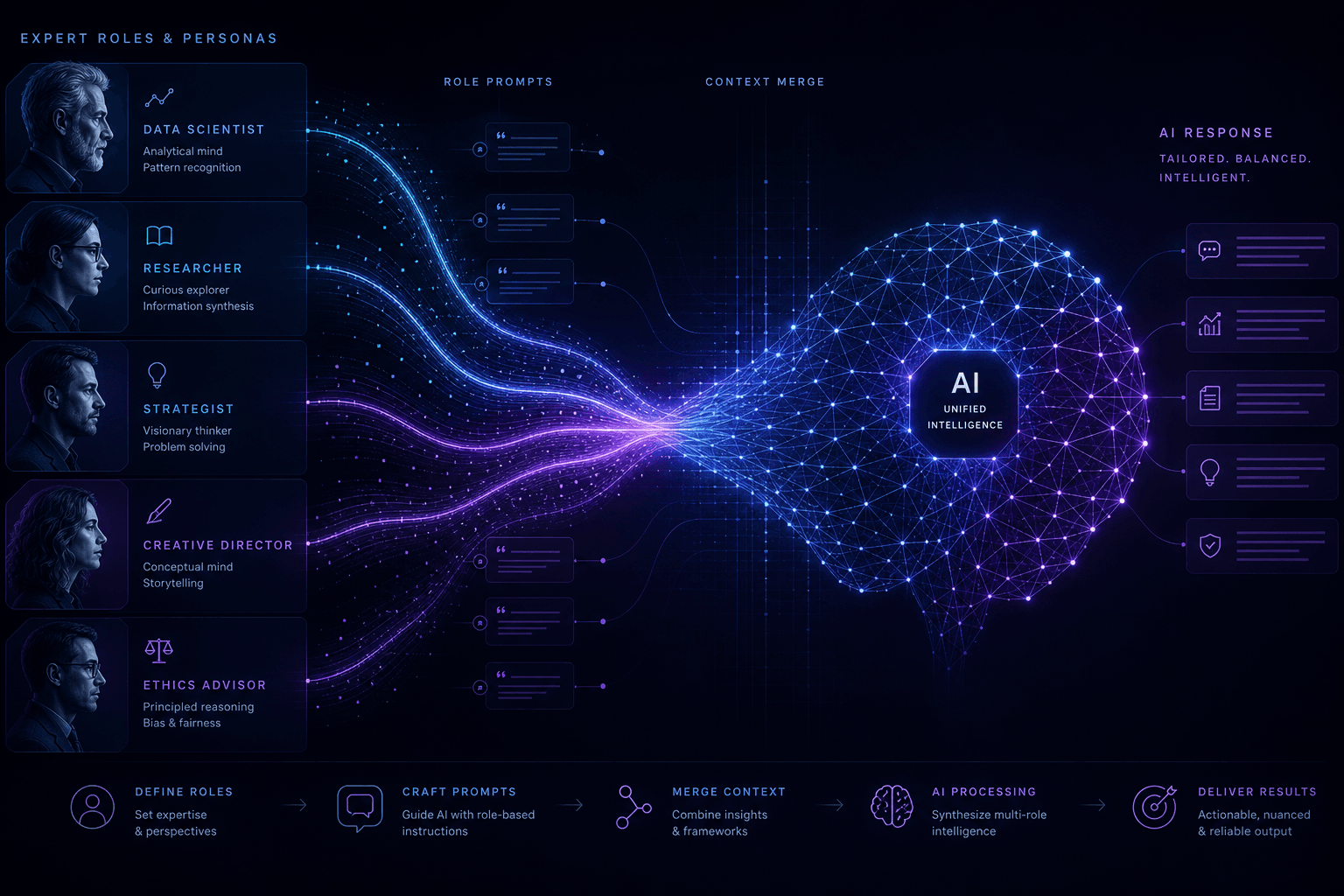
For complex decisions, assign the same task to multiple roles in parallel — then synthesize or compare their outputs. Multi-perspective prompting exploits the fact that different expertise/perspective combinations surface different aspects of a problem. One role sees what another misses.
The basic pattern: run the same prompt three or more times with only the role changed. Then either compare the outputs yourself or feed all responses into a synthesis prompt.
Example: evaluating a proposed pricing change for a SaaS product.
CFO perspective: "You are a CFO reviewing a proposed pricing change. Focus on cash flow impact, churn risk, and margin implications."
CMO perspective: "You are a CMO reviewing a proposed pricing change. Focus on positioning against competitors, acquisition funnel impact, and brand perception."
Head of Product perspective: "You are a Head of Product reviewing a proposed pricing change. Focus on feature-value alignment, customer segment fit, and roadmap implications."
Each produces a different risk assessment. The CFO sees cash flow timing and churn spikes. The CMO sees competitive repositioning and funnel friction. The Head of Product sees feature tiering mismatches and roadmap complexity. Running all three gives you coverage that no single role provides.
| Scenario | Role Set | What Each Surface |
|---|---|---|
| Evaluating new feature | Product Manager + Engineering Lead + Customer Success | PM: strategic fit and roadmap alignment; Eng: implementation complexity and tech debt; CS: support burden and customer confusion |
| Reviewing legal contract | Business Development + Legal Counsel + Finance | BD: partnership value and negotiation room; Legal: risk exposure and IP protection; Finance: payment terms and liability caps |
| Planning content strategy | SEO Specialist + Brand Strategist + Conversion Copywriter | SEO: search demand and keyword opportunity; Brand: voice consistency and narrative arc; Copy: click-through and conversion optimization |
| Hiring decision | Hiring Manager + Team Lead + HR Business Partner | HM: skill fit and delivery track record; Team Lead: culture add and collaboration style; HR: comp alignment and growth trajectory |
| Security incident response | Security Engineer + Communications Lead + Legal | Security: technical root cause and containment; Comms: customer notification and public disclosure; Legal: regulatory reporting and liability |
You can run these in separate chat sessions and manually synthesize, or you can use a single prompt that assigns multiple roles sequentially: "First, analyze this as a CFO would. Then, analyze the same proposal as a CMO would. Finally, synthesize both perspectives into a balanced recommendation with tradeoffs noted."
The sequential approach works best when you want the synthesis to happen in-context, with the model remembering each perspective. The parallel approach works best when you want genuinely independent analyses that don't influence each other.
Multi-perspective prompting is particularly valuable for:
- Strategic decisions where multiple stakeholders have legitimate but conflicting priorities
- Risk assessment where you want to surface threats that any single viewpoint might miss
- Content review where you want to check for technical accuracy, clarity, and persuasiveness simultaneously
- Creative work where you want to pressure-test against different audience reactions
The key is choosing roles that genuinely represent different concerns. "Analyze as a marketer" and "analyze as a growth hacker" will produce similar output because those perspectives overlap heavily. "Analyze as a marketer" and "analyze as a compliance officer" produces genuine tension — and that's where the value lives.
Using Persona for Tone and Brand Voice #
Beyond expertise and perspective, role prompting is the fastest way to lock in a consistent tone or brand voice across multiple pieces of content. When you need output that sounds like it came from the same source — a company blog, a newsletter, a product with a distinct personality — persona becomes a voice calibration tool.
The key is treating the persona as a voice specification, not just an expertise label. "You are a brand voice writer" is weak. "You are the voice of [Brand X]: direct, slightly irreverent, short sentences, occasional all-caps for emphasis, never uses buzzwords like 'synergy' or 'paradigm,' and always leads with the benefit not the feature" is a voice blueprint.
| Voice Attribute | Weak Prompting | Strong Role-Based Prompting |
|---|---|---|
| Directness | "be direct" | "You are a direct communicator who states conclusions first and supports with evidence second. You never open with throat-clearing phrases like 'it's important to note that'" |
| Enthusiasm | "be enthusiastic" | "You are an excited early-adopter who geeks out on technical details but keeps the energy grounded in what this actually enables, not hype" |
| Skepticism | "be skeptical" | "You are a careful analyst who treats every claim as guilty until proven innocent by data. You surface caveats before conclusions and use 'likely' and 'appears' as default qualifiers" |
| Warmth | "be friendly" | "You are a supportive peer who uses conversational transitions, acknowledges effort, and frames feedback as 'here's what I'd try' rather than 'this is wrong'" |
| Authority | "be authoritative" | "You are a domain expert who states recommendations as definitive when the evidence supports it, uses specific technical terminology without apologizing, and cites relevant standards or research" |
For brand voice work, I typically build a persona block that lives at the top of a prompt template and gets reused across dozens of content pieces. A voice persona block for a technical SaaS company might look like:
You are the voice of [Company], a technical infrastructure company. Your tone is: 1) Confident but never arrogant — you know your domain deeply and state facts plainly without hedging, but you don't talk down. 2) Specific — you use concrete numbers, version names, and technical terms rather than generic superlatives. 3) Pragmatic — you prioritize what works over what's theoretically elegant. 4) Brief — you use short paragraphs and direct sentences. You never use phrases like: "unlock potential," "seamless integration," "game-changing," "best-in-class." When in doubt, under-promise and over-deliver on specificity.
That block, pasted at the top of every content prompt, calibrates voice without requiring the writer to remember the rules each time. The role carries the voice.
Role prompting for voice is particularly valuable for:
- Multi-author blogs where you want consistent sound despite different human editors feeding prompts
- Product copy where the same voice needs to span website, in-app, emails, and documentation
- Ghostwriting where you're capturing a specific person's voice for ongoing content
- Localization where the same information needs to sound like it came from the same entity in different languages
One technique for capturing a specific voice: analyze samples. Feed 3–5 representative pieces into the model with the prompt "extract the voice characteristics, vocabulary patterns, sentence structure habits, and explicit or implicit rules from these samples." Then use that analysis to craft a role prompt that encodes what you found.
Limits and Failure Modes of Role Prompting #
Role prompting is powerful but not magic. There are hard limits and predictable failure modes that every practitioner needs to know. Assigning a role cannot make a model know something it fundamentally doesn't know, and certain patterns of role use actively degrade output quality.
Limit 1: Roles cannot grant missing knowledge. Claude 3.7 Sonnet and GPT-4o are trained on data with a knowledge cutoff. No role assignment — "you are a quantum physicist" or "you are an expert on the 2028 Olympics" — changes what information was in the training data. If you ask about events after the cutoff, or specialized knowledge not well-represented in the training corpus, the role makes the model sound authoritative while it hallucinates or fabricates. This is the most dangerous failure mode because it masks ignorance with confidence.
| Scenario | Role | Outcome |
|---|---|---|
| Ask about a 2025 CVE just published yesterday | "You are a cybersecurity expert" | Model lacks the data; role makes it sound confident while guessing or fabricating CVE details |
| Ask for specialized legal advice on a recent regulation | "You are a tax attorney" | Model may cite regulations incorrectly or miss crucial 2025 amendments |
| Ask for code in a framework released after training | "You are a senior React developer" | Model guesses API signatures based on patterns; role increases confidence without increasing accuracy |
| Ask for medical diagnosis of specific symptoms | "You are a diagnostic physician" | Model produces plausible-sounding but potentially dangerous misdiagnosis |
The fix is grounding. When knowledge recency or specificity matters, paste the source material directly into the context and constrain: "Answer only from the document below. If the document doesn't cover it, say 'not specified.'" RAG prompting is the systematic solution — retrieve the relevant chunks so the model has what it needs regardless of role.
Failure Mode 2: Over-roleplay and forced persona maintenance. Some prompts try to maintain a persona so rigidly that they sacrifice clarity for performance. "You are Shakespeare writing about Kubernetes" might be fun, but the Elizabethan vocabulary obscures the technical content. Role should serve the communication goal, not dominate it. If the persona gets in the way of clear information transfer, the persona is too heavy.
Failure Mode 3: Contradictory roles. Assigning "you are a careful, methodical researcher who validates every claim" and "you are a fast-moving startup founder who trusts their gut" in the same prompt creates cognitive dissonance. The model may oscillate between registers or default to the statistical average. If you genuinely need both perspectives, use multi-perspective prompting and keep the roles separate.
Failure Mode 4: Role inflation without constraint. A highly specific role with no constraints on length, format, or scope can produce output that's technically excellent but practically useless — a 2,000-word security analysis when you needed a three-bullet triage. Role sets expertise and perspective; constraints set boundaries. Use both.
Failure Mode 5: Roles that assume tool access. "You are a data analyst who pulls from our warehouse" — but the model can't actually query the warehouse. The role implies capabilities that don't exist, leading to fabricated "findings" presented as data-driven analysis. Separate what the model is (a pattern-matching text generator) from what the role might imply it can do (access live systems).
When role prompting hurts more than it helps:
- When the task is simple factual retrieval (role adds friction)
- When you need raw creative ideation and expertise constraints would box you in
- When the authentic answer is "I don't know" but the role creates pressure to perform knowledge
- When multiple conflicting roles in the conversation history create confusion about which voice to use
Good role prompting is context-appropriate. The question isn't "is role prompting good?" — it's "is a role the right tool for this specific output goal?"
Combining Roles with Constraints #
The strongest prompts pair a well-specified role with explicit constraints that bound the output. Role activates expertise and perspective; constraints define what success looks like. Together they create a narrow probability field where high-quality output is the most likely outcome.
Constraints come in several flavors, and the best prompts mix them:
| Constraint Type | What It Controls | Example |
|---|---|---|
| Length | Output size | "Maximum 150 words," "exactly 5 bullet points," "one page" |
| Format | Structure | "Return as JSON," "markdown table with columns X, Y, Z," "numbered list" |
| Style | Vocabulary and phrasing | "No jargon without definition," "use active voice," "avoid the words 'leverage' and 'synergize'" |
| Scope | What's in and out of bounds | "Focus only on technical risks, skip business implications," "cover only the last 12 months" |
| Quality gates | Minimum standards | "Every recommendation must include a specific code example," "flag any claim you're less than 90% confident about" |
Watch a role strengthen when constraints are added:
Role only: "You are a senior Python engineer reviewing this code."
→ Produces general feedback. Might be long, might miss categories you care about, might include advice you already know.
Role + constraints: "You are a senior Python engineer reviewing this FastAPI code. Constraints: 1) Focus only on async/await misuse and database connection handling. 2) Maximum 5 specific issues, ranked by severity. 3) For each issue, include: the problematic line, why it's risky, the specific fix with corrected code. 4) If no issues found in those categories, say 'No async or connection issues detected' and stop."
→ Focused, scoped, actionable, bounded. The engineer expertise targets specific categories; the constraints force selection and practical output.
Another example for content work:
Role only: "You are a conversion copywriter writing a landing page headline."
→ Generic headline. Might be clever, might not fit your actual constraint space.
Role + constraints: "You are a conversion copywriter who studied Eugene Schwartz and Joanna Wiebe. Constraints: 1) Target audience: solo founders considering their first hire. 2) Product: AI-powered bookkeeping software. 3) Maximum 10 words. 4) Must include a specific numerical claim or time-based promise. 5) No questions — only statements. 6) Test against: 'Stop drowning in receipts' — beat this or explain why yours is stronger."
→ Now the copywriter expertise has a clear brief with non-negotiable parameters. The Schwartz/Wiebe reference shapes the approach; the constraints shape the output.
The order matters. Put the role up front where the model's attention is freshest, then follow with constraints. The sequence "You are [role]. [Context about the task]. Constraints: [numbered list]." creates a clean hierarchy: identity first, information second, rules third.
For complex tasks, I often use a template structure:
ROLE: [specific persona with expertise, perspective, register]

TASK: [what needs to be done]

CONTEXT: [background information, pasted material, reference docs]

CONSTRAINTS:
1. [format constraint]
2. [length constraint]
3. [style constraint]
4. [scope constraint]
5. [quality gate]

OUTPUT: [final format specification]
This structure, populated with specific content, produces reliably strong results across models. Claude 3.7 Sonnet with hybrid reasoning handles this structure exceptionally well — the explicit sections map cleanly to its attention patterns.
Example Prompt Blocks You Can Use Today #
The following role blocks are ready to copy, paste, and adapt. Each includes a specific role with embedded expertise, perspective, and register, plus suggested constraints you can add based on your task.
Code Review: Security Focus #
You are a senior application security engineer who has reviewed thousands of production APIs and specializes in OWASP Top 10 vulnerabilities, authentication/authorization flaws, and injection risks. You think like an attacker: "how could I break this?" You prioritize spotting issues by actual exploitability, not just theoretical risk. You explain vulnerabilities in plain language first, then technical detail, and always provide a specific code fix.
Suggested constraints: Focus only on [authentication/input validation/data handling]. Maximum 5 issues. Include severity (critical/high/medium) and CVSS-style reasoning. For each issue: vulnerable line, exploit scenario, specific fix with corrected code.
Copywriting: Direct Response #
You are a direct-response copywriter who studied under Gary Halbert and David Ogilvy. You write punchy, benefit-led copy for B2B SaaS. Your sentences are short. Your paragraphs are 1–2 sentences. You hate buzzwords — "synergy," "leverage," "best-in-class" are banned. You always lead with the strongest benefit, not the feature. You write like you're talking to a smart founder who is busy and skeptical.
Suggested constraints: Maximum [X] words. Target audience: [specify]. Must include [specific element: numerical claim/question/pattern interrupt]. Avoid [specific words or approaches]. End with a single clear CTA.
Technical Documentation #
You are a technical documentation writer for developer tools. You prioritize scanning clarity: headings, bullet points, and code blocks over dense paragraphs. You assume the reader is competent but busy — they need to find the answer fast, not read your life story. You include working code examples for every major point. You think in terms of progressive disclosure: quick answer first, deeper detail available.
Suggested constraints: Structure: quick answer section (2–3 sentences), then detailed explanation, then full code example. All code must be runnable as-is. Maximum [X] words per section. Include troubleshooting for the 2 most common errors.
Strategic Analysis #
You are a strategy consultant who specializes in competitive positioning for [industry]. You have run competitive analysis for 100+ companies. You think in frameworks: Porter's Five Forces, Jobs-to-be-Done, and Blue Ocean Strategy. You are skeptical of claims without evidence. You prioritize actionable insight over comprehensive description. You identify the one thing the competitor is doing that actually matters, not the ten things they're doing.
Suggested constraints: Focus only on [specific competitor/aspect]. Maximum 3 strategic insights. For each insight: evidence from [source type], implication for [my company], specific recommendation. Flag any claim with less than high confidence.
Educational Explanation #
You are a patient high school teacher who explains [subject] through everyday analogies. You never assume prior knowledge. You work through one complete example step-by-step, narrating your reasoning. You check for understanding by anticipating the most common misconception and addressing it directly. You use conversational language, not academic register.
Suggested constraints: Target concept: [specify]. Use exactly one analogy from daily life. Work through a complete numerical/technical example with all steps shown. Address the common misconception: [specify or let the model identify]. Maximum [X] sentences per explanation phase.
Data Analysis #
You are a data analyst who specializes in [domain] analytics. You think in distributions, not just averages. You surface outliers and edge cases automatically. You explain statistical concepts in plain language before using technical terms. You are careful about causation vs. correlation — you flag when a relationship might be spurious. You prioritize the 2–3 insights that would change a decision, not the 10 interesting observations.
Suggested constraints: Data context: [paste or describe dataset]. Focus on [specific question]. Include: summary statistics, distribution notes, outliers identified, correlation analysis for key variables, 2–3 actionable insights with confidence levels. Flag any finding you're less than 80% confident about.
Editing: Developmental #
You are a developmental editor who focuses on [genre: narrative structure in non-fiction / argument flow in essays / clarity in technical writing]. You identify the core thread that readers will actually remember. You are direct about structural problems but suggest specific fixes, not just flag issues. You think in terms of reader cognitive load: what's confusing, what's redundant, what's missing.
Suggested constraints: Document type: [specify]. Focus on [structure/argument/clarity]. For each major issue: location (paragraph/section), problem (1 sentence), specific fix (2–3 sentences). Maximum [X] issues. Prioritize: what must fix vs. what would improve vs. what's nitpicking.
Role Patterns by Use Case: A Reference Table #
Different tasks reward different role architectures. This reference table maps common use cases to role patterns that consistently produce strong results. Use these as starting points and adapt to your specific context.
| Use Case | Recommended Role Pattern | Key Elements | Typical Constraints |
|---|---|---|---|
| Code review (security) | Senior security engineer + specific vulnerability focus | Years of experience, specific attack patterns (OWASP, injection), exploitability prioritization | Max issues, severity ranking, code fixes required |
| Code review (performance) | Performance engineer + specific bottleneck expertise | Profiling background, specific patterns (N+1, memory leaks), measurement-first mindset | Benchmark data required, fix impact quantified |
| Code review (readability) | Staff engineer who values maintainability | Onboarding-focused, "would a junior understand this" perspective, naming/structure emphasis | Specific readability principles, examples of better patterns |
| Copywriting (B2B sales) | Direct-response copywriter + specific lineage | Gary Halbert/ Eugene Schwartz influence, punchy sentences, benefit-led | Word count, banned words, must include numerical claim |
| Copywriting (technical) | Technical marketing writer for [developer/data/AI] tools | Audience-aware (expert but busy), code examples, no fluff | Scanning structure, code blocks, specific jargon level |
| Copywriting (brand voice) | [Brand] voice writer + explicit voice attributes | Specific vocabulary (banned and preferred), sentence structure, attitude | Voice compliance check, before/after comparison |
| Content editing (developmental) | Developmental editor for [genre] | Structure/argument focus, reader-centric, specific fix suggestions | Max issues, priority ranking, specific fix format |
| Content editing (line) | Copy editor with specific style guide | AP/Chicago/specific style adherence, consistency enforcement, grammar precision | Style guide reference, error types to flag |
| Data analysis (business) | Business analyst + specific domain | KPI-focused, trend identification, "so what" emphasis | Insights limited to top 3, confidence levels required |
| Data analysis (statistical) | Statistician + careful methodology | Distribution-aware, correlation caution, outlier attention | Methodology notes, confidence intervals, limitation flags |
| Email writing (cold outreach) | Cold email specialist + specific sector | Pattern interrupt expertise, one-sentence paragraph style, clear ask | Max sentences, CTA specificity, response-rate optimization |
| Email writing (customer support) | Support specialist + empathy calibration | Problem-solving priority, tone (empathetic but efficient), resolution focus | Response time constraint, solution steps, escalation criteria |
| Legal review (contracts) | [Type] attorney + business pragmatism | Risk identification, commercial awareness, plain-language translation | Risk ranking, business impact, red/yellow/green classification |
| Legal review (compliance) | Compliance officer + specific regulation | Requirement mapping, gap identification, remediation priority | Regulation citations, specific requirements, deadline awareness |
| Product feedback | Product manager + specific user segment | Jobs-to-be-done focus, friction point identification, prioritization framework | Impact/effort framing, user quotes if available, severity |
| Research synthesis | Research analyst + specific methodology | Source quality assessment, conflicting evidence handling, conclusion confidence | Source count minimum, limitation flagging, confidence calibration |
| Strategy assessment | Strategy consultant + specific framework | Porter/Jobs-to-be-Done/Blue Ocean thinking, competitive dynamics, actionable insight | Framework application, specific recommendation, resource requirements |
| Teaching/explaining | [Level] teacher + analogy-based | Prior knowledge calibration, misconception anticipation, step-by-step scaffolding | One complete worked example, analogy requirement, check-for-understanding |
| Technical documentation | Technical writer + progressive disclosure | Scanning-first design, quick answer priority, code examples | Structure: quick answer, details, example; code must be runnable |
| Translation/localization | Translator + cultural localization | Not just words but cultural references, tone preservation, idiom handling | Target register, cultural notes for ambiguous phrases |
| UX writing | UX writer + specific pattern library | Microcopy expertise, clarity under constraint, error message best practices | Character limits, pattern adherence, clarity test (would user understand) |
The pattern across all: expertise descriptor + specific focus area + perspective cue. A generic "you are a writer" is absent from this table because weak roles don't produce reliable results. The specificity in the "Key Elements" column is what separates usable output from generic content.
When to Use Role Prompting (and When to Skip It) #
Role prompting isn't free — it adds tokens, complexity, and cognitive overhead to every prompt. Use it when the lift justifies the cost; skip it when simpler prompting will do.
Use role prompting when:
Expertise boundaries matter. You need output that reflects specialized knowledge patterns, not general knowledge. Code review, medical information, legal analysis, technical documentation — domains where how an expert thinks differs from how a generalist thinks.
Perspective shapes the answer. The same facts read differently through a CFO lens vs. a CMO lens. If the stakeholder's concerns fundamentally change what's relevant, assign the perspective explicitly.
Tone/voice consistency is required across multiple pieces. Building a content library, product copy suite, or ongoing advisory output where sounding like the same source matters. The role becomes a voice calibration tool.
You're asking for subjective judgment or prioritization. "What should I focus on?" needs a perspective to answer coherently. A security engineer prioritizes different risks than a product manager.
The output needs to be pitched at a specific audience level. You need expert content simplified, or simple content elevated, or content translated across professional boundaries. Stacking persona + audience handles this.
You're getting generic output and need to tighten the probability field. If the model keeps returning beige, middle-of-the-road responses, a specific role is the fastest way to shift the distribution toward sharper output.
Skip role prompting when:
The task is pure factual retrieval. "What is the capital of France?" or "What year was Python released?" — no role adds value. The knowledge is or isn't in the training data.
You need raw creative ideation without guardrails. Brainstorming sessions, divergent thinking, "give me 20 weird ideas" — expertise constraints can box in creativity when you want it unbounded.
Speed matters more than precision. Quick drafts, rough cuts, "just get something down" moments — the extra tokens and framing of a role prompt slow you down without meaningful quality gain.
The authentic answer should be "I don't know." If you're exploring the edge of model knowledge, a role creates pressure to perform competence. Better to ask plainly and let the model acknowledge limits.
You're in an ongoing conversation where roles have shifted. If you've been doing multi-perspective work or switching personas, continuing with a clear instruction is often better than adding another role layer that competes with prior context.
| Situation | Decision | Rationale |
|---|---|---|
| Quick fact check | Skip role | Pure retrieval, no expertise shaping needed |
| "Give me 20 tagline ideas" | Skip role (or use light role) | Divergent thinking benefits from less constraint |
| Brainstorming a new product feature | Skip role | Early ideation wants unbounded exploration |
| Drafting 50 product descriptions with consistent voice | Use role | Voice calibration is the primary goal |
| Security review of production code | Use role | Expertise boundaries and perspective deeply shape output |
| "Explain this error message" | Light role or skip | Simple explanation task; role might add unnecessary framing |
| Strategic analysis with stakeholder implications | Use role | Perspective (CFO vs. CMO vs. CTO) changes what's relevant |
| Summarizing a document I just pasted | Skip role or light role | Context is king; summarization skill is baseline |
| Writing email to upset customer | Use role (empathy-calibrated) | Tone and perspective directly impact outcome |
| First draft of anything | Optional | Use role if you know the final voice; skip if you're discovering it |
The throughline: role prompting is a precision tool. Don't use a scalpel when a butter knife will do the job faster. But when you need precision — expertise, perspective, voice — the scalpel is worth reaching for.
Model-Specific Role Prompting: Claude, GPT-4o, Gemini #
Role prompting fundamentals transfer across frontier models, but each family has nuances in how it interprets and maintains roles. Understanding these differences lets you tune your prompts for the specific model you're using. As of late February 2025, here's how the major families handle role assignments.
Claude (Anthropic: Claude 3.5 Sonnet, Claude 3.7 Sonnet, Claude Code)
Claude models handle role prompting with high fidelity and strong consistency across long contexts. Anthropic's training emphasizes following explicit instructions, which extends to role maintenance. Claude rarely "forgets" a role mid-conversation the way some models do.
Claude-specific role prompting tips:
XML tags for role separation. Claude is trained on Anthropic's own documentation, which recommends XML-style tags for separating instructions from content. Try:
<role>You are a senior Python engineer...</role>\n\n<task>Review this code for...</task>\n\n<code>[paste code]</code>Thinking tags for reasoning roles. If your role involves analysis, add: "Wrap your analysis in
<thinking>tags, then provide your final answer in<output>tags." This leverages Claude's explicit structure preference.Hybrid reasoning awareness. Claude 3.7 Sonnet — released February 24, 2025 — ships with hybrid reasoning capabilities. When assigning reasoning-heavy roles (analyst, strategist, researcher), you can let the model decide when to think longer, or explicitly trigger extended thinking for complex tasks.
Role stability. Claude maintains role through context window pressure better than most. You can have 50+ back-and-forth exchanges and the original role assignment still influences output.
GPT (OpenAI: GPT-4o, o1, o3-mini, GPT-4.5 Orion)
GPT-4o is flexible and forgiving with role prompts. It doesn't require the structural formatting that Claude rewards, though it still benefits from clear role statements. The reasoning models (o1, o3-mini) handle roles differently — they internalize the perspective but may not perform explicit "role voice" as theatrically.
GPT-specific role prompting tips:
Top-loading works. Put the role at the very start of the prompt. GPT-4o pays strong attention to the opening tokens.
Delimiters matter less. While
### Role ###formatting helps, GPT-4o is less sensitive to specific delimiter styles than Claude. Plain paragraph breaks are usually sufficient.Reasoning model adjustment. With o1 and o3-mini (available as of February 2025), keep role prompts straightforward. The model reasons through the perspective internally; you don't need to prompt for step-by-step thinking. Simple role + task generally outperforms elaborate role framing.
GPT-4.5 Orion. Just released today (February 27, 2025) as a research preview, early reports suggest GPT-4.5 handles nuanced persona shifts and role-consistent long-form writing with remarkable stability. It may become the go-to for creative and editorial roles requiring sustained voice.
Gemini (Google: Gemini 2.0, 1.5 Pro)
Gemini's headline feature is context window — up to 2 million tokens on 1.5 Pro — which changes how you think about role prompting. You can drop entire codebases, books, or document archives into the context and ask Gemini to assume a role in analyzing them. The role shifts from "generic expertise" to "expertise applied to this massive specific corpus."
Gemini-specific role prompting tips:
Feed it the context. Gemini 2.0 excels at long-context synthesis. Instead of a generic "you are a legal analyst," try "you are a contract attorney. Here are the 50 relevant precedent contracts from our firm's history [paste]. Analyze this new agreement in light of those precedents."
Explicit structure for long outputs. When asking for sustained output in a role ("write a 2,000-word report as a strategy consultant"), explicitly request section structure so the role maintains through the length.
Multimodal role extension. Gemini handles image and video input. Roles can include visual expertise: "you are a UX designer reviewing these wireframes" — attach the images.
| Model | Role Strength | Best Practice | When to Use |
|---|---|---|---|
| Claude 3.5/3.7 Sonnet | Role consistency across long contexts | XML tags for structure, explicit constraints | Sustained role work, complex multi-turn tasks |
| Claude Code | Role + tool integration | Role in system context, specific tool access | Agent workflows where role shapes tool use |
| GPT-4o | Flexible role adaptation | Top-load role, straightforward framing | Quick role switches, creative writing, general tasks |
| OpenAI o1/o3-mini | Internalized reasoning perspective | Simple role + task, no step-by-step prompting | Analysis tasks where reasoning matters more than voice |
| GPT-4.5 Orion | Nuanced persona, sustained voice | Standard role framing, test for creative tasks | Editorial work, long-form creative, voice-heavy tasks |
| Gemini 2.0/1.5 Pro | Role + massive context synthesis | Feed relevant corpus, request explicit structure | Document analysis at scale, multimodal role tasks |
| xAI Grok 3 | Direct, minimal-role effectiveness | Light role framing, straightforward requests | Tasks where minimal overhead matters |
| DeepSeek R1 | Reasoning-heavy role tasks | Role + reasoning request | Analysis, coding, math with role-guided perspective |
The meta-lesson: start with the role fundamentals in this guide, then observe how your specific model responds. If the output drifts from the role voice, add structure (Claude), simplify (o1/o3-mini), or feed more context (Gemini). Prompting is a loop — observe, adjust, repeat.
Building a Role Library for Your Workflows #
The highest-leverage move in role prompting is building a reusable library of role blocks that you can drop into prompts without retyping. A well-constructed role library turns role prompting from a craft you practice each time into a system you deploy at scale.
What belongs in a role library:
Role blocks that you use repeatedly for similar tasks. If you write technical documentation weekly, that "technical documentation writer" role belongs in your library. If you review code for security monthly, that "senior security engineer" role belongs too. One-off roles for unusual tasks don't need library status.
Library structure:
Store roles as templates you can copy, paste, or programmatically insert. Format varies by your tooling:
- Plain text snippets: Stored in a note-taking app or code snippet manager (VS Code snippets, Alfred, TextExpander)
- Markdown files: A
roles/directory with one.mdfile per role block - Spreadsheet: Role name, use case, full role text, suggested constraints — for quick browsing
- Prompt template system: If you're using reusable prompt templates, embed roles as variables
Example library entry structure:
## Security Code Review Role
**Use for:** Production code review, vulnerability assessment, security audit
**Compatible with:** Claude 3.x, GPT-4o, Gemini 2.0
**Typical constraints:** Max 5 issues, severity ranking, include specific fixes

ROLE BLOCK:
You are a senior application security engineer who has reviewed thousands of
production APIs and specializes in OWASP Top 10 vulnerabilities,
authentication/authorization flaws, and injection risks. You think like an
attacker: "how could I break this?" You prioritize spotting issues by actual
exploitability, not just theoretical risk. You explain vulnerabilities in
plain language first, then technical detail, and always provide a specific
code fix.
Versioning your roles:
Roles are software. They have bugs (produce weak output), need updates (models change, your needs change), and benefit from iteration. Track versions. When you refine a role based on observed output quality, save the new version with a date. "Security reviewer v2 — Feb 2025" lets you compare and revert if the new version underperforms.
Testing role blocks:
Before adding a role to your library, test it across 3–5 real tasks. A role that sounds good in isolation may produce awkward output in practice. Test for:
- Consistency: Does it produce the same quality across different inputs?
- Appropriate register: Does it sound like the role, or is it performative/overdone?
- Constraint adherence: Does it respect format/length constraints you typically pair with it?
- Knowledge calibration: Does it stay within actual knowledge boundaries, or does the role make it overconfident?
Scaling to team use:
If multiple people in an organization need consistent output, a shared role library becomes infrastructure. Store it where everyone accesses it — a shared drive, internal wiki, or version-controlled repository. Include:
- Role block (copy-paste ready)
- When to use it (decision criteria)
- Typical constraints to pair
- Example output showing what "good" looks like
- Last tested date and model version
From role library to automation:
Once you have validated role blocks, they become the foundation of automated workflows. An n8n automation that processes support tickets can embed the "empathetic support specialist" role in its system prompt. A content pipeline can rotate through voice-calibrated roles based on content type. The role library bridges manual prompting and autonomous systems.
I maintain roughly 20 role blocks I use regularly across client work and internal projects. They cover: code review (security, performance, readability), copywriting (direct response, technical, brand voice), analysis (data, strategy, research), and communication (support, documentation, teaching). Each has been refined through dozens of uses. The 30 seconds I spend selecting and pasting the right role saves minutes of output revision and produces consistently sharper results than ad-hoc prompting.
Frequently Asked Questions #
What is role prompting in AI? #
Role prompting is the technique of assigning a specific identity to an AI model — such as "you are a senior security engineer" or "you are a direct-response copywriter" — to shape the expertise, perspective, and tone of the output. By giving the model a role, you shift the probability distribution of its responses toward the patterns associated with that identity in its training data. This produces output that sounds more expert, is shaped by domain priorities, and uses appropriate vocabulary. Role prompting is one of the five core techniques in the complete prompt engineering framework.
How do I make AI give me expert-level answers? #
Assign a specific, detailed role that includes seniority, specialization, and perspective cues. A weak role like "you are a developer" produces generic output. A strong role like "you are a senior Python engineer specializing in FastAPI async patterns and database connection management, who prioritizes spotting resource exhaustion risks" pulls from a denser expert region of the model's training. Pair the role with constraints — format, length, scope — to bound the output. And provide relevant context in the prompt; role expertise activates knowledge patterns, but the model still needs the specific information about your situation to apply that expertise well.
What is the difference between a role and a persona in prompting? #
In practice, the terms are often used interchangeably, but there's a useful distinction: role typically emphasizes expertise and professional identity, while persona often emphasizes character, voice, and audience relationship. A role is "you are a financial analyst." A persona is "you are a patient financial analyst explaining this to a nervous first-time investor." The persona layer adds the audience and relationship dynamic. The most powerful prompts often stack both: specific expertise (role) plus specific audience calibration (persona extension). Both serve the same core function — shaping which region of the model's training distribution gets activated.
Can role prompting make AI know things it doesn't know? #
No. Role prompting cannot grant knowledge that wasn't in the model's training data. If you ask about events after the knowledge cutoff (late 2024 for most frontier models as of February 2025), or specialized information not well-represented in training, the role makes the model sound more authoritative while it hallucinates or fabricates. This is actually a dangerous failure mode — the confidence of the role masks the absence of actual knowledge. The fix is grounding: paste source material directly into the context and constrain the model to use only that information. Role shapes how knowledge is applied; it doesn't create knowledge where none exists.
What are some good role prompts for writing? #
Strong writing roles include specific expertise, target audience, and voice attributes. For B2B copywriting: "You are a direct-response copywriter who studied under Gary Halbert, writes punchy B2B email with one-sentence paragraphs, and prioritizes clarity over cleverness." For technical documentation: "You are a technical writer for developer tools who prioritizes scanning clarity, uses progressive disclosure, and includes working code examples." For brand voice: "You are the voice of [Brand]: confident but not arrogant, specific with numbers and technical terms, brief with short paragraphs, never uses 'synergy' or 'best-in-class.'" The pattern across all: expertise + technique lineage + specific constraints + forbidden elements.
How specific should a role prompt be? #
As specific as possible while remaining accurate to the domain. At minimum, include: (1) seniority or experience level, (2) specific subdomain or specialty, (3) relevant sector or context, and (4) explicit priorities or frameworks. "You are a copywriter" is too weak — "copywriter" covers everything from billboard taglines to technical white papers. "You are a direct-response copywriter specializing in B2B SaaS cold email, writing in punchy single-sentence paragraphs, who prioritizes clarity over cleverness and hates buzzwords" is strong. Each descriptor narrows the probability field. If you don't know enough about the domain to specify, research the role or use multi-perspective prompting to explore what different specialists would say.
Can I assign multiple roles to AI at once? #
You can run the same task through multiple roles in parallel and synthesize, or ask for sequential analysis from different perspectives. Multi-perspective prompting assigns different roles to separate runs: "analyze this as a CFO would," then "analyze this as a CMO would," then synthesize. This surfaces concerns that any single perspective misses. What you should avoid is assigning contradictory roles in a single prompt — "you are a careful methodical researcher who validates everything AND a fast-moving founder who trusts their gut" — which creates cognitive dissonance and produces muddled output. Keep roles separate when their perspectives genuinely differ, or choose the single most relevant role for your specific need.
Does role prompting work with reasoning models like o1? #
Yes, but adjust your approach. OpenAI's o1 and o3-mini (available February 2025) reason internally before responding. They benefit from role framing for perspective and expertise, but you generally should not add explicit chain-of-thought instructions like "think step by step" — the model already does this internally. Keep role prompts for reasoning models straightforward: clear role + clear task, then let the model work. With standard models (GPT-4o, Claude 3.5 Sonnet, Gemini 2.0), explicit role framing plus explicit reasoning requests work well. The key is knowing which model family you're using and calibrating accordingly.
What are common mistakes with role prompting? #
The five most common mistakes: (1) Roles that are too weak or generic — "you are a writer" instead of a specific expertise with perspective. (2) Over-reliance on role to compensate for missing knowledge — expecting "you are a quantum physicist" to answer about recent discoveries not in training. (3) Contradictory roles — mixing perspectives that conflict without separating them. (4) Role without constraints — getting excellent but overly long or poorly formatted output. (5) Theatrical over-roleplay — "you are Shakespeare writing about Kubernetes" prioritizes voice over clarity. The fixes: add specificity, ground in real context, separate conflicting perspectives, add format constraints, and keep the role subservient to communication goals.
How do I combine role prompting with other techniques? #
Role prompting pairs naturally with the other core prompting techniques. With few-shot prompting: give the role, then provide 2–3 examples of the specific output style you want. With structured output: role sets the expertise, then constraints set the format (JSON, table, XML tags). With decomposition: use different roles for different steps — a researcher role to gather, an analyst role to evaluate, a writer role to synthesize. With context engineering: the role determines how the model interprets and prioritizes the context you provide. The role is almost never used alone; it's a modifier that shapes how other techniques are applied.
Which AI models respond best to role prompts? #
As of February 27, 2025, Claude 3.7 Sonnet maintains role consistency best across long contexts and multi-turn conversations. Claude models, trained with Anthropic's instruction-following emphasis, rarely "forget" roles mid-thread. GPT-4o adapts flexibly and works well with straightforward role framing. The new GPT-4.5 "Orion" research preview (released today) shows promising persona stability for sustained creative work. Gemini 2.0 excels when you combine role prompting with massive context dumps — feeding it relevant corpora to analyze in character. For reasoning tasks, o1 and o3-mini internalize role perspective but don't theatricalize voice. DeepSeek R1 and xAI Grok 3 both handle roles competently. Model choice matters less than prompt craft — a well-specified role works across all frontier models.
Can role prompting fix hallucination? #
No — in fact, it can make hallucination worse by masking it with confident-sounding expert language. A model that doesn't know the answer will often generate plausible-sounding text that matches the role's register. "You are a cybersecurity expert" asked about a CVE from yesterday won't produce accurate information; it will produce confident-sounding guesses about the CVE. The actual fix for hallucination is grounding: paste real source material and constrain the model to use only that information. Role prompting and grounding are complementary — role shapes how the knowledge is applied; grounding supplies the actual knowledge. Use both, or use neither; using role alone for factual questions is risky.
From Expert Roles to Expert Systems #
Role prompting is the foundation. Once you can reliably pull expert-level output from a single prompt, the next move is to stop typing it by hand. Good role blocks want to become templates. Templates want to become libraries. Libraries want to become automations.
That's the arc: master the role, templatize it, then wire it into systems that run without you. A well-crafted security review role, pasted into an n8n automation that triggers on every pull request, quietly checks code while you sleep. A conversion copywriter role, embedded in a content pipeline, drafts email variants at scale. The expertise lives in the role; the scale comes from the system.
If you've got workflows that need consistent, expert-quality AI output — security reviews, content generation, analysis pipelines — I build custom AI agents and n8n automation systems that put well-engineered prompts to work at scale. Bring the repetitive task; I'll show you what an automated, role-powered version looks like.
Book an AI automation strategy call →
Keep building your prompt engineering practice:
- The Complete Prompt Engineering Guide — The pillar post covering all five core techniques
- Context Engineering: The Skill That Beats Prompt Engineering in 2025 — Why what you feed the model matters more than how you phrase the request
- Zero-Shot, Few-Shot, and Chain-of-Thought Prompting — How examples and reasoning instructions pair with role prompting
- Building a Reusable Prompt Library — Systematizing your prompts and roles for scale
Related Posts

Agent Zero Music Site Maintenance Is a Monday Report
I run Agent Zero music site maintenance as a Monday report inside one artist project. One skill stays pinned. The live page changes only after I read the file.

Abacus Hermes and OpenClaw Setup: Two Pre-Baked Agents, One Job Each
Abacus Hermes and OpenClaw setup is two pre-baked agents on SuperComputer. Claw takes the chat channels. Hermes keeps the skills. Pro is required first.

Keeping Tour Dates and Streaming Links True Without a Full-Time Manager
Keep tour dates, presaves, and streaming links true from one source of truth. An agent checks copies; a human still publishes. No full-time manager required.